
Dedication copy of an unrecorded edition
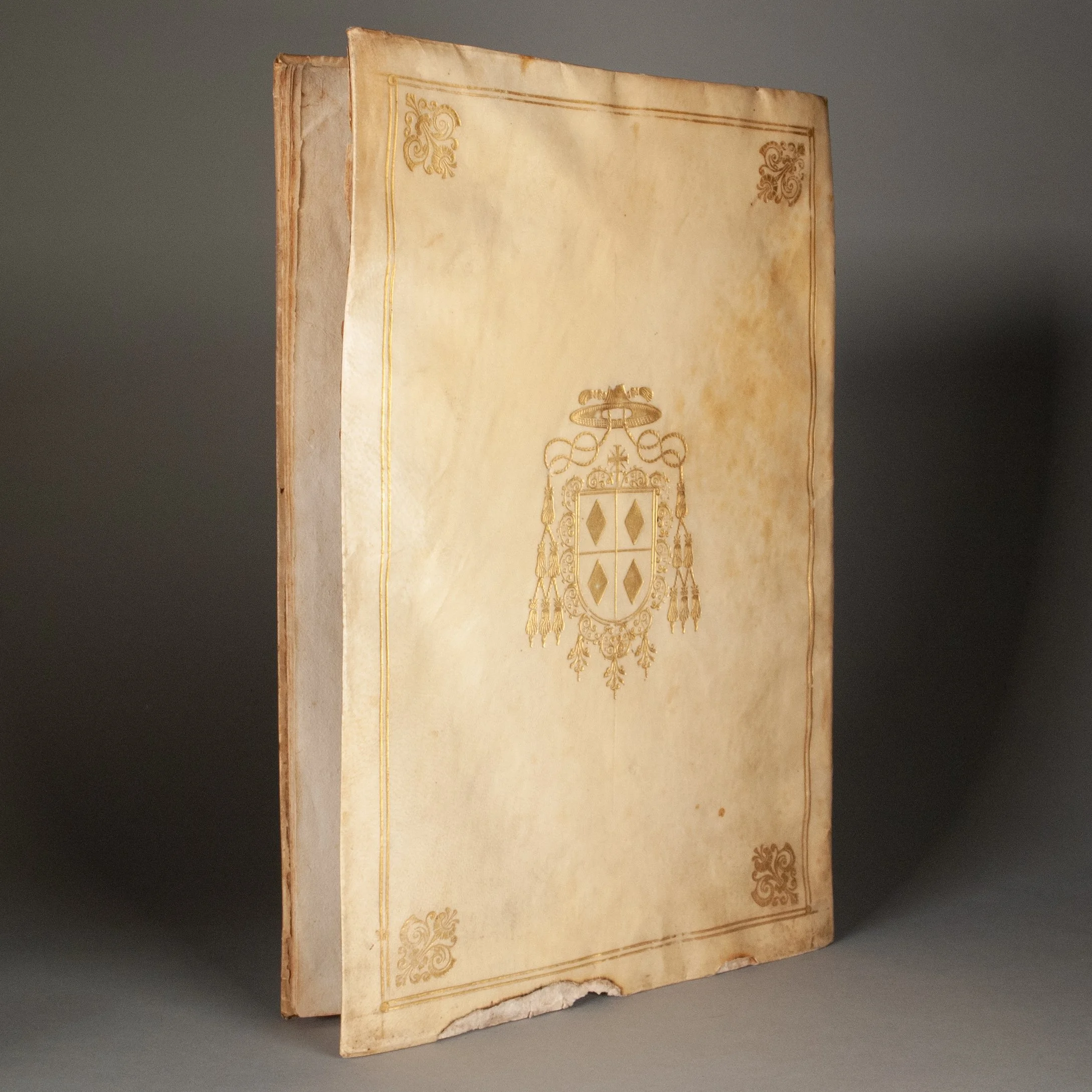
Dedication copy of an unrecorded edition
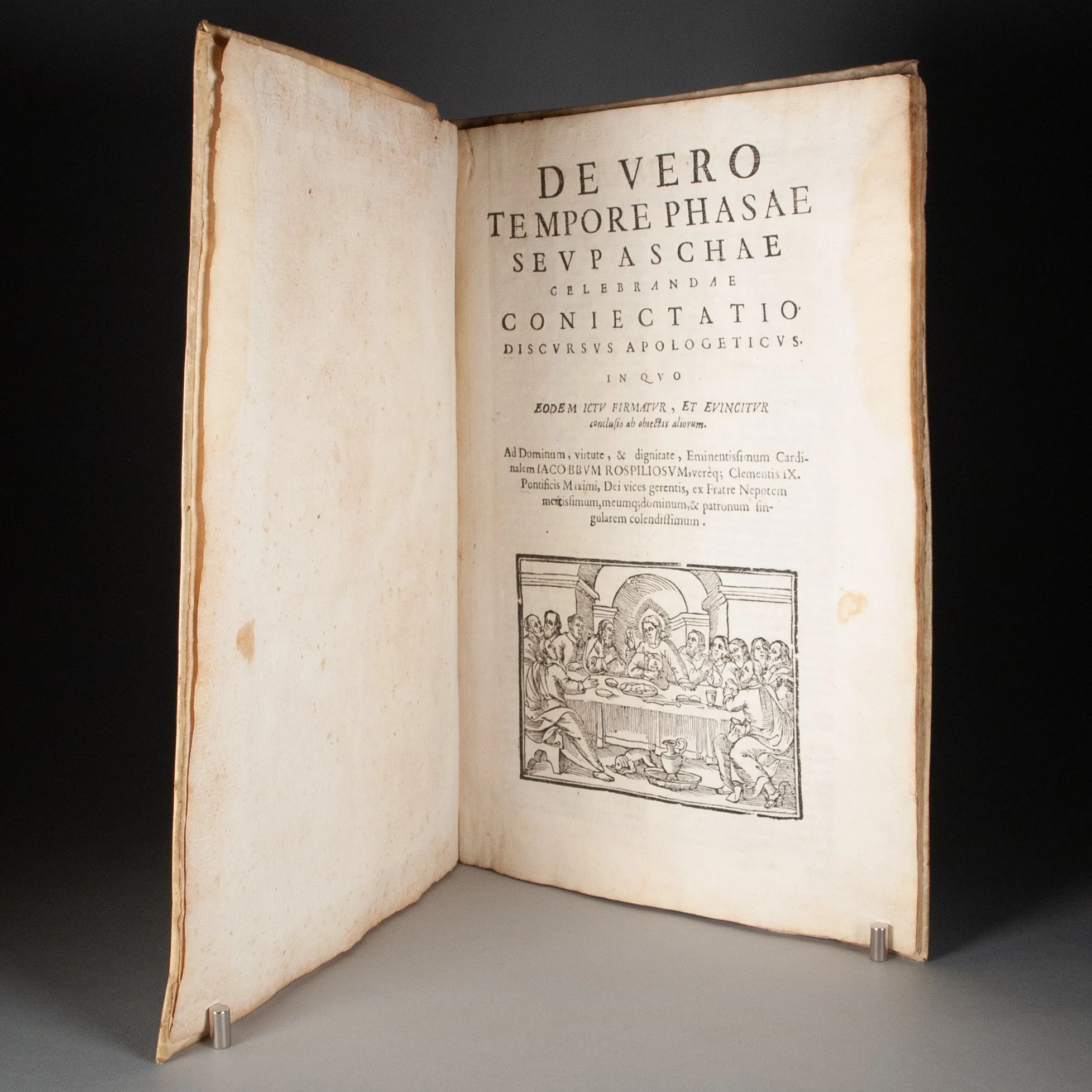
De vero tempore phasae, seu, Paschae celebrandae coniectatio discursus apologeticus; in quo eodem ictu firmatur et evincitur conclusio ab obiectis aliorum; ad dominum, virtute & dignitate, eminentissimum Cardinalem Iacobbum Rospiliosum...
by Josephus de Tertius (Giuseppe de Terzi)
[Rome? 1668 or 1669]
[28] p. | Folio | pi^2(pi1+A-C^4) | 301 x 203 mm
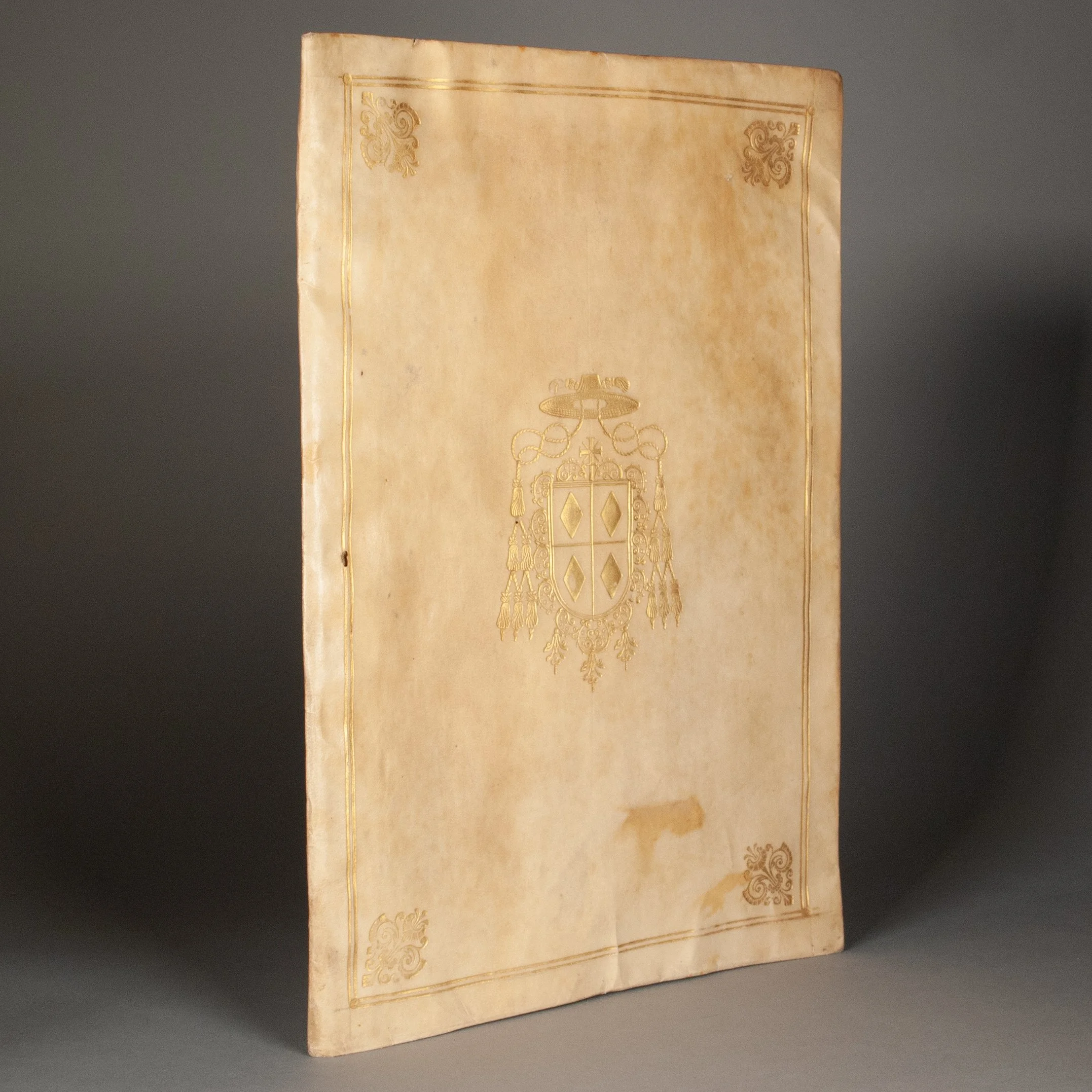
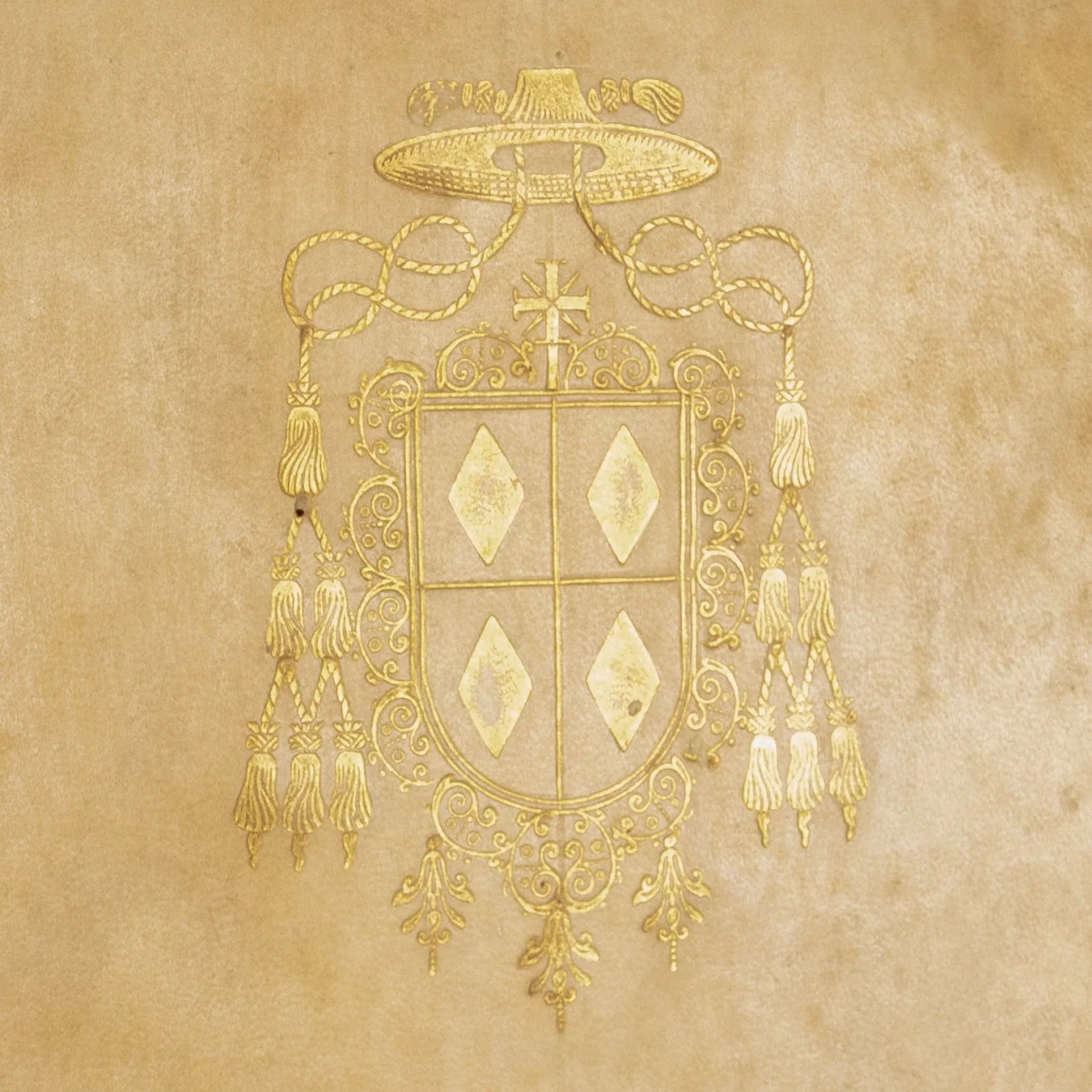
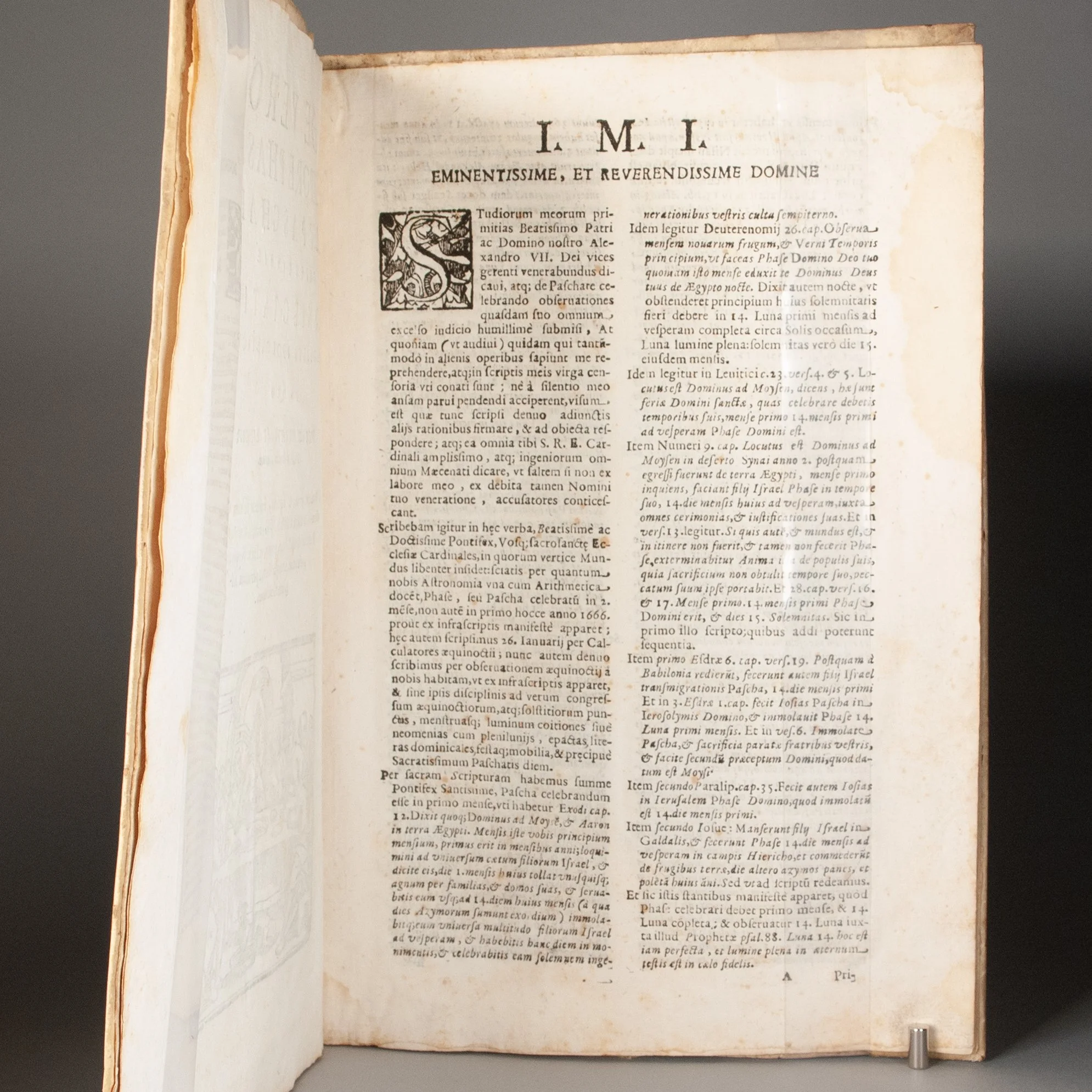
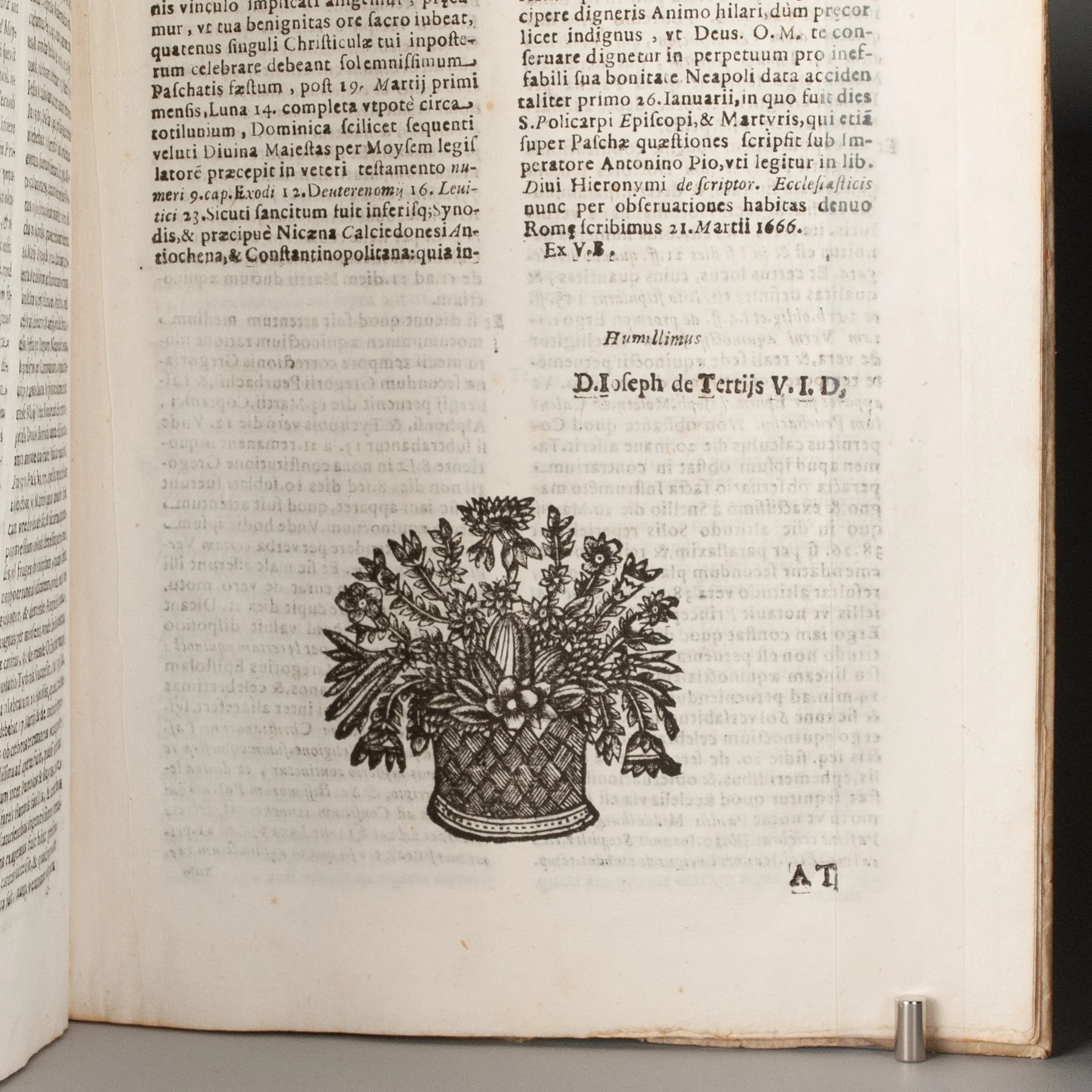
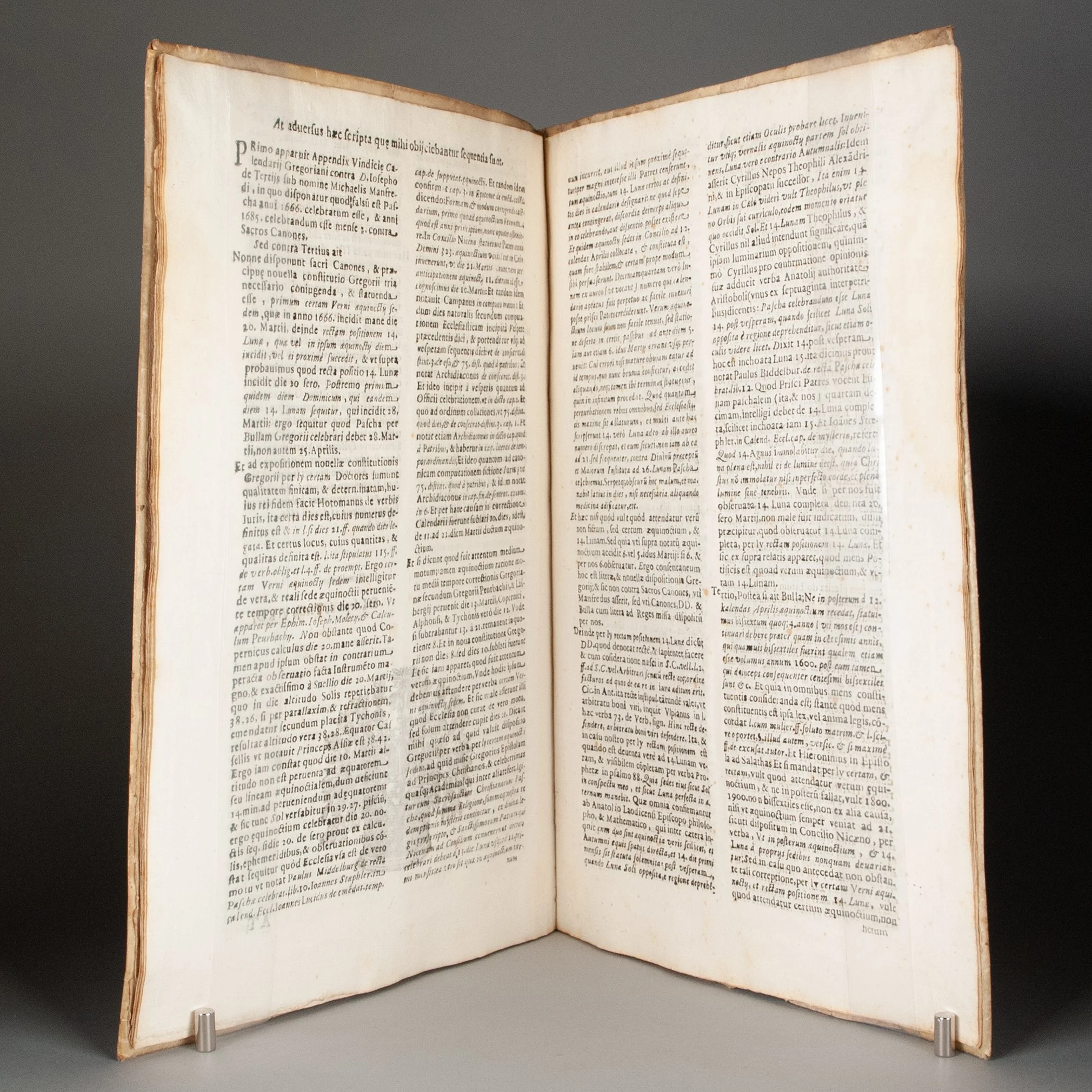
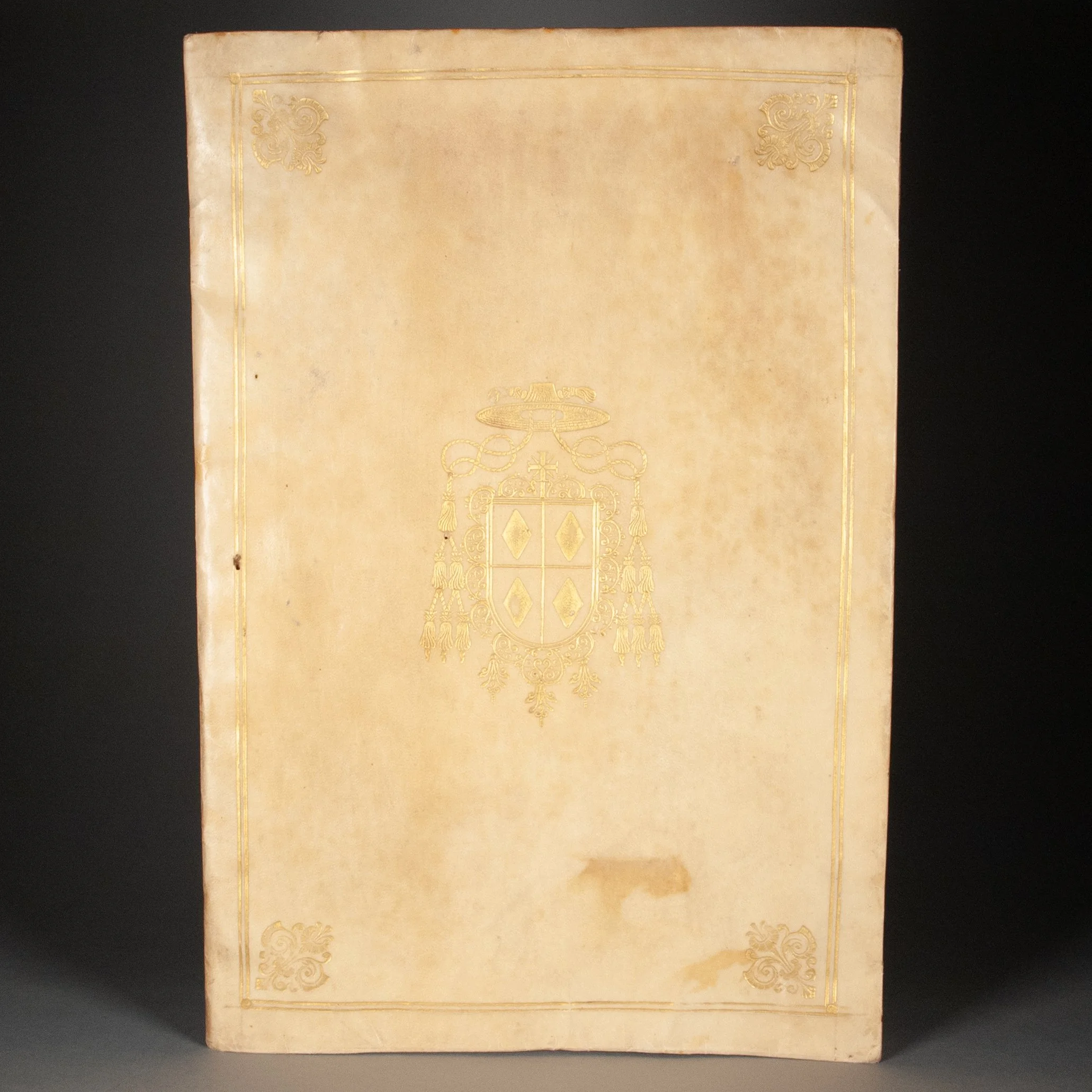
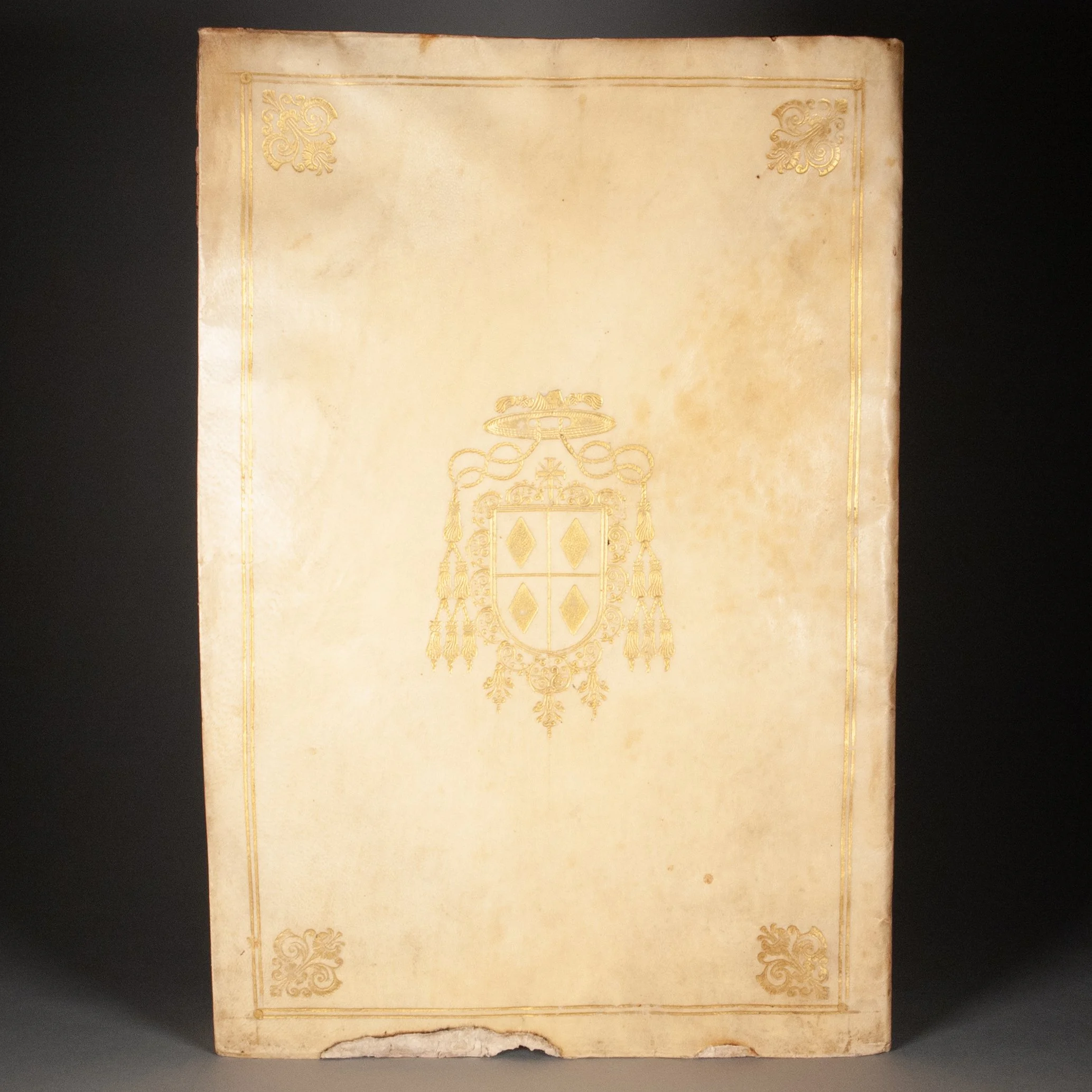
A brief treatise on calendar reform by the Italian mathematician, and the only known copy of an unrecorded edition. Terzi left a modest published record, but perhaps more impressively tutored Maria Mancini—niece of Cardinal Mazarin, and the spellbinding (unrequited) love interest of Louis XIV—in astronomy and certain divination methods. ¶ Like so much ink spilled on the topic at the time, Terzi's work focuses on the accurate dating of Easter. He necessarily draws on scripture for his arguments, and the early church fathers, but no less on more contemporary scientific luminaries like Copernicus, Brahe, and Joseph Scaliger (De emendatione temporum). The work is astronomical and mathematical at its core, and largely stems from a dispute with astronomer Michele Manfredi, who had previously criticized him (see B3v). Marshalling a good deal of scientific evidence, Terzi here defends his own Easter calculations, and explains step by step—in something like dialogue format—why Manfredi was wrong. ¶ Despite the official Gregorian reform of 1582—the widespread adoption of which admittedly took centuries—debate continued on some of the finer points of the calendar. For one particular year, for example, Terzi here explains why the data underlying the Gregorian reform was inaccurate (see B1r). It may at times feel like splitting hairs, but accurate chronology, in a world so fully in thrall to the church calendar, was of vital importance. And it invariably attracted the most advanced minds. "A rebarbative field, one whose proponents had to be equally at home in philology and astronomy, chronology engaged the sharpest intellects in the world in its late sixteenth-century heyday: not only Scaliger, but Tycho Brahe, Johannes Kepler, and Sir Henry Savile studied it avidly" (Grafton). Debating calendar reform was not for the faint of heart. ¶ The binding bears the arms of a Cardinal Rospigliosi. There were two of them at the time, Giacomo and Felice, both nephews of Pope Clement IX (nepotismo, eh?). While this could theoretically have been Felice's copy, we can hardly overlook the fact that Terzi dedicated the work to Giacomo. And given the gilt binding with the cardinal's arms, we'd rather wager this was the author's presentation copy to his dedicatee. ¶ The work is entirely without imprint, but we can reasonably suggest Rome as place of production, where both the author and dedicatee could be found. Giacomo Rospigliosi was made cardinal on 12 December 1667, and Pope Clement IX—identified on our title page as pontiff—died in 1669, providing a reliably narrow date range. Terzi dated the first part of the work, ending on B3r, 21 March 1666.
PROVENANCE: With Cardinal Rospigliosi's arms on the binding, as described above, and the remnants of an old paper label in the upper left of the front paste-down.
CONDITION: Contemporary semi-limp parchment, with a decorative border and the aforementioned Rospigliosi arms on each cover. Woodcut of the Last Supper on the title page. ¶ Some mild marginal dampstaining, and a bit of light foxing. The parchment just lightly soiled, and some loss to the lower edge of the rear cover (likely burnt). A handsome book.
REFERENCES: Anthony Grafton, "Joseph Scaliger as a Reader," Old Books, New Learning (2001), p. 154 (cited above); Anthony Grafton, Commerce with the Classics (1997), p. 188 (“And no subject has fewer obvious attractions than their [Kepler et al.] favorite discipline: chronology, the bristlingly technical form of classical scholarship that concerned itself with the nature of ancient calendars and the precise dates of historical events, and that expressed its opinions in massive tables as well as impenetrable prose.”); Pietro Ricciardi, Bibliotheca matematica (1893), col. 515-516 (citing two other works by Terzi: De gradu horoscopante, Paris, 1690; Discussioni fisiche mathematiche, Rome, 1705); Gabriella Berti Logan, Italian Women in Science from the Renaissance to the Nineteenth Century (Ph.D. dissertation, University of Ottawa, 1998), p. 366 (on his work with Mancini, and placing Terzi in Rome); David Pearson, Speaking Volumes (2022), p. 138 (“Expensive bindings may have been intended not to promote personal identity, but to woo influence or patronage. Countless examples exist of books which have been finely bound for such purposes—presentation copies of sermons, books given to a dedicatee, authors hoping that their books will be read, noticed or rewarded by being thus brought to the attention of someone in position to help them."), 142 (“Using bookbindings to curry favour, by giving handsomely bound books to prospective patrons, is a tradition going back to medieval times")
Item #963