
Unrecorded snake oil handbill
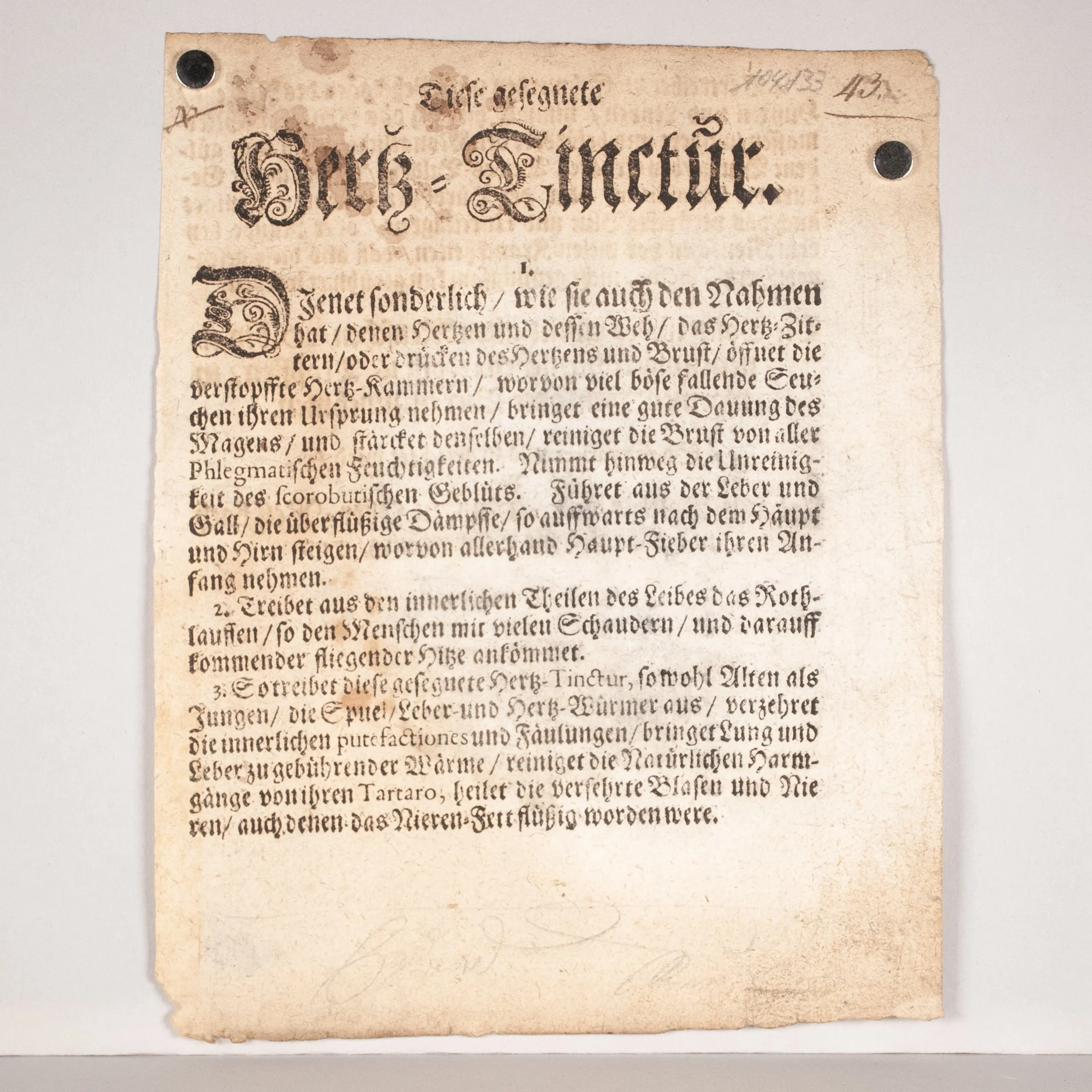
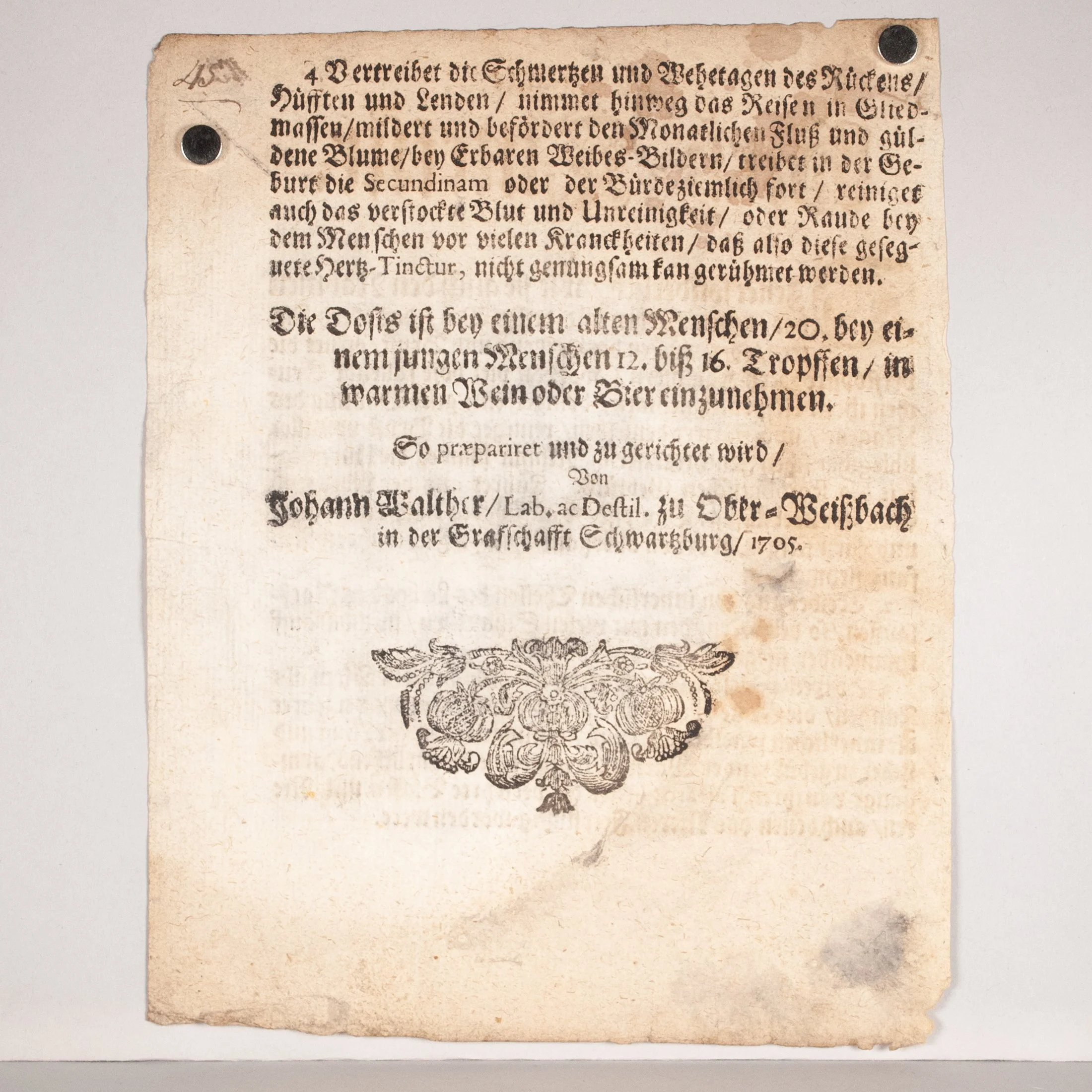
Unrecorded snake oil handbill
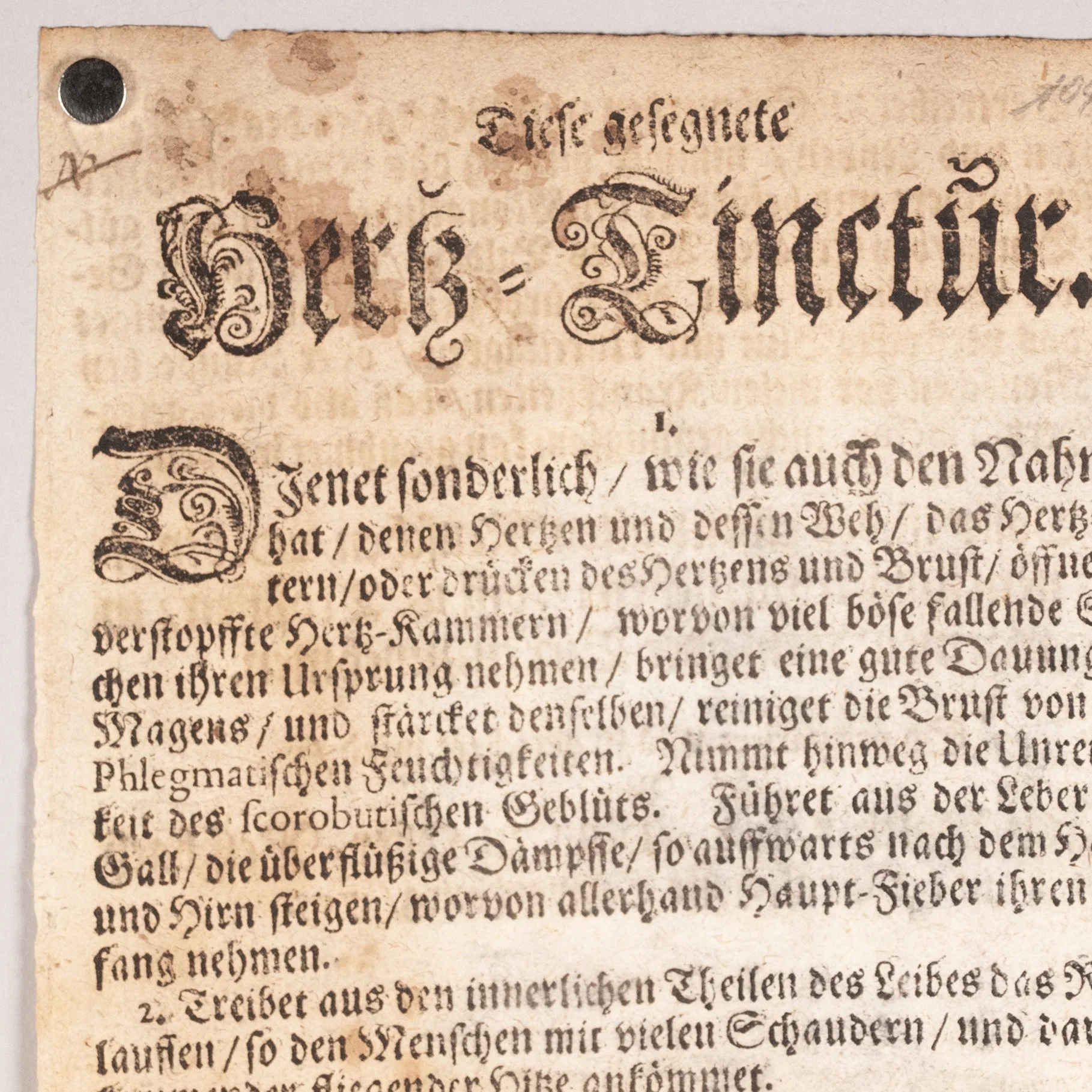
Diese gesegnete Hertz-Tinctur
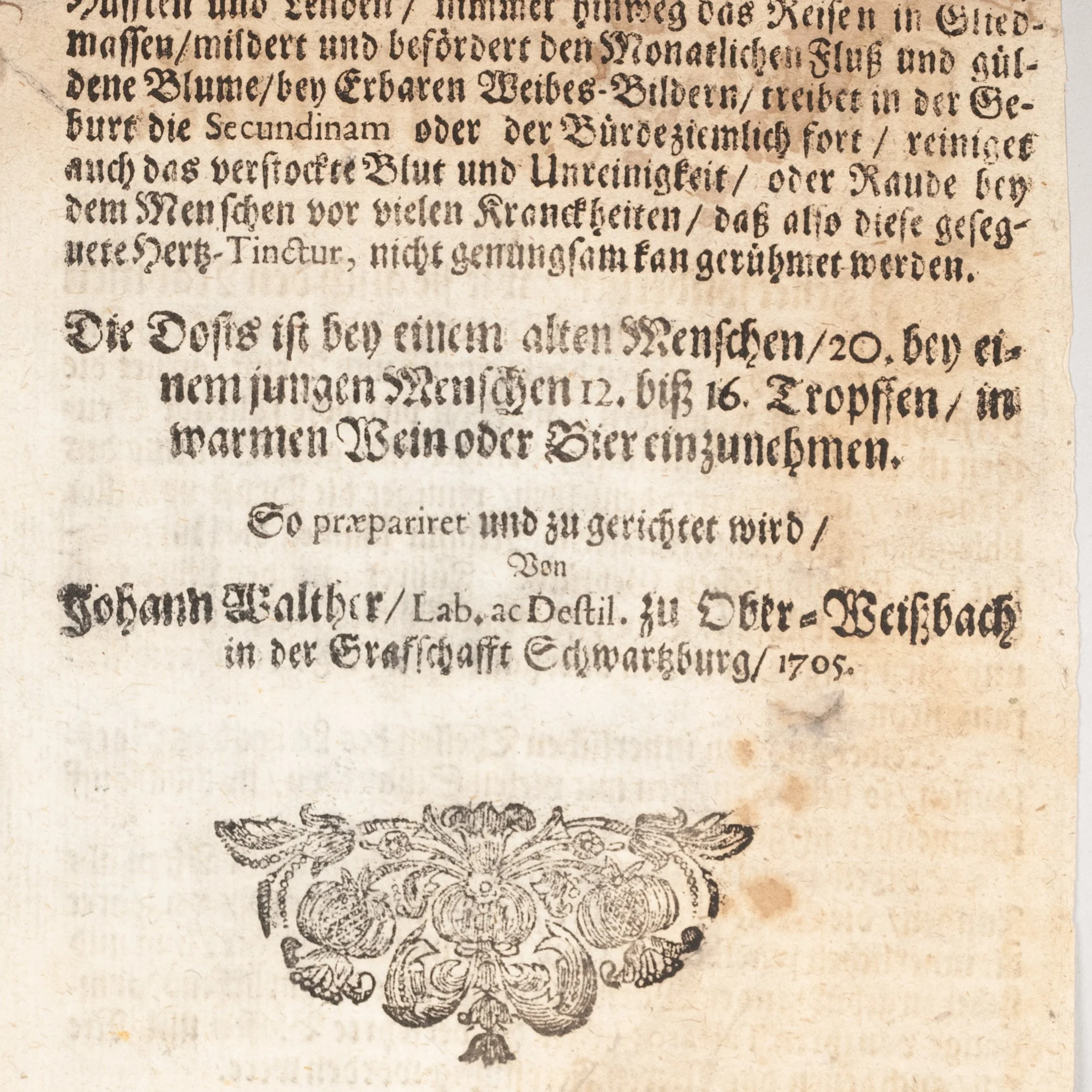
by Johann Walther
[Thuringia?] 1705
1 handbill | Quarter-sheet | 200 x 158 mm
A workaday snake oil handbill, by all appearances unrecorded, advertising Walther's "blessed heart tincture." His nostrum does far more than just clear blocked heart chambers and fix palpitations. It promotes good digestion, cleanses your phlegmatic humors, heals damaged bladders and kidneys, eliminates nausea and the sources of many fevers, cleans the urinary tract, "regulates and promotes monthly flow," and "effectively expels afterbirth." The tincture's preparator is one Johann Walther in Oberweissbach. He identifies himself as lab. ac destil., offering the authority of someone well versed in distilling and compounding liquids. "This blessed heart tincture cannot be praised enough," the author boasts, before closing with dosing instructions. ¶ The hyperbole here is typical of this ephemeral genre. "The petitions that the charlatans submitted to the local authorities are models of sobriety compared with the handbills that they used to advertise their activities to the public," which "seemingly promised anything and everything. This promotional literature deserves to be examined in detail, for here the empirics speak directly to us, without the mediation of the medical profession or the police. It constitutes a rich source of information on the authors' practice. More than that, it reveals the way in which the itinerants appealed to a popular public" (Ramsey). Such proto-patent medicine was a vital part of the sprawling early modern medical system. Properly trained physicians may have sat atop the hierarchy, but they competed with a vast array of treatments—some based to varying degrees on empirical evidence, others in faith and superstition—offered by a diverse cast of self-proclaimed healers. ¶ We find no other copies and trace no mention of the handbill.
PROVENANCE: Some old marks in pencil and ink.
CONDITION: Dusty and soiled, and perhaps some old sewing holes along the left edge.
REFERENCES: Matthew Ramsey, Professional and popular medicine in France, 1770-1830 (1988), p. 135-136 (cited above; "although the advertisements themselves assumed a literate audience, they closely resembled the harangues that the charlatan delivered to the crowd assembled before his stage"), 145 (reflecting on the authorship of similar French handbills, and suggesting some "were surely the product of a hired pen"); Mary Lindemann, Medicine and society in early modern Europe (2013), p. 237 (“people generally did not perceive academically trained physicians as especially or uniquely qualified to heal. Physicians, in short, by no means monopolized and controlled, or even dominated, the medical marketplace. Rather, physicians competed on equal or even disadvantageous terms with a wide range of healers for the medical trade of the day.”)
Item #874