Pioneering writing manual
Pioneering writing manual
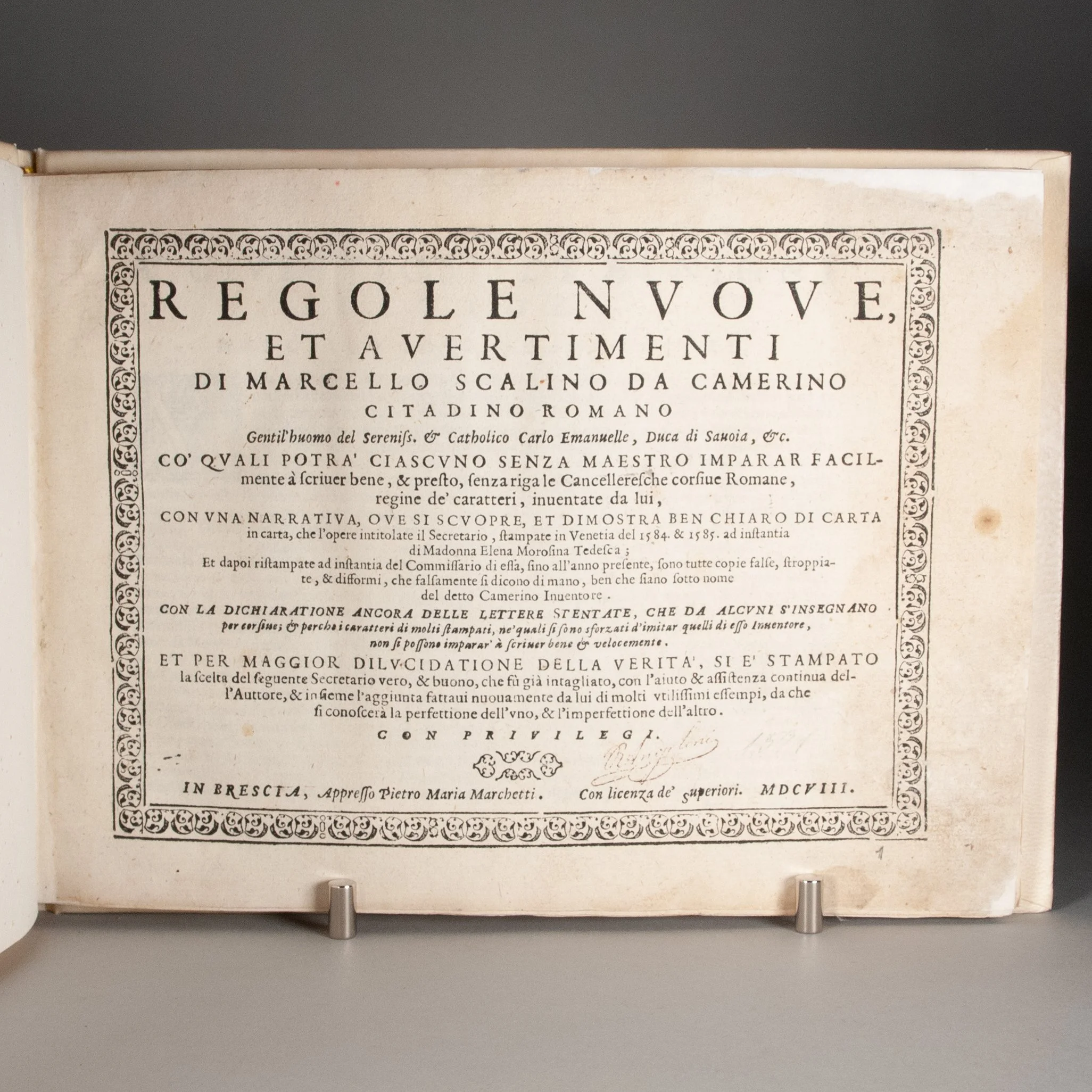
Regole nuove et avertimenti...co'quali potra' ciascuno senza maestro imparar facilmente à scriver bene & presto senza riga le cancelleresche corsive romane, regine de' caratteri, inventate da lui; con una narrativa, ove si scuopre et dimostra ben chiaro di carta in carta, che l'opere intitolate Il secretario, stampate in Venetia del 1584 & 1585 ad instantia di Madonna Elena Morosina Tedesca; et dapoi ristampate ad instantia del commissario di essa, sino all'annoa presente, sono tutte copie false, stroppiate, & difformi, che falsamente si dicono di mano, ben che siano sotto nome del detto Camerino inventore; con la dichiaratione ancora delle lettere stentate, che da alcuni s'insegnano per corsive, & percha i caratteri di molti stampati ne'quali si sono sforzati d'imitar quelli di esso inventore, non si possono imparar' à scriver bene & velocemente; et per maggior dilucidatione della verita', si e' stampato la scelta del sequente secretario vero & buono che fù già intagliato, con l'aiuto & assistenza continua dell'auttore & insieme l'aggiunta fattavi nuovamente da lui di molti utilissimi essempi, da che si conoscerà la perfettione dell'uno & l'imperfettione dell'altro
by Marcello Scalino (Scalzini) | plates engraved by Giacomo Franco
Brescia: Pietro Maria Marchetti, 1608
[10], 41, [1] p. + 26 plates | Oblong 4to | A-E^4 F^6 | 175 x 237 mm
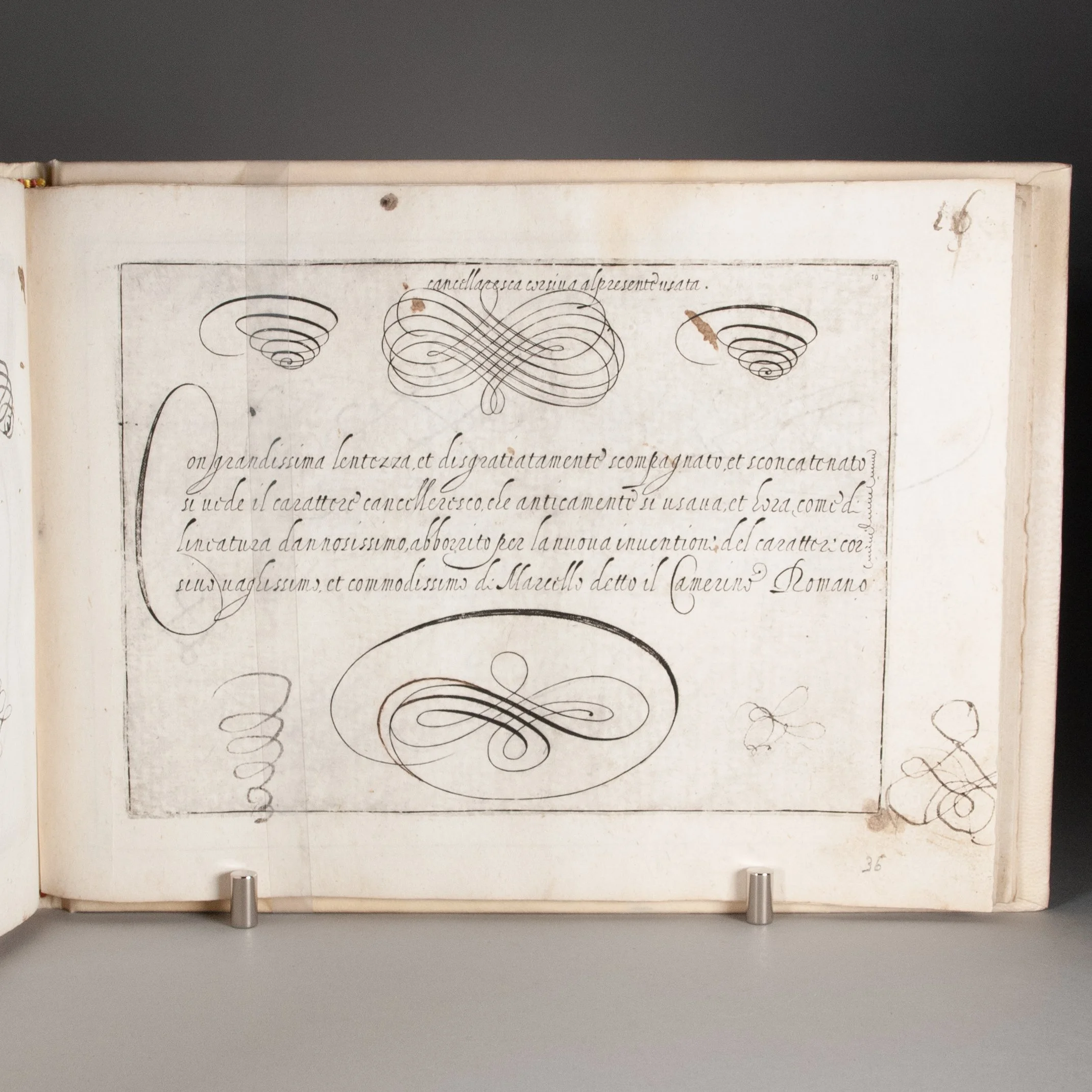
An early edition of this influential writing manual for aspiring professional secretaries, first published in 1581 as Il secretario and reprinted at least half a dozen times before our 1608 edition appeared (though all but the 1591 Brescia edition were Venetian piracies, something to which our title calls attention). This 1608 Brescia edition seems likely to have been the third authorized edition. It was printed from Franco's second set of plates, which were based on those he prepared for the 1581 first edition, and first used in the second authorized edition of 1591. ¶ By the time Scalzini published, the writing manual was a firmly established genre, a textbook for an ever expanding bureaucratic labor force. Students with years of formal schooling might have acquired suitable chancery skills, but instructors like Scalzini aimed for those who intended to write professionally. Ludovico Vicentino degli Arrighi blazed the chancery trail in 1522 with his Operina, and in 1538 Johan Neudörffer issued the first writing book printed from intaglio plates, an undeniable improvement on predecessors like Arrighi. Scalzini was an accomplished calligrapher, too, even legendary for having allegedly written out the Pater Noster on one side of a lentil, and the Credo on the other. Impressive, if gimmicky (see plates 5 and 21 for similar showboating). Nothing established one's reputation quite like having a published writing book to one's name. Like so many textbooks, however, survival rates tend to be low. "Writing books in particular were subject to physical abuse from copying and tracing, even dismemberment, in order to reproduce models and learn hands. As in all texts, copybooks were often passed down from student to student and generation to generation, revealing often valuable information about the transmission of knowledge, but resulting in considerable wear and tear” (Becker). ¶ Along with Giovan Francesco Cresci and Lodovico Curione, Scalzini's letters "were to be the most important contemporary influences on the writing masters of Italy and the Netherlands in the last two decades of the sixteenth century" (Worthen). Though his boast on the title page, that he invented the hand presented here, may be a bit of a stretch. His letters largely resemble those found in earlier chancery manuals. But with some new variations, he "pushed the process still further," producing "a taller, narrower script than that with which his predecessors may be identified" (Morison). Beyond the letterforms, he "was truly the first among all the masters of calligraphy in the 16th century who knew how to place theory before practice, or rather, who knew how to extract from his own and others' experiences an organized and rational system of theoretical rules" (Pasero). And with the Secretario, he was the first to place speed above all else, focusing on the single hand best suited to meet the demands of the modern secretary, and the first to publish the highly ornate single-stroke flourishes that became ubiquitous in Baroque writing manuals. "Overall, it can be said that with Scalzini the image of modern calligraphy was born" (Petrucci). ¶ For better or worse, Scalzini was also party to what was probably the first penmanship debate to publicly manifest in print. His Secretario (or Regole nuove as titled here) defied Cresci's own writing manual, which Scalzini castigated as a relic of a slower, more medieval age for its focus on traditional book hands. Suggesting any skilled calligrapher could write a neat chancery slowly, Scalzini promoted the vital importance speed for the modern secretary. "The real test is when a secretary in the service of some prince or lord is obliged, in the ordinary course of duty, to write 40 or 50 long letters in four or five hours" (Osley). The two traded barbs, Cresci insisting that his own method hardly precluded the attainment of speed and efficiency, and even suggesting that woodcut facsimiles were superior to those engraved in copper. ¶ This is the only complete copy, of any edition, we find in auction records (Swann, 2013). We otherwise find at auction only a defective ca. 1587 copy (Forum, 2020) and a defective 1581 first edition (Minerva, 2016). In North America, we find copies of this edition only at the Library of Congress and the Newberry, and just a few copies more in Europe.
PROVENANCE: Old ink stamp on title and subsequent leaf (R. Angeloni?). Old pen trials scattered throughout the plates, mostly on the blank versos, paying particular attention to Scalzini's innovative flourishes. An inscription on the verso of plate 15 is a more complete imitation of the author's script. We find a few names scattered throughout, too: perhaps a Stefano Carboni, a Vincenzo, another Carboni. And there's a rather mean comment on plate 12: Asino il correttore opure l'agiuntore, suggesting someone was an ass.
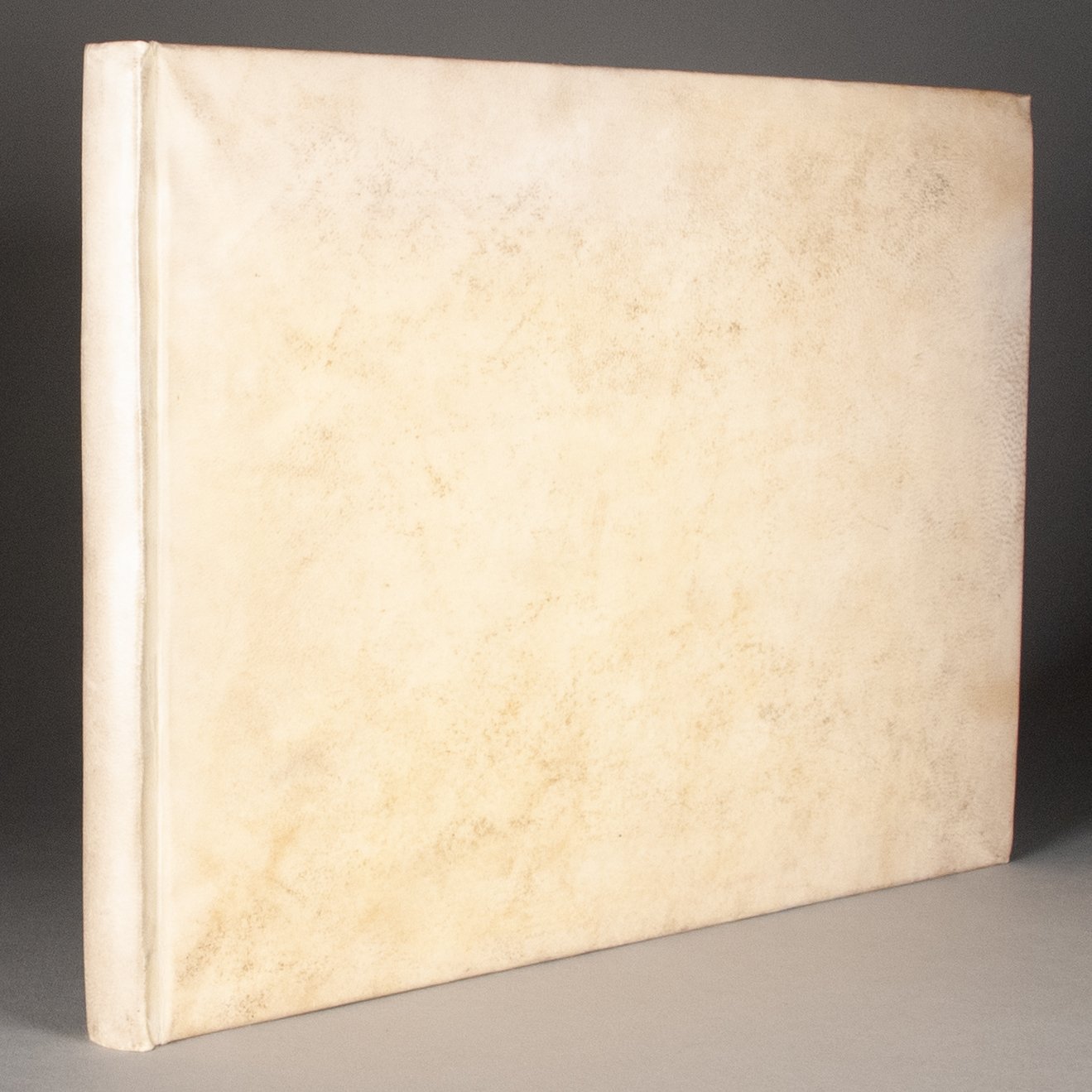
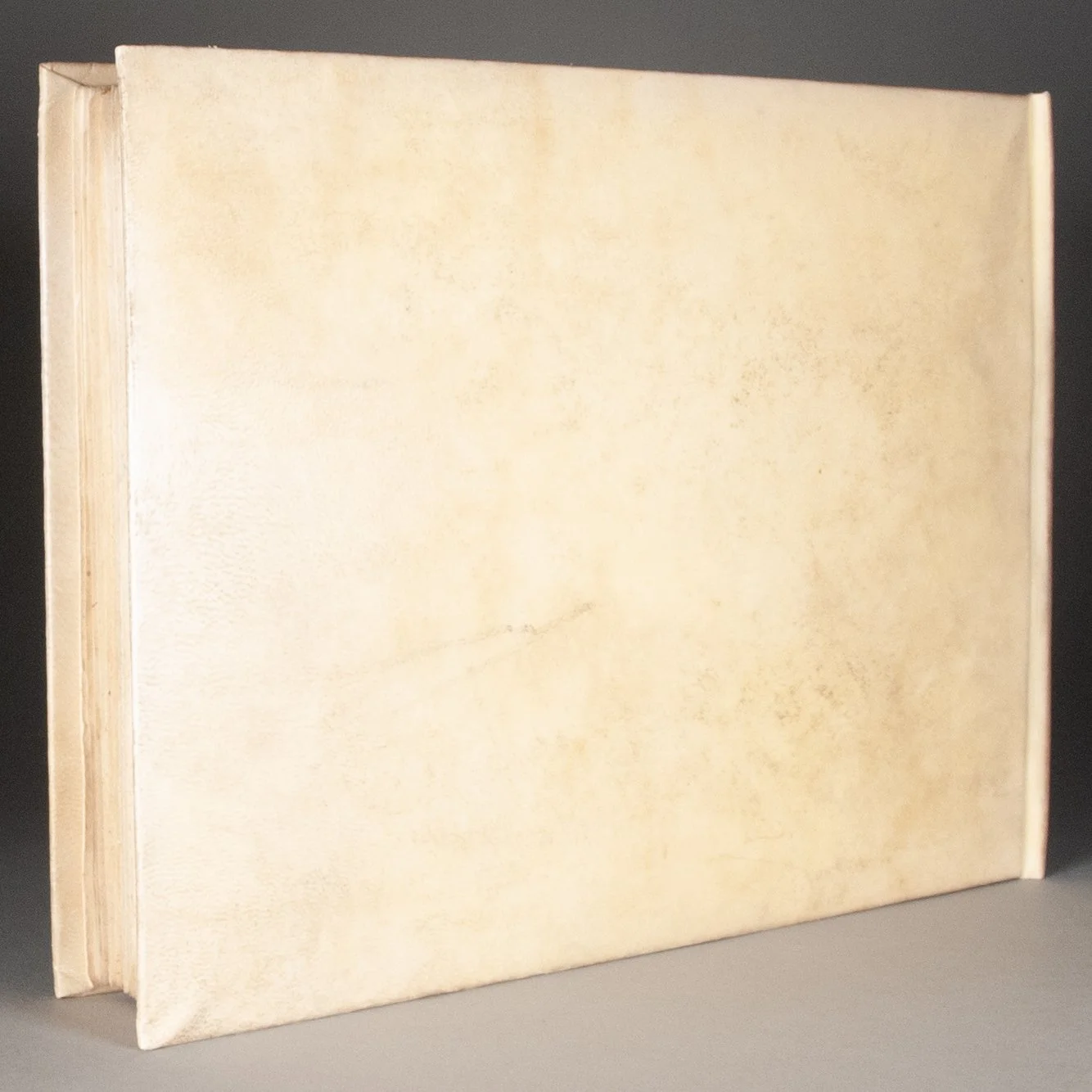
CONDITION: Modern parchment over boards. ¶ Moderate soiling throughout, the last few leaves more heavily; first six leaves with marginal repairs, the first five completely remargined at the inner margin; occasional marginal repairs to the plates, most extensive in the outer margins of the last two, but nothing reaching the plate marks. Parchment a bit scuffed.
REFERENCES: USTC 4039012 ¶ David P. Becker, The Practice of Letters: The Hofer Collection of Writing Manuals 1514-1800 (1997), p. XI (cited above), 13, #28 (a ca. 1600 edition, but that "the Newberry Library owns a 1608 edition of the Regole nuove with the same plates and a letterpress text explaining Scalzini's methods; he speaks in his preface of Franco's skill in reengraving and improving the earlier illustrations"); Amy Namowitz Worthen, "Calligraphic Inscriptions on Dutch Mannerist Prints," Nederlands Kunsthistorisch Jaarboek 42/43 (1991/1992), p. 265 (cited above), 266 (on Neudörffer and the rise of engraved manuals; "The production of intaglio-printed lettering in writing books was made possible by the practice engravers gained cutting lettering for prints, title pages, and maps"); Simran Thadani, "'For the Better Atteyning to Faire Writing': An Analysis of Two Competing Writing-Books, London, 1591," Papers of the Bibliographical Society of America 107.4 (Dec 2013), p. 465 ("Panke and Bales's pamphlets are not the first ever printed debate about the principles and methods of good penmanship; that distinction likely falls to the Italian trio of Palatino, Giovan Francesco Cresci, and Marcello Scalzini, whose spat in the 1580s concerned the degree to which letterforms should be embellished with flourishes or decoration."); Armando Petrucci, Annali della scuola normale superiore di Pisa, Classe di lettere e filosofia, Series III, 23.2 (1993), p. 621 (on his elaborate single-stroke flourishes, "the first that I know of"), 625 (cited above, and on Scalino's promotion of speed for secretaries); Carlo Pasero, "Marcello Scalini e la calligrafia del XVI secolo," La bibliofilía (35.11/12 (Nov/Dec 1933), p. 433 (his letters derived from earlier manuals), 434 (cited above); Philip Sohm, Pittoresco (1991), p. 76-79 (on the Cresci-Scalzini spat); A.S. Osley, Luminario: An Introduction to the Italian Writing-Books of the Sixteenth and Seventeenth Centuries (2024), p. 96 (cited above), 97 ("This book, moreover, is the first to exhibit the complicated abstract patterns, all supposed to be written spontaneously in a single stroke, which were to occupy so much space in later writing-books"; also on the debate with Cresci); Stanley Morison, Early Italian Writing-Books (1990), p. 124 (Scalzini "was an innovator in more than on respect; his innovations were partially made possible, and certainly exaggerated, by the possibilities inherent in copperplate printing"), 125 ("It will be understood that Il Secretario in any edition, authorized or spurious, is an interesting book"), 126 (cited above)
Item #949