
Grolier style comes to Germany | Complementary panel-stamped bindings
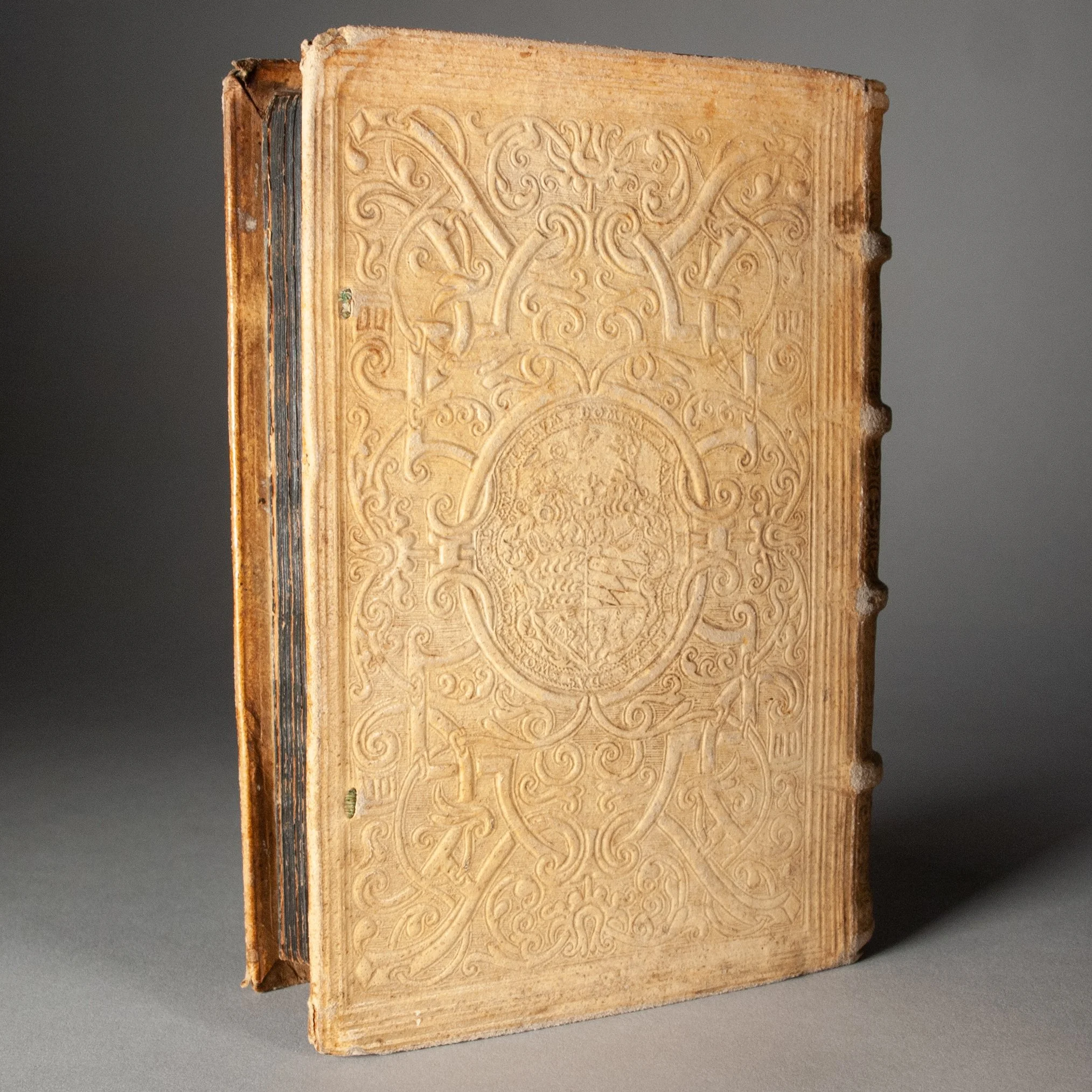
Grolier style comes to Germany | Complementary panel-stamped bindings
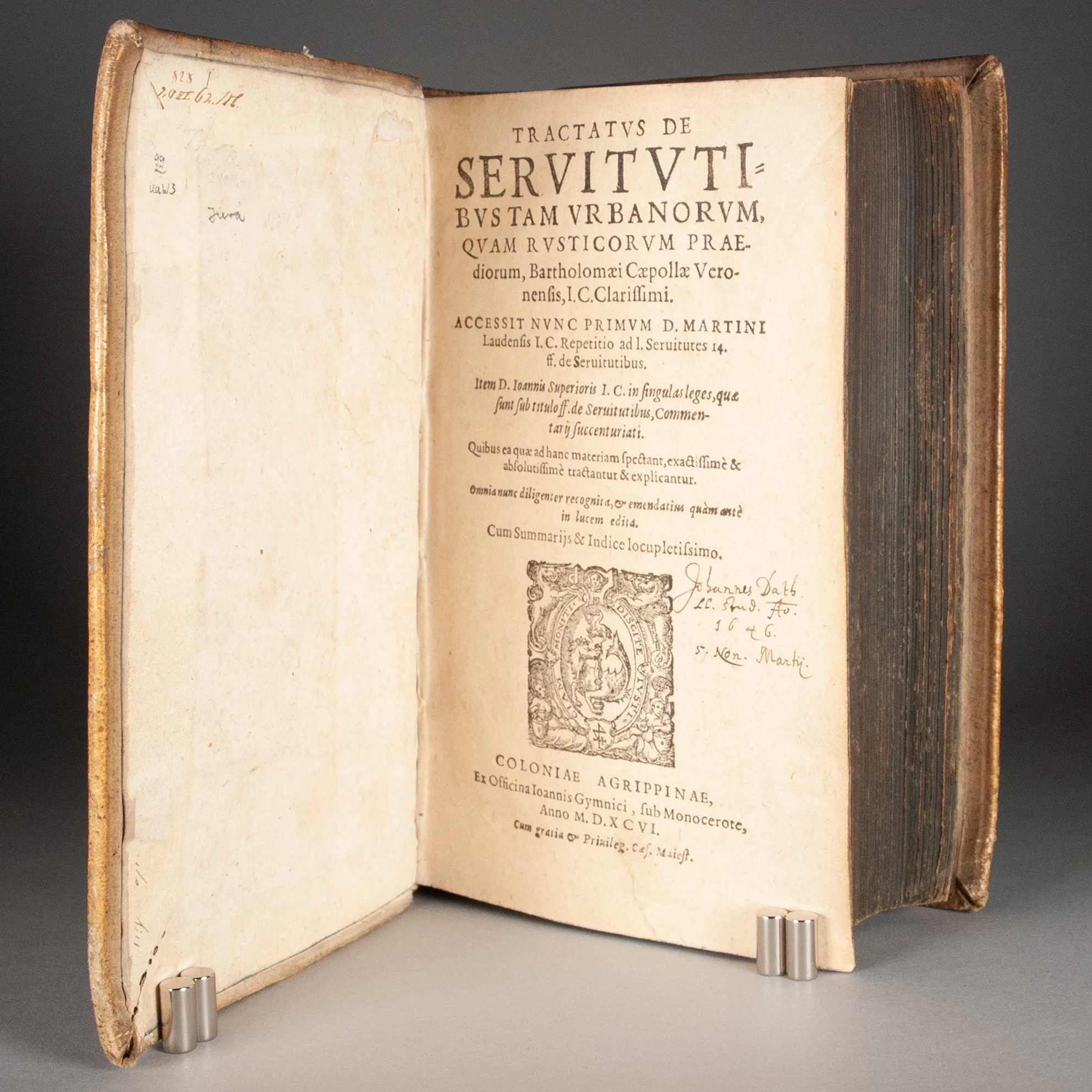
Tractatus de servitutibus tam urbanorum quam rusticorum praediorum...accessit nunc primum D. Martini Laudensis I.C. repetitio ad 1. Servitutes 14. ff. de servitutibus; item D. Ioannis Superioris I.C. in singulas leges, quae sunt sub titulo ff. de servitutibus, commentarii succenturiati; quibus ea quae ad hanc materiam spectant, exactissimè & absolutissimè tractantur & explicantur; omnia nunc diligenter recognita & emendatius quam antè in lucem edita; cum summariis & indice locupletissimo
by Bartolomeo Cipolla
Cologne: Johann Gymnich III (Heirs of?), 1596
[64], 161, 160-835, [3] p. | 8vo | [cross]-4[cross]^8 A-3F^8 3G^4 | 180 x 110 mm
and
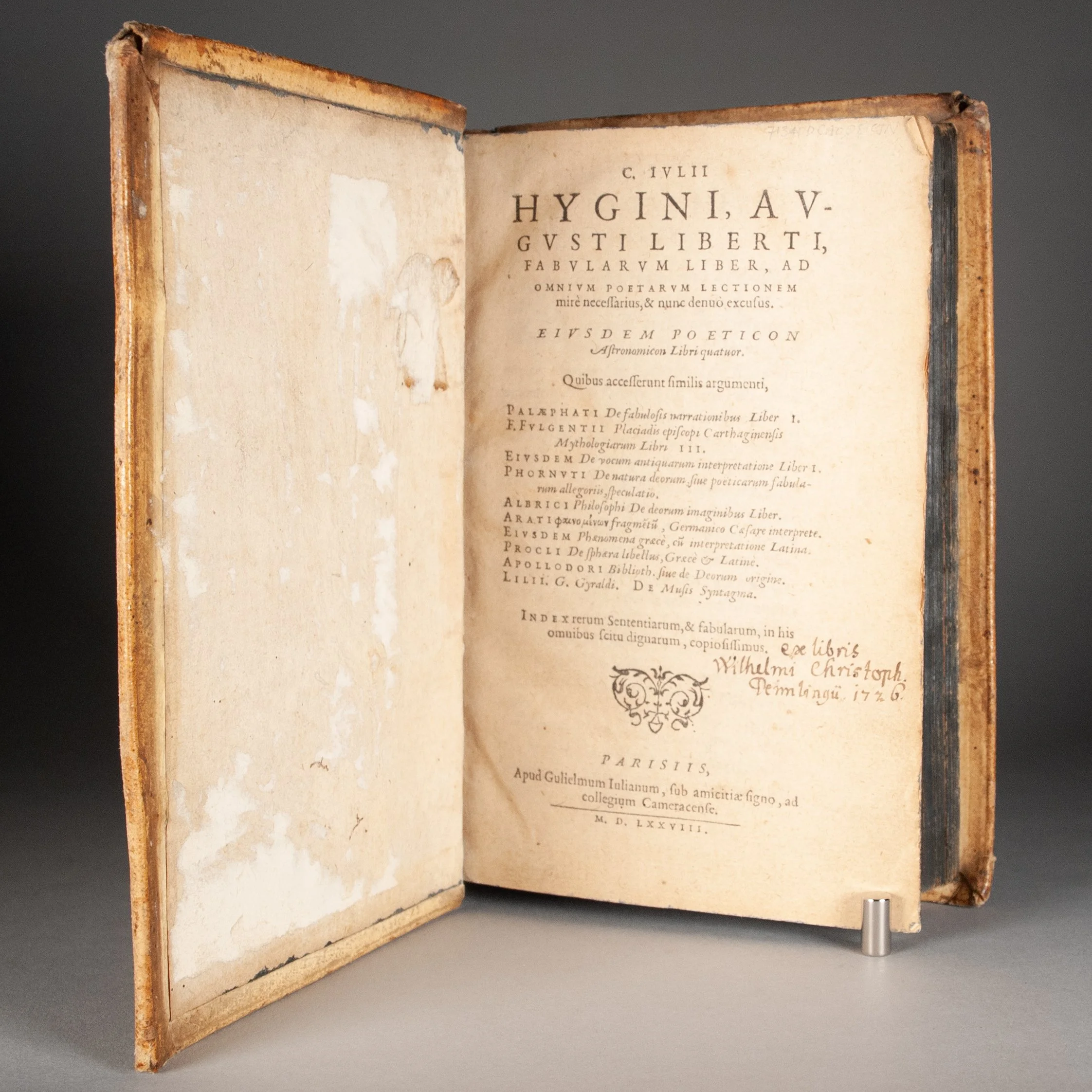
Fabularum liber, ad omnium poetarum lectionem mirè necessarius & nunc denuò excusus; eiusdem Poeticon astronomicon libri quatuor; quibus accesserunt similis argumenti: Palaephati De fabulosis narrationibus liber I; F. Fulgentii Placiadis episcopi Carthaginensis Mythologiarum libri III; eiusdem De vocum antiquarum interpretatione liber I; Phornuti De natura deorum, sive, Poeticarum fabularum allegoriis, speculatio; Albrici philosophi De deorum imaginibus liber; Arati...fragme[n]tum, Germanico Caesare interprete; eiusdem Phaenomena Graecè, cu[m] interpretatione Latina; Procli De sphaera libellus, Graecè & Latinè; Apollodori biblioth. sive De deorum origine; Lilii G. Gyraldi De musis syntagma; index rerum sententiarum & fabularum, in his omnibus scitu dignarum, copiosissimus
by C. Julius Hyginus and others
Paris: Guillaume Julien, 1578
[8], 238, 239-243, [1], 244-250, [1], 253-317, [59] leaves | 8vo | ã^8 A-2H^8 2I^6 2K-3A^8 3B^4 | 177 x 111 mm
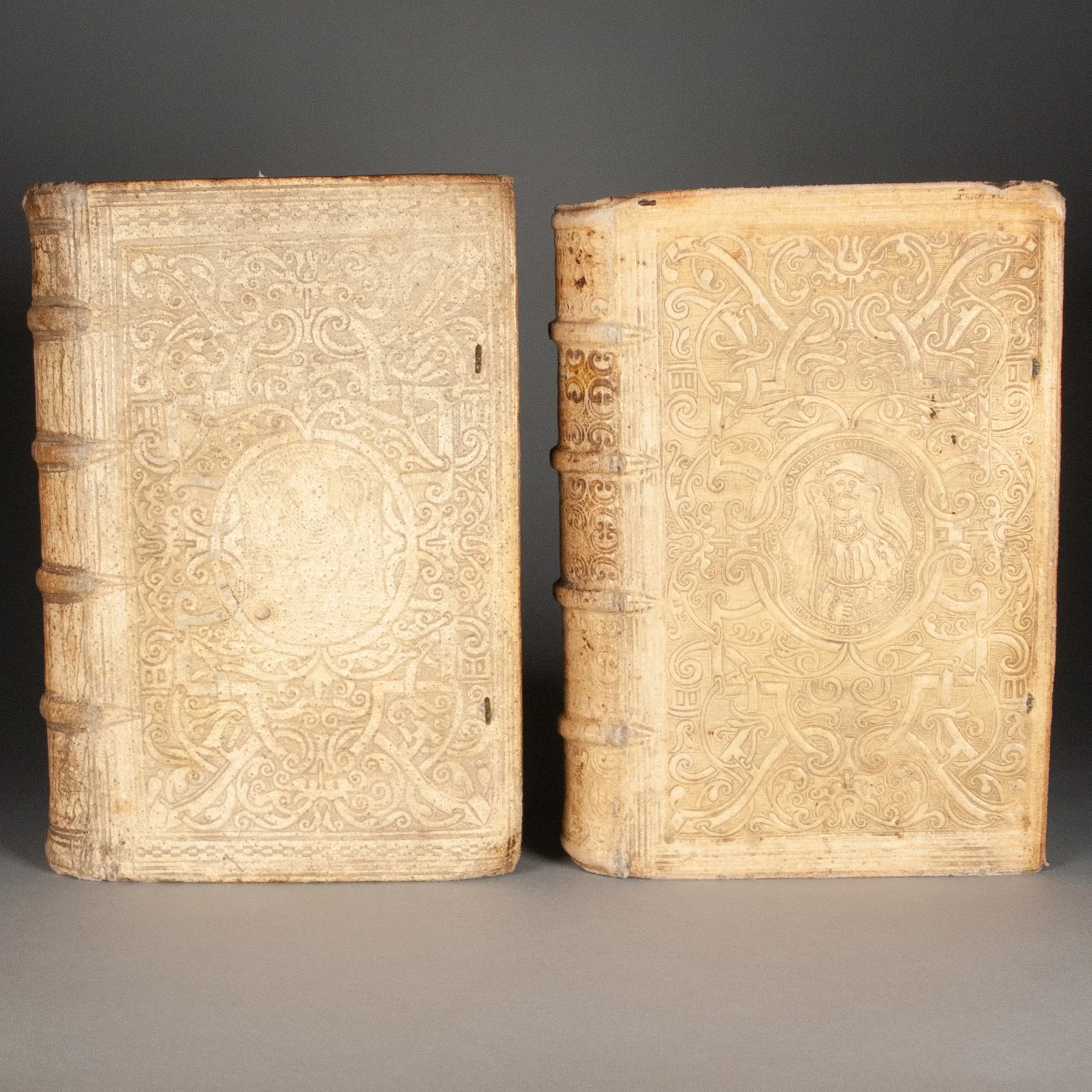
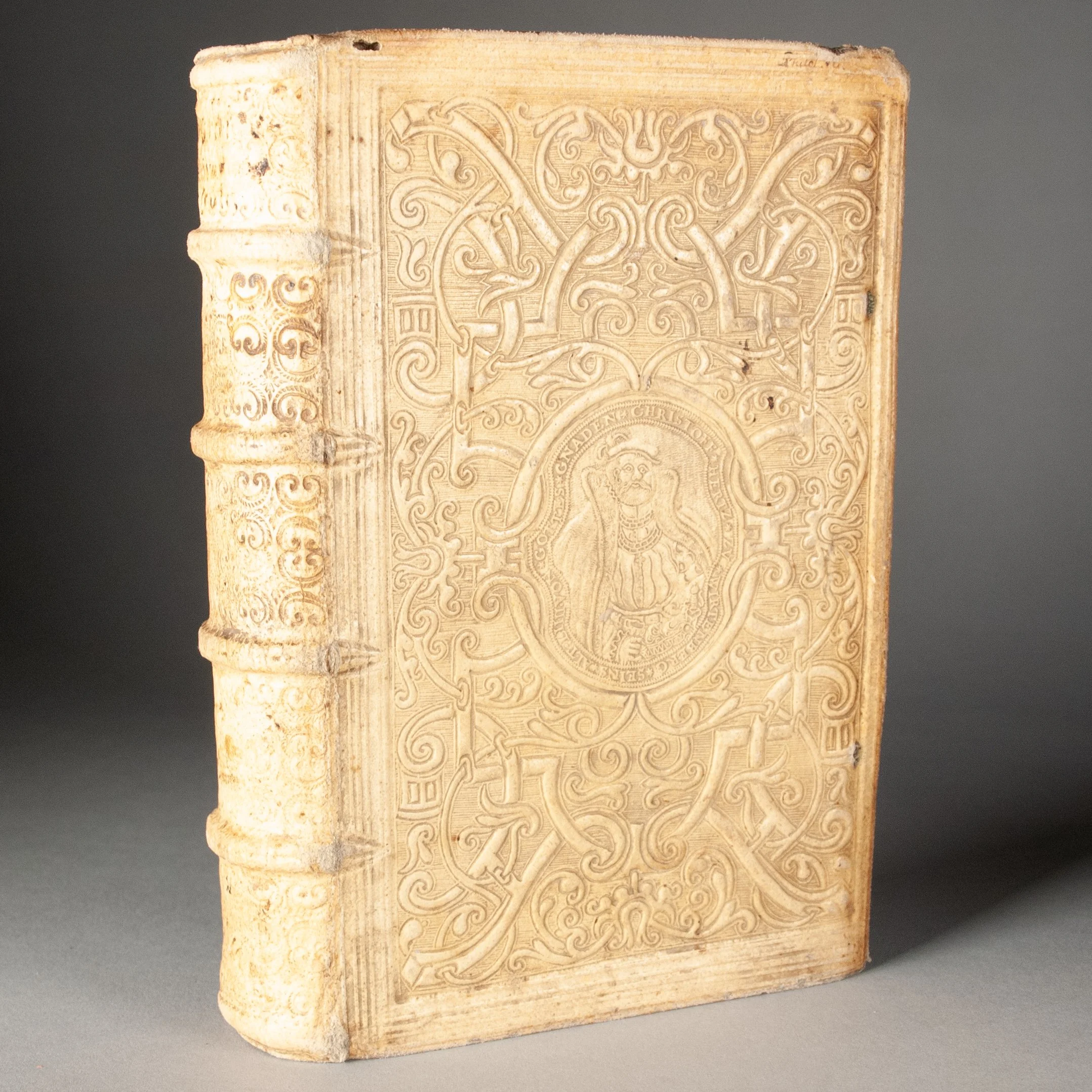
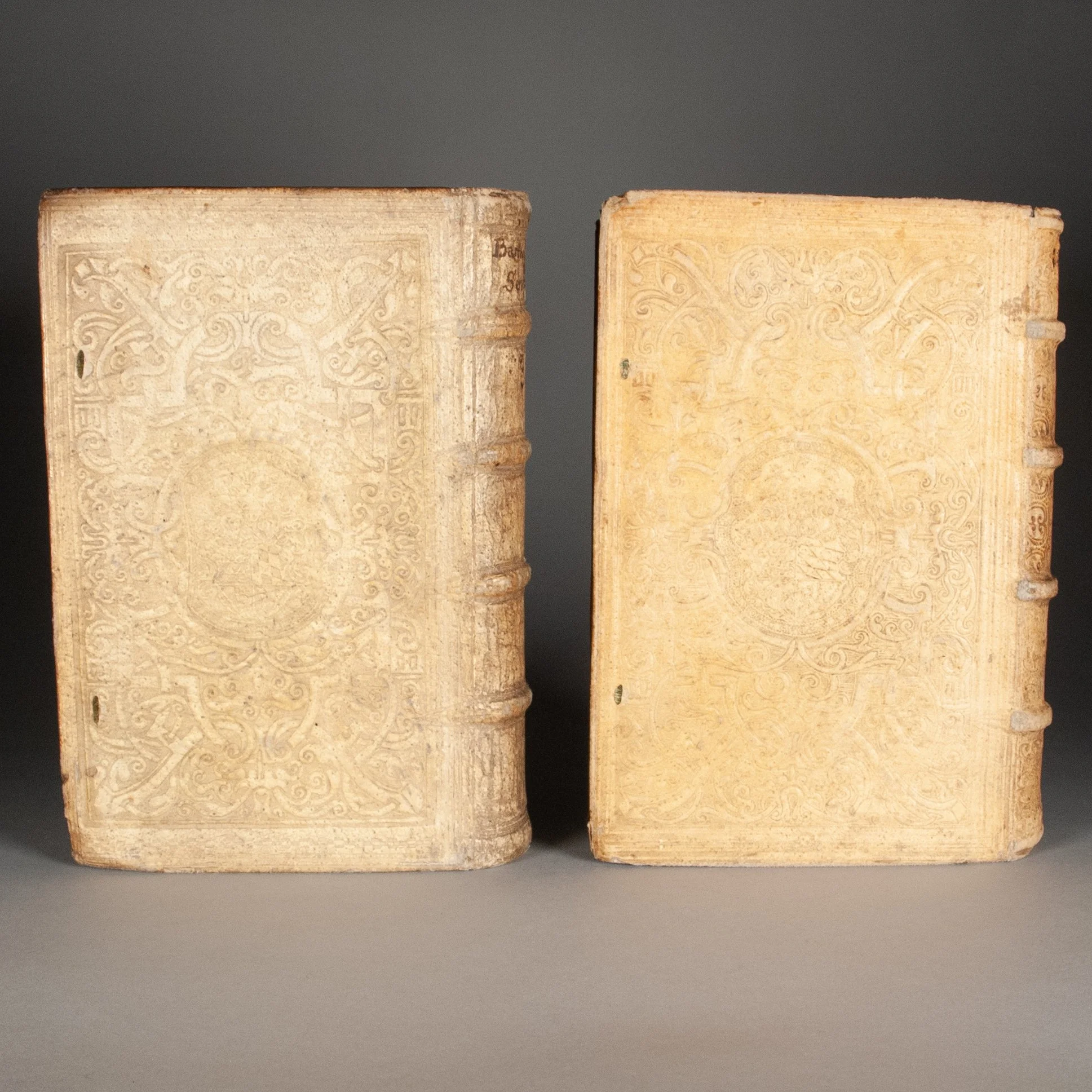
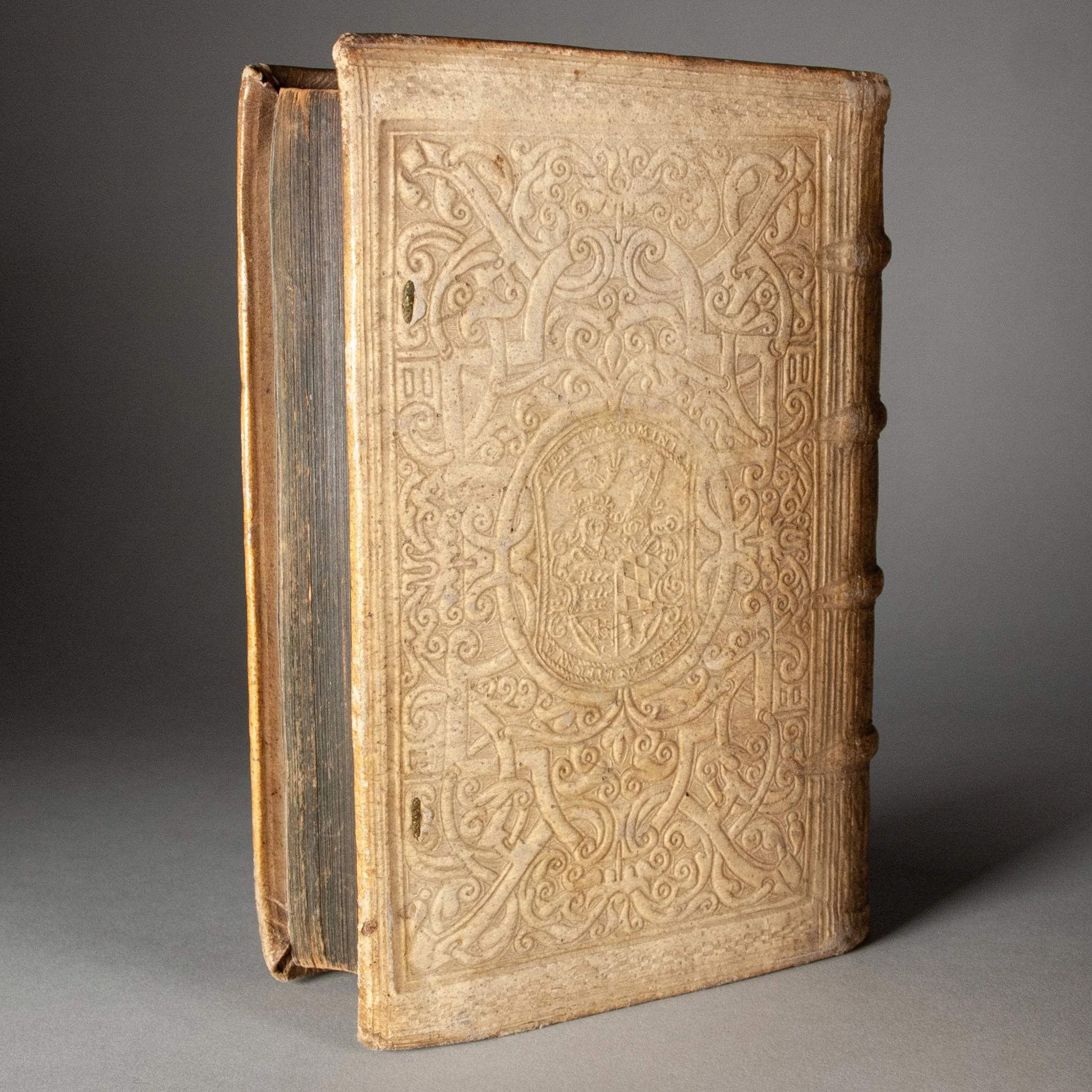
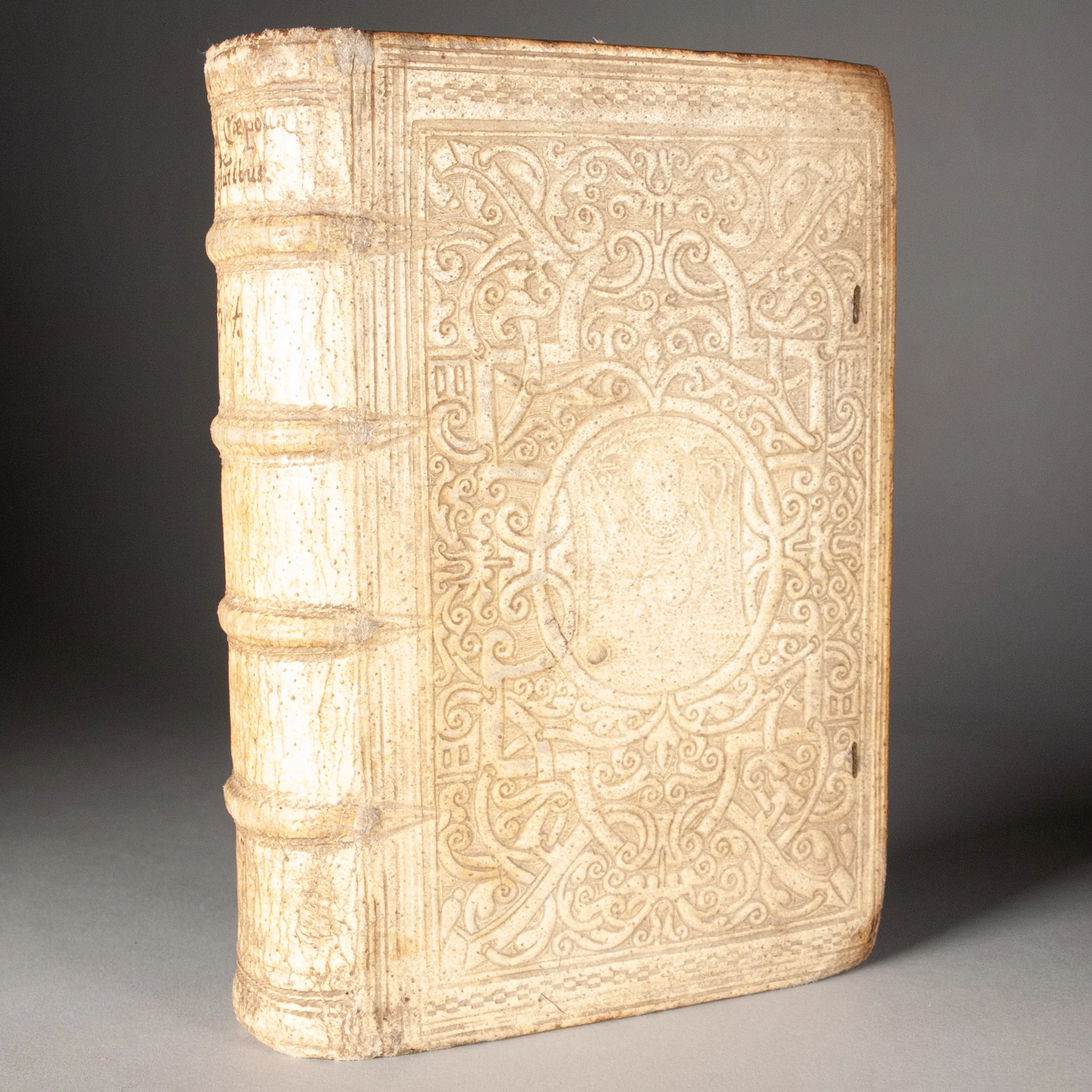
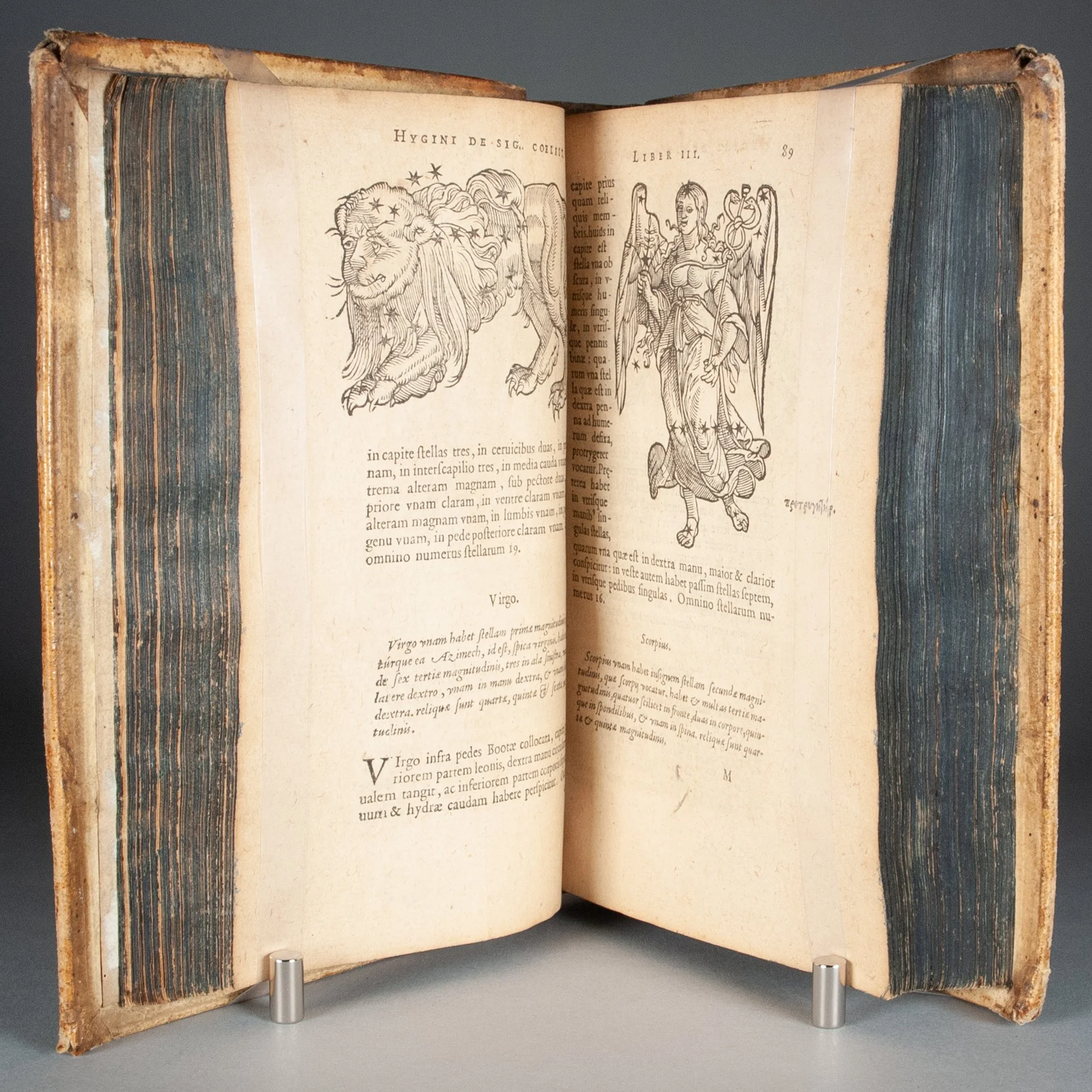
An early edition of this fable collection headlined by the Fabulae traditionally attributed to Gaius Julius Hyginus, an attribution today doubted. Hyginus is surely best known for his Poeticon Astronomicon, included here and illustrated with those invariably endearing constellation woodcuts (48 woodcuts altogether, including representations of the planets). It is perhaps the second edition of this particular compilation, preceded by at least one edition in 1570; we suspect the 1578 Jean Parent edition is the same as ours, simply issued for another Parisian bookseller. We pair this fable collection with a later edition of Cipolla's enduring treatise on land servitude, first published around 1473 and regularly reprinted through the 18th century. ¶ The two volumes make a compelling pair of bindings, telling witnesses to a German style that adapted the arabesque scrollwork motif rooted in Italy, popularized in France, and famously patronized by Jean Grolier. Whereas the style's French complements used gold on tanned leather, Germans adapted it to their locally favored technique of blind stamping on pigskin. In a land that preferred rectangular portrait panels surrounded by thick rectangular rolls, this arabesque style, with its elliptical center, is all the more conspicuous for its French and Italian influence. In Germany, "only a few, mostly princely, patrons displayed a taste for a more Italianate style" (Hobson). Our azured backgrounds, too, echo the hatched or stippled grounds on some of the finest French gilt bindings from the same period. ¶ While the designs for Grolier's bindings were built up from small tools, the use of panels represented significant gains in efficiency. "By their means any bookbinder, though quite unskilled in the difficult art of tooling 'à petit fers', could produce the rich decorative effect seen on the Grolier and Mahieu books, simply by impressing a ready-made block on the sides of his bindings" (Goldschmidt). The panels on our covers are strikingly similar, and obviously derived from the same model. They typically had an open space at center to accommodate any portrait or shield, ours no exception (note the untidy joint between the scrollwork and portrait panels). Such panels were likely made for commercial distribution—Flemish versions at least were more commonly cast than individually engraved—and perhaps were available at major book fairs much like the popular Flemish panels. ¶ Known shops working in this style included those of Samuel Streler in Tübingen and Hans Wagner in Lauingen. But given the variety of both scrollwork panels and Württemberg portraits used, we won't hazard a guess any narrower than suggesting Württemberg the likely region of production. We've found in the literature some half a dozen very similar scrollwork panels, and our identical Hyginus panel on a binding Schmidt found in the Darmstadt Landesbibliothek, also bearing the arms of the House of Württembeg. The front cover of our Hyginus bears a panel portrait of Christoph, Duke of Württemberg. Bindings so decorated are rather curiously found almost exclusively on books printed after his death in 1568. "Perhaps, therefore," Haebler suggests, "it is more to the piety of his book-loving son, Ludwig III, than to his own wish that his memory has been kept alive in this way." To be sure, our Cipolla front cover bears a portrait of Ludwig III, and its back cover the arms of the House of Württemberg (a version Haebler assigns to the son). Haebler records five different panels for Christoph. Our Hyginus has Haebler V on its front cover, and Haebler IV, the Duke's arms, on its back. ¶ A striking pair of bindings, at once demonstrating both the capacity of panel stamping and a local variation on one of Europe's most celebrated binding styles.
PROVENANCE: The Hyginus possibly from the library of Ludwig III, Duke of Württemberg, following Kaebler's suggestion. But the use of such portraits was not necessarily restricted to bindings made for the person pictured. Our Cipolla, for example, was printed three years after the death of Ludwig III in 1593. We suspect the motif was simply in vogue in Württemberg, the same way royal arms were frequently used to decorate books without royal provenance. ¶ A few old annotations in the fables volume (fol. 49, 112, 313, and more extensive annotation to the Cipolla on some twenty pages. ¶ Ownership inscription on the Cipolla title dated 1646 (Johannes Dathus?), and on the fables title dated 1726 (Wilhelm Christopher). Old clipped bookseller's description tipped to the rear paste-down in the Hyginus.
CONDITION: Both volumes in contemporary pigskin over wooden boards, panel-stamped in blind as described above, with a bit of extra blind tooling to cover remaining open spaces. Edges of the leaves stained a dark blue. ¶ Hyginus paper a bit darkened, and the last few leaves a bit wormed at the inner margin (affecting some text). The bindings mildly soiled, darker on the spines; all ties lost; just traces of worming in the paste-downs, and at the top left corner of the Hyginus front cover; paper remnants covering the Hyginus front paste-down, something having been removed; corners bumped, and the Hyginus corners additionally worn; portrait of Ludwig III pretty flat, but details still discernible in raking light.
REFERENCES: USTC 170440 (fables), 699202 (Cipolla); VD16 C 1960 (Cipolla) ¶ Staffan Fogelmark, Flemish and Related Panel-Stamped Bindings (1990), p. 80 ("it is clear that what gave the panel such a great advantage over hand tools was its almost unlimited iconographic possibilities,” which otherwise could only be achieved with the cuir ciselé method), 133 (on the mass production of Flemish panels with blank shields and their availability at fairs); Anthony Hobson, Humanists and Bookbinders (1989), p. 130 (cited above; “the German public retained its preference for rectangular portrait panels impressed in blind [over round Italian cameos], a development of medieval fashion, and only a few, mostly princely, patrons displayed a taste for a more Italianate style"); E. Ph. Goldschmidt, Gothic & Renaissance Bookbindings (1928), v. 1, p. 285 ("The engraved panel of interlaced scrollwork necessarily arose as the easy short cut to producing the rich effect that Grolier's binder had attained by laborious tooling"), 316-317 (cited above, and also a binding with the Württemberg arms), v. 2, plate LXXV (an azured arabesque Grolier binding, Paris, ca. 1560), plate XCI (a stippled strapwork binding, Paris, ca. 1562); H. George Fletcher, Judging a Book by Its Cover (2023), #2.13 (an arabesque binding with stippled background, Paris, 1560s); Peter Fuhring, "Renaissance Ornament Prints: The French Contribution," The French Renaissance in Prints (1994), p. 163-164 (on the origins of French strapwork in decoration at Fountainebleau); Konrad Haebler, Rollen und Plattenstempel des XVI. Jahrhunderts (1929), v. 2, p. 90-91 (cited above), 92-94 (Haebler IX, the Ludwig III portrait, and Haebler X, his arms; "Duke Ludwig (d. 1593) seems to have been the greatest bibliophile among the Württembergers; at least his portrait and coat of arms appear more frequently than those of anyone else. He may have inherited his love of books from his father, Duke Christoph. Incidentally, not all bindings decorated with his panels can be attributed to his private library."); Adolf Schmidt, Bucheinbände aus dem XIV.-XIX. Jahrhundert in der Landesbibliothek zu Darmstadt (1921), Tafel 31, Abbildung 43 (gilt strapwork binding with azured background, ca. 1585); Tafel 49, Abbildung 76 (panel identical to our Hyginus), Abbildungen 77-78 (similar panels); Europäische Einbandkunst aus sechs Jahrhunderten (1992), "Tübinger Platteneinband eines Streler-Nachfolgers; um 1585" (another binding similar to ours; attesting Samuel Streler and Hans Wagner as binders in this style)
Item #962