Beaux arts cornerstone from the father of the fairy tale
Beaux arts cornerstone from the father of the fairy tale
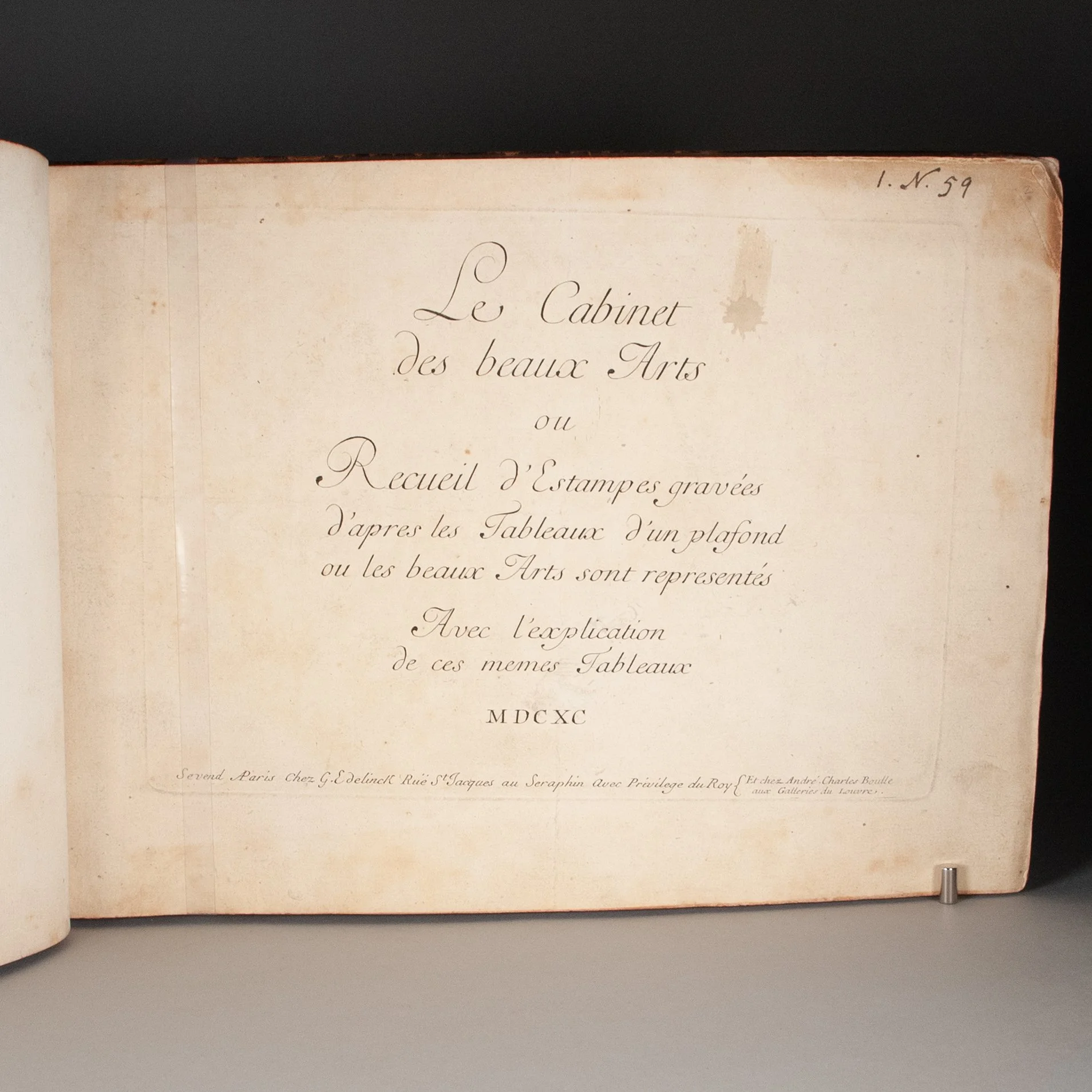
Le cabinet des beaux arts, ou, Recueil d'estampes gravées d'apres les tableaux d'un plafond ou les beaux arts sont representés; avec l'explication de ces memes tableaux
by Charles Perrault
Paris: Gérard Edelinck and André-Charles Boulle, 1690
[5], 42, [1] p. + [13] plates (1 folding) | 246 x 324 mm
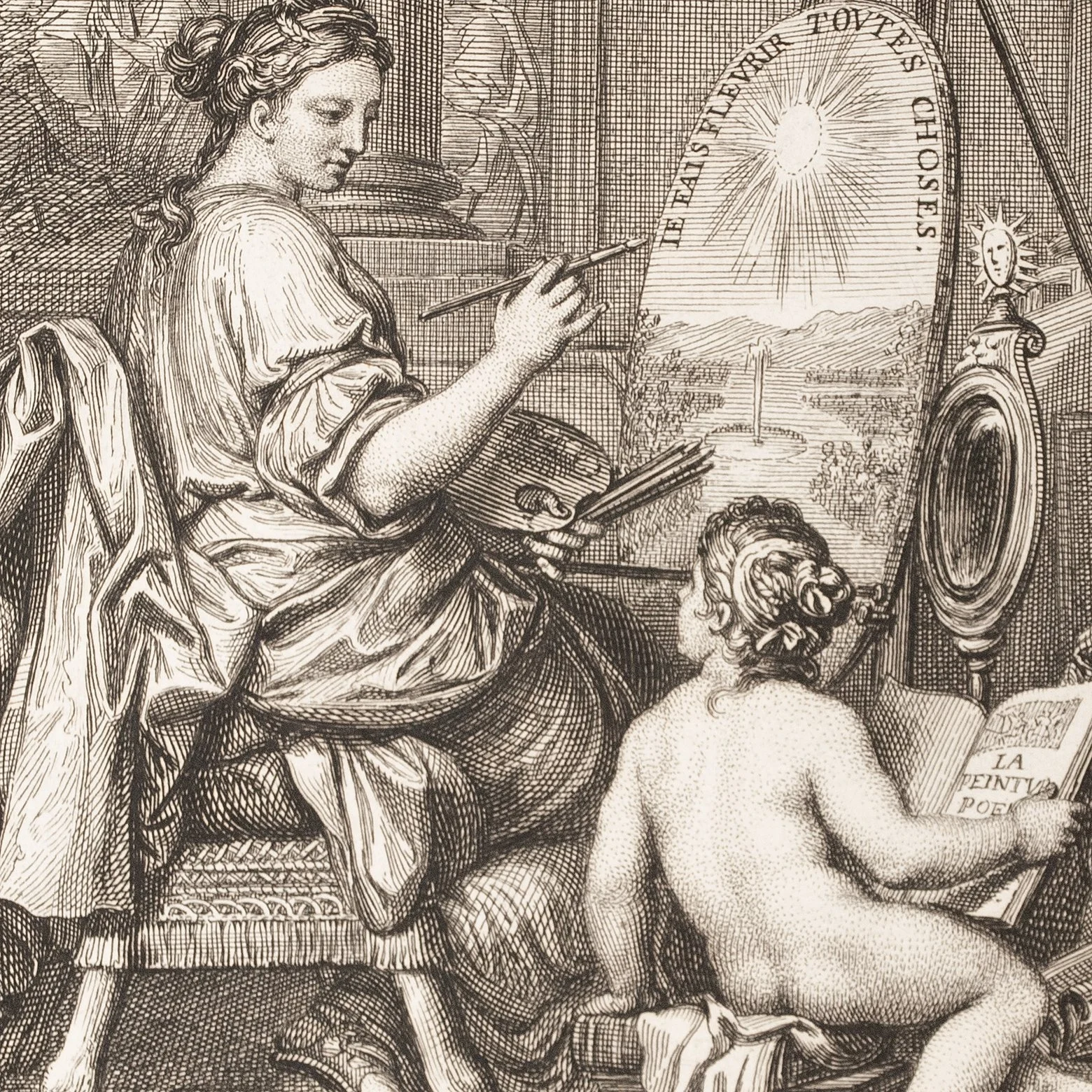
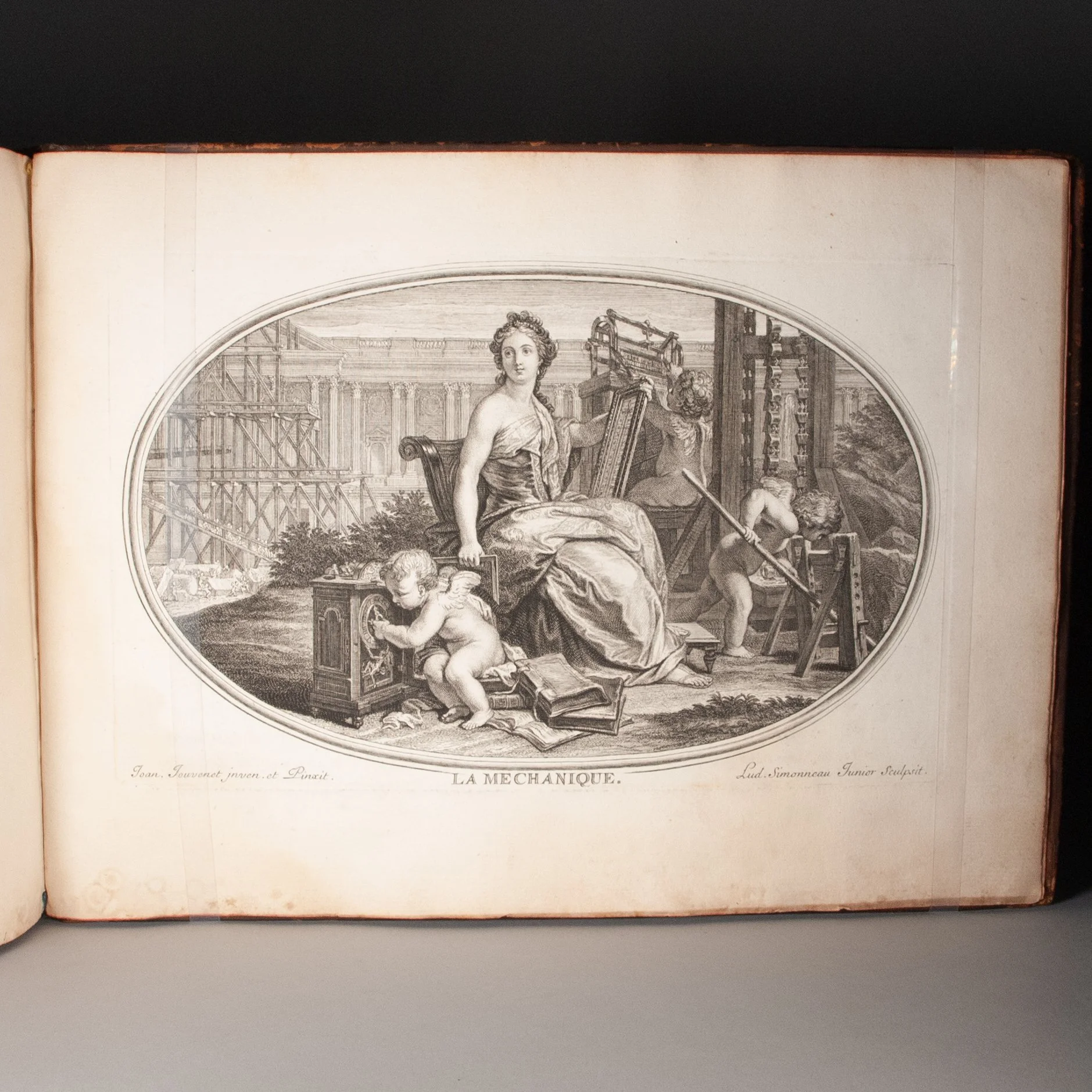
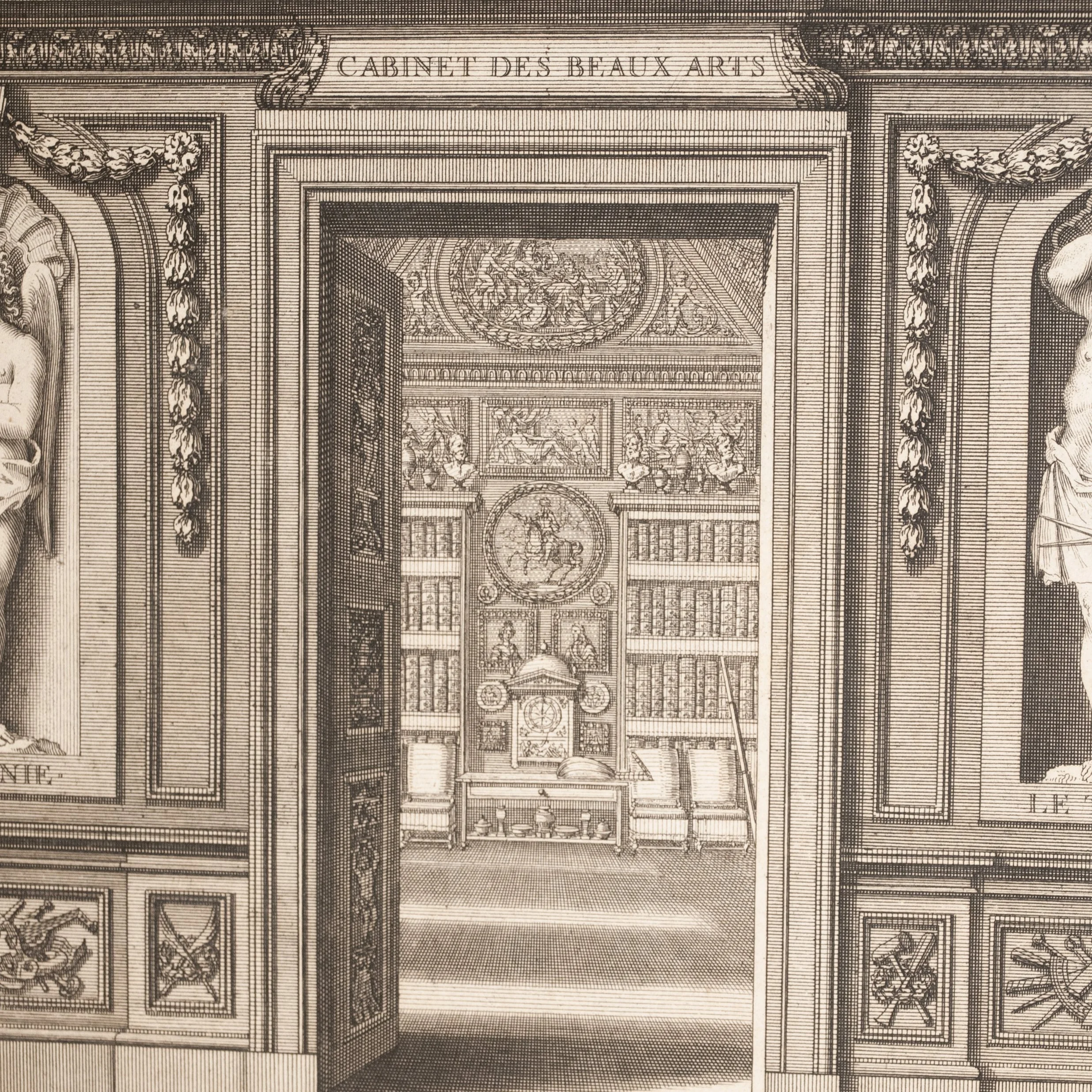
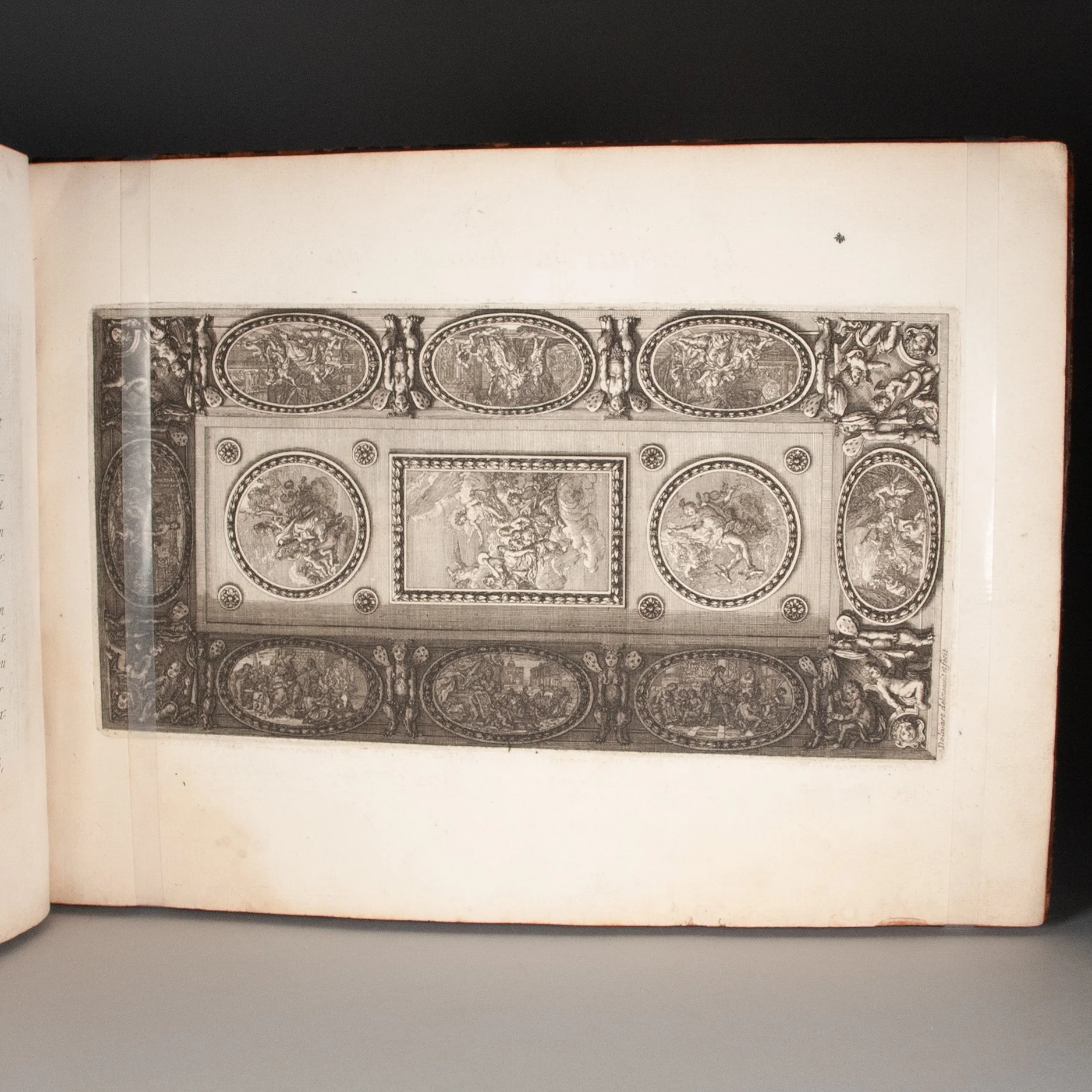
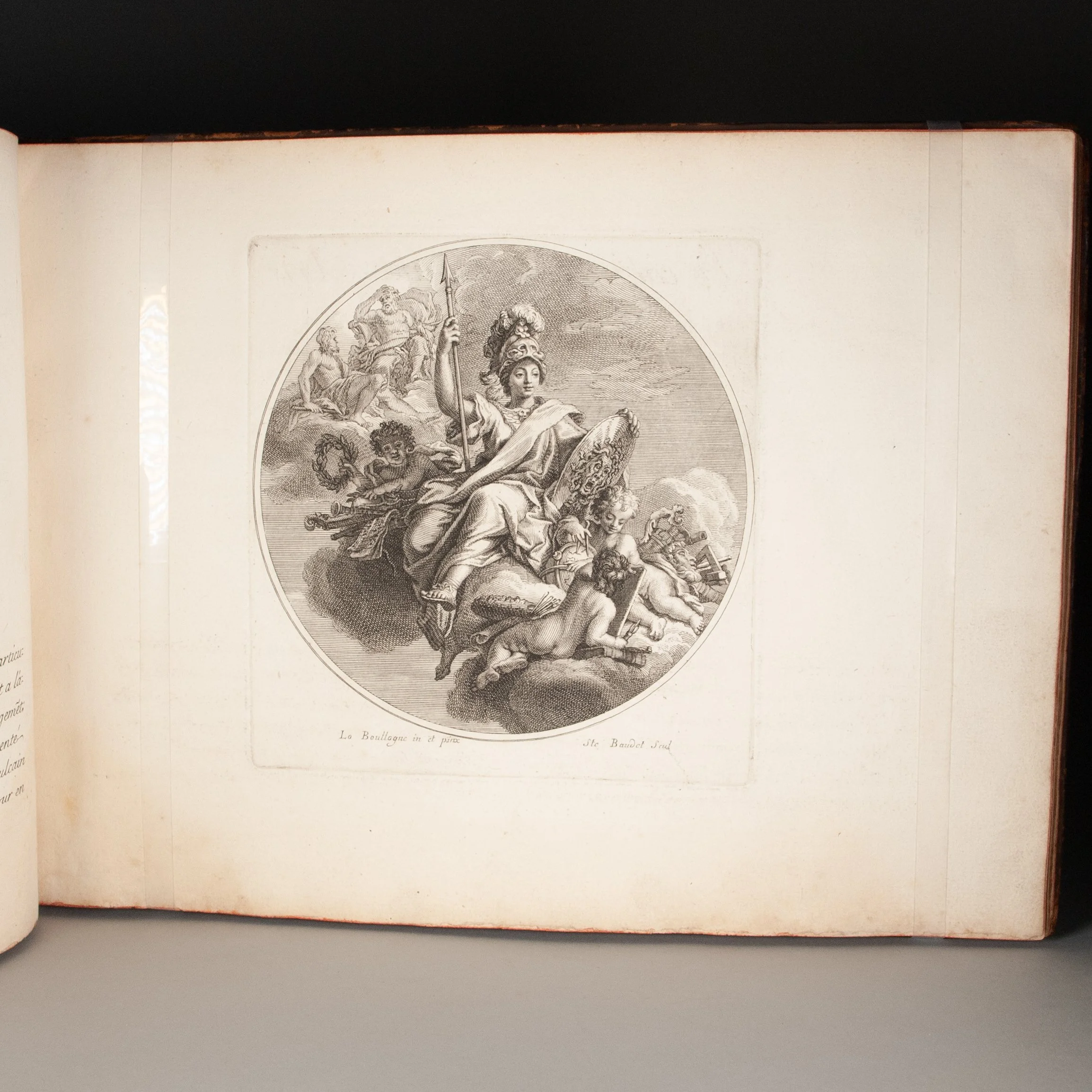
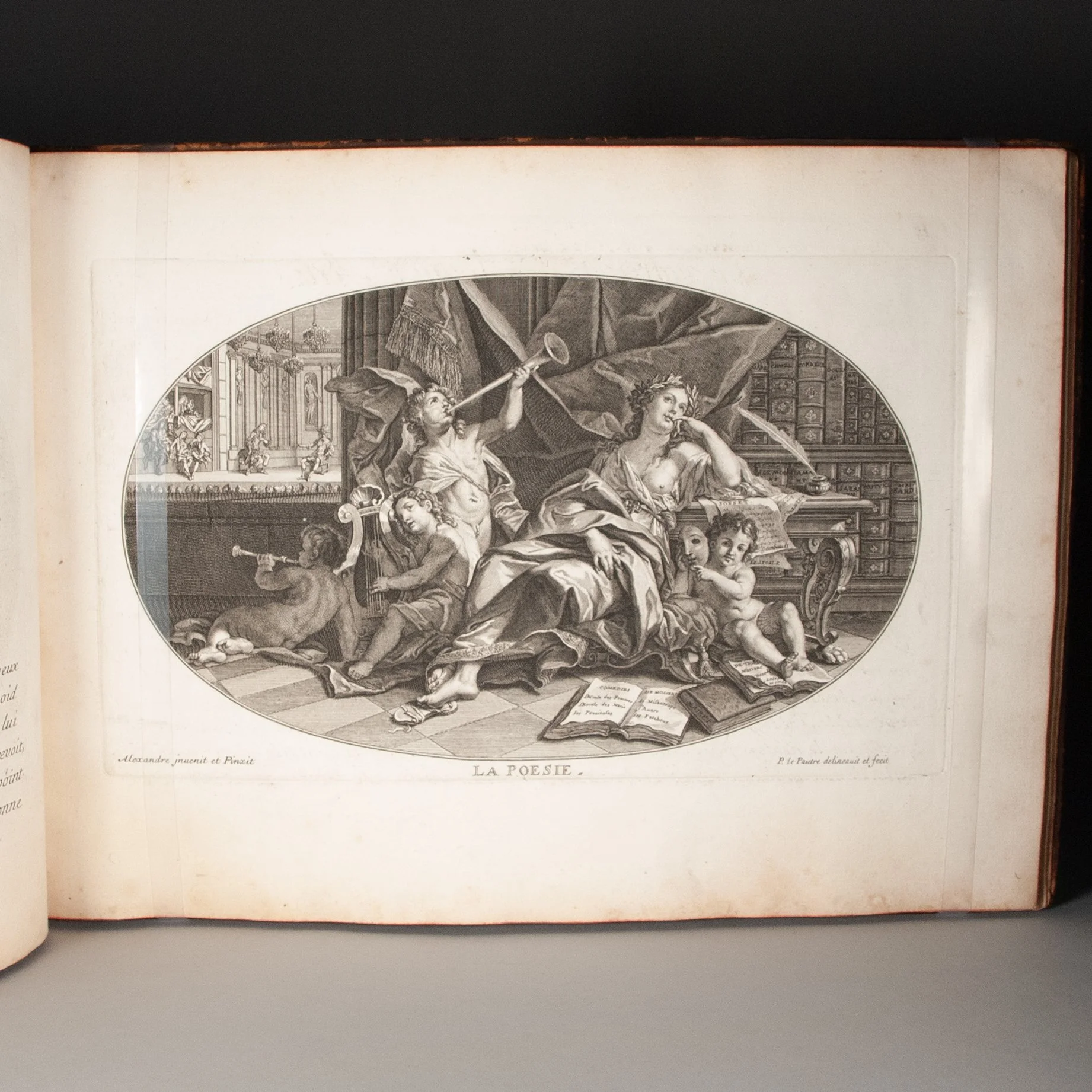
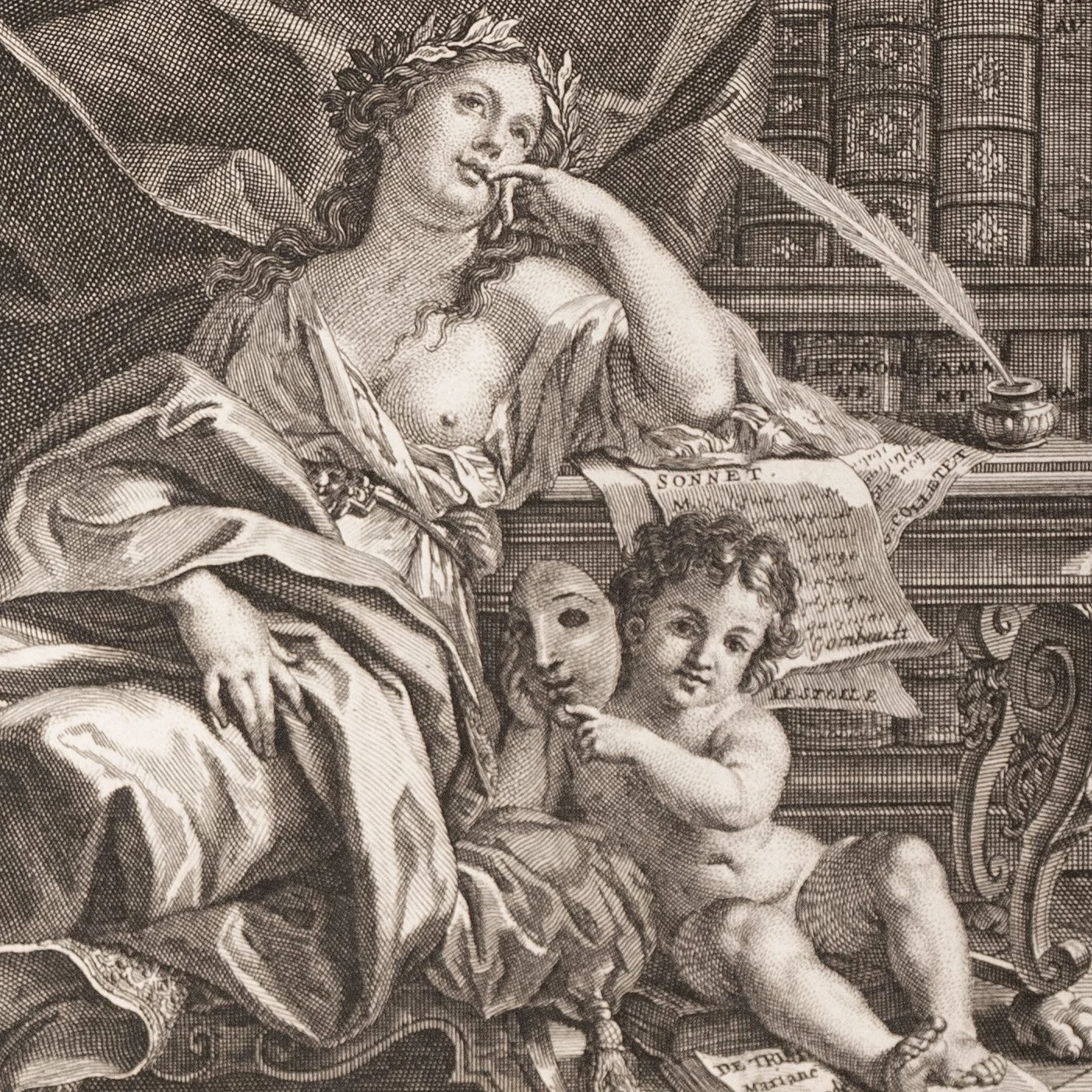
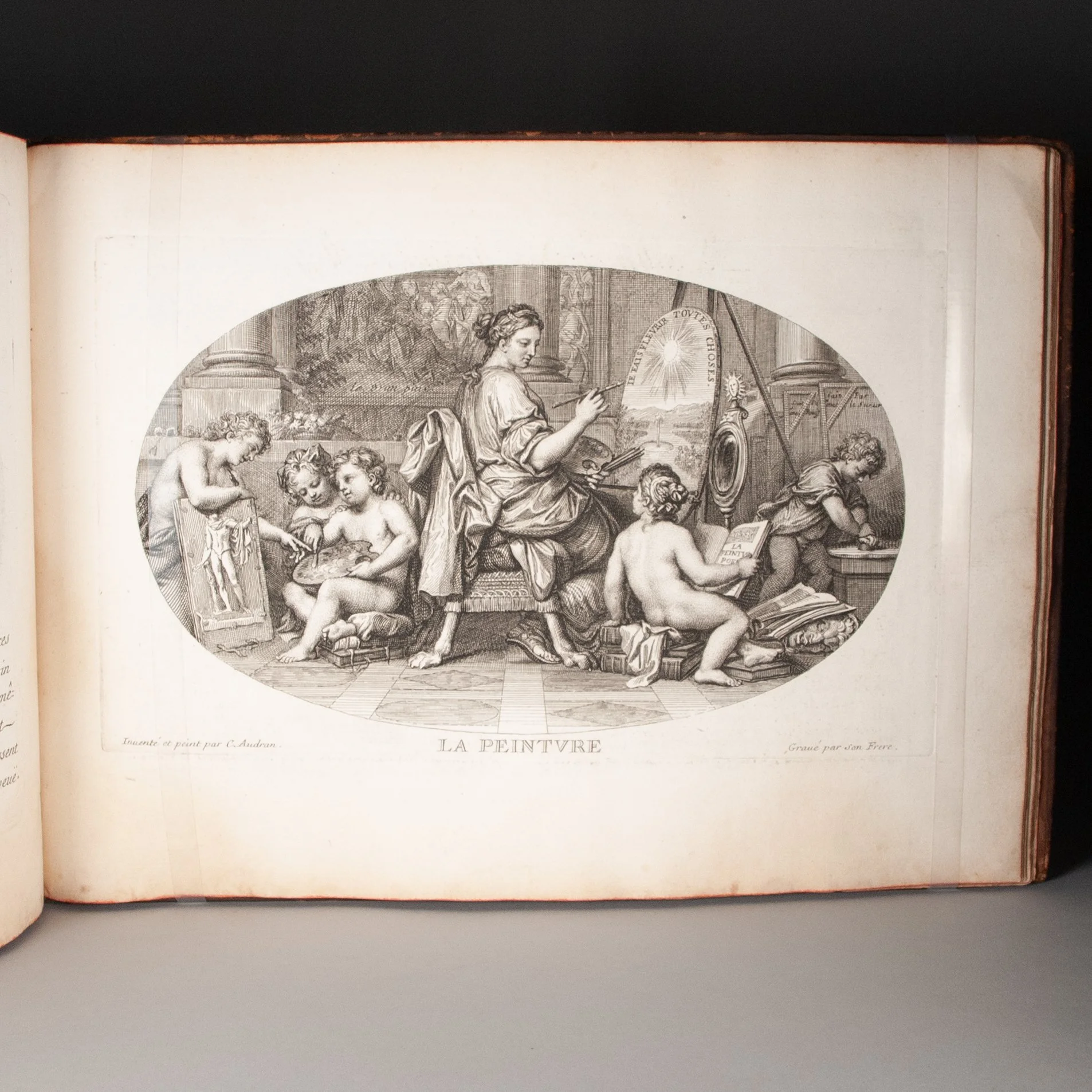
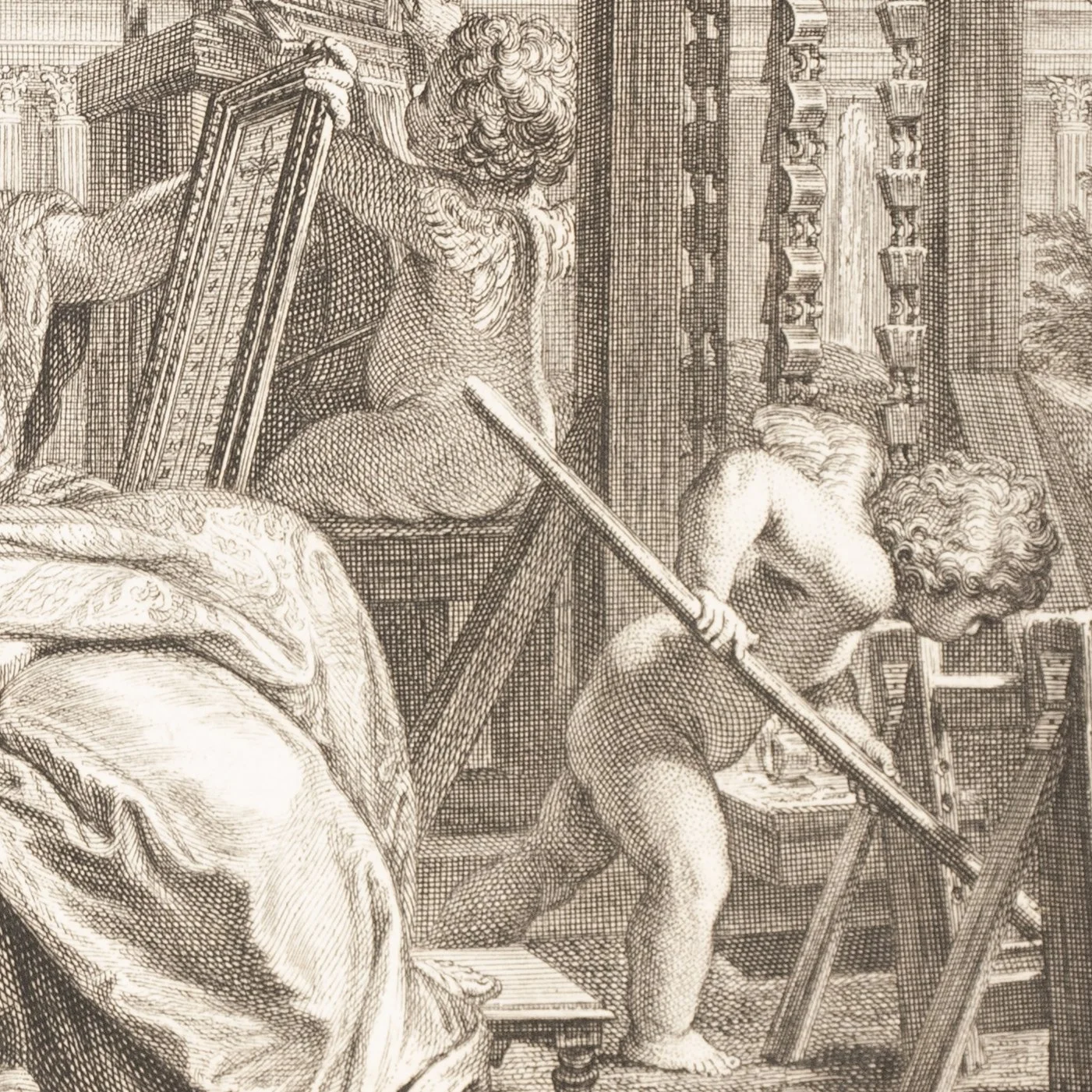
First and only edition of this fully engraved cornerstone of the Quarrel of the Ancients and Moderns, all the more important as a record of lost paintings by some of France's most esteemed artists. The etchings (enhanced with the burin) reproduce eleven paintings that once adorned the ceiling of the library in the private home of Charles Perrault, that titan of French letters commonly considered the father of the modern fairy tale. Today the work is typically credited with inaugurating the use of the term beaux arts, and even in its own day the book "attracted attention for its ambition" and "the publication of the collection is among the most outstanding initiatives in the art of decoration in 17th-century France" (Martin). Most of the paintings the volume reproduces have been lost. For many years, only one had been firmly identified, though Marie-Pauline Martin appears to have traced three more. ¶ The Querelle des anciens et des modernes was more or less as it sounds, a debate between two sparring factions on the best of literary and artistic achievement. The Ancients advocated for the elevation of classical work, which had clearly stood the test of time, essentially to continue the work of the Renaissance. The Moderns argued that, since the kingdom of Louis XIV was the greatest to yet grace the earth, its achievements must surely surpass that of the ancient world. Perrault was in the crown's employ—he served as secretary to the official who supervised the French Academy, which set the Sun King's artistic standards—so he argued from an inherently stronger position, backed by the full support of the state. Perrault was the de facto leader of the Moderns, and his Parallèle des anciens et des modernes, a multi-volume work that began publication in 1688,was a critical contribution to the discourse (and source of the punning Querelle). If his Parallèle was something of a textual manifesto, then this Cabinet is a kind of visual counterpart, a visual manifestation of faith in contemporary art. "During the years of the Quarrel, he recruited the best painters in Paris to turn his library into a visual statement of his support for the Moderns. Those who did not visit his library could still get at least an impression of it by looking at the engraved plates of the Cabinet des beaux arts" (Bertucci). ¶ One plank of Perrault's platform, which he lays out in the accompanying text, was the equal regard for liberal and mechanical arts. This represents a culmination of centuries of artistic thought. Throughout the Middle Ages, and with few exceptions, artists were invariably viewed as mere craftspeople—laborers who worked with their hands. This began to change with the Renaissance. "Encouraged by Humanism in literature, religion and education, art gradually came to be seen as an intellectual occupation. The artisanal aspect remained important, but successful artists increasingly presented themselves as learned figures" (Jonckheere). Artists had finally earned the privilege to place their work among the liberal arts, as participants in intellectual labor. Perrault here comes full circle and claims the two—the liberal arts and the mechanical arts—to be equals. There was a progressive aspect from the audience's perspective, too. Not so weighed down by two millennia of cultural patrimony, "modernity ostensibly demanded much less of its spectators in the way of connoisseurship and erudition" (though we'd hardly say these scenes abandon traditional iconography altogether). "In short, Perrault's Cabinet des Beaux-Arts seemed to create a cultural space for newcomers, both collectively and individually" (Scott). ¶ The book is exceptional not simply for its significance to the querelle, but no less as an anthology of the best French artists of the age. The allegorical paintings include a depiction of Apollo by Charles de La Fosse, this a foldout plate; Mercury, both designed and engraved by Jean-Baptiste Corneille; Minerva, by Louis de Boullogne II; Eloquence, by René-Antoine Houasse; Poetry, by Alexandre Ubeleski; Music, by Noël Nicolas Coypel; Architecture, here attributed to Boulogne l'aisné, though Louis Boullogne the Elder died in 1674 (perhaps his son copied his design?); Painting, by Claude Audran III; Sculpture, by Jacques Antoine Friquet de Vauroze; Optics, by Nicolas Corneille; and Mechanics, by Jean Jouvenet. The engravers who reproduced these paintings are Louis de Chastillon, Étienne Baudet, Jean-Baptiste Bonnart, Pierre Lepautre, Gérard Edelinck, Benoît Audran, Louis Cossin, Charles Louis Simonneau, and Louis Simonneau II. Preceding these full-page reproductions are a view of the library's entrance engraved by a member of the Le Pautre family, and a view of the entire ceiling—identifiably rendering each of the eleven paintings—engraved by Jean Dolivar. The head- and tail-piece were designed by Charles Le Brun II and engraved by François Chauveau. ¶ An extraordinary compendium of the very best in French painting and engraving.
PROVENANCE: Old shelf-mark on title (1.N.59).
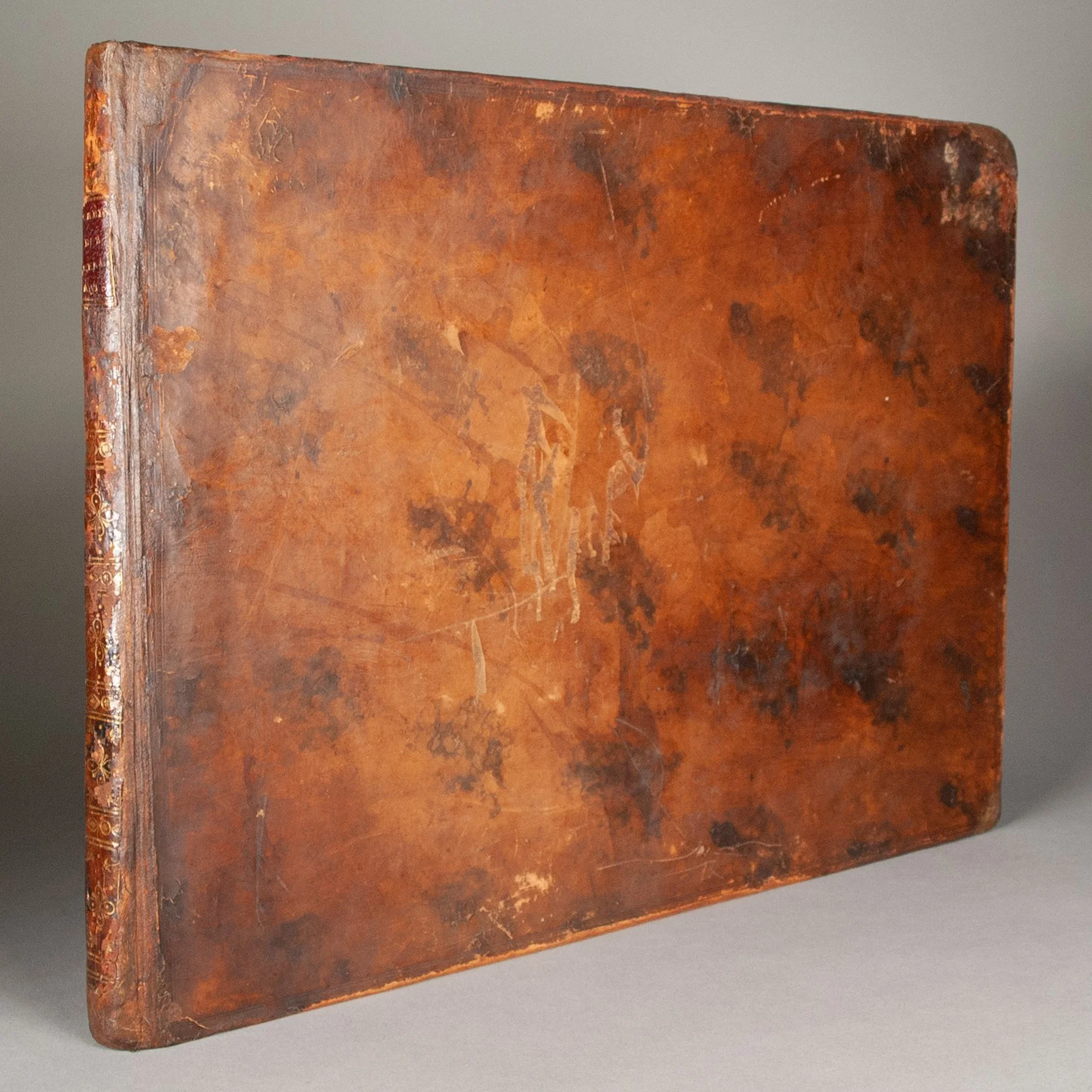
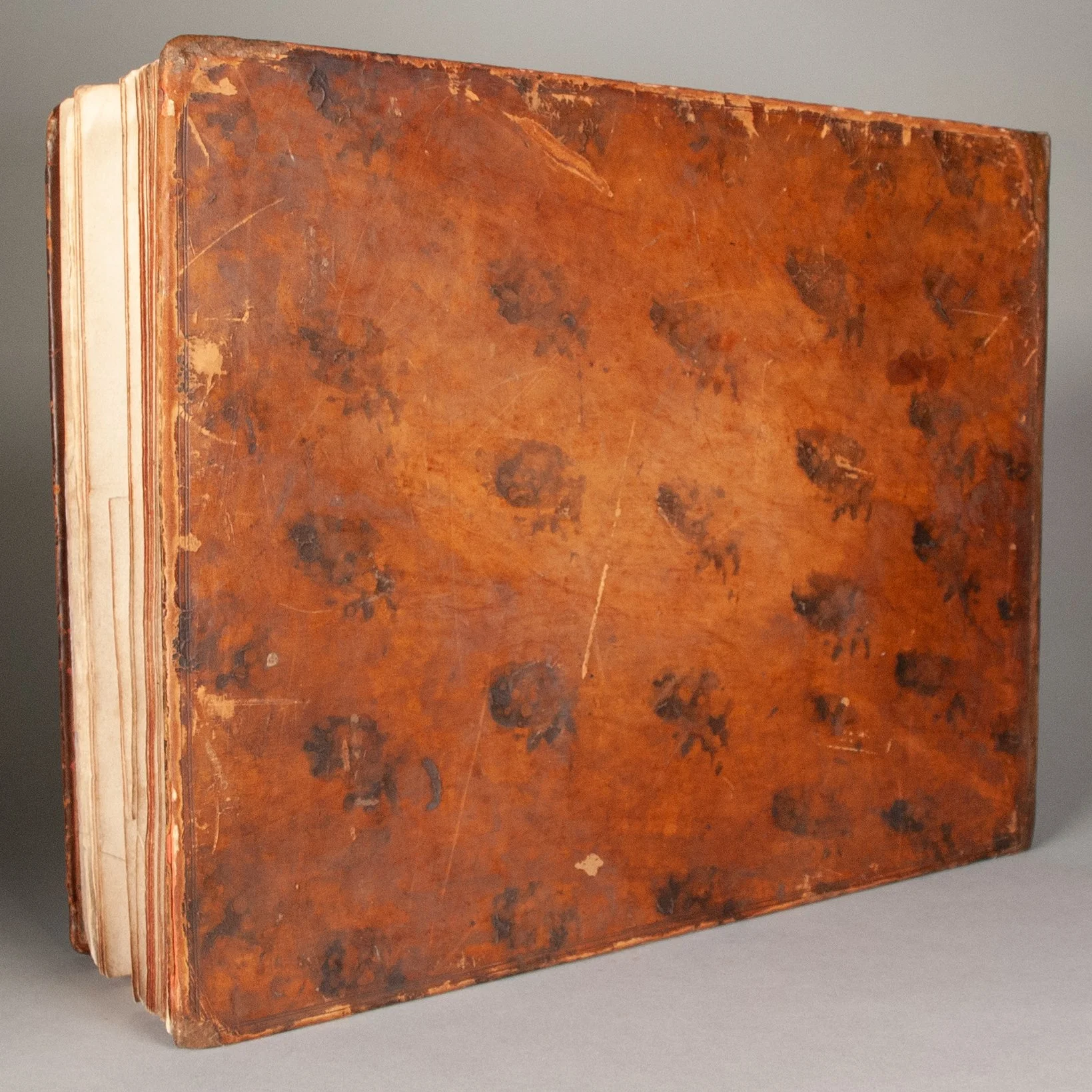
CONDITION: Eighteenth-century brown leather with a cat's paw pattern, the spine tooled in gold; marbled endpapers. ¶ Scattered mild to moderate foxing and soiling, the title bearing the worst; last few leaves mildly dampstained in the lower margin; a half dozen leaves at front with negligible worming in the lower margin, nowhere near any content; a few 1 cm closed tears in the foldout Apollo plate, one of them crossing the plate mark, but stopping just shy of the image itself. Professionally and sympathetically rebacked, preserving most of the original spine; corners the boards likewise repaired, and the upper corner of the front fly-leaf restored; leather a bit scuffed, and worn at the extremities; upper corner neatly ripped from the second front fly-leaf, presumably an old inscription.
REFERENCES: Cicognara #3433; Brunet, Manuel du libraire, v. 4, col. 509 ¶ Marie-Pauline Martin, "Le Cabinet des Beaux-arts de Charles Perrault: le monument d'un moderne," Revue de l'art 190 (2015), p. 9 (cited above; an altogether excellent assessment of the work); Maxime Préaud, Inventaire du fonds français: Graveurs du XVIIe siècle: Pierre Lepature, tome 13 (2008), p. 294 (describing the title and Poésie plate); Katie Scott, The Rococo Interior (1995), p. 218 (cited above), 219 ("If Perrault had allowed personal whim to play some part in devising his ceiling, ultimately, the cabinet served to proclaim not his taste but the triumphant patronage of Louis XIV"); Paola Bertucci, Artisanal Enlightenment: Science and the Mechanical Arts in Old Regime France (2017), p. 18 (cited above), 19 ("Perrault explained [here] that the notion of beaux arts replaced ancient classifications of human learning which defined the liberal and the mechanical arts as, respectively, the work of the mind and the work of the hand. He rejected the ancient hierarchy that placed the liberal above the mechanical arts because only the former were noble and dignified. The beaux arts, Perrault explained, were those arts that inspired and educated one's taste and genius."); Koenraad Jonckheere, A New History of Western Art (2022), p. 376 (cited above); Stephen Parcell, Four Historical Definitions of Architecture (2012), p. 180 ("the first book to refer explicitly to the beaux-arts"); Nicholas Cronk, The Classical Sublime: French Neoclassicism and the Language of Literature (2002), p. 159 ("In the early 1680s, Charles Perrault commissioned a series of eleven paintings from the most prominent painters then working in the capital, to create a Cabinet des Muses for his Paris home...the iconographical importance of the project was evidently at least as important to Perrault as its actual realisation. The one painting of the eleven to have survived is L'Eloquence, by René-Antoine Houasse."); Natalie Heinich, "De l'apparition de l''artiste' a l'invention des 'beaux-arts,'" Revue d'histoire moderne et contemporaine 37 (Jan-Mar 1990), p. 14 (on the book's role in formalizing the beaux arts: "Thus we witness the birth of a generic category which...will impose its own form on the whole of European culture from the 18th century onwards"); Pierre Rosenberg, "Un émule polonais de Le Brun: Alexandre Ubelesqui," Artibus et Historiae 11.22 (1990), p. 166 ("The interest in this work is the personality of the patron and the list of artists")
Item #881