
Pictorial catechism, hand-colored and varnished
Pictorial catechism, hand-colored and varnished
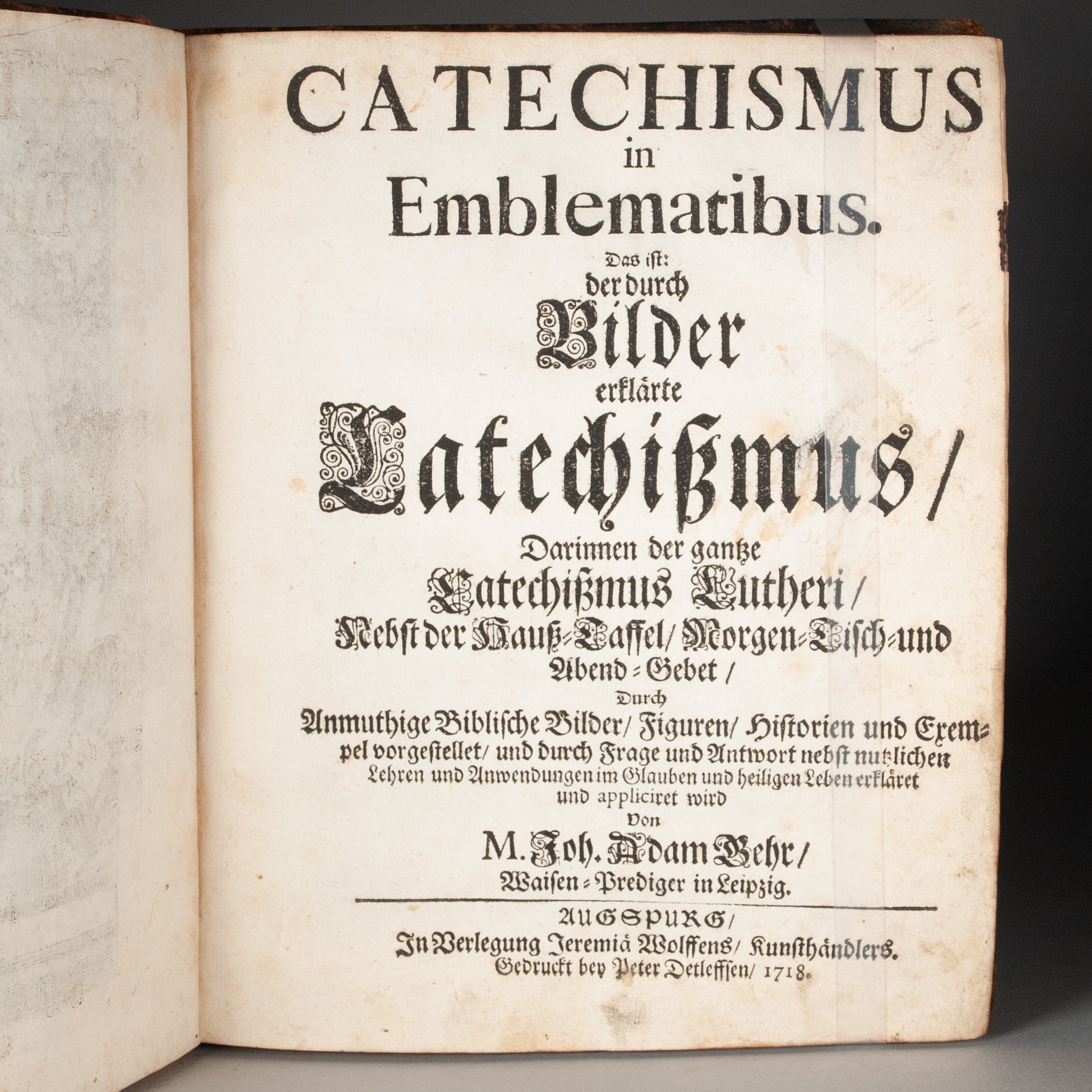
Catechismus in emblematibus, das ist, Der durch Bilder erklärte Catechissmus, darinnen der gantze Catechissmus Lutheri, nebst der Hauss-Taffel, Morgen-Tisch-und-Abend-Gebet; durch anmuthige Biblische Bilder, Figuren, Historien und Exempel vorgestellet, und durch Frage und Antwort nebst nutzlichen Lehren und Anwendungen im Glauben und heiligen Leben erkläret und appliciret wird
by Johann Adam Behr | illustrations by Johann Andreas Thelot
Augsburg: Peter Detlefsen for Jeremias Wolf, 1718
58, 57-153, [1] p. + [36] plates | 4to | A-T^4 V^2 | 195 x 161 mm
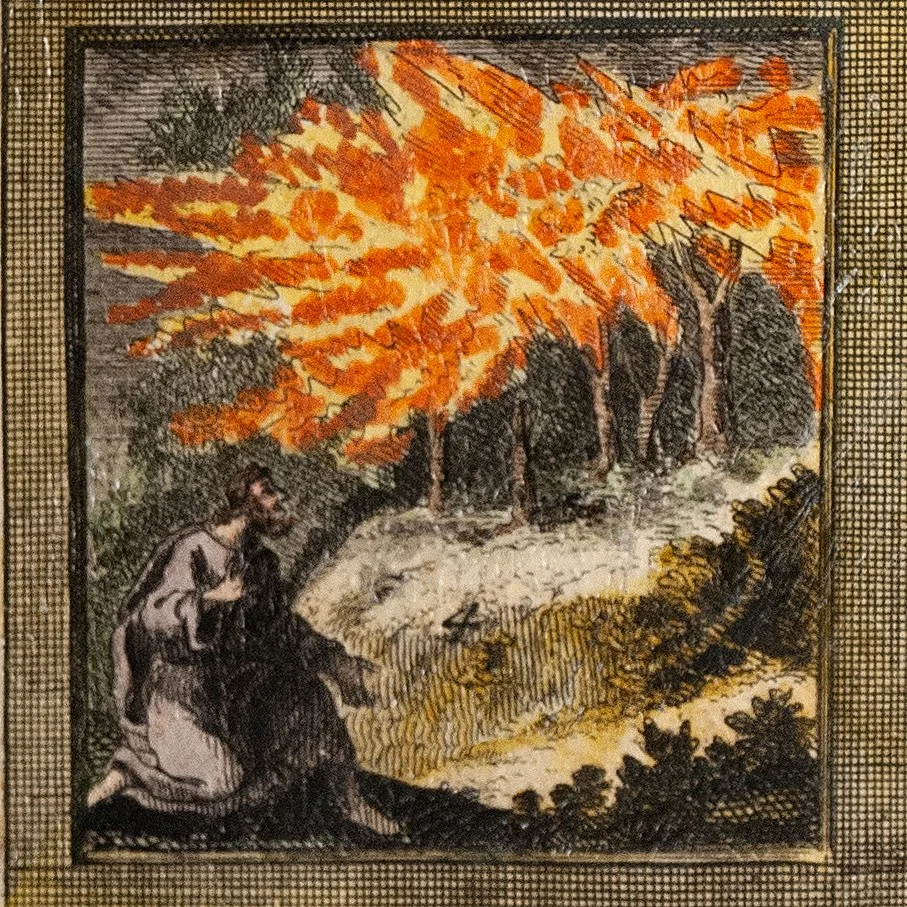
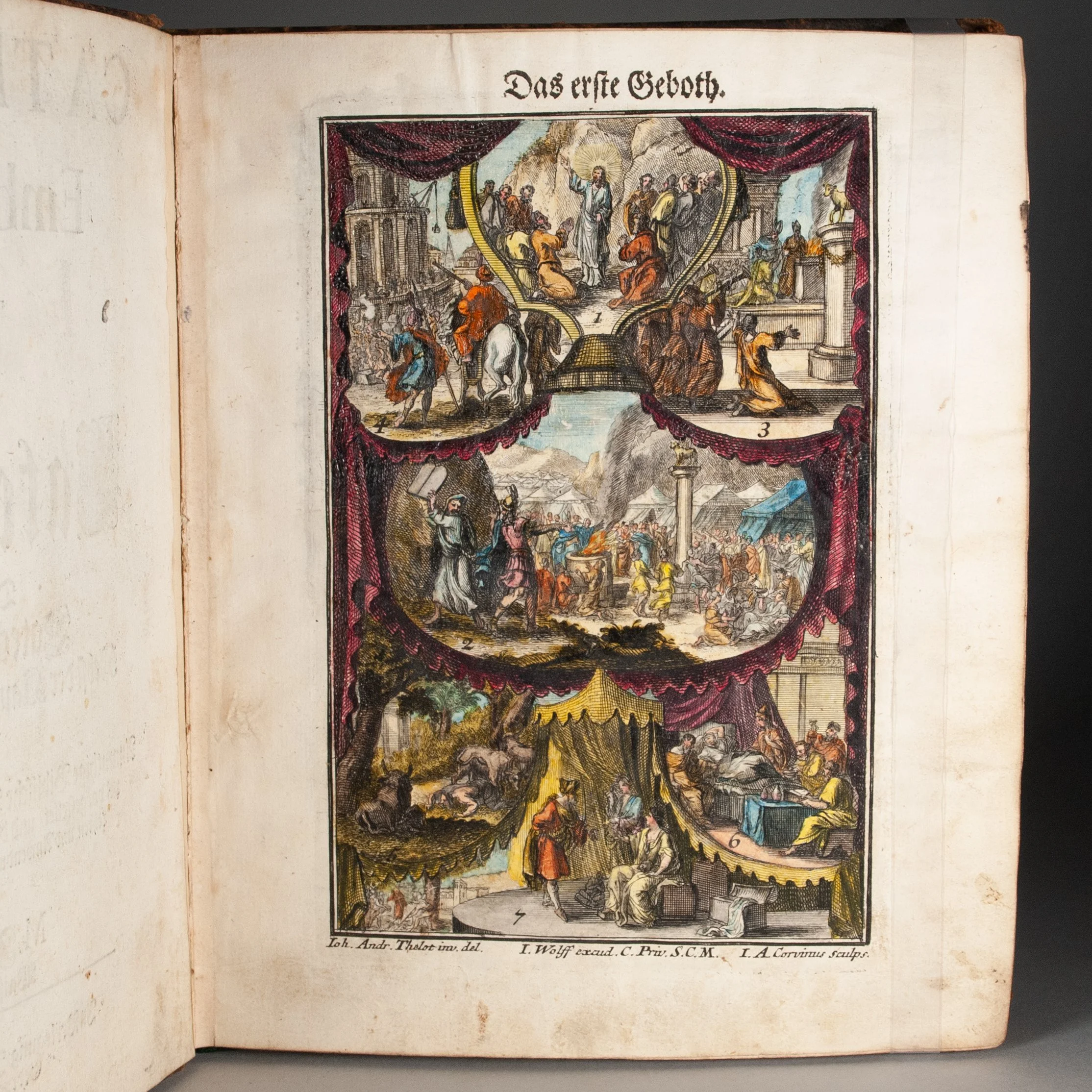
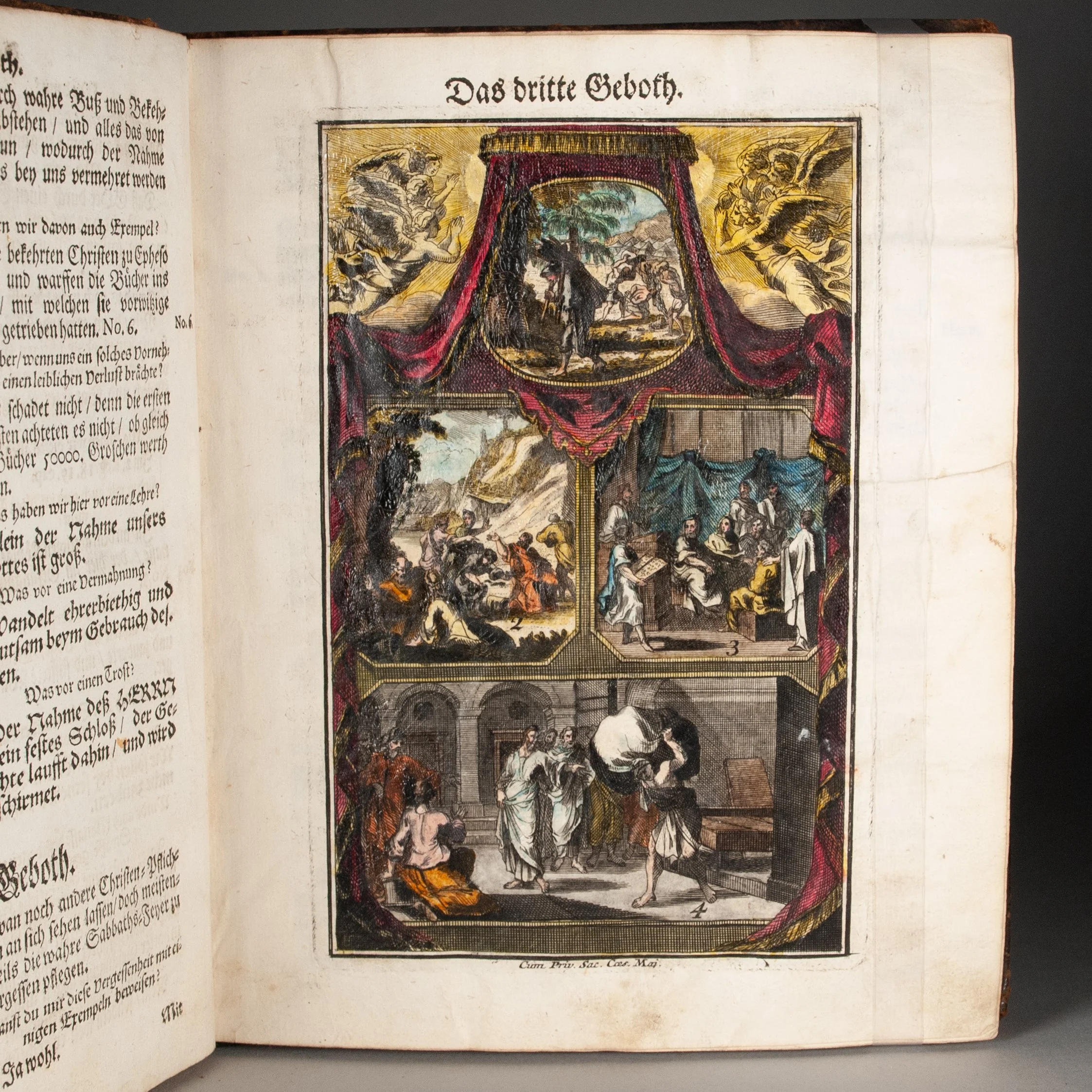
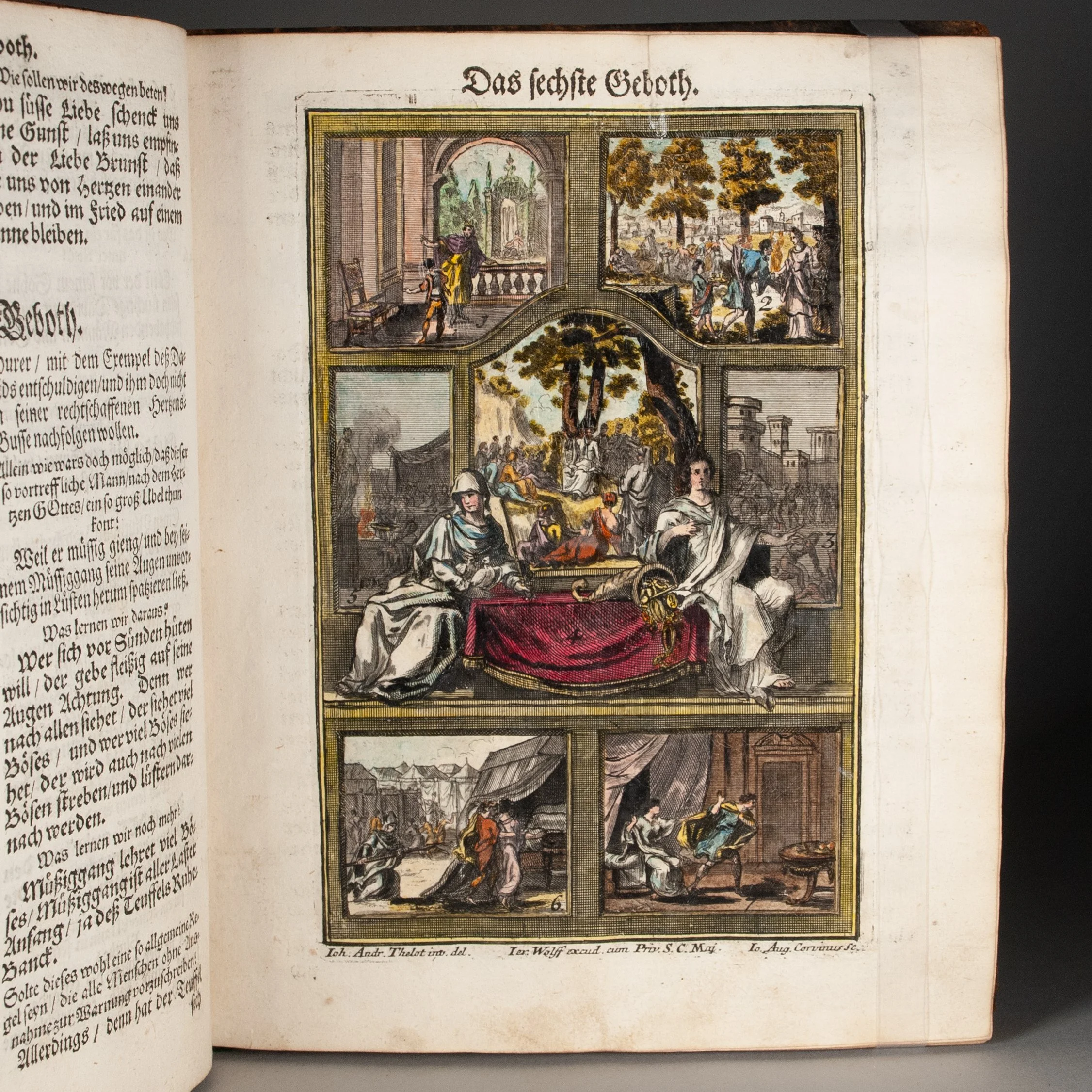
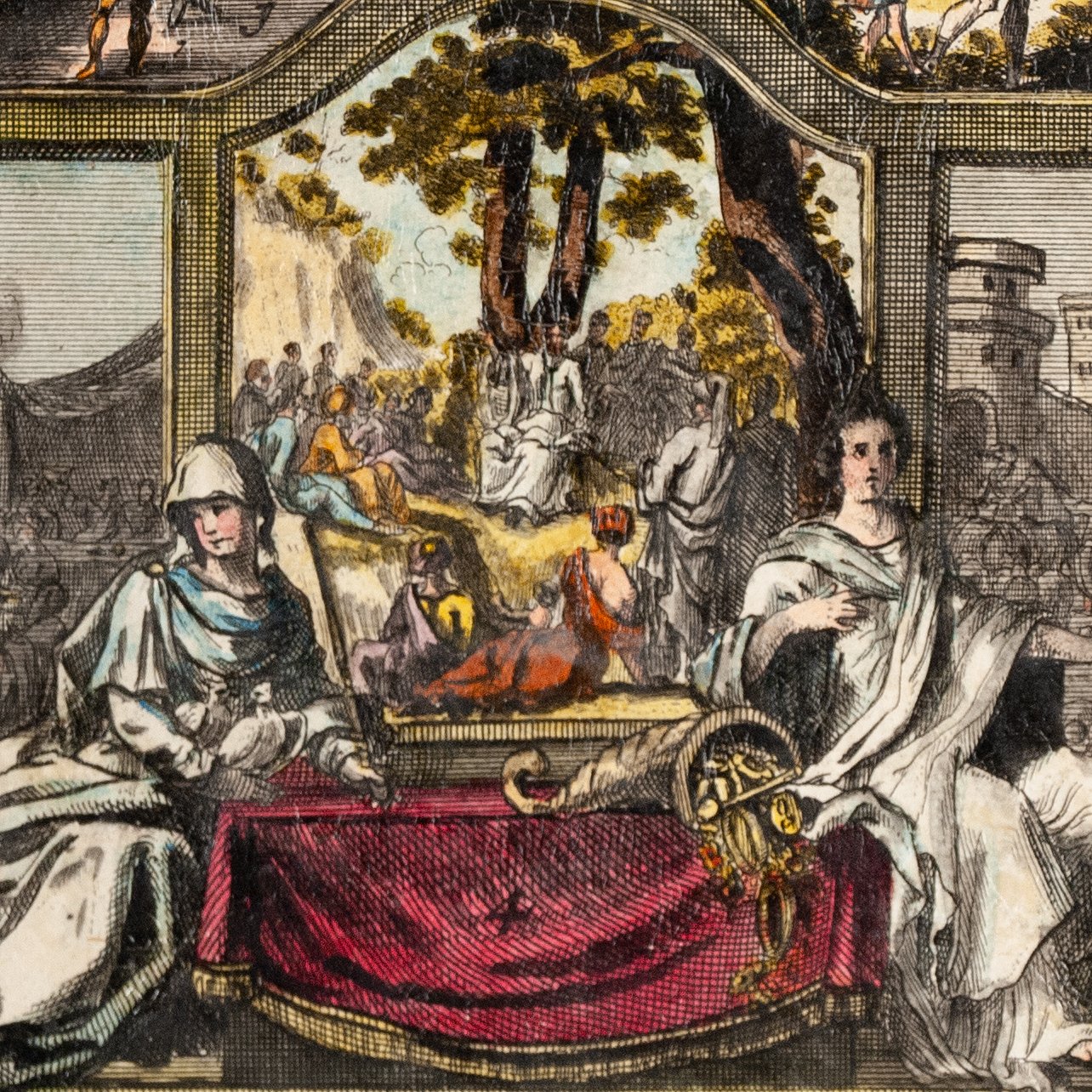
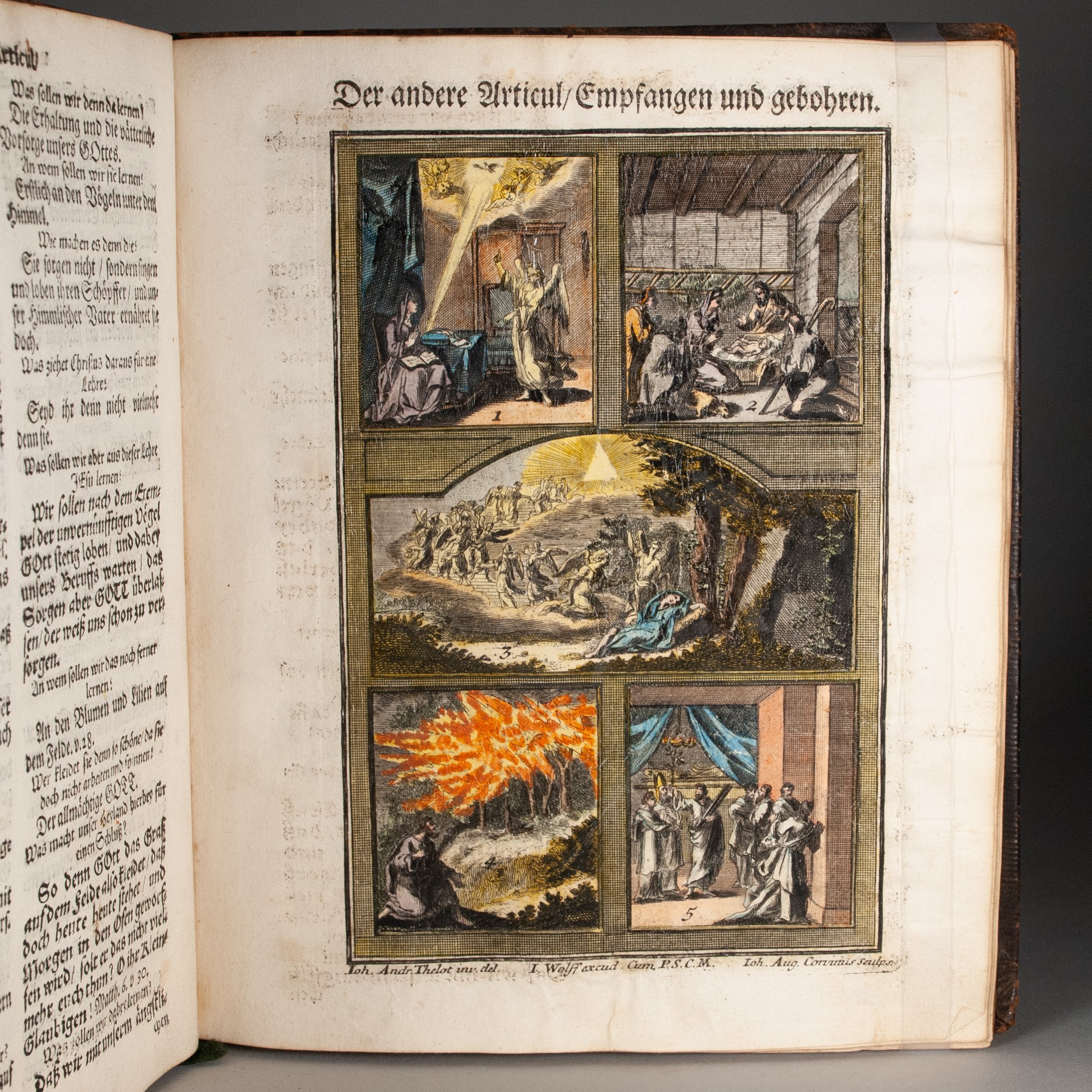
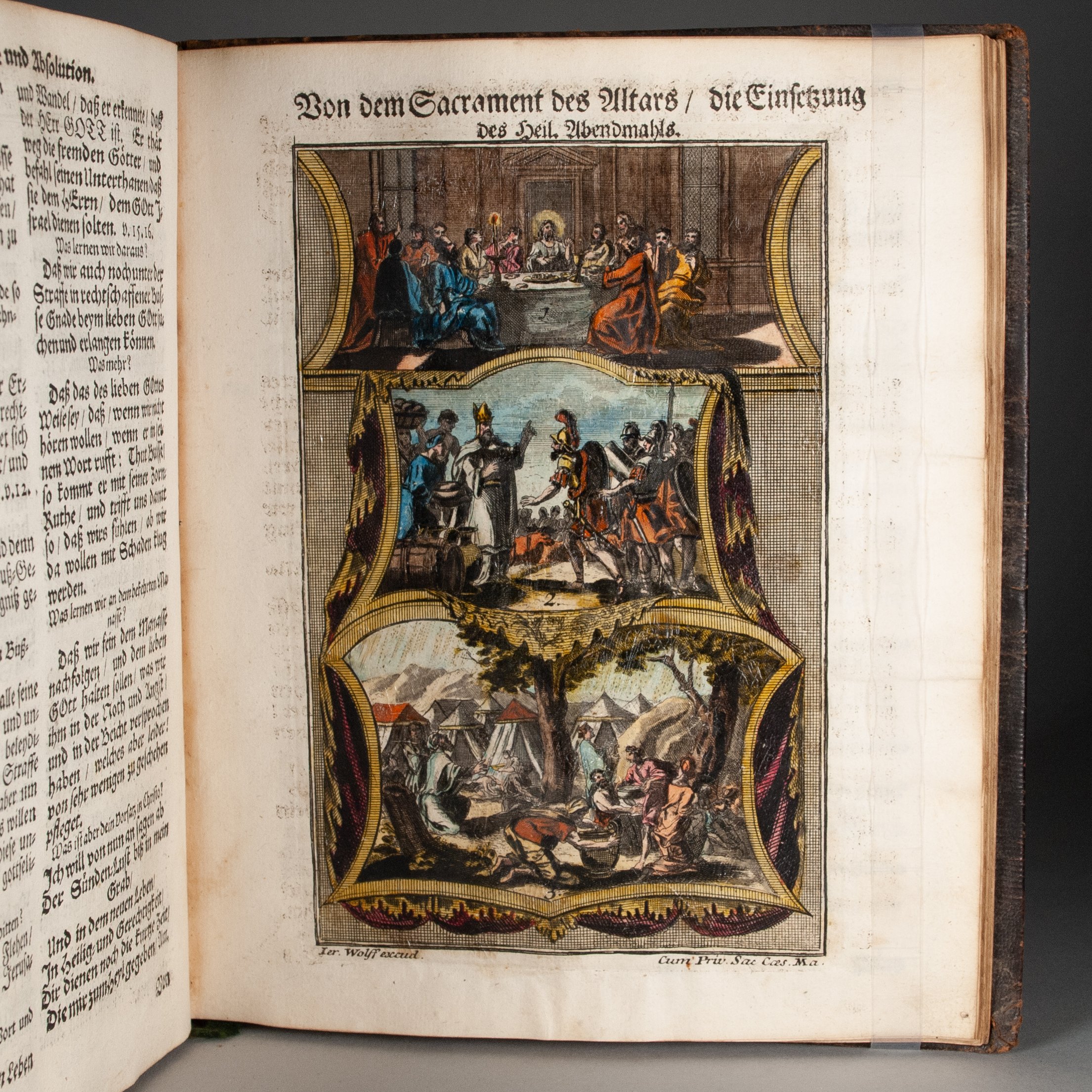
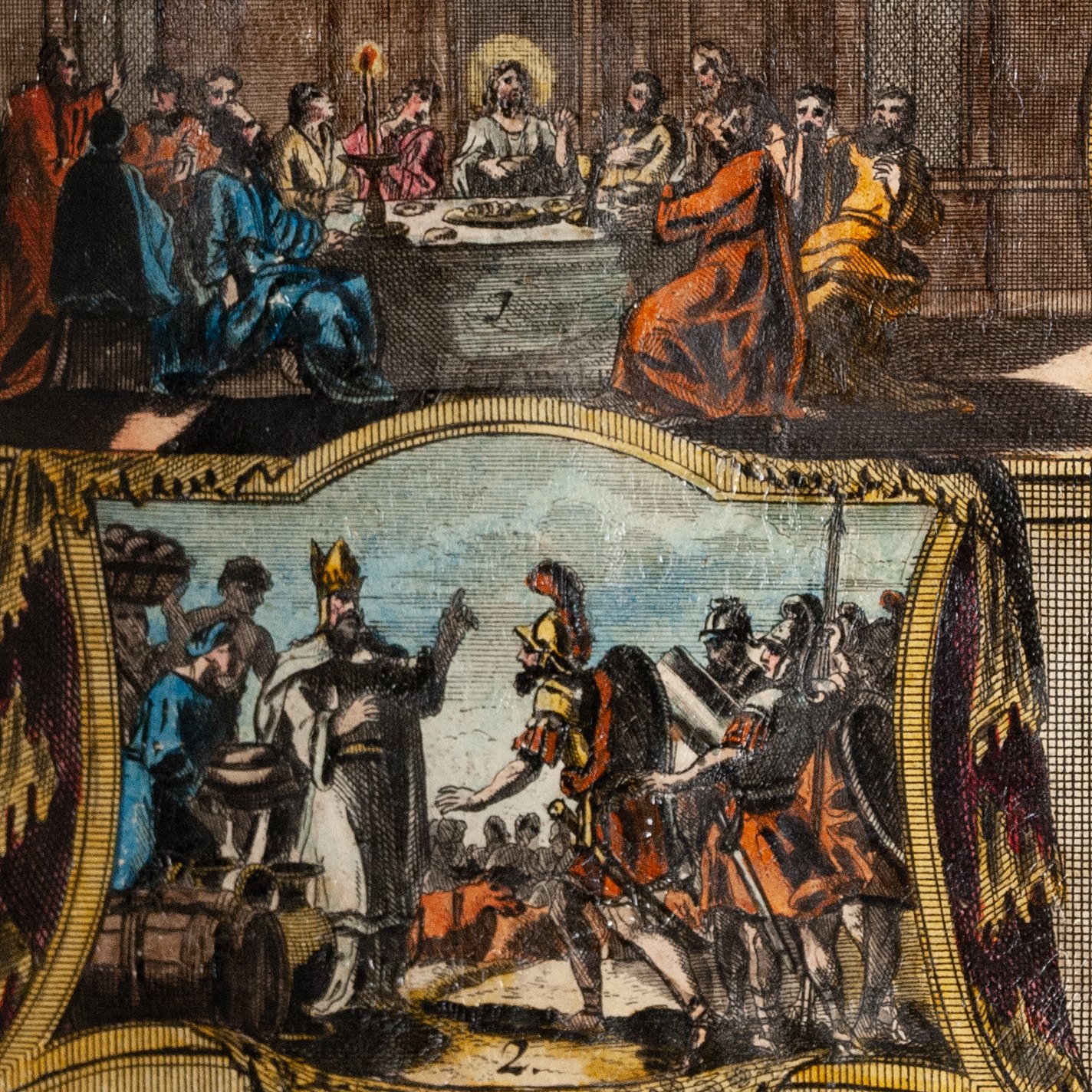
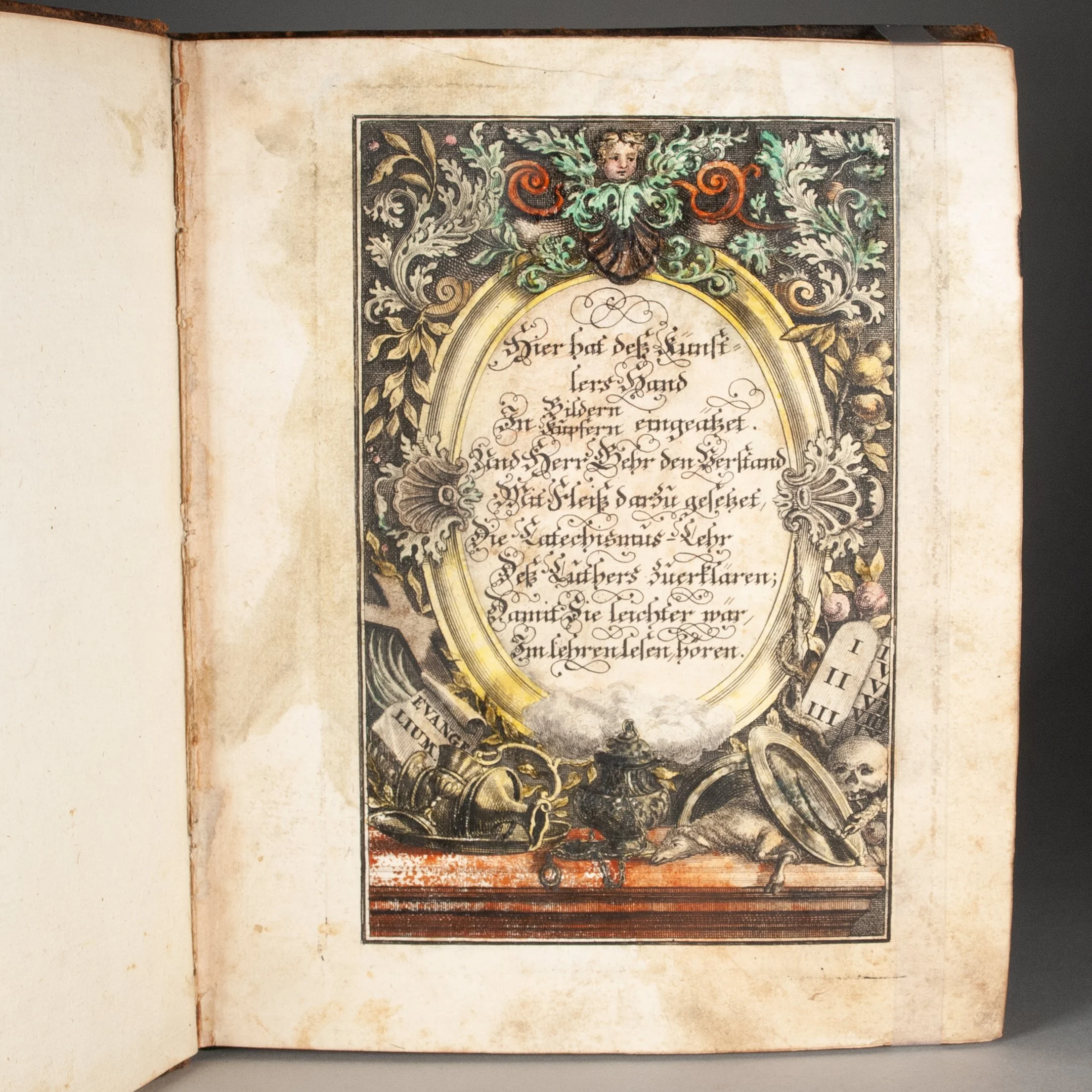
First and only edition of this pictorial Lutheran catechism, its 36 plates hand-colored and varnished. Behr has adapted his text from Luther's Small Catechism (and generally follows Luther's original strcuture) and Johann August Corvinus etched the accomplished goldsmith's designs for the work. "Although his drawings served mainly as preliminaries for his highly valued goldsmiths' work or for his numerous printed graphics, the lightness of touch in some of them confirms that Thelott was not merely a craftsman but an artist of real stature" (Hagen). With the exception of the engraved title, each plate contains up to eight individual scenes, these mapped to the text by number. The plates cover the Ten Commandments, with one plate dedicated to each, plus a bonus second for the 10th; five plates illustrating the Apostles' Creed; nine for the Lord's Prayer, including one for each of its seven petitions; two plates for the four questions on Baptism; and eight plates to cover the remainder. ¶ It was perfectly common to varnish paintings at the time, as a trip to any art museum will make plain. But varnishing prints was quite uncommon, and plainly rare to varnish illustrations within a book. We suspect the publisher, Jeremias Wolf, played some role in this. Publishers frequently coordinated the coloring of prints and illustrations. More to the point, the imprint identifies Wolf not simply as a publisher, but as a Kunsthändler, an art dealer. And to an art dealer, varnishing a painted surface must have seemed de rigueur, and would have helped create a luster similar to that of a finished oil painting. Augsburg is perhaps an unsurprising place for such a choice, as it had a well established community of Briefmaler, those who painted prints professionally. In 1615, Augsburg recorded a whopping thirty Briefmaler operating within its walls, dwarfing the dozen printers, four illuminators, six engravers, and fifteen woodblock cutters. As the printing press vastly increased the quantity of both single-sheet prints and book illustrations, so rose the demand for the colorist’s labor. “Between ca. 1550 and 1750 at least 260 Briefmaler were active in Augsburg alone" (Paas). ¶ As a genre, catechisms delivered the fundamentals of Christian doctrine in a simple question-and-answer format, a configuration maintained here. Lutherans were the true masters of early catechisms, though eventually the Catholic Church prepared its own to answer the Protestant deluge. “The catechism was such fertile territory for authors and publishers alike because of its enormous versatility as a devotional and pedagogic tool,” Pettegree and Weduwen write of those used by Dutch Protestants, though much of this should be true for any confession. “Ministers used catechisms as a means to arm themselves for the struggle against dissidence in their congregations; private citizens read them for pleasure, or to still a troubled soul or conscience. In this diversity of purpose lay the root of multiplicity. All catechisms taught the essentials of faith in a series of questions and answers. But from thereon the scope for elaboration was enormous.” As elaboration goes, it’s easy to imagine the appeal of this image-forward vernacular edition. Young readers could digest it on their own, while clergy and parents could use it to instruct those in their care, the lessons reinforced by eye-catching images. ¶ Plenty of catechisms contained illustrations, but this expressed focus on image is unusual. The opening text doesn't simply ask, "What is the first commandment?" as Luther's original did. Rather it asks, "What is depicted on this copperplate engraving," with follow-up questions on the individual scenes depicted therein. For a scene illustrating the worship of the Golden Calf, for example, the text asks, "What does the other calf represent, No. 3?" This is not to say the illustrated genre lacked precedent. The medieval Biblia Pauperum could be taken as an early analog, if not strictly a catechism, and so too the countless illustrated Bibles published over the years. Missionaries certainly used pictorial catechisms (frequently in manuscript) to instruct natives in overseas territories, a use that perhaps culminated in the Catholic ladders of the 19th century. Many have even pointed to stained glass windows, and other decoration in churches, as tools that must have played a similar role for the illiterate faithful. ¶ A potent example of Lutheran print, and this the only hand-colored copy we find in auction records.
PROVENANCE: Inscription by one Poeschel on front fly-leaf dated 1850. Old list of biblical figures on a rear fly-leaf, perhaps matching them with common symbols (lists headed Personnen and Sachen).
CONDITION: Nineteenth-century full leather, with a pair of old ribbon markers. ¶ First and last dozen leaves moderately soiled; first and last gatherings guarded at the inner margin; small bit torn from the lower margin of the 2nd Commandment plate, and closed tear in the lower inner margin of the 9th Commandment, neither affecting the image; small, discreet repair to lower inner margin of the 7th Petition plate, not affecting image; varnish sometimes soaked through the blank versos, causing dark spotting; piece torn from the lower margin of H4, affecting a couple lines of text. Spine a little cocked, and the leather generally scuffed and worn. A solid copy.
REFERENCES: VD18 11433914; Mario Praz, Studies in Seventeenth-Century Imagery (1975), p. 268; Arthur Rümann, Die illustrierten deutschen Bücher des 18. Jahrhunderts (1927), p. 10, #69 ¶ Bernt von Hagen, "Thelott [Thelot], Johann Andreas," Grove Art Online (2003), accessed online (cited above); Max Schweidler (Roy Perkinson, tr.), The Restoration of Engravings, Drawings, Books, and Other Works on Paper (2006), p. 94 ("Varnished engravings are rare"); Andrew Pettegree and Arthur der Weduwen, The Bookshop of the World: Making and Trading Books in the Dutch Golden Age (2019), p. 140 (cited above; “Protestantism’s most original contribution to Christian pedagogy. The catechism played a remarkable role in the Protestant movement, not least because it defied all expectations of a trend towards didactic uniformity. Here, as in so much, Luther led the way.”); Anke te Heesen (Ann M. Hentschel, tr.), The World in a Box (2002), p. 124 ("The growth in number of such graphic illustrations in the seventeenth and eighteenth centuries is explained by the rising importance of children's education, a new emphasis on the visual sense, and the associated tendency to present knowledge in a transmittable form"); Christopher Vecsey, “The Good News in Print and Image: Catholic Evangeliteracy in Native America,” U.S. Catholic Historian 27.1 (Winter 2009), p. 10 (“If we emphasize the place of writing in codifying Christian doctrine for the colonial edification of America’s Natives, we should not neglect the pictorial catechisms used everywhere from the Quechuas to the Micmacs, and beyond”); Maurice de Wulf, “Western Philosophy in the Thirteenth Century,” Harvard Theological Review 11.4 (Oct 1918), p. 422 (on medieval cathedrals: “Each stone had its language. Covered with sculptures, it presents a complete religious programme. It is for the people the great book of sacred history, the catechism in images.”); Alberto Manguel, A History of Reading (1996), p. 103 (on the Biblia Pauperum, but perhaps applicable here: "Preachers and priests would no doubt gloss upon these images, and retell the events portrayed, linking them in an edifying manner, embroidering on the sacred narration...It has been suggested that the main purpose of the Biblia Pauperum was not to provide reading for the unlettered flock but to lend the priest a sort of prompter or thematic guide, a starting-point for sermons or addresses."); Jeffrey R. Watt, "The Impact of the Reformation and Counter-Reformation," Family Life in Early Modern Times 1500-1789 (2001), p. 144 (Protestants published large numbers of catechisms, many of which were intended for home use, in which a parent or clergyman would read questions to a child, who was to memorize the appropriate answers. Although they had existed in pre-Reformation Europe, the catechisms published in Lutheran Germany showed an unprecedented secular concern, aiming not only to offer religious instruction but also to promote a strong civic conscience among the young.”); Linda A. Pollock, "Parent-Child Relations," Family Life, p. 202 (“The best gift a parent could give to a child was to bring him or her up as a God-fearing Christian. Protestant mothers had a specific responsibility to catechize children and servants in the home"); John Roger Paas, “Georg Kress, a Briefmaler in Augsburg in the late sixteenth and early seventeenth centuries,” Gutenberg-Jahrbuch (1990), p. 177-179 (cited above)
Item #925