
Visual catalog of eminent sculpture collection
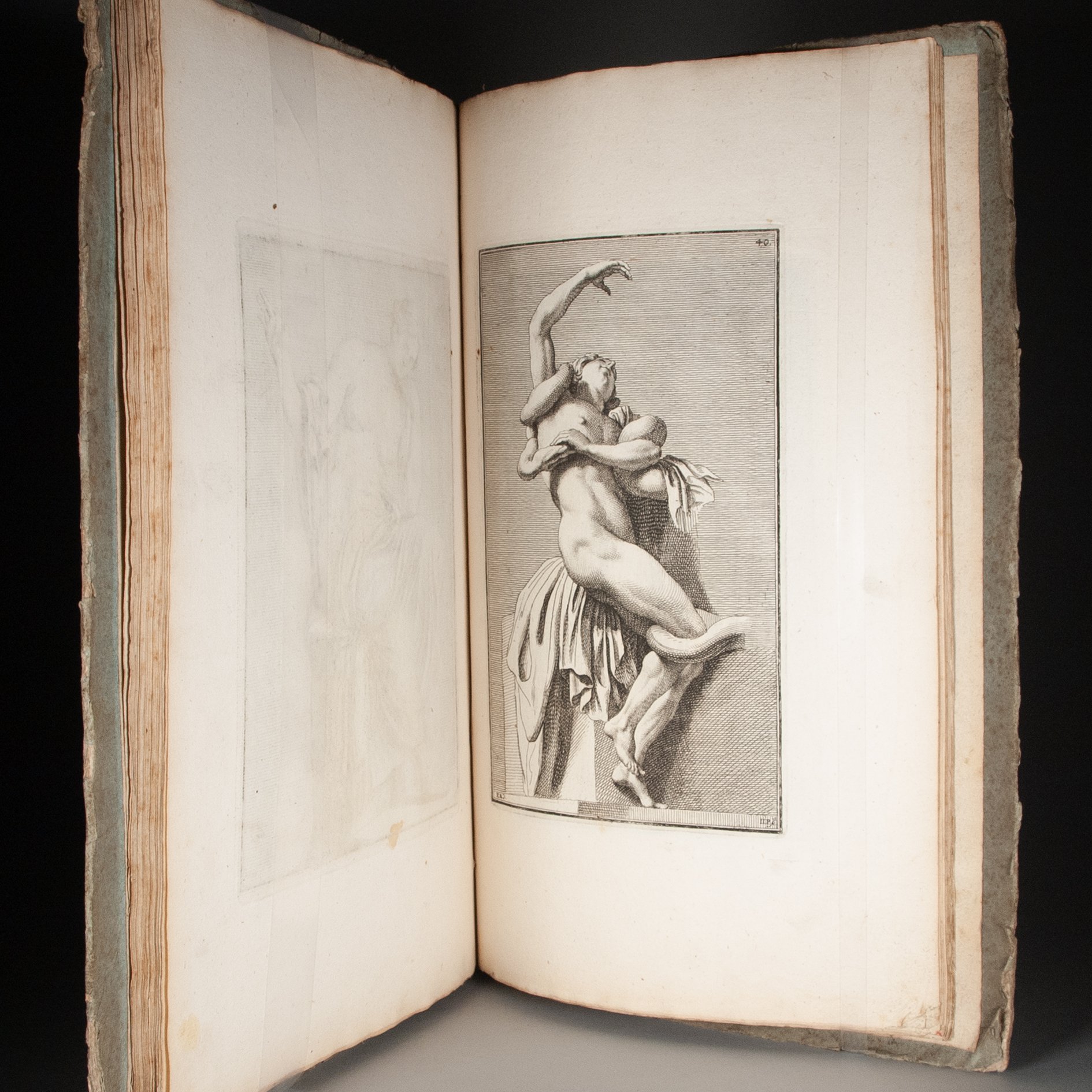
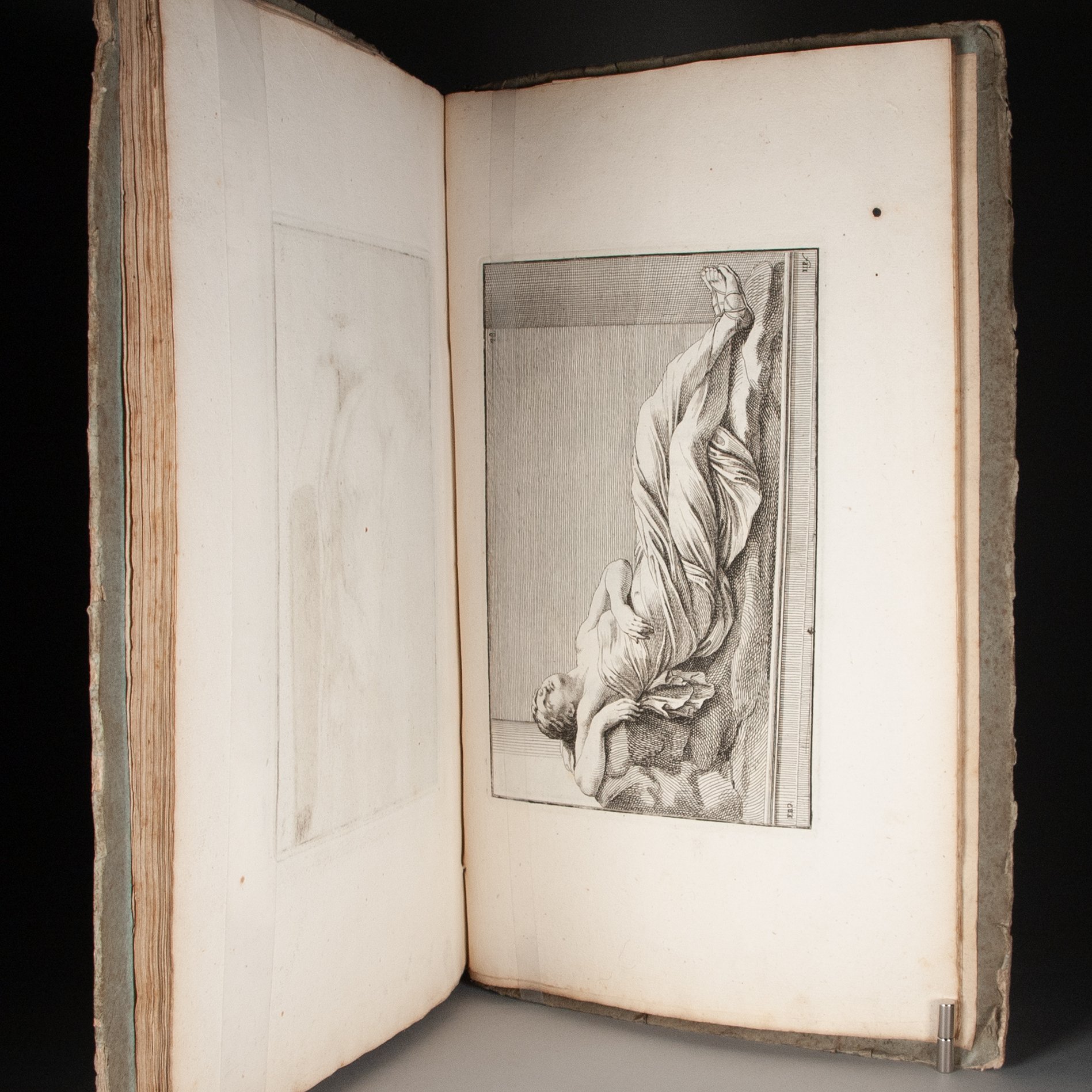
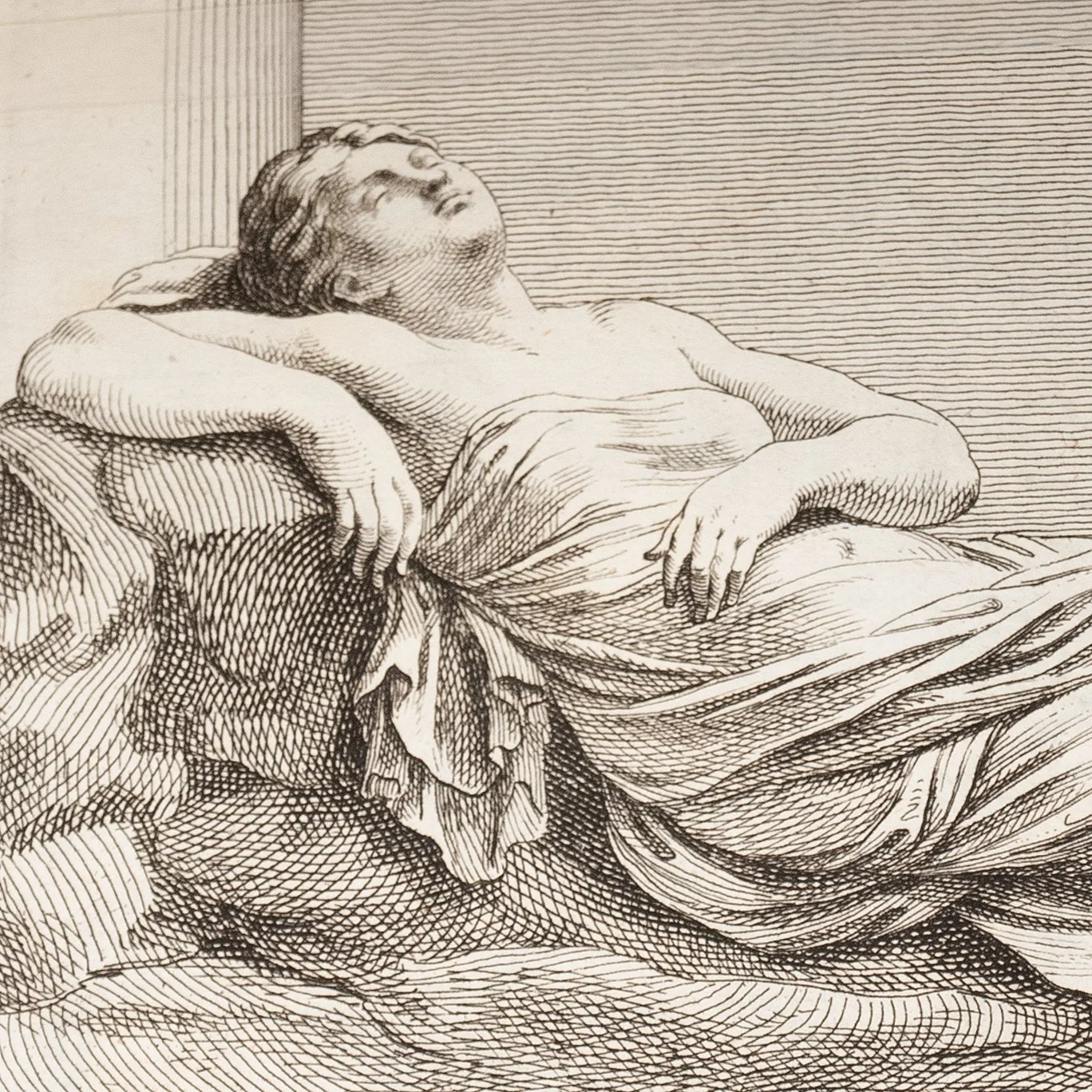
Visual catalog of eminent sculpture collection
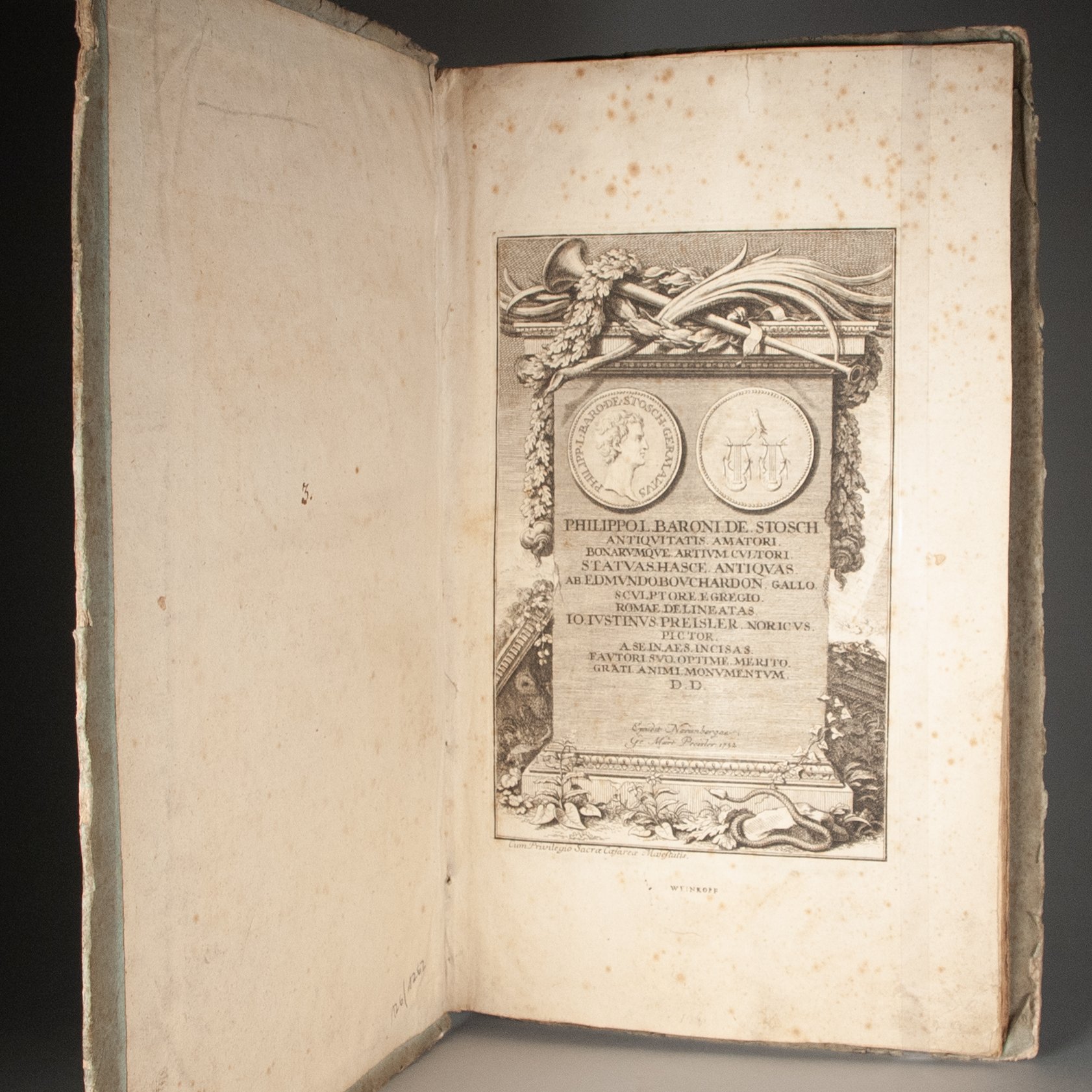
Philippo L. Baroni de Stosch, antiquitatis amatori bonarumque artium cultori, statuas hasce antiquas ab Edmundo Bouchardon, Gallo sculptore, egregio Romae delineatas; Jo. Justinus Preisler, Noricus pictor, a se in aes incisas fautori suo optime merito grati animi monumentum [Statuae antiquae]
etched by Johann Justus Preissler after drawings by Edme Bouchardon
Nuremberg: Georg Martin Preissler, 1732
[2], 50 plates | Folio | 357 x 225 mm
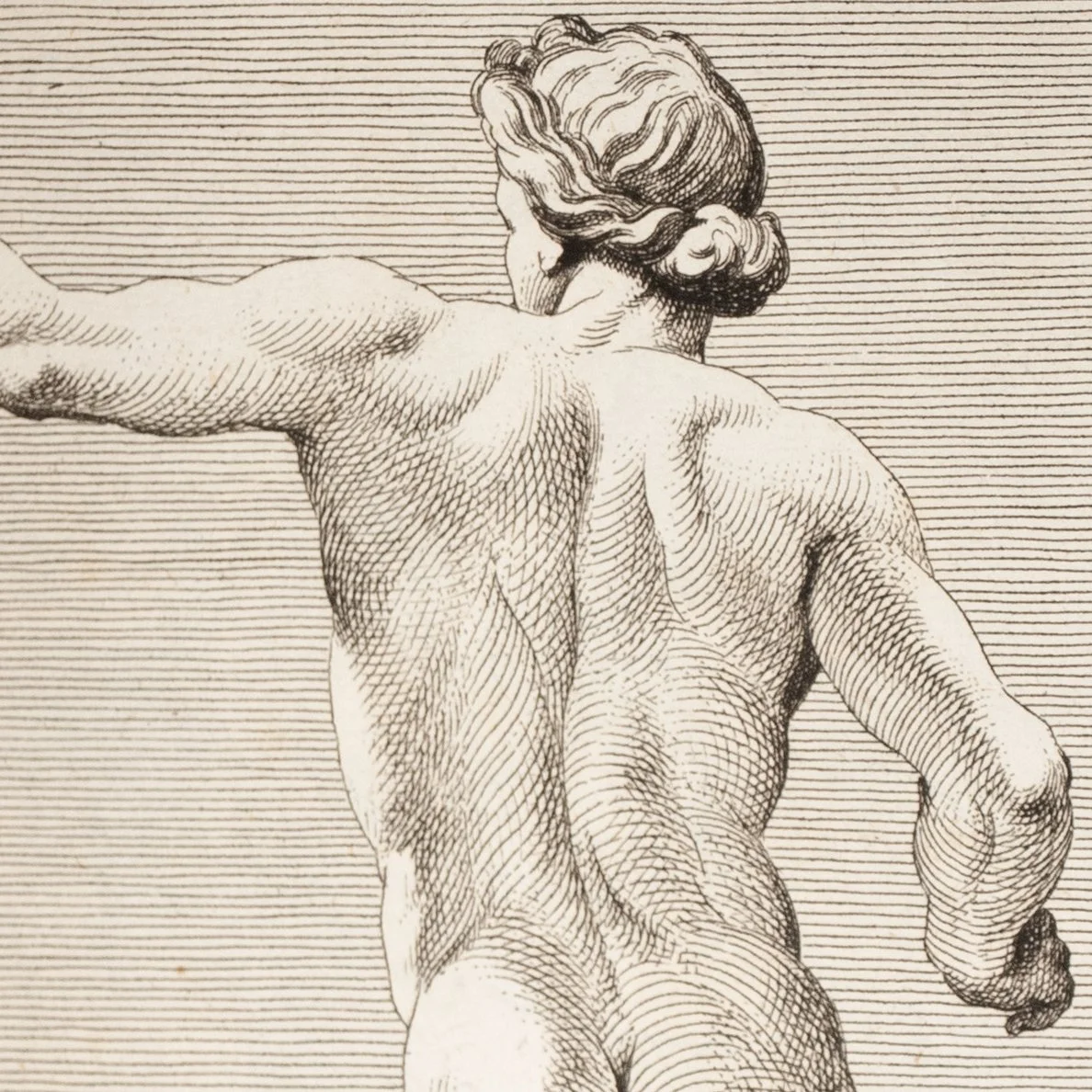
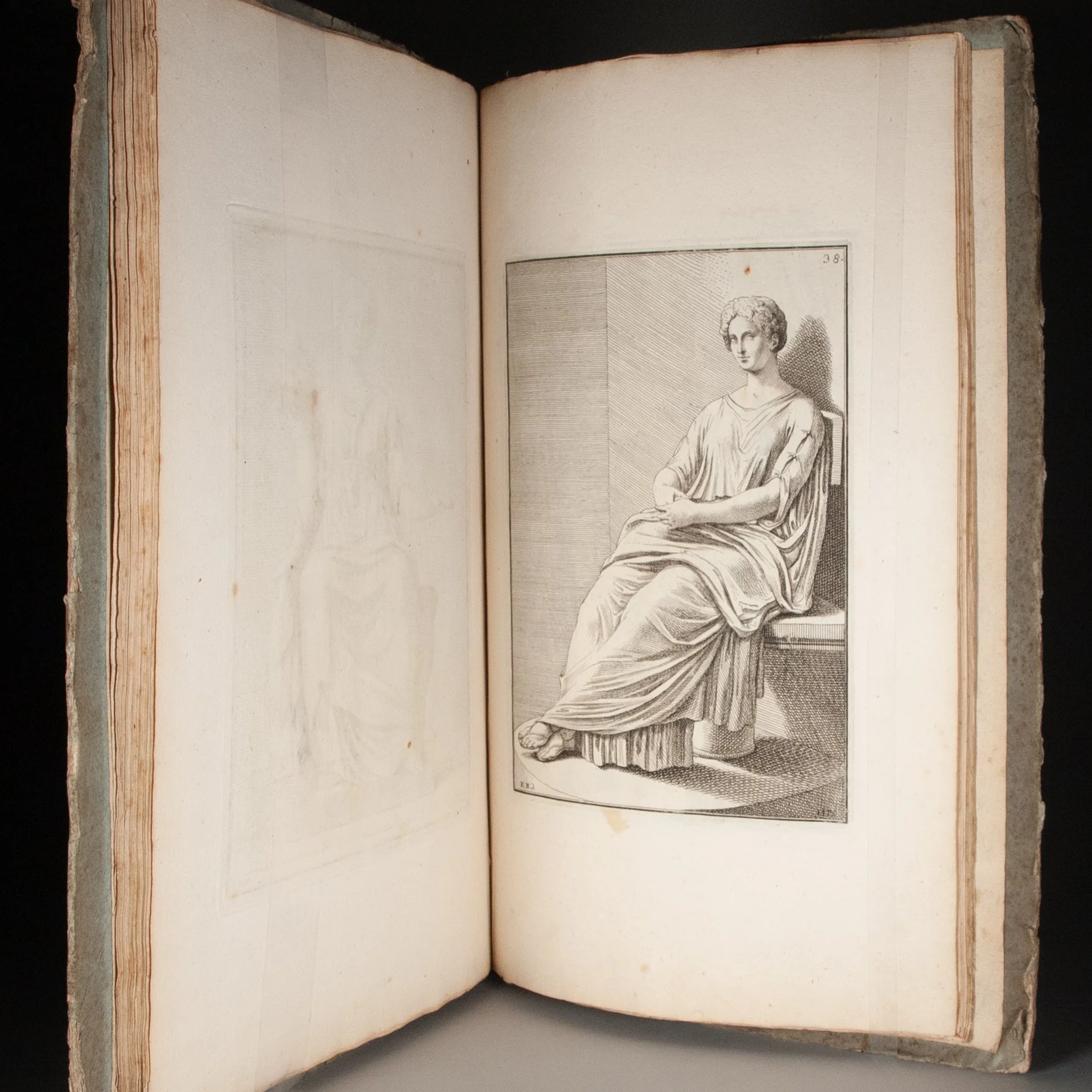
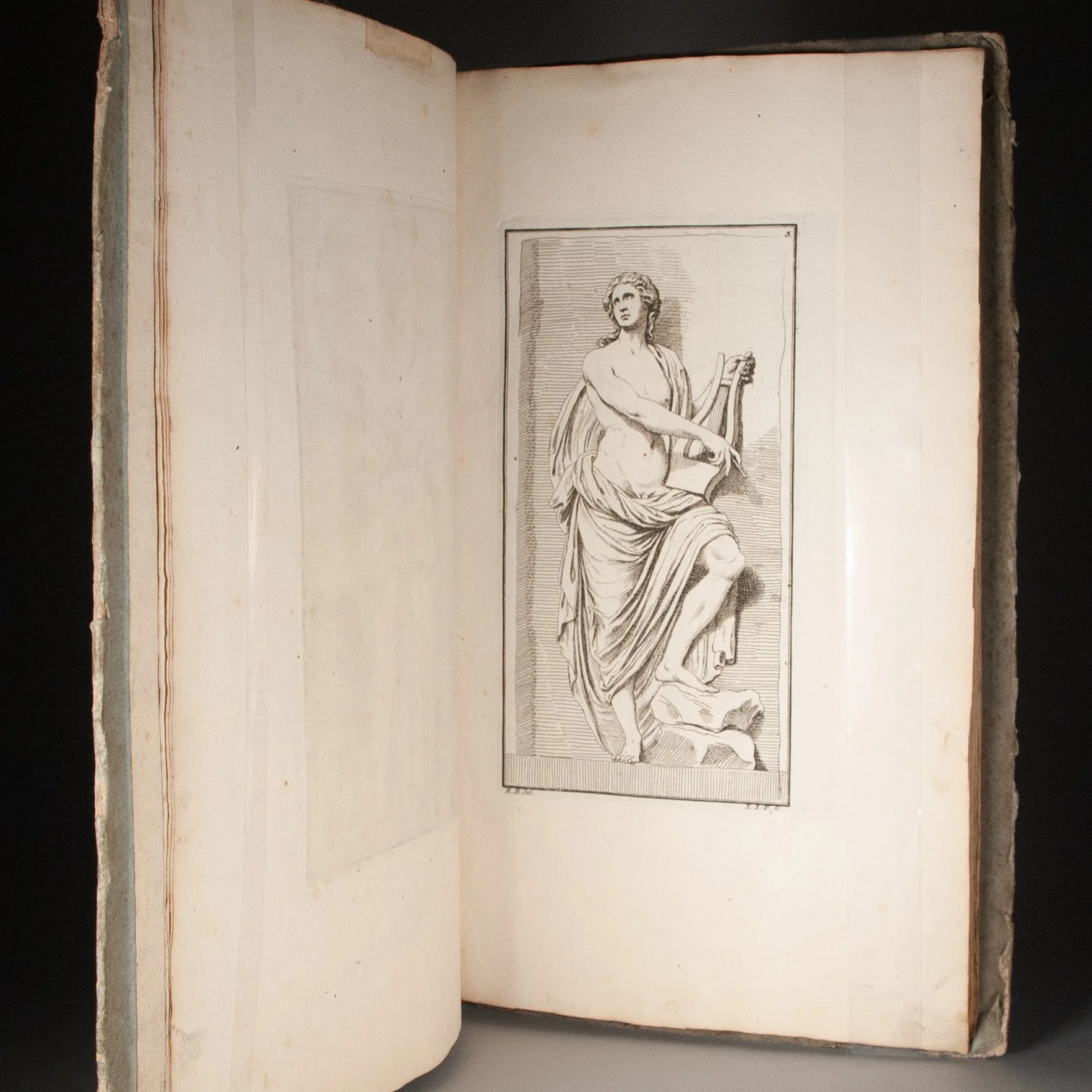
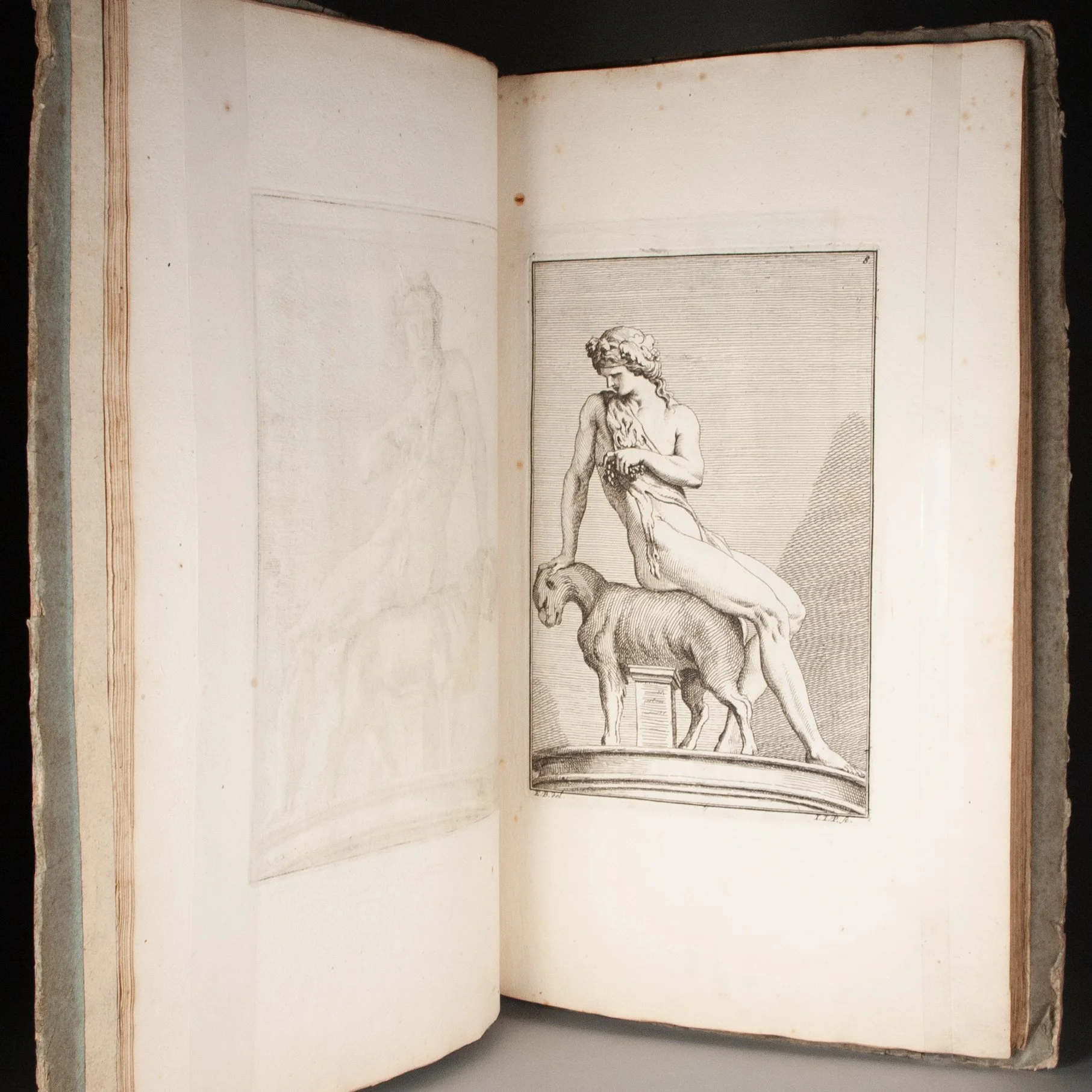
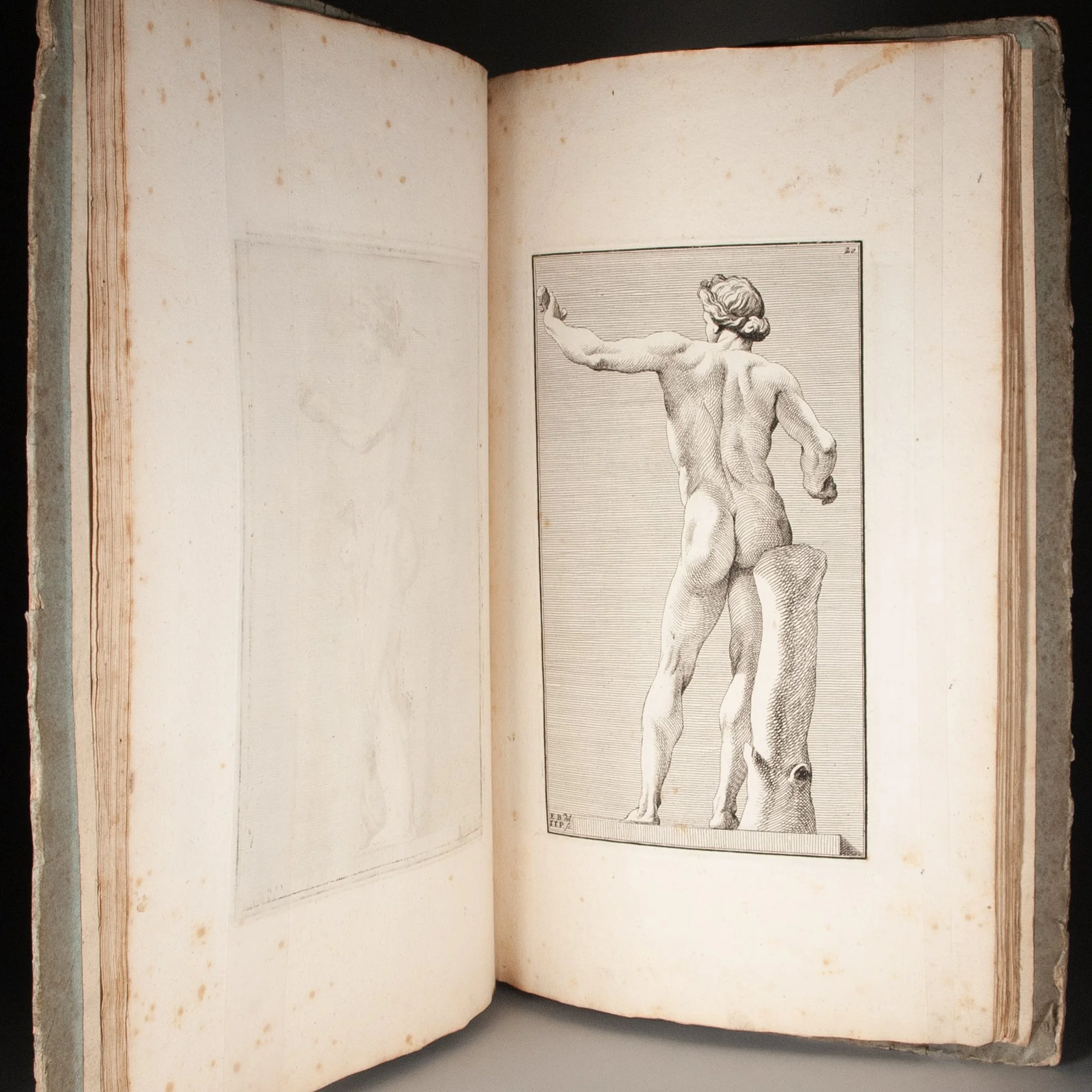
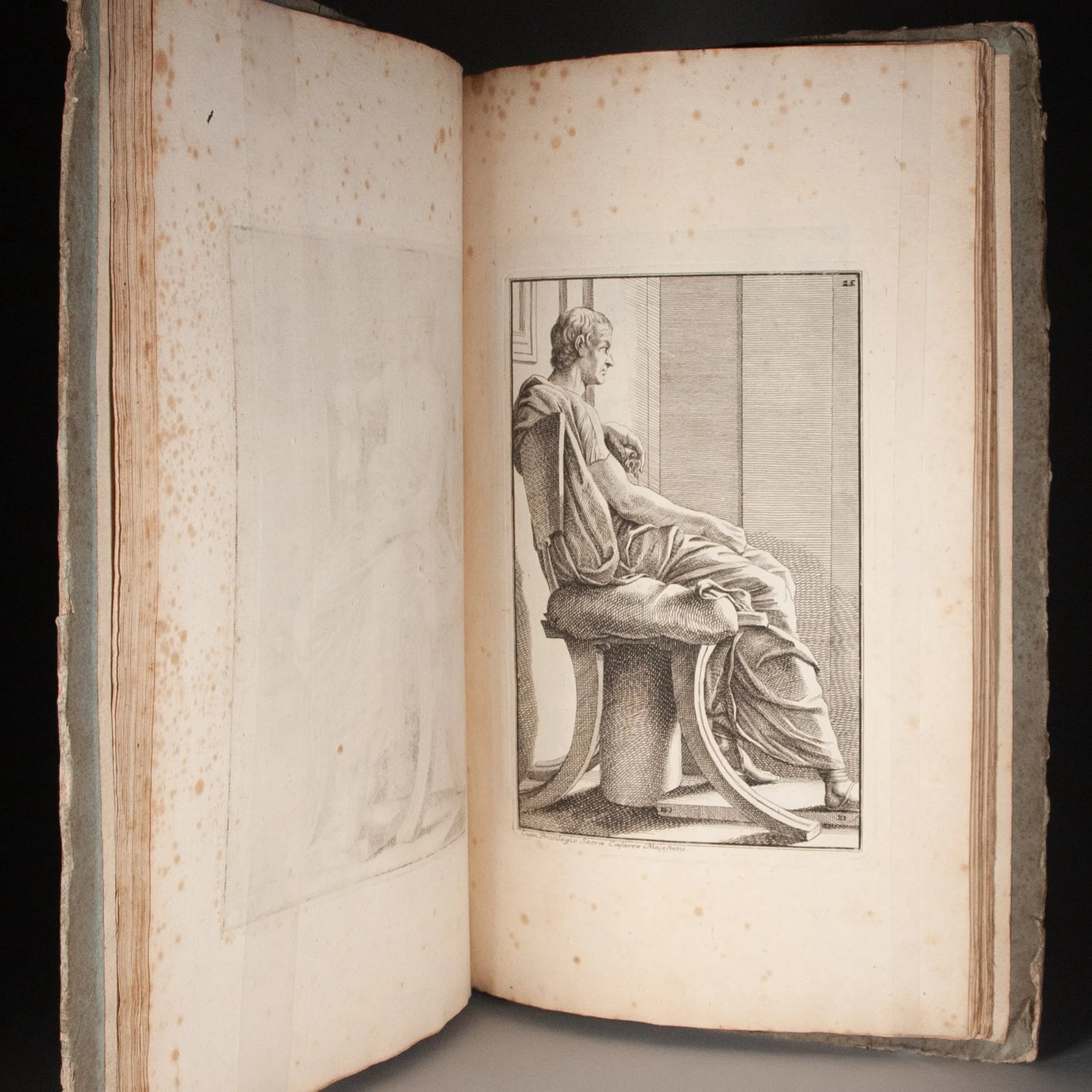
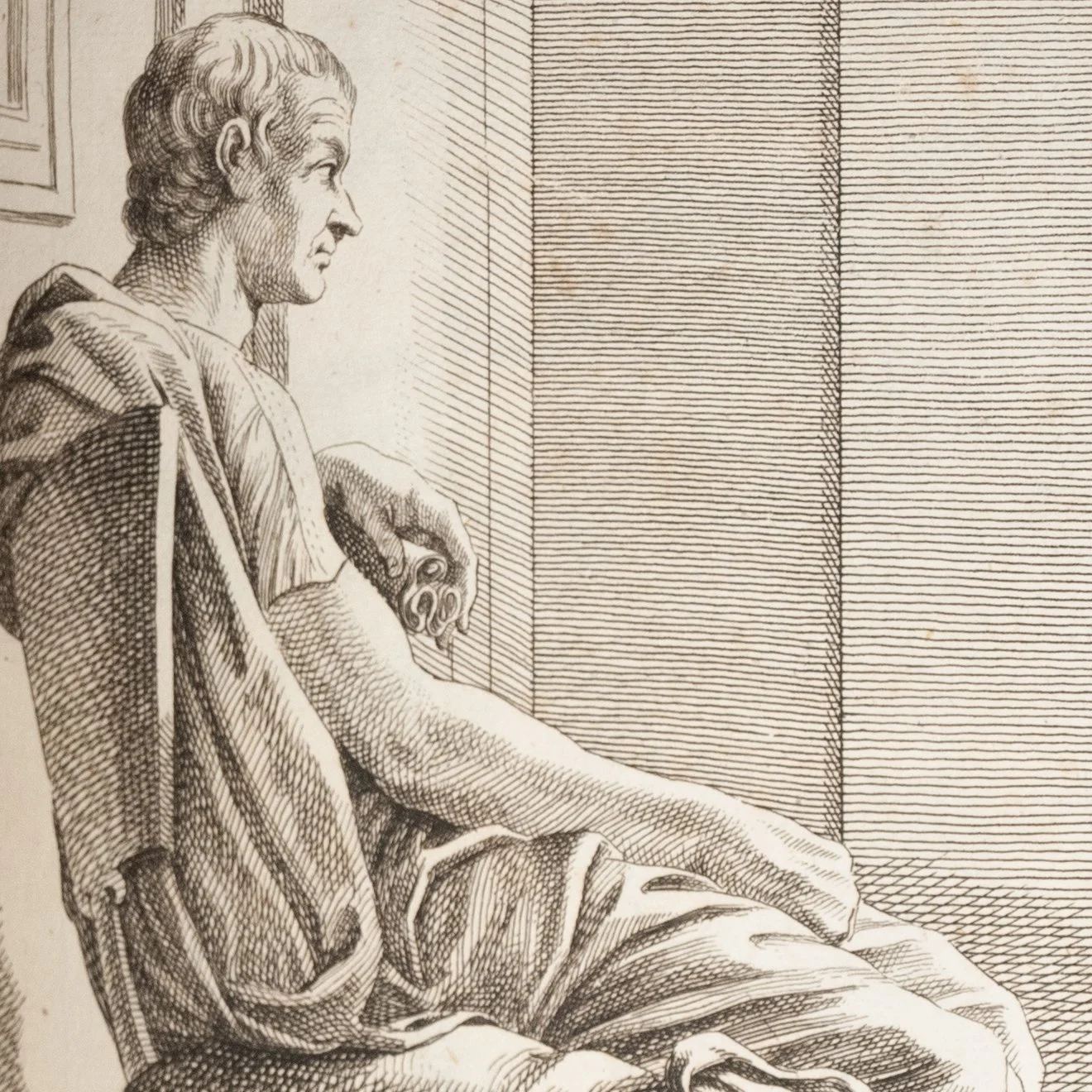
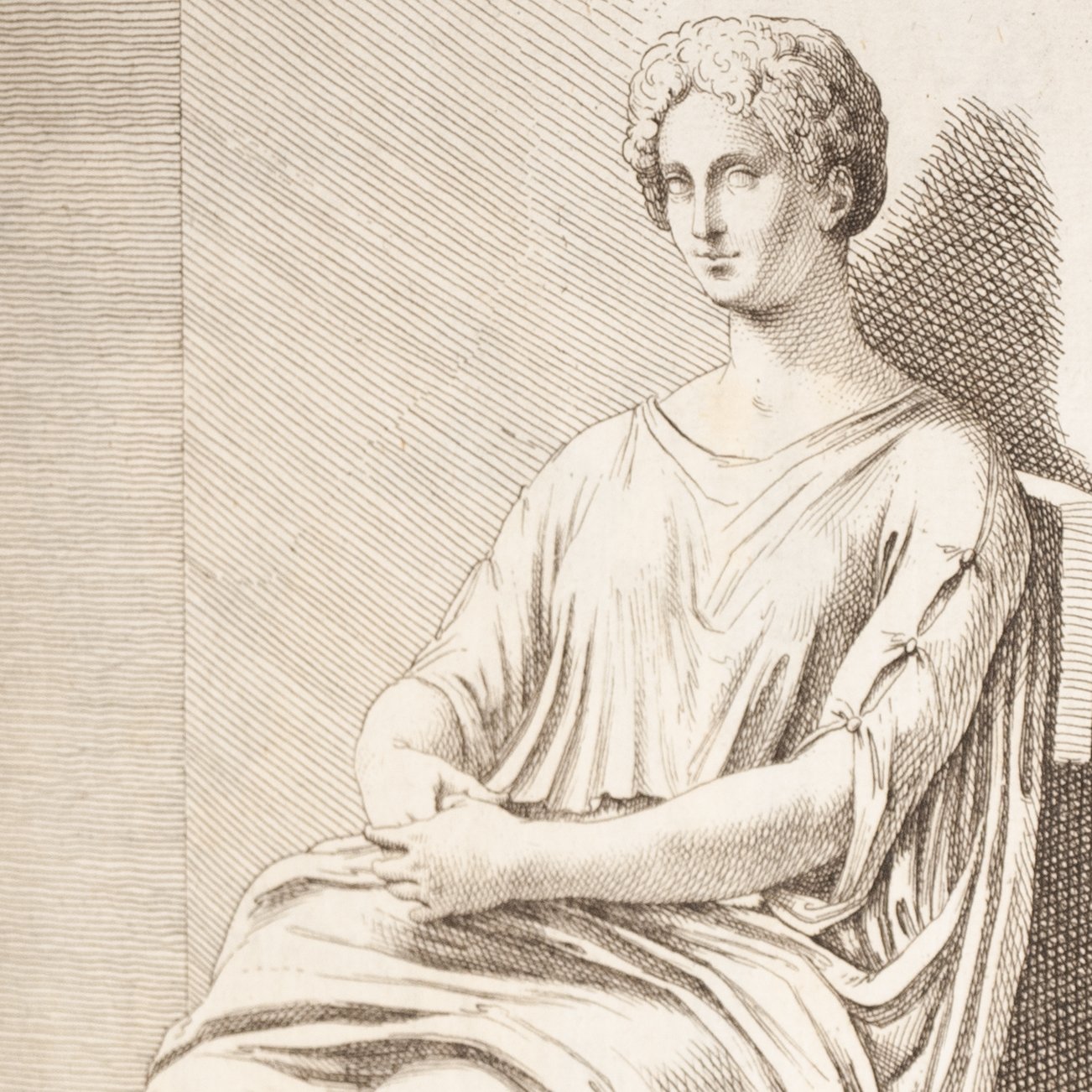
First edition of this visual catalog of sculpture from the renowned collection of Philipp von Stosch, a Polish-born art dealer and connoisseur who settled in Rome and Florence (Cicognara 3545 seems to record a second edition). Bouchardon, who made the red chalk drawings from which Preissler worked, "was one of the greatest sculptors during the reign of Louis XV (reg. 1715-74) and one of the most prolific and talented draftsmen of eighteenth-century France" (Desmas). He studied and worked in Rome 1723-1732, during which time he worked a good deal with Von Stosch. Perhaps equal parts art dealer, archaeologist, and spy—Stosch reported on Rome court intrigue to the British Crown—Stosch developed a reputation as an expert on antiquities and assembled a truly impressive collection for himself. He left Rome for Florence in 1731, "perhaps to escape a planned assassination attempt by Stuart supporters" (Bernardini). ¶ We're rather drawn to these reproductions of original works of art—themselves sometimes reproductions—largely because they played a vital role in disseminating styles and developing the field of art history. “It is easy for us of today to forget that in the past, just as today, the people who talked and wrote about art, knew much, if not actually most, of what they knew about works of art from reproductions and not from the originals" (Ivins). John Singleton Copley, widely considered the first great American painter, taught himself from black-and-white prints after European masters. And frankly we just enjoy the bold contours and high contrast of Preissler's etchings—and presumably Bouchardon's drawings—illuminated in a manner to lend dramatic tonal values. The gladiator (Plate 20), illuminated from the front, was drawn from the back, with most of its sinewy form in shadow. An anonymous seated Roman (Plate 25) was similarly lit, and powerfully drawn from the side. ¶ Whether or not all of these statues are genuinely ancient, as the title would have us believe, is a complicated question. The statue of Apollo playing the lyre (Plate 3) is plainly not, and "was probably made in Rome between 1610 and 1630, probably by a Florentine sculptor from the circle of Domenico Pieratti and Andrea Ferrucci" (Deterling). All the same, it "has always attracted the interest of artists." Beyond its inclusion here, numerous artists have drawn the statue, it appears in a number of paintings, and it served as the model for a sculpture now in Copenhagen by Giovanni Baratta (1670-1747). It came from the illustrious collection at Rome's Palazzo Giustiniani, nurtured by brothers Benedetto (1550-1622) and Vincenzo Giustiniani (1564-1637). It was among a group of sculptures that Mary Clark Thompson purchased in 1903 for the Met in New York. The museum kept some, and a few others went to Williams College and Vassar. This Apollo is among a small trove that went to Clark's own Sonnenberg estate in Canandaigua, NY, where it remains today. ¶ Other statues are at least partially ancient. Another Apollo (Plate 26) is remarkable for the surviving documentary evidence of its restoration in 1618—a rather drastic restoration, to be sure, as only the torso of the original remained. Stosch's Bacchus seated on a panther (Plate 8), now at the Met and also from the Giustiniani collection, is a similar amalgam of ancient and modern parts—indeed, the only sculpture among those Thompson gave to the Met whose restorations the museum chose to preserve. Other notable statues pictured here include an Aphrodite of Knidos (Plate 4), one of a number of copies of a lost original made by Praxiteles in the fourth century BCE, "the first nude monumental statue of a goddess in the Greek world" (Davies, et al.); and our opening plate, a statue of Jupiter, gained currency throughout the 18th century, being reproduced, for example, in Joseph Spence's Polymetis (1747), and also as the frontispiece to its abridgement by Nicholas Tindal (A Guide to Classical Learning). ¶ Scarce in auction records, and WorldCat reports no copies in North America.

PROVENANCE: Weinkopf stamped at the foot of the title.
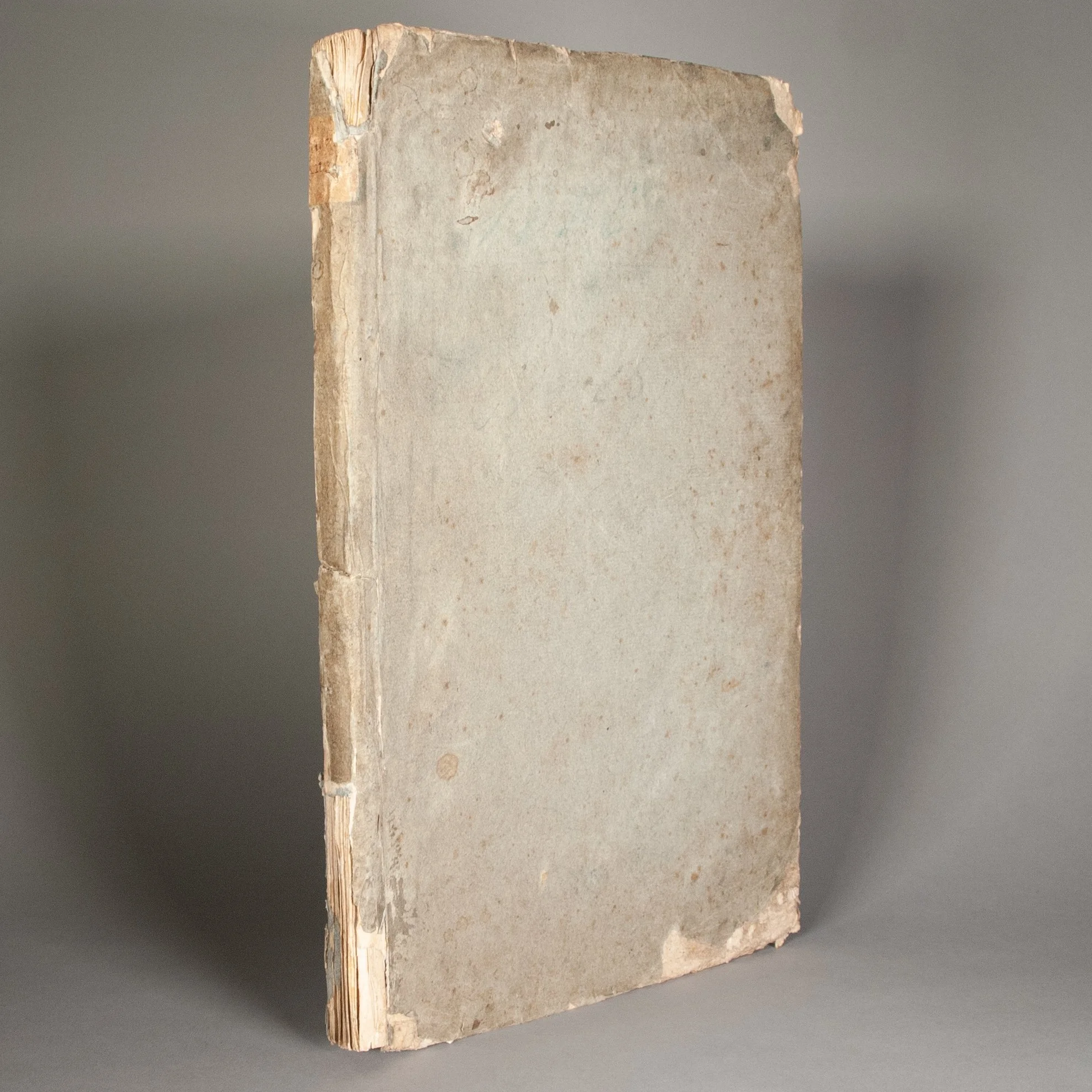
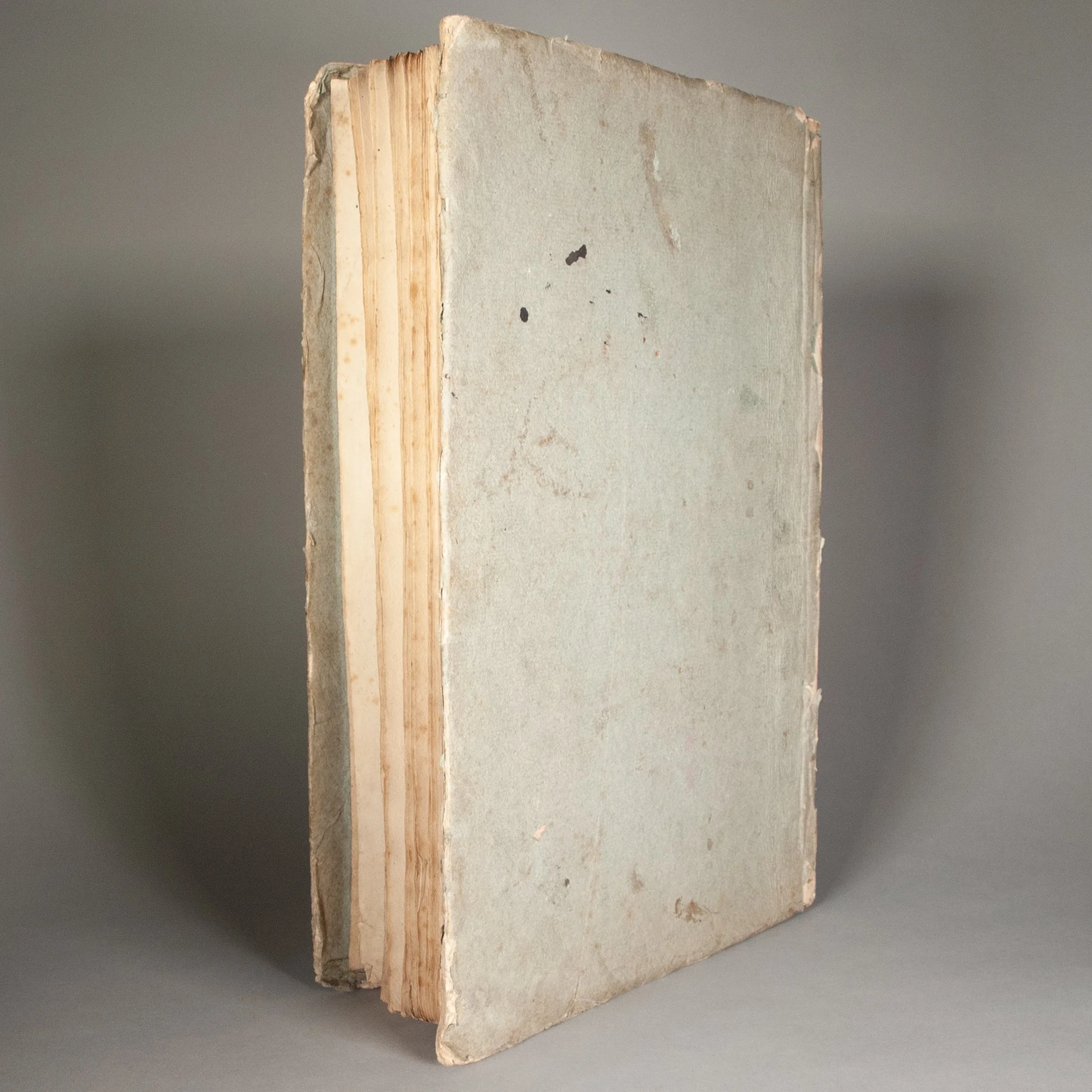
CONDITION: Old, and very possibly contemporary, blue paper-covered boards. ¶ First few leaves moderately soiled; title heavily foxed, and the margins of some prints, though the images are rarely affected; 1" tear in the upper margin of the first two leaves, repaired. Binding heavily worn at the extremities, the lower third of the backstrip lost, and some of the head; boards very foxed and soiled. Not much of a looker superficially, but still solidly bound and holding together very well.
REFERENCES: VD18 10851895 ¶ Jörg Deterling, "Un 'Apollo' in altorilievo dalla collezione Giustiniani," Prospettiva 169/171 (Jan-Jul 2018), p. 218 (cited above), 219 (cited above, with good history of the Apollo statue); Penelope J.E. Davies, et al., Janson's Basic History of Western Art (2014), p. 2 (on Copley), 100 (cited above); Maria Grazia Picozzi, "'Tutte le statue, che sono nel cortile de' Verospi': contributo alla ricostruzione della raccolta di antichità della famiglia Verospi nel XVII secolo," Archeologia Classica 55 (2004), p. 258-260 (on the restoration of the Apollo, reproducing our Plate 26); P.O. Rave, "Über Philipp von Stosch," Berliner Museen 7.1 (Jun 1957), p. 23-24 (some background on the preparation of this book, noting that some of the artists who assisted with it "lived in his house and were almost exclusively employed on his projects," J.J. Preisler and Bouchardon among them); Anne-Lise Desmas, "Edme Bouchardon's Vade Mecum in Rome," Master Drawings 56.1 (Spring 2018), p. 31 (cited above); Ingrid Sattel Bernardini, "Stosch, Philipp, Baron von," Grove Art Online (2003), accessed online (cited above); Tomas Macsotay, "From Sculpture to Engraving: Obscenity and Desire in Edmé Bouchardon's Copies of Antiquities according to Preissler's Etchings in Statuae Antiquae (1732)," Reproducing Images and Texts (2021), p. 264 ("the German draughtsman did not imitate in every instance the ways in which Bouchardon's red chalk crosshatched and parallel-traced the forms of bodies and attributes seen in the sculptures. But the spirig of the two artists is certainly close. Comparison between some existing originals shows that Preissler often recreated similar effects through different, often finer, patterns of line...And some departures from the drawings help to reinstate a certain liveliness imparted by Bouchardon's red chalk technique."); Olga Raggio, "I. A Giustiniani Bacchus and François Duquesnoy," Metropolitan Museum Journal 40 (2005), p. 199-200 (good background on Thompson's role in the Giustiniani sculptures), 202 ("Seen as a combination of ancient and modern parts, the Giustiniani group reveals an unusually subtle and complex effort at integration on the part of the seventeenth-century sculptor responsible for its restoration"); William M. Ivins, Jr., "A Note on Engraved Reproductions of Works of Art," Studies in Art and Literature for Belle da Costa Greene (1954), p. 195 (cited above); Antony Griffiths, Prints and Printmaking (1996), p. 46 (“It has been customary to deplore the fact that later engraving, in comparison with fifteenth-century work, was so largely reproductive rather than ‘original’, but the entire history of western art would have been quite different if engravings had not rapidly disseminated every stylistic innovation all around Europe")
Item #903