
Itinerant German-American binder on a truly German-American imprint
Itinerant German-American binder on a truly German-American imprint
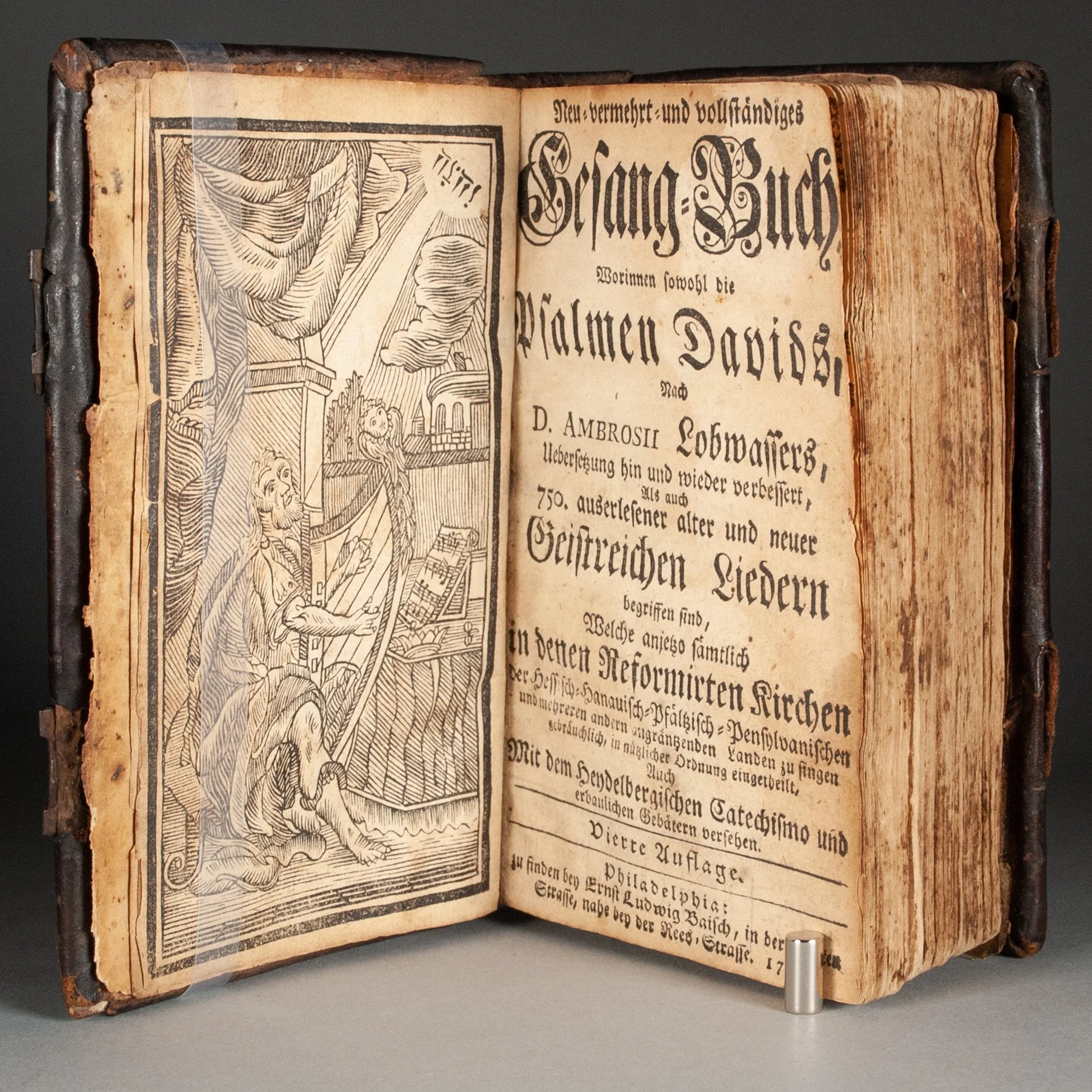
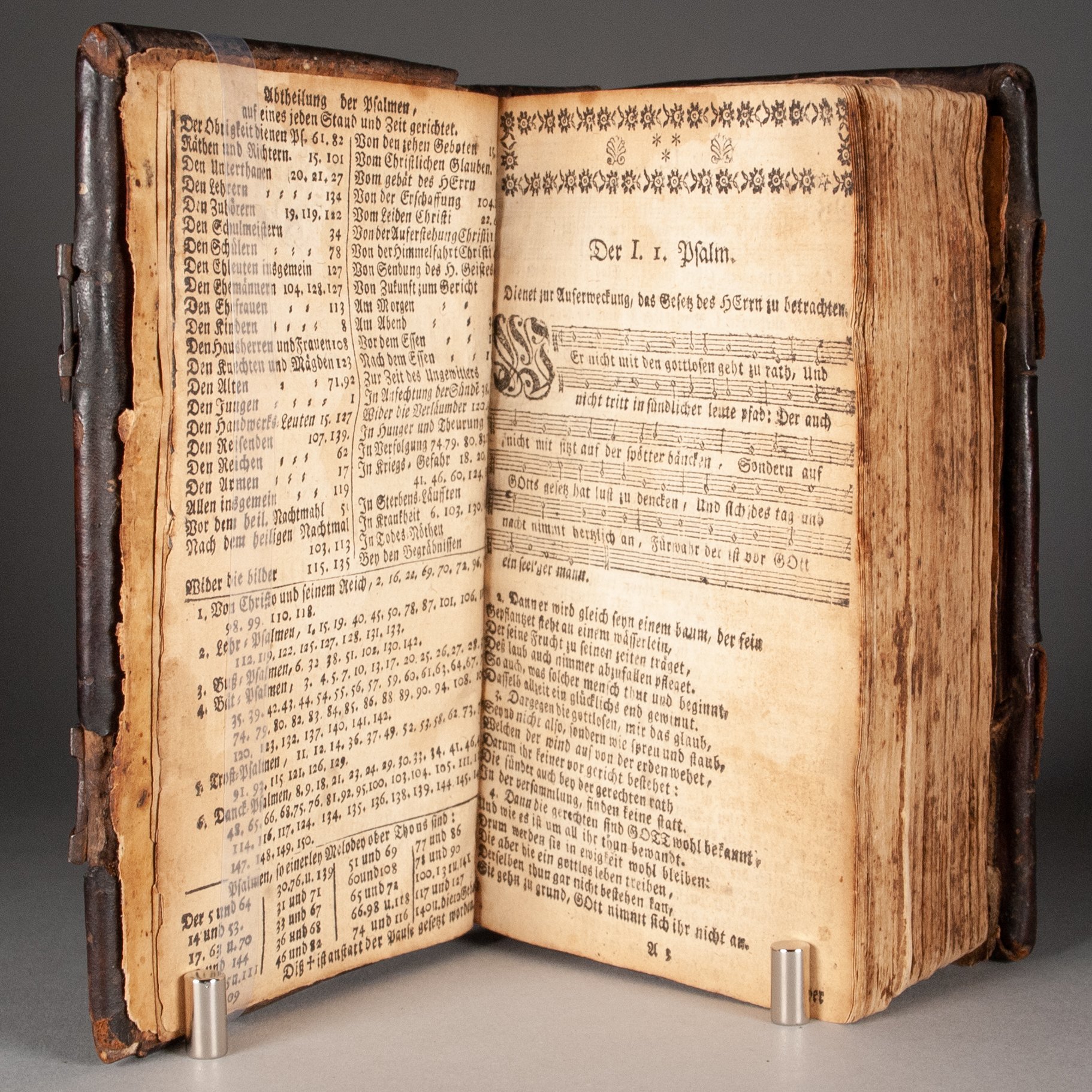
Neu-vermehrt- und vollständiges Gesang-Buch, worinnen sowohl die Psalmen Davids, nach D. Ambrosii Lobwassers, Uebersetzung hin und wieder verbessert, als auch 750. auserlesener alter und neuer geistreichen Liedern begriffen sind, welche anjetzo sämtlich in denen Reformirten Kirchen der Hessisch-Hanauisch-Pfältzisch-Pensylvanischen und mehreren andern angräntzenden Landen zu singen gebräuchlich, in nützlicher Ordnung eingetheilt; auch mit dem Hendelbergischen Catechismo und erbaulichen Gebätern versehen; vierte Auflage
Psalms translated by Ambrosius Lobwasser
Philadelphia [Tübingen?]: Ernst Ludwig Baisch, 1774
190, [2]; 480, [12]; 24, 72 p. | 12mo | A-H^12; (A)-(V)^12 (X)^6; a-d^12 | 153 x 88 mm
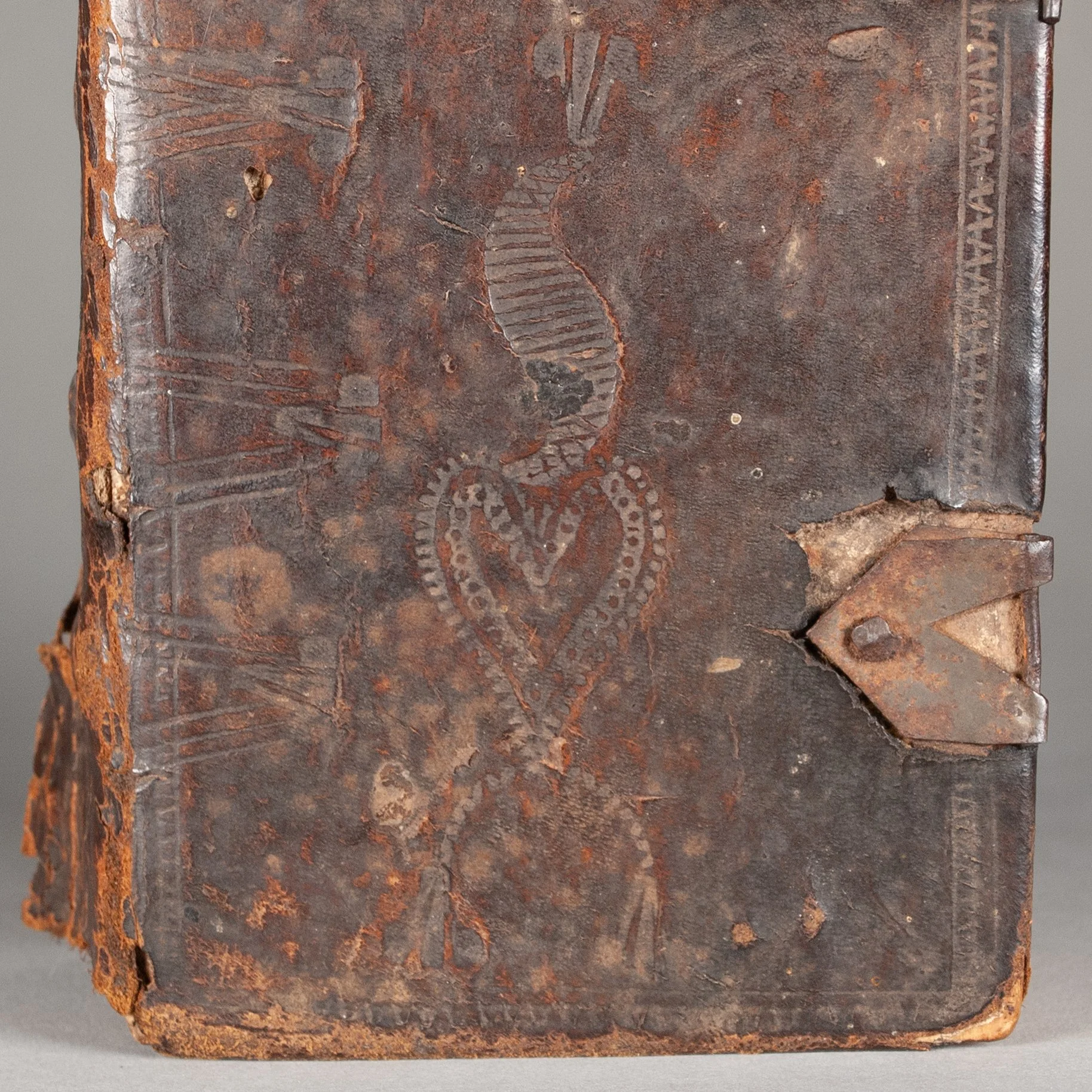
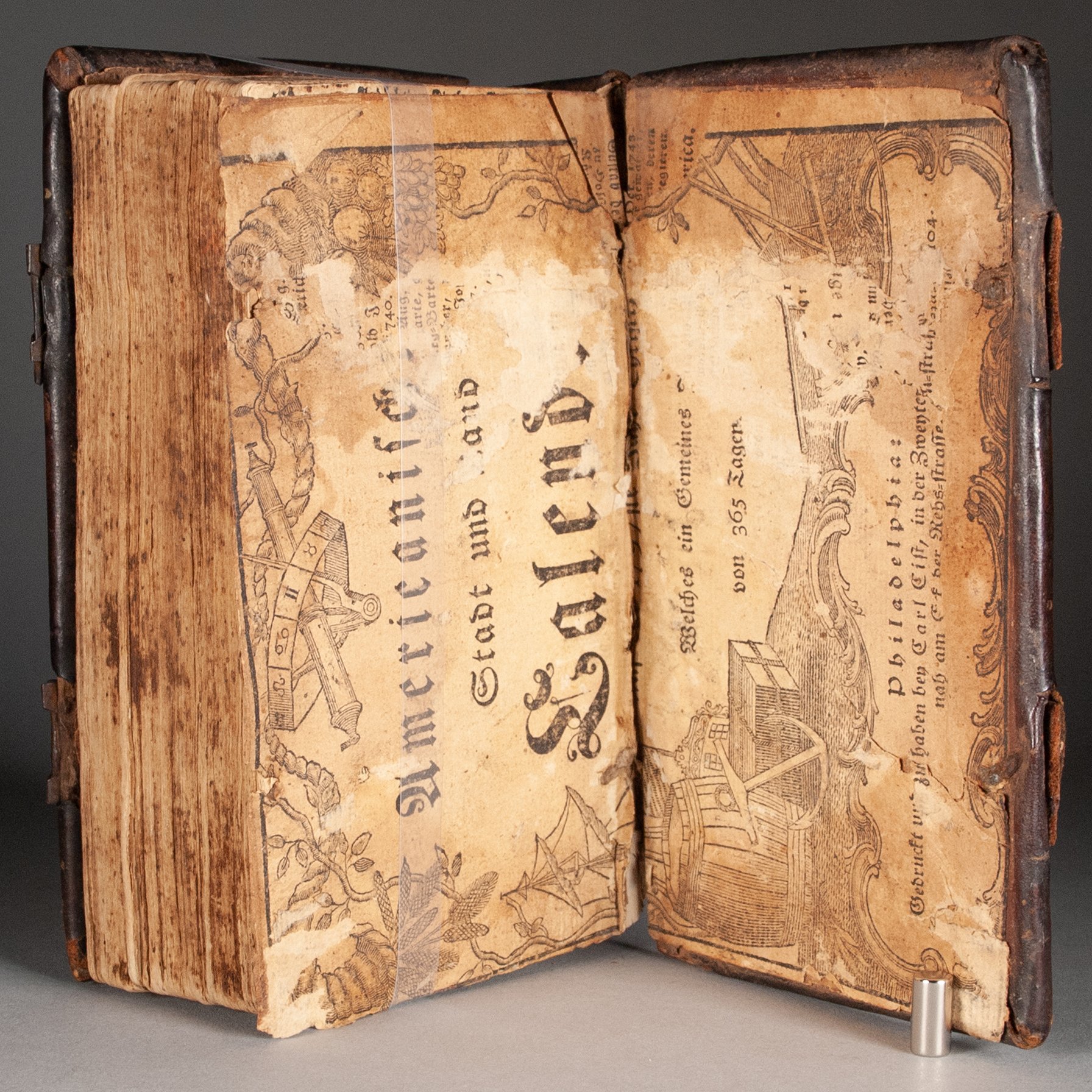
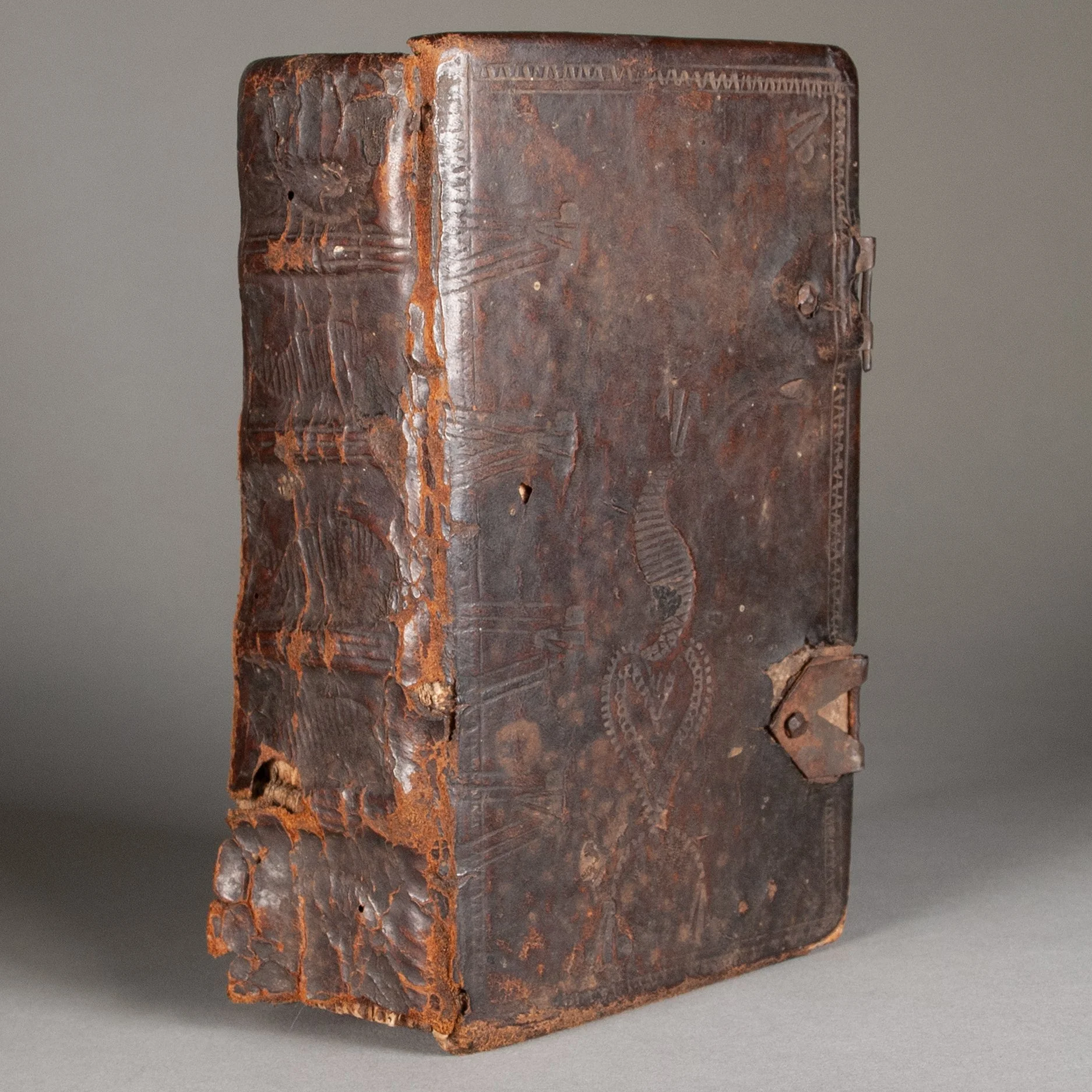
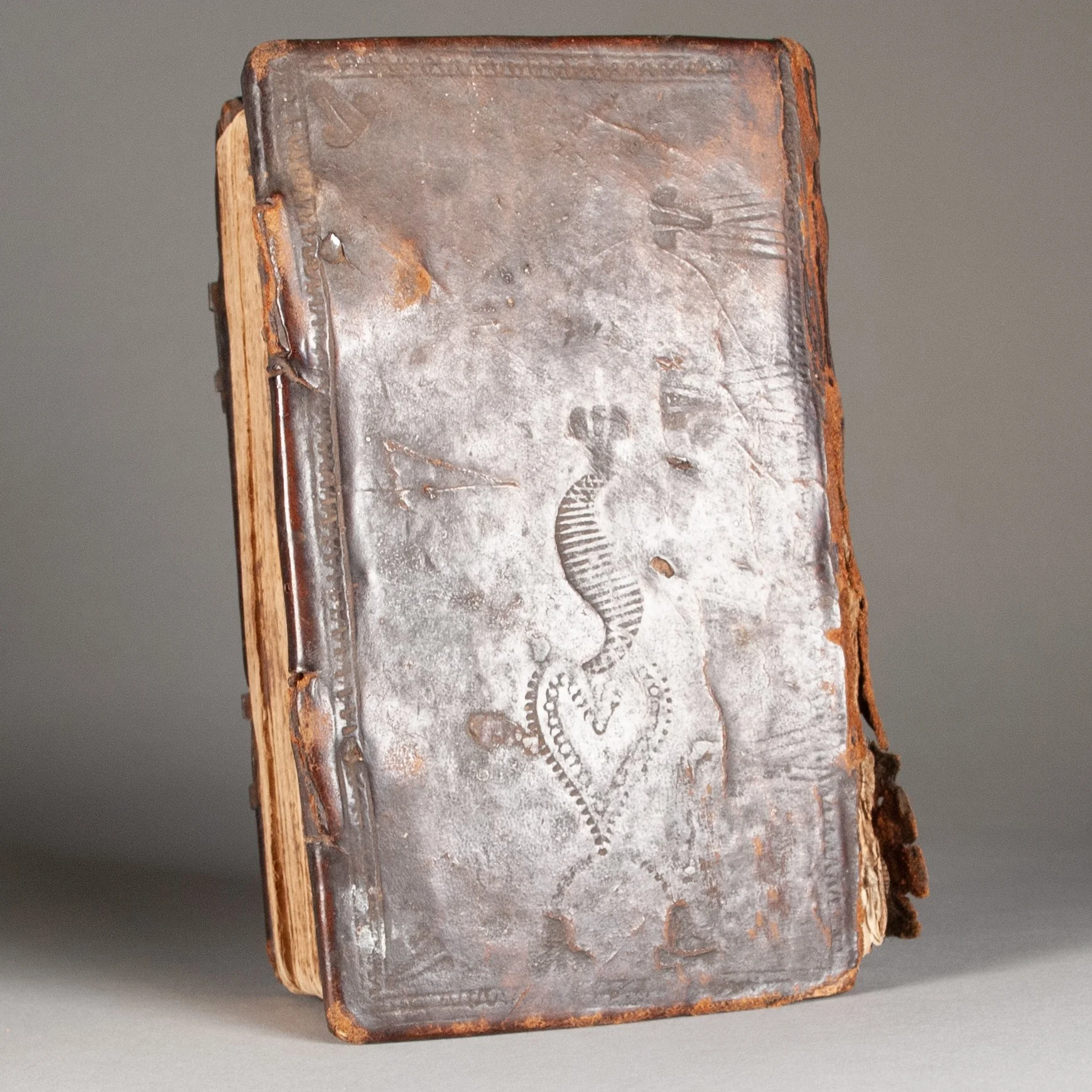
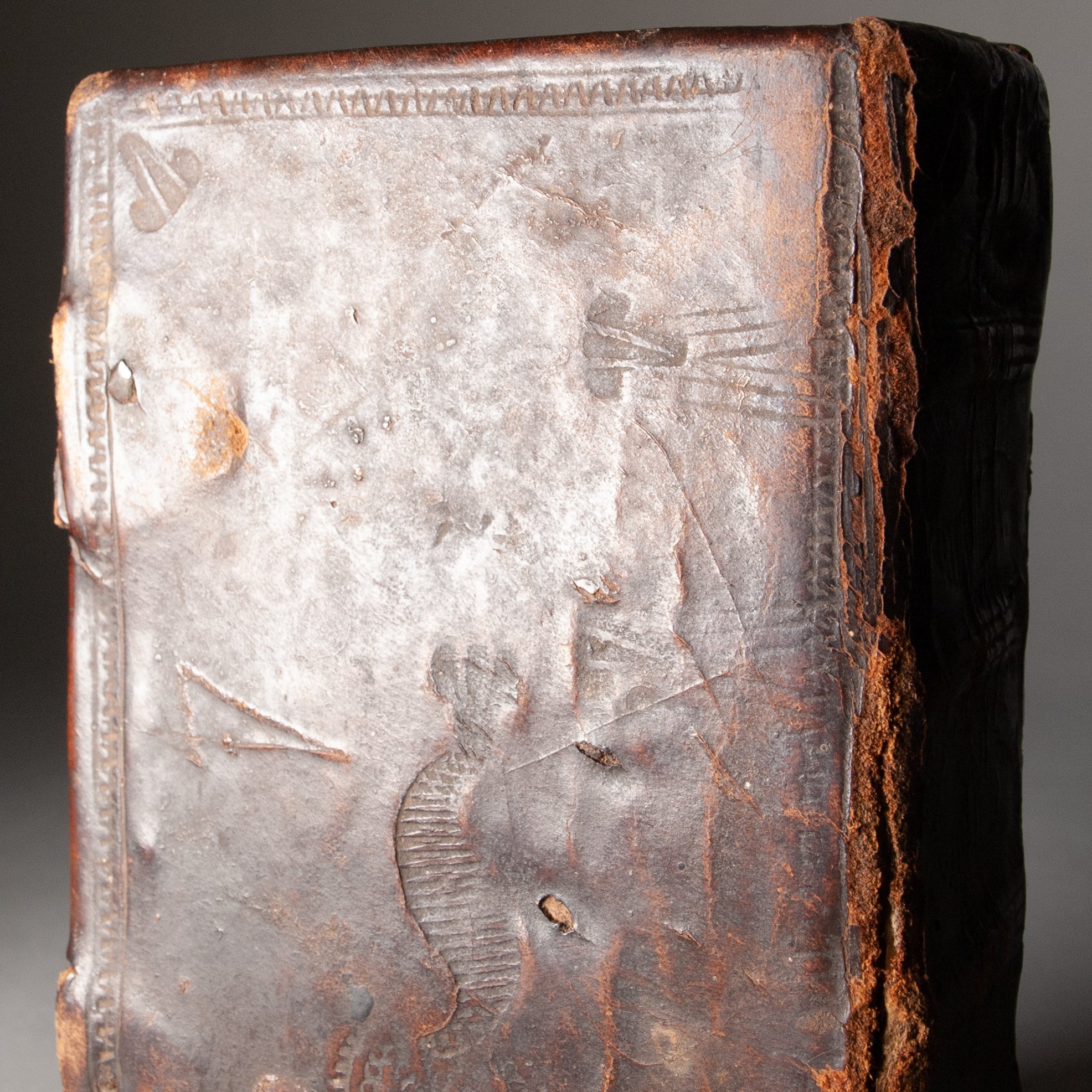
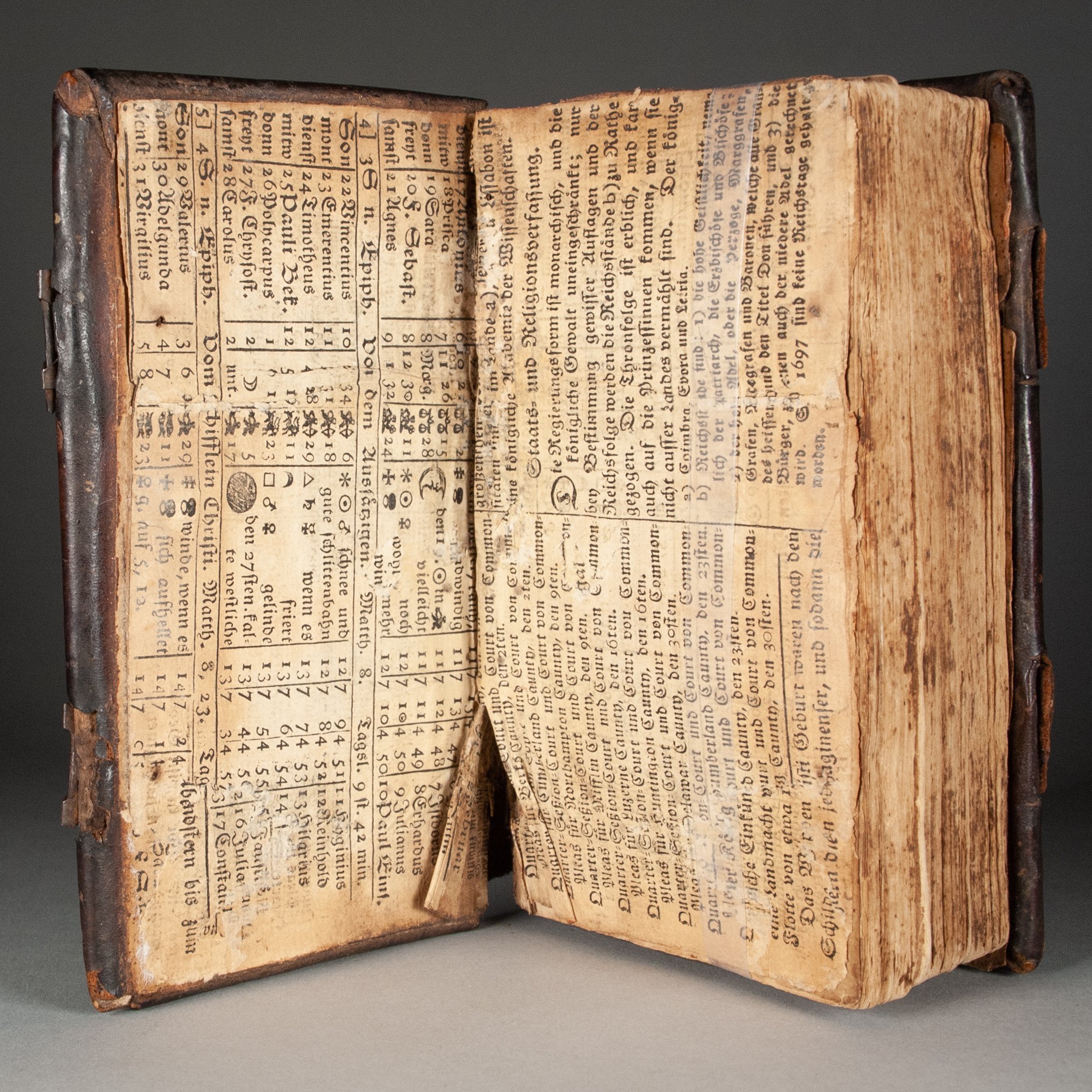
An enthralling colonial American hymnal for Pennsylvania's German speakers, incorporating Lobwasser's German hymns, at least in part translated from the French psalter arranged by Clément Marot and Théodore de Bèze, 1551-1566. Lobwasser's version circulated widely, sometimes to the chagrin of Lutheran Protestants, as it had strong Calvinist overtones. Our title page calls this the fourth edition. Presumably this refers to those published by Baisch, though we locate only one other edition with his imprint (ESTC W34038, also 1774). We suspect Baisch's model could be traced to Christopher Saur, who published a number of hymnals nearly identical in title as early as 1753. ¶ Baisch's colonial model notwithstanding, the publisher went abroad for the presswork. This colonial American imprint was actually printed in Germany, where Baisch was traveling in 1774. "It would appear, therefore, that while in Germany Baisch ordered from certain German printers a number of copies" of this and a few other texts, "to be issued with new title-pages citing Philadelphia as the place of issue and his name as publisher" (Goff). Another of Baisch's German commissions came from the same anonymous press, with internal evidence suggesting it might have been printed in Tübingen. Baisch's 1775 Bible came from Reutlingen, a stone's throw from Tübingen, and so we gain a sense of the geographic area where Baisch was traveling. ¶ Here in a fantastically compelling early American binding, the work of an anonymous craftsman whom Willman Spawn dubbed the "Itinerant German Binder." "The bindings used a limited number of very crudely cut tools—usually a tulip, heart, and leaf-shaped stamp." Our heart is readily identifiable with the example Spawn reproduces, and we have here his characteristically thick leather over wooden boards. "I became intrigued by the bindings," Spawn continues, "and noted the binder's habitual use of printer's waste for pastedowns and endleaves. As more examples were identified it became clear that this binder did not stay put in eastern and central Pennsylvania. Endpapers made from newspapers, an almanac, and manuscripts allow us to locate his work in Philadelphia, Easton, Lancaster, Somerset county, in western Pennsylvania, and Harrisonburg, Virginia." Sure enough, for his endpapers, the binder here used waste from the 1797 edition of Charles Cist's Philadelphia Americanischer Stadt und Land Calender (ESTC W41536 or W43587, the decorative title page fortuitously preserved). "His use of local materials, along with the sort of texts he was rebinding, provides a glimpse into one of the ways rural communities were served by the evolving American book trade. It came to their door" (Spawn). ¶ Many of Baisch's books were bound in Germany, often in a colorful Bauerneinband style. Since some 23 years separate the hymnal's printing and its current binding, it's entirely possible Baisch here conformed to his specialties of repair and rebinding. It's easy to imagine a book intended for daily use falling apart after a generation. But rather than conform to decorative motifs standard in American binding, the work of the Itinerant Binder is conspicuous for its whimsy. Indeed, there's a spiritual affinity between his designs and those found on German Bauerneinband, or peasant bindings. And style aside, given the number of Baisch imprints in their original German bindings, this copy stands out simply for having an early American one. ¶ We find no identified examples of the Itinerant German Binder's work in auction records.
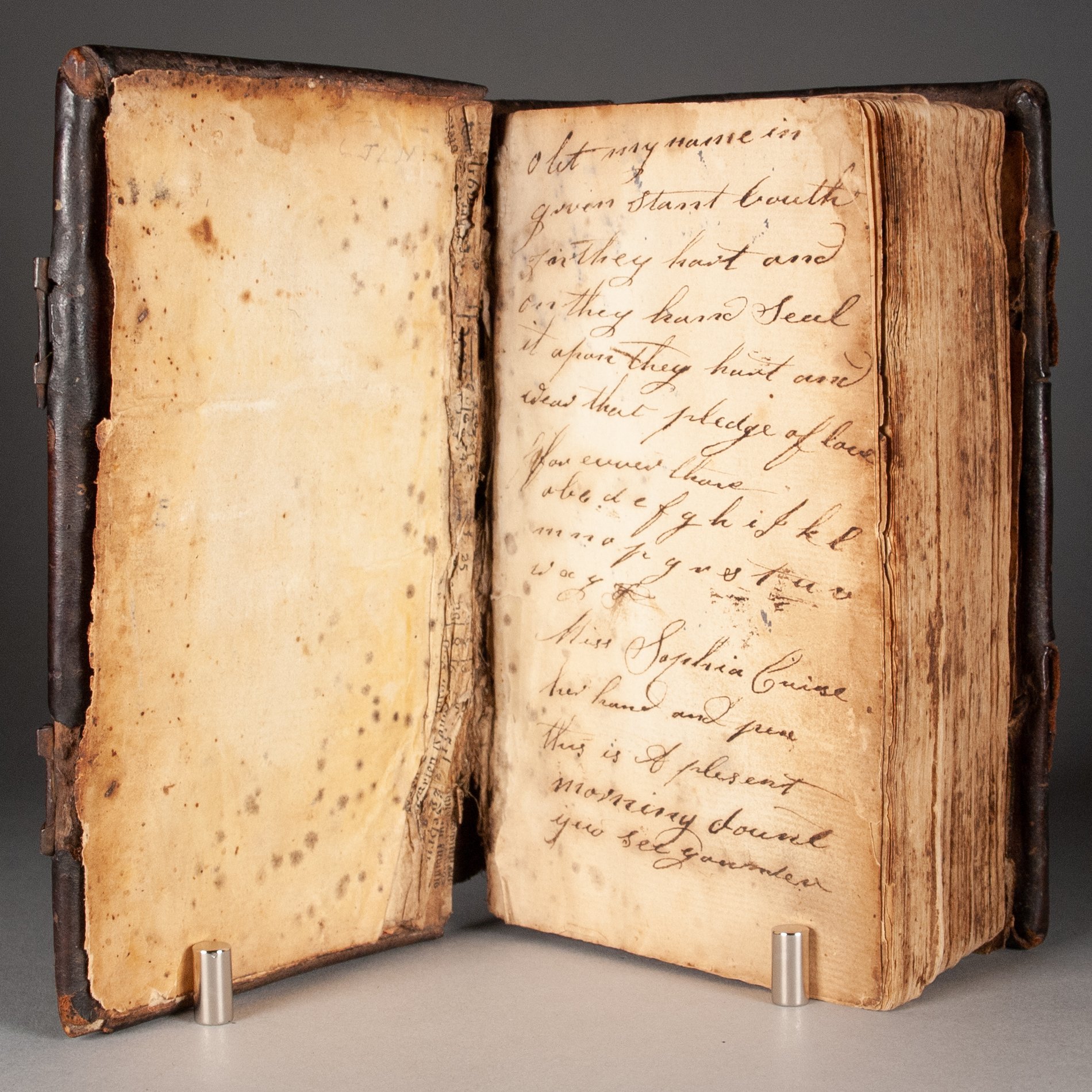
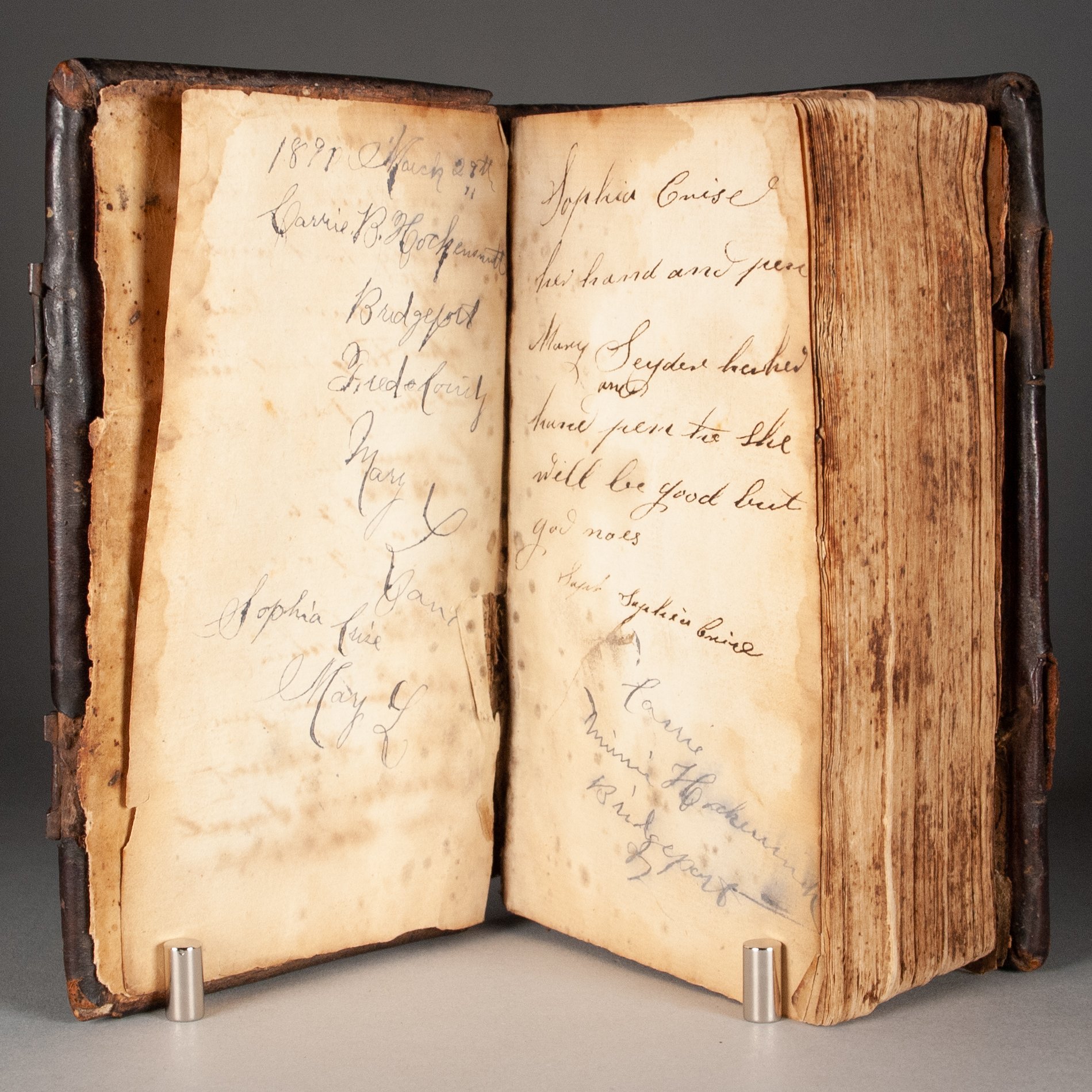
PROVENANCE: Owned by four different women across the 19th century, with their names, inscriptions, and pen trials scattered across two fly-leaves at front: Sophia Crise (or Krise; b. 3 Oct 1800) of Frederick County, Maryland; Mary Seyder; Carrie B. Hockensmith, dated 28 March 1891; and Carrie's sister Minnie, both of Bridgeport, Frederick County, MD. We tend to associate German settlers with Pennsylvania, though the steadily rising cost of land there encouraged some to look elsewhere as the 18th century advanced. Frederick Country, Maryland, was one such new Canaan. "The abundance of unoccupied land which was at once cheap and fertile, a legal system which offered a large measure of civil and religious liberties, and the guarantee that property rights would be protected and secure were strong magnets for those seeking better opportunity for themselves and their families. By 1790 Germans formed fully fifty percent of the county's population" (Kessel).
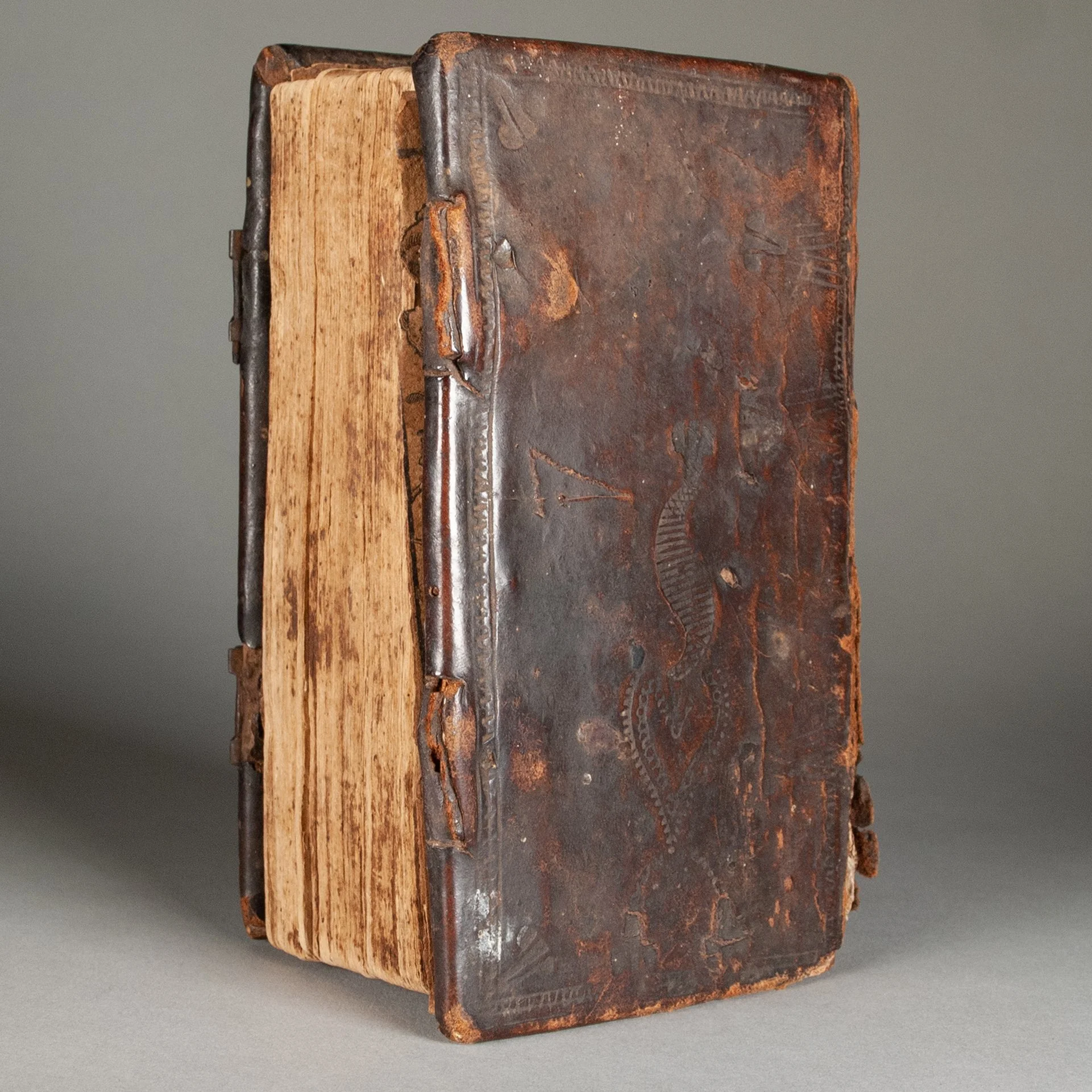
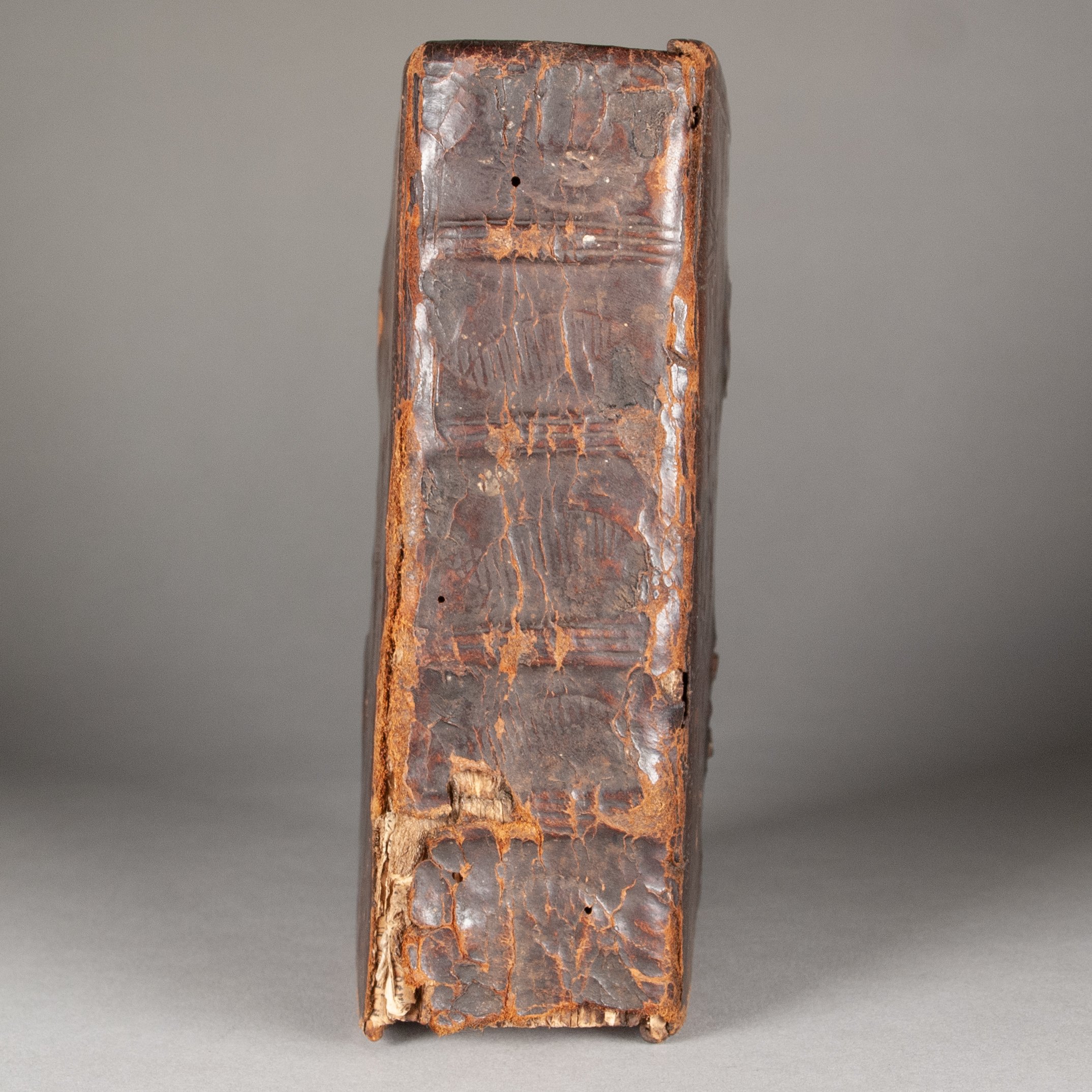
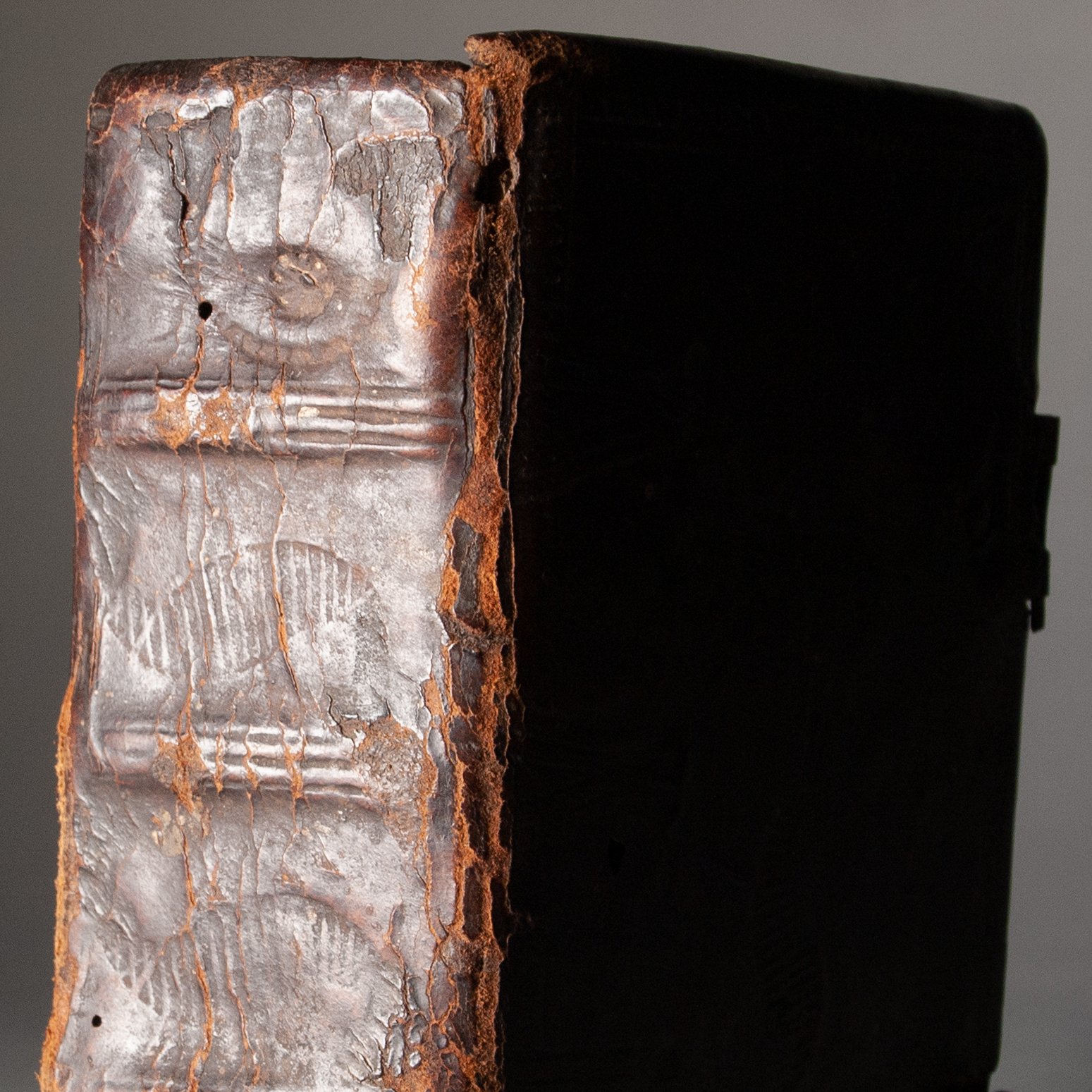
CONDITION: Brown leather over wooden boards, and tooled in blind: the covers framed with a pair of overlapping rolls, decorated rather liberally with a tool representing the three holy nails, and each cover dominated by an unusual stacked design of holy nails, a wavy cartouche, and a heart atop an arch. The three middle compartments of the spine use the same cartouche tool, with a circular motif in the top and bottom compartments. Retaining the catchplates of old steel clasps, not the brass you'd typically expect. With a full-page woodcut as a frontispiece, and occasional notated music. ¶ Trimmed quite close, occasionally just grazing some text; darkened with age, and some mild dampstaining; 2" closed tear in (H)3, affecting text, and open tears in (X)2-3, with perhaps a square inch of loss. The binding certainly roughed up, its hinges split, fully detached at the front, but still hanging on at the back; leather split two-thirds up the rear joint, with some loss in the bottom spine compartment; spine a bit cocked; leather covering the lower catchplate lost (nicely exposing the steel) and leather straps lost; rear endpaper (almanac title page) partially skinned, a bit shaky and askew, but holding; old front fly-leaf torn away, leaving just traces of German inscriptions.
REFERENCES: ESTC W6292 ¶ On the content: Frederick R. Goff, "German Folk Bindings on 'Philadelphia' Books of 1774," Gutenberg Jahrbuch 1968, p. 324 (cited above; "From an examination of all four editions represented in the Library of Congress, it is certain, as Charles Hildeburn pointed out many years ago, that these were printed in Germany rather than in America."), 329-330 (on the possible place of printing); Claudio Bacciagaluppi,Artistic Disobedience: Music and Confession in Switzerland, 1648-1762 (2017), p. 47 (on Lobwasser’s source); Bodo Nischan, Prince, People, and Confession: The Second Reformation in Brandenburg (1994), p. 153 (“While Lobwasser was nominally a Lutheran, he had Calvinist sympathies and has been variously described as a Philippist or crypto-Calvinist. His translation of the Huguenot psalter, prompted by both humanist and religious considerations, played an important role in the spread of Reformed ideas in Germany. Calvinists quickly recognized its propaganda value, just as Lutherans viewed the singing of Lobwasser’s psalms—the ‘siren song of Calvinism’—as a sure mark of confessional deviation.") ¶ On the binding and provenance: Willman Spawn and Thomas E. Kinsella, American Signed Bindings through 1876 (2007), p. 17 (cited above; "The itinerant binder was rebinding mostly German texts, staying close to the German communities and repairing their well-worn service books, hymnals and Bibles. The craftsmanship of this binder is unmistakable."); Elizabeth Augusta Kessel, Germans on the Maryland Frontier: A Social History of Frederick County, Maryland, 1730-1800 (Ph.D. Dissertation, Rice University, 1981, v. 1, p. iii (cited above)
Item #895