
Printed book as friendship album
Printed book as friendship album
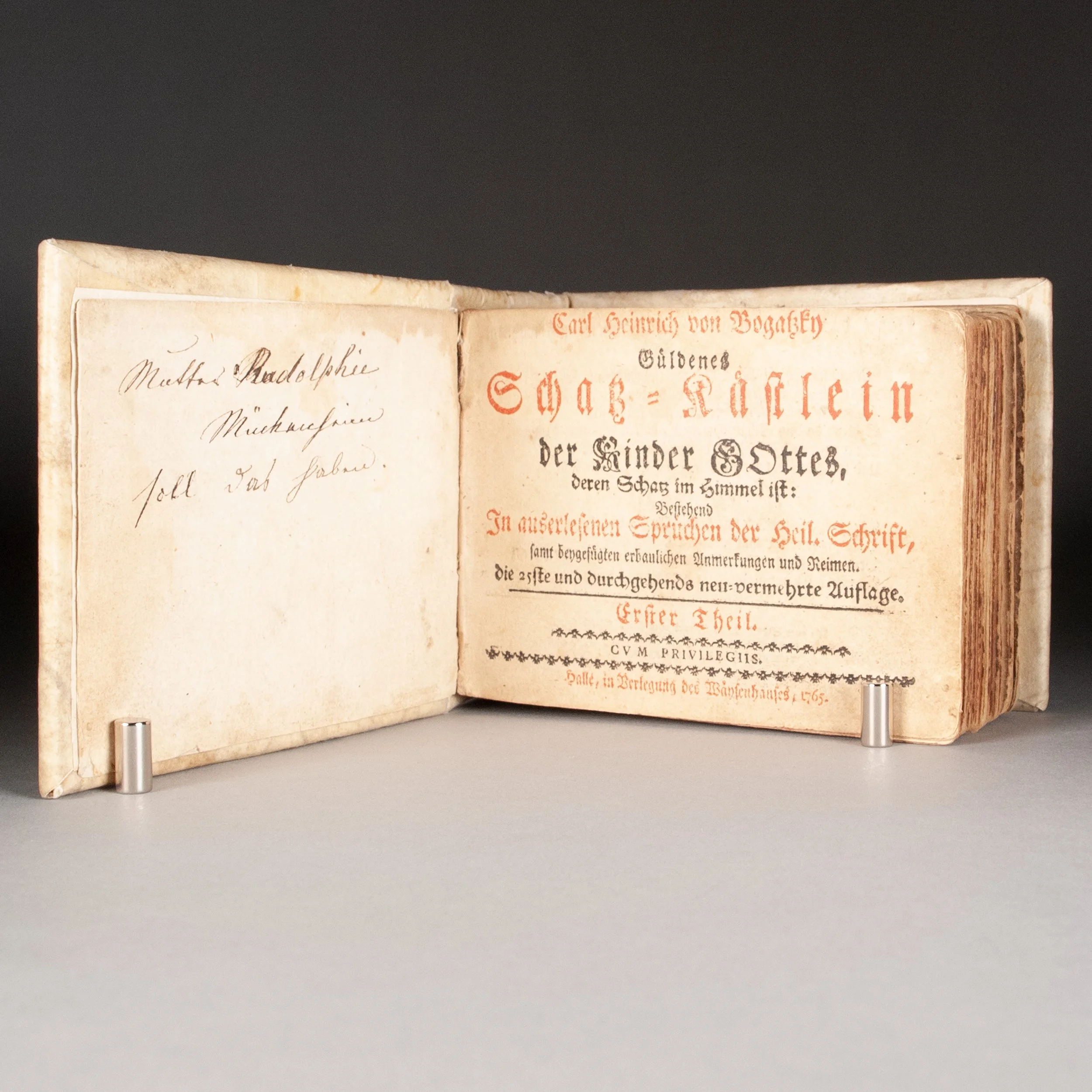
Güldenes Schatz-Kästlein der Kinder Gottes, deren Schatz im Himmel ist; bestehend in auserlesenen Spruchen der Heil. Schrift, samt beygefügten erbaulichen Anmerkungen und Reimen; die 25ste und durchgehends neu-vermehrte Auflage
by Carl Heinrich Bogatzky
Halle: In Verlegung des Wäysenhauses (Orphanage at the Francke Foundations), 1765
[4], 300, [2], 301-365, [12] leaves | a^4 A-Z^16 chi^4(-chi4?) Cc^8 | 91 x 115 mm
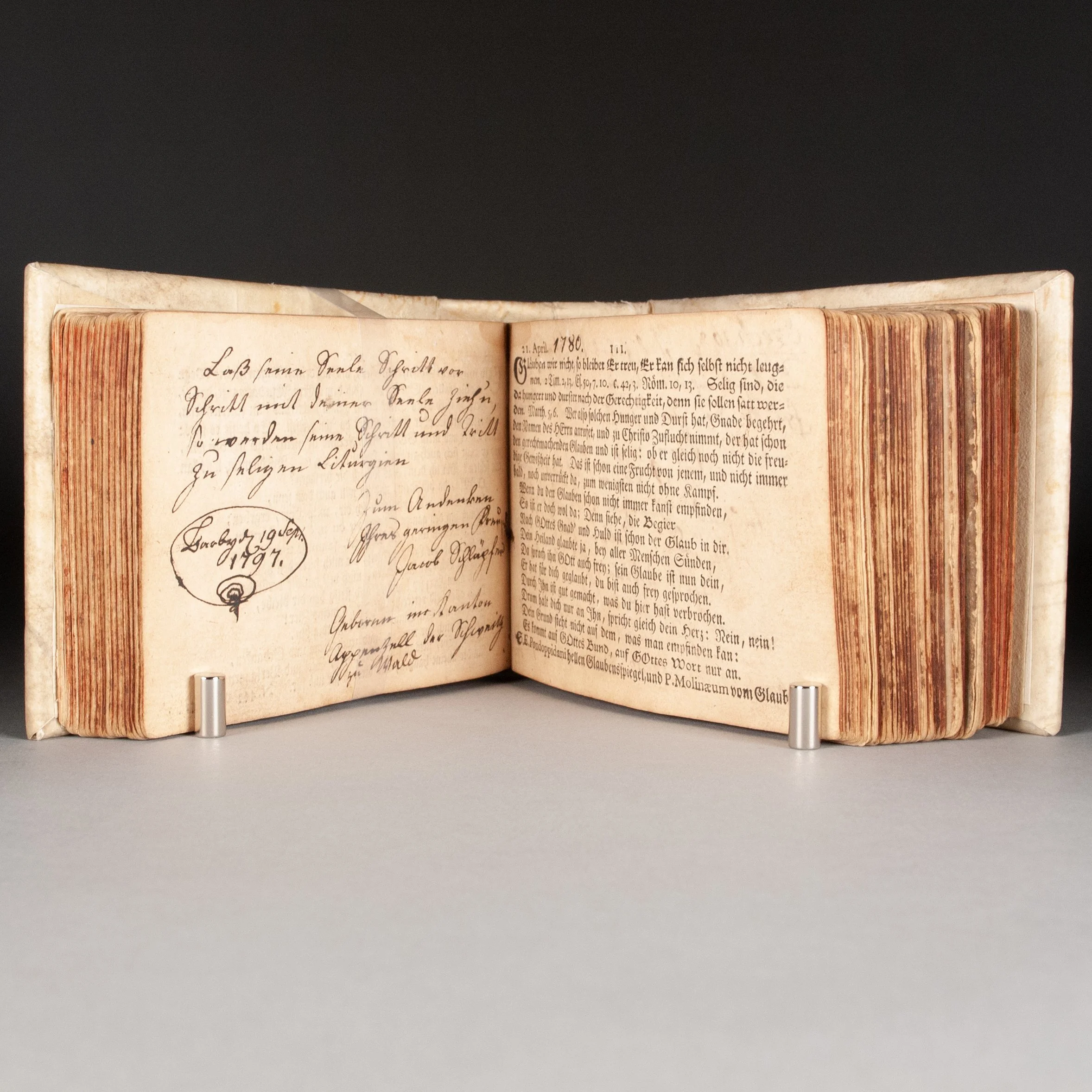
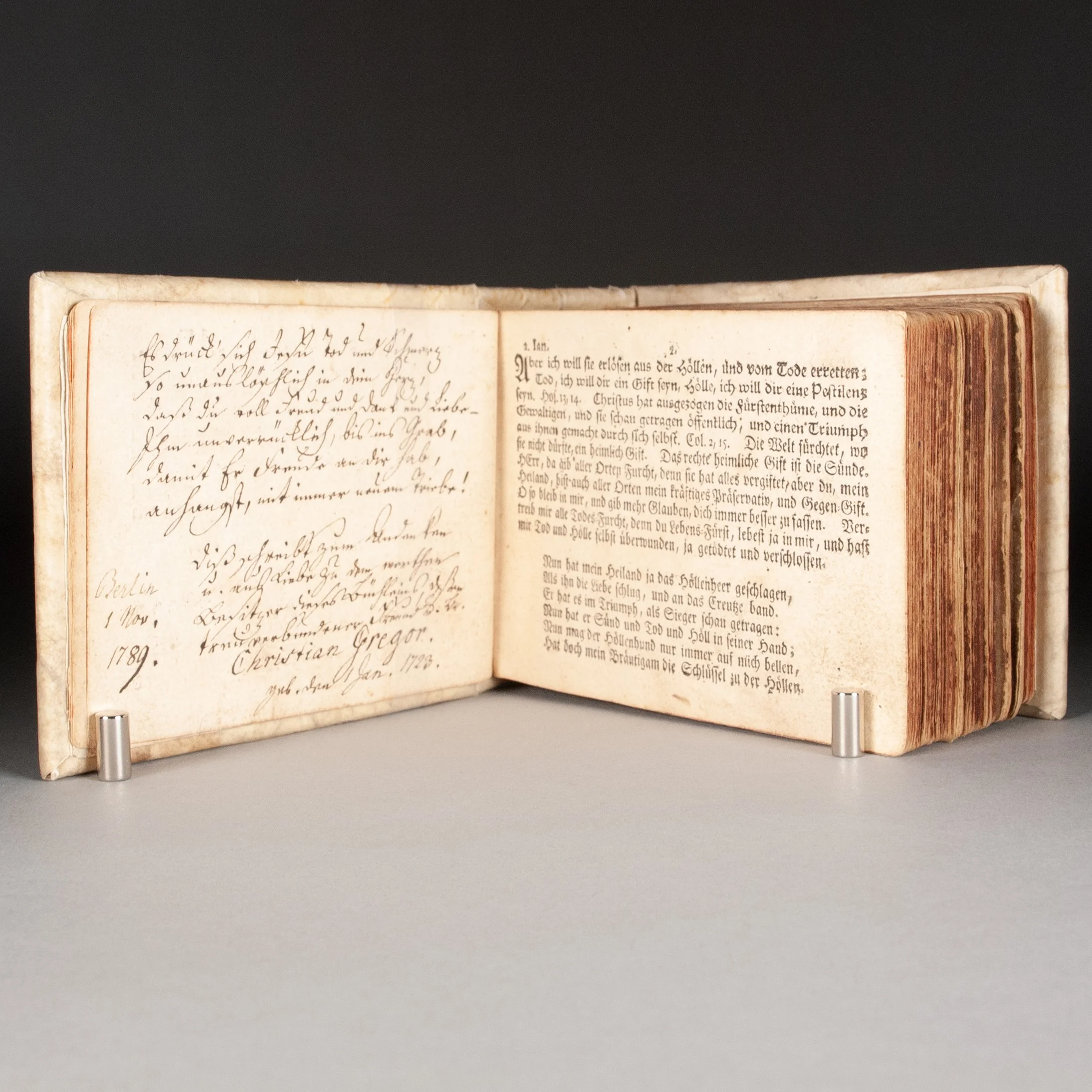
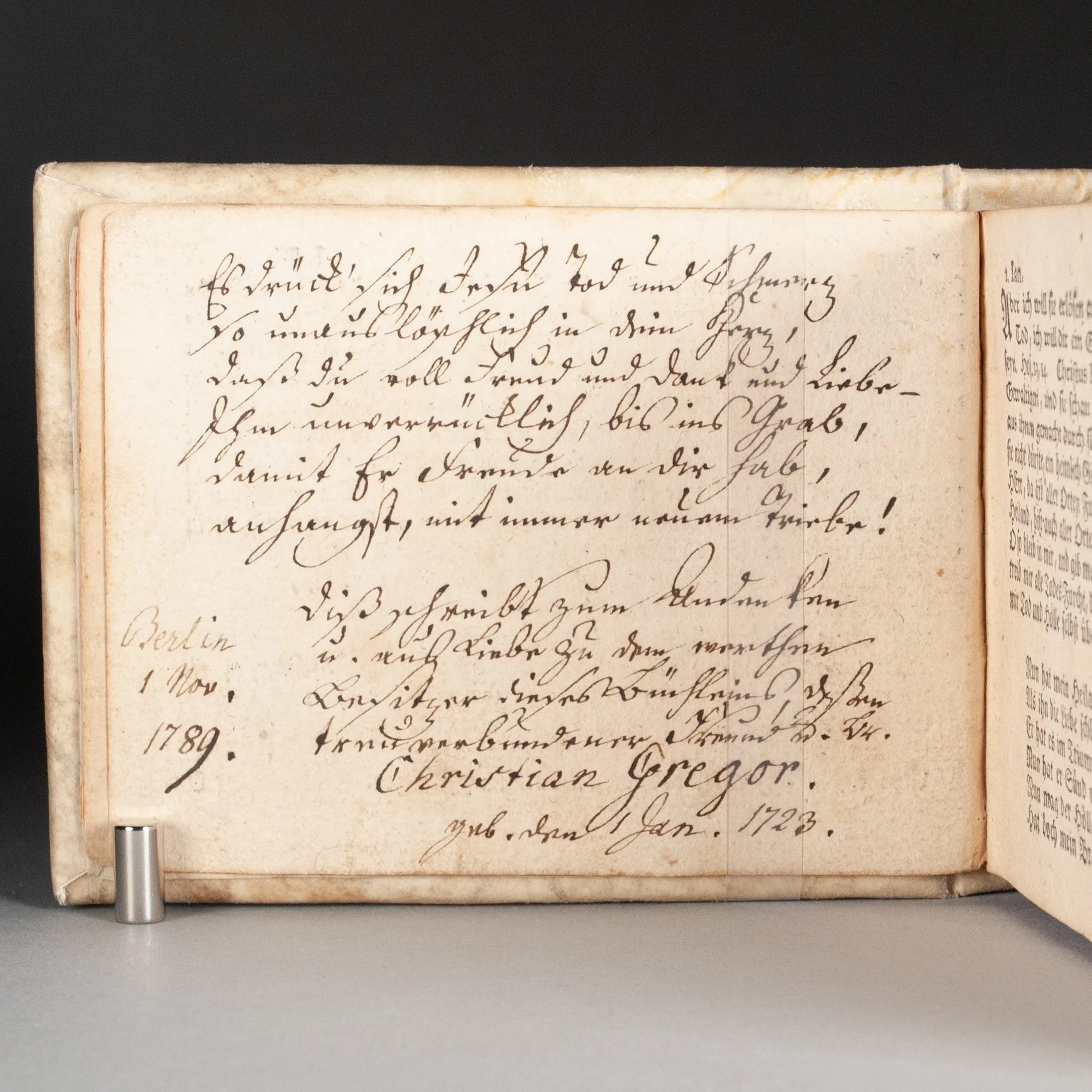
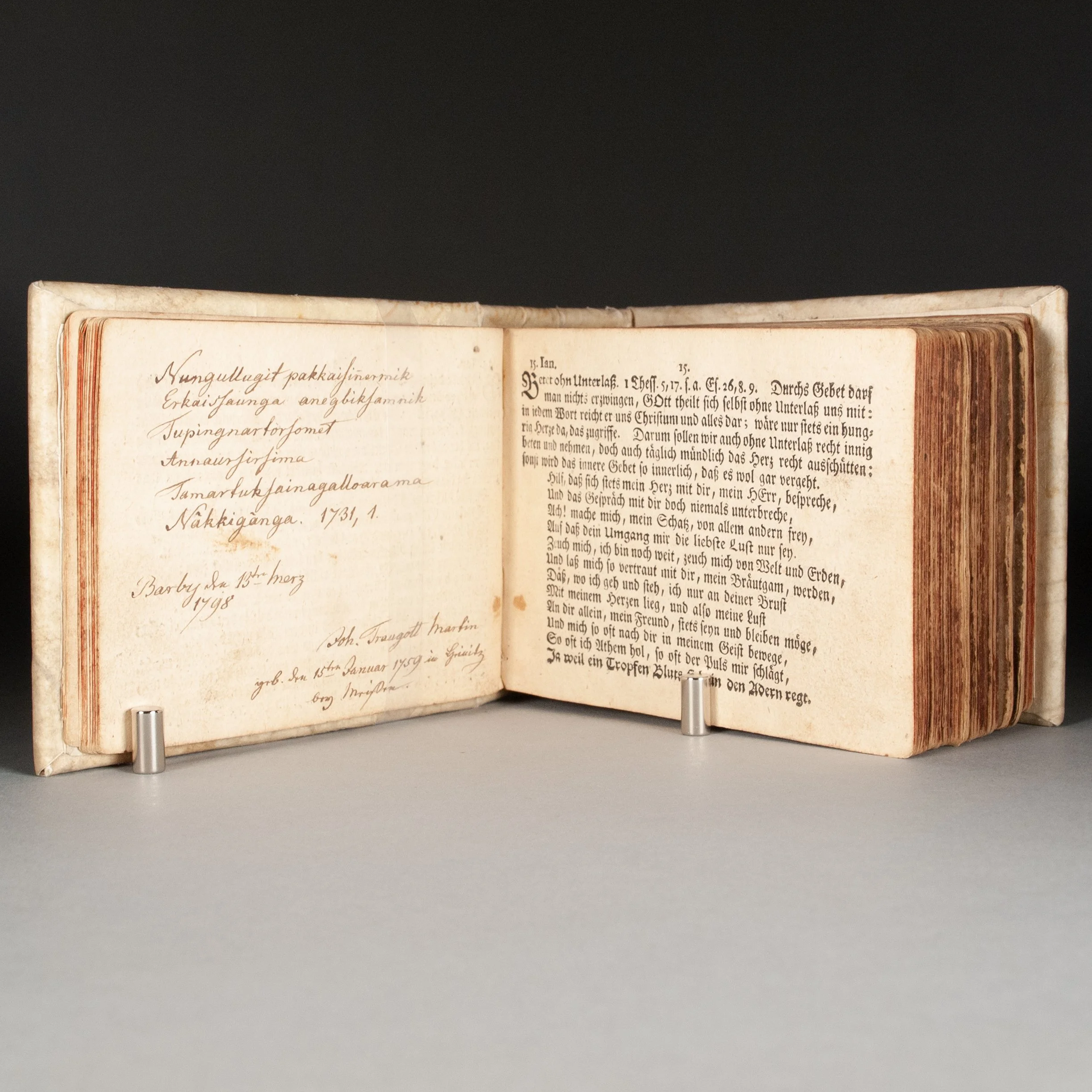
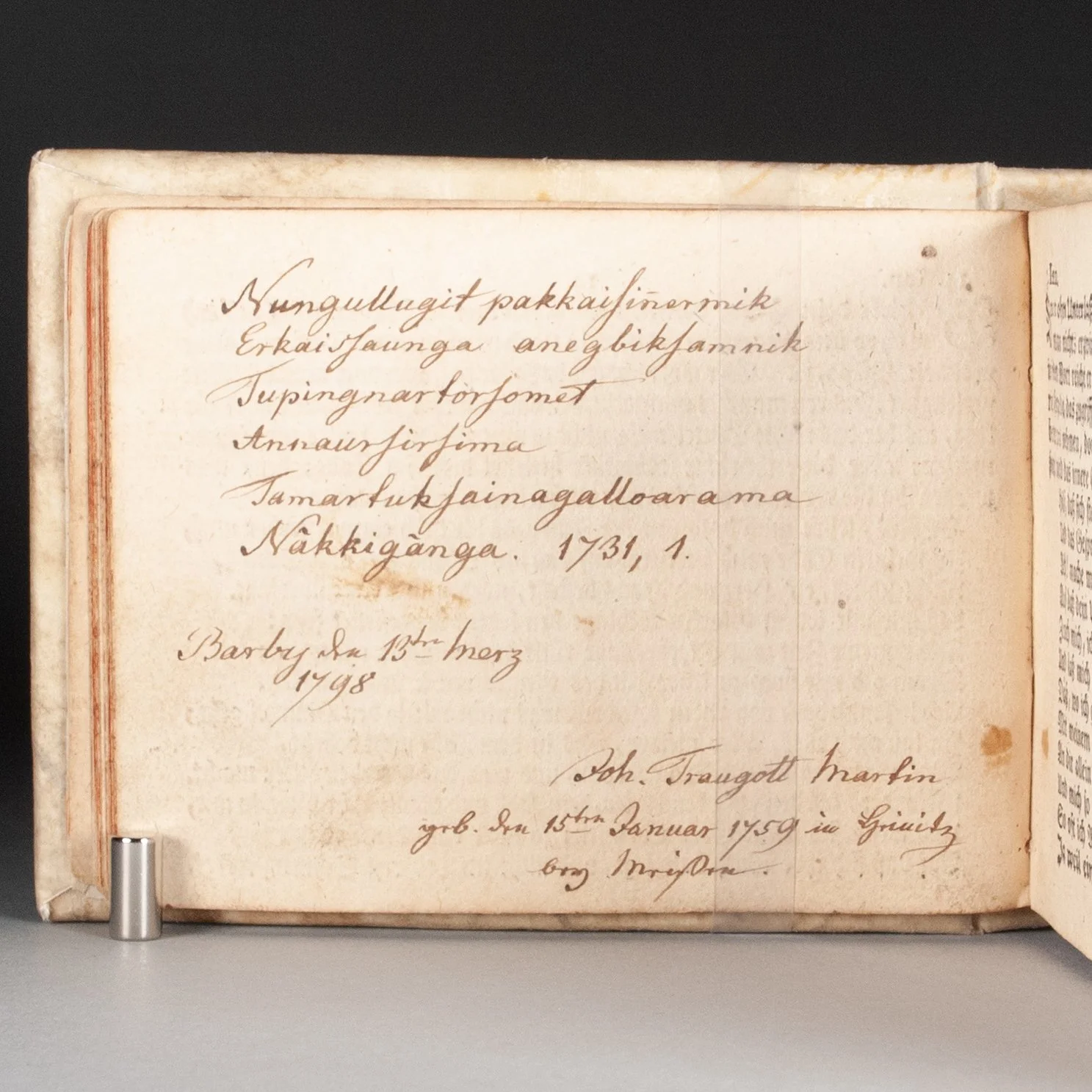
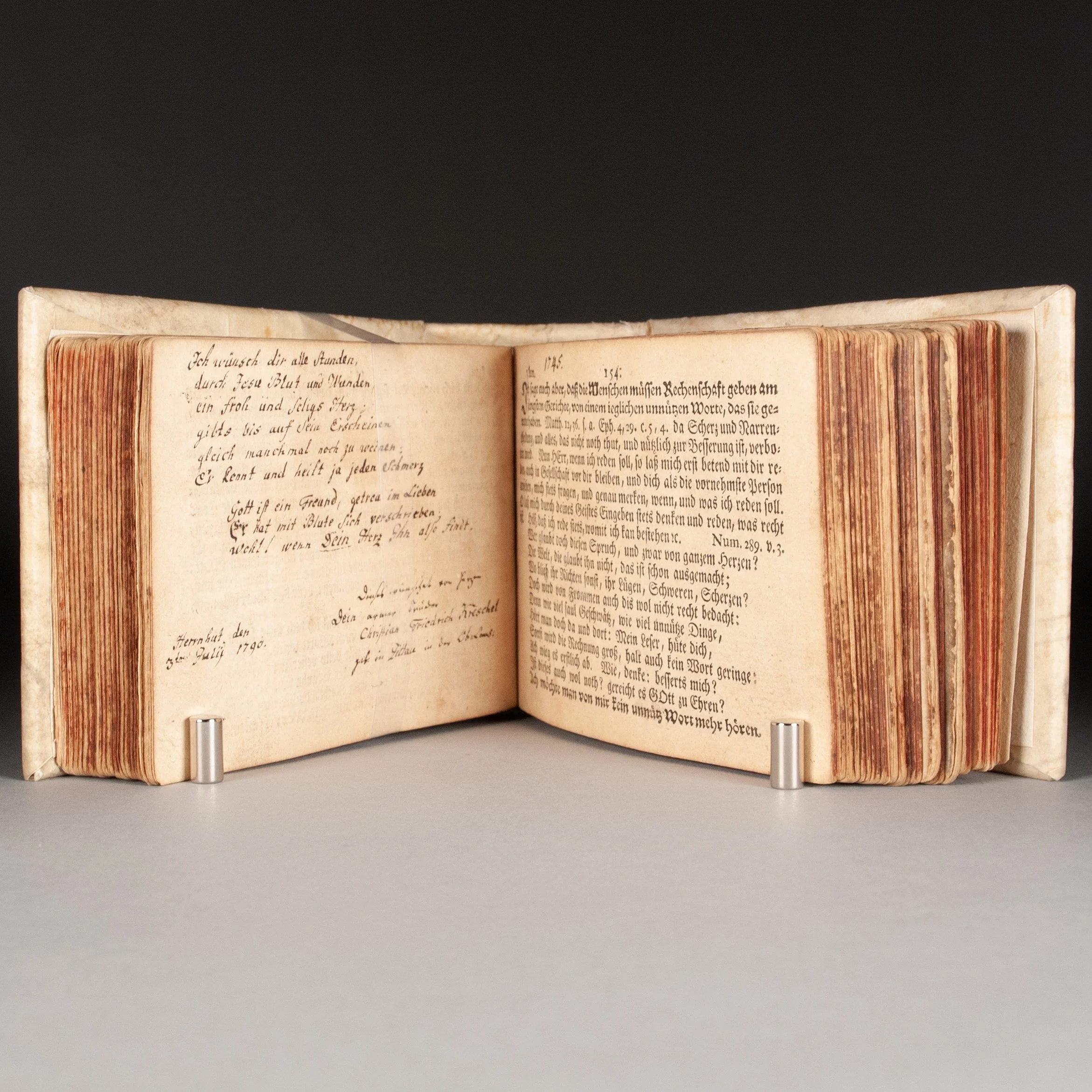
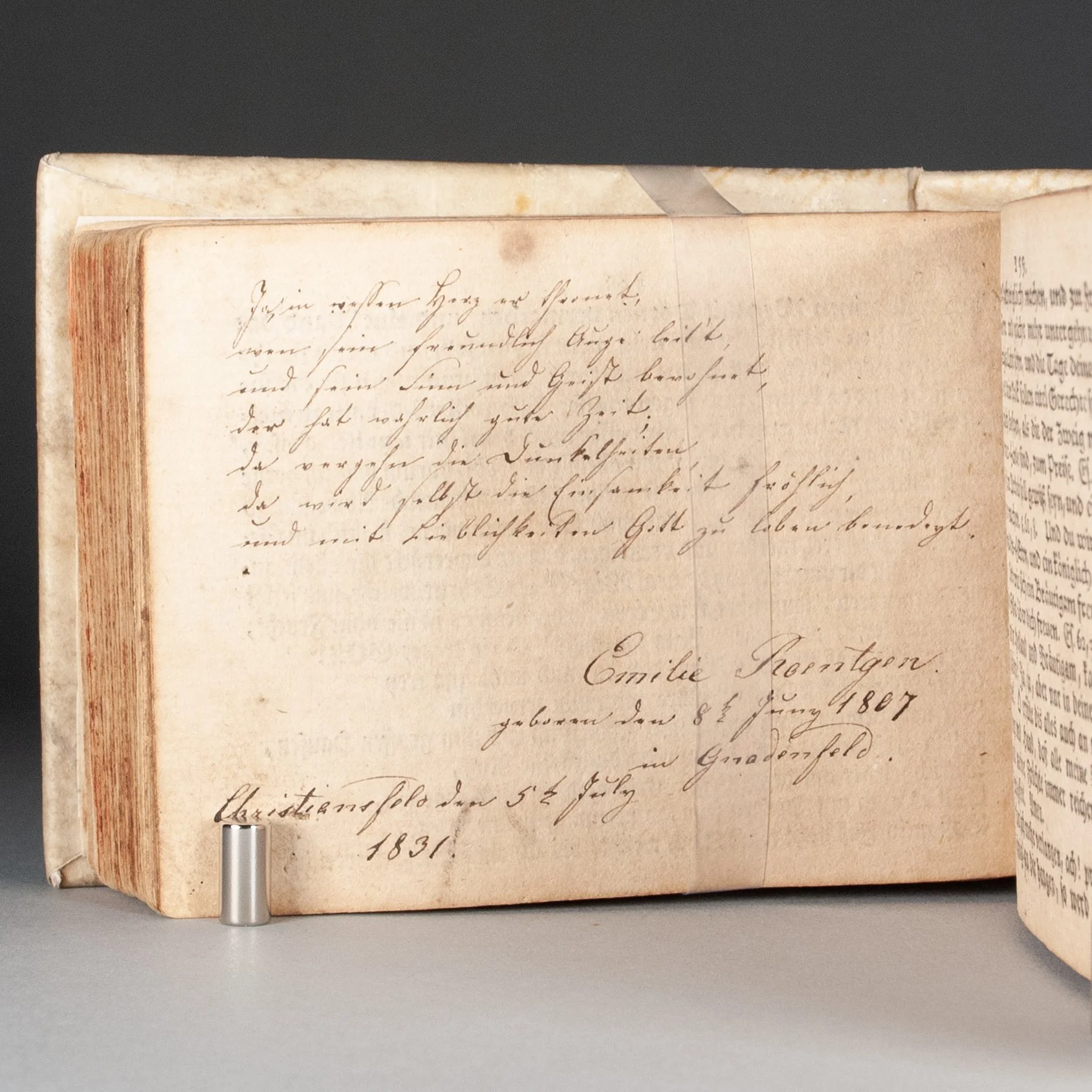
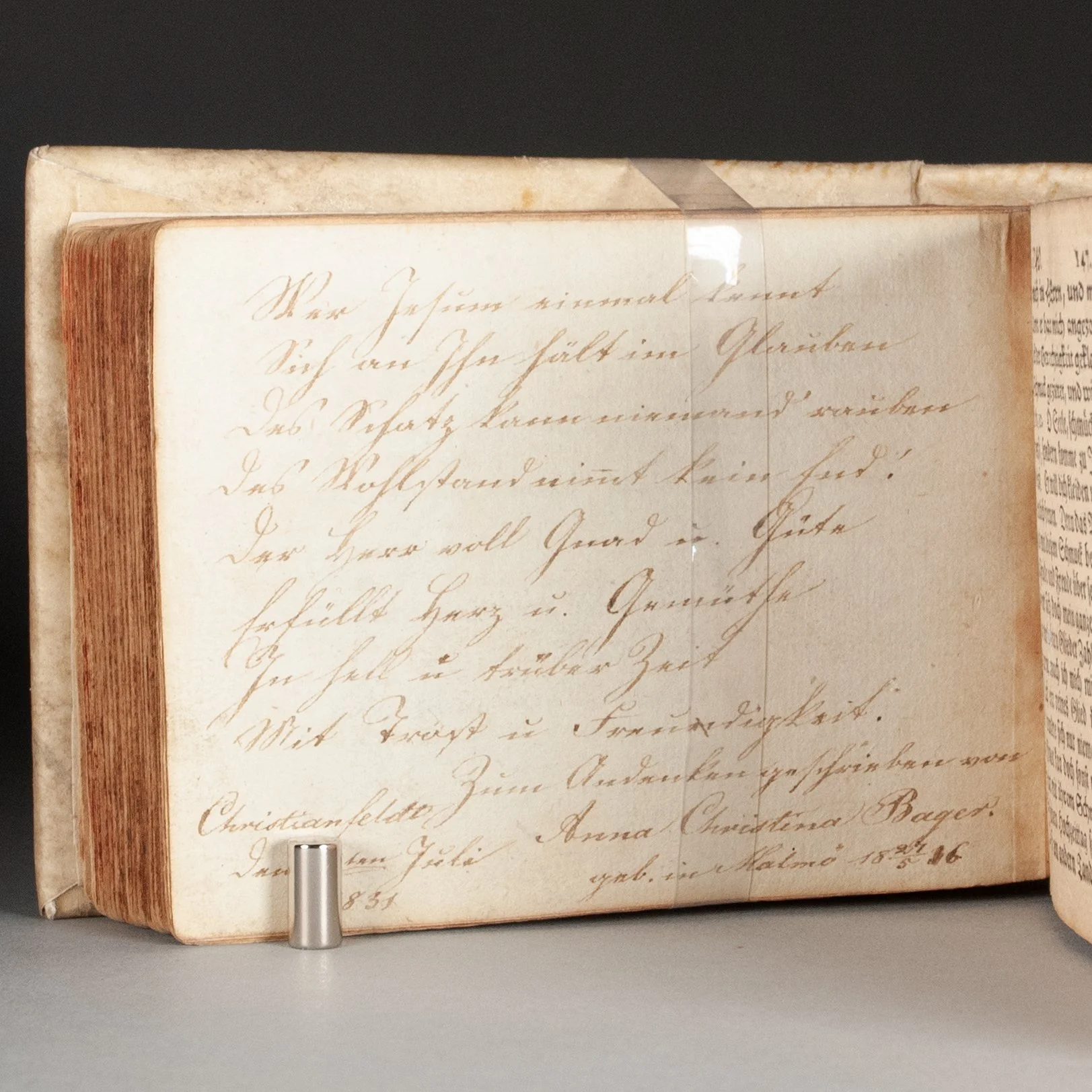
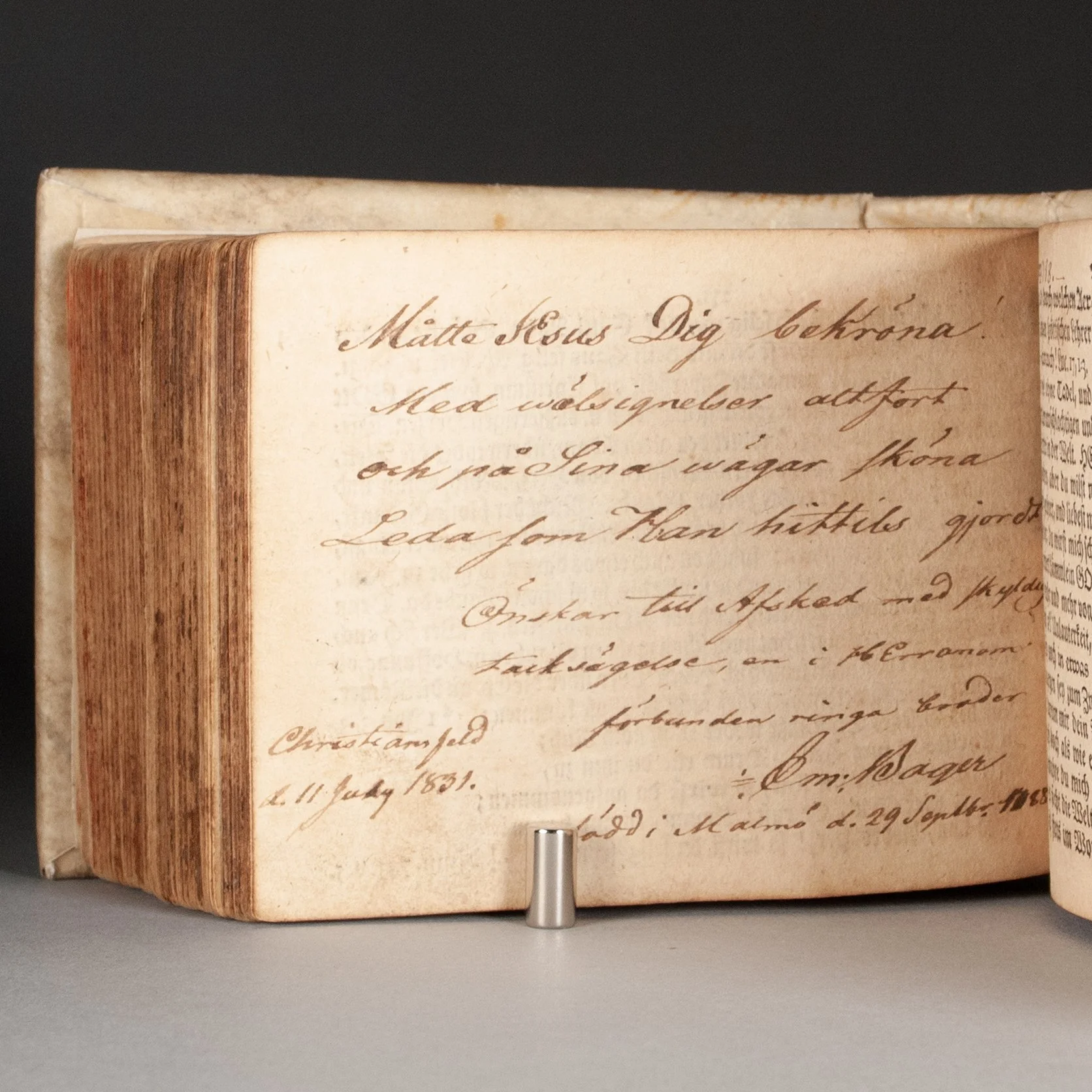
Stated 25th edition of this Pietist treasury of scripture for children, "enormously popular," even in England and America. The book was in print by 1728 and remained so even into the twentieth century. Our edition, like all others, was published to help fund the city's orphanage, part of the ambitious social programming of the Franckesche Stiftungen founded in 1695. The content is structured as a daily calendar, its reader intended to meditate daily on a single leaf, each containing a bit of scripture and accompanying commentary. Far more intriguing, the author suggests the book might also be used as an album amicorum, or friendship album (see the final preliminary leaf: manche auf die leere Seite Christliche Freunde zu erbaulichen Andenken etwas einschreiben lassen, und solches, an statt eines Stammbuchs zu gebrauchen pflegen). ¶ Sure enough, our copy was used just like an album amicorum, with 143 inscriptions scattered across the book's blank versos. These typically include a bit of religious verse, a memento of the occasion, and a note indicating where and when the author was born. The inscriptions appear to belong largely to members of the Moravian Church, in Barby especially. For most of the later 18th century, Barby was home to an important Moravian seminary—unsurprising context, as alba amicorum had long been especially popular among Protestant students. Entries range from 1789 to 1838. They were written at a number of German towns beyond Barby— Karlsbad, Herrnhut, and Niesky, for example—but also occasionally abroad, at Amsterdam and Christiansfeld, Denmark. ¶ The opening entry, dated at Berlin on 1 November 1789, is by Christian Gregor, a Moravian bishop and composer who exerted a tremendous influence on Moravian music. One of the most remarkable must be that written in Greenlandic by Johann Traugott Martin (fol. 14), a Moravian missionary who had been stationed in Greenland, where he developed "an unusually deep knowledge of the Inuit language" (Gordon). He dated his inscription 13 March 1798, before going to Labrador later that same year. Anna Christina Bager of Malmö added her inscription to an inserted leaf, dated 11 July 1831 at the Moravian settlement of Christiansfeld, Denmark (facing fol. 147). Our book's owner picked up inscriptions from a number of young women in Christiansfeld, with one each in Swedish and French (fol. 271 and 184, respectively). Other inscriptions belong to Johannes Baptista von Albertini, a mycologist who studied at the Barby seminary (fol. 47), plus politicians and statesmen, bishops and theologians, and even members of a cabinetmaking family. ¶ The album amicorum, or Stammbuch, was one of the most popular genres of manuscript in early modern Germany, common especially among northern European students leaving home for university. Its origins can be traced to Reformation Wittenberg, when students would ask Luther and Melanchthon to autograph their Bibles, a practice that quickly gave rise to the dedicated Stammbuch as we know it. "Melanchthon, as his contemporary biographer notes, apparently spent an 'incredible' amount of time and effort on these entries" (Rublack). Professors and fellow students would supply their autographs, often accompanied by a pithy inscription, or sometimes a drawing, much as school yearbooks are used today. Oblong formats like ours were standard. By no means limited to students, travelers might carry an album with them to document meetings with friends and notables, and the album could even be sent by post with solicitations for contributions. Examples taking a printed text as their platform are certainly atypical, but not without precedent. Emblem books, for example, were occasionally pressed into such service. And of course the author here expressly suggests that particular use. W.W. Schnabel's Repertorium Alborum Amicorum reports six other copies of this book so used. ¶ A wonderful little hybrid, combining print intended for daily consumption with highly personal manuscript.
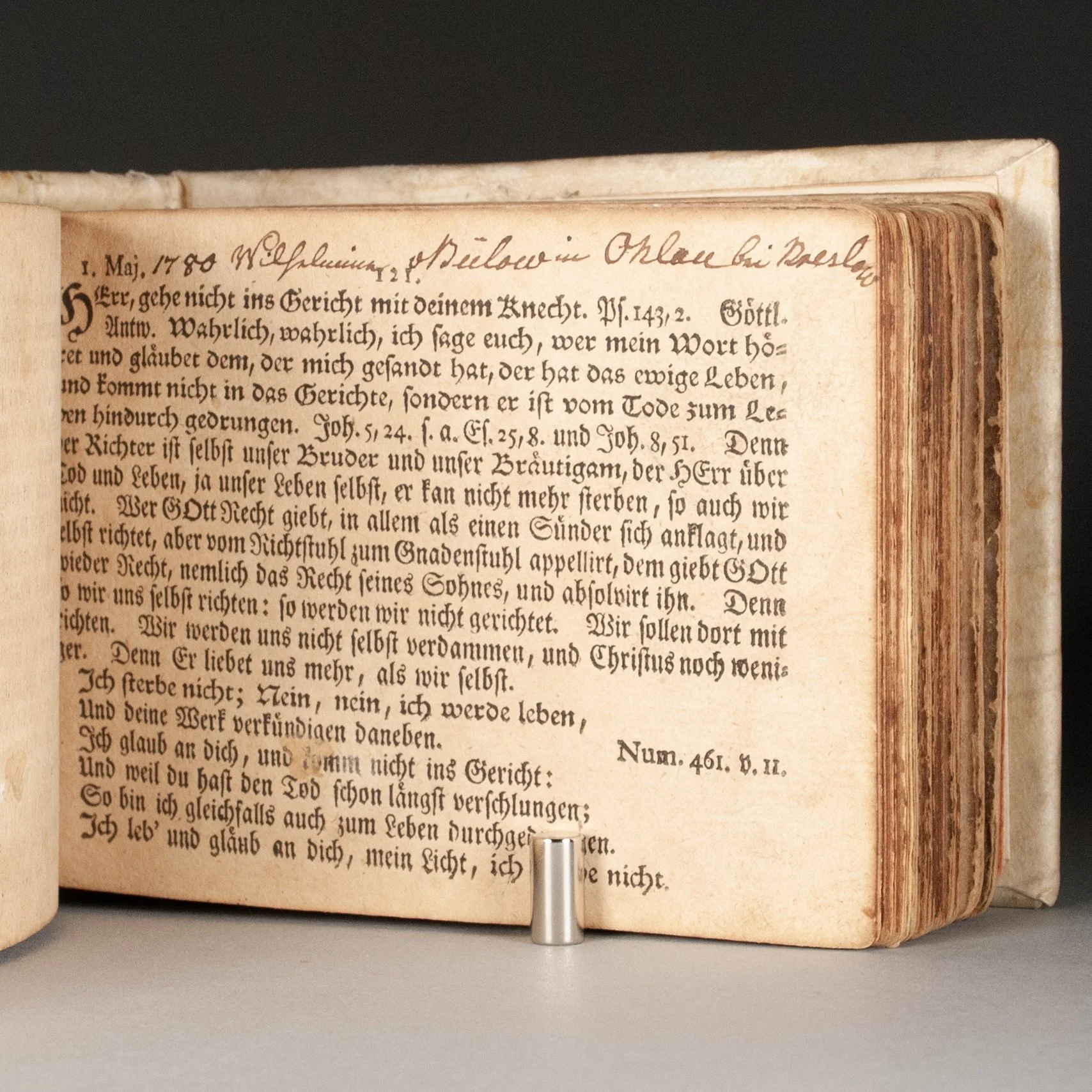
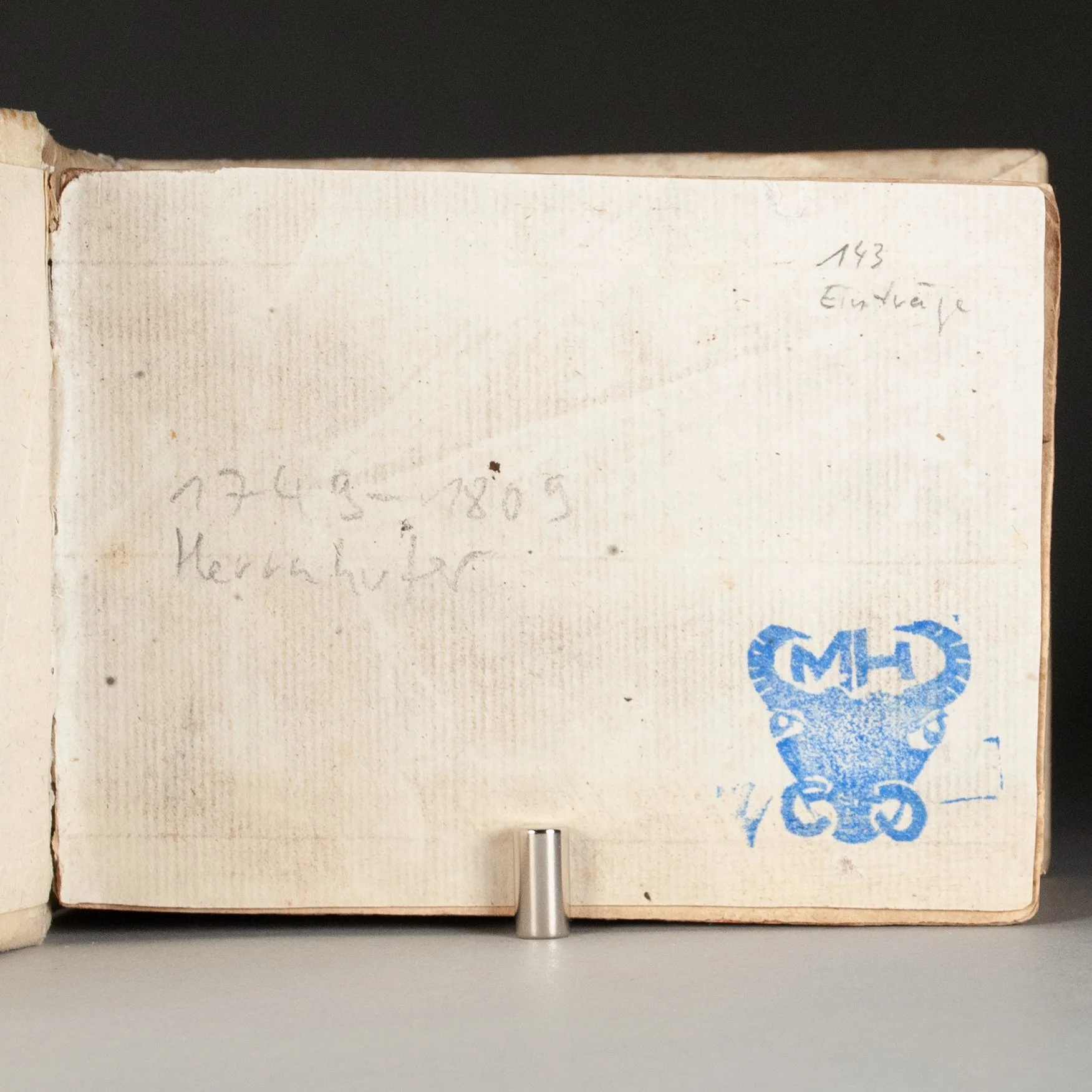
PROVENANCE: Old ownership inscription of one Rudolphie(?) on the front fly-leaf, this person perhaps the collector of autographs. Taken together, the inscriptions suggest an itinerant owner—Amsterdam in 1792, Denmark in 1831, to say nothing of the several towns in Germany—but one who passed through Barby with some regularity. We wonder if the owner was himself a Moravian missionary. ¶ Inscriptions are written on the blank page facing that of the author's birthday (and so their birth years are typically penned beside the printed date). Rather than offering full-page inscriptions, a handful of others have simply signed their name beside the date corresponding to their birthday (see fol. 121, for example). A later owner has penciled on some printed pages identifying details for the authors. ¶ Modern blue ink stamp on front fly-leaf with initials MH.
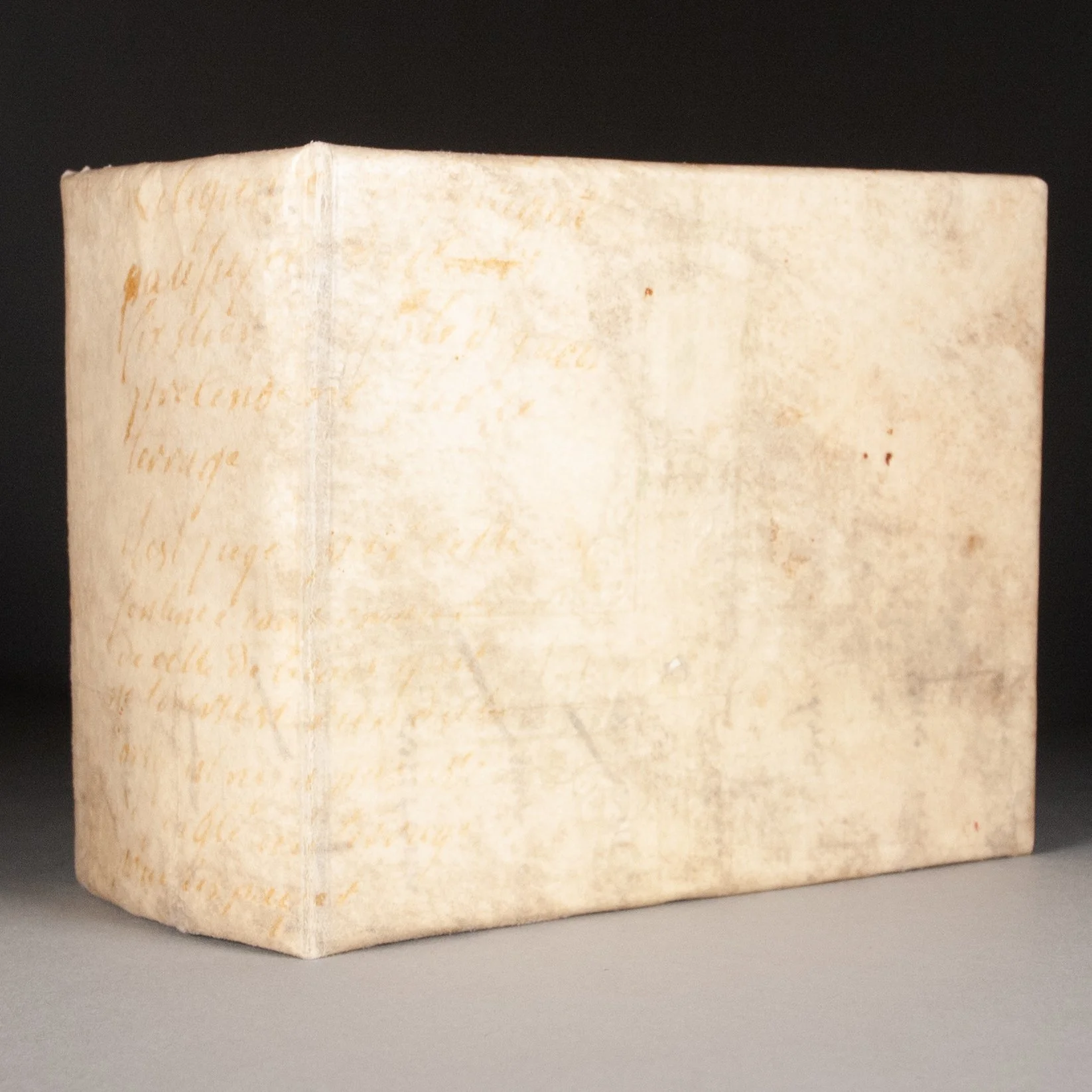
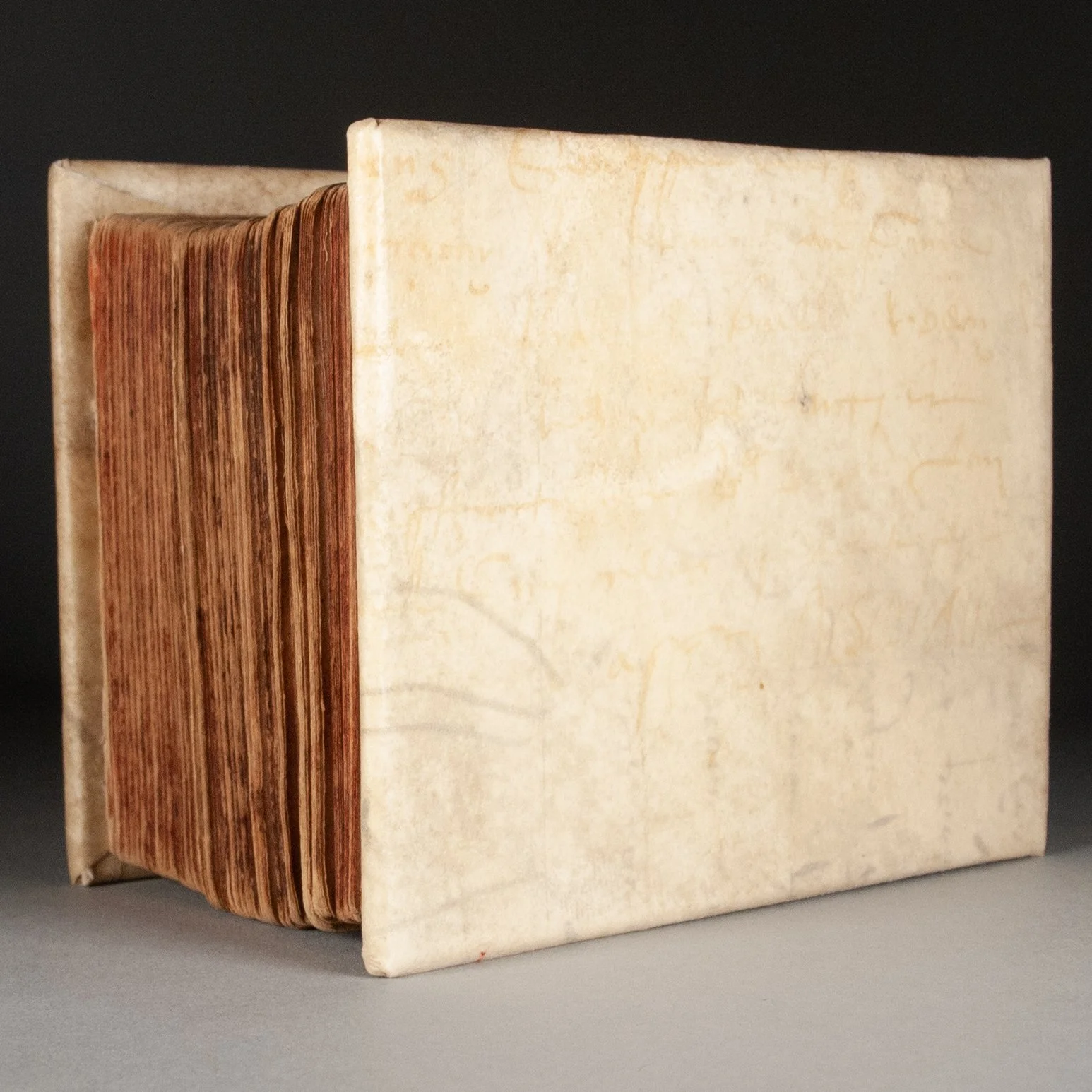
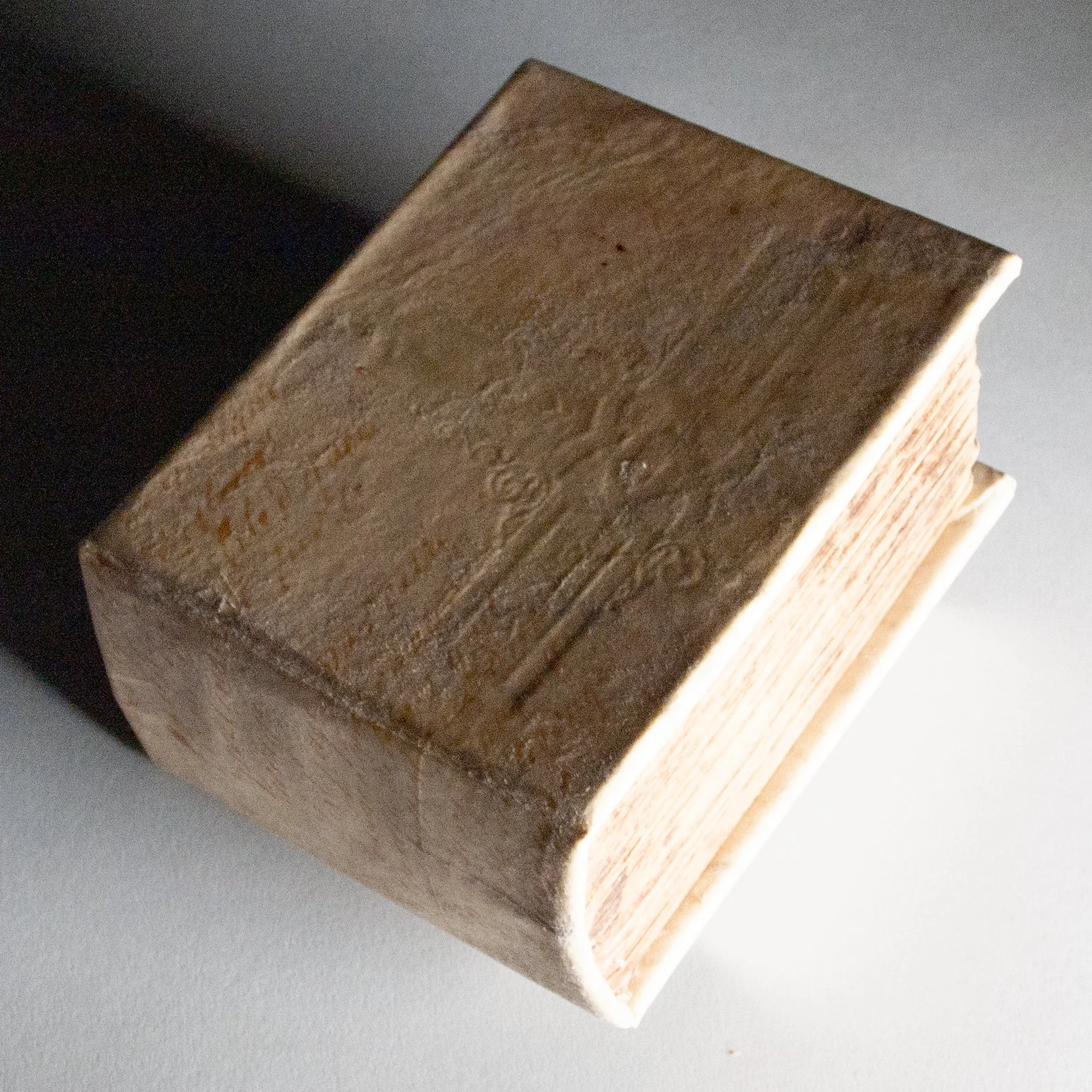
CONDITION: Modern parchment over boards, reusing an old document, but also with vestiges of embossed decoration; new endpapers added. Largely printed on the rectos only, many blank versos with inscriptions, as described above. With a separate divisional title page on the folio following 300, this likely accounting for the erster Theil notice on the title page. The book follows the foliation of earlier editions and is by all appearances complete, that quirky final Cc^8 gathering notwithstanding. ¶ Fol. 140 detached (but present); small hole in fol. 322, affecting a few characters; occasional moderate soiling from thumbing and regular use; last couple gatherings with a mild dampstain in the upper right. The old parchment rubbed and with a couple of tiny stains.
REFERENCES: This edition not in VD18 ¶ Isabel Rivers, "Biblical aids, editions, translations, and commentaries by dissenters, Methodists, and Church of England evangelicals in eighteenth-century England," The Bible in early transatlantic pietism and evangelicalism (2022), "Biblical Treasuries" (unpaginated ebook; cited above; "In its passage from Germany to England, the book was taken up and modified by editors, sellers, and authors of different denominations"); Tom Gordon, Called Upstairs: Moravian Inuit Music in Labrador (2023), p. 368n59 (cited above, on Johann Traugott Martin); Suzanne Karr Schmidt, Interactive and Sculptural Printmaking in the Renaissance (2018), p. 395 (“the Stammbuch, or album amicorum, served to collect signatures, images, and classical and religious mottos. These books grew in popularity from mid-century as a means of recording travel, notes from friends, relatives or professors, and even the occasional newsworthy curiosity.”); David Paisey, "The autograph album of a journeyman bookbinder," For the love of the binding (2000), p. 241 (“Albums were kept above all by students at Protestant universities, but also by aristocrats, patricians, and members of the educated bourgeoisie, to record the distinguished and interesting persons they met, particularly teachers and other notables, but also men (and later increasingly, also women) from their own circles"); Roger E. Stoddard, "Morphology and the book from an American perspective," Printing History 17, 9.1 (1987), p. 12 (“In the sixteenth and seventeenth centuries an album amicorum could be made by interleaving a published emblem book with blanks"); Roger Stoddard, Marks in books (1985), #49 (an Alciati emblem book used in the 1560s as a Stammbuch); Ulinka Rublack, Reformation Europe (2017), p. 191 (cited above, on the Wittenberg origins of the album amicorum); Renaud Milazzo, "33. The heroic mottoes of Paradin, medium for an album amicorum," A century of typographical excellence: Christophe Plantin & the Officina Plantiniana (2020), p. 364 (a 1583 edition of Symbola heroica used as an album amicorum; "The vogue of a 'book of friends' followed in parallel that of books of emblems and mottoes and came to light in the Holy Roman Empire when denominational divisions led to the opening of new universities. Very popular among Protestant students, this fashion also affected Catholics but with less success.")
Item #904