
Nun's sex cult
Nun's sex cult
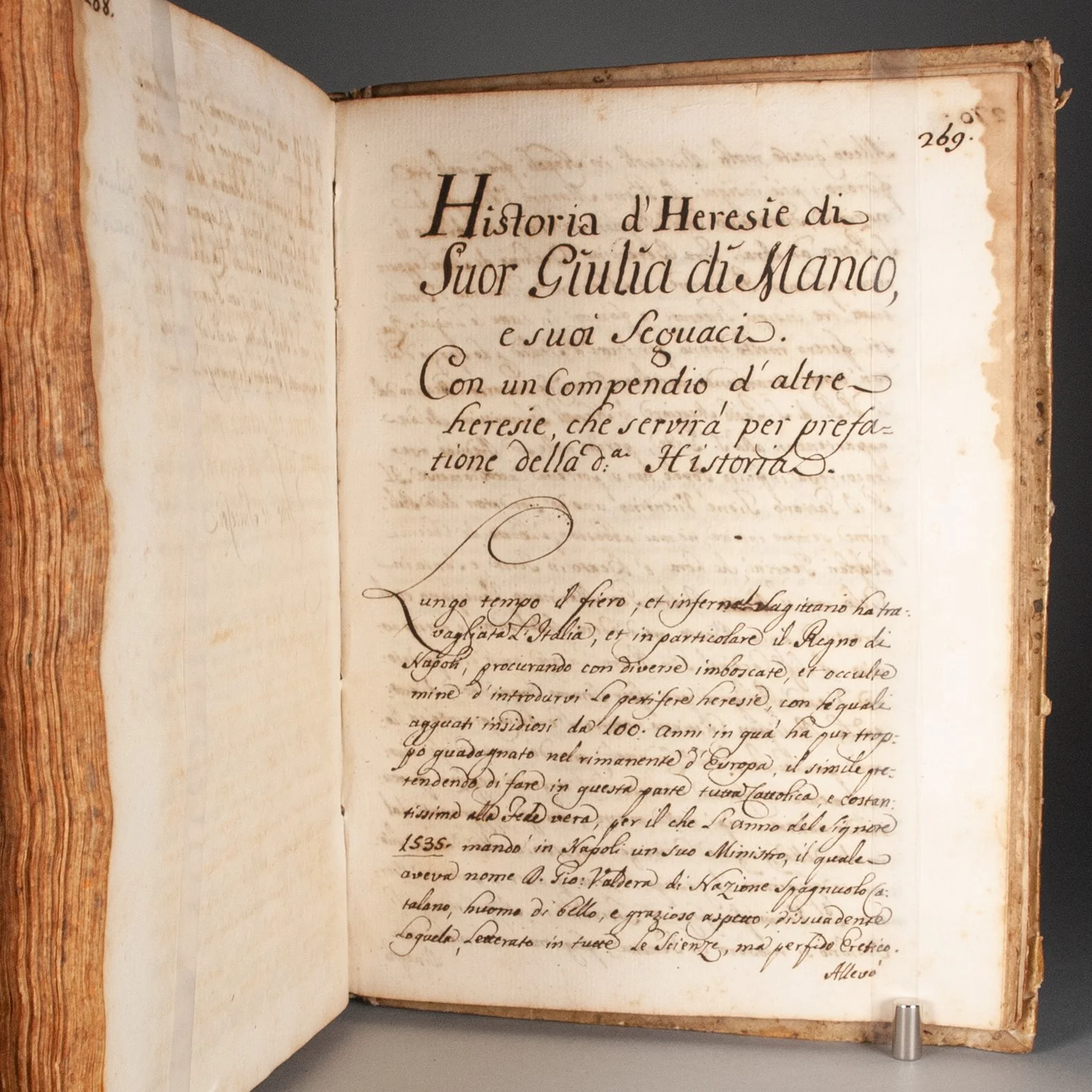
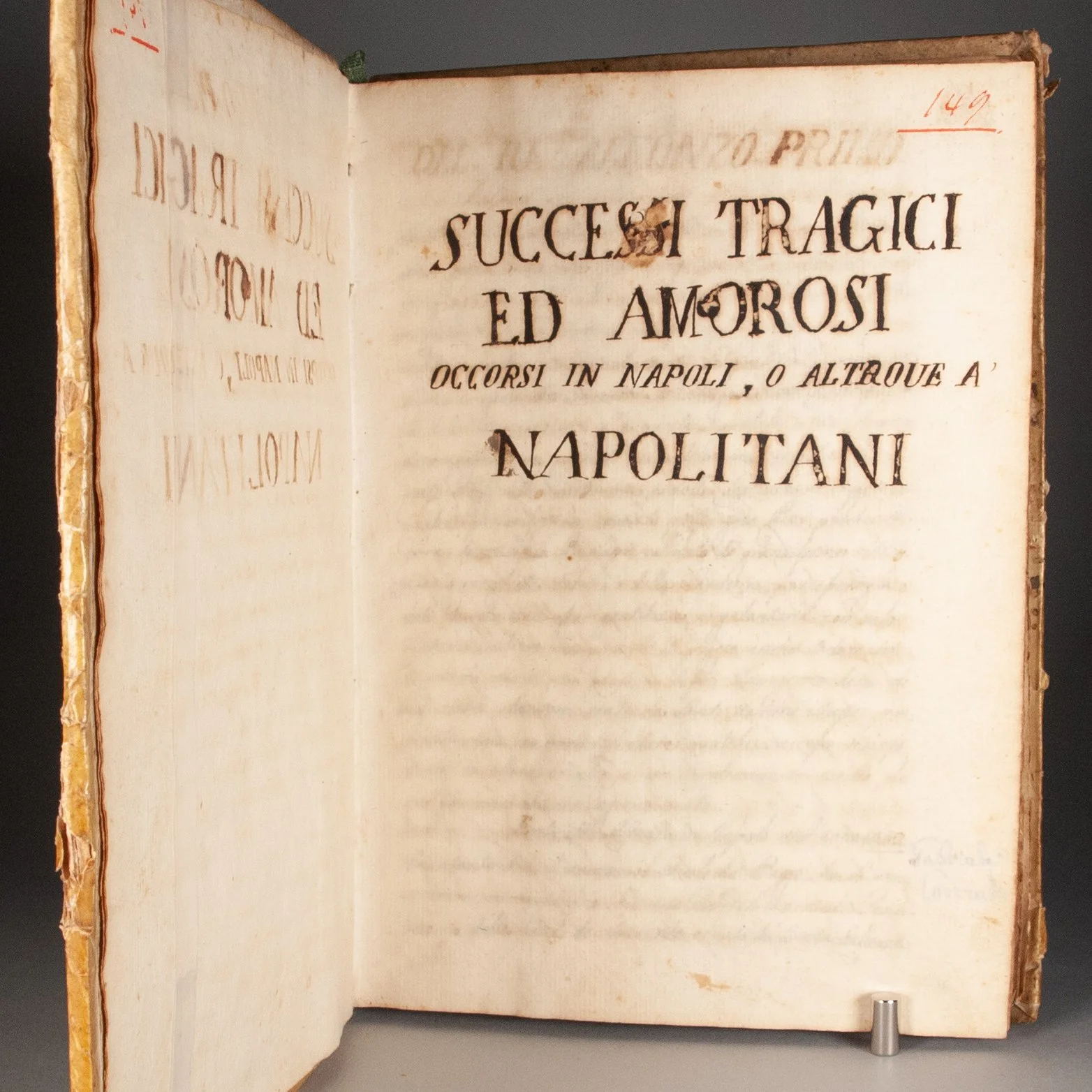
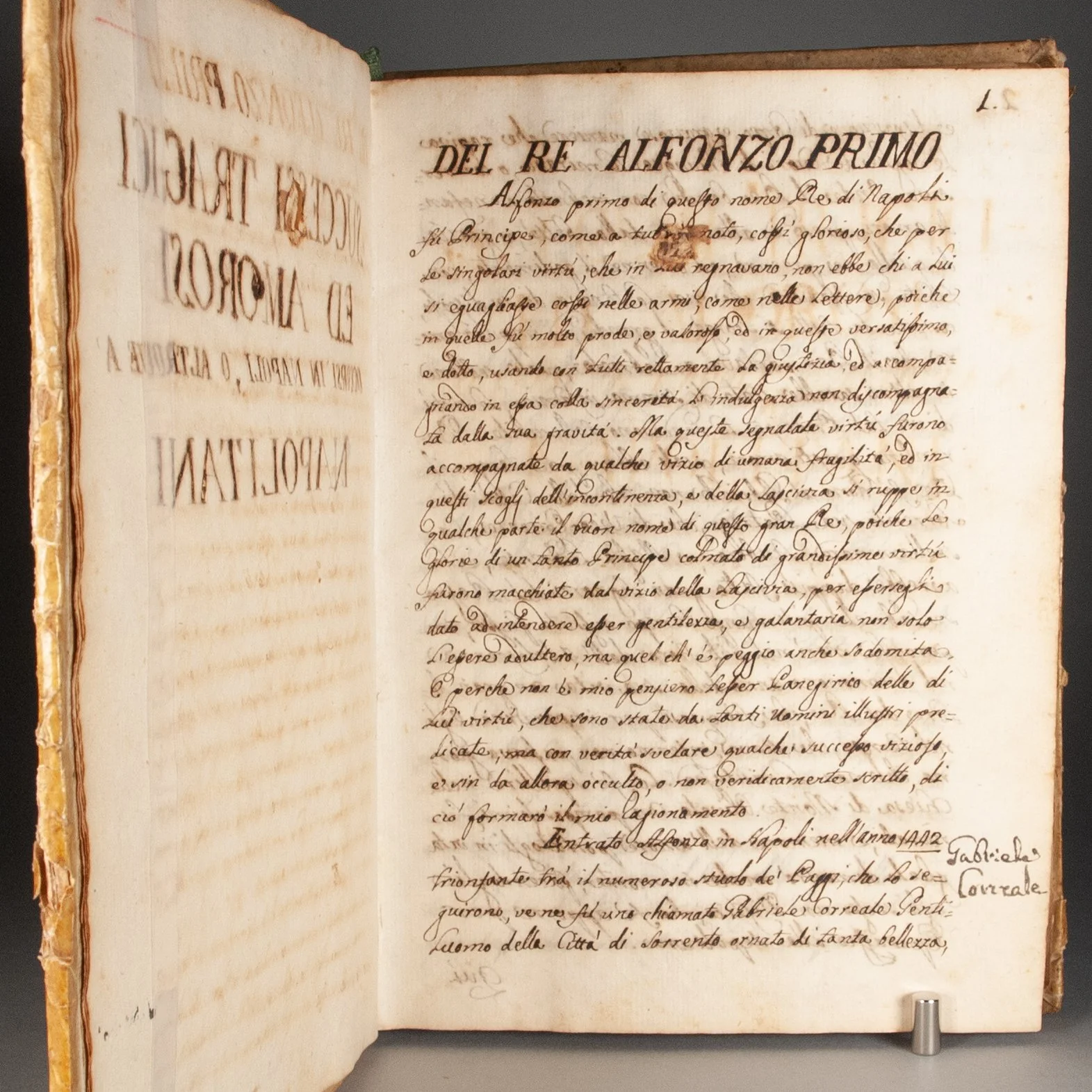
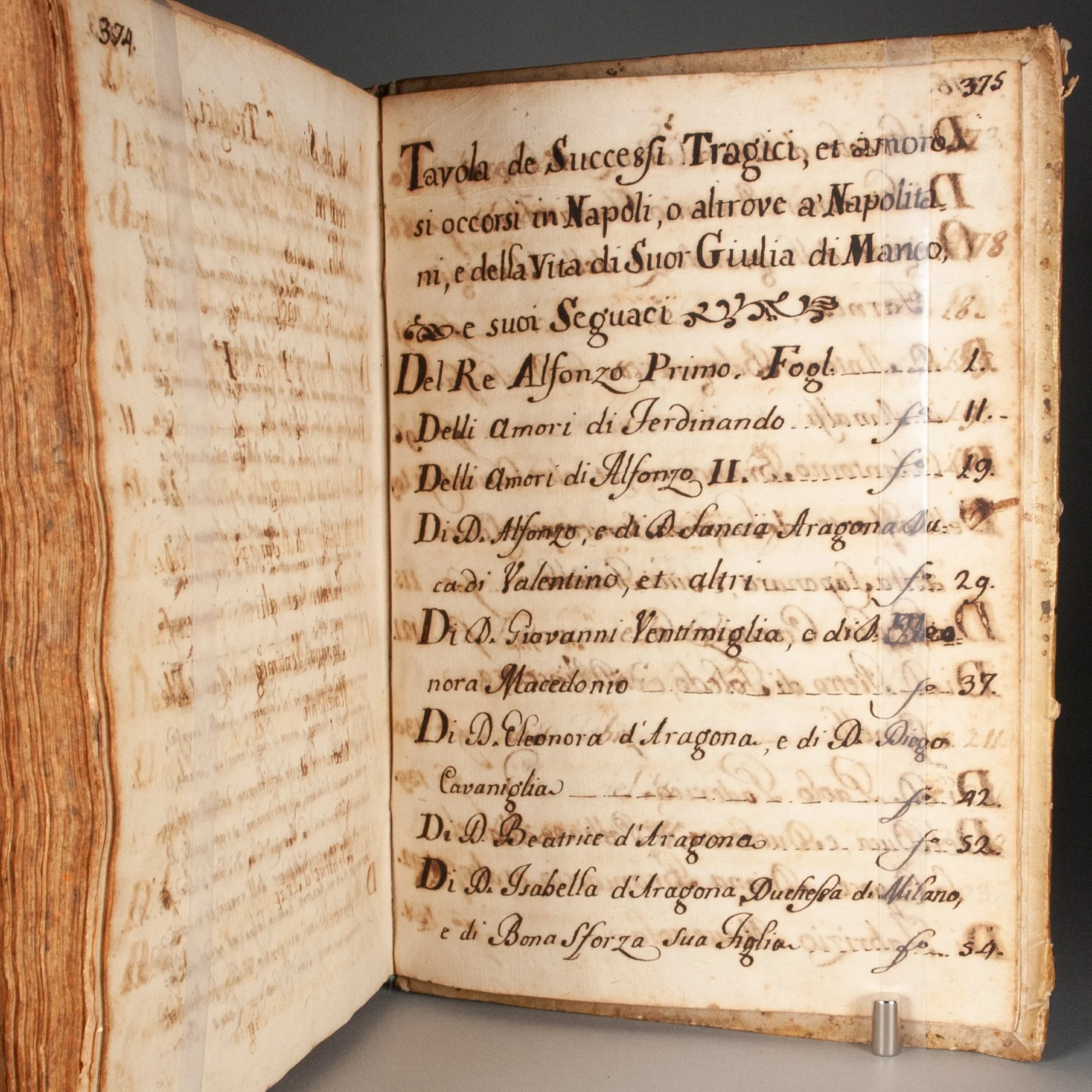
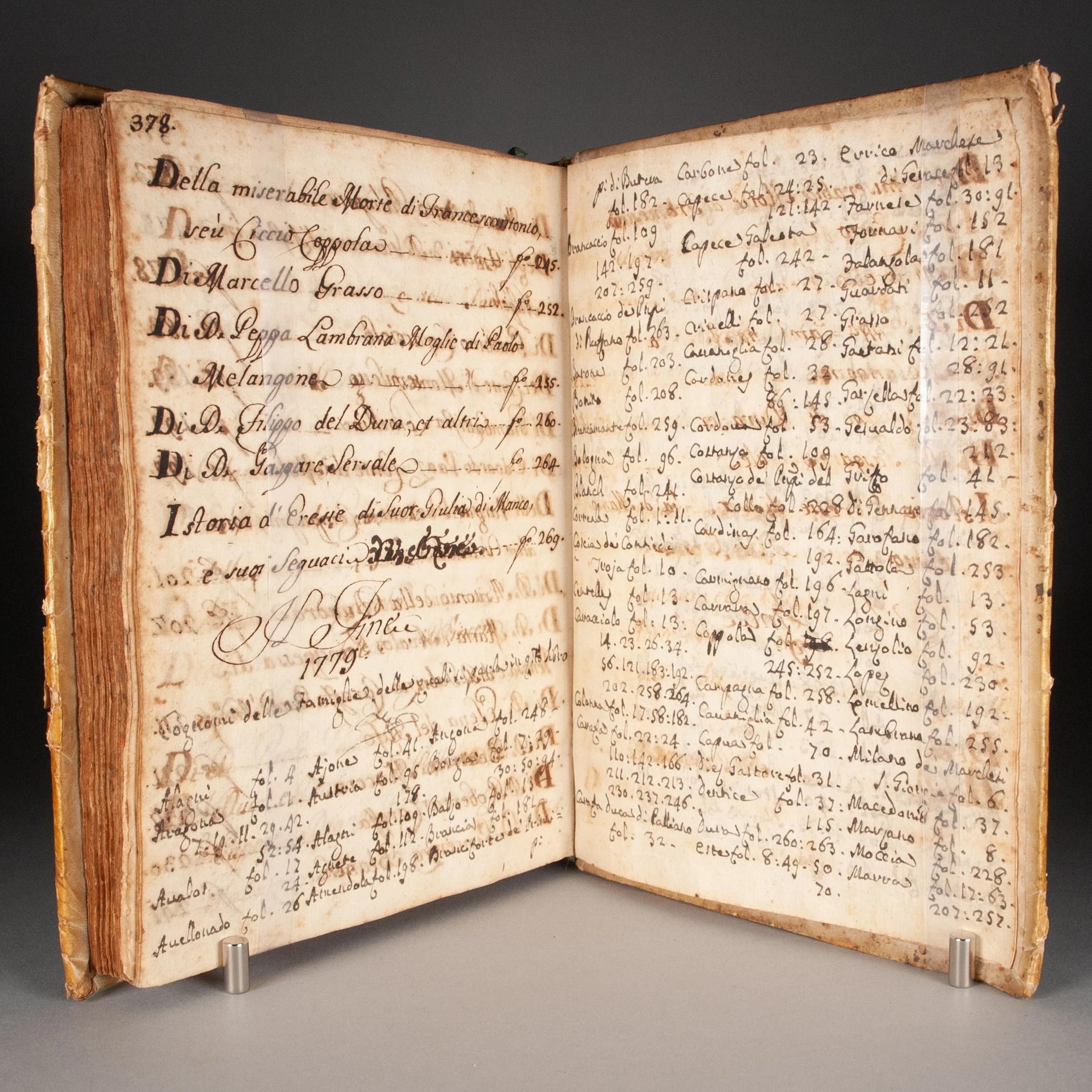
Successi tragici ed amorosi occorsi in Napoli o altrove a' Napolitani [bound with] Historia d'heresie di Suor Giulia di Marco
Successi attributed to Silvio and Ascanio Corona | Historia by Valerio Pagano
[Italy, 1779]
[6], 317, 338-378 p. | 4to | 211 x 148 mm
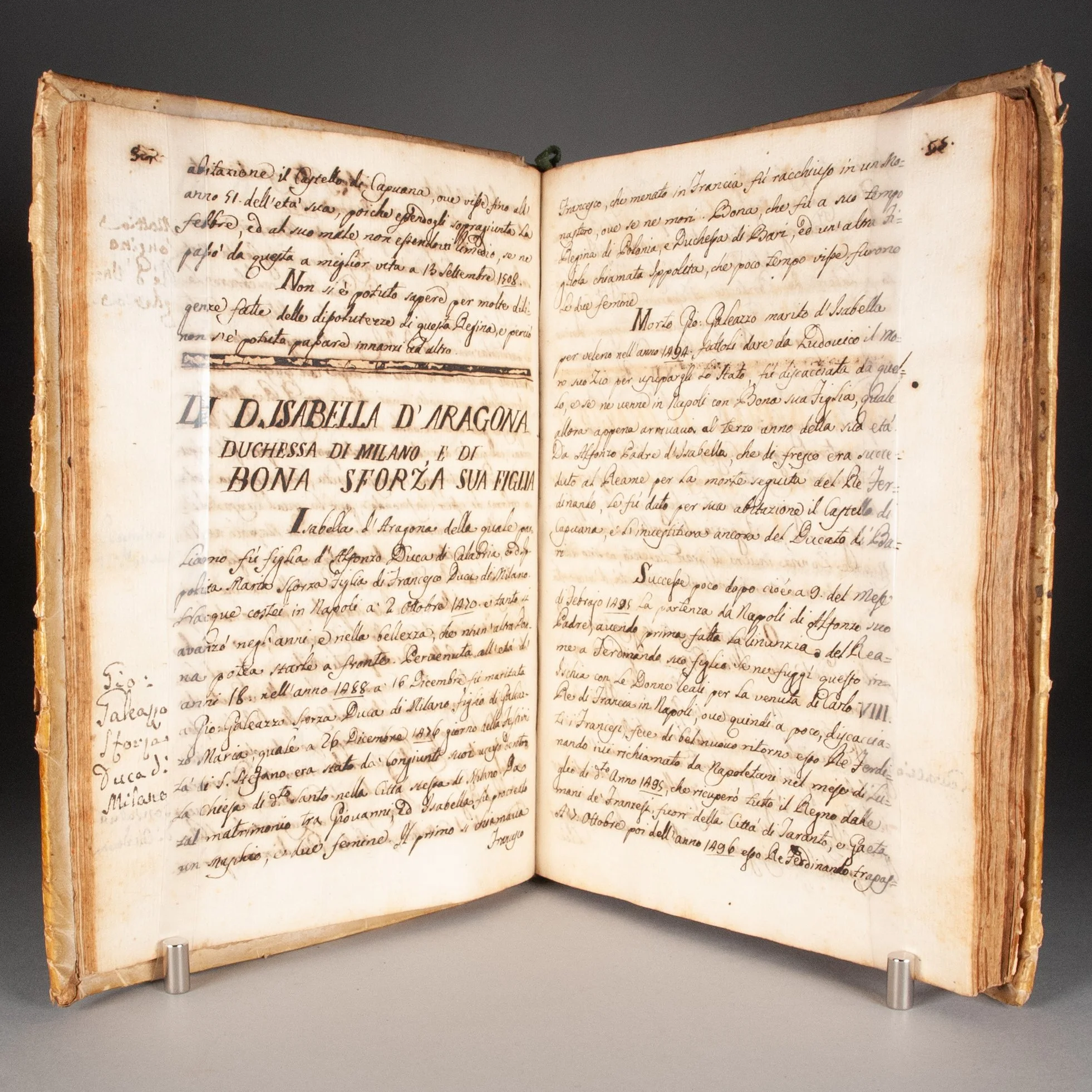
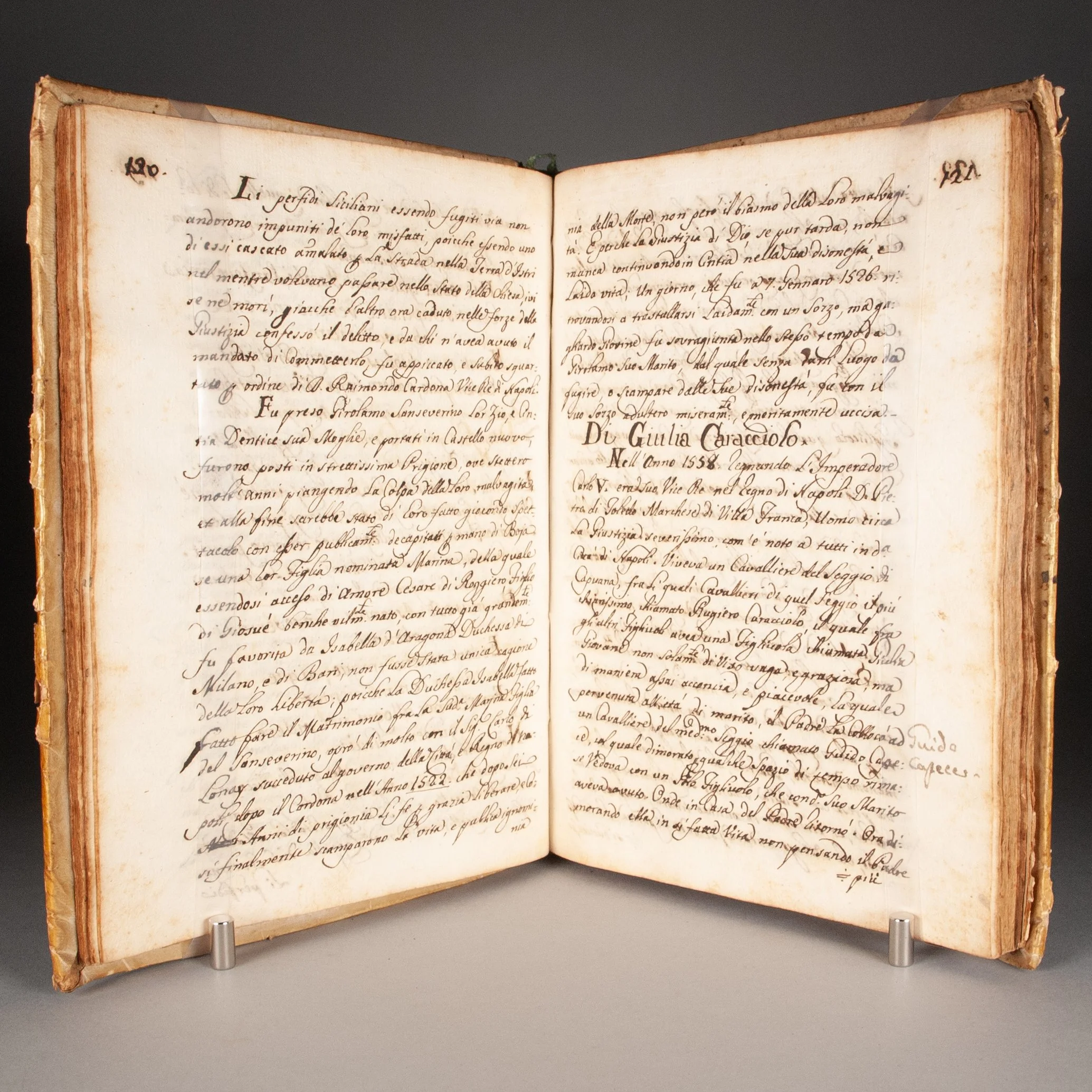
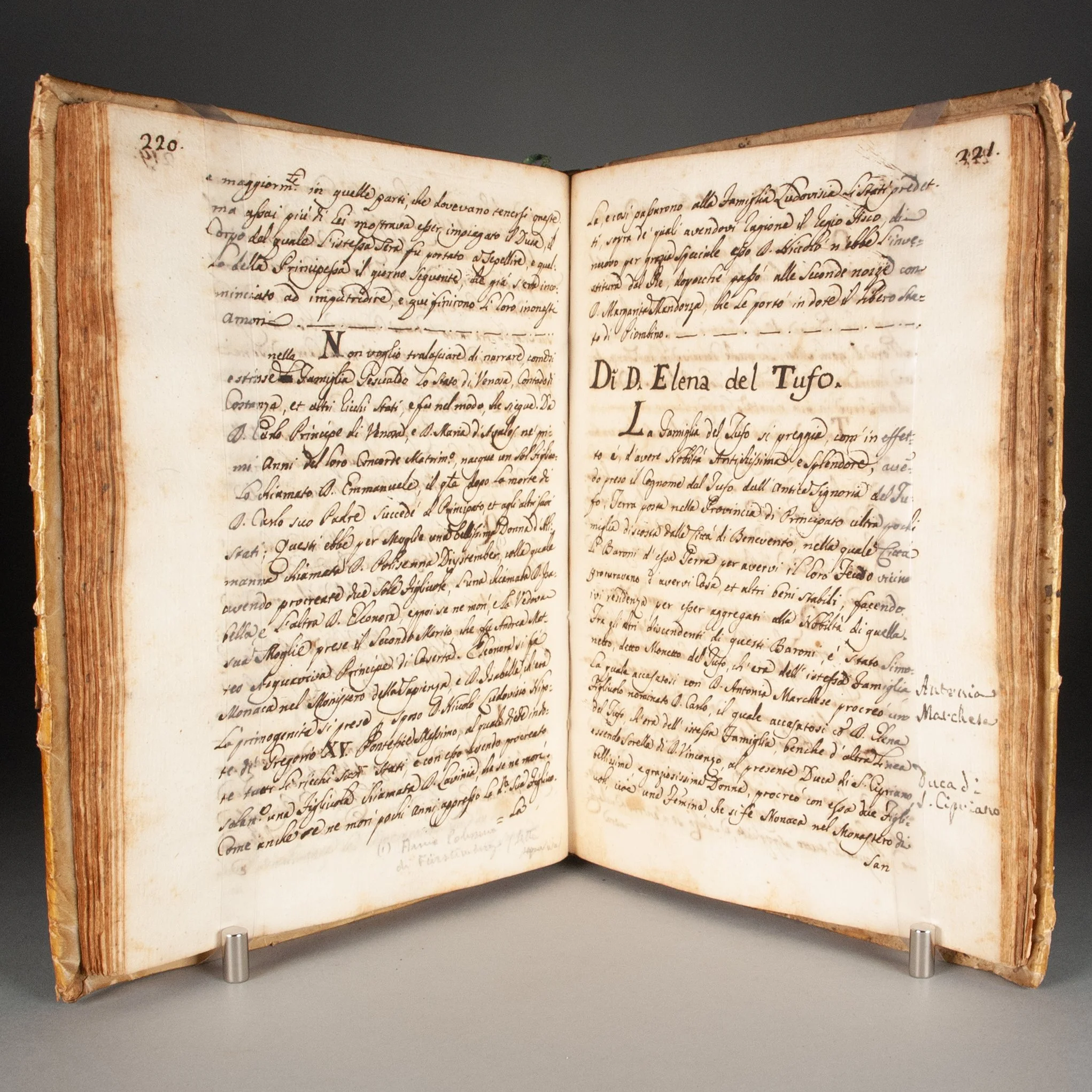
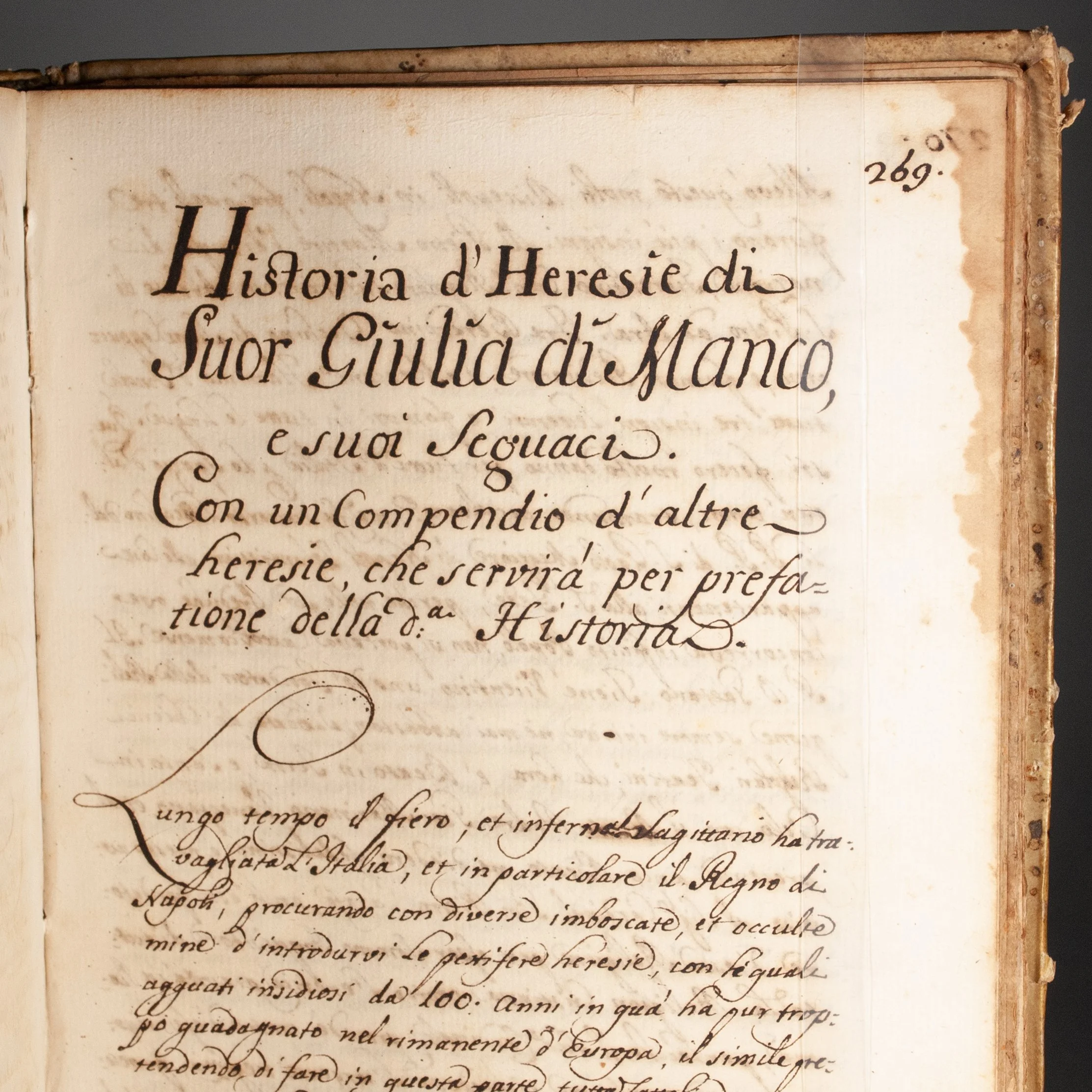
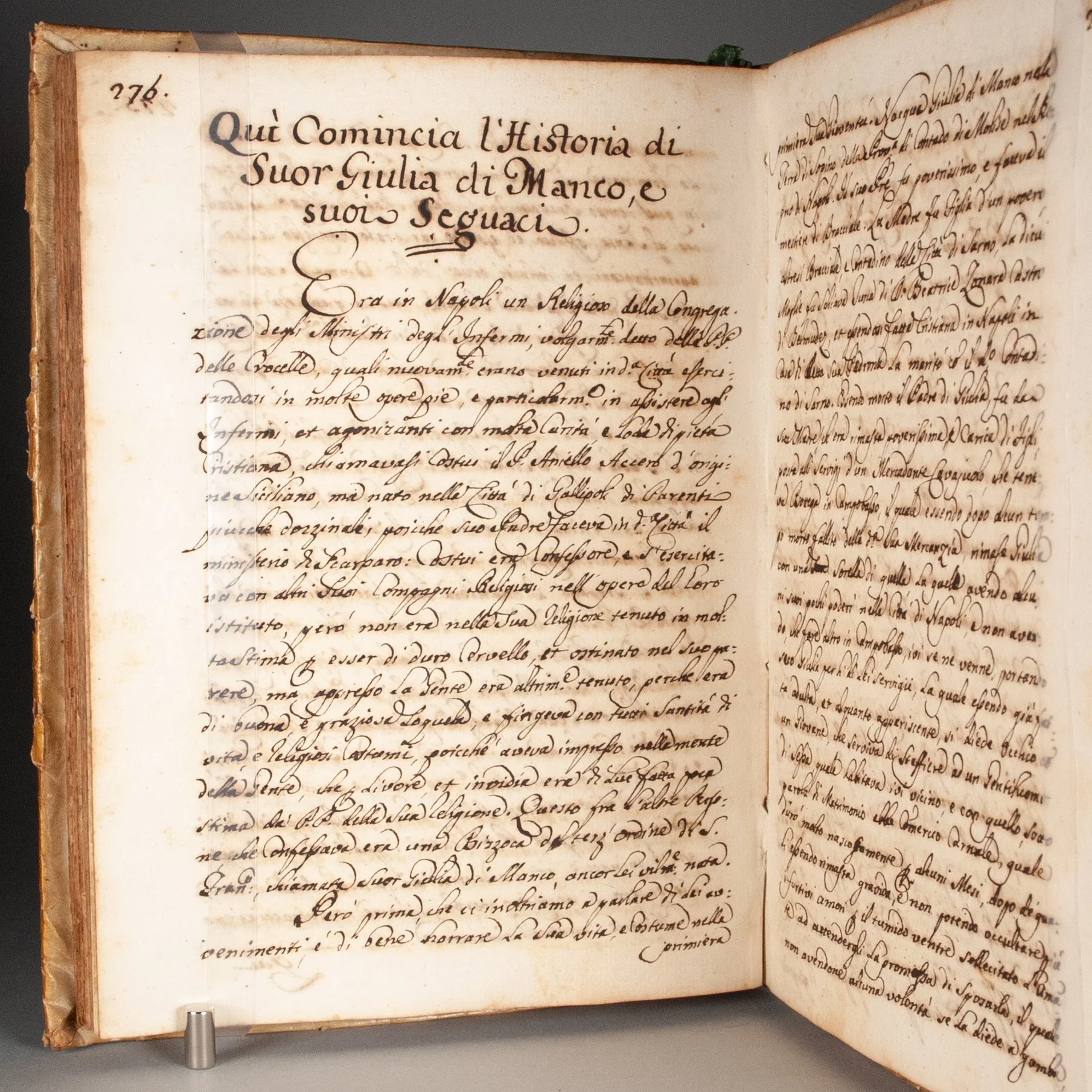
A compendium of amorous escapades among the Naples elite, men and women alike—the consummate example of a book deemed too salacious for print, and so circulated only in manuscript (it remains unpublished even today). To be sure, a lengthy word of caution was added to a copy Angelo Borzelli found in a Naples library, since the content might easily be put to impious ends. Owners "must therefore keep this book hidden with great secrecy, and with the utmost caution kept in a place where it will not be seen or easily taken by strangers or frivolous youths." The work is most frequently attributed to a pair of Corona men—brothers or simply associates, this is unclear—but the collection is more likely an amalgamation that developed over time. The episodes are spread across nearly three centuries, for example, but largely appear to have been written by contemporaries. ¶ Occupying more than a hundred pages, and easily the longest of the manuscript's many sensational stories, the headliner here is surely the Historia d'heresie di Suor Giulia di Marco. This recounts the events of one Sister Giulia di Marco, who, along with a priest (Aniello Arciero) and a lawyer (Giuseppe de Vicariis), founded a cult—not our word, one used by scholars—that practiced a "bizarre amalgam of spirituality and sexual libertinism" (Schutte). Di Marco alleged to have received a vision from God, who wished her to multiply and fill his holy kingdom, hence the prodigious sex that followed. "Among the supernatural gifts that Giulia supposedly enjoyed was the ability to remain chaste even while having sexual intercourse; in her case, her spiritual director claimed, intercourse was not a sin but actually rendered her closer to God" (Tutino). She invited adherents "to copulate with each other while she had sexual intercourse with her spiritual director, father Arciero. Orgasms were the culmination of the mystical journey and a sign of a successfully achieved spiritual union with God." Di Marco had a devoted following (obviously), attracted a number of local elites, and even enjoyed the occasional saintly veneration. ¶ The text here, which focuses on Sister Giulia's trial and the abjurations of its three principals, is typically attributed to a Theatine monk, Valerio Pagano, and so unsurprisingly takes a hypercritical view of things. "The prurient elements of the story are highlighted: group sex with as many as ten males and ten females pairing up in couples in noble palaces with copulation the height of their spiritual communion as 'carnal charity.' Orgasm became mystical ecstasy, with ejaculation received by Suor Giulia in pious refrain, 'Gesù, Maria; Gesù, Maria.' Suor Giulia confessed to having five or six abortions," John Marino writes. But Marino also offers a more nuanced interpretation of events, one rooted in the infertility of the Countess of Lemos, a frequent visitor. "Herein lies the key to the scandal, because the personal and societal imperative for children and heirs found a religious remedy in Suor Giulia's sponsorship of a controlled environment for evenings dedicated to 'religious' intercourse among partners desiring conception. These clandestine soirees are described as individual couples pairing off in a communal, sanctified space—not really group sex at all but more like infertile couples having intercourse in church in order to receive God's blessing to promote conception." Of course the Inquisition didn't see it that way. Its eight-year investigation culminated in 1615 with her lifetime imprisonment. "Feigned sanctity it may have been, but more complicated problems of female infertility and charismatic spirituality, rivalry between new Counter-Reformation religious orders, and contested politics in state and church rather than titillating sexual promiscuity were at stake" (Marino). ¶ Borzelli traced more than two dozen manuscripts of the Successi, with varying numbers of episodes. The original version contained 32, he believed, though 36 was a common number among 18th-century copies, while others ran into the 40s. Giulia di Marco's Historia, which Borzelli noted in only one copy, was apparently not standard (though we've seen it in at least one other). Plenty of men figure in these amorous anecdotes, but also many women: Isabella of Aragon (p. 54-67), Bona Sforza (p. 67-70), Giulia Caracciolo (p. 121-130), and Elena del Tufo (p. 221-228) are some aristocratic examples, and of course many others appear as mistresses.
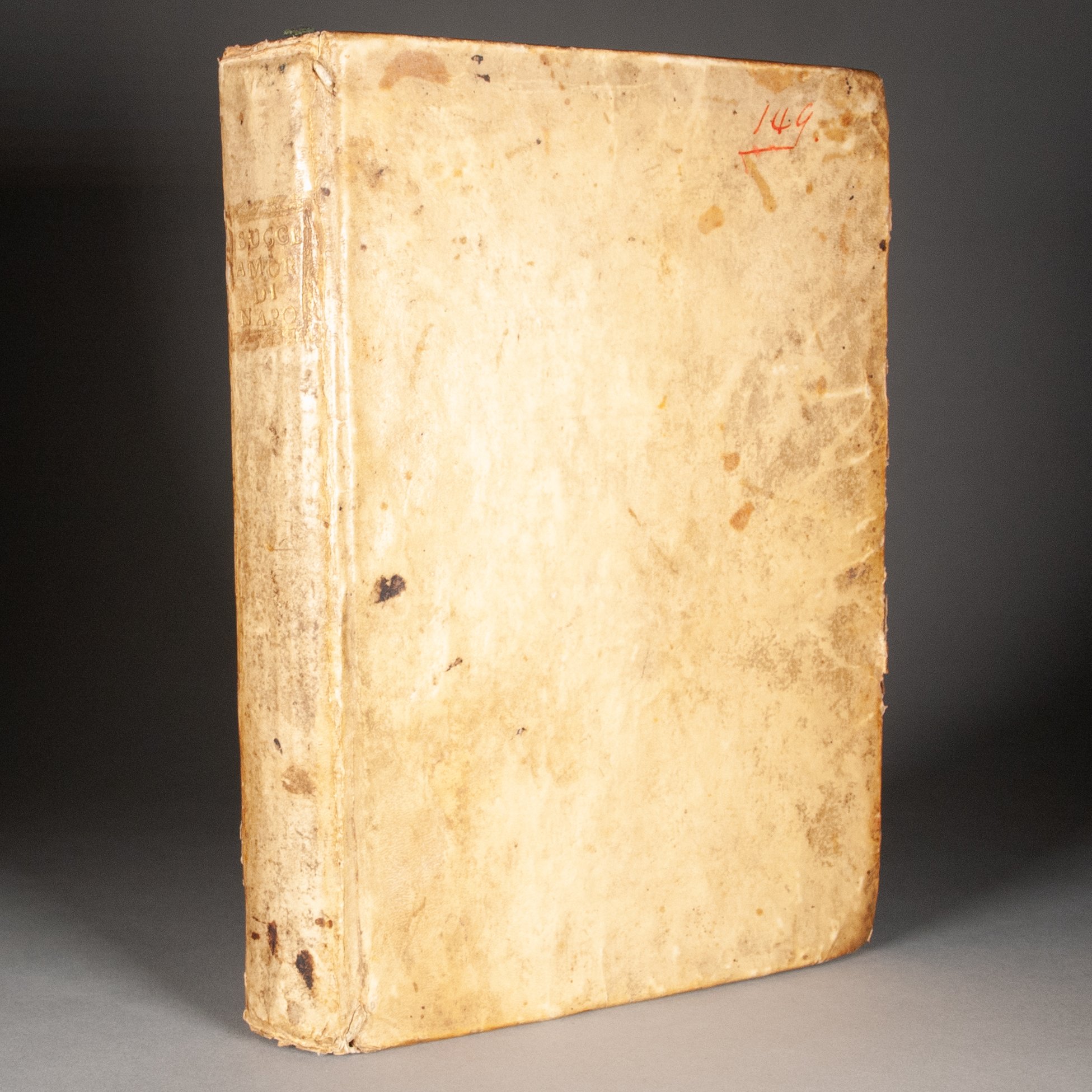
PROVENANCE: An early reader has copied into the margins the names of the many players, and likewise added an index at end. ¶ Old number 149 in red ink in the upper right of the title, and also on the front cover. Bookplate or other label removed from the front paste-down, with a couple scraps of paper remaining. We acquired from an Italian auction house (with an export license, as always).
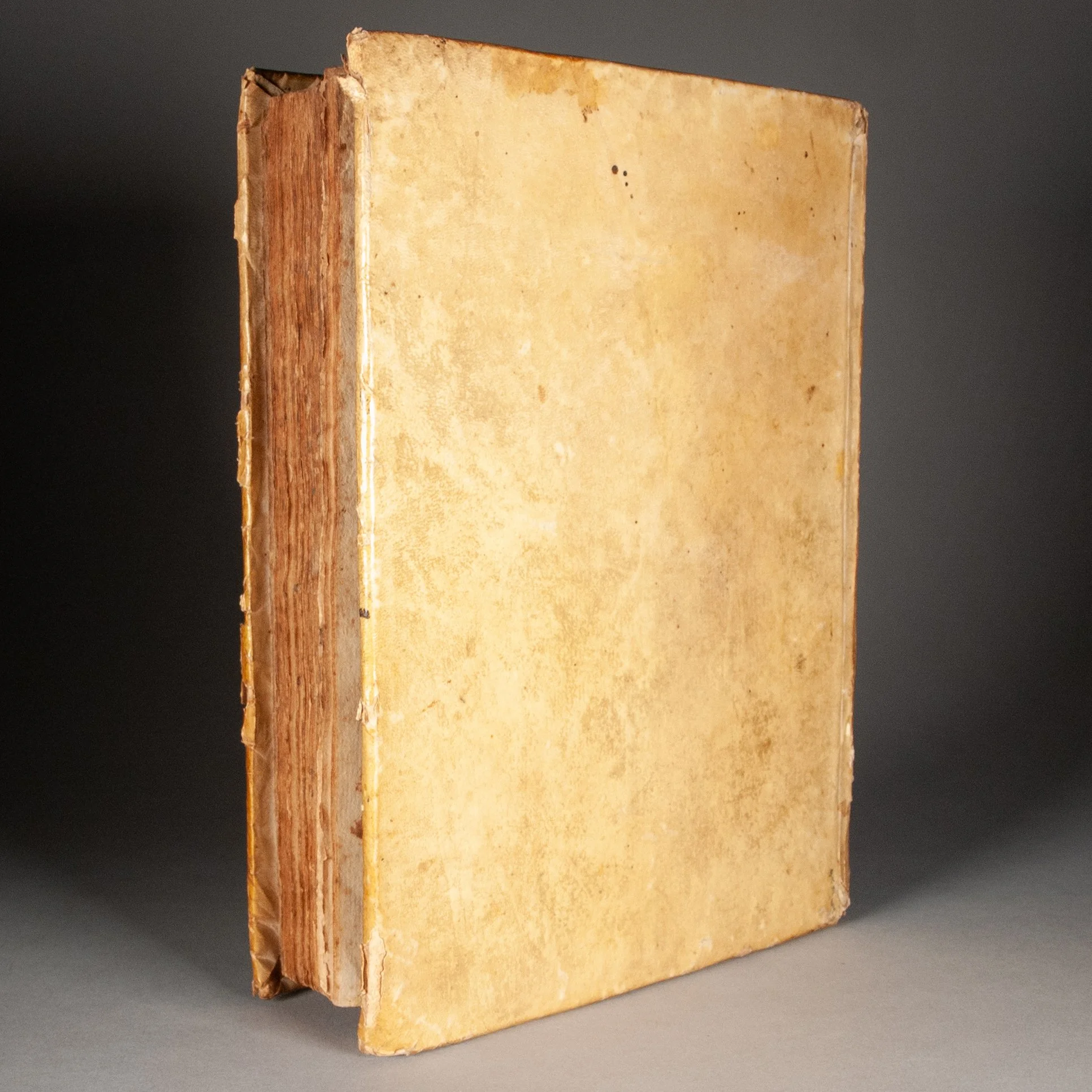
CONDITION: Contemporary parchment over flexible boards; title gilt-stamped on spine. Written in dark brown ink—in two different hands, we suspect—on laid paper with an armorial watermark; dated at end, Il fine 1779. Complete despite pagination. First two leaves are blank. Our text of Sister Giulia's Historia largely matches that found in the digitized copy at Johns Hopkins. ¶ Penned with a corrosive ink, and the most heavily inked areas have burned through the paper, with scattered textual loss; some gatherings near the back released from their lower stitching, but still held fast by the upper stitching; p. 253/254 badly stained, with subsequent marginal staining to nearly the end of the text block; a couple of closed tears in p. 23/24 rather curiously repaired with a pair of small, round red stickers. Parchment soiled, and worn at the extremities; corners bumped; front paste-down skinned from the removal of a bookplate or label.
REFERENCES: Angelo Borzelli, Successi tragici et amorosi (1908), p. 12 ("there is not only one author of the Successi, but there are several," noting the chronological spread of 1450-1720), 22 (cited above); Anne Jacobson Schutte, Aspiring Saints (2001), p. 65 ("Because the trio managed to recruit numerous followers, some of them in the upper social strata, and because their activities evoked bitter quarrels between receptive Jesuits and hostile Theatines, this case took local inquisitors and the Congregation of the Holy Office eight years to resolve"); John A. Marino, Becoming Neapolitan (2011), p. 128 (the origin of her motivation, and generally good background), 129-130 (cited above; "the sexual promiscuity at the center of the abjurations raised questions of heresy beyond the overt sinful adulterous acts themselves"), 132 (cited above), 133 (good summary of the cult's followers), 136 (her heavy-handed arrest); Stefania Tutino, 1626: A year in the life of the Roman Inquisition (2025), p. 92 (cited above); Yann Sordet, Histoire du livre et de l'édition (2021), p. 445 ("manuscript distribution remained an important method of textual distribution until the end of the 18th century. Various reasons explain this choice for certain work or for certain corpora: economic constraints, a wish to control circulation of the text, imperatives of prudence and discretion."); Brandon W. Hawk, "Fragmens philosophiques: An eighteenth-century clandestine manuscript of Voltaire's apocrypha and related works," The Library 7th Series 27.1 (Mar 2026), p. 71 ("While it is easy to imagine a sudden and permanent shift away from handwritten manuscripts and toward printed books after the introduction of the printing press in the fifteenth century, media scholars and book historians have complicated this teleological history. The relationship between handwritten and printed books should be understood as dynamic and highly contextual rather than linear or developmental: scribal and print practices intermingled in the early modern period, just as they continue to intermingle in our present culture.")
Item #892