
Extra-illustrated | With misleading proofs
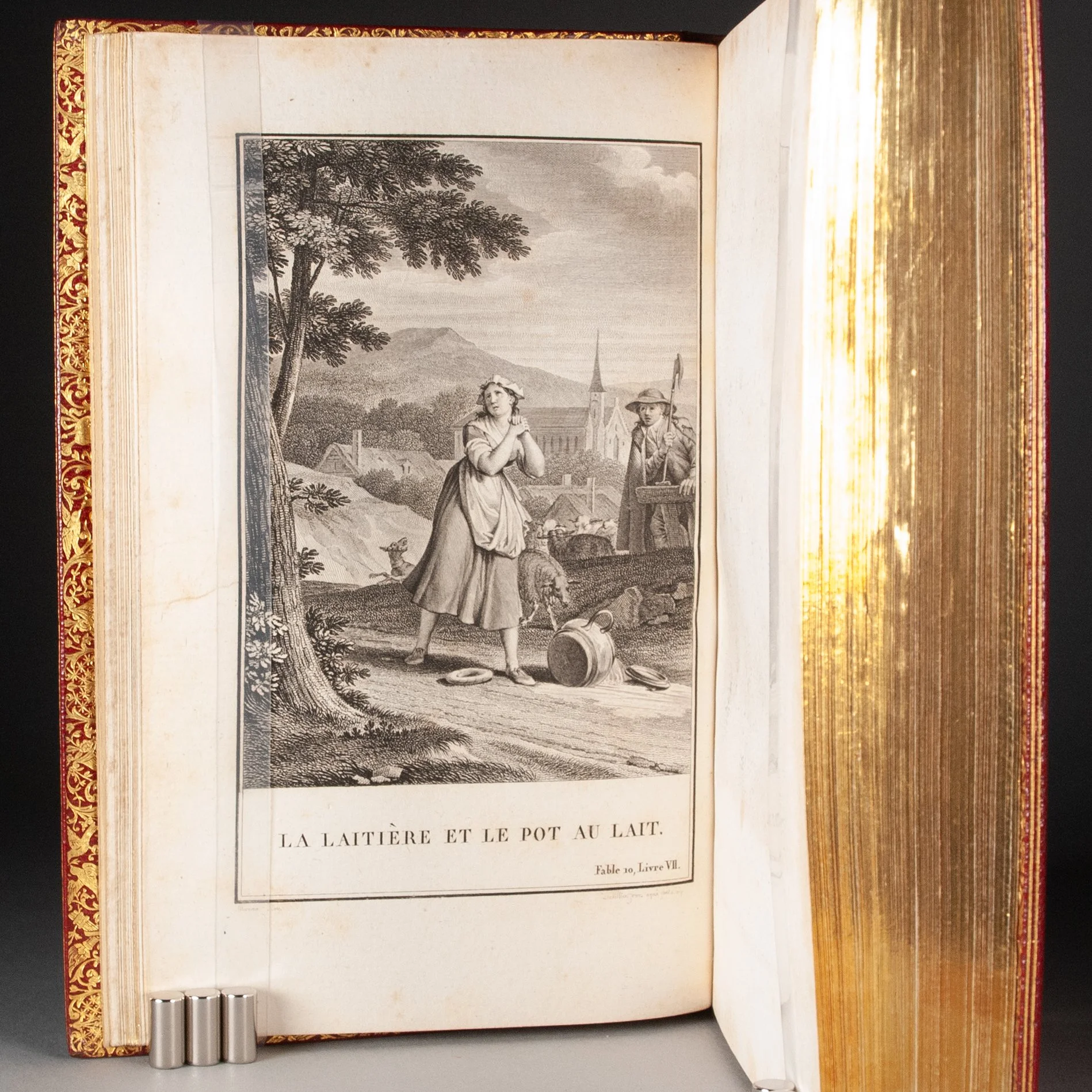
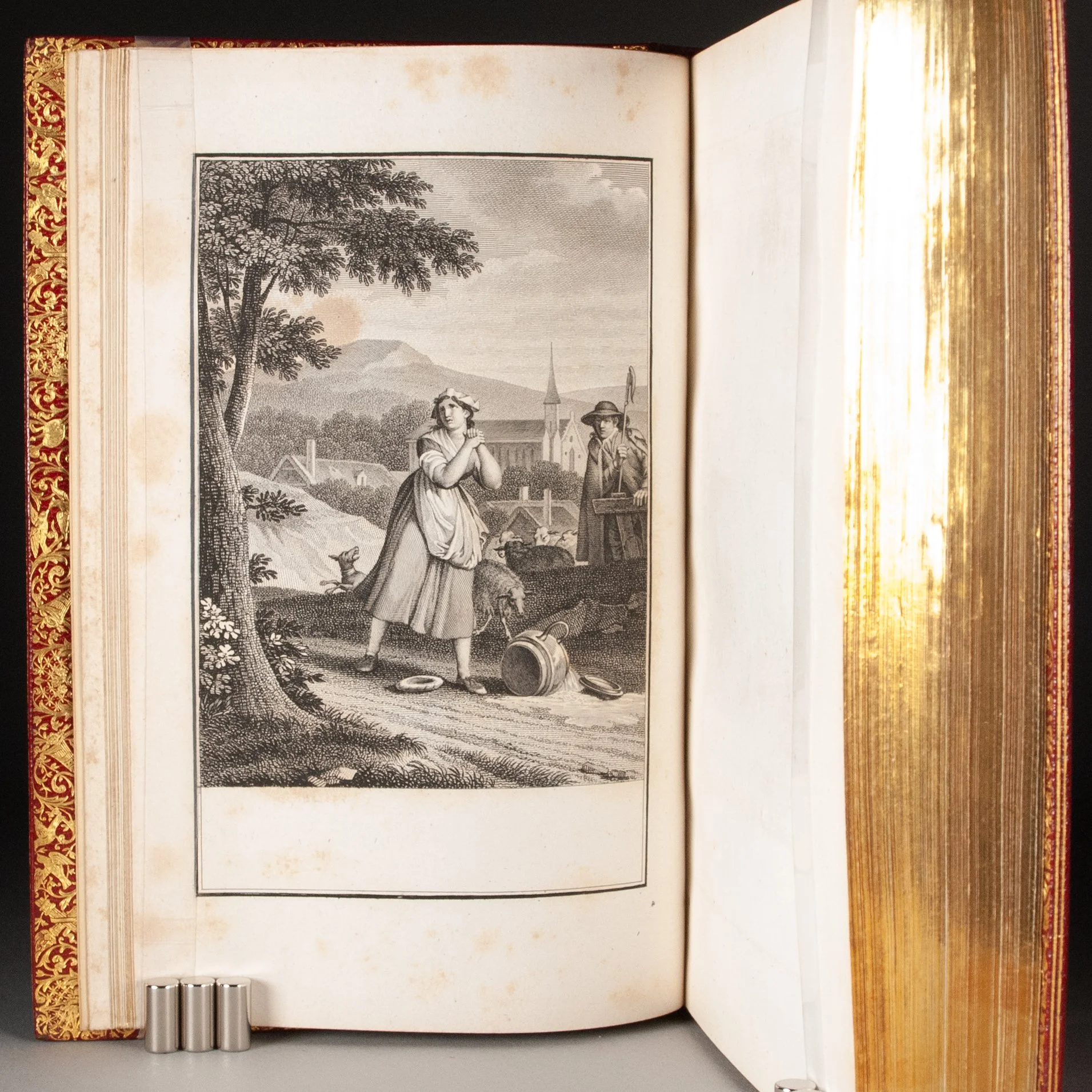
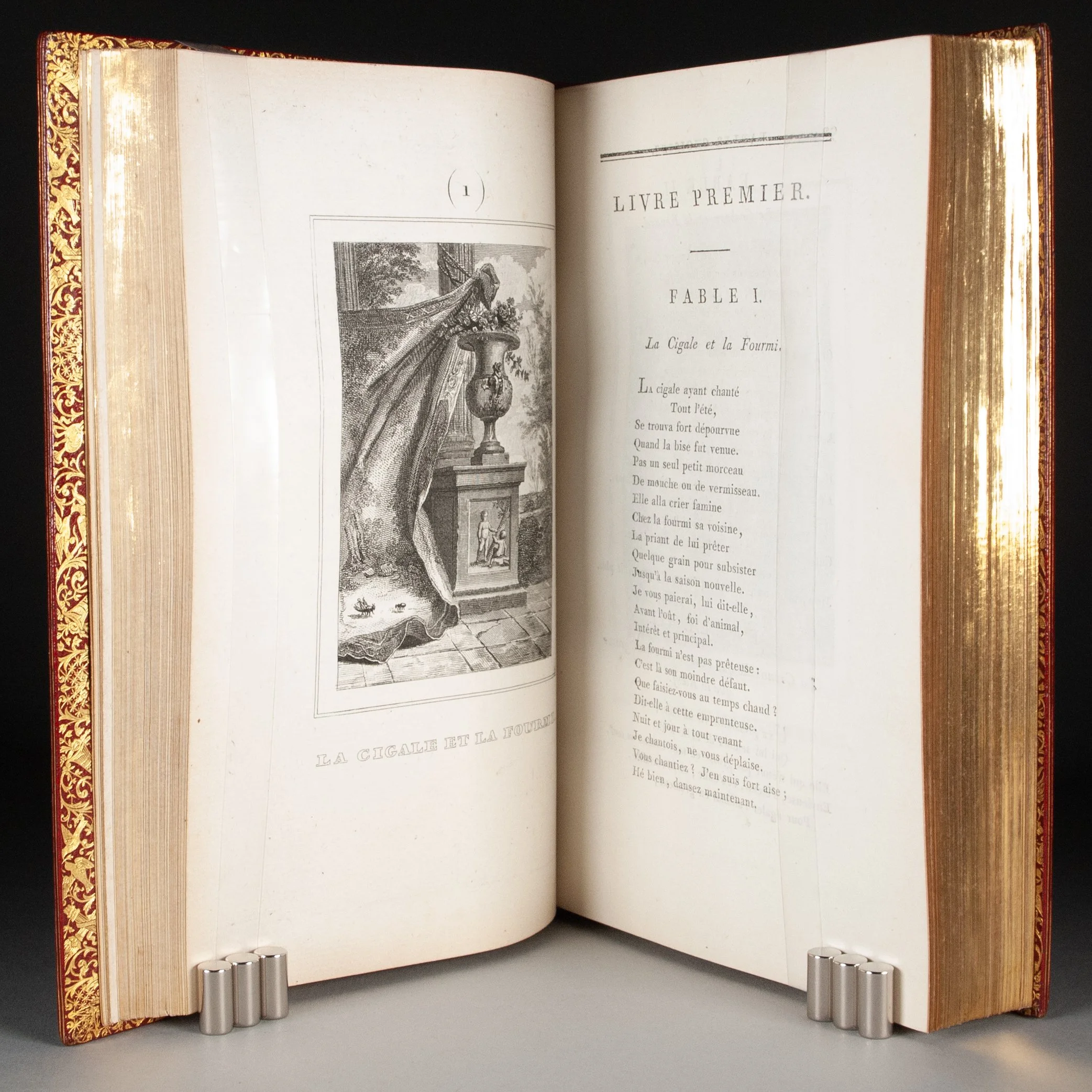
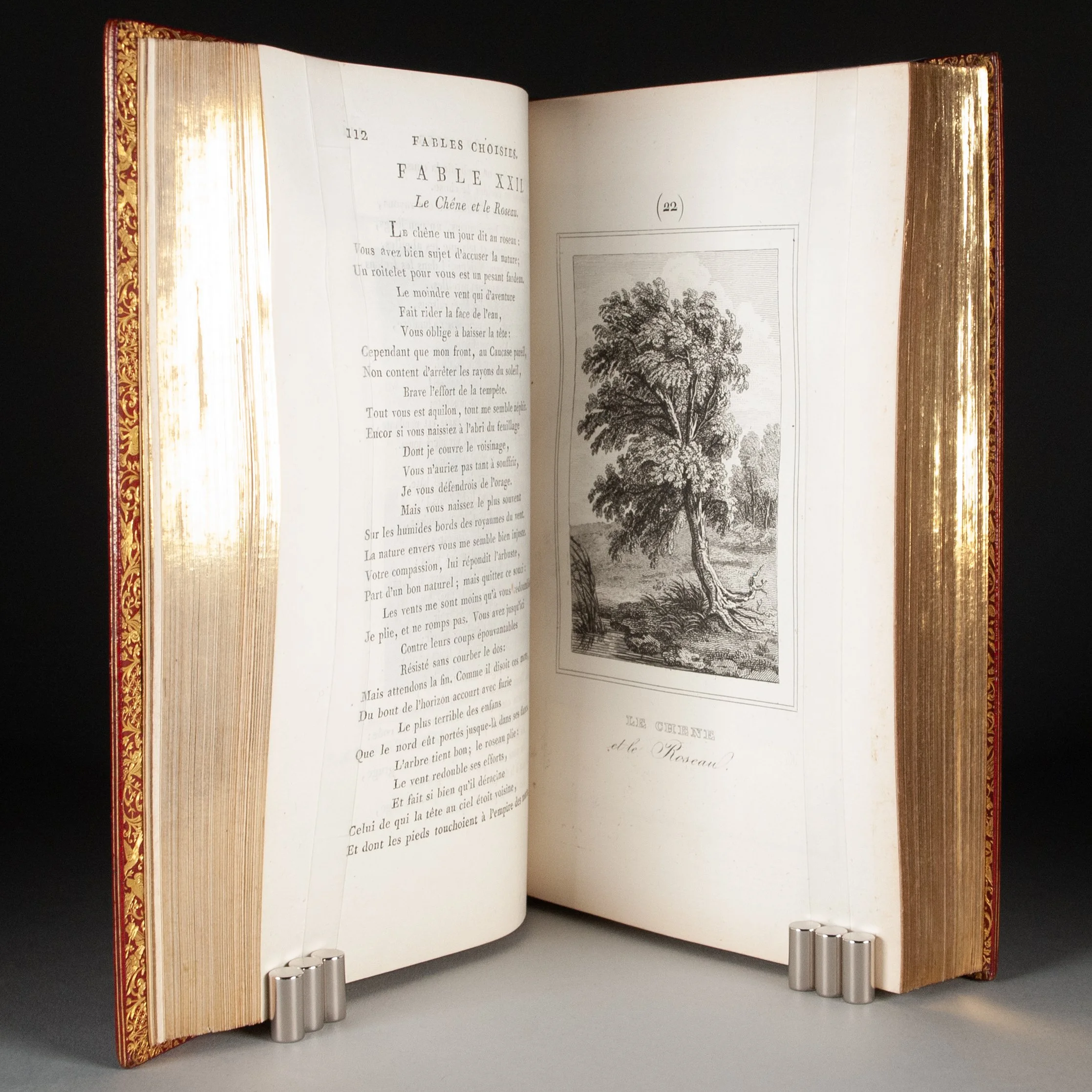
Extra-illustrated | With misleading proofs
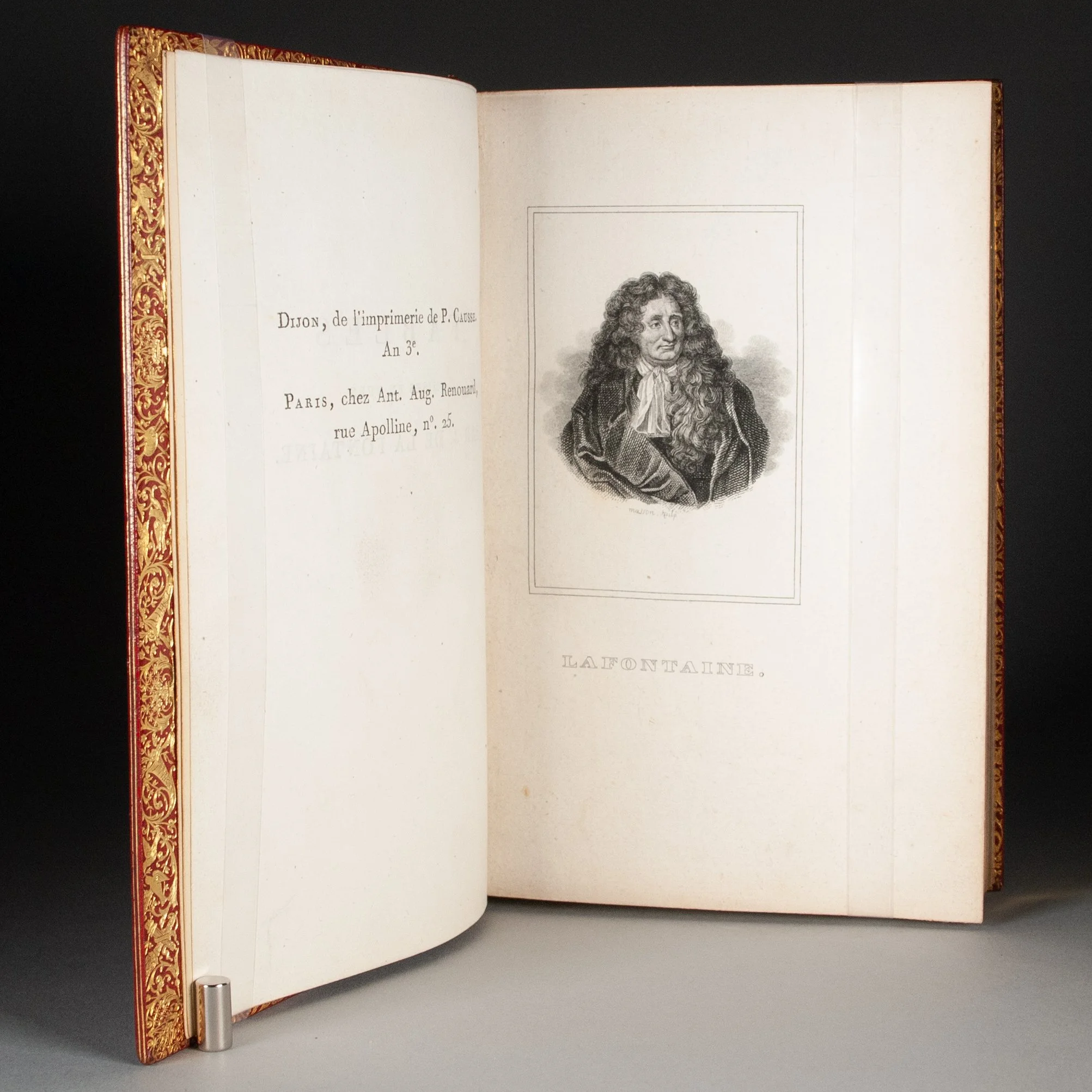
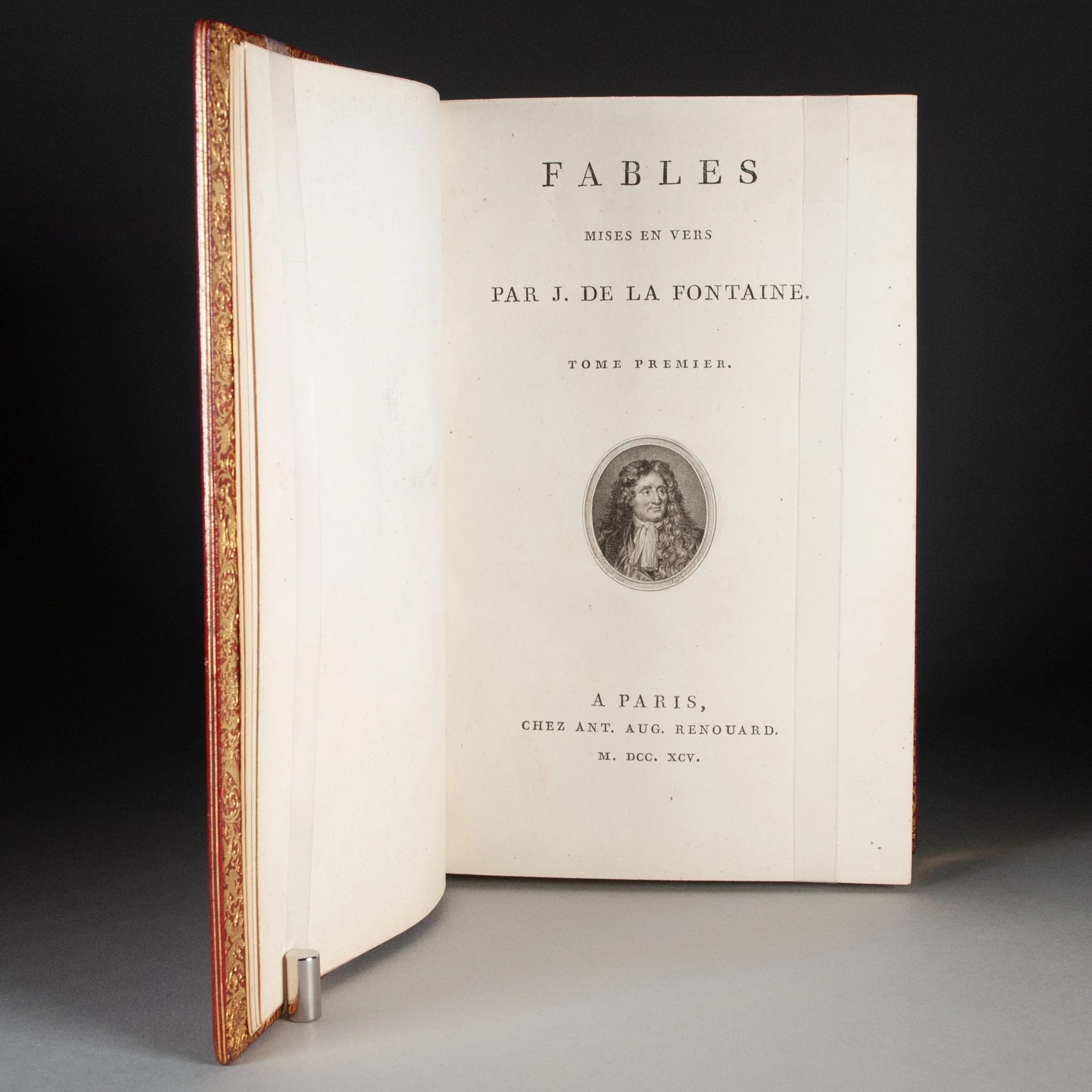
Fables mises en vers
by Jean de La Fontaine
Paris: Pierre Causse (in Dijon) for Antoine-Augustin Renouard, 1795
2 vols | v. 1: [4], xlviij, 234 p. + [144] plates; v. 2: [4], 247, [1] p. + [134] plates | 8vo | v.1: pi^2 [1]^8 2-3^8 1-6^8 [7]^4 8^8-14^8 15^10(-1510); v. 2: pi^2 1-15^8 16^4 | 178 x 15 mm
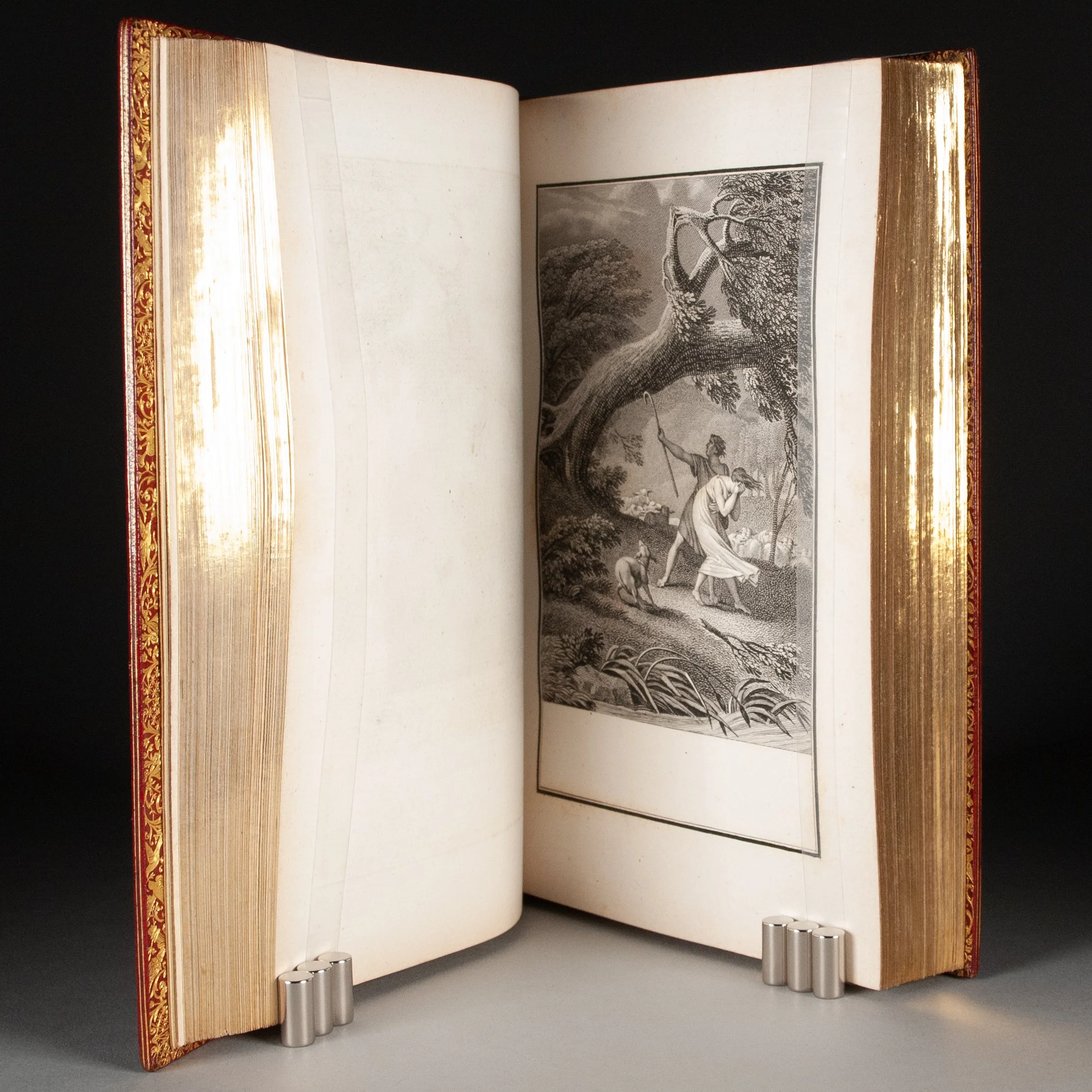
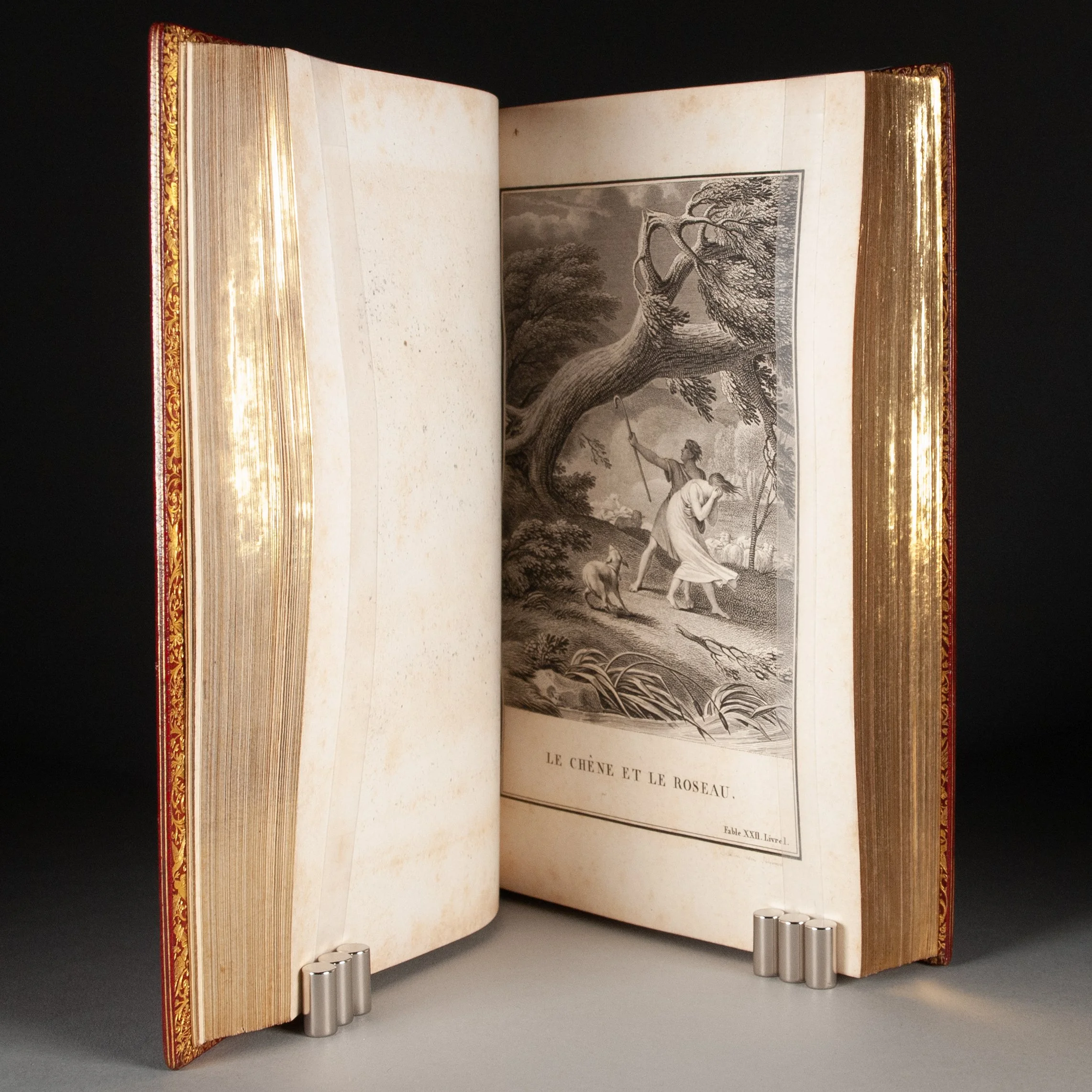
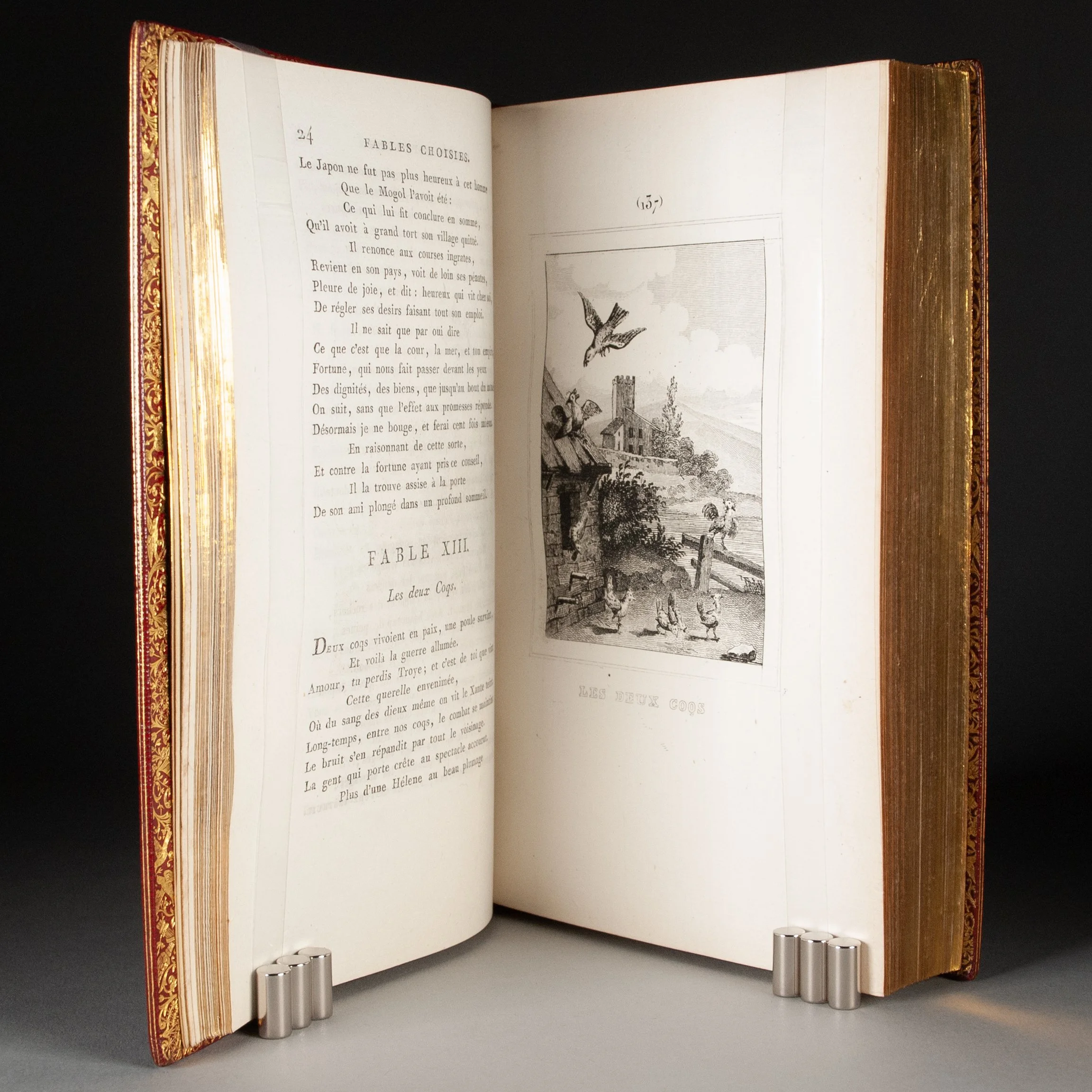
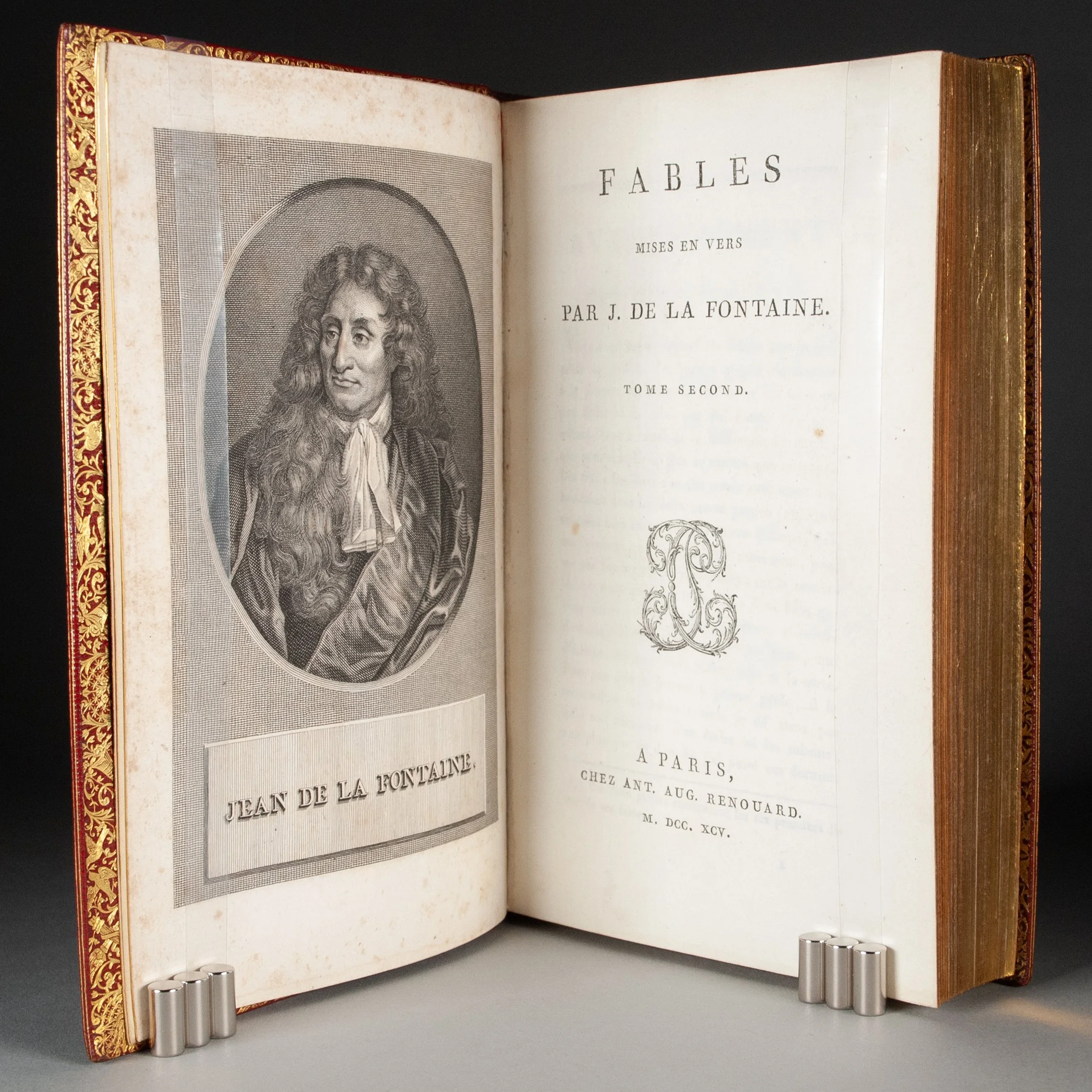
A striking set of this classic fable collection, published by the esteemed book dealer and bibliographer Renouard, and here extra-illustrated with 278 plates. The vast majority of these—248 of them—are from a cohesive numbered series that copied those of Jean-Baptiste Oudry, whose illustrated edition endures as "one of the landmarks in French decorative book-making" (Updike) and counts as one of "the two masterpieces of French book illustration during the first half of the eighteenth century" (Ray). Our plate numbers runs to 245, without 66 and 188, but with six others appearing twice, with alternate scenes. These should date to the early 19th century are are variously signed by Le Jeune, Couzé, or Jean Nicolas Adam (1786-ca. 1840). ¶ Twenty-four plates appear as a dozen pairs, both after the same designs by Jean-Michel Moreau the Younger. The dozen earlier versions come from the 1814 six-volume edition of La Fontaine's Oeuvres complètes. The other dozen are slightly later, some of them signed by Friedrich Schroeder in 1820 or 1821, all of these proofs before lettering. We suspect these were the updated Moreau plates that Debure published in 1829. It's a strange juxtaposition. Since the later plates are proofs before lettering, they have the effect of deceptively presenting themselves, intentionally or not, as proofs of the earlier finished plates. ¶ This set participates in two concurrent manias: one for extra-illustration, the other for collecting proof states of illustrations. Both sometimes reached absurd levels. In the case of the former, the result might be "the creation of huge multi-volume beasts where a one- or two-volume book became spread over many more" (Pearson). We suspect our large, cohesive series was published with at least one eye on this extra-illustration market, which would have allowed owners to combine them with whatever La Fontaine edition they liked. The practice has a rich history dating to the earliest years of print, when it was perfectly common for owners to augment their devotional manuscripts with a few woodcuts. Early printed books, too, sometimes served as repositories for illustrations gathered elsewhere. The Bible became an obvious venue for the practice, as did other similarly common texts. It wasn't long before print publishers began producing thematic series specifically to satisfy this desire. "For instance, in the 1630s, the printseller Robert Peake sold readers English-made copies of Boetius à Bolswert's popular New Testament illustrations to insert into their Bibles" (Trettien). What set those early examples apart from later ones was intention. What had been an intervention designed to augment meaning became one designed to augment the object. Regardless of age, each example became a unique assemblage of disparately produced print media. And “like marginalia of the same period, extra-illustration can be thought of as a reader’s personal contribution to a book, and as constituting a form of comment and evaluation. Extra-illustrated books like annotated ones afford later readers not only incidental rewards in the way of unpredictable connections and rare or unique documentation, but also a detailed guide to what attracted readers’ attention long ago" (Jackson). ¶ As for the obsession with print proofs, no country could best the insatiable appetite in France. “After ‘premières épreuves,’" Antony Griffiths tells us, "the next development was to prove that an impression was very early by issuing it before the addition of the lettering. Since the publisher usually added the lettering, it was easy for him to run off sets before letter…The next step after printing editions of states before letter was to make similar de facto editions of etched states, before work on the plate was completed with the engraver’s burin" (Griffiths). This fashion could quickly expand the volume, adding three or more versions of every single illustration.
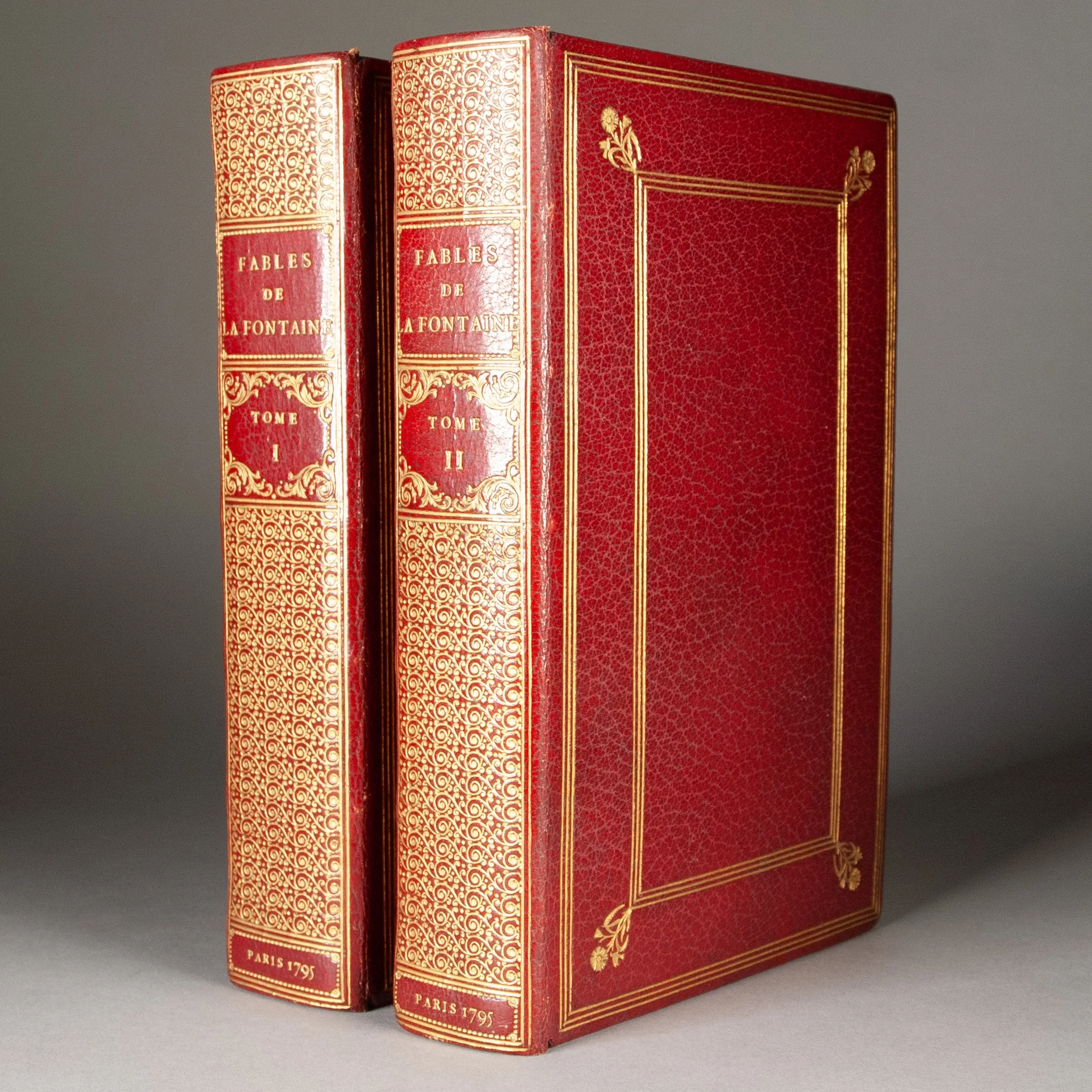
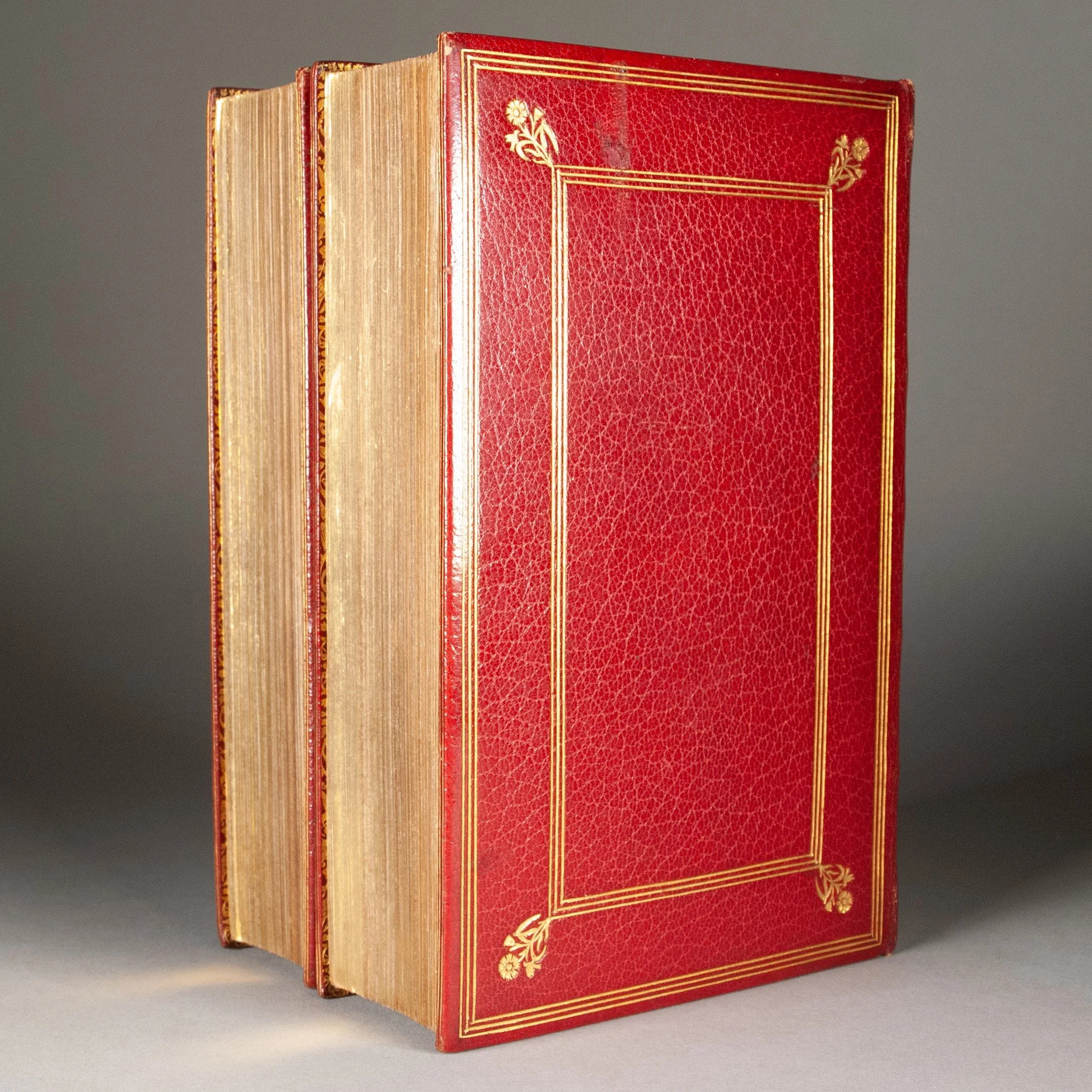
CONDITION: In gorgeous gold-tooled red morocco signed by Charles de Samblanx and Jacques Weckesser, who worked together in Brussels from 1802/1803 to 1909. Collectors were still indulging in extra-illustration in the late 19th and early 20th centuries, so it's hard to say whether these two were the first to add the illustrations, or if the text blocks came to them that way. All edges gilt, and housed in a custom slipcase. The Moreau plates face v. 1, p. 112, 122, 140, 181, 197, 219; and v. 2, p. 19, 37, 80, 122, 146, 199. ¶ The Moreau plates and frontispiece portraits moderately foxed, but otherwise quite fresh internally. Old scuff at the top of the rear cover of v. 1, about an inch long, but otherwise impeccable.
REFERENCES: J. Lewine, Bibliography of Eighteenth Century Art and Illustrated Books (1898), p. 276 (bound with 12 Moreau plates) ¶ Mahérault, L'oeuvre de Moreau le jeune (1880), p. 185-186 (describing the 1814 Moreau plates), 187-188 (the Schroeder plates); Daniel Berkeley Updike, Printing Types (1962), v. 1, p. 222 (cited above); Gordon N. Ray, The Art of the French Illustrated Book (1982), v. 1, p. 21; David Pearson, Speaking Volumes (2022), p. 101-102 (cited above); H.J. Jackson, Marginalia (2001), p. 191 (reference to "the Victorian period when the craze was at its height"), 193 (cited above); Whitney Trettien, Cut/Copy/Paste (2021), p. 101 (cited above); Antony Griffiths, Prints for Books: Book Illustration in France 1760-1800 (2004), p. 49-50 (“As demand increased more rapidly than the available pool of skilled engravers could satisfy, they were no longer content with a passive role. They wanted to keep the profits themselves. And so a surprising and unprecedented thing happened: the designers and engravers seized the initiative and began to produce sets of illustrations of their own account."); 103 (cited above); Christian Coppens, "Fancy Fencing: Fencers Bound to Bindings," The Book Collector (Winter 2008), p. 588 (citing the De Samblanx-Weckesser partnership as 1882-1909, though we've also seen both 1883 and 1889 as the start date)
Item #905