First engravings for a vernacular classic | "The most elaborate of the sixteenth-century editions"—Mortimer
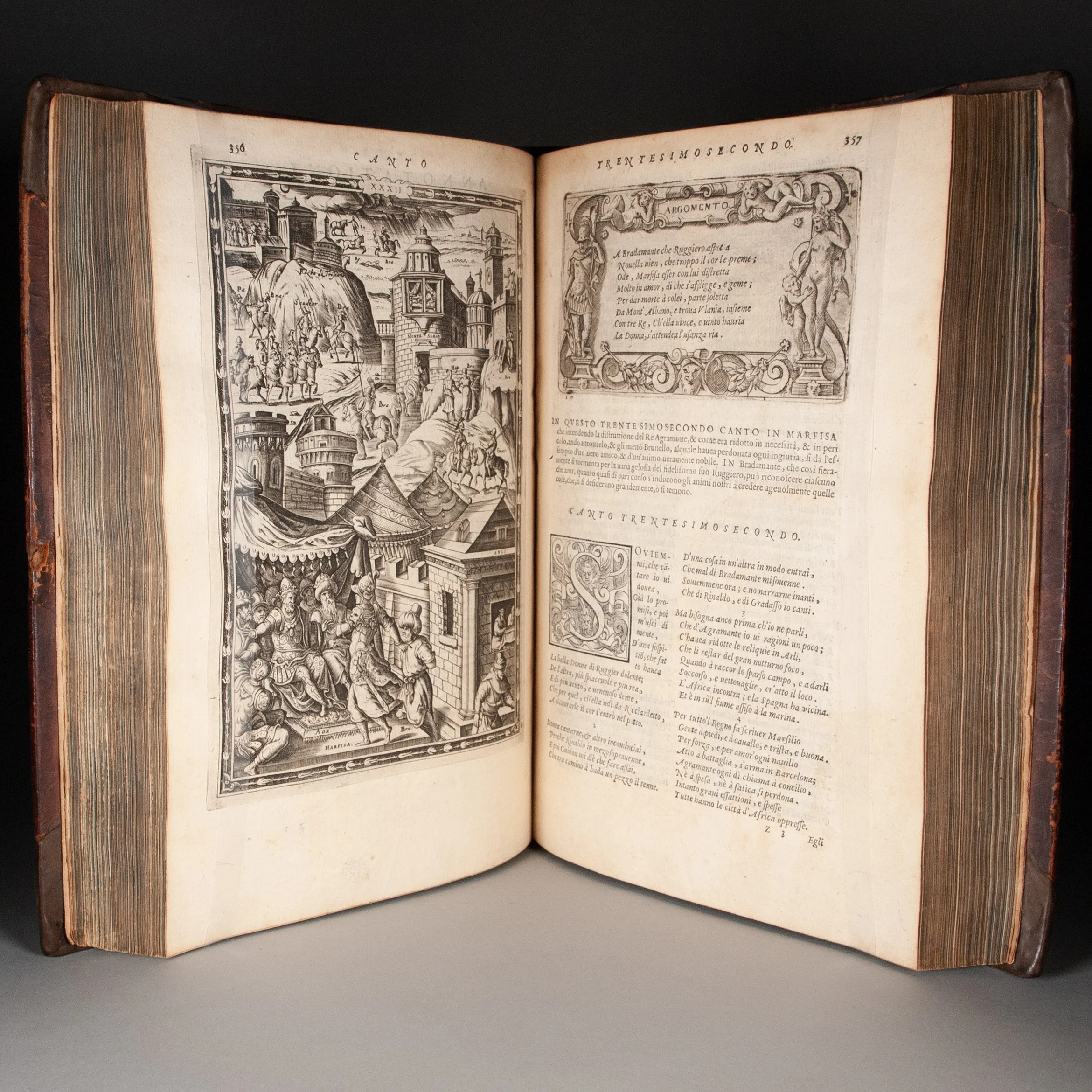
First engravings for a vernacular classic | "The most elaborate of the sixteenth-century editions"—Mortimer
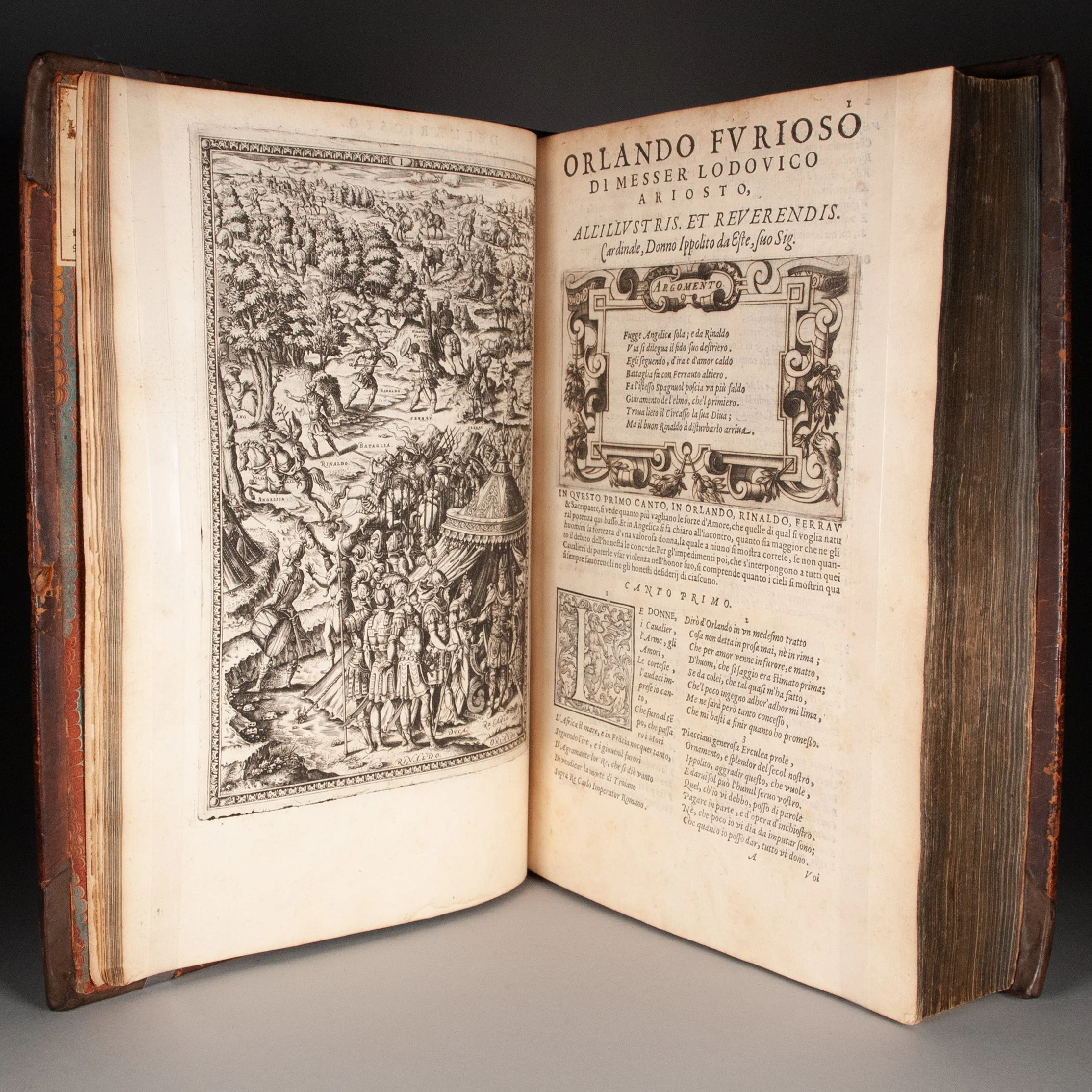
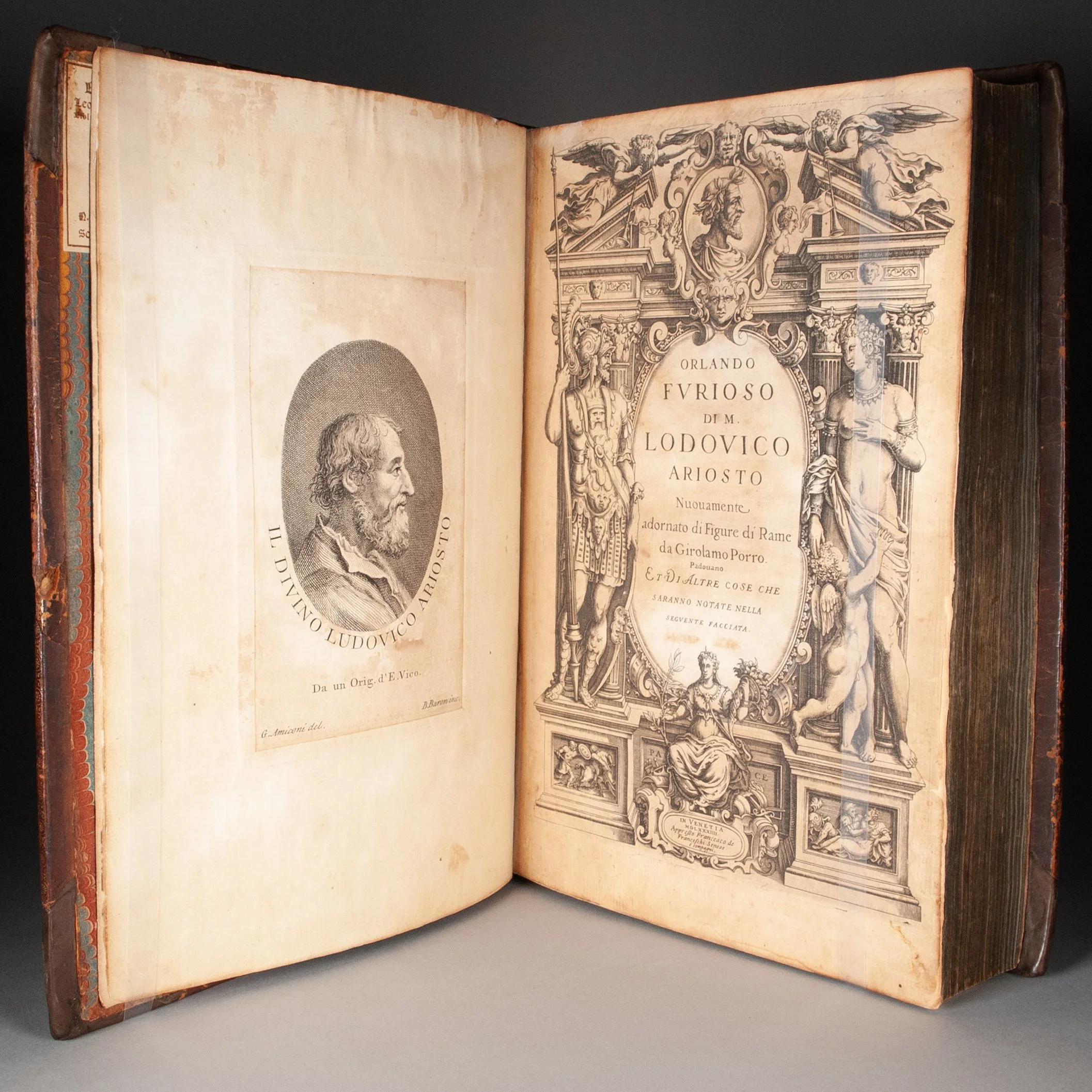
Orlando Furioso di M. Lodovico Ariosto, nuovamente adornato di figure di rame da Girolamo Porro, Padovano, et di altre cose che saranno notate nella seguente facciata
by Ludovico Ariosto | engravings by Girolamo Porro
Venice: Francesco de Franceschi, 1584
[40], 654, [34] p.; 43, [1] leaves | 4to | ^4 *^8 ***^8 A-Z^8 a-v^8; a-l^4 | 277 x 189 mm
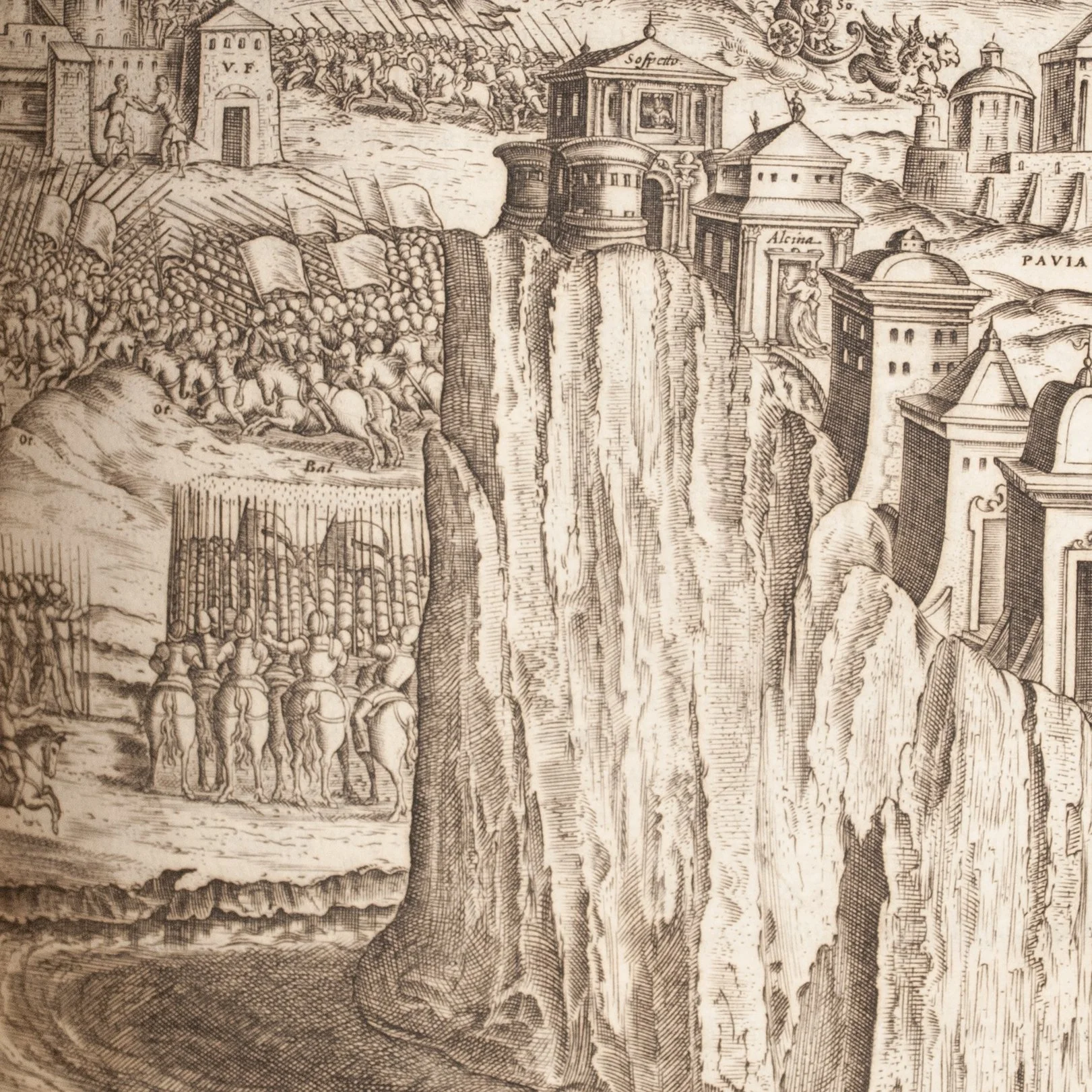
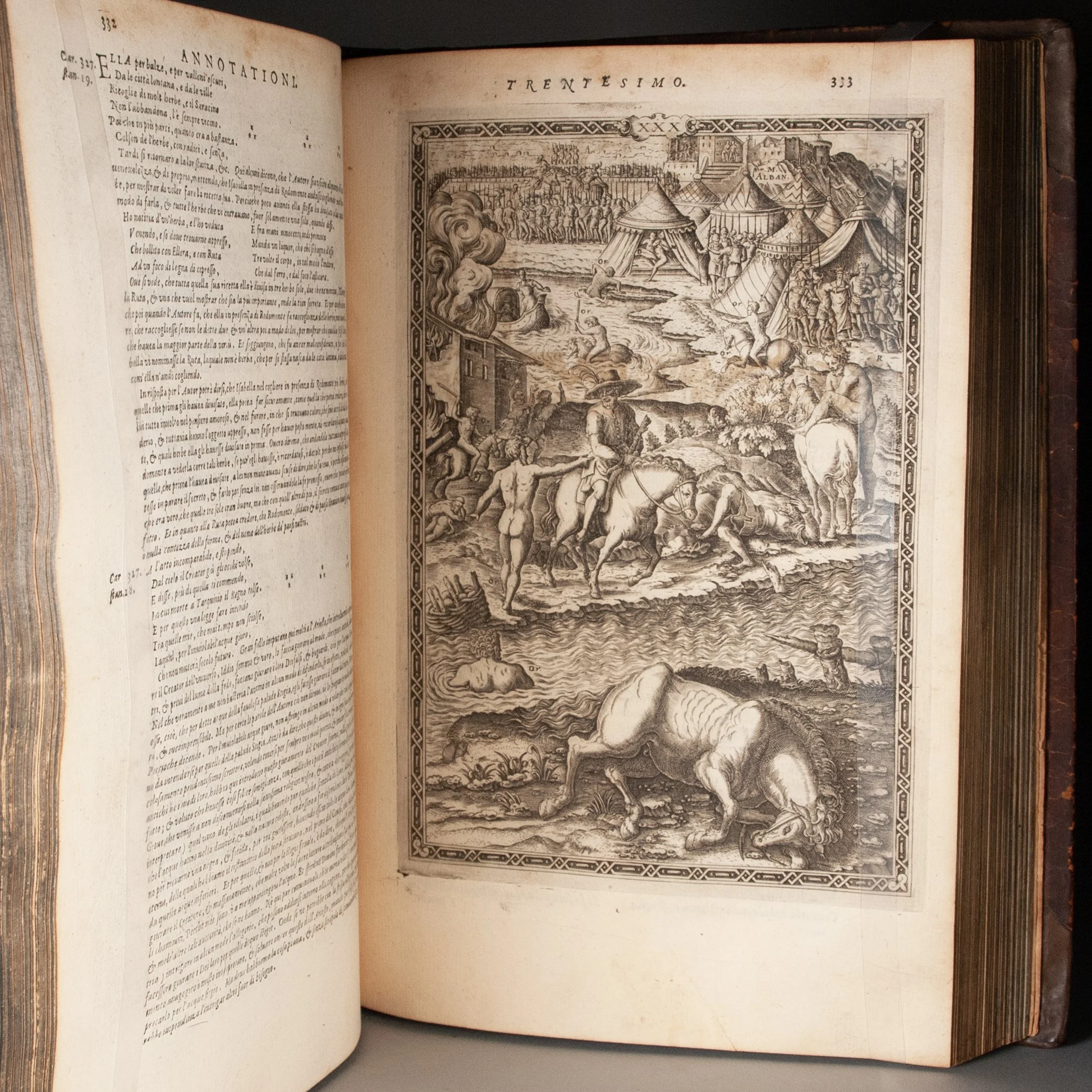
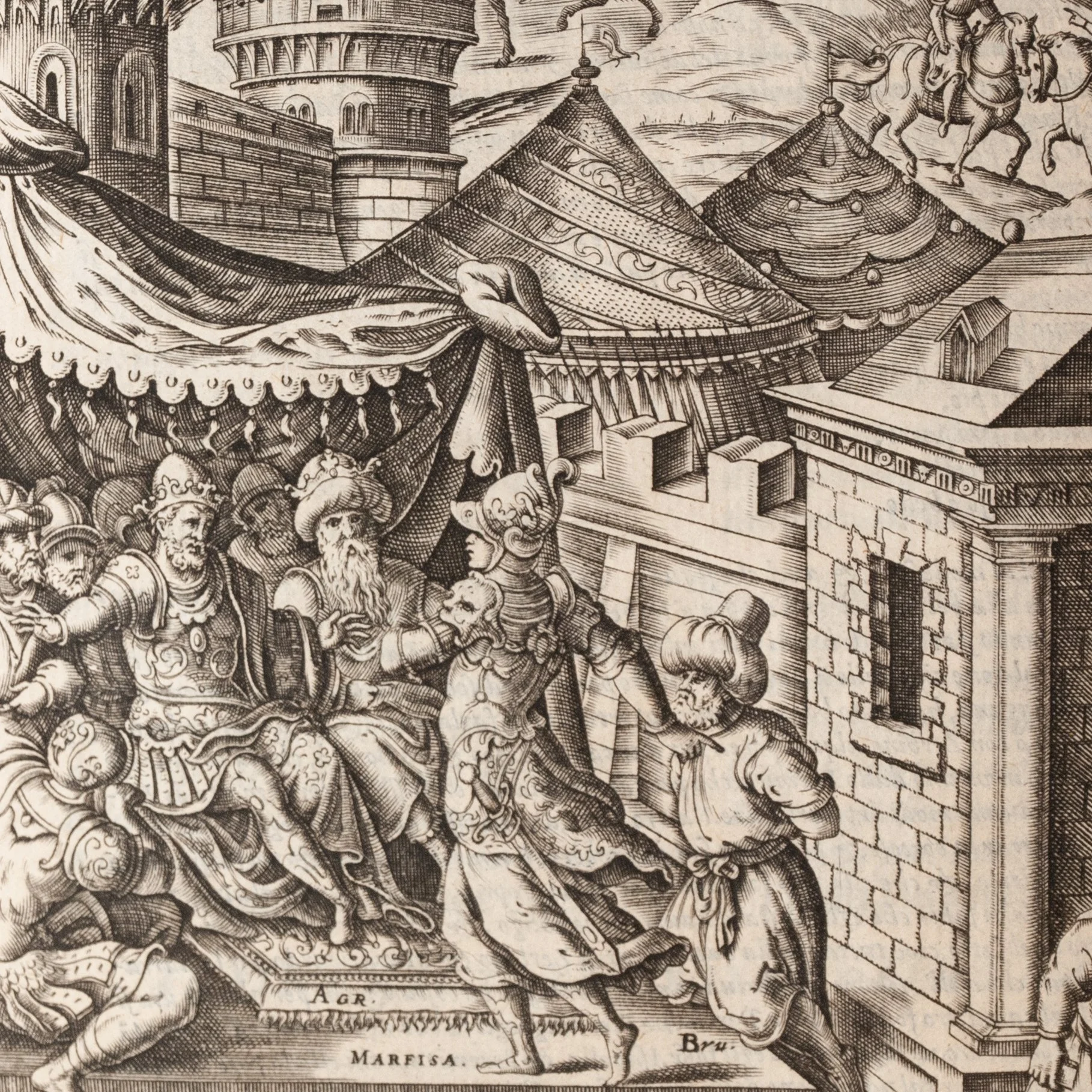
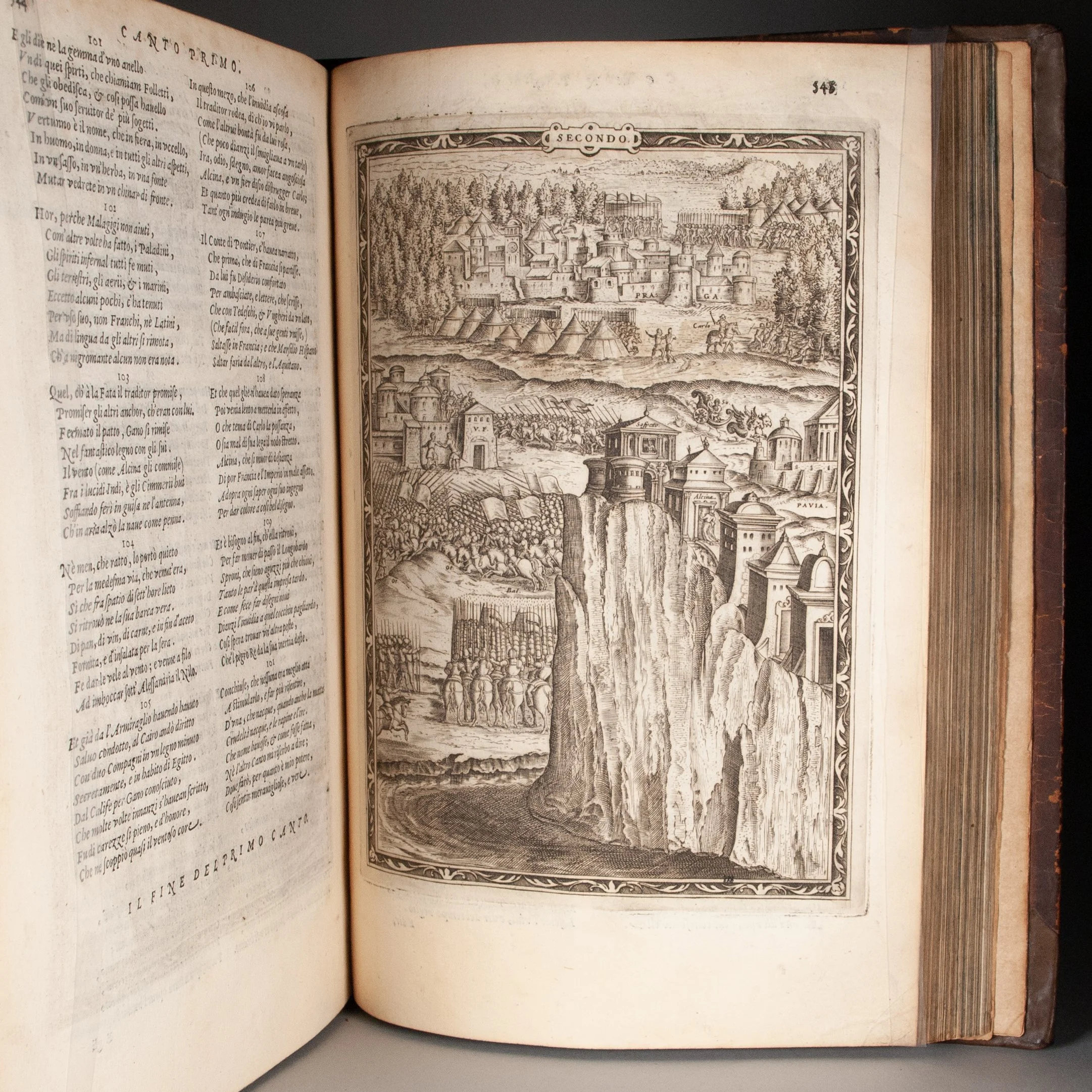
A magnificently illustrated edition of this classic of world literature, a vernacular epic poem that claimed the rare distinction of being taught in the classroom, "the only vernacular classic to win such approval" (Grendler). This edition introduced some new paratexts, including Alberto Lavezola's Osservationi, which appear at end with a separate title page. ¶ This is the first and only edition illustrated by Girolamo Porro, which justifiably earns its reputation as the most sumptuous edition produced in the sixteenth century, illustrated throughout with 51 full-page engravings (one for each canto, and one for each of the posthumously published cinque canti at end). As is often the case, our engraving for Canto 33 is repeated for Canto 34, the latter thought to have been suppressed for depicting the pagan Astolfo with John the Evangelist. Porro based his engravings on the woodcuts prepared for Vincenzo Valgrisi's 1556 edition, though Valgrisi didn't include the cinque canti until 1562, so we suspect Porro used one of the half dozen editions published between then and 1580. In the Anglo-American context at least, Porro's legacy is typically viewed through the lens of the 1591 English translation, which based its illustrations on these Porro engravings. ¶ While Valgrisi's edition was the first to contain full-page illustrations (see Mortimer #29), this 1584 edition did him one better, being the very first Orlando Furioso illustrated with engravings. To be sure, editions adorned with woodcuts were rather ubiquitous in the second half of the 16th century. These typically manifested as smaller illustrations within decorative frames, seldom occupying more than half a page. But the use of copper plates represented an evolutionary leap forward, affording far greater detail, evident here in these sharp impressions. The white space is generally clean, the plates carefully wiped after inking, and even the finest lines have a crisp appearance. ¶ Porro at times plainly borrowed his composition from the Valgrisi woodcuts, and he is sometimes dismissed as having simply transferred the woodcuts to another medium. Others, however, believe Porro is due credit for his own artistic choices. "Porro occasionally selects different subjects; those he illustrates usually climb the page in chronological order which...is not always the case with Valgrisi, and he sometimes omits descriptive details of the narrative which are clearly delineated in his supposed model. There are, in fact, many instances which lead one to surmise that Porro, while resembling his predecessor in style and lay-out, took little note of the content of the woodcuts" (Falaschi). ¶ In addition to the full-page engravings, each canto opens with an argomento in an elaborate engraved frame and a large 11-line woodcut initial. The title, too, is fully engraved, and the titles for both the Cinque canti and Osservationi appear within engraved borders. Our copy also has an added frontispiece portrait of the author, designed by Jacopo Amigoni (Giacomo Amiconi; 1682-1752) after an original by Enea Vico. It's an apt complement to Porro's engravings, if only because Porro was thought to have been one of Vico's students.
PROVENANCE: From the library of legendary Florentine publisher Leo Olschki, with his small bookplate on the front paste-down. Small, old signature obliterated from the title.
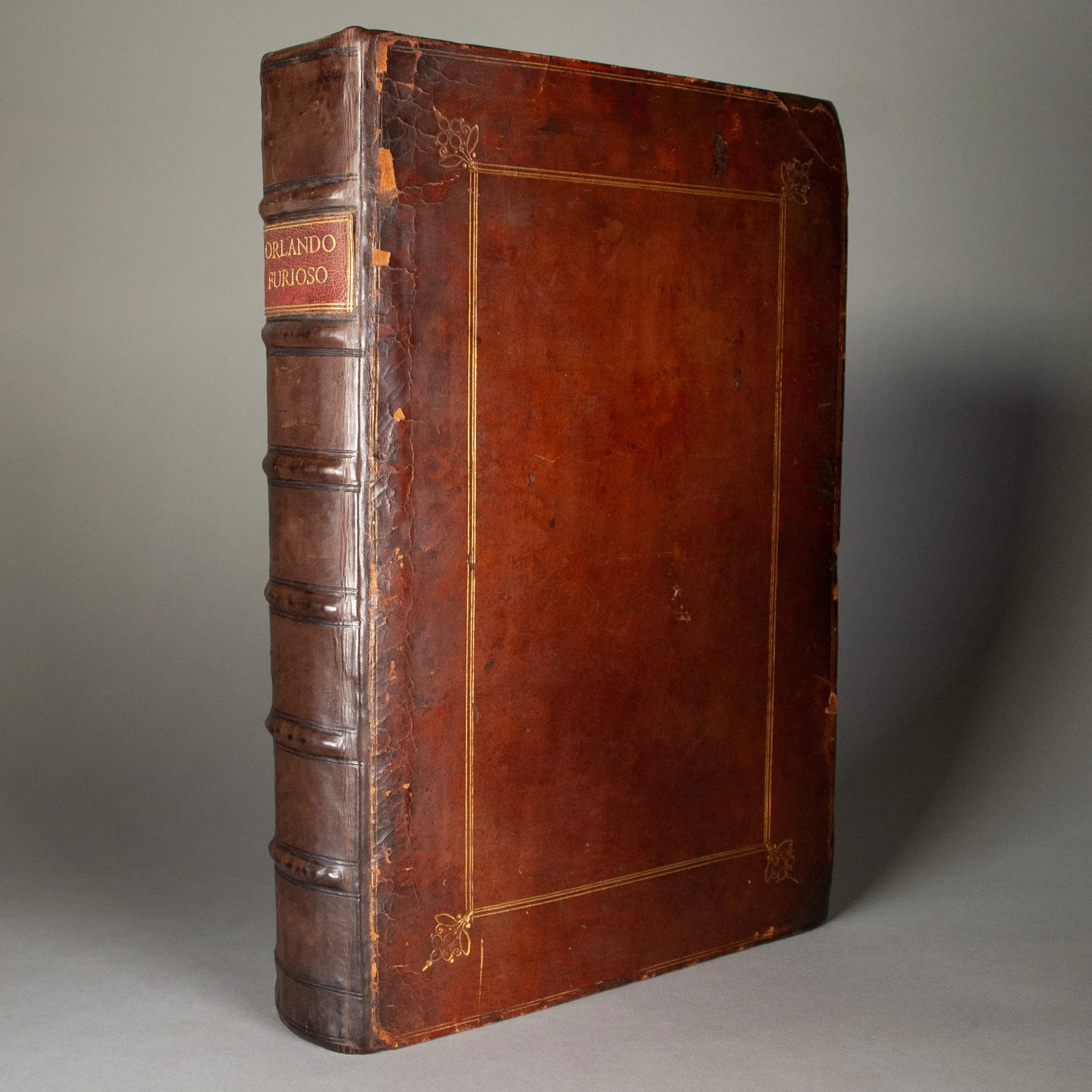
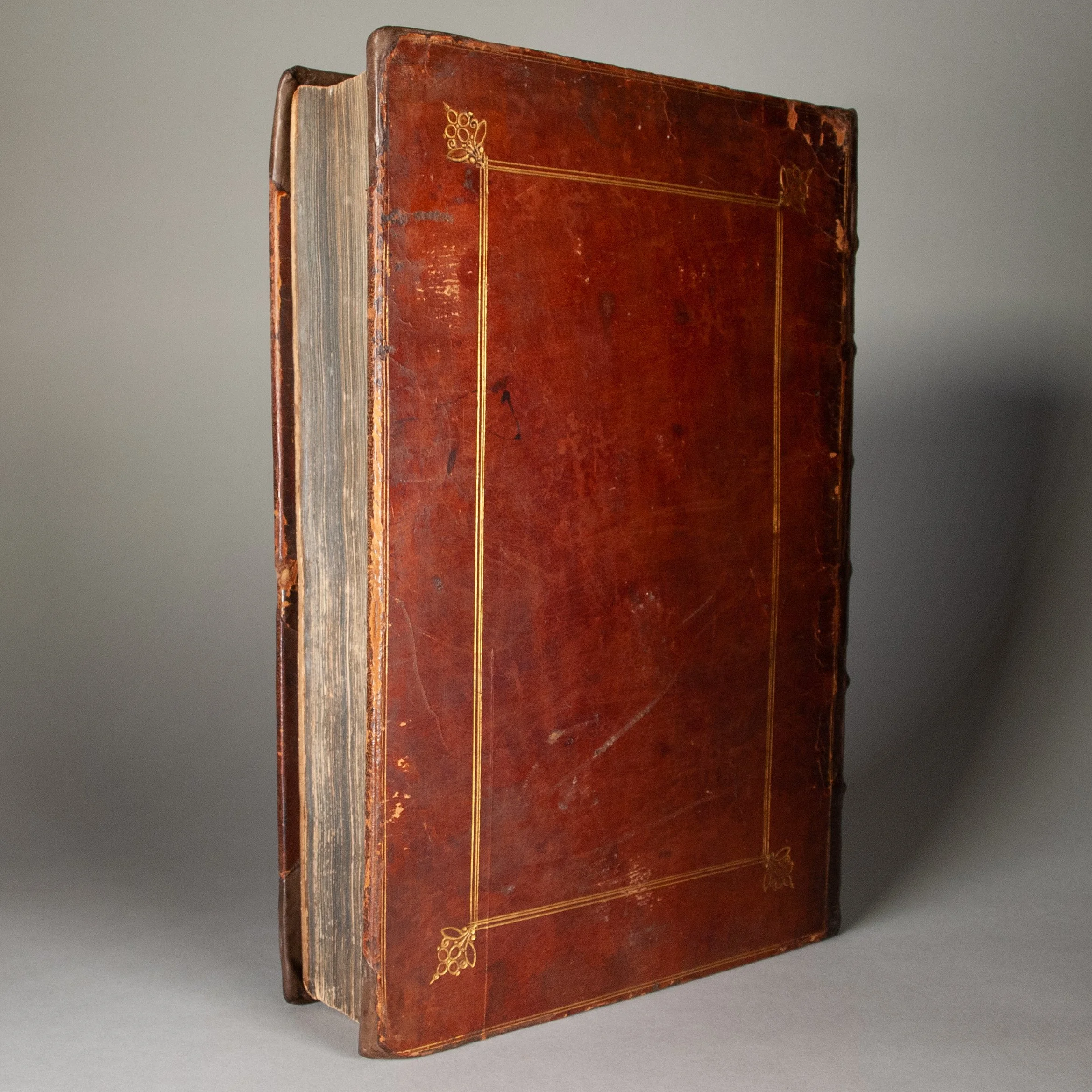
CONDITION: Eighteenth-century brown calf (rebacked), probably British, with a simple gold frame on each cover. Leaves u8 and l4 (second sequence) are blank. ¶ Title soiled and darkened, remargined, and with some small chips and tears at the edges (one just barely touching the engraved area); some scattered foxing, generally light; the letterpress occasionally a bit grubby, with inky fingerprints and inked furniture; handful of scattered marginal tears, nothing affecting text. Recently rebacked in matching brown leather, the corners of the boards likewise repaired; original leather moderately scuffed and worn; front fly-leaf with some small repairs at the fore edge.
REFERENCES: EDIT16 CNCE 2807; USTC 810794; Ruth Mortimer Italian 16th Century Books (1974), v. 1, #30 (cited above; "Details of some episodes are borrowed from Valgrisi, but Porro did not simply copy the woodcuts. In some cases, he brought different scenes into the foreground.") ¶ On the illustrations: Enid T. Falaschi, "Valvassori's 1553 illustrations of 'Orlando Furioso': the development of multi-narrative technique in Venice and its links with cartography," La Bibliofilía 77.3 (1975), p. 248 ("This Venetian edition of 1584, printed by Francesco Franceschi, is perhaps the most famous of the sixteenth century. It is the first one where an artist is name and which has engravings, as opposed to woodcuts, throughout. Porro, whose name is given on the frontispiece, was a Paduan who trained as a goldsmith and is thought to have been a pupil of Enea Vico, the engraver and medallist from Parma."); Anne Palms Chalmers, "Venetian Book Design in the Eighteenth Century," The Metropolitan Museum of Art Bulletin New Series 29.5 (Jan 1971), p. 232 ("Orlando was illustrated with engravings for the first time in 1584," namely the present edition) ¶ On the text: Paul F. Grendler, Schooling in Renaissance Italy (1989), p. 298 (cited above); Peter Burke, "Learned Culture and Popular Culture in Renaissance Italy," The Renaissance in Europe: A Reader (2000), p. 75 (“According to the poet Bernardo Tasso, the Furioso was read by craftsmen and children. According to the Venetian publisher Comin dal Trino, it appealed to common people (il volgo). Unusually for the sixteenth century, this modern text was taught in some schools alongside the Latin classics.”)
Item #952