
Vernacular Virgil with woodcuts by Virgil Solis


Vernacular Virgil with woodcuts by Virgil Solis
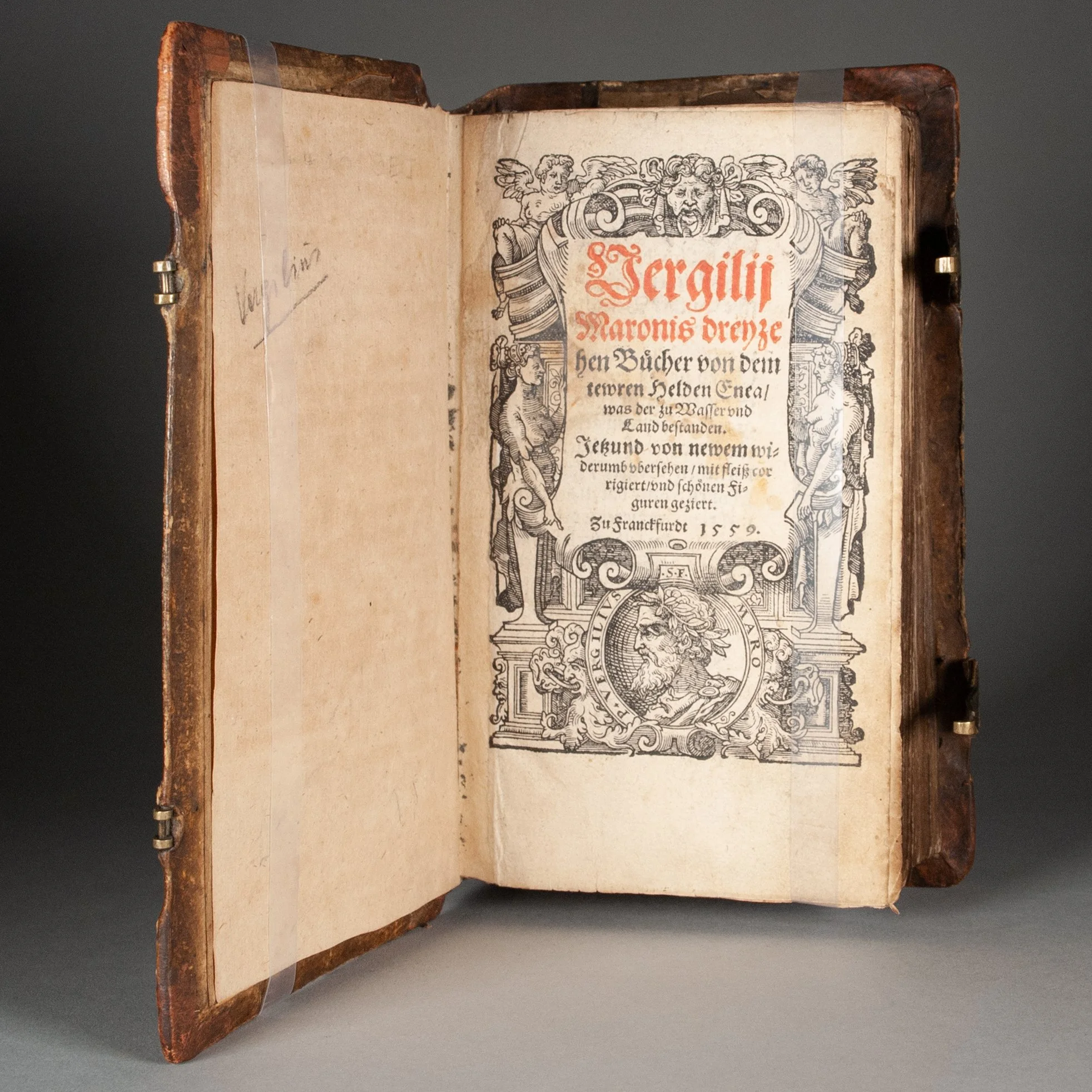
Dreyzehen Bücher von dem tewren Helden Enea, was der zu Wasser und Land bestanden; jetzund von newem widerumb ubersehen, mit fleiss corrigiert, und schönen Figuren geziert
by Virgil | translated by Thomas Murner | woodcuts by Virgil Solis
Frankfurt: David Zöpfel, 1559
[688] p. | 8vo | A-Z^8 a-v^8 | 175 x 102 mm
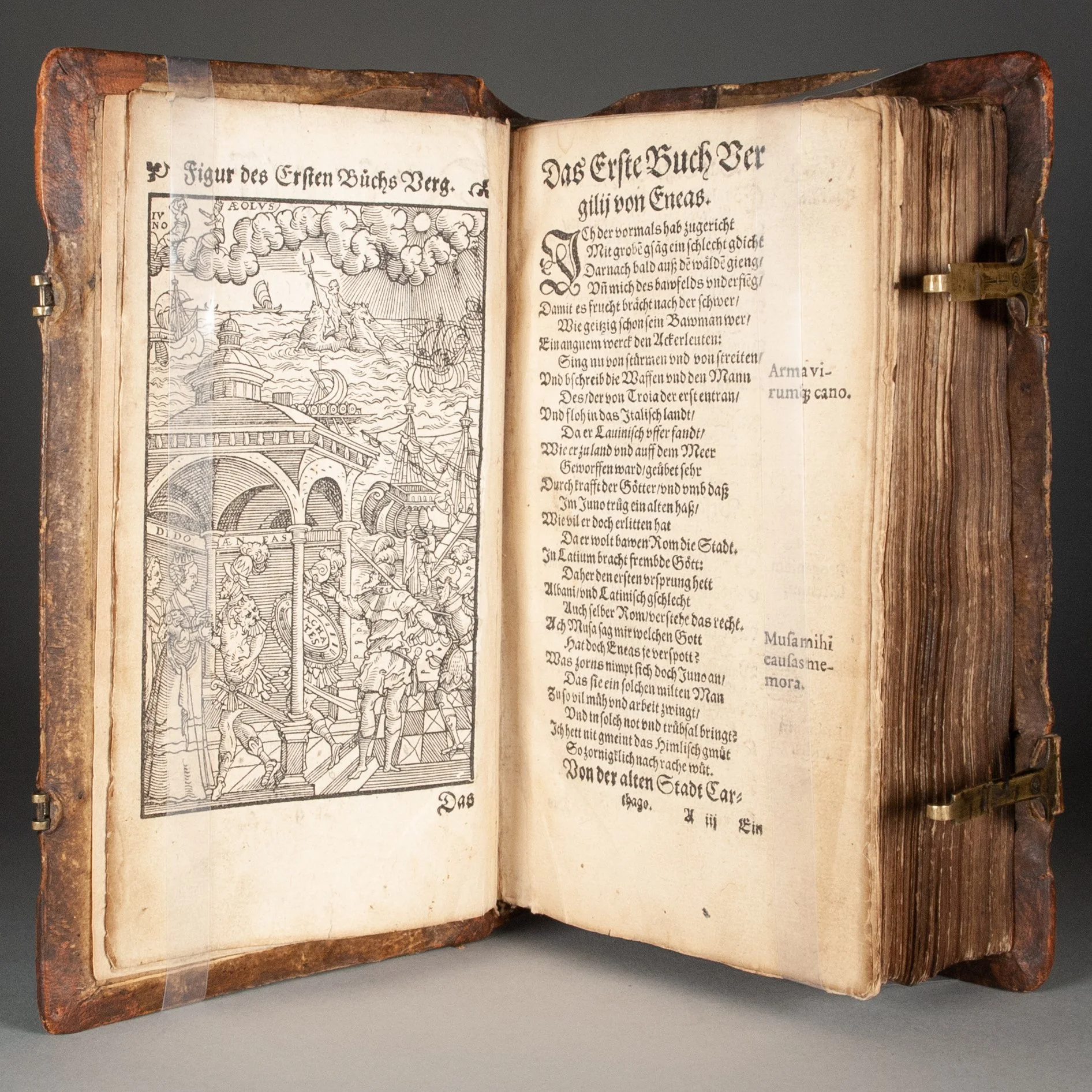
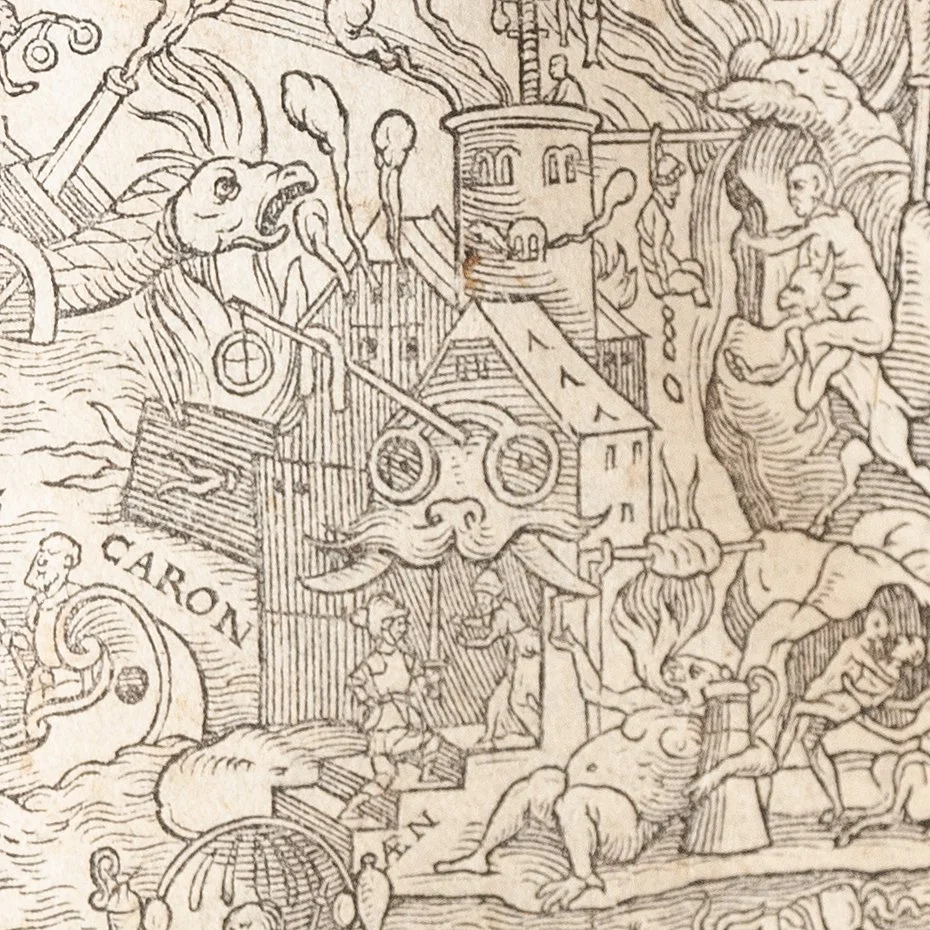
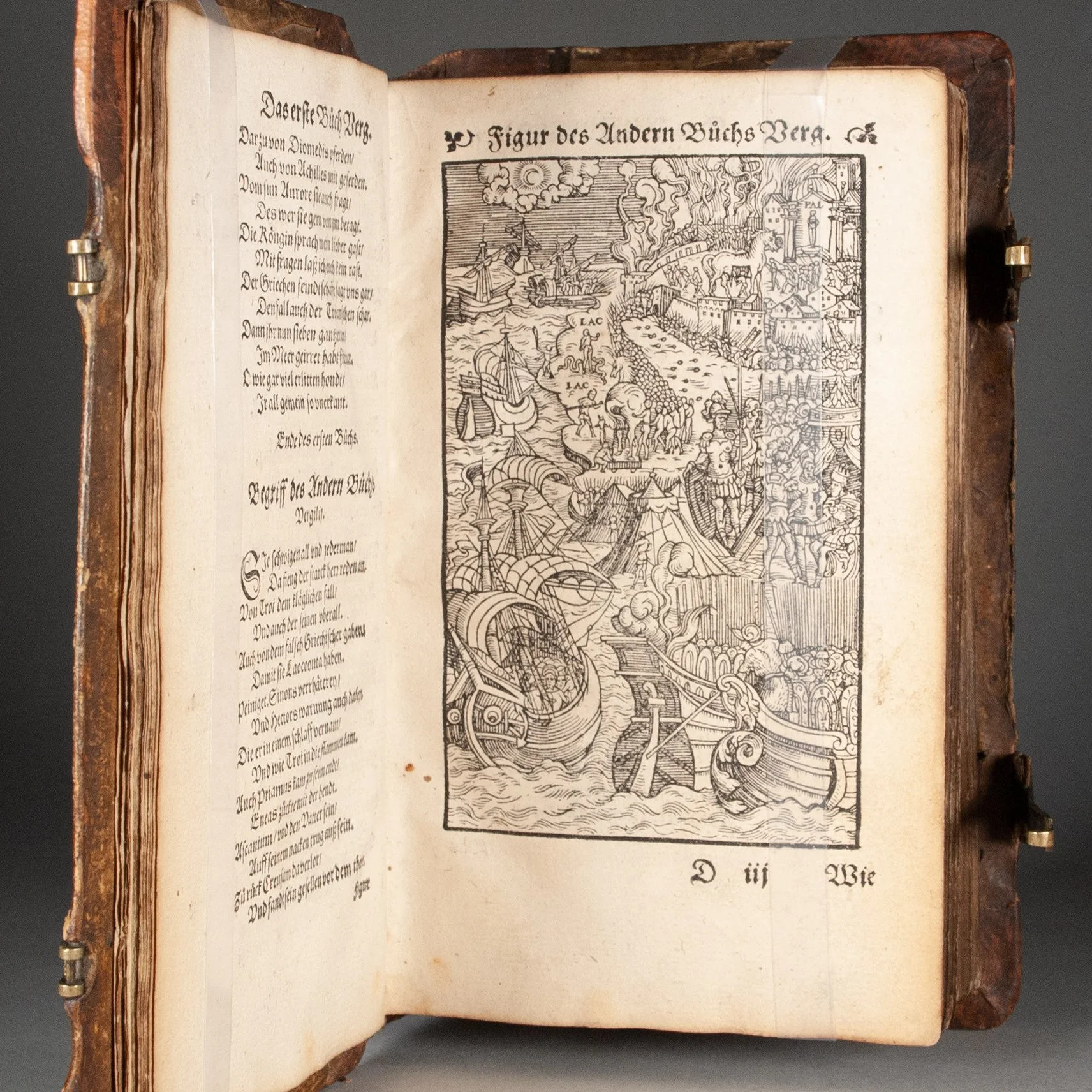
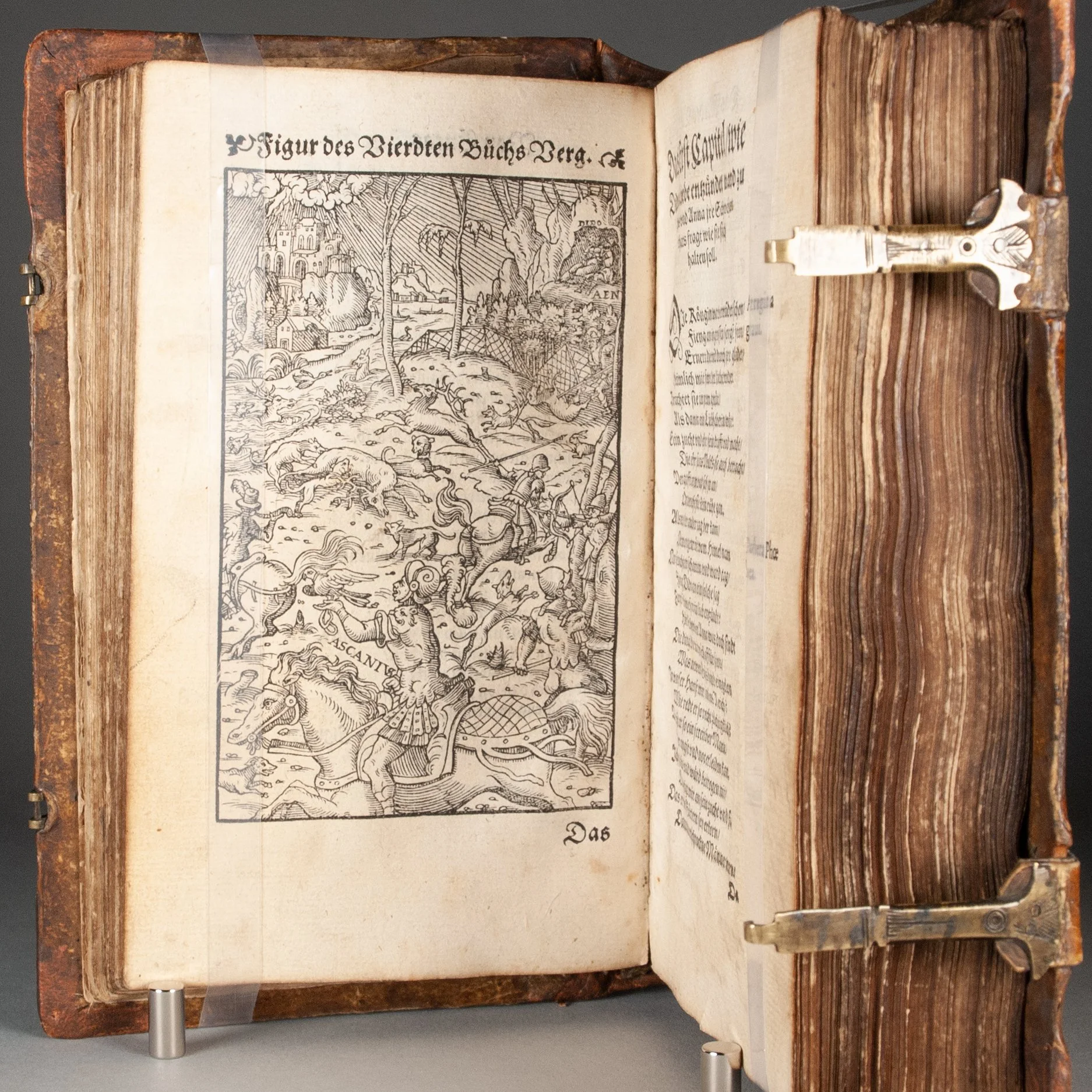
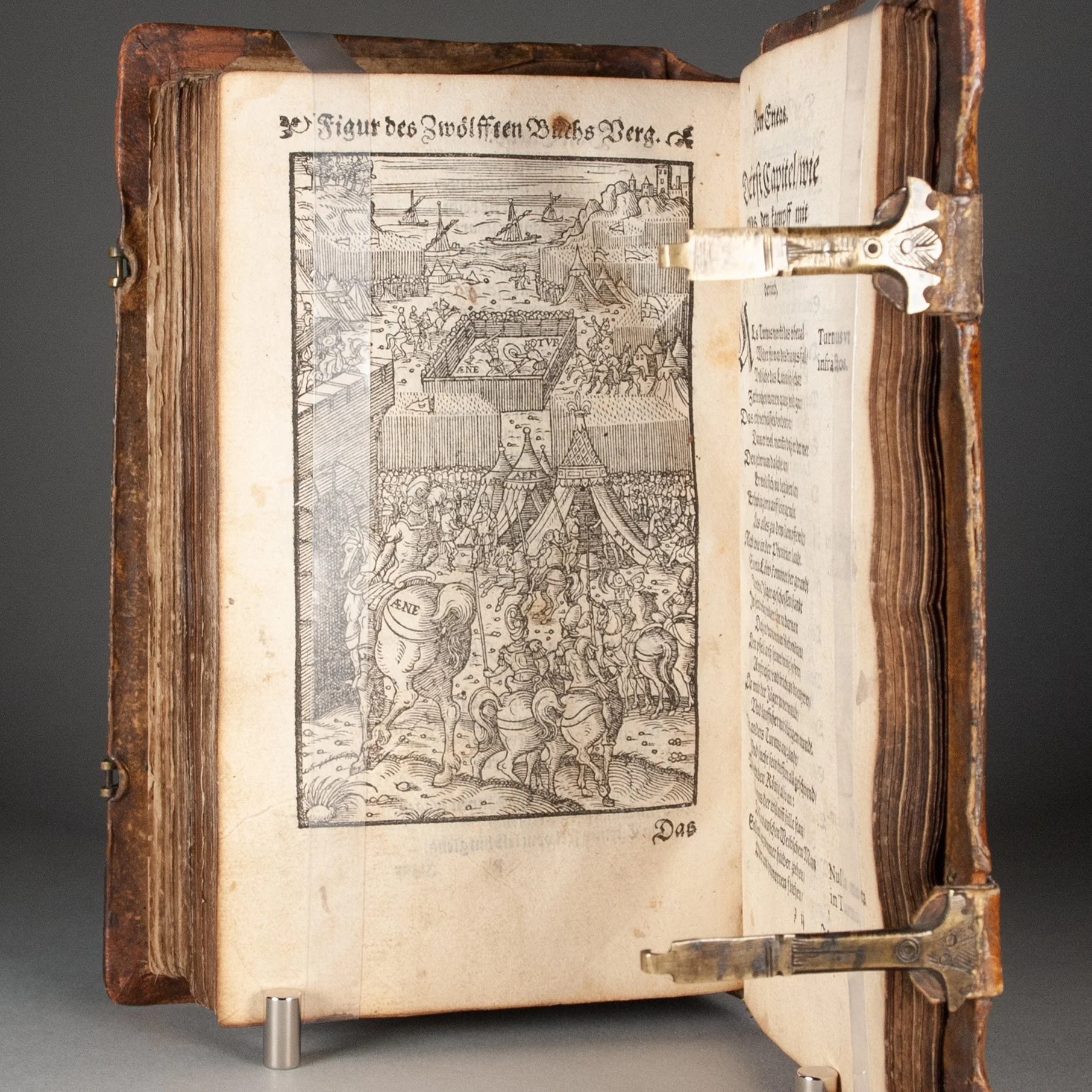
Likely the fourth edition of Murner's vernacular translation of Virgil's Aeneid, and the first appearance of these thirteen full-page woodcuts by Virgil Solis, strong impressions from fresh blocks. Solis appears to have found inspiration, at least in part, in the 1543 Murner edition (whose woodcuts were also reused in the 1559 Strasbourg edition). The woodcut illustrating Book 1, for example, was plainly copied from it. While some of these seem almost completely disconnected from those 1543 woodcuts—see especially those opening Books 2 and 12—others clearly borrowed the broad strokes of composition from them (compare the woodcuts opening Book 4, for example). Even so, these cuts by the Nuremberg virtuoso are undeniably more accomplished than their 1543 forebears—no surprise there—which at times left little of substance to copy anyway. A few of these illustrations later appeared in Feyerabend's 1581 Ovid. ¶ Cultural historian Charles Zika calls particular attention to the illustration opening Book 6: "The upper sections of the 1559 woodcut extend the iconography of earlier versions of Virgil's underworld in quite significant ways. In particular, the artist has borrowed fantastic elements from the Netherlandish traditions associated with artists such as Hieronymus Bosch and Pieter Bruegel. The gateway of hell has become a bespectacled walrus head, an inn sign protruding from its forehead, and hanging from it a sausage." There's even a witch riding a goat in the upper left corner. ¶ Editions of the Aeneid were ubiquitous. "Vergil was, for the Humanists, as for the Middle Ages, Poeta—just as Paul was Apostolus and Aristotle Philosophus. He was the Poet." Some students even memorized the work, "persuaded—as were most literate people—that this noble poem contained the whole of moral truth " (Di Cesare). Murner was no slouch either. If most Catholic writers failed to match the satirical appeal of their Protestant opponents, Murner was the exception, whose Great Lutheran Fool proved "a sarcastic exposé of Luther’s worst shortcomings, and it gave Protestants a taste of their own strong medicine" (Eire). Murner's Virgil first appeared in 1515, with subsequent editions in 1543 and 1544, and another at Strasbourg the same year as ours. Our woodcut title frame, with its SF monogram, likely indicates ownership and/or production by Sigmund Feyerabend, a Frankfurt woodcutter who would go on to become one of the city's most prominent publishers (and would later reuse some of these Virgil woodcuts). Some even suggest Feyerabend himself cut the blocks after Solis's designs.
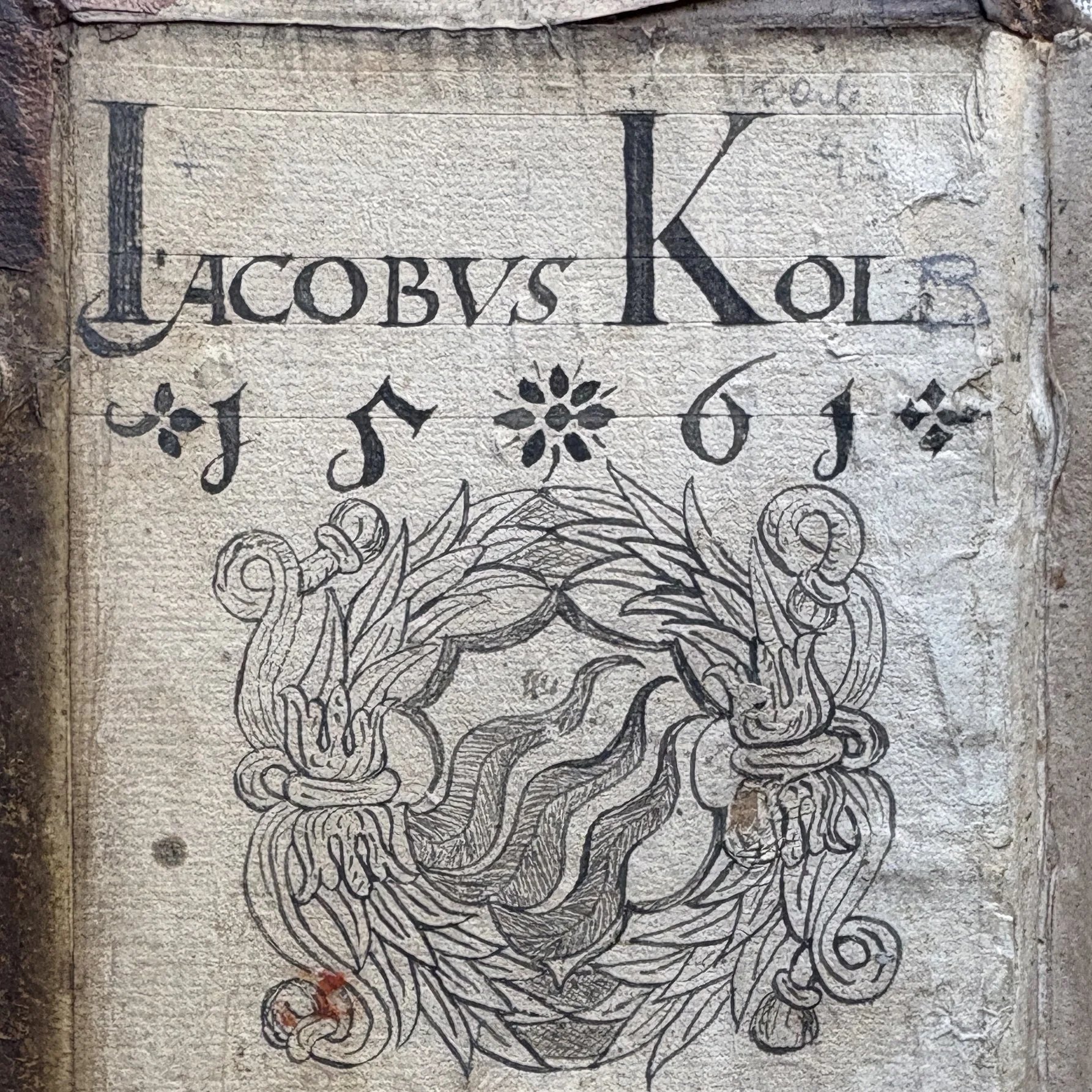
PROVENANCE: With an arresting contemporary manuscript ex libris on the front paste-down, of one Jacob Kolb and dated 1561. In a narrow compartment on the front cover, where we'd normally find initials, is a small blind stamp bearing Kolb's coat of arms, no doubt a tool Kolb himself kept on hand for marking his books. ¶ Penciled ownership signature on front fly-leaf of Joseph B. Dallett, accomplished scholar and print collector. ¶ Some scattered light marginalia in Book 4.
CONDITION: Contemporary blind-tooled pigskin, original brass clasps preserved. Title within a woodcut border, and with thirteen full-page woodcuts on A2v, D3r, G6v, K6v, N7v, R3v, X2v, a6v, d6v, g8r, l5v, p1v, and s7v. ¶ First two leaves remargined, affecting a little text on the title verso; first few leaves soiled and a trifle chipped at the edges; last leaf torn in the upper inner corner, not affecting the colophon; scattered soiling and mild dampstaining, with heavier damp to d8; finger smudges on S4-5. Recased, with a new front fly-leaf added; spine ends and board corners restored; pigskin generally worn and soiled, with a bit of loss in the upper right of the rear board.
REFERENCES: VD16 V 1430; USTC 700656; The New Hollstein...Virgil Solis, Book Illustrations, Part I (2006), p. 89-95 (the woodcuts) ¶ Charles Zika, The Appearance of Witchcraft: Print and Visual Culture in Sixteenth-Century Europe (2007), p. 129 (cited above); Mario A. Di Cesare, "Seeking the Renaissance Vergil," Bibliography and the Study of 15th-Century Civilisation (1987), p. 187 (cited above; "Beginning with that first Humanist, Petrarch—not to mention that great proto-Humanist, Dante—the veneration of Vergil was persistent, broad, and certain, and it extended to most areas of culture"); Carlos M.N. Eire, Reformations (2016), p. 374 (cited above; “The success of Protestantism can be attributed in large measure to its popular appeal, and to the pamphlets and sermons that spread the Protestant message in the vernacular, employing humor, satire, and illustrations. On the whole, early Catholic apologists failed to engage at that level. An exception was Thomas Murner, a Franciscan friar.")
Item #960