Early dated dos-à-dos binding
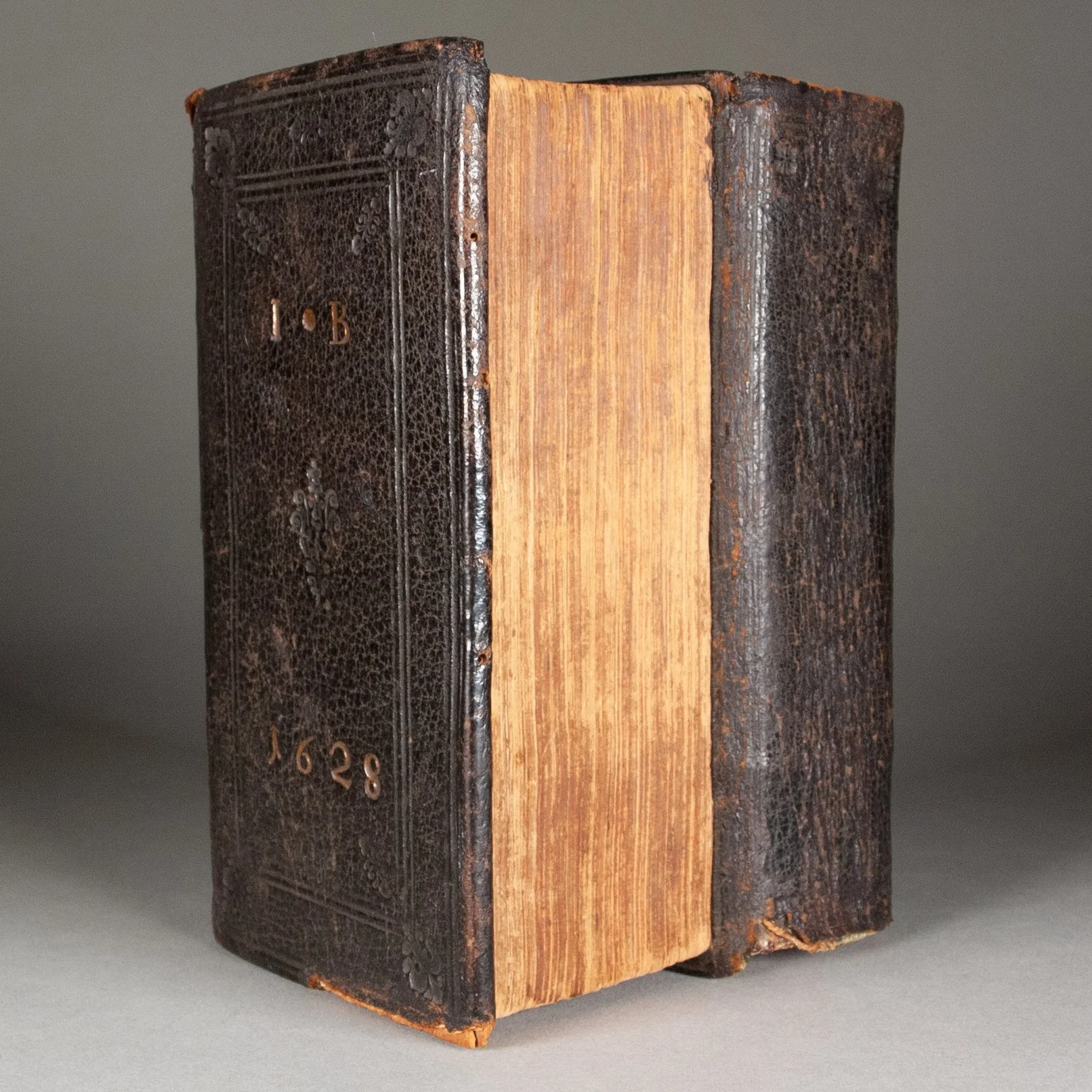
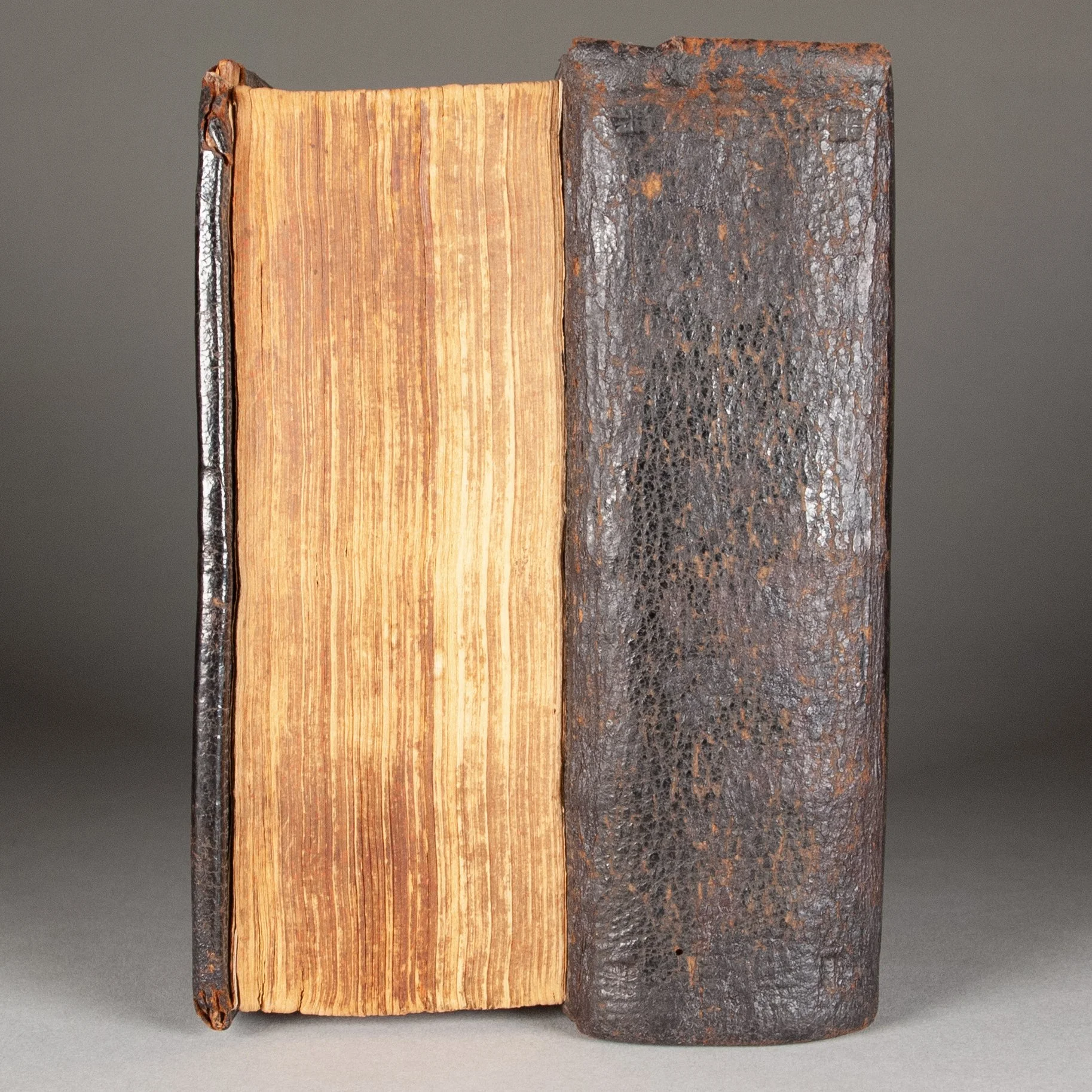
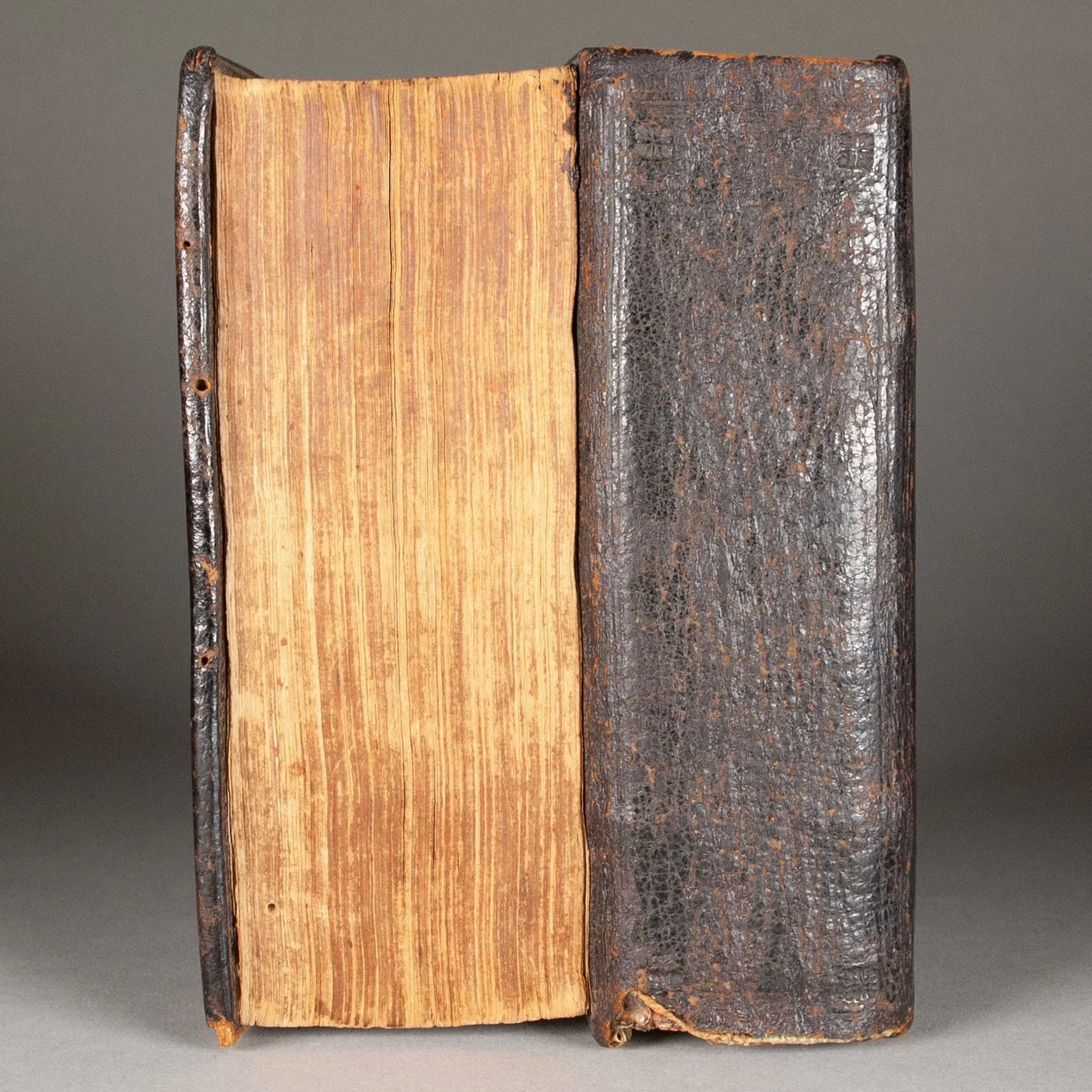
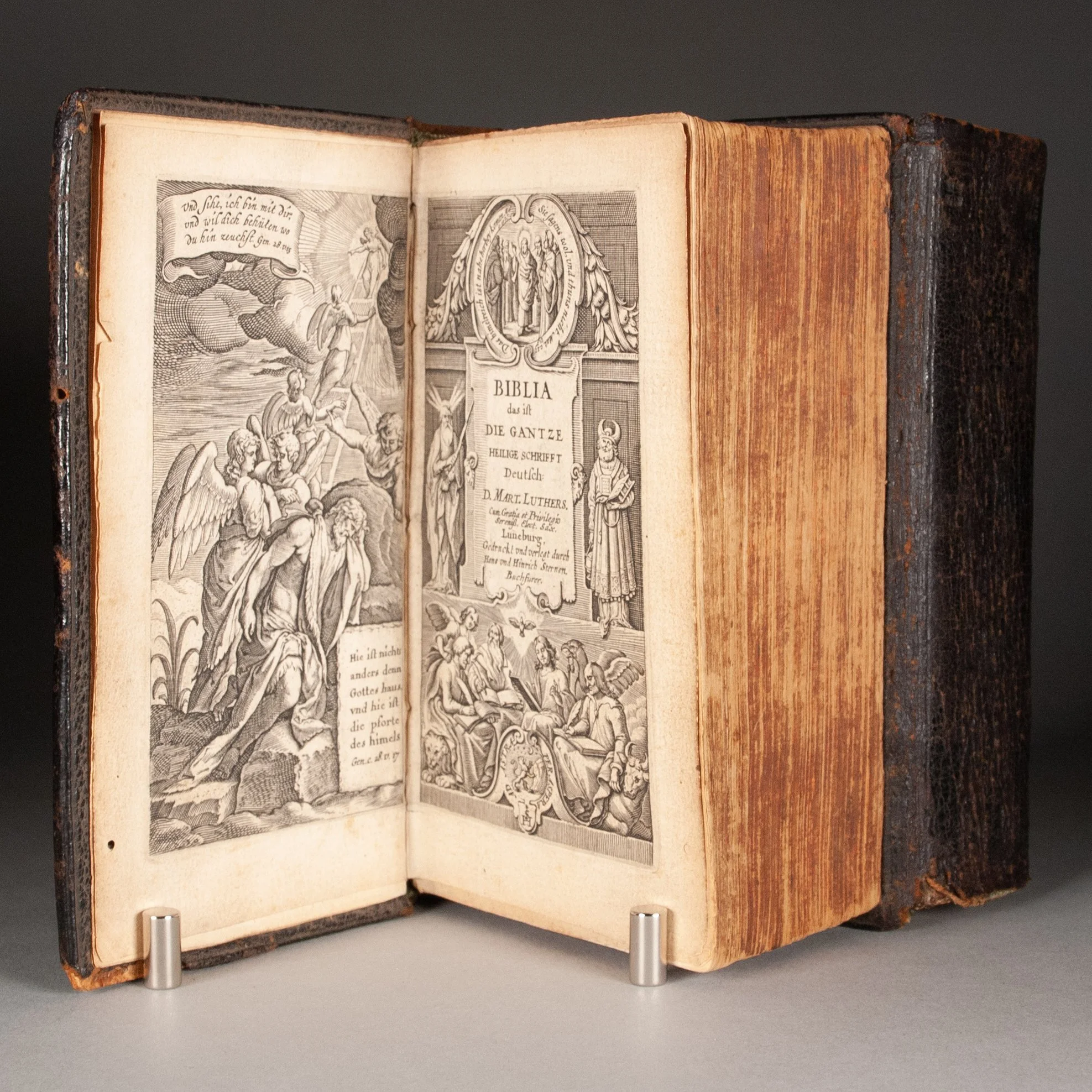
Early dated dos-à-dos binding
Biblia, das ist, Die gantze Heilige Schrifft Deutsch
translated by Martin Luther
Lüneburg: Heinrich and Johann von Stern, 1627
v. 1: [96], 408 p. + [2] plates; [2], 542 p. -- v. 2: [2], 590; [2], 426, [8] p. | 12mo | v. 1: )::(2-3 )a(^12(-)a(1.12) )b(-)d(^12 A-R^12; a-y^12 z^8 -- v. 2: (A)-(Aa)^12 (Bb)^8; A-S^12 T^2 | 143 x 76 mm
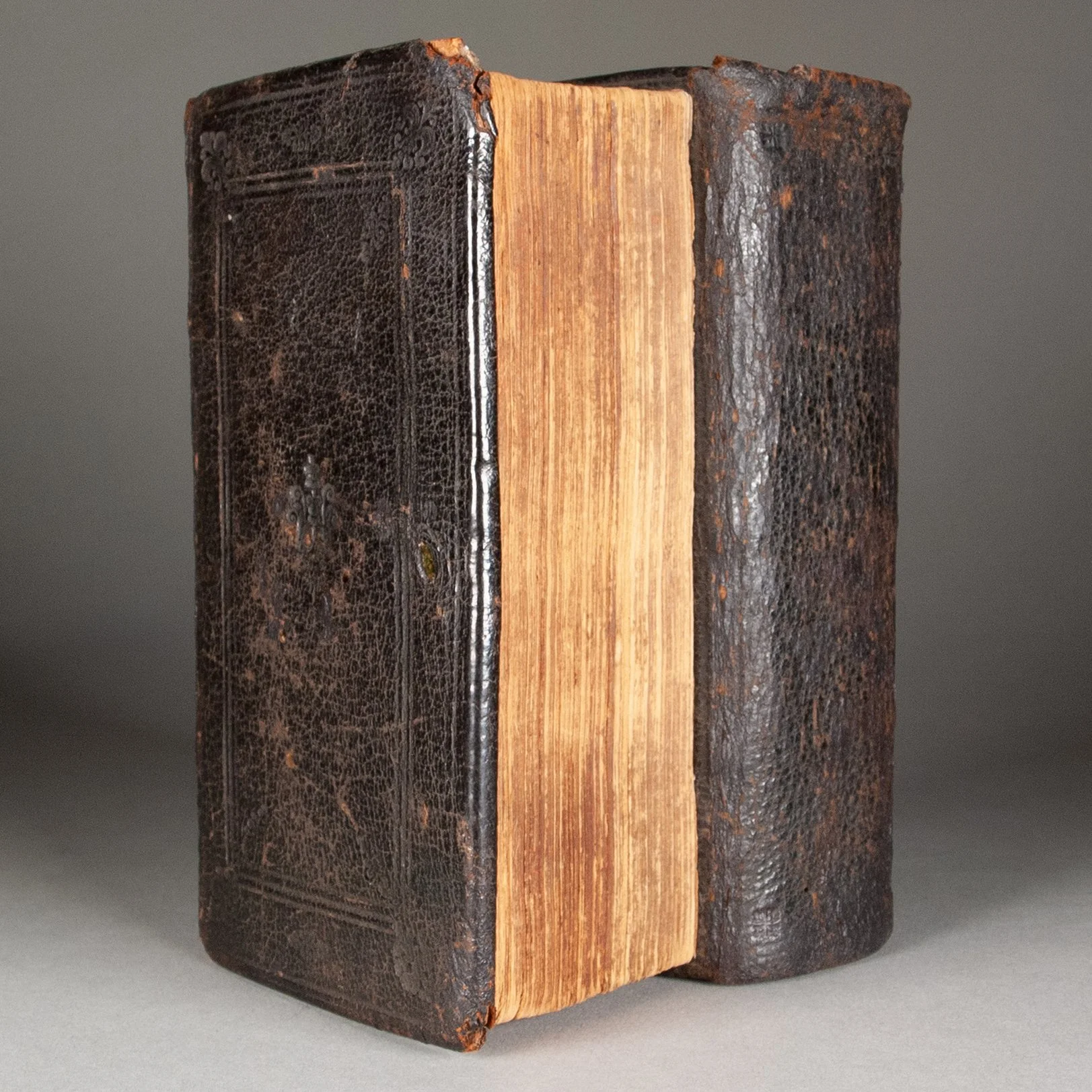
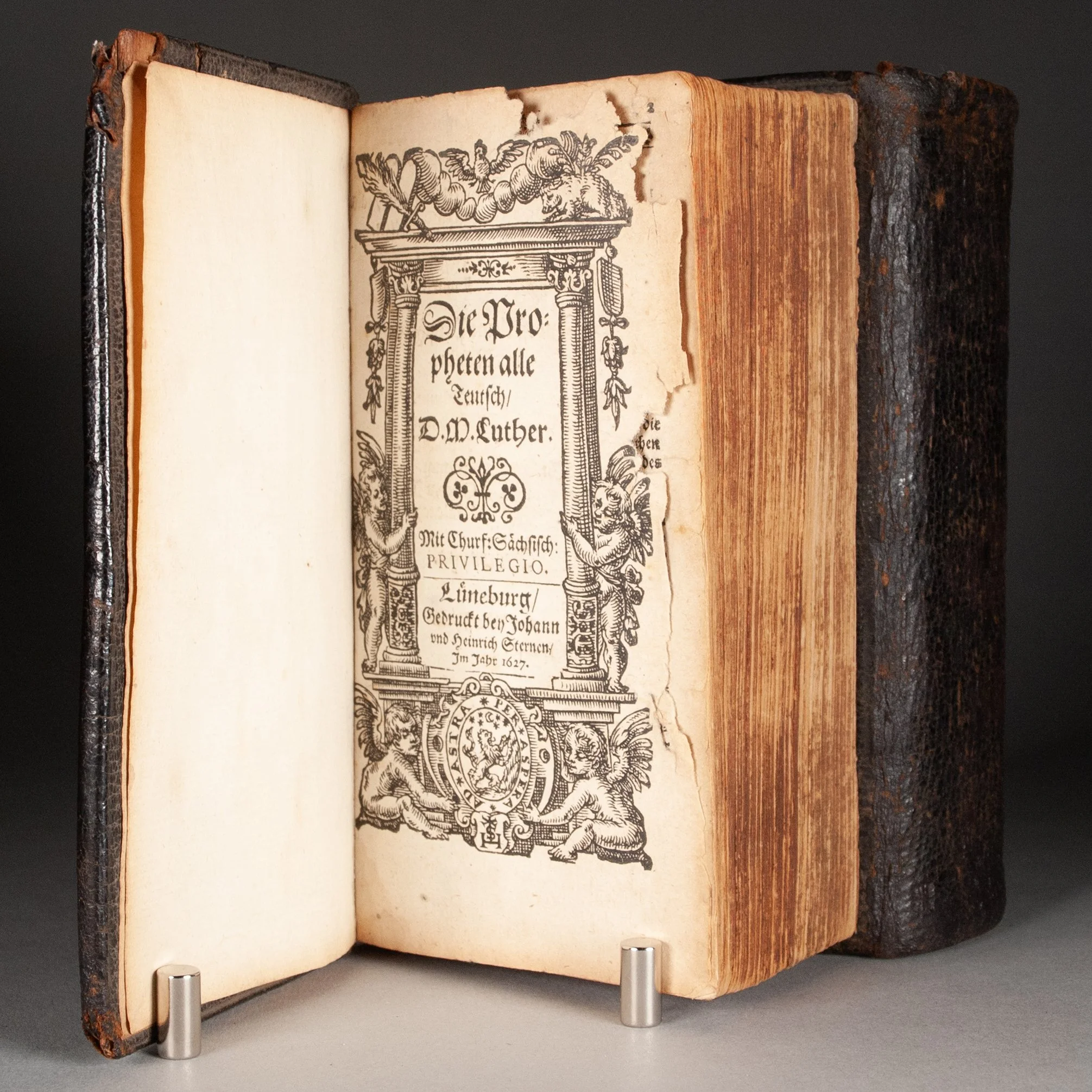
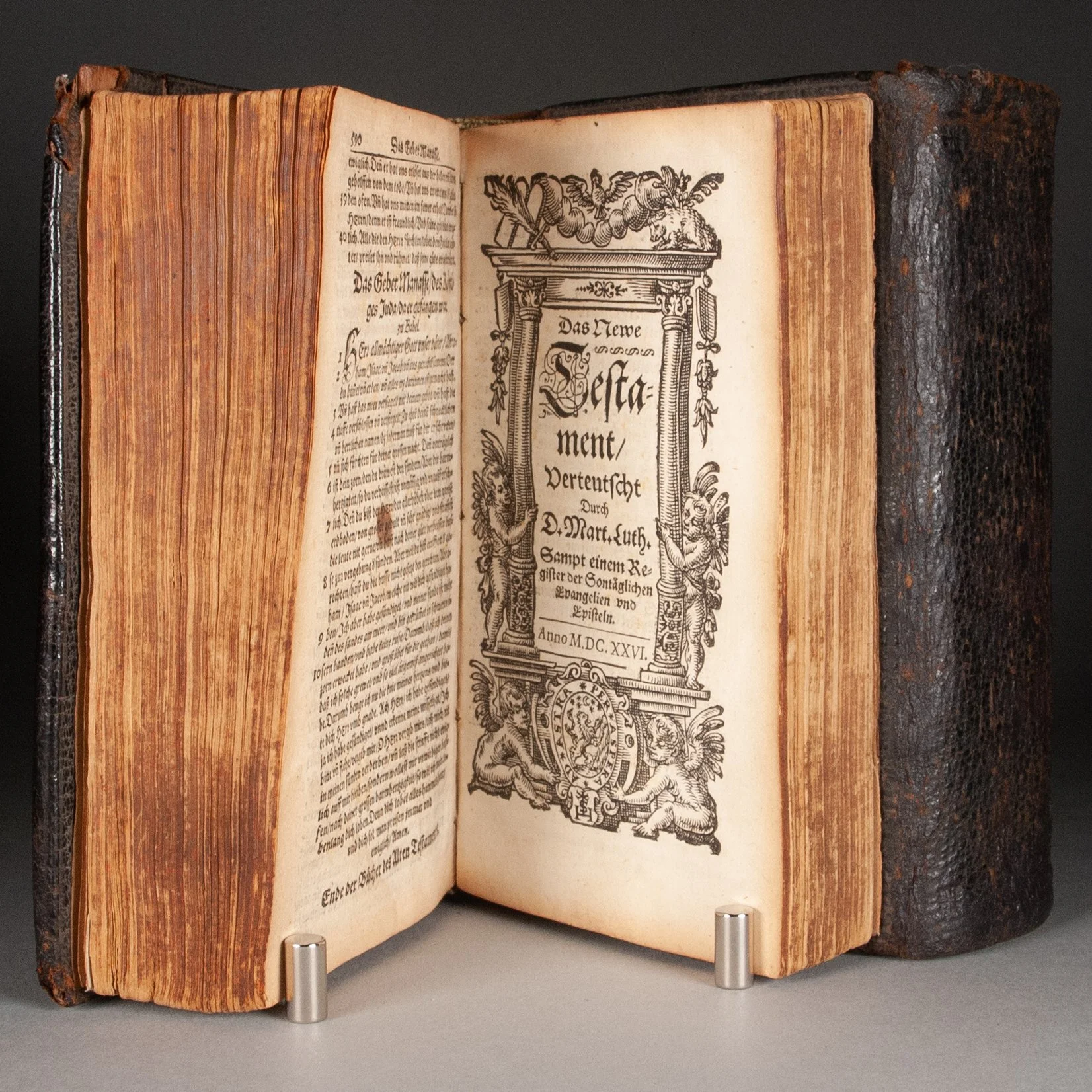
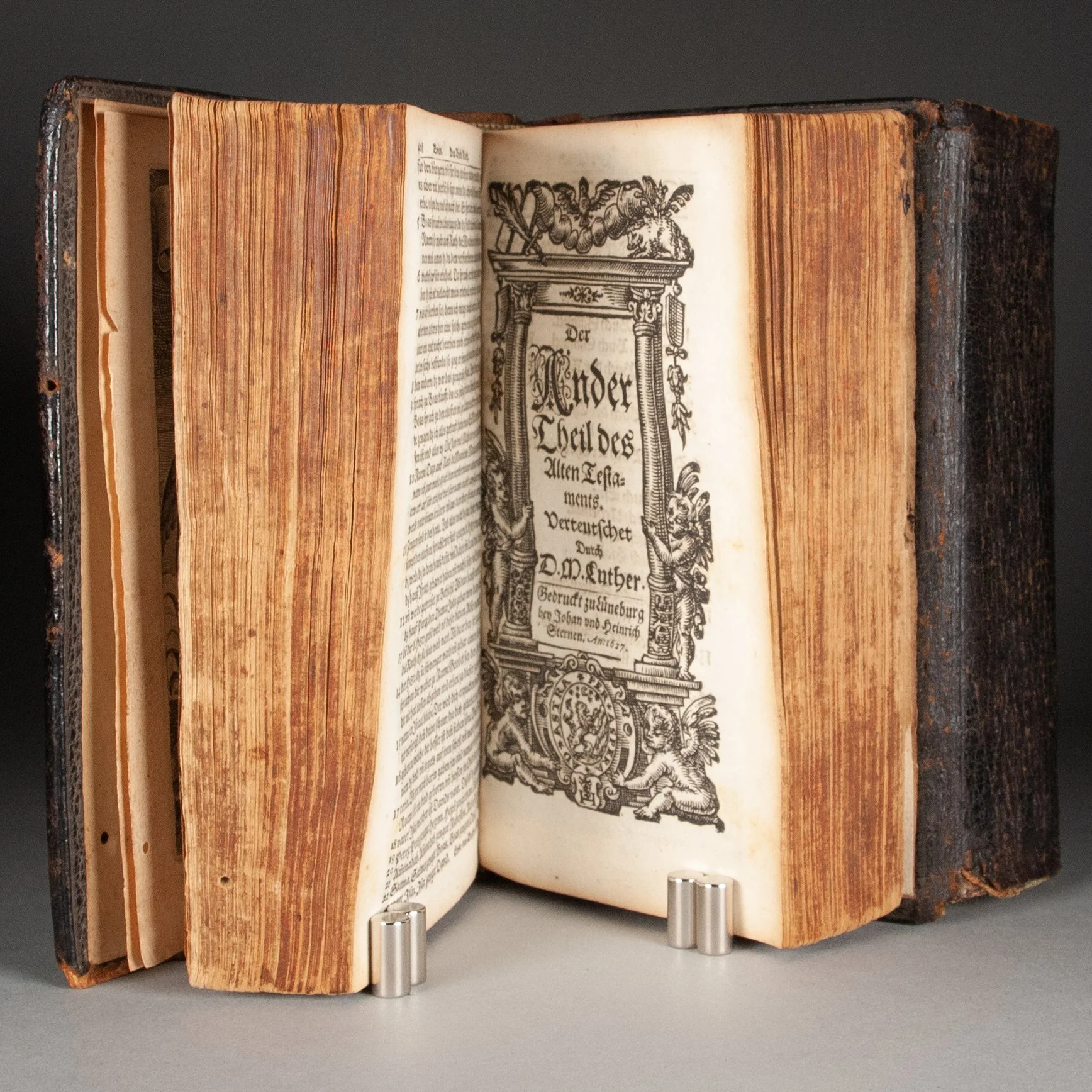
One of countless editions of Luther's complete Bible, his translation "the first to become a bestseller in the strict meaning of the term" (Steinberg). This edition contains four discrete parts: Most of the Old Testament in two volumes, then the Prophets, and finally the New Testament, each section with a separate title page. ¶ In quite an early dos-à-dos binding, a striking style in which two texts are bound in opposite directions, each sharing a rear board positioned in the middle of the volume, the fore-edges of one text sitting atop the spine of the other. "In all areas of applied arts, forms occasionally appear that seem to have arisen less from reasons of beauty or utility than from the impulse to create something new, bizarre, and quite surprising" (Schmidt). "This also applies to bookbinding," Kurt Köster added, whence the dos-à-dos binding, known in Germany as Zwillingsbände and in France as reliures jumelles. This playful novelty structure was born in Northern Europe, perhaps as early as the 1540s, and enjoyed a niche fashion that endured well into the 18th century. They're found on devotional texts more often than anything else, a broad genre that was commonly subjected to deluxe and fanciful bindings—surely in part because they were so frequently used, but doubtless, too, as a kind of conspicuous consumption. One's daily devotional book was most likely to be used in public and admired by others. ¶ These bindings were especially popular across the channel, “probably produced in greater numbers in England than anywhere else," Nixon suggested, "since they were a convenient form in which to take to church the Anglican prayer book and the Psalms in metre by Sternhold and Hopkins bound together at one end, with the New Testament at the other.” Their purported 1540s origin notwithstanding, surviving examples that early are elusive. The earliest we can trace (like others) are a ca. 1570 London binding and a rare Italian example likely bound not later than 1569. The earliest confirmed German example we find is a 1582 binding at the Morgan, also dated, though Junkte says Heinz uncovered one ca. 1570 at the Baden State Library (presumably German). ¶ Dos-à-dos bindings this early, from the structure's formative heyday, are rare. Examples in auction records that might predate ours are typically English devotional texts in embroidered bindings. To be sure, aside from the present, we find just one exception: that rare Italian example, sold at Sotheby's in 2023 ($30,480). The present example is the earliest dated dos-à-dos binding we find in auction records, regardless of geographic origin, and we find at auction no potentially earlier examples from France, the Low Countries, or German-speaking lands.
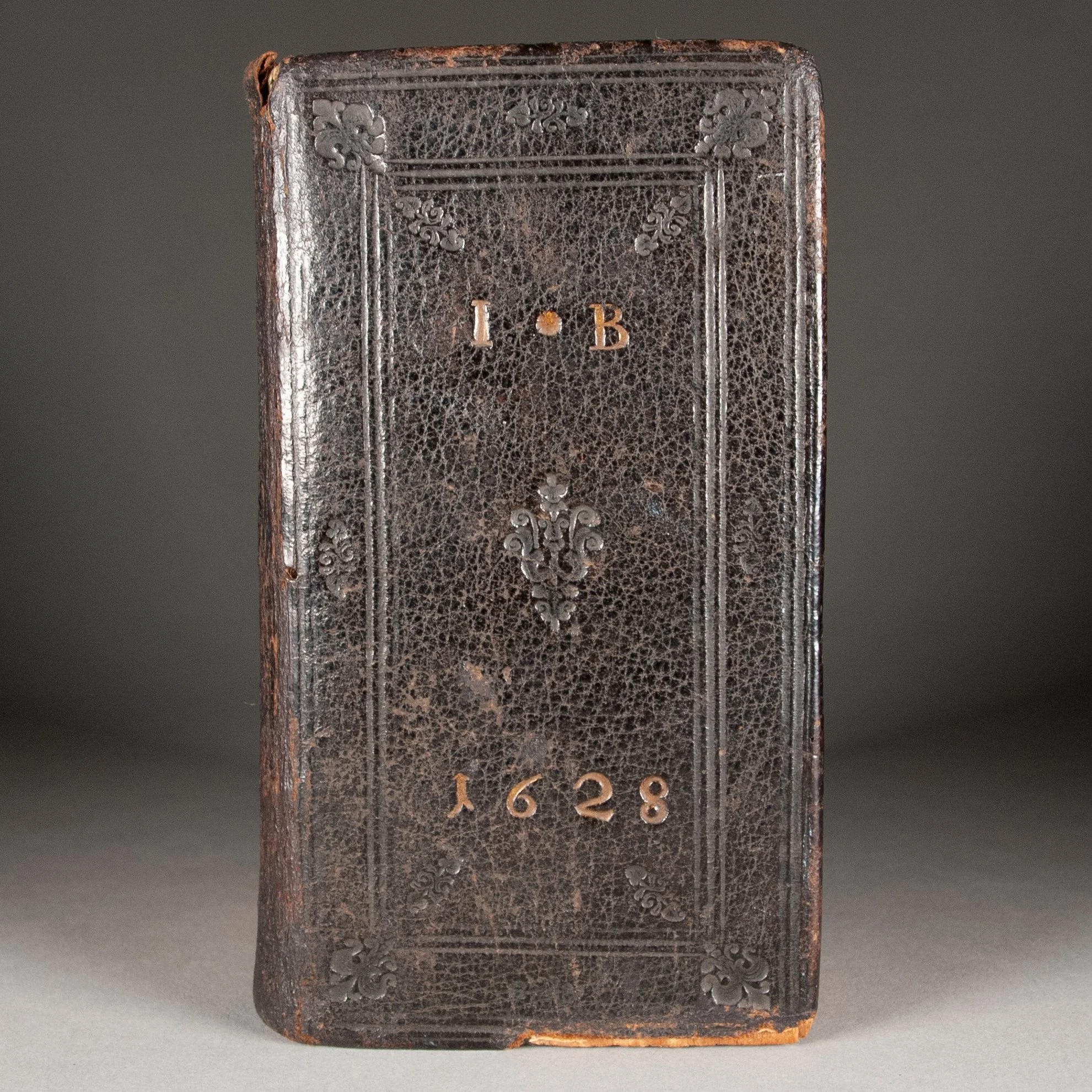
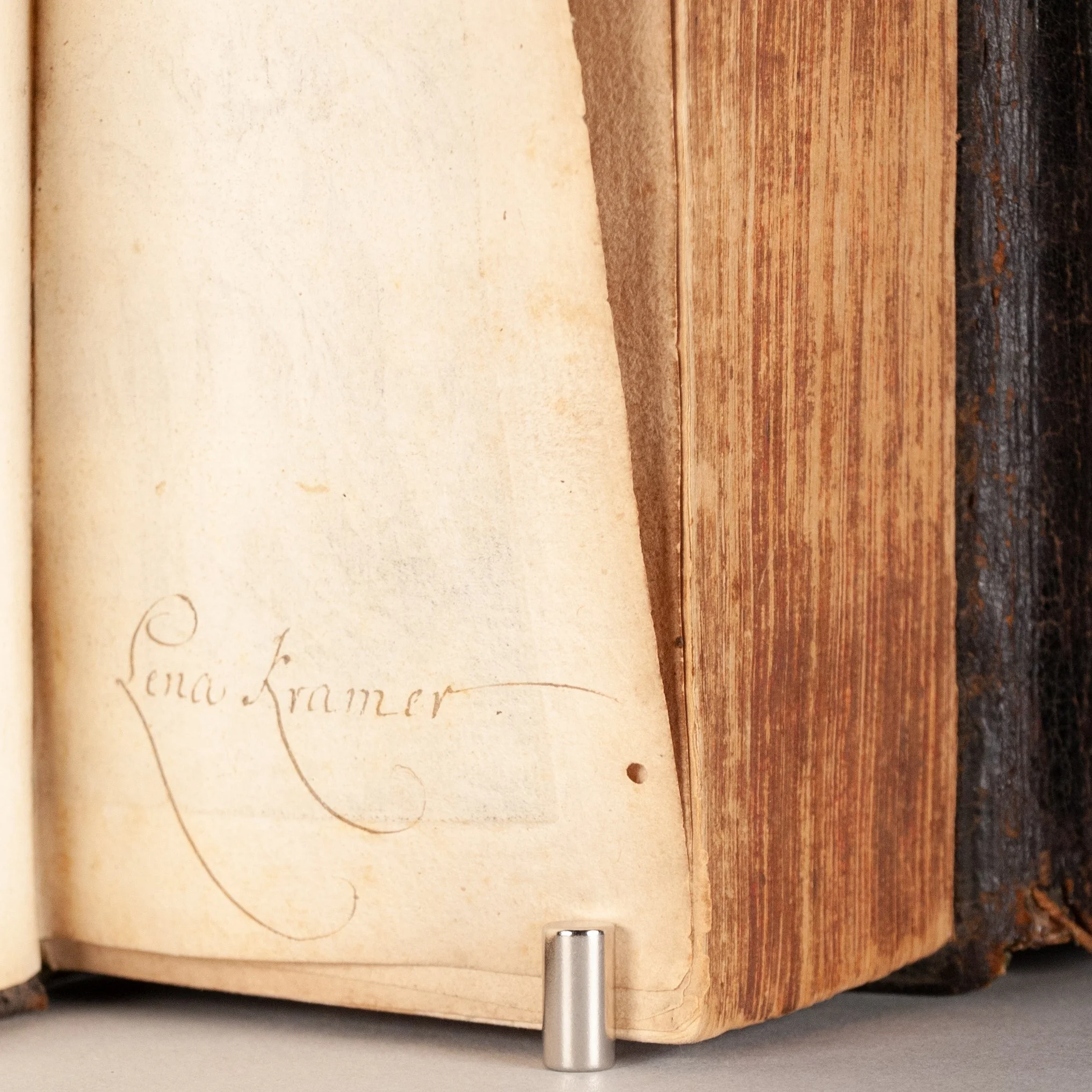
PROVENANCE: Initials IB on the front cover and dated 1628. Ownership signature of Lena Kramer on the recto of the frontispiece, and that of Louis Snabilie scrawled on the verso of the engraved title—joint ownership signatures of husband and wife. Snabilie (1733/34-1784) married Helena Kramer (1737/38-1794) sometime around the middle of the 18th century. The couple worked for the same merchant in Amsterdam. ¶ Modern bookplate on front paste-down of Helge Loewenberg-Domp, a Dutch singer who died in 2021 at the impressive age of 105. This copy sold that same year at Bubb Kuyper (€5,016).
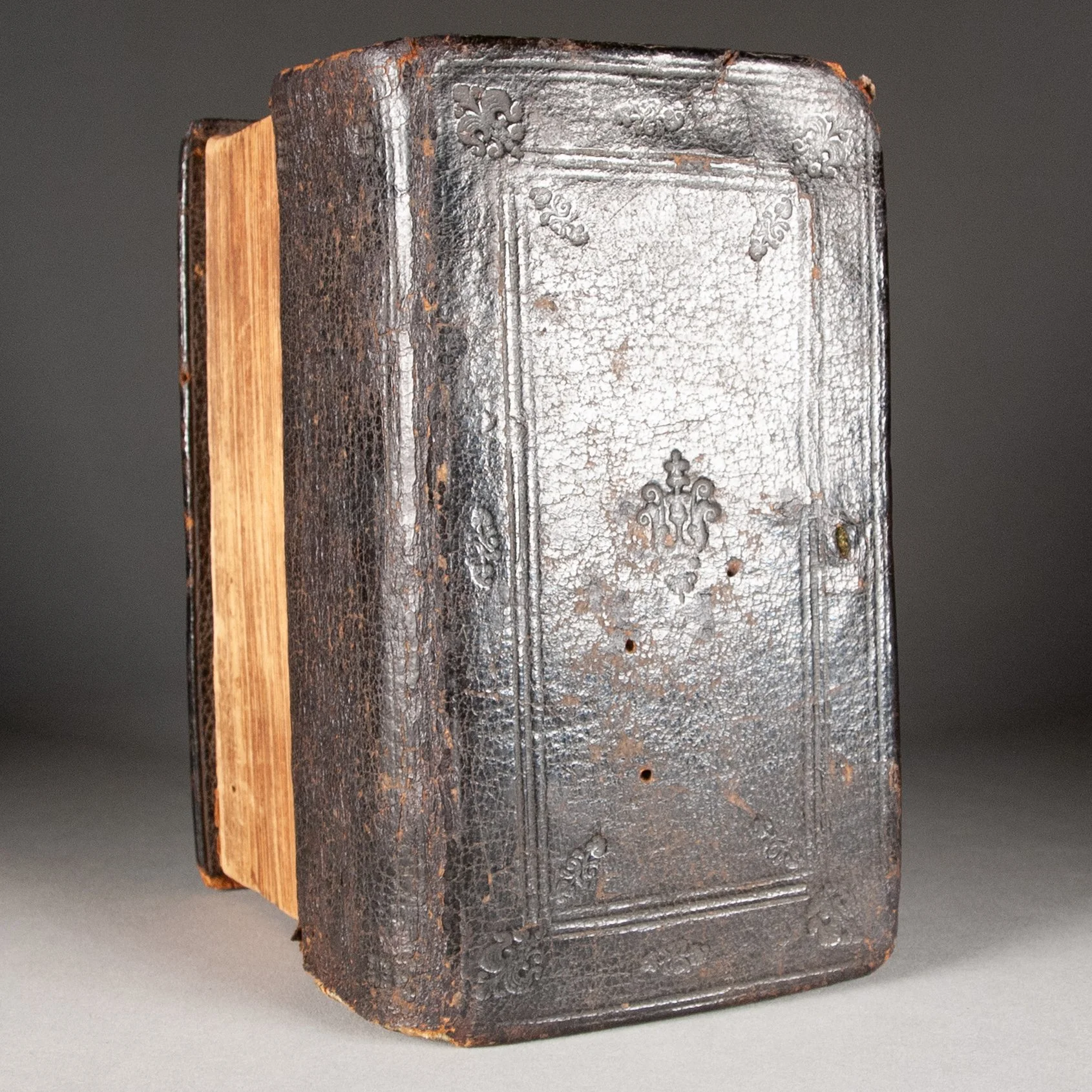
CONDITION: The four parts bound as two volumes, dos-à-dos. Contemporary dark goatskin over thin wooden board, certainly made in Northern Europe, with date and owner's initials in gilt; covers tooled in blind, concentric frames with corner fleurons, and a small tool at center. Evidence of a lost tie at the fore-edge of the board covering the Propheten—a bit curious on its own, but this is admittedly a bulky object, and we can imagine it would have been useful to wrap a ribbon around it. ¶ At a glance, the first two gatherings suggest up to four missing prelims, though we rather suspect our book is as issued. The catchword on )a(11 indeed corresponds to )b(1, and our copy already claims two more leaves of prelims than VD17 calls for. Meanwhile, VD17 calls for six unnumbered leaves following the New Testament, compared to our four. We might indeed be missing two leaves, though our copy does end with a colophon, as one might expect. Since our first volume has two more leaves at front than called for, we wonder if those leaves )::(2-3, which contain a pair of morning and evening blessings, might have been relocated from the end. We've been unable to locate a digitized copy for comparison. ¶ Mild foxing and a bit of marginal worming; Propheten title tattered at the edges, with some loss, just barely avoiding the decorative border (and next two leaves also a bit tattered at the edges); tiny bit of dampstaining in the lower inner corner of v. 2. Binding worn at the extremities, exposing some wood; small chip in the tail of one spine; boards with some wormholes. Well preserved and still solidly bound.
REFERENCES: VD17 23:673436T (Biblia), 23:673438H (Ander Theil), 23:673454R (Propheten), 23:673457P (Newe Testament) ¶ S.H. Steinberg, Five Hundred Years of Printing (1996), p. 65 (cited above); Howard M. Nixon, Sixteenth-century gold-tooled bookbindings in the Pierpont Morgan Library (1971), p. 211 (“From time to time otherwise respectable bookbinders are smitten with the desire to perpetrate a whimsy"), 213 (cited above, and good background, illustrating a German example dated 1582); Mirjam M. Foot, The Henry Davis Gift (1983), v. 2, p. 80, #49 (the London binding, ca. 1570, by the MacDurnan Gospels Binder); Martin Breslauer, Fine books and manuscripts in fine bindings (Catalogue 110), p. 100, #54 (the ca. 1567 Italian example); Christie's, The History of the Book: The Cornelius J. Hauck Collection (2006), p. 246, #193 (dos-à-dos binding on a 1604 Leiden imprint, but described as mid-17th-century), Kurt Köster, "Mehrfachbände und Vexierbücher: Materialen zu Einbandkuriosa des sechzehnten und siebzehnten Jahrhunderts," Archiv für Geschichte des Buchwesens 14 (1973–1974), col. 1879, cited above, and citing Schmidt), 1881 (upholding the 1582 binding as the earliest known German example); Amédée Boinet, "Une reliure 'jumelle' allemande du 16e siècle," Gutenberg-Jahrbuch 1959, p. 275 (calling the 1582 German example "the earliest that we can actually cite"); Fritz Junkte, "Unbekannte Zwillingsbände," Gutenberg-Jahrbuch 1964, p 389 (citing Heinz)
Item #985