Devotional prints for new tastes | Copied from a master of the medium
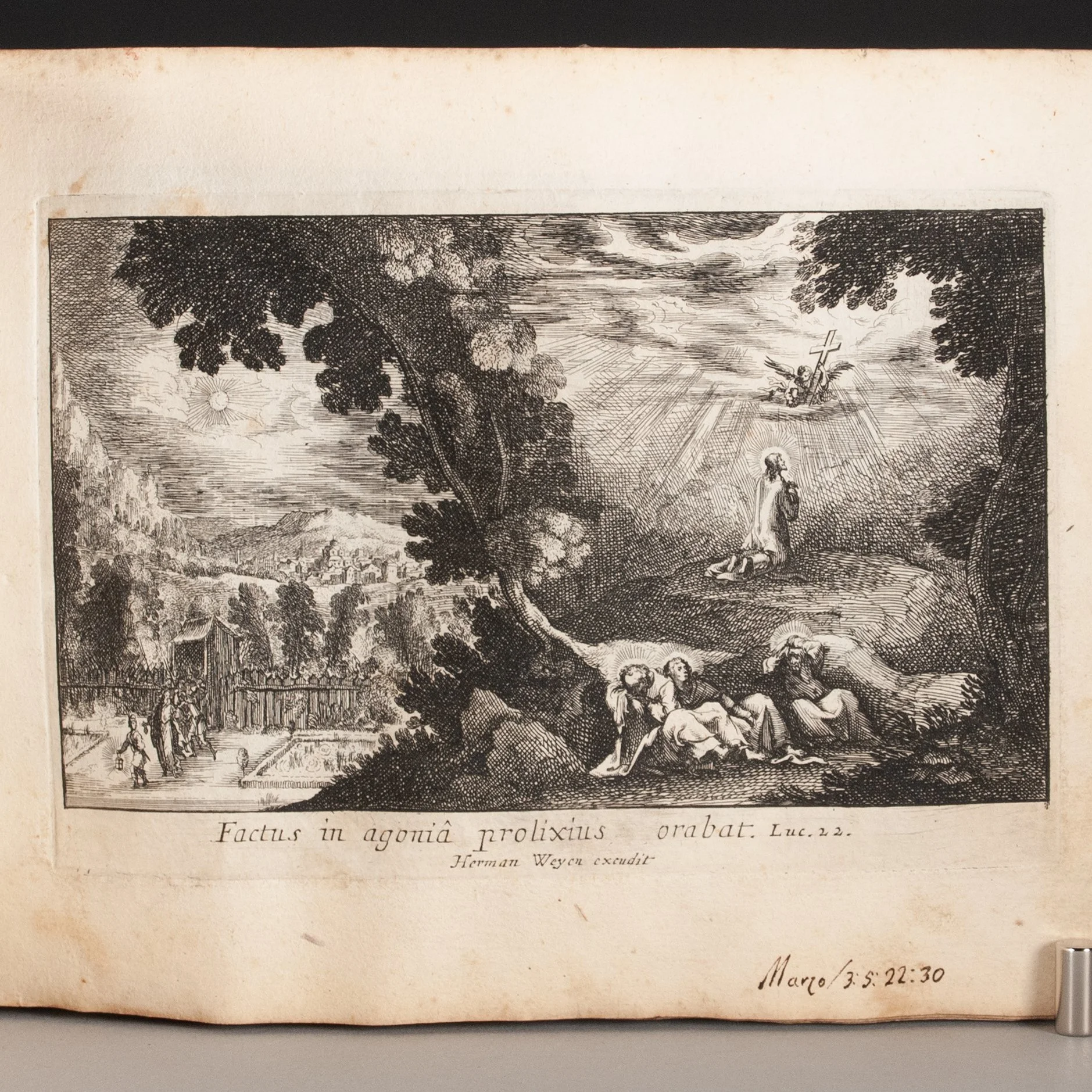
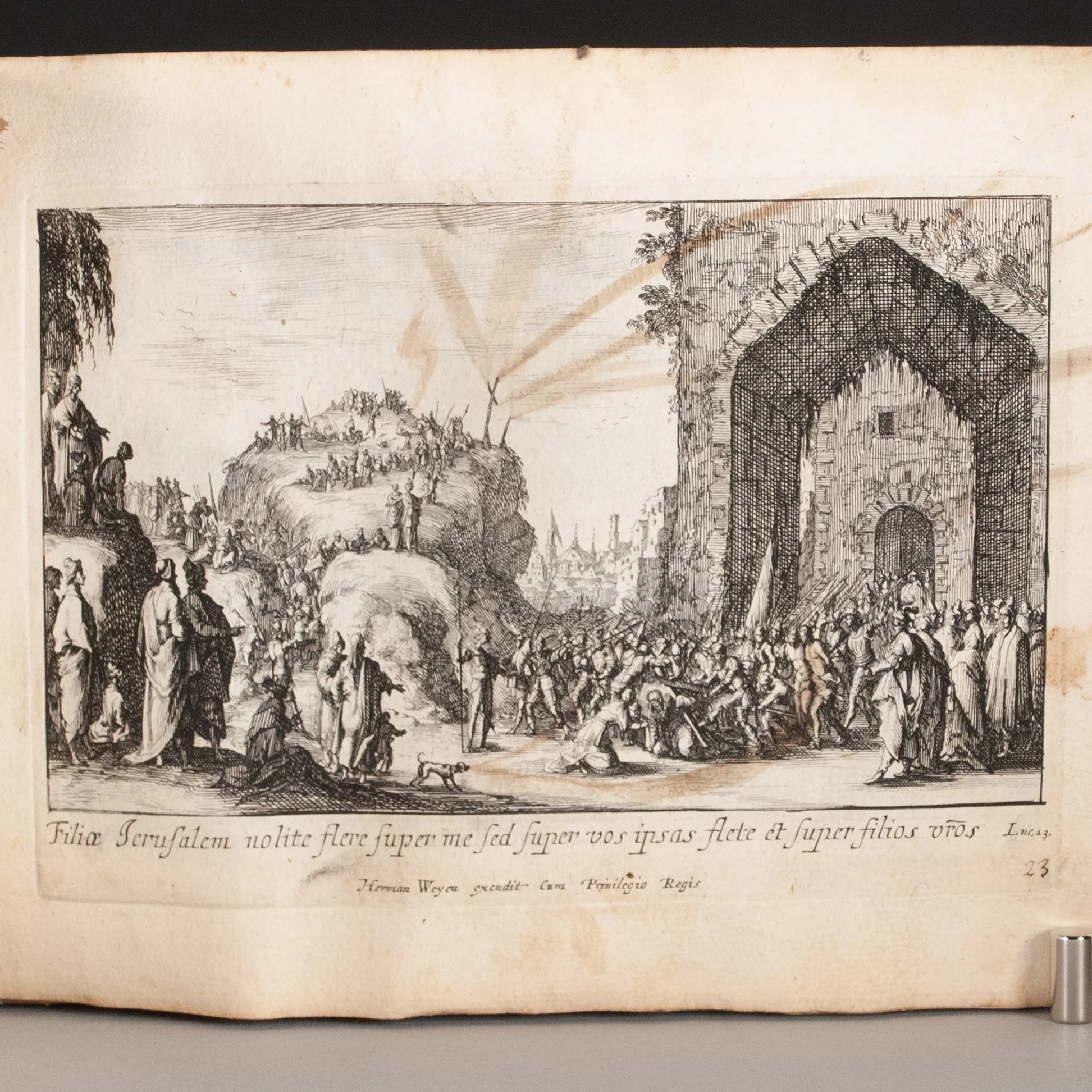
Devotional prints for new tastes | Copied from a master of the medium
[La Passion de Notre Seigneur]
by N. (Nicolas?) Cochin after Jacques Callot
[Paris]: Herman Weyen, [not after 1669?]
[12] leaves | Bound suite of prints | 133 x 202 mm
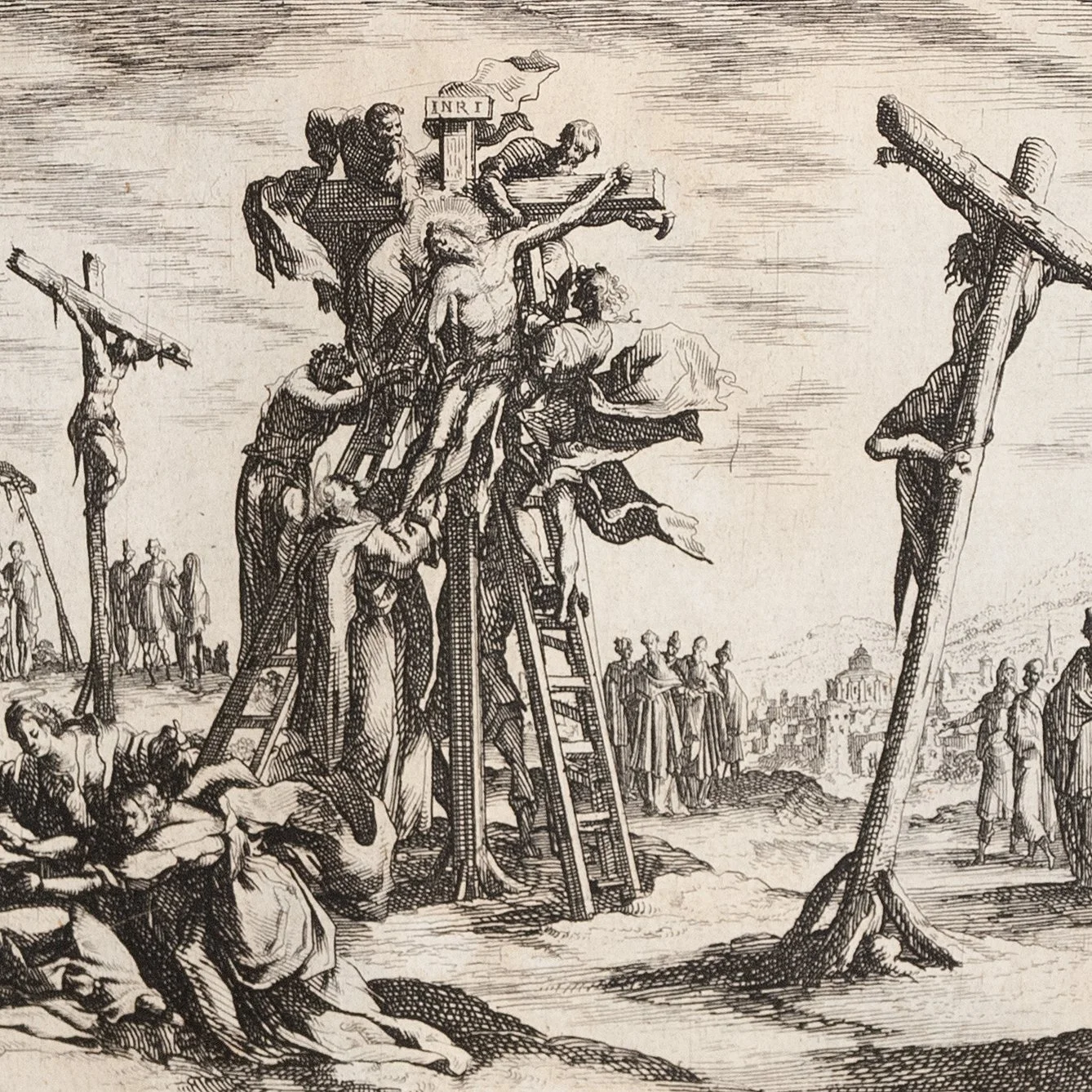
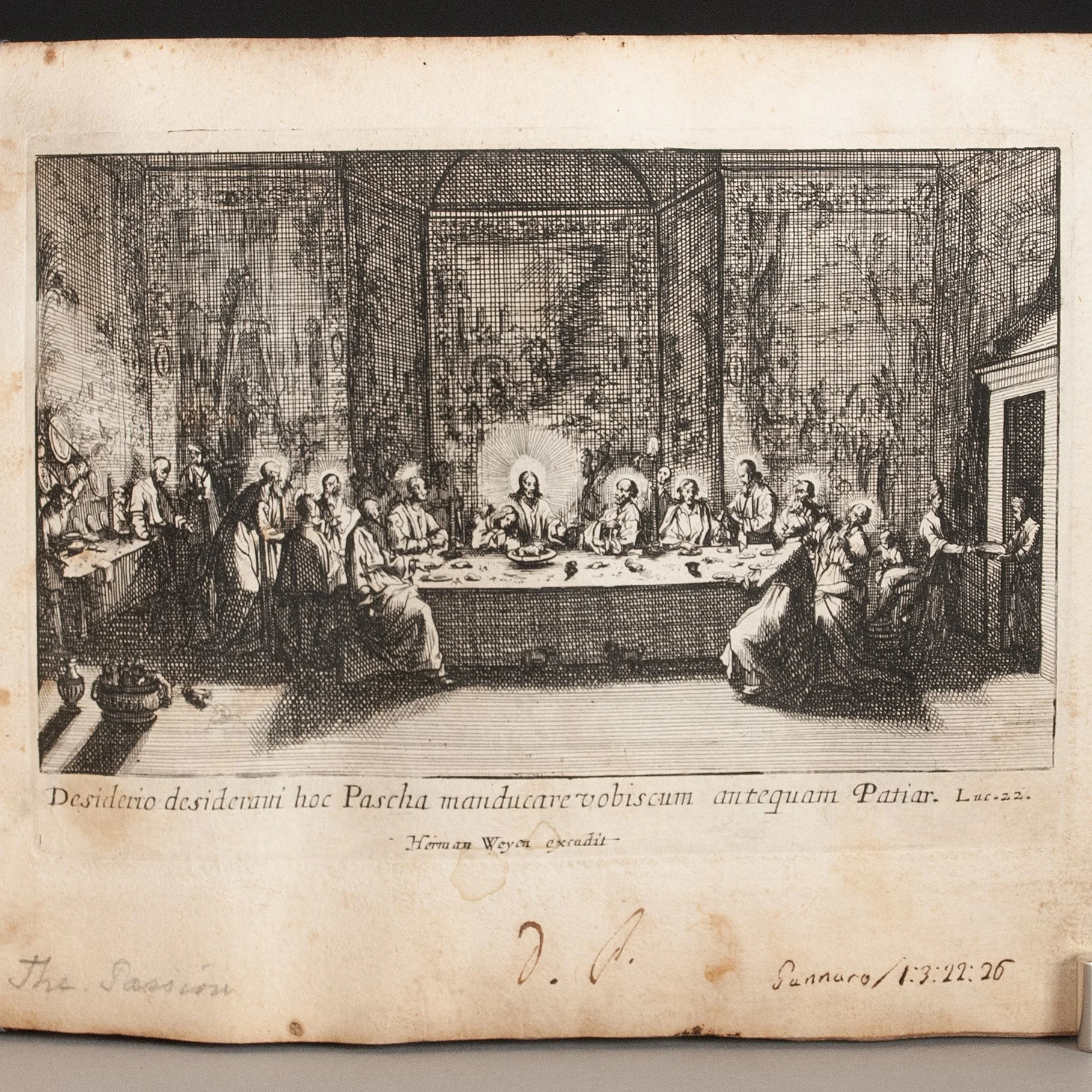
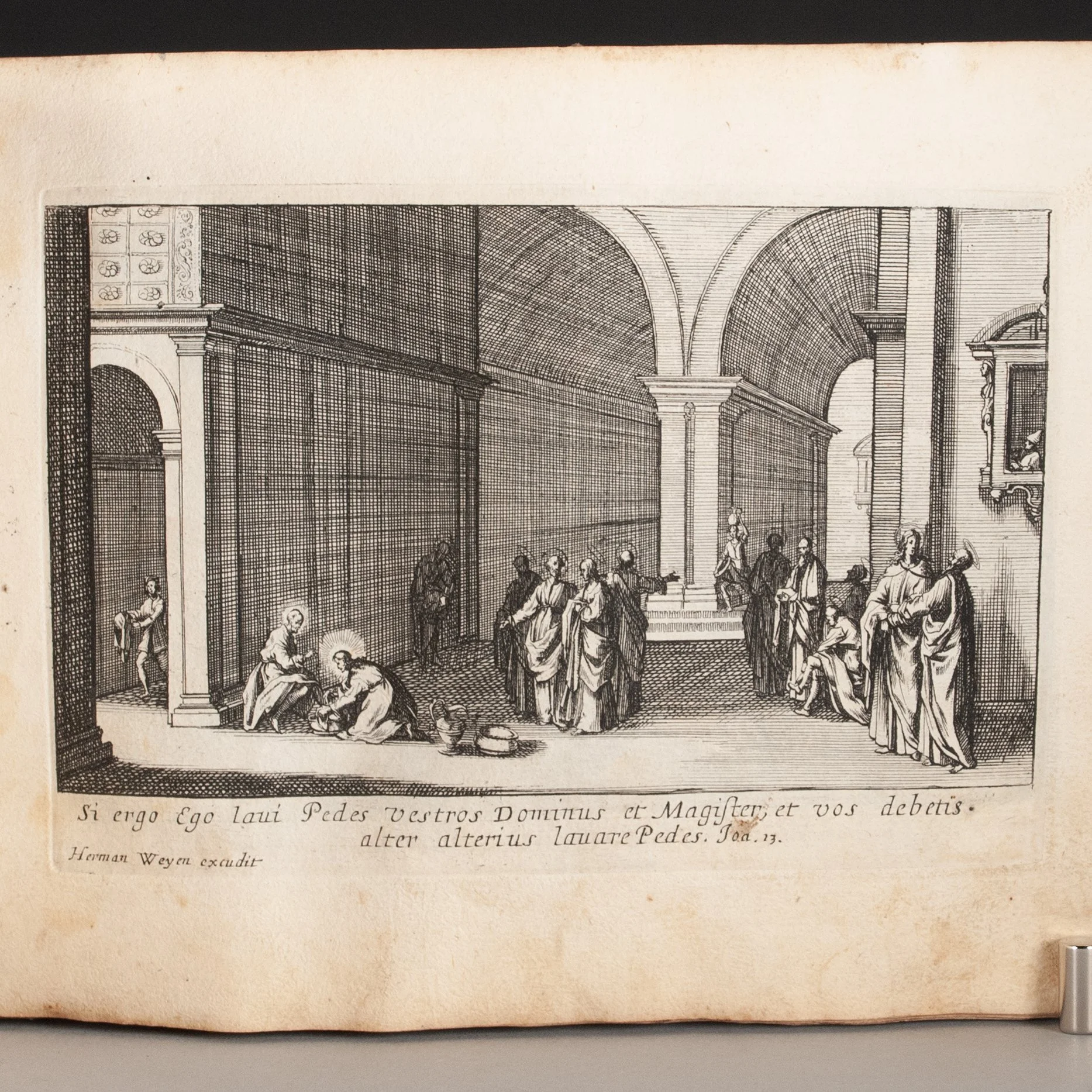
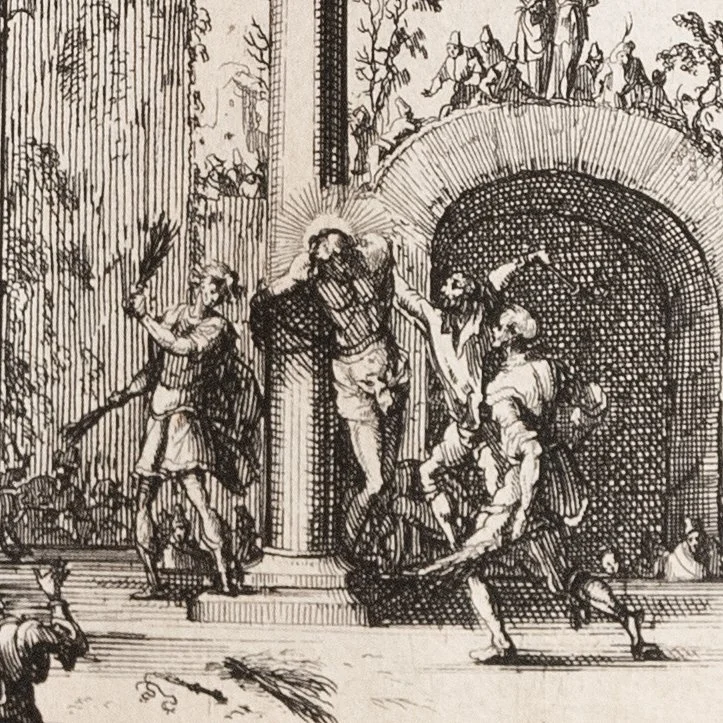
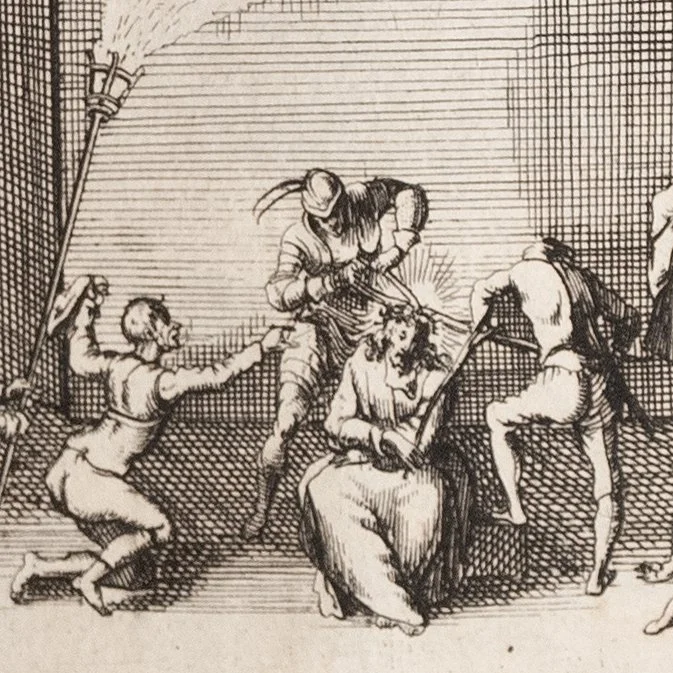
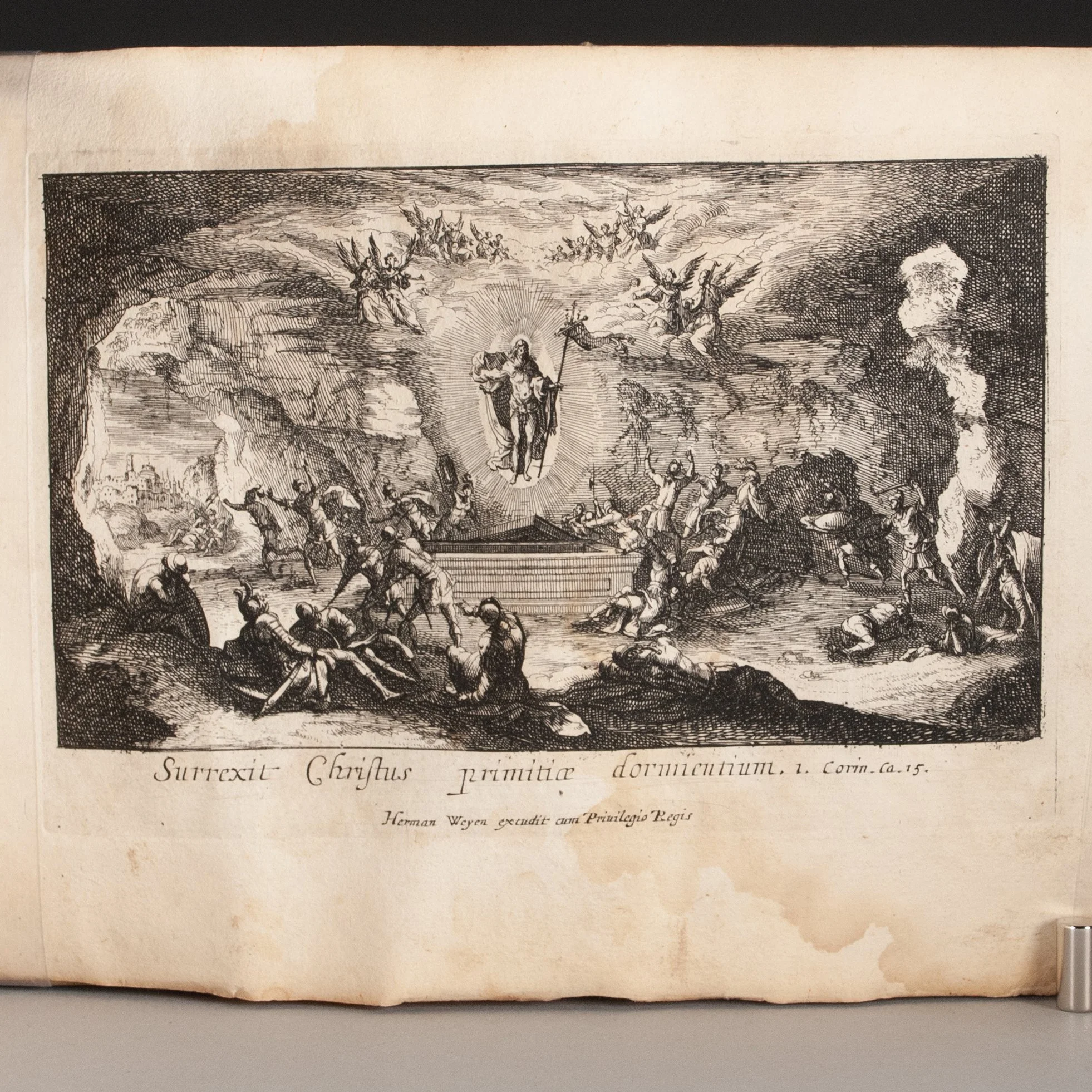
A rare suite of prints depicting the Passion of the Christ, etched (and touched up by burin) by one of the Cochin brothers, and published by prolific Paris printmaker and publisher Herman Weyen. Seven of these prints are direct copies of Jacques Callot's wildly successful Passion de Notre Seigneur, the other five more loosely based on Callot designs (Callot's Passion only included seven plates). Successful devotional images were widely imitated, so it's little surprise that echoes of Callot's designs will be found in much earlier work. Zoom in on Callot's versions, for example, and you'll find strikingly similar composition in Albrecht Altdorfer's ca. 1513 Flagellation and Crowning with Thorns. ¶ Callot's scenes are obviously much more expansive than Altdorfer's, and his environments far richer, which is precisely what we love about them. Beyond any devotional function, these prints must have satisfied a taste for both architectural and landscape scenes, too, and certainly for the complex narrative scenes then in fashion, history painting at the time held as the pinnacle of artistic achievement by French academicians. All to say, while a tightly composed Passion woodcut of the early 16th century served a focused devotional function, the drastic expansion of the post-Reformation art market, with a greater diversity of customers seeking a greater diversity of genres, rendering scenes to appeal to multiple audiences was plainly good business. It's no wonder Callot's designs were so liberally copied. ¶ Brothers Noël and Nicolas Cochin came from a long line of artists. Both worked as engravers, and Weigert simply combined their corpus under a single N. Cochin, thereby avoiding the hazards of distinguishing one from the other. At the same time, Weigert's commentary would give the edge to Nicolas in our case. He was apparently much fonder of copying Callot than Noël, and our figures and clouds match a description of how Nicolas typically rendered them. We find no consensus on dating these prints. Catalogers at Vassar's Loeb Art Center call their Pilate Washing His Hands 1625-1628. That's certainly too early for Noël (b. 1622), and likely a bit early for Nicolas (b. 1610). Meanwhile, the Musée des beaux-arts in Nancy calls Christ Carrying the Cross1673—a year after Weyen's death, and four years after he sold his stock to son-in-law François Poilly. The Bibliothèque nationale simply calls their prints 17th-century. Of course plates frequently outlasted their original publishers, and Poilly could certainly have reissued them without updating Weyen's imprint. At the same time, ours are still well defined impressions, and the relatively shallow grooves of etched plates didn't hold up as long as the deeper cuts of engraved work. So we hesitate to date these too late in the 17th century. While a complete sequence contains 12 plates, Weigert suggests there were two versions of The Last Supper. Finally, our series should not be confused with another Passion series Weyen published, in oval medallions. ¶ A rare suite, scarcer than Callot's originals, and in a satisfying contemporary workaday binding.
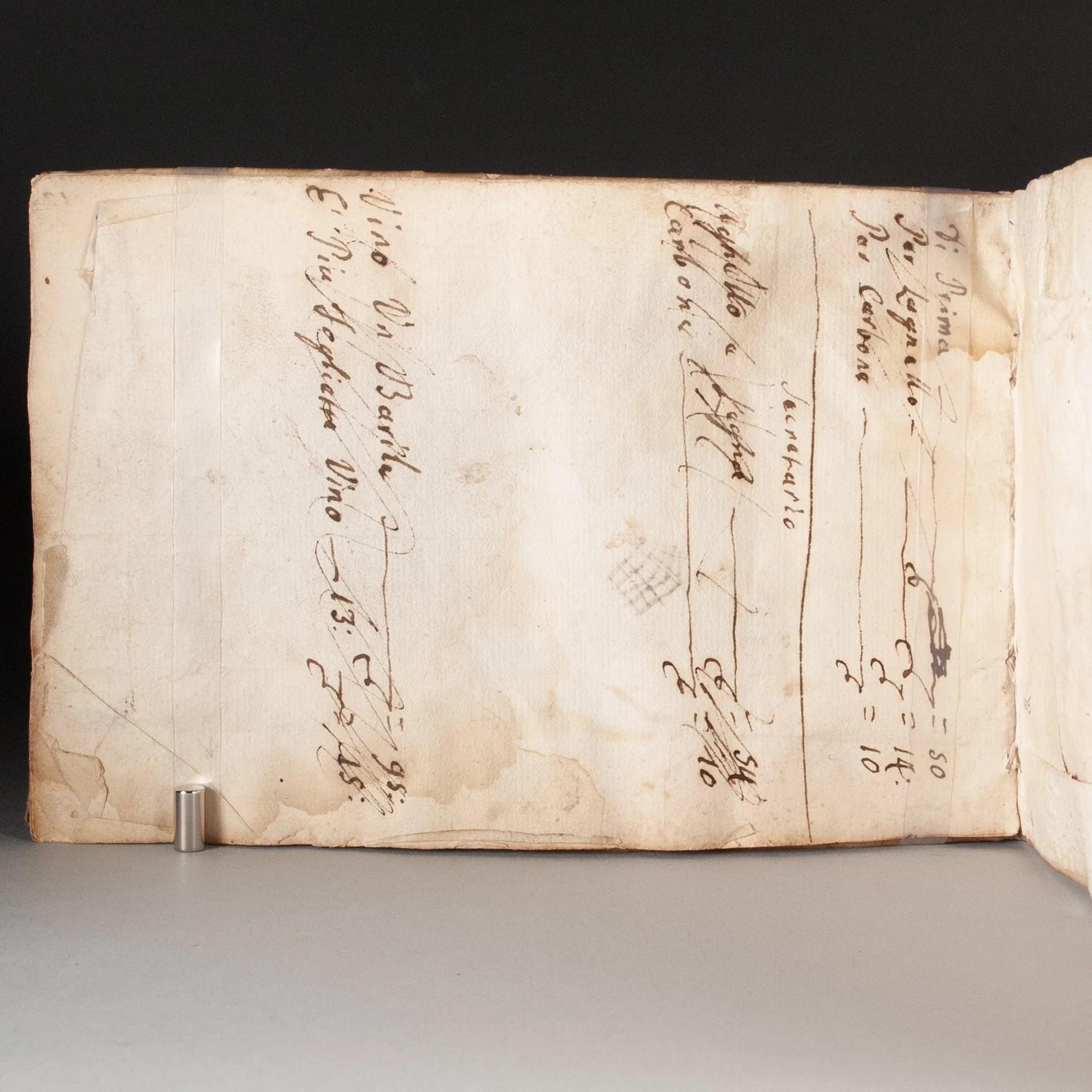
PROVENANCE: Several transactions recorded in Italian on the rear fly-leaf, in an early hand, noting prices paid for wine and coal. Pen trials on the front fly-leaf, and a few notes inked on the opening plate.
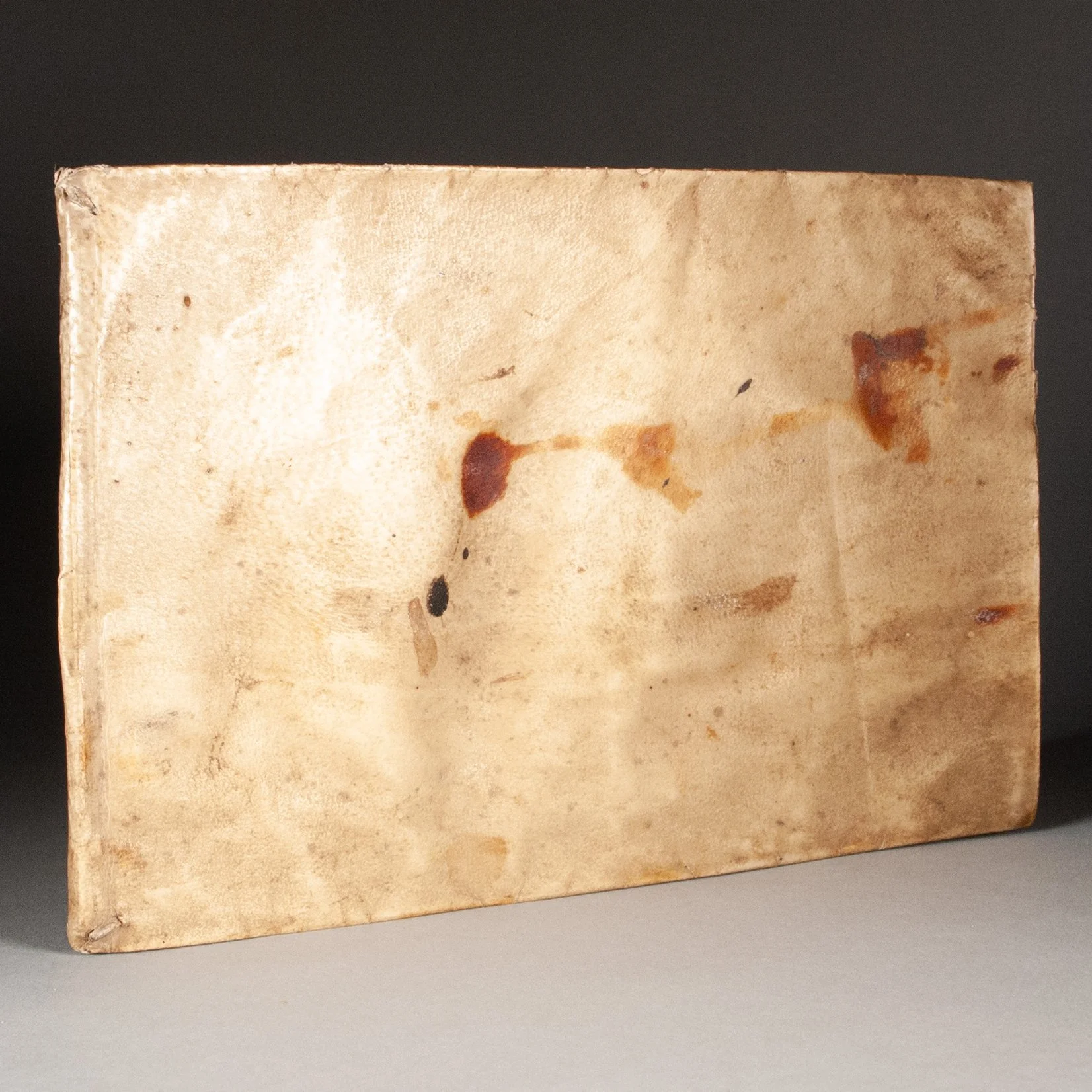
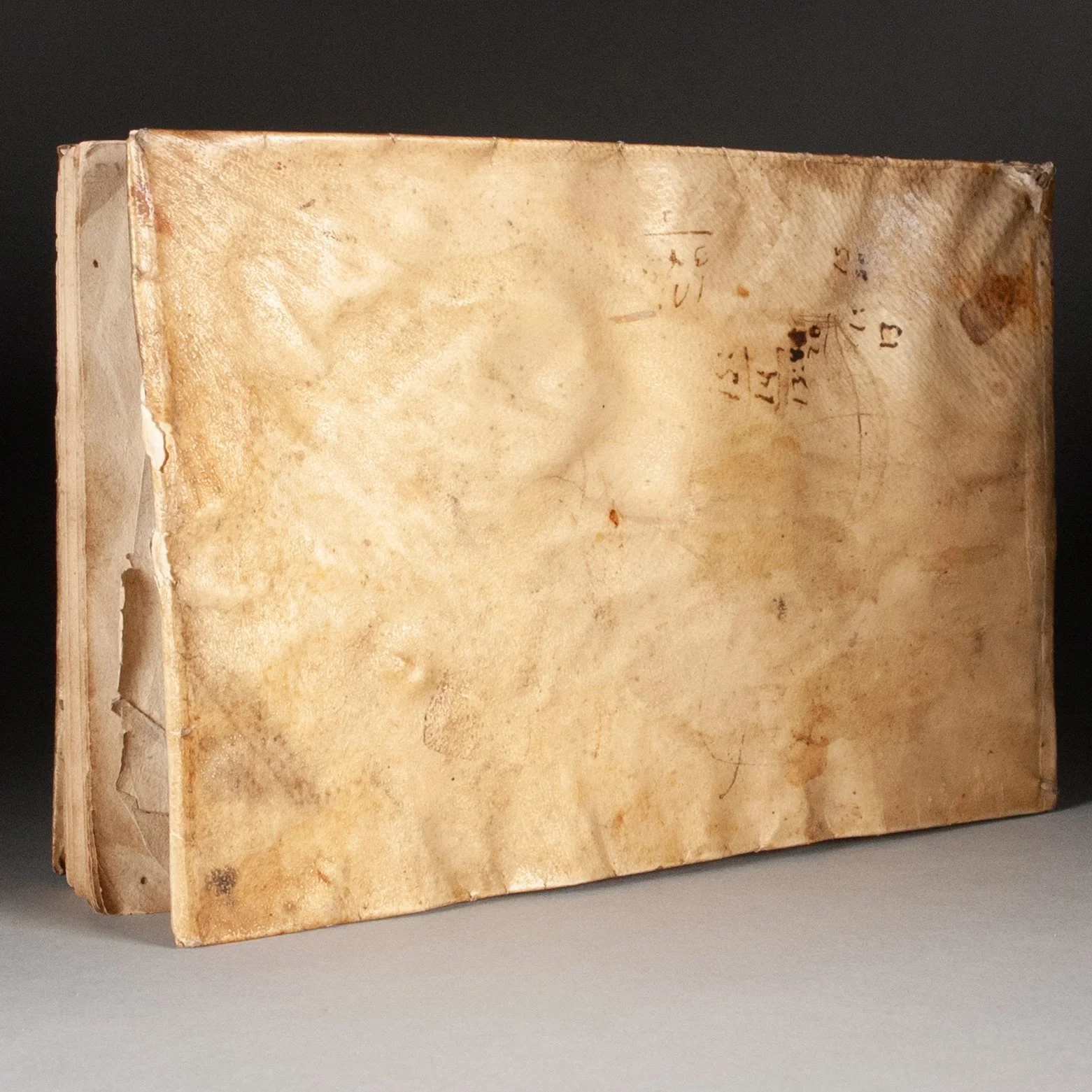
CONDITION: Contemporary limp parchment. ¶ Soiled and dampstained; old plate numbering added in both pencil and ink. Parchment soiled and crinkled, with a bit of math worked out on the rear cover; small portion trimmed from the front fly-leaf, perhaps a former owner's name.
REFERENCES: Roger-Armand Weigert, Inventaire du fonds français, graveurs du XVIIe siècle (1954), v. 3, p. 29, #260-272; Edouard Meaume, Recherches sur les ouvrages de Jacques Callot (1924), v. 1, p. 38-44, #12-18 (Callot's originals); Catalogue en ligne de l'oeuvre gravé de Jacques Callot (reproducing some of Callot's originals and select copies, arranged by Meaume number) ¶ Weigert, v. 3, p. 19 (comparing Nicolas to Noël); Allgemeines Künstlerlexikon (1820), v. 2, p. 5072 (confirming 12 plates in the complete series); Hermann Voss, "Aus der Umgebung Albrecht Altdorfers und Wolf Hubers," Mitteilungen der Gesellschaft für Vervielfältigende Kunst (1909), pt. 4, p. 77 (on the echoes of Altdorfer in Callot's Passion); Warren Chappell, A Short History of the Printed Word (1970), p. 127 ("Perhaps the most influential as well as prolific of the seventeenth-century illustrators was Jacques Callot"); Dirk Imhof, "From Arnold Nicolai to Peter Paul Rubens: Book Illustration under Plantin and the First Moretuses," A Century of typographical excellence: Christophe Plantin & the Officina Plantiniana (2020), p. 102 ("“One disadvantage was that the lines bitten away by the acid were much shallower, which meant that good quality prints from an etching were fewer in number"); Koenraad Jonckheere, A New History of Western Art (2022), p. 71 ("Etching in particular, which developed in the course of the sixteenth century and achieved its first peak in the seventeenth in the hands of Rembrandt, among others, proved to be an inexhaustible source of playfulness and creativity")
Item #944