Spielteufel: ein gemein Ausschreiben von der Spieler Brüderschafft und Orden, sampt iren Stifftern, guten Wercken, und Ablas; mit einer kurtzen angehengter Erklerunge, nützlich und lustig zu lesen
by Eustachius Schildo
Oberursel: Nicolaus Heinrich the Elder, 1561
[102] p. | 8vo | A-F^8 G^4(-G4) | 147 x 91 mm
An early edition of the Lutheran preacher's creative rebuke against gaming and gambling, a successful contribution to Germany's popular Teufel series, which spread amusing takedowns of contemporary society's most common vices. The Spielteufel is the Gaming or Gambling Devil, but contemporary readers could also enjoy copies of the Drunkard Devil, Marriage Devil, Usury Devil, and Tyranny Devil. These were strong sellers at the Frankfurt Book Fair. At the 1569 spring fair, for example, a single bookseller sold 62 copies of a Spielteufel, and a combined 390 copies of other Teufel titles, Drunkard Devil topping the chart. "By far the most of these tracts were sold to Leipzig and Magdeburg buyers," Thompson remarks, "from which circumstance the reader may draw his own conclusions." We find two editions of the Spielteufel in 1557, three in 1561, then one each in 1562 and 1564. ¶ Schildo portrays his Spielteufel as the leader of a band of nine individual devils who stalk different methods of gaming and gambling—dice and cards, for example—tempting players into ungodly behavior. It's a kind of ironic call to arms, to enlist similarly minded devils in their unholy brotherhood. "We rogues, deceivers, and all brethren of the game," the text begins, "together with our faithful accomplices: the card painters, dice carvers, and the skillful masters of chess, board games, and other instruments upon which games are played...do hereby, in the name of our idol, the Gaming Devil...make it known and manifest to all and sundry, specifically to any and all inclined and willing to join our order, that we play not for the sake of gain, but solely for the sake of amusement" (B1v: Wir Spitzbuben...kurtzweil willen spielen). As you might imagine, this path does not end with gaming and gambling, but inevitably leads to other vices, some of them worse still. "Our good works are many, too," the devils say, among them, "cursing, lying, cheating, hitting, fighting, murdering, breaking, and the like" (B5r). We assume "good works" (guten Wercken) to be a swipe at the Catholic Church, Luther having fundamentally disagreed with that particular tenet of the Roman faith. ¶ The author honed his bona fides at the University of Wittenberg, and here partook in a genre that was tremendously popular among readers and preachers alike. Protestants believed that Satan and his servants roamed the earth in physical form. "Once these figures were observed refining their strategies—slipping into human souls as insidious whisperers—the path was set toward a process of rationalization. The tempter no longer approaches the individual victim in person as an emissary of Hell; rather, he has evolved into a reprehensible character trait embedded within human society itself" (Elschenbroich). The Teufelbuch in many ways represents an evolution from Sebastian Brant's Ship of Fools. "Protestant in origin, these treatises deal with man's personal devil-inspired bent for vice and might be thought of as a variation of Brant's parade of vices, usually without his homely humor. They were very popular in the later years of the sixteenth century and offered the clergy a fruitful field for preachment" (Zeydel). ¶ As it happens, Heinrich was the first printer in Oberursel, then a small town near Frankfurt. His earliest imprints are dated 1557, and he worked prolifically through the end of the century. ¶ Rare in all editions. In North America, WorldCat reports only a copy of this edition at the Cleveland Public Library, and a 1562 edition at the Folger. This is the only copy of any edition we find in auction records.
CONDITION: Blue paste paper boards ca. 1900. Title page printed in red and black. ¶ A trifle foxed, and a discreet dampstain at the inner margin of the first several leaves (not affecting text). Boards rubbed at the extremities. A nice copy of a scarce title.
REFERENCES: USTC 694466; VD16 S 2855 ¶ Edwin H. Zeydel, Review of Ria Stambaugh's Teufelbücher in Auswahl, The German Quarterly 44.2 (Mar 1971), p. 253 (cited above); Dieter Harmening, Review of Ria Stambaugh's Teufelbücher in Auswahl, Zeitschrift für deutsches Altertum und deutsche Literature 102.4 (1973), p. 238 ("it is within the 'fool literature' of the late Middle Ages...that the 'devil literature' of Lutheran orthodoxy (characteristic of the post-Reformation era beginning in the mid-16th century) finds its true precursor. In this later tradition, the various 'specialized devils' and 'devils of vice' step in to take the place of the fools."); Adalbert Elschenbroich, Review of Ambrosius Pape and Oliver Finley Graves's Bettel und Garteteuffel, Colloquia Germanica 16.1 (1983), p. 64 (cited above); Michael A. Conrad, Ludische Praxis und Kontingenzbewältigung im Spielebuch Alfons' X. und anderen Quellen des 13. Jahrhunderts (2022), p. 98 (an overview of the content); James Westfall Thompson, The Frankfort Book Fair (1911), p. 37 ("It is to be observed that many tracts were sold, which were directed against the various vices of the age. Judged by this evidence, the greatest vice of the sixteenth century must have been drinking. Next comes arrogance or pride, chiefly the luxury of dress...Gambling and profanity seem to have been common."), 38 (cited above)
Item #902
Spielteufel: ein gemein Ausschreiben von der Spieler Brüderschafft und Orden, sampt iren Stifftern, guten Wercken, und Ablas; mit einer kurtzen angehengter Erklerunge, nützlich und lustig zu lesen
by Eustachius Schildo
Oberursel: Nicolaus Heinrich the Elder, 1561
[102] p. | 8vo | A-F^8 G^4(-G4) | 147 x 91 mm
An early edition of the Lutheran preacher's creative rebuke against gaming and gambling, a successful contribution to Germany's popular Teufel series, which spread amusing takedowns of contemporary society's most common vices. The Spielteufel is the Gaming or Gambling Devil, but contemporary readers could also enjoy copies of the Drunkard Devil, Marriage Devil, Usury Devil, and Tyranny Devil. These were strong sellers at the Frankfurt Book Fair. At the 1569 spring fair, for example, a single bookseller sold 62 copies of a Spielteufel, and a combined 390 copies of other Teufel titles, Drunkard Devil topping the chart. "By far the most of these tracts were sold to Leipzig and Magdeburg buyers," Thompson remarks, "from which circumstance the reader may draw his own conclusions." We find two editions of the Spielteufel in 1557, three in 1561, then one each in 1562 and 1564. ¶ Schildo portrays his Spielteufel as the leader of a band of nine individual devils who stalk different methods of gaming and gambling—dice and cards, for example—tempting players into ungodly behavior. It's a kind of ironic call to arms, to enlist similarly minded devils in their unholy brotherhood. "We rogues, deceivers, and all brethren of the game," the text begins, "together with our faithful accomplices: the card painters, dice carvers, and the skillful masters of chess, board games, and other instruments upon which games are played...do hereby, in the name of our idol, the Gaming Devil...make it known and manifest to all and sundry, specifically to any and all inclined and willing to join our order, that we play not for the sake of gain, but solely for the sake of amusement" (B1v: Wir Spitzbuben...kurtzweil willen spielen). As you might imagine, this path does not end with gaming and gambling, but inevitably leads to other vices, some of them worse still. "Our good works are many, too," the devils say, among them, "cursing, lying, cheating, hitting, fighting, murdering, breaking, and the like" (B5r). We assume "good works" (guten Wercken) to be a swipe at the Catholic Church, Luther having fundamentally disagreed with that particular tenet of the Roman faith. ¶ The author honed his bona fides at the University of Wittenberg, and here partook in a genre that was tremendously popular among readers and preachers alike. Protestants believed that Satan and his servants roamed the earth in physical form. "Once these figures were observed refining their strategies—slipping into human souls as insidious whisperers—the path was set toward a process of rationalization. The tempter no longer approaches the individual victim in person as an emissary of Hell; rather, he has evolved into a reprehensible character trait embedded within human society itself" (Elschenbroich). The Teufelbuch in many ways represents an evolution from Sebastian Brant's Ship of Fools. "Protestant in origin, these treatises deal with man's personal devil-inspired bent for vice and might be thought of as a variation of Brant's parade of vices, usually without his homely humor. They were very popular in the later years of the sixteenth century and offered the clergy a fruitful field for preachment" (Zeydel). ¶ As it happens, Heinrich was the first printer in Oberursel, then a small town near Frankfurt. His earliest imprints are dated 1557, and he worked prolifically through the end of the century. ¶ Rare in all editions. In North America, WorldCat reports only a copy of this edition at the Cleveland Public Library, and a 1562 edition at the Folger. This is the only copy of any edition we find in auction records.
CONDITION: Blue paste paper boards ca. 1900. Title page printed in red and black. ¶ A trifle foxed, and a discreet dampstain at the inner margin of the first several leaves (not affecting text). Boards rubbed at the extremities. A nice copy of a scarce title.
REFERENCES: USTC 694466; VD16 S 2855 ¶ Edwin H. Zeydel, Review of Ria Stambaugh's Teufelbücher in Auswahl, The German Quarterly 44.2 (Mar 1971), p. 253 (cited above); Dieter Harmening, Review of Ria Stambaugh's Teufelbücher in Auswahl, Zeitschrift für deutsches Altertum und deutsche Literature 102.4 (1973), p. 238 ("it is within the 'fool literature' of the late Middle Ages...that the 'devil literature' of Lutheran orthodoxy (characteristic of the post-Reformation era beginning in the mid-16th century) finds its true precursor. In this later tradition, the various 'specialized devils' and 'devils of vice' step in to take the place of the fools."); Adalbert Elschenbroich, Review of Ambrosius Pape and Oliver Finley Graves's Bettel und Garteteuffel, Colloquia Germanica 16.1 (1983), p. 64 (cited above); Michael A. Conrad, Ludische Praxis und Kontingenzbewältigung im Spielebuch Alfons' X. und anderen Quellen des 13. Jahrhunderts (2022), p. 98 (an overview of the content); James Westfall Thompson, The Frankfort Book Fair (1911), p. 37 ("It is to be observed that many tracts were sold, which were directed against the various vices of the age. Judged by this evidence, the greatest vice of the sixteenth century must have been drinking. Next comes arrogance or pride, chiefly the luxury of dress...Gambling and profanity seem to have been common."), 38 (cited above)
Item #902

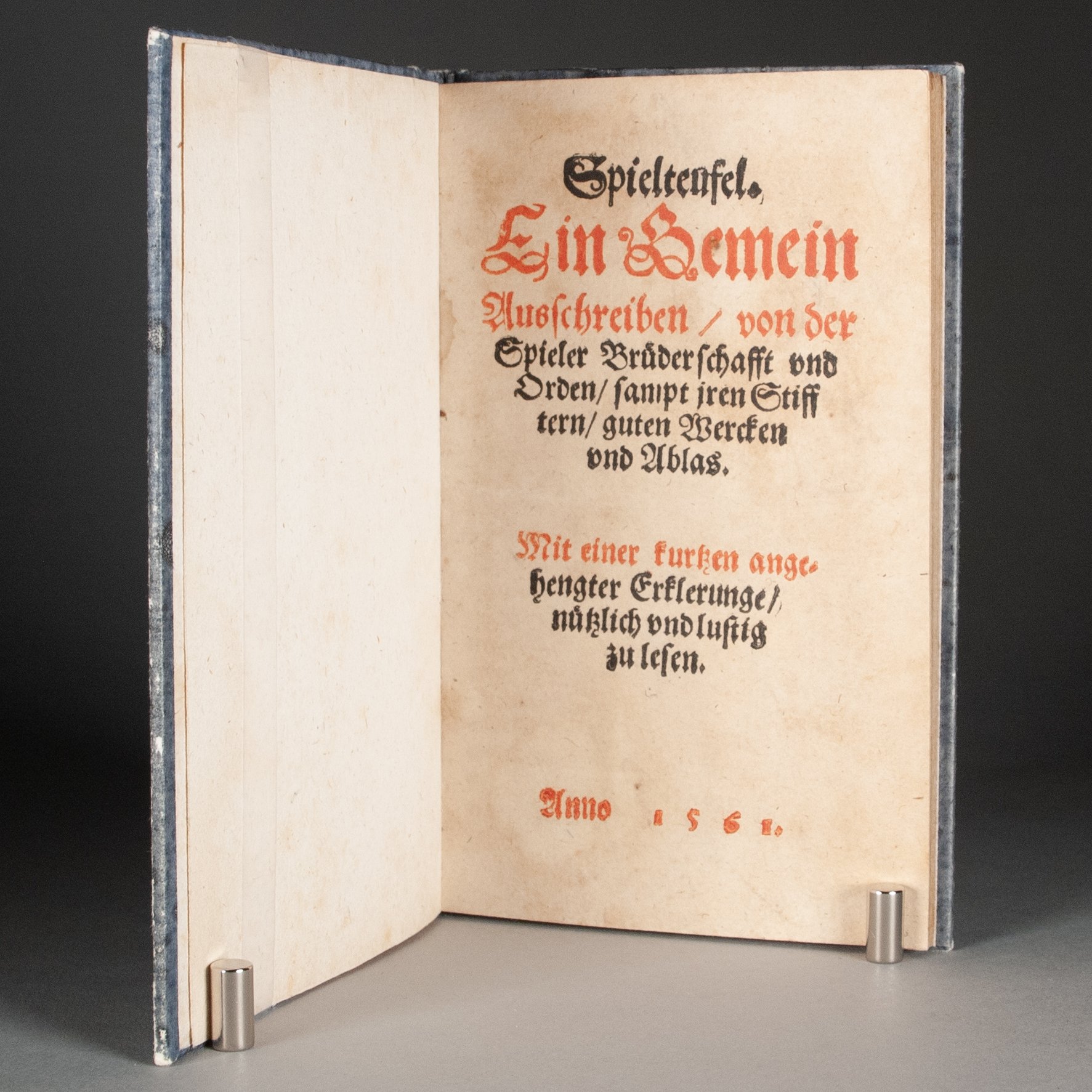 Image 1 of 6
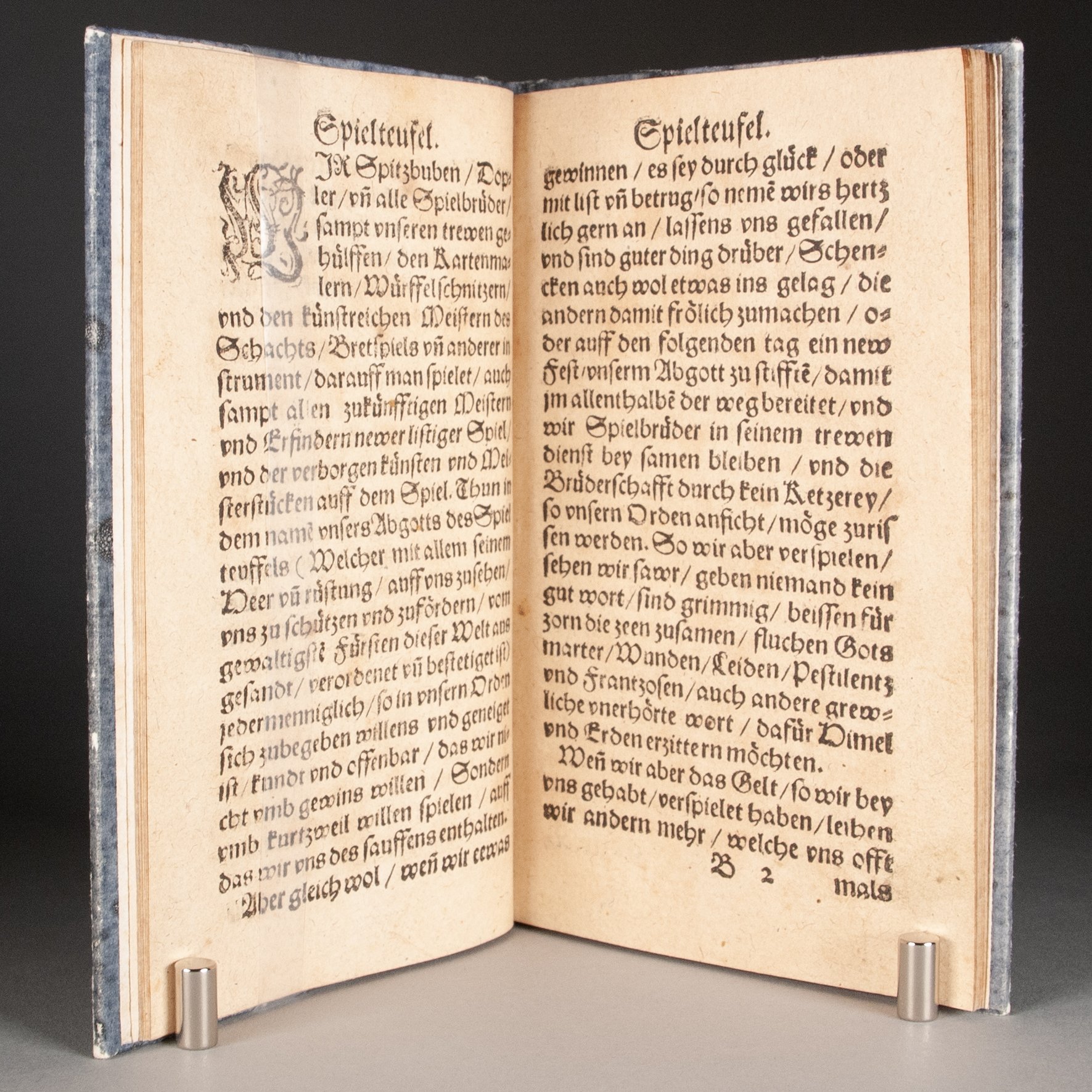 Image 2 of 6
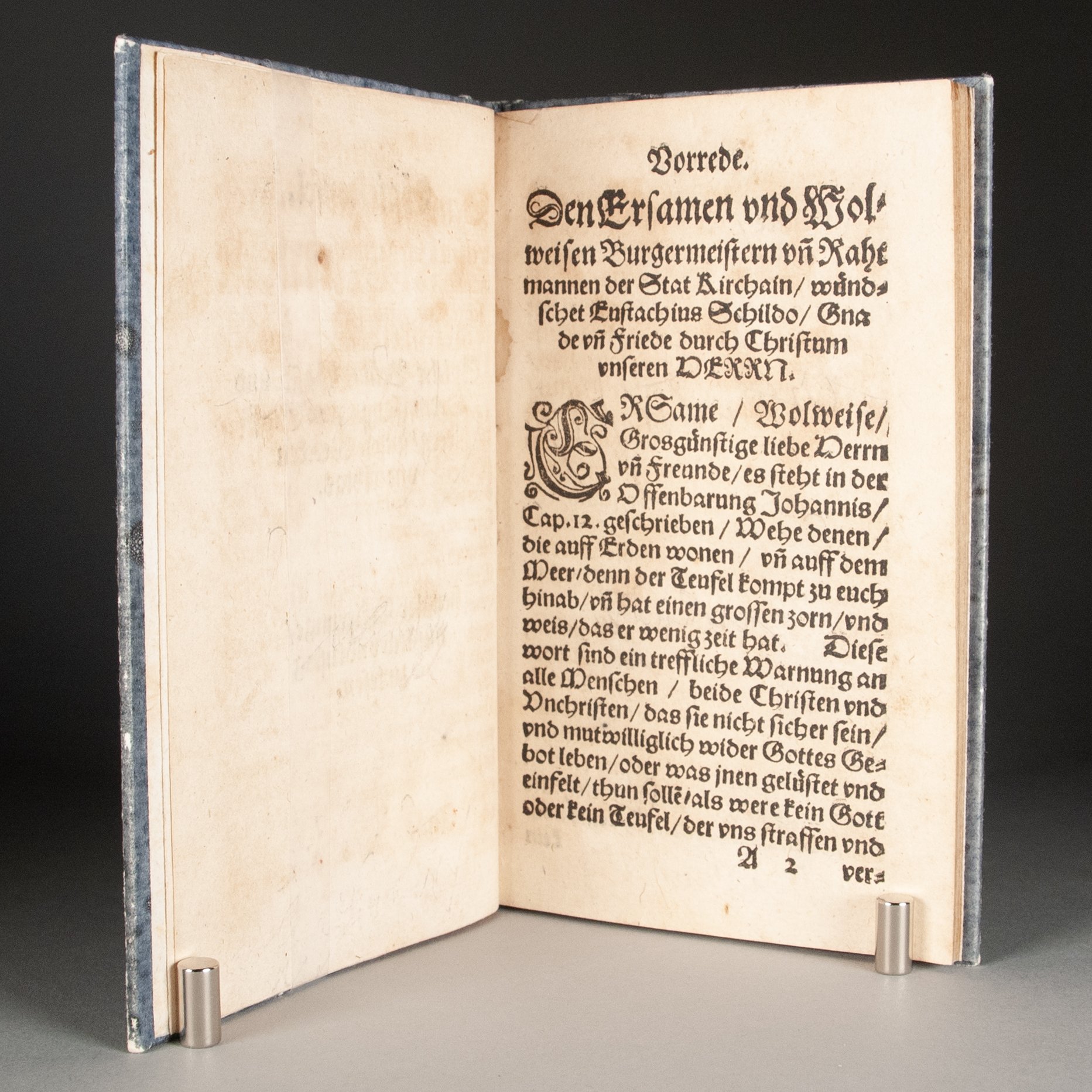 Image 3 of 6
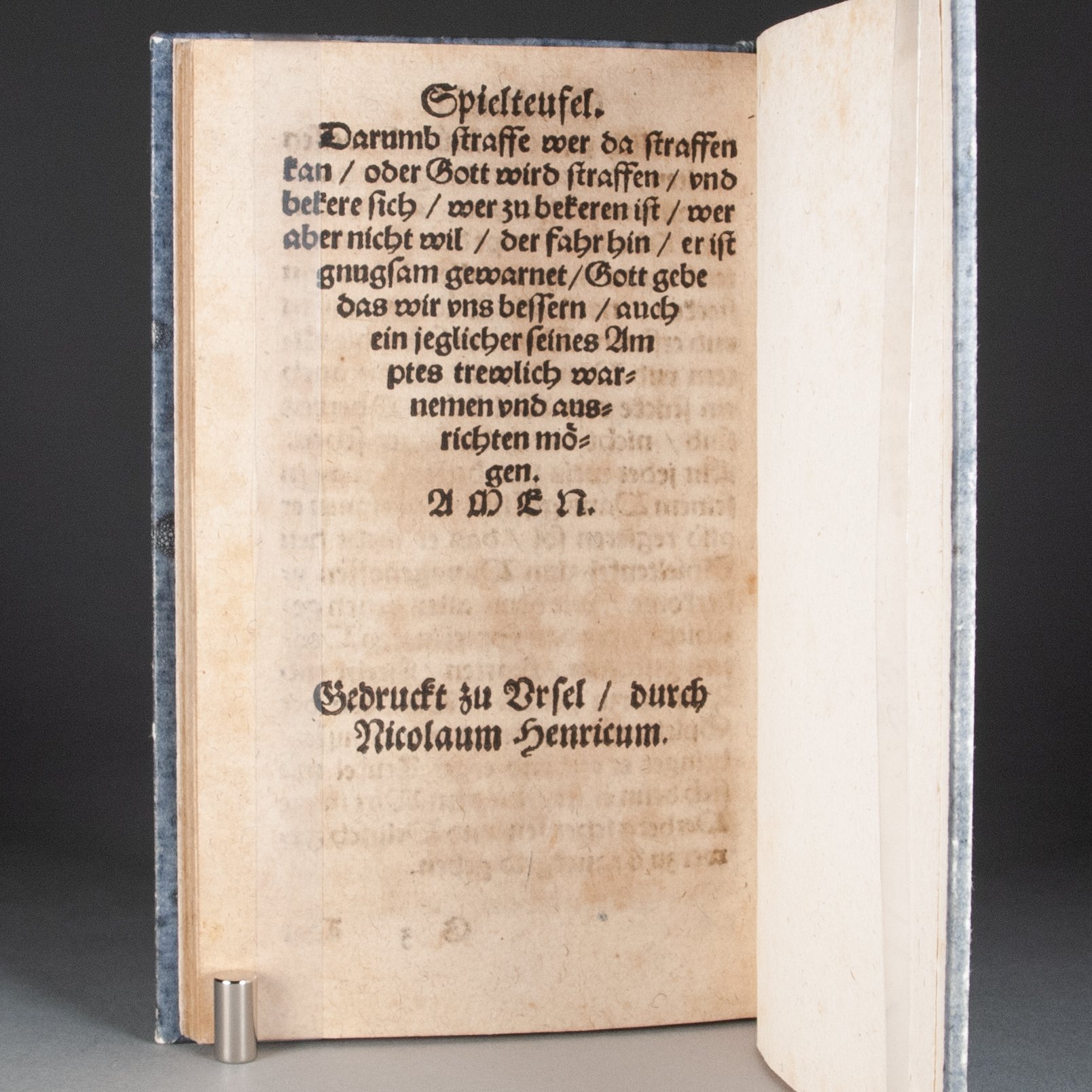 Image 4 of 6
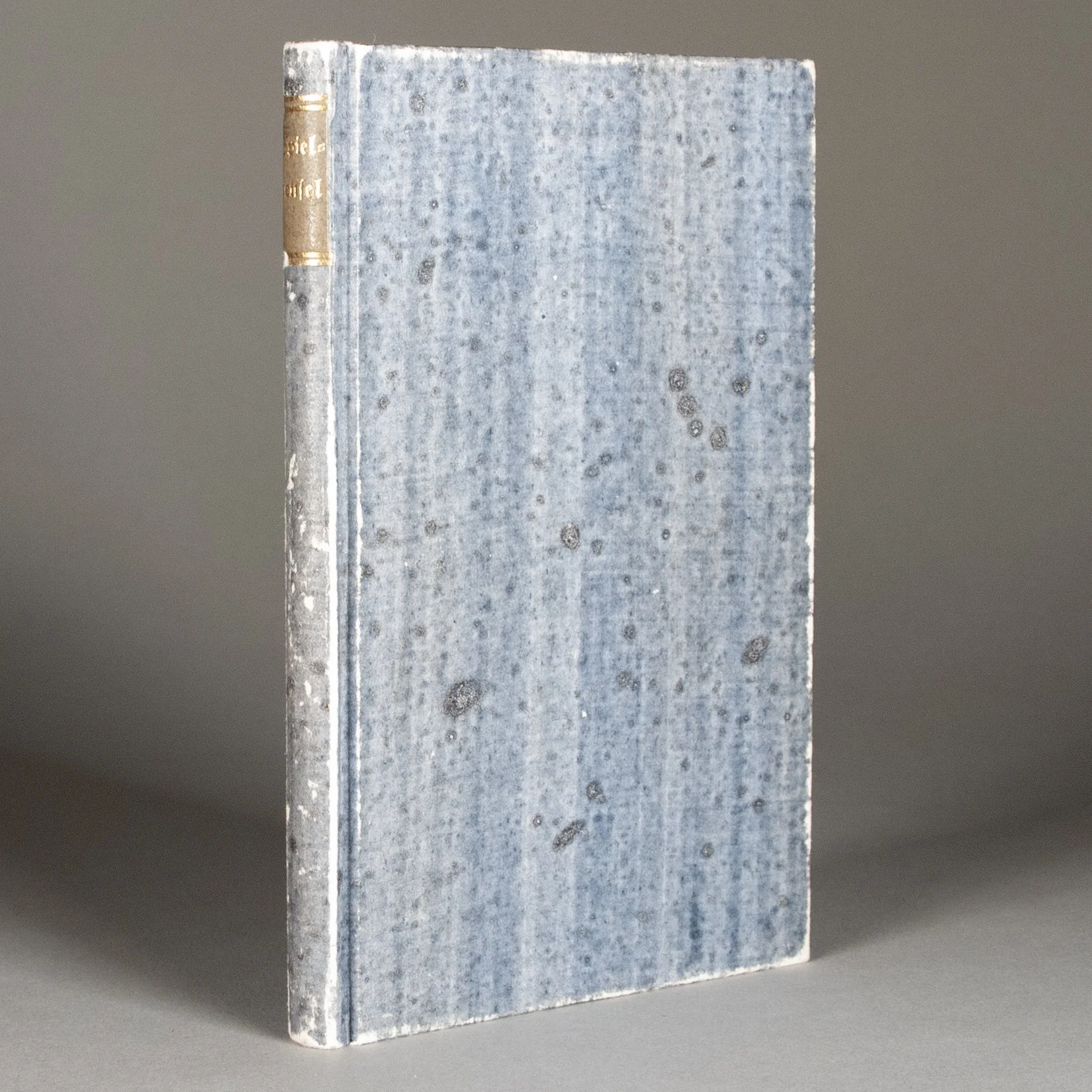 Image 5 of 6
 Image 6 of 6