
Extraordinary hybrid
Extraordinary hybrid
[Breviary, pars autumnalis]
[Liège? second half of the 16th century, incorporating elements from the late 15th century]
[7]; [5], 20, 22-38, 40-70, 72-75; 10, [1], 11-18, [2], 19-24, [1], 25-29, [2], 30-33, [1], 34-36, [2], 37-42, [1], 43-46, [1], 47-52, [1], 53-55, [2], 56-62, [1], 63-65, [2], 66-69, [1], 70-74, [1], fol. 75, [1], 76-79, [1], 80-82, [1], 83-87, [1], 88-89, [1], 90-91, [1], fol. 92, [2], 93-94, [1], fol. 95, [5]; [36]; 10, [1], 11-18, 15-70, 72-154, fol. 154, 155-166, fol. 166, 167-187, fol. 187, 188-222, [12] leaves | 96 x 78 mm
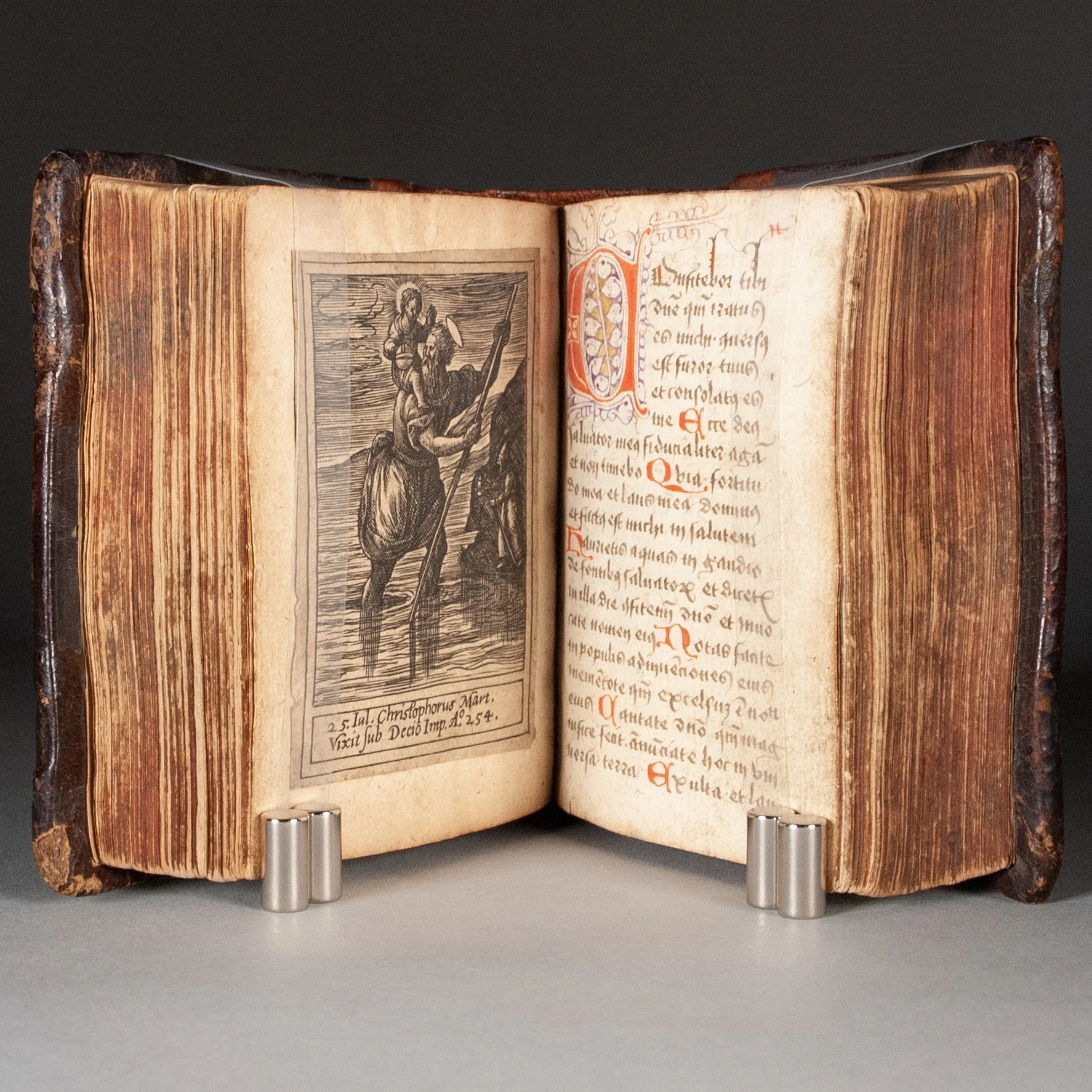
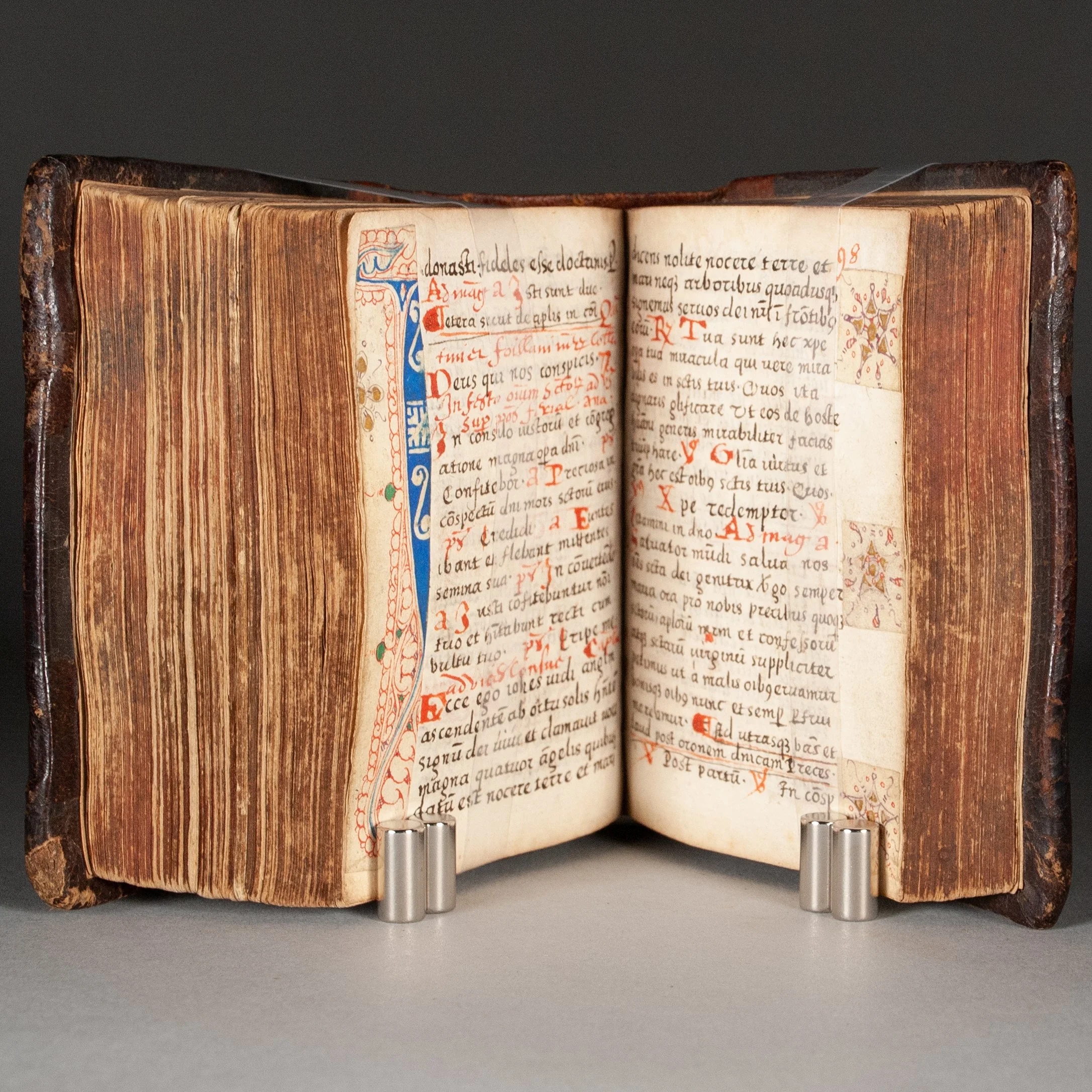
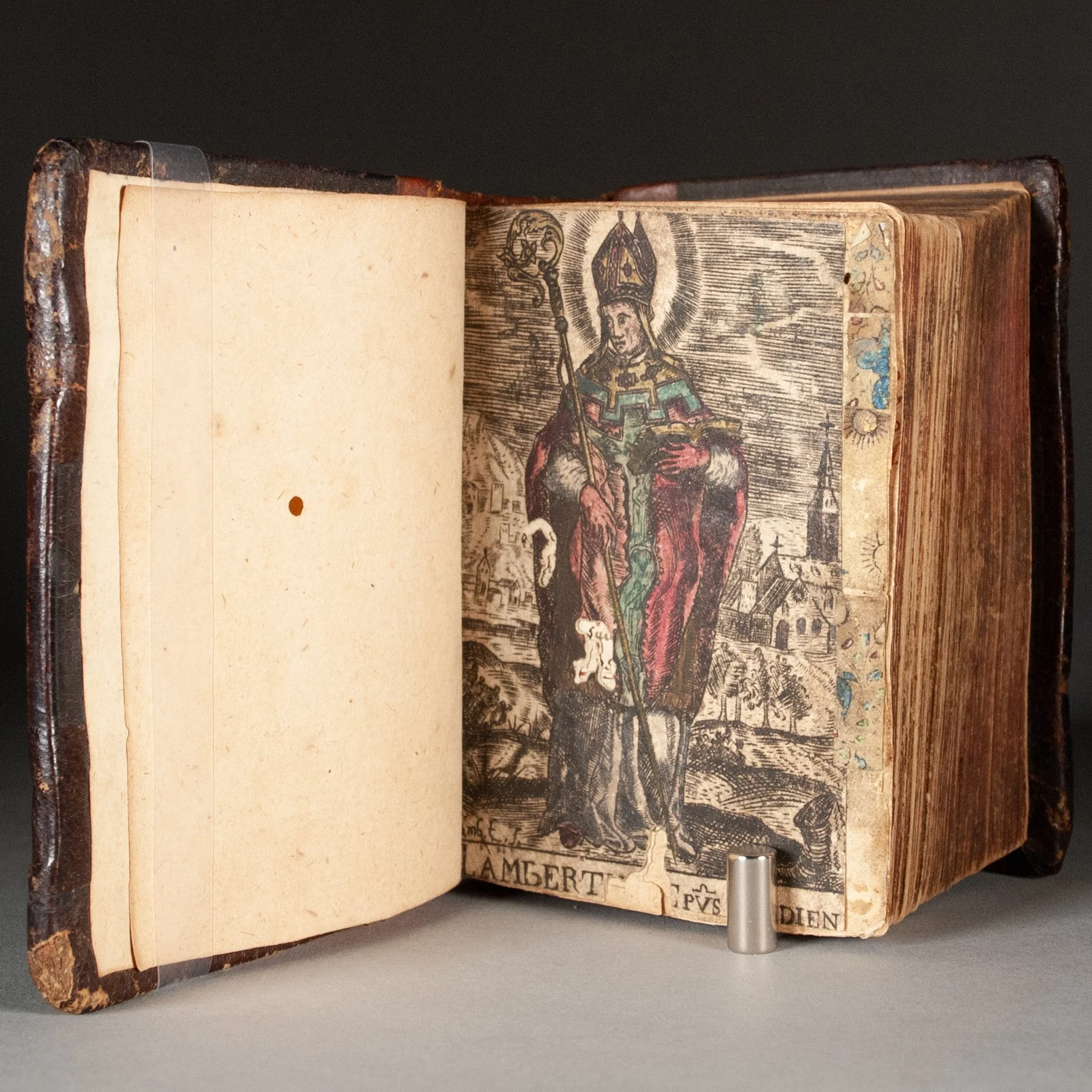
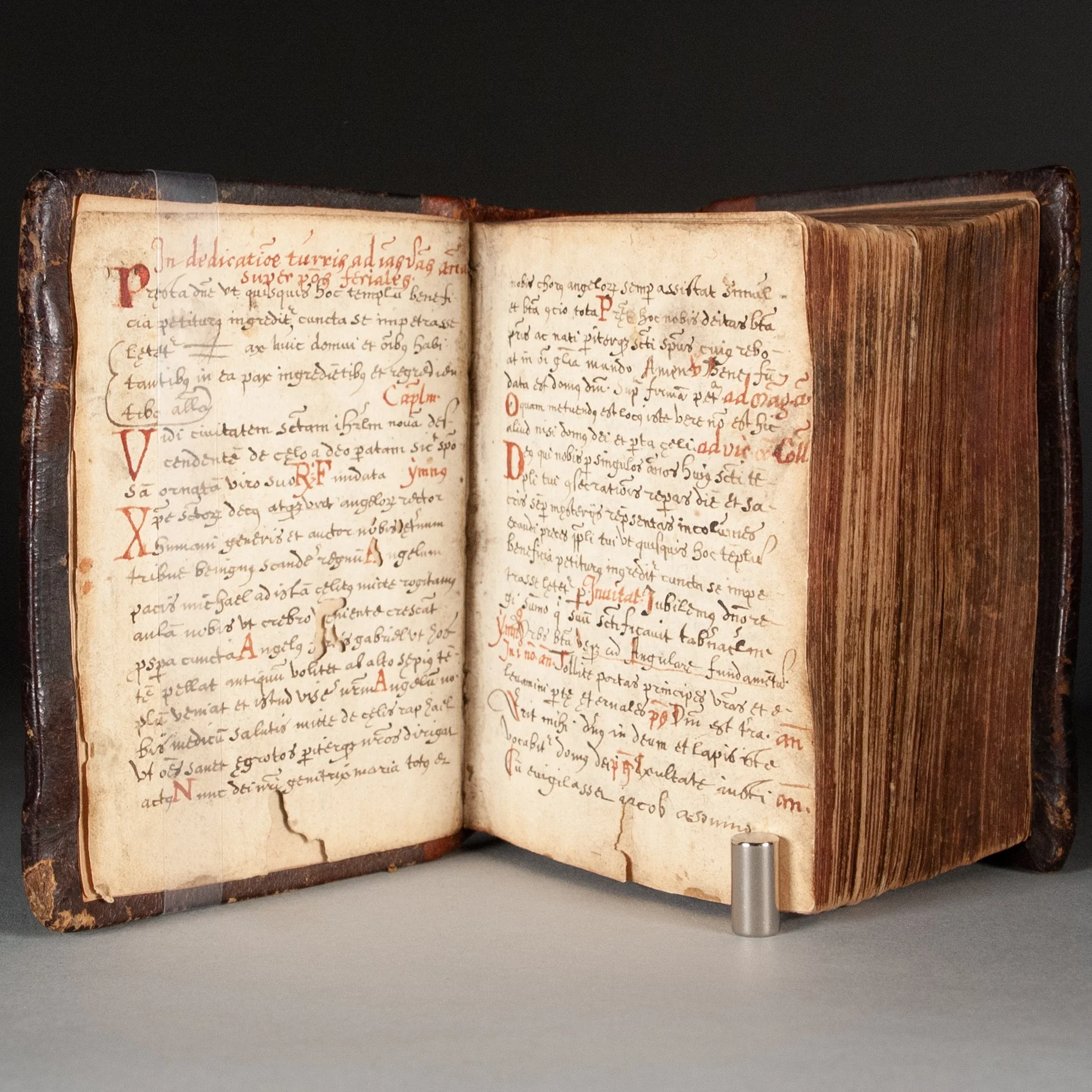
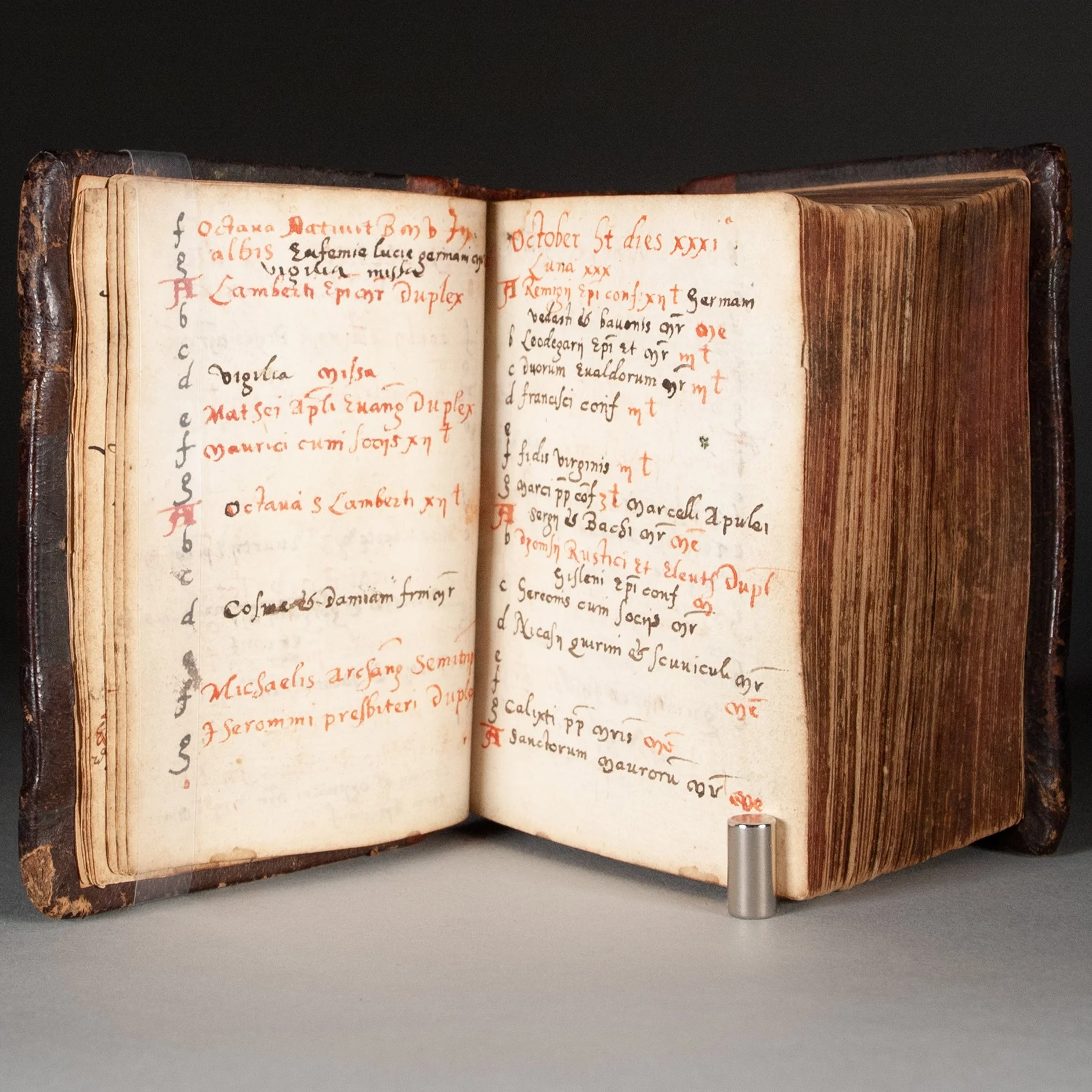
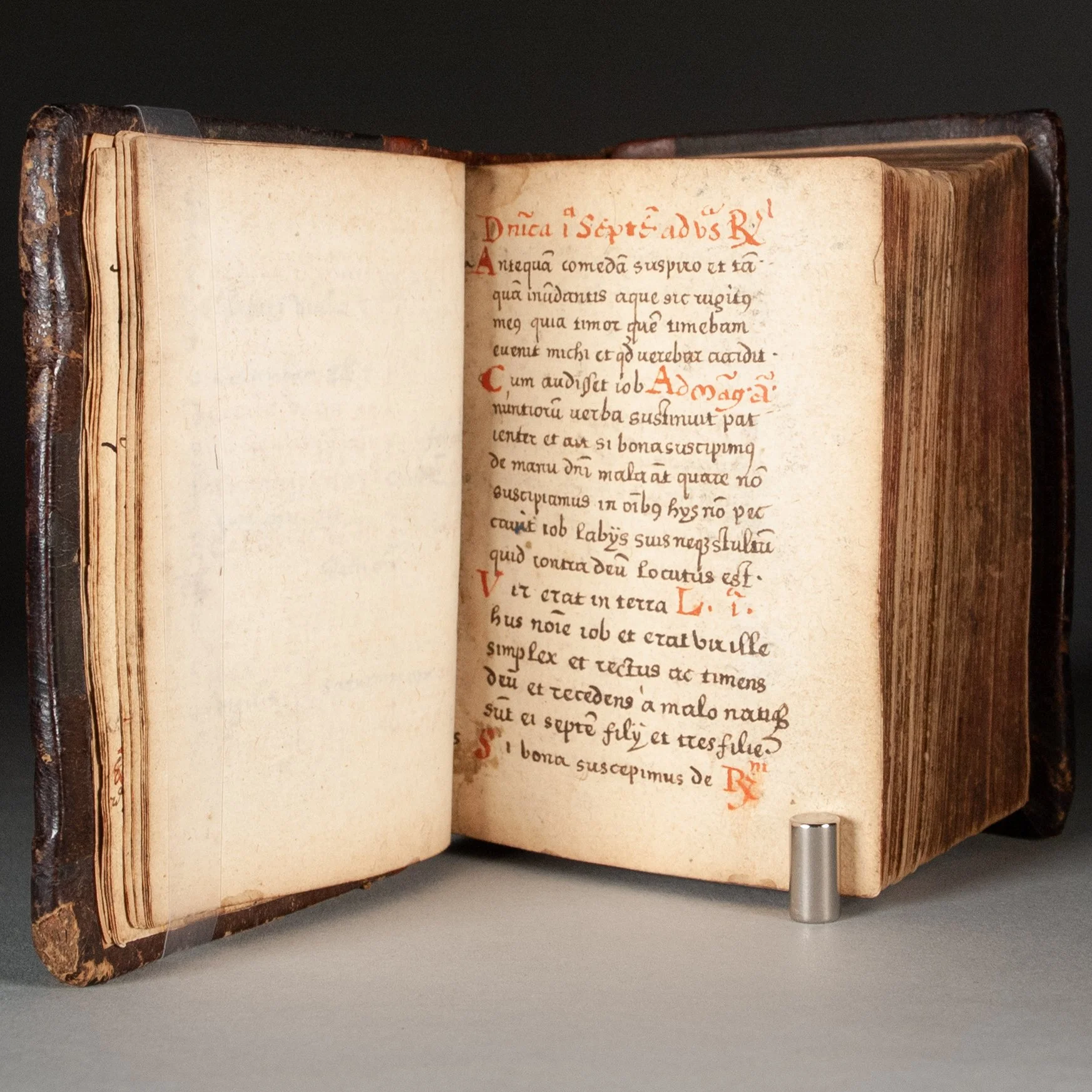
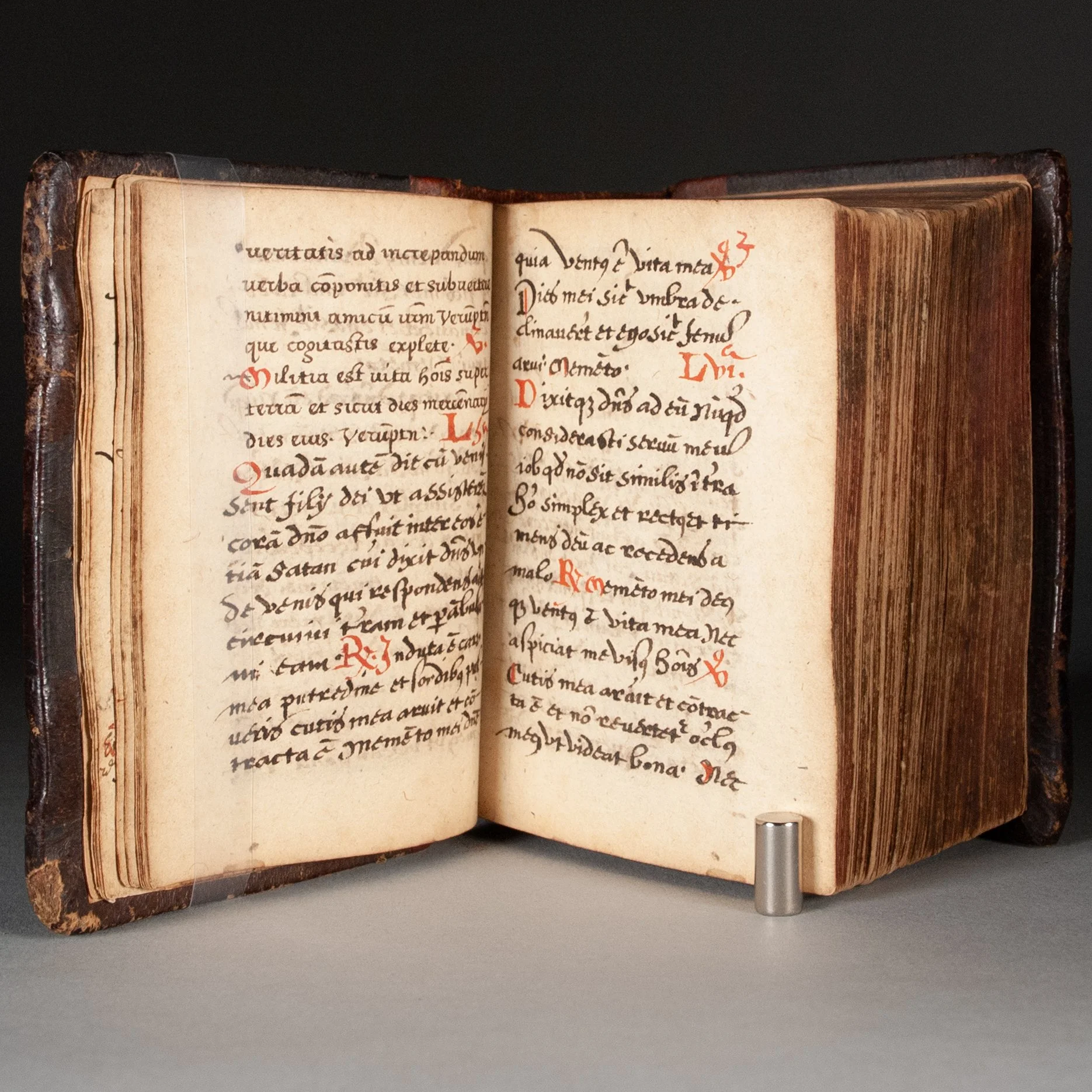
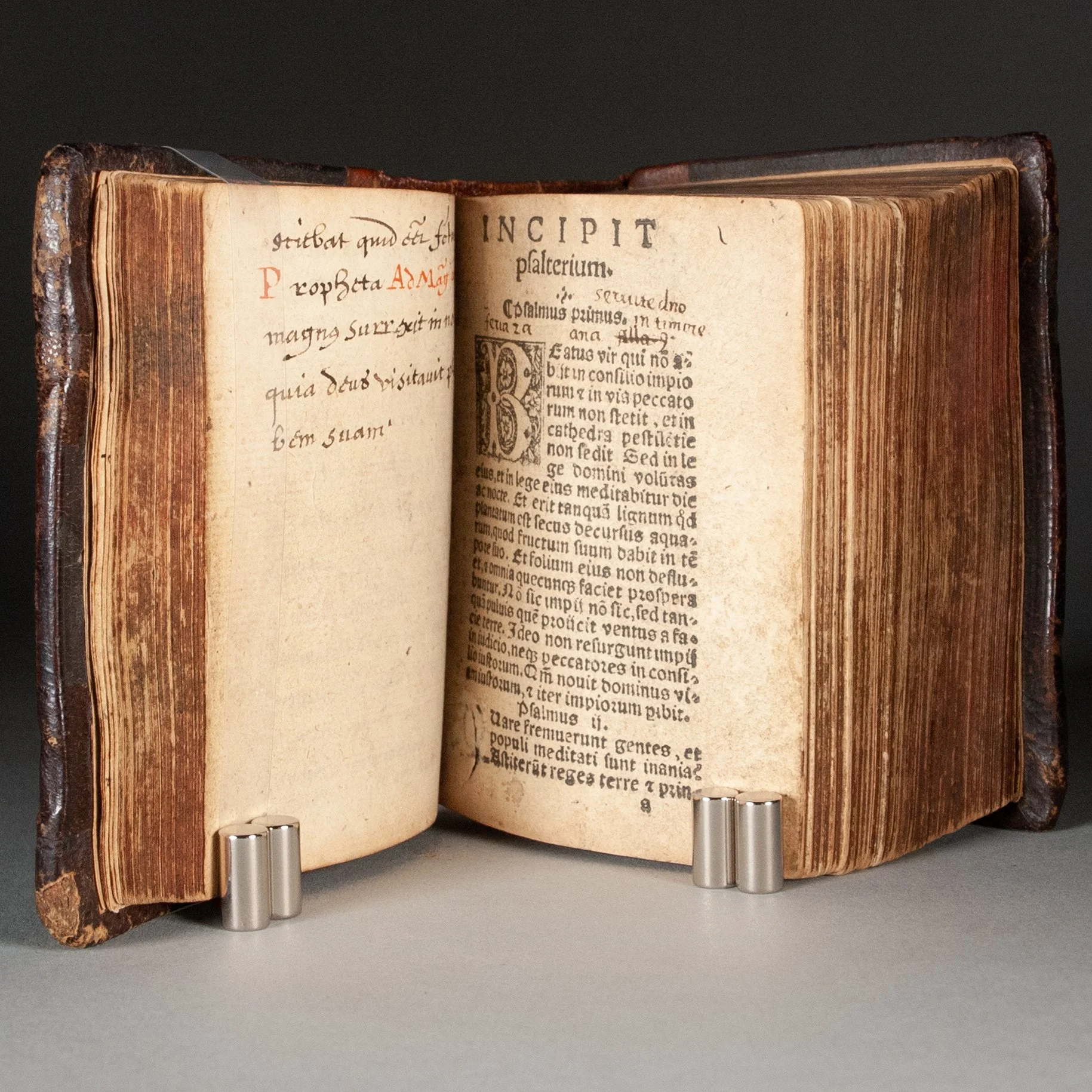
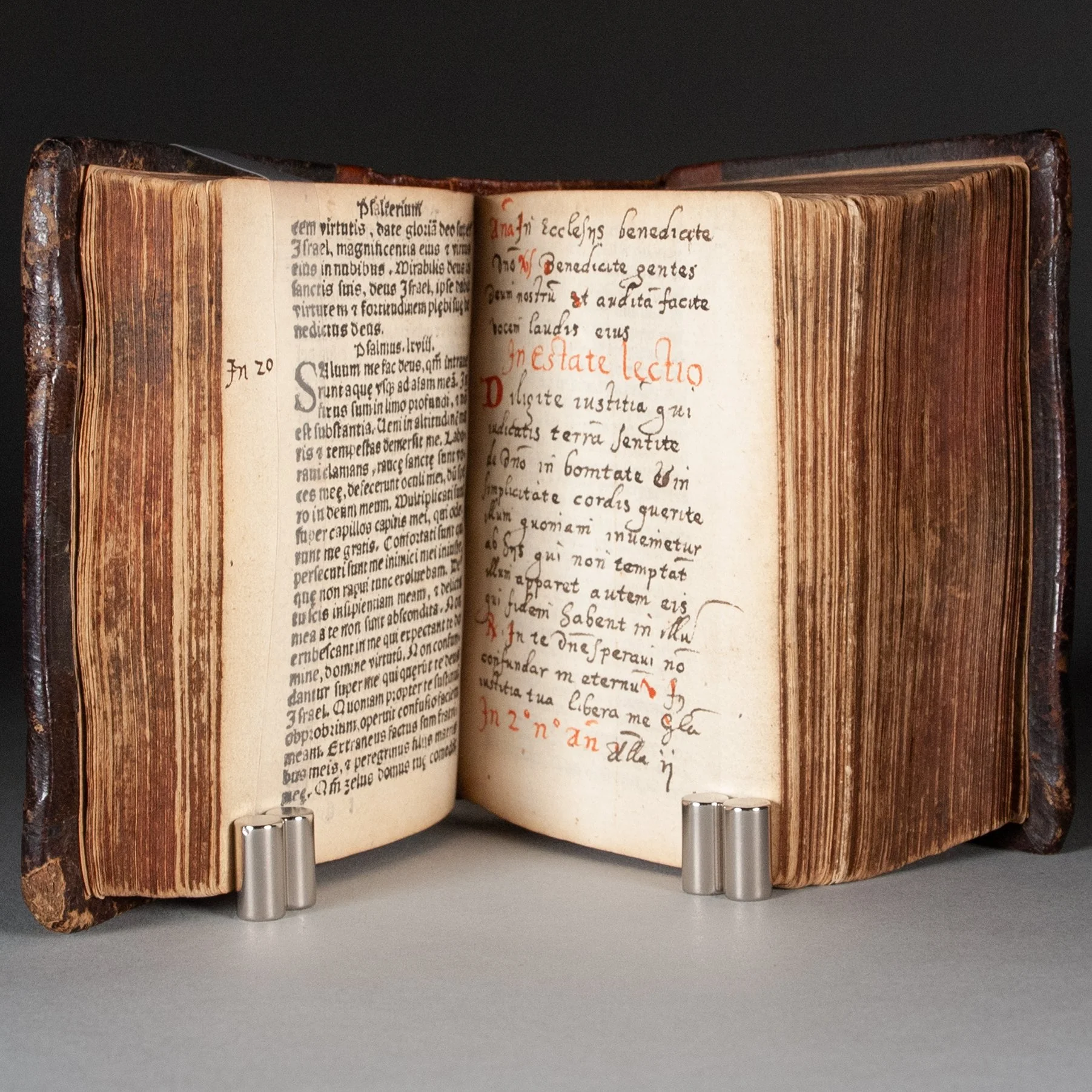
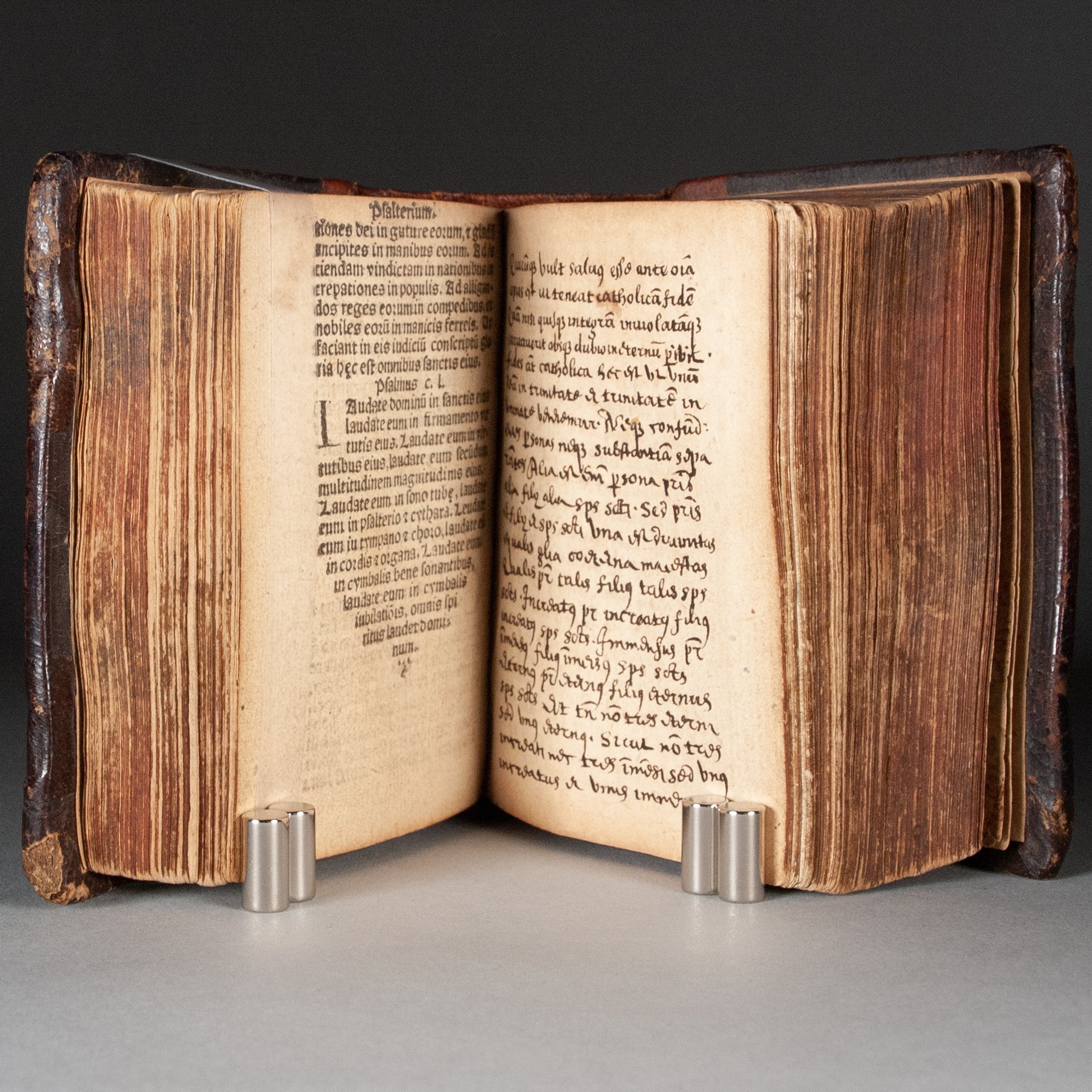
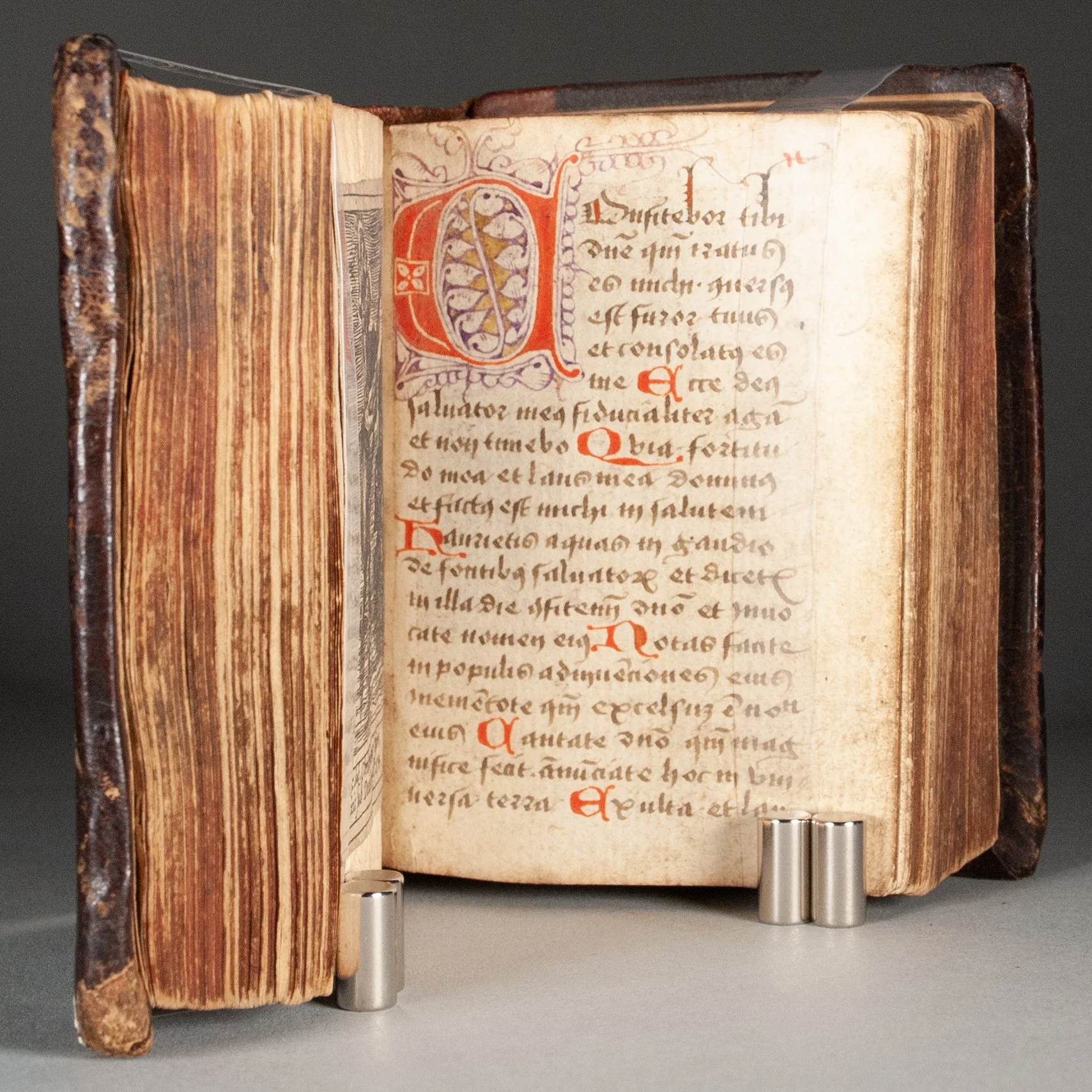
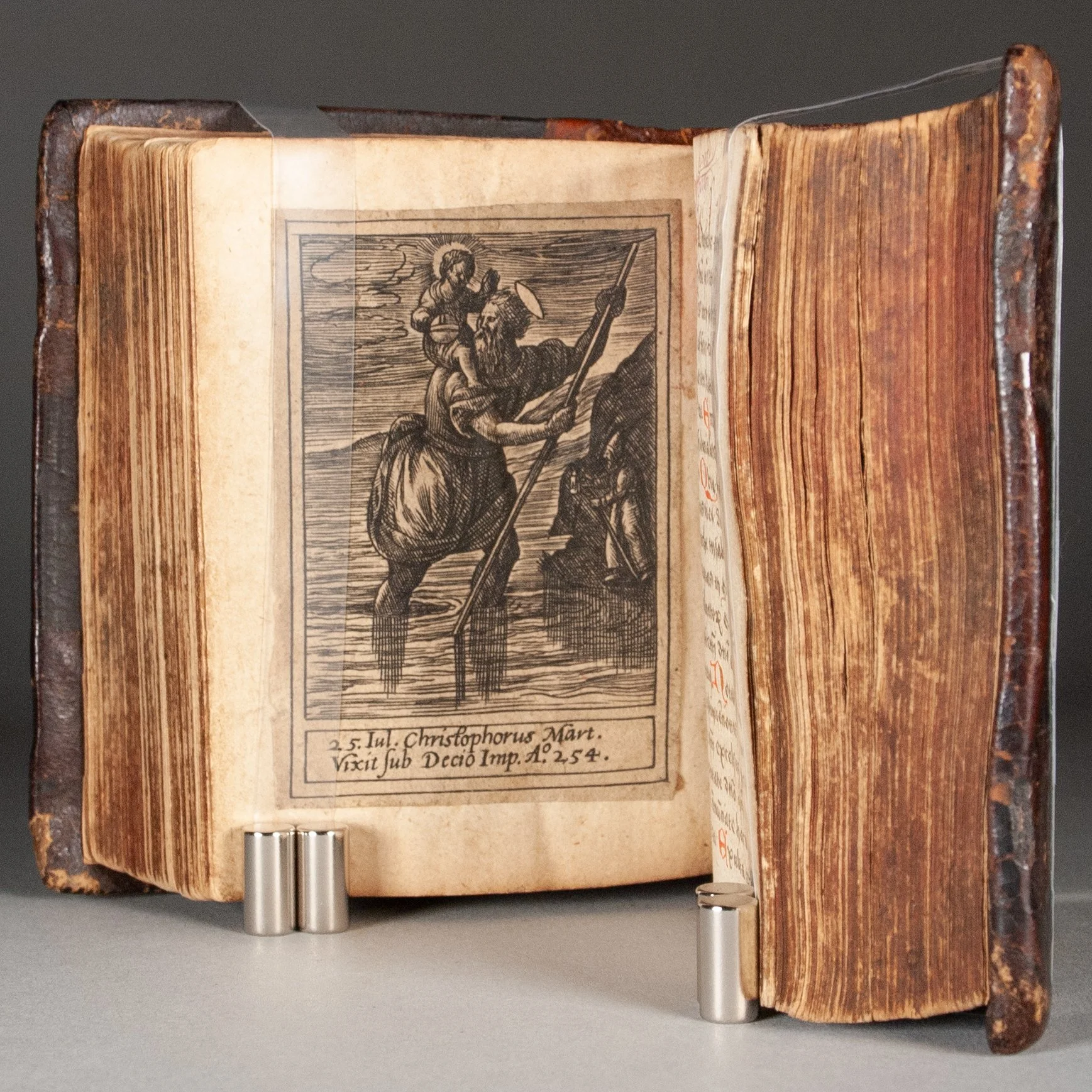
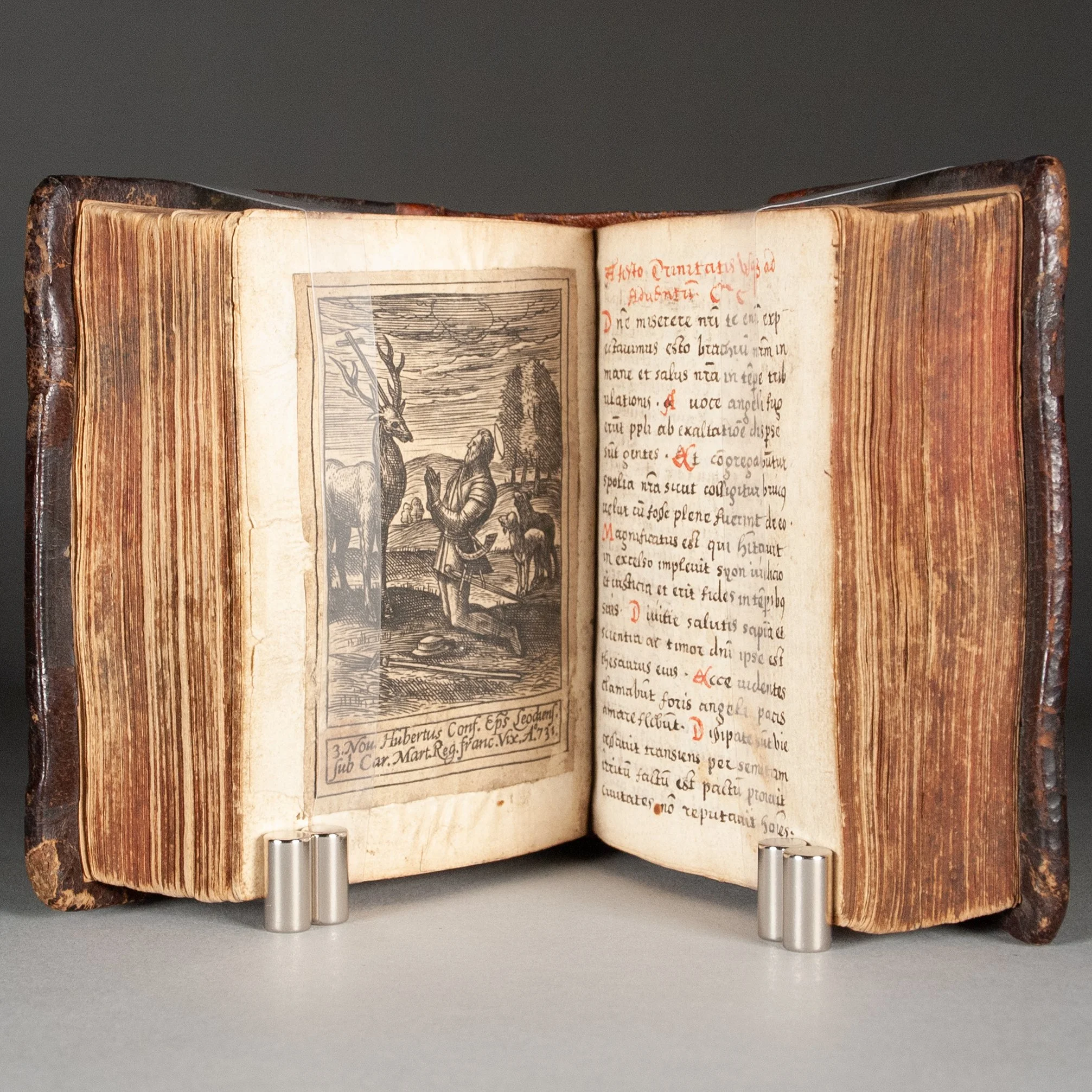
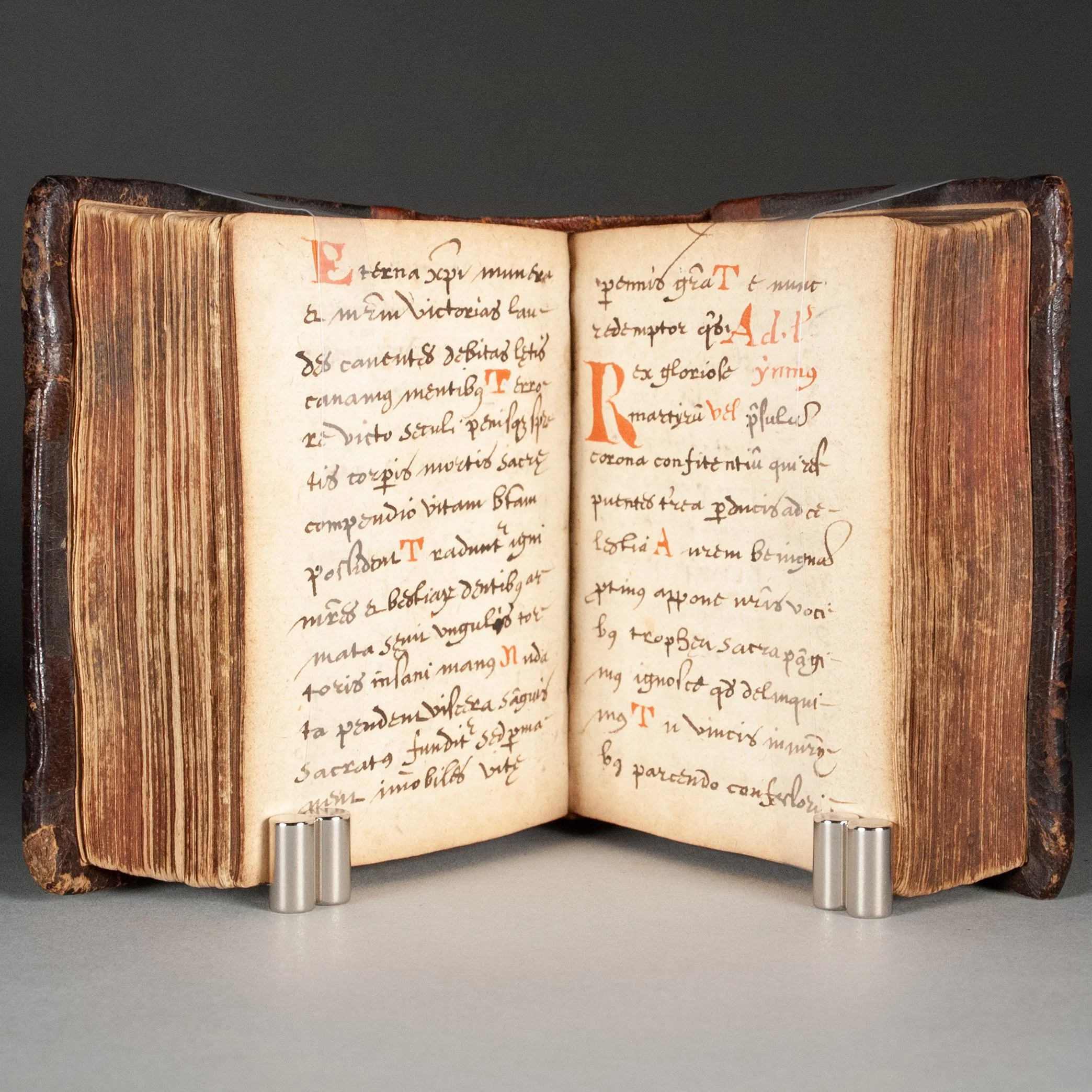
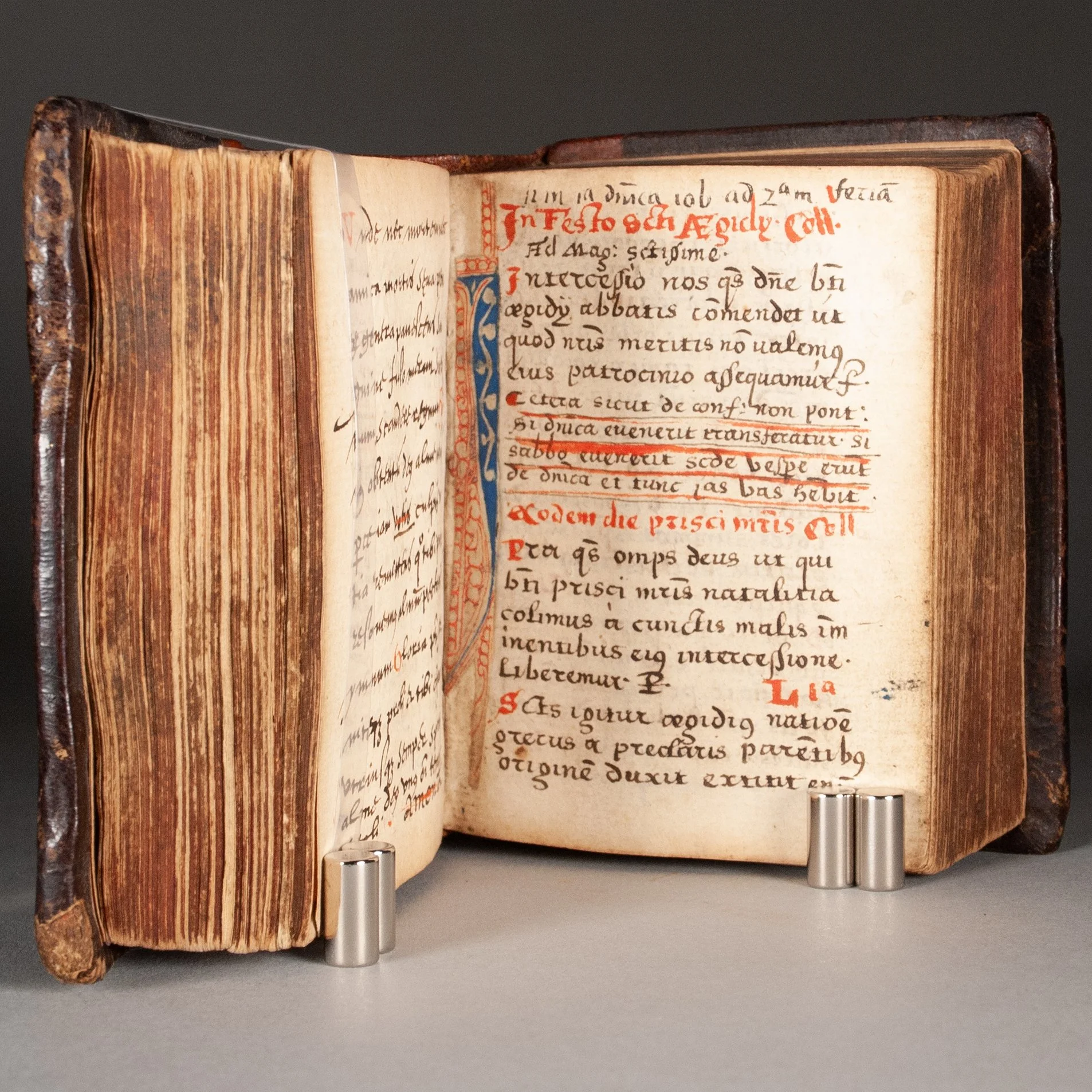
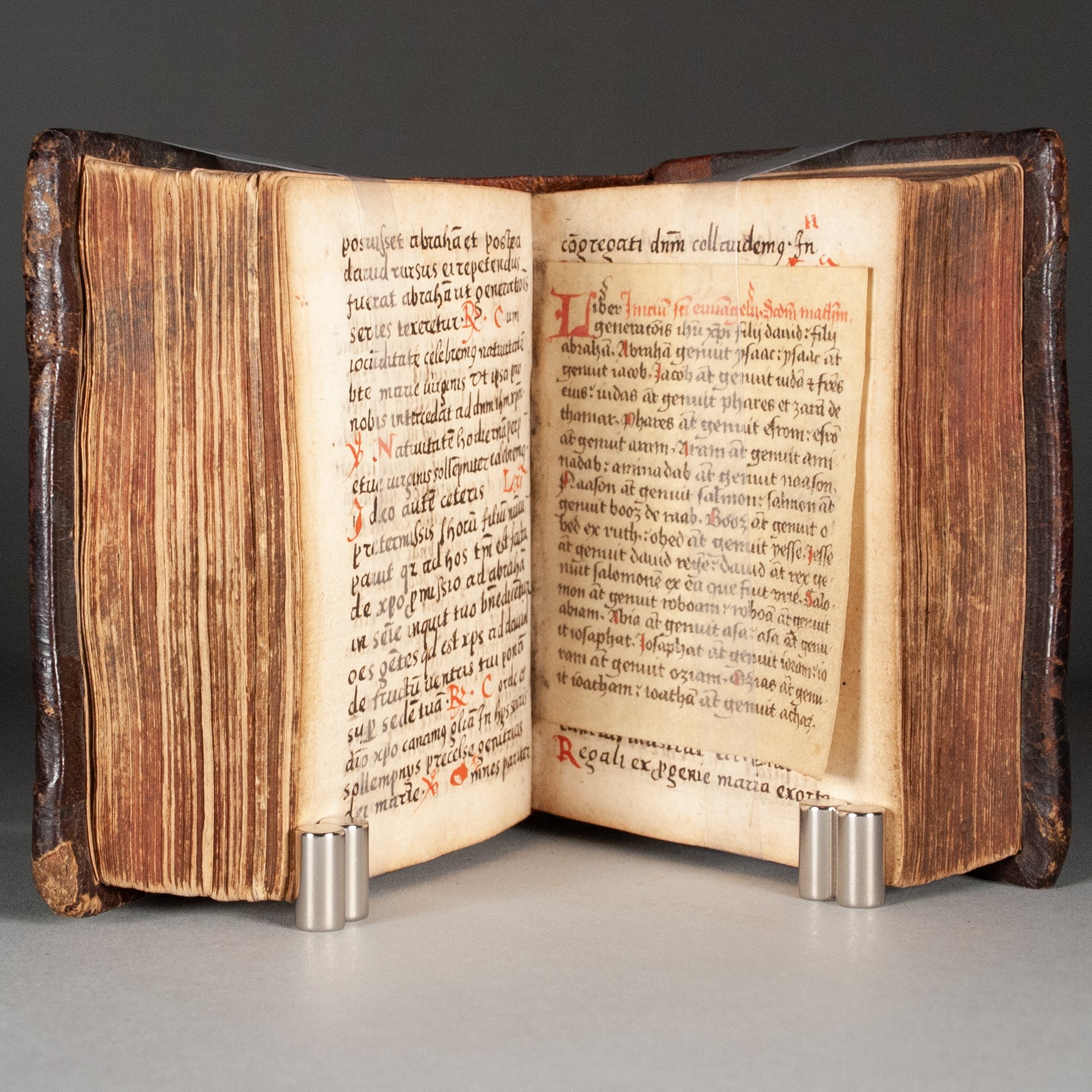
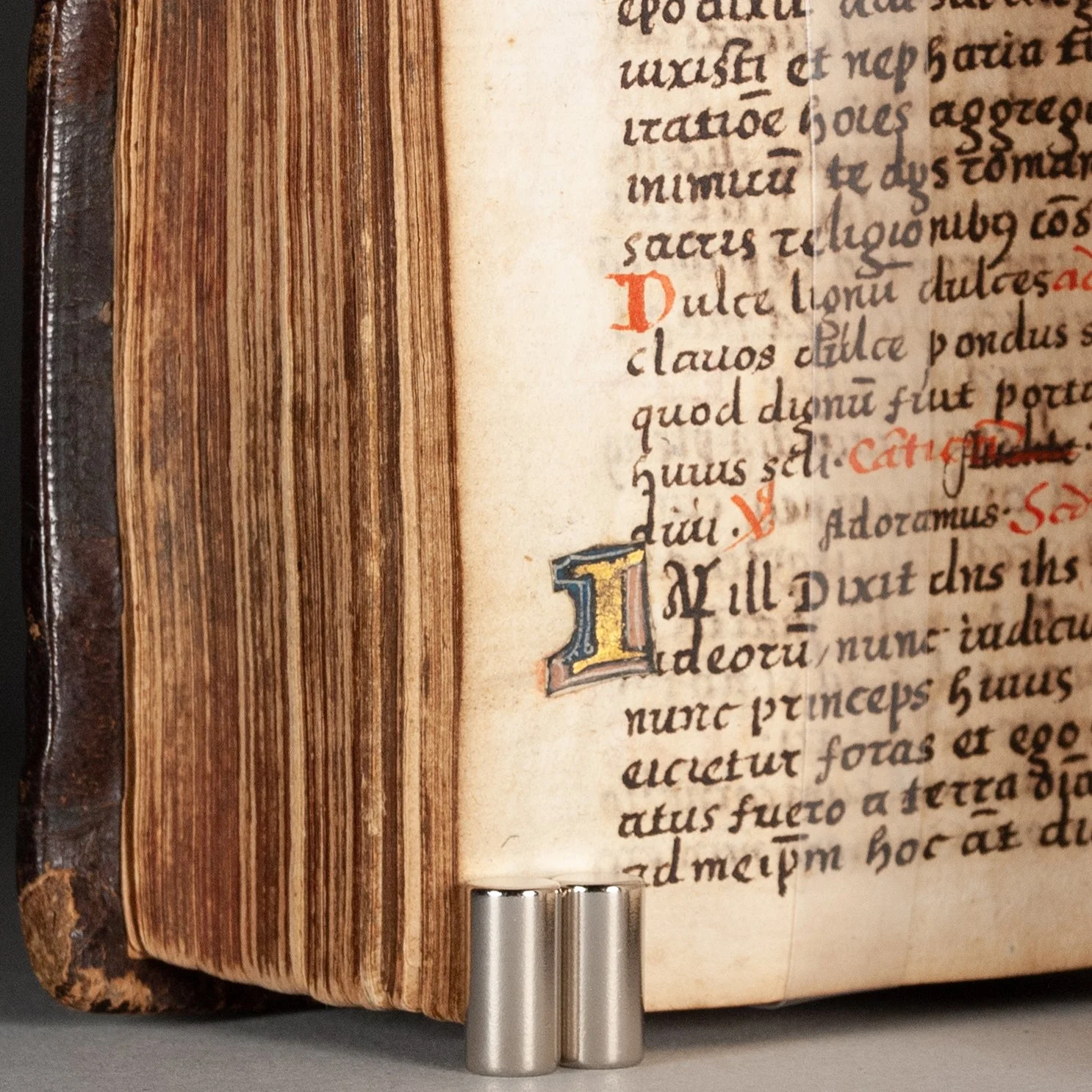
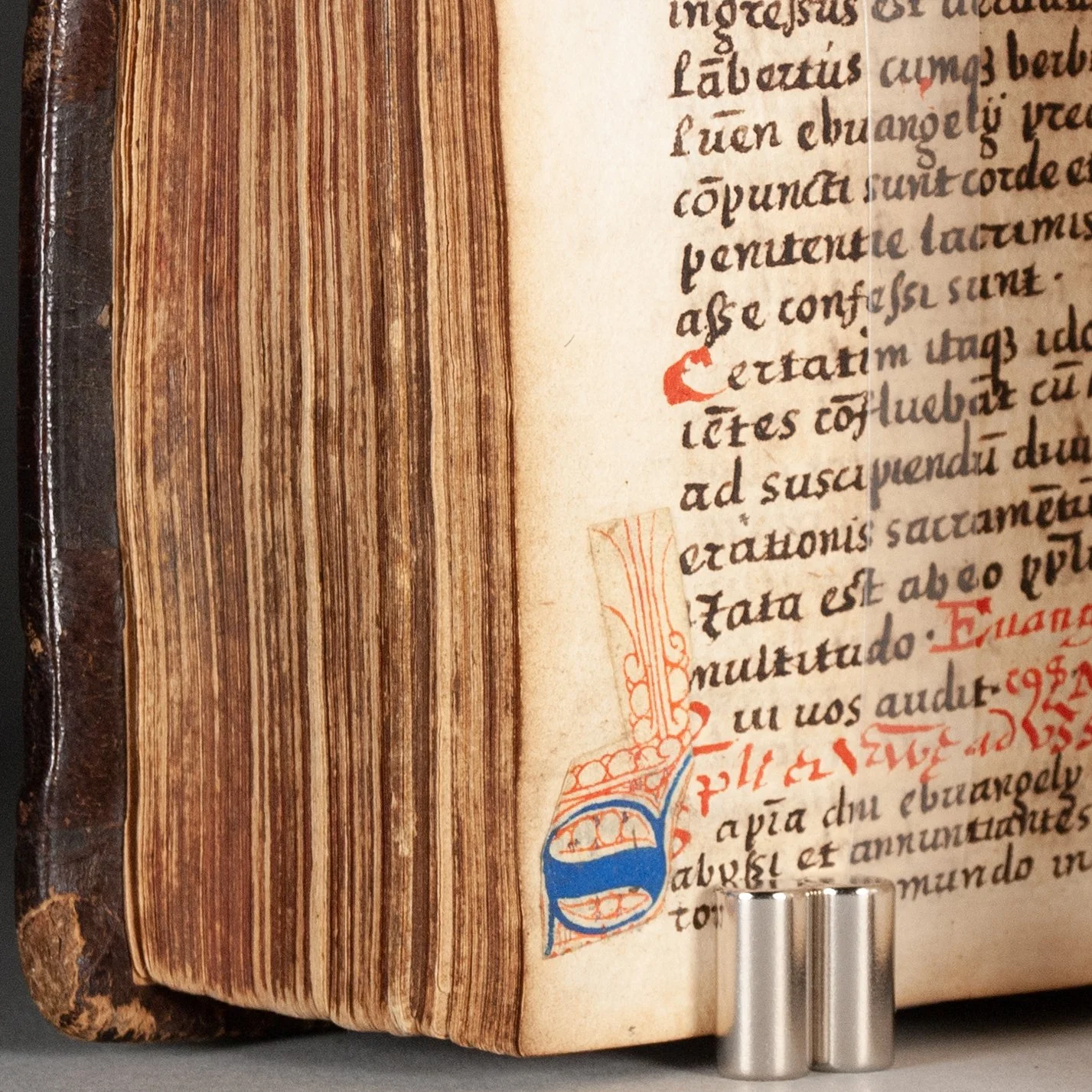
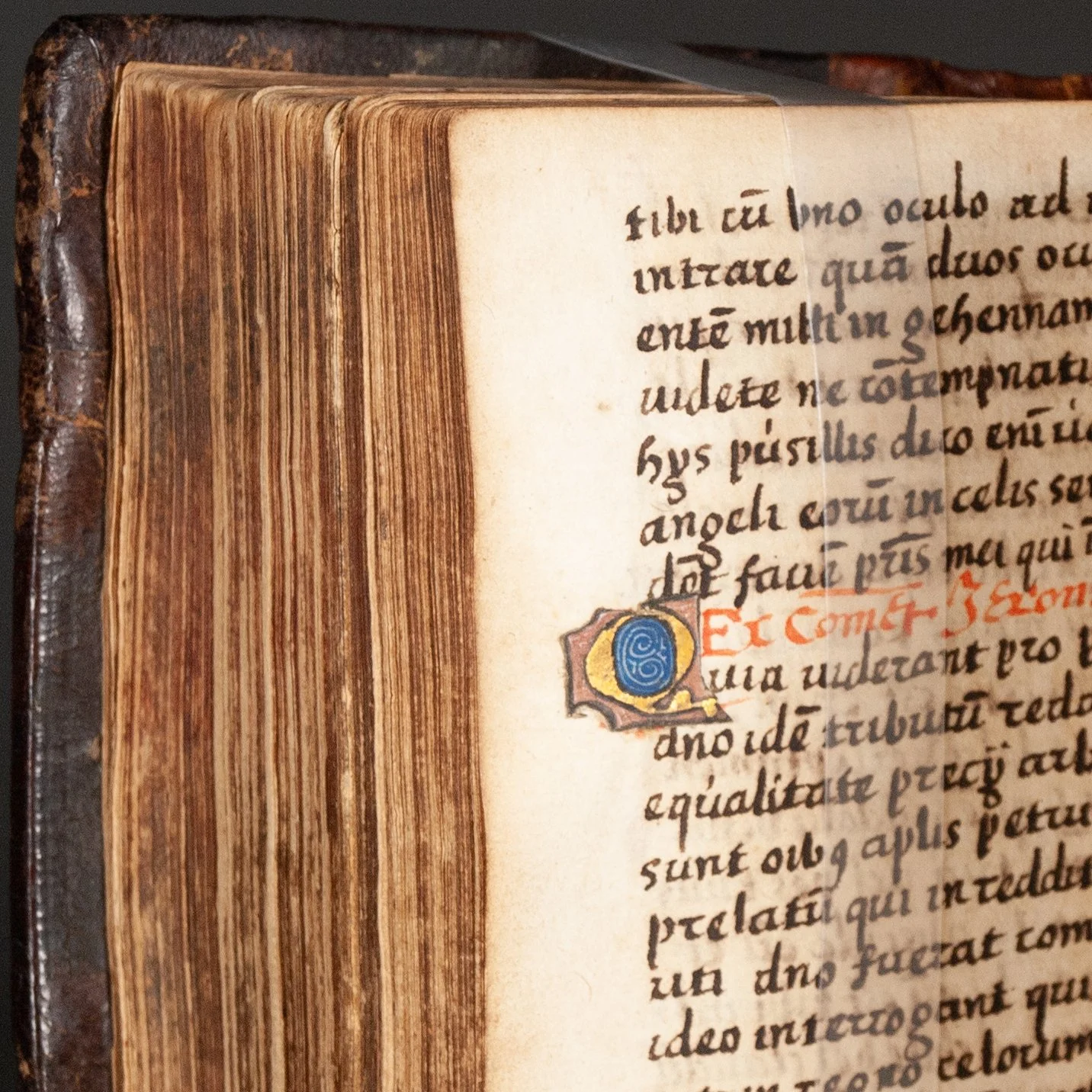
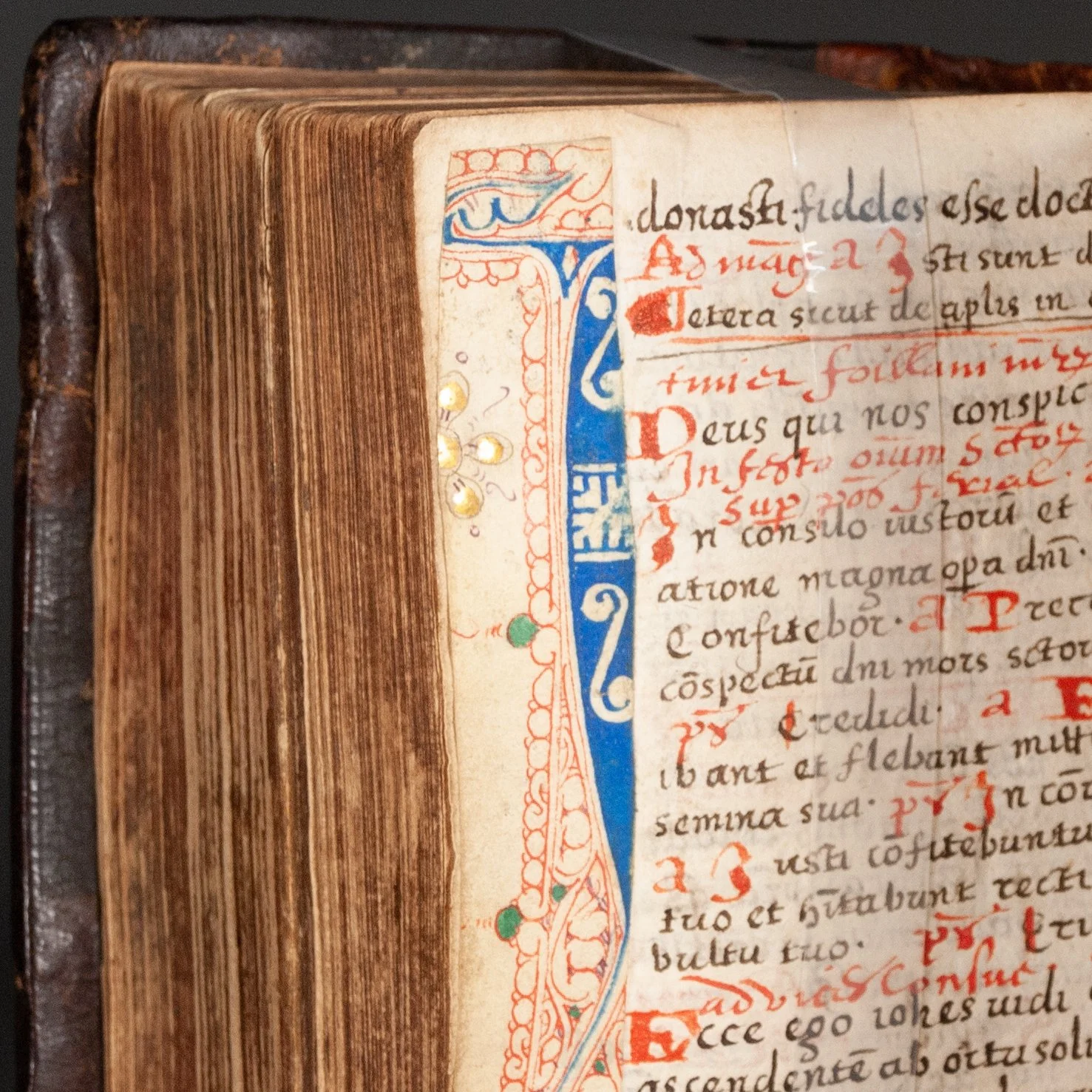
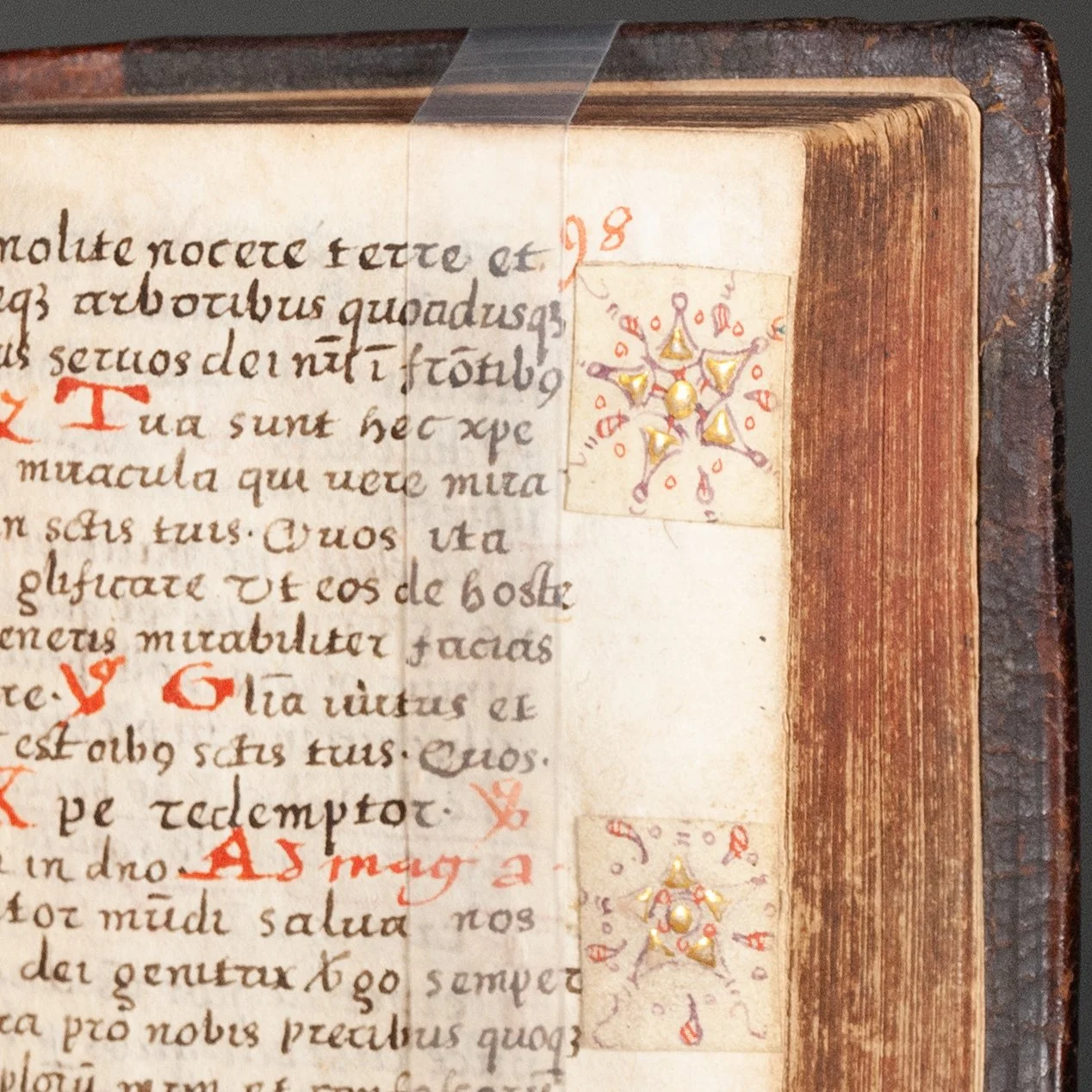
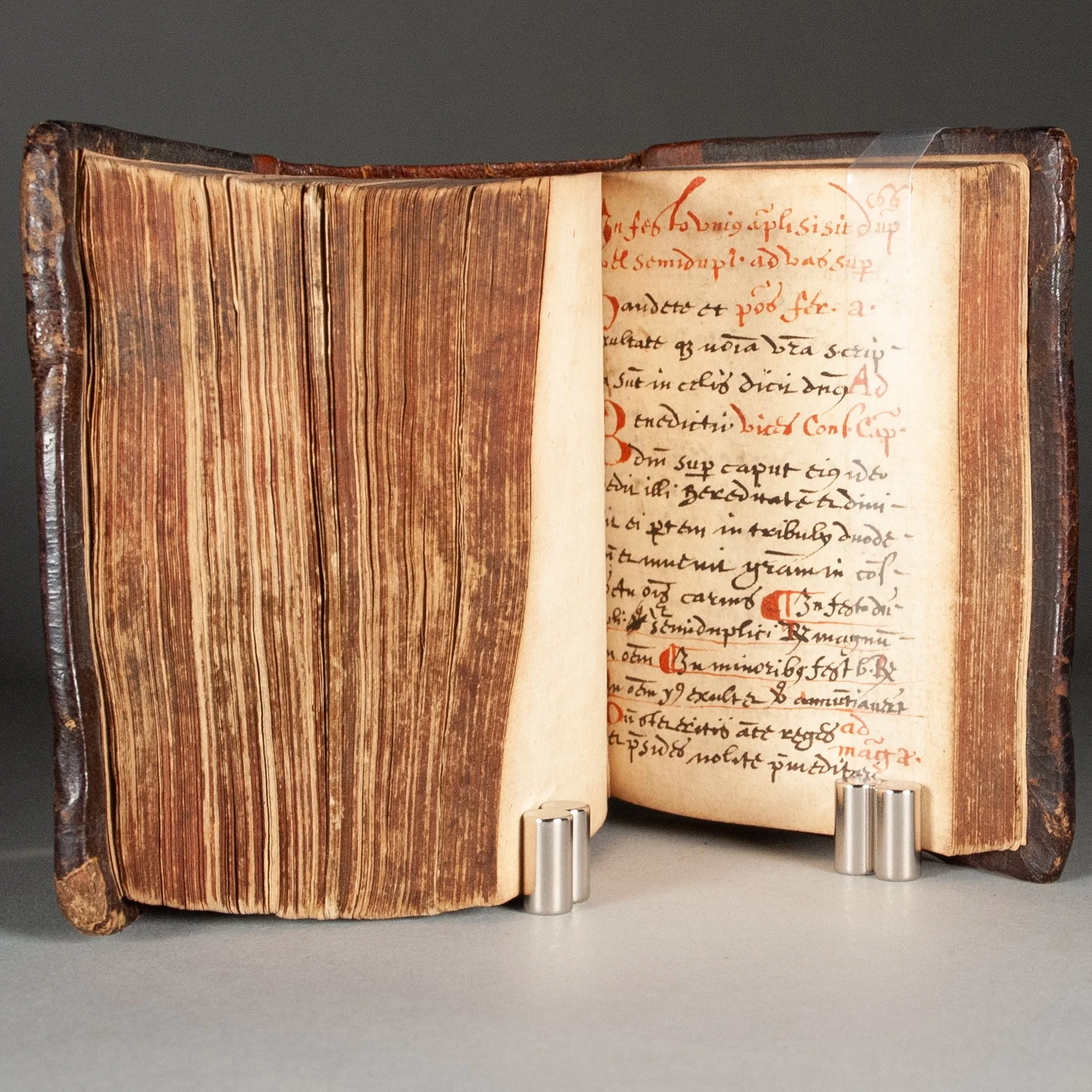
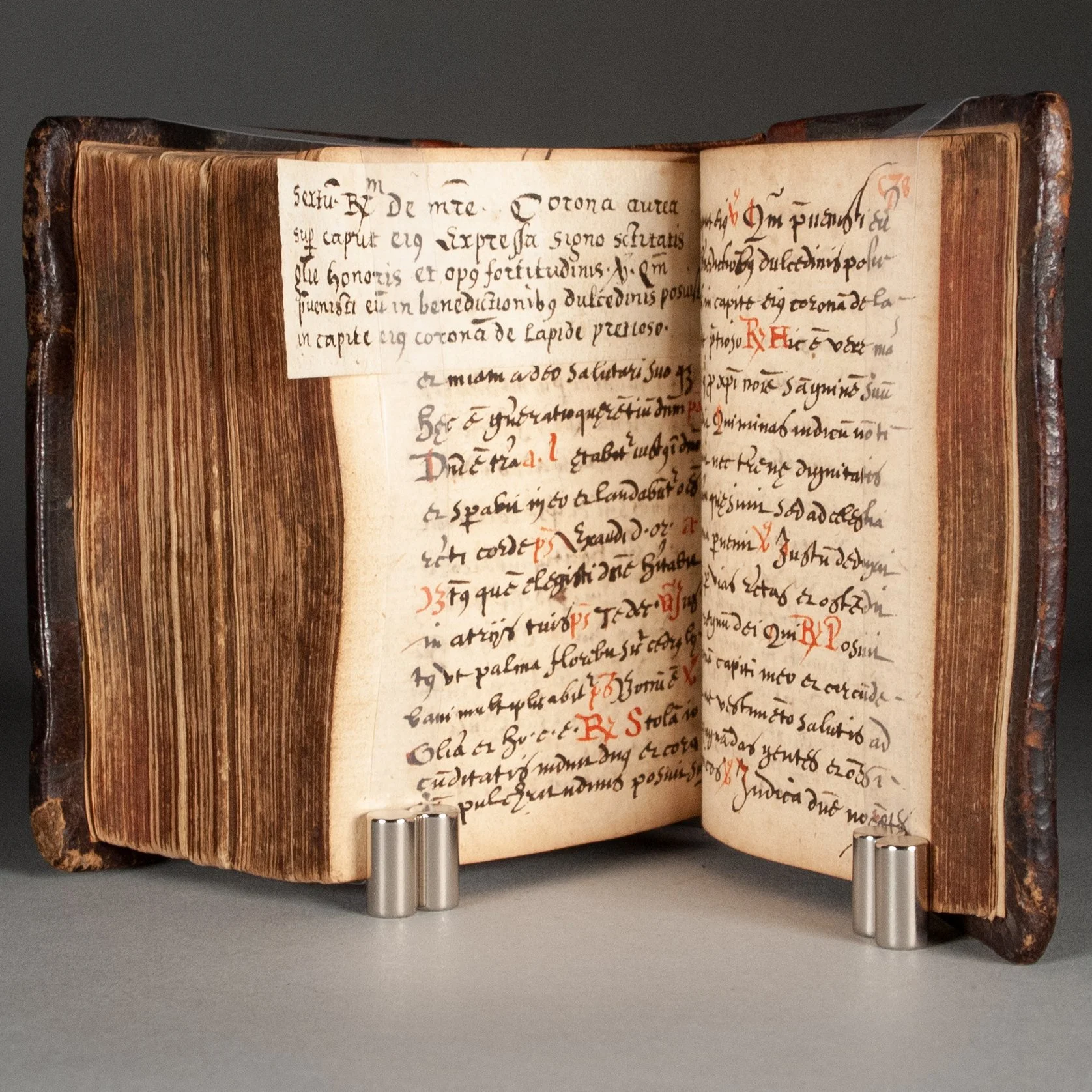
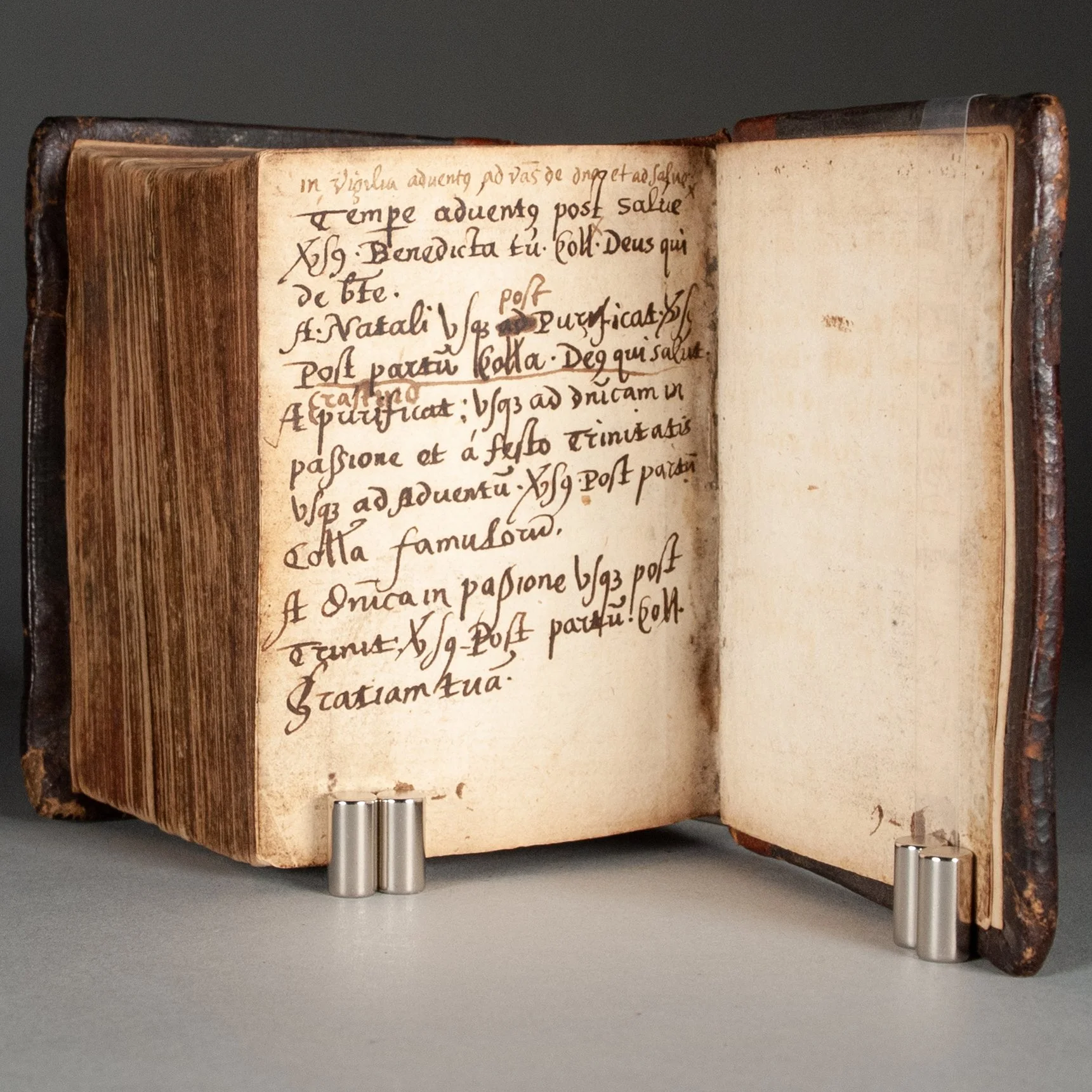
An extraordinary little hybrid breviary, containing only the pars autumnalis and presumably the last of a four-volume set (our calendar has only September, October, and November, the last three months of the liturgical year). The book is a wildly captivating assemblage of print and manuscript: primarily a 16th-century manuscript on paper in brown and red ink, in two different hands; expanded with a printed psalter, this heavily interleaved with some 30 further leaves of manuscript; a dozen leaves pulled from earlier, more accomplished manuscripts, with several decorative initials in blue and red penwork (likely late 15th-century, one of these leaves on vellum and in miniature format); with a handful of leaves at front in yet another hand; augmented with three engraved illustrations (Saints Lambert, Christopher, and Hubert); and some of the 16th-century manuscript (plus the leading illustration of St. Lambert and one page of the printed psalter) further embellished with 23 late medieval illuminations on vellum cut from yet another manuscript—including two striking blue and red penwork initials running the full page length, and most of these heightened with burnished gold. The last three leaves of the unnumbered middle sequence represent unfinished scribal work, with blank spaces intended for rubrication never added. ¶ The unidentified printed psalter is certainly a northern edition, and the bulk of the manuscript content points to production along the lower Meuse (in what was once the heart of the Carolingian Empire). The opening illustration, for example, depicts Lambert of Maastricht (ca. 636-ca. 705), bishop and patron saint of Liège; another illustration depicts St. Hubert of Liège, that Belgian city's first bishop; and the calendar celebrates Remaclus and Theodard, both 7th-century bishops of Maastricht. The offices contained herein are rich in canticles and hymns—texts that would have been sung—with celebrations of certain saints further suggesting the same rough geographic origin. For example, one discrete section (within the unnumbered sequence that follows the printed psalter) opens with Saints Giles, Remaclus, and Lambert. Much (most?) of the paper lacks a discernible watermark, though we find a gothic P in the most decorative manuscript portion, likewise in the paper of the printed psalter. This watermark was widely used across northern Europe in the 15th and 16th centuries, and largely disappeared in the 17th. Heawood, for example, reports documented uses only through 1608. The Council of Trent published a standardized breviary in 1568, after which a customized volume like this would have become increasingly unlikely. Such radically assembled books didn't disappear altogether, of course, though the practice came to focus on private devotional volumes. This binding fits the same time frame, the use of a single small gold tool in each spine compartment not uncommon in the second half of the 16th century, enduring into the 17th. ¶ The breviary was a private liturgical text subjected to intensive daily use, filled with psalms, various offices, and celebrations of saints, as you'll find here. It was commonly divided into four sections—one for each season—and so complete copies frequently appeared in four volumes. Given diocesan differences (especially before the Council of Trent), and ongoing revisions to approved texts, service books were particularly prone to customization to ensure their ongoing utility (if not replaced altogether). And the breviary was among the most complex of liturgical books, with content and arrangement found in a bewildering variety of permutations. But of course this volume represents something far more than simple revision. This is a Frankenstein's monster assembled by plundering at least half a dozen different sources, print and manuscript alike, to create exactly what an early reader wanted but presumably couldn't find. William Sherman concedes that we moderns might assume such destruction of religious books to have been tantamount to desecration, but "the use of scissors and paste was by no means inherently sacrilegious in the sixteenth century. It played a more central role in Tudor and Stuart textual culture than we have tended to realize." Continuing in the British context, Sherman points to the creations at Little Gidding as a culmination of this phenomenon, finding them to be "very much of a piece with the sixteenth- and seventeenth-century vogue for creating hybrid miscellanies of printed and manuscript fragments." To be sure, such recombination has a rich history. There was a Victorian craze for extracting illuminations from medieval manuscripts, though more benign forms of the practice date to the earliest days of the European press. There's evidence that Fust and Schoeffer's 1458 Canon Missae, for example, was printed "for the express purpose of being inserted into manuscripts," and scribes may have "sometimes used printed sections to simplify their own task" (Bühler). The reverse could also be true, with missing sections from printed books being sometimes supplied in manuscript. ¶ The cut-and-paste medieval illuminations are what really get us. It's unusual, though not unheard of. William Sherman, for example, finds a similar case at the Huntington (RB438000:87), a 1560s manuscript copy of the Anglican Book of Common Prayer embellished with decorative initials cut from late medieval manuscripts. The practice calls to mind the late 15th-century habit of embellishing manuscript with printed illustrations, which gained particular currency in the Low Countries and Germany. And of course the inclusion of three printed illustrations makes our book a direct participant in that very tradition. A whole cottage industry developed around these practices, with many publishers producing images specifically intended to augment manuscript and other print. These amalgams of early print and manuscript are undeniably arresting, though in a sense not at all novel. "The long history of Western literacy provides many examples of writers cutting and pasting found materials into new assemblages," writes Whitney Trettien, "stretching back to ancient Greek and Latin cento poems, patched together from snippets of other texts, and forward to the collage aesthetic of Riot GRRRL zines in the 1980s and 90s." Trettien provocatively asks us to consider all books fragmentary. "That scholars have ever imagined the textual record being composed otherwise is a fantasy born, I suspect, from the social construction of print and the convention of cataloging by edition, which has trained western readers to imagine books in terms of perfect, shelf-stable editions rather than messy, performatively material individual copies." ¶ An astonishing witness to that uneasy transition from manuscript to print, which—it's true—never really ended.
PROVENANCE: Scattered light marginalia, and occasional passages struck through, clear evidence of ongoing use and revision; five-line slip inserted between fol. 177 and 178 in the final numbered sequence. ¶ We acquired it from a New York auction house, and to them from an American estate, where it appeared to have sat for many years (if not generations).
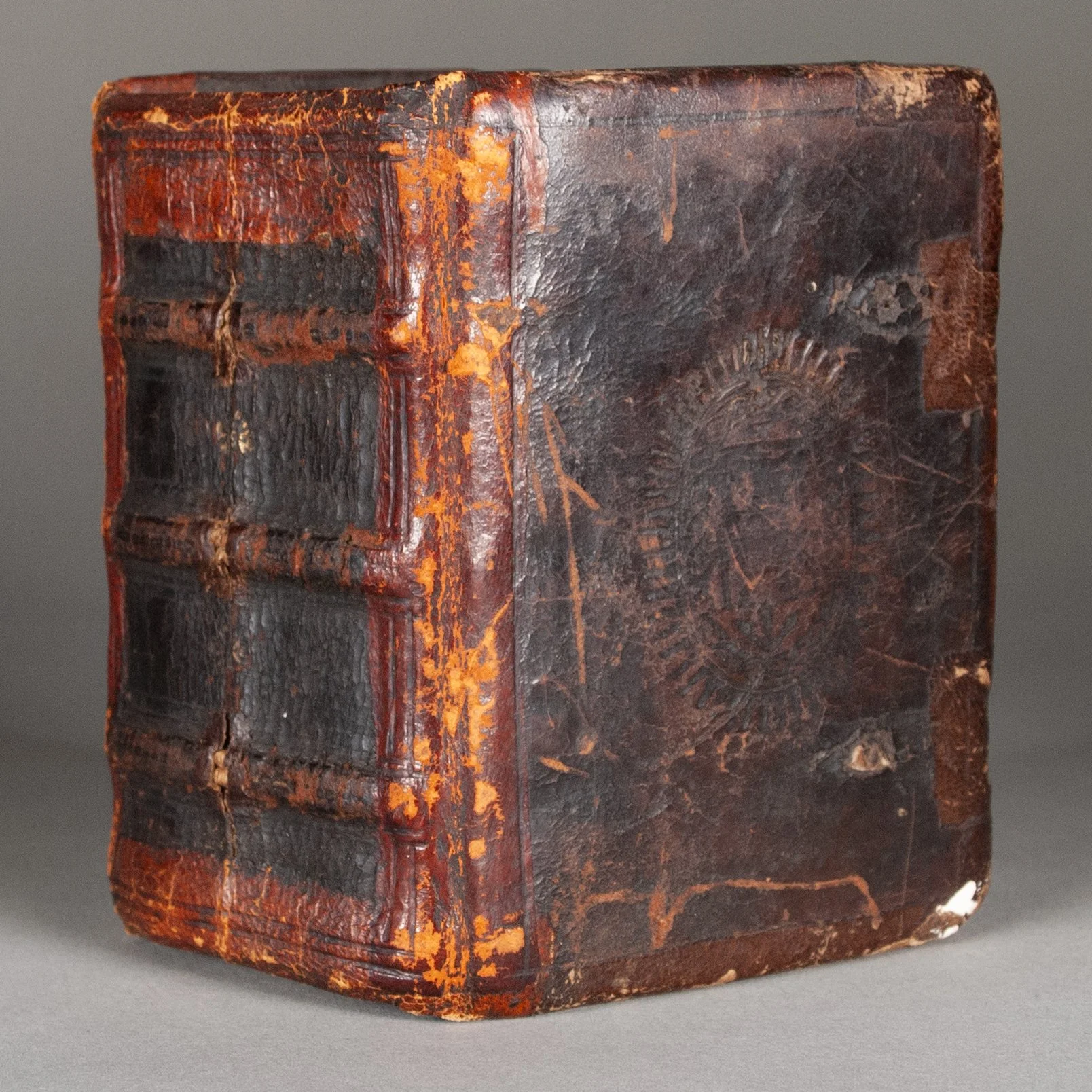
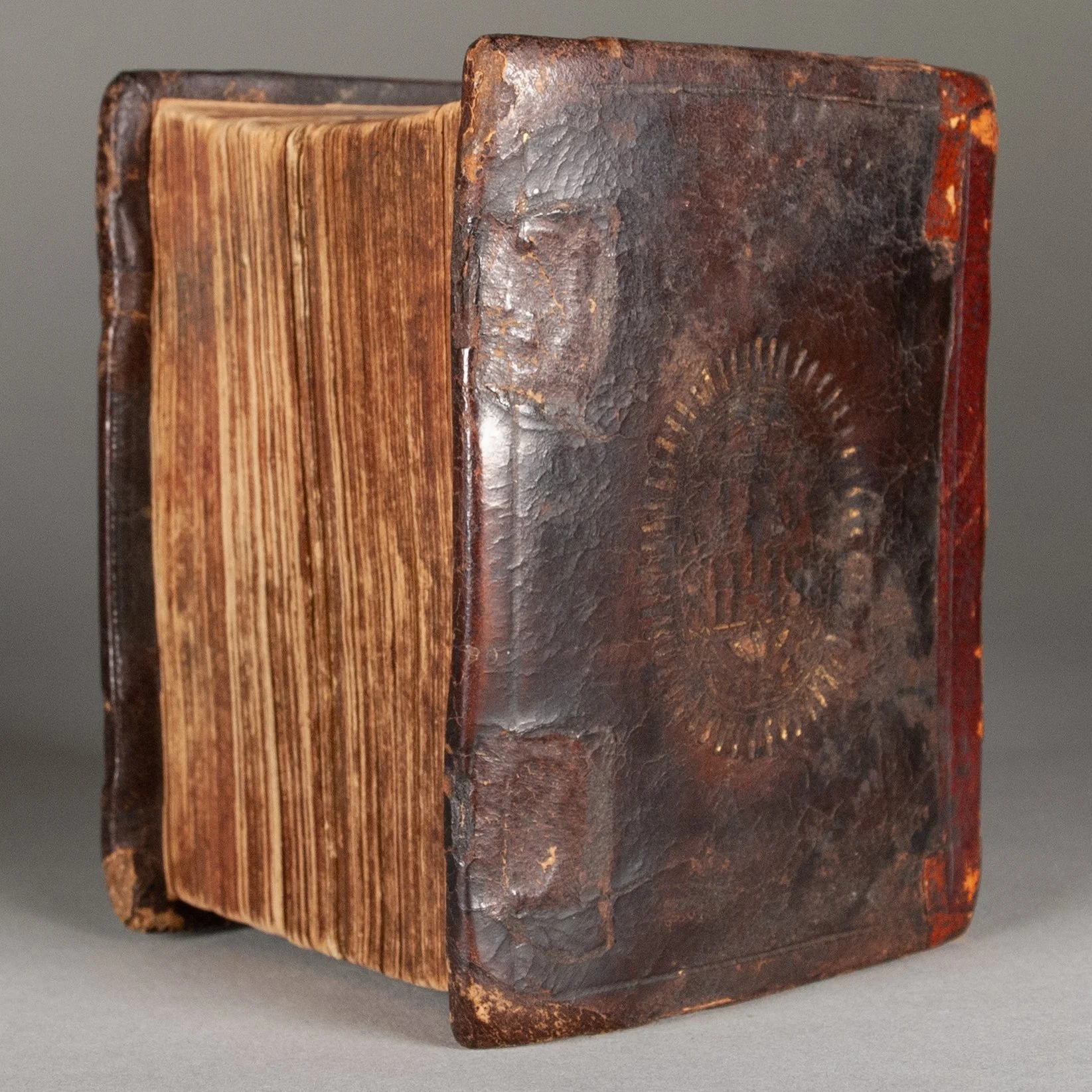
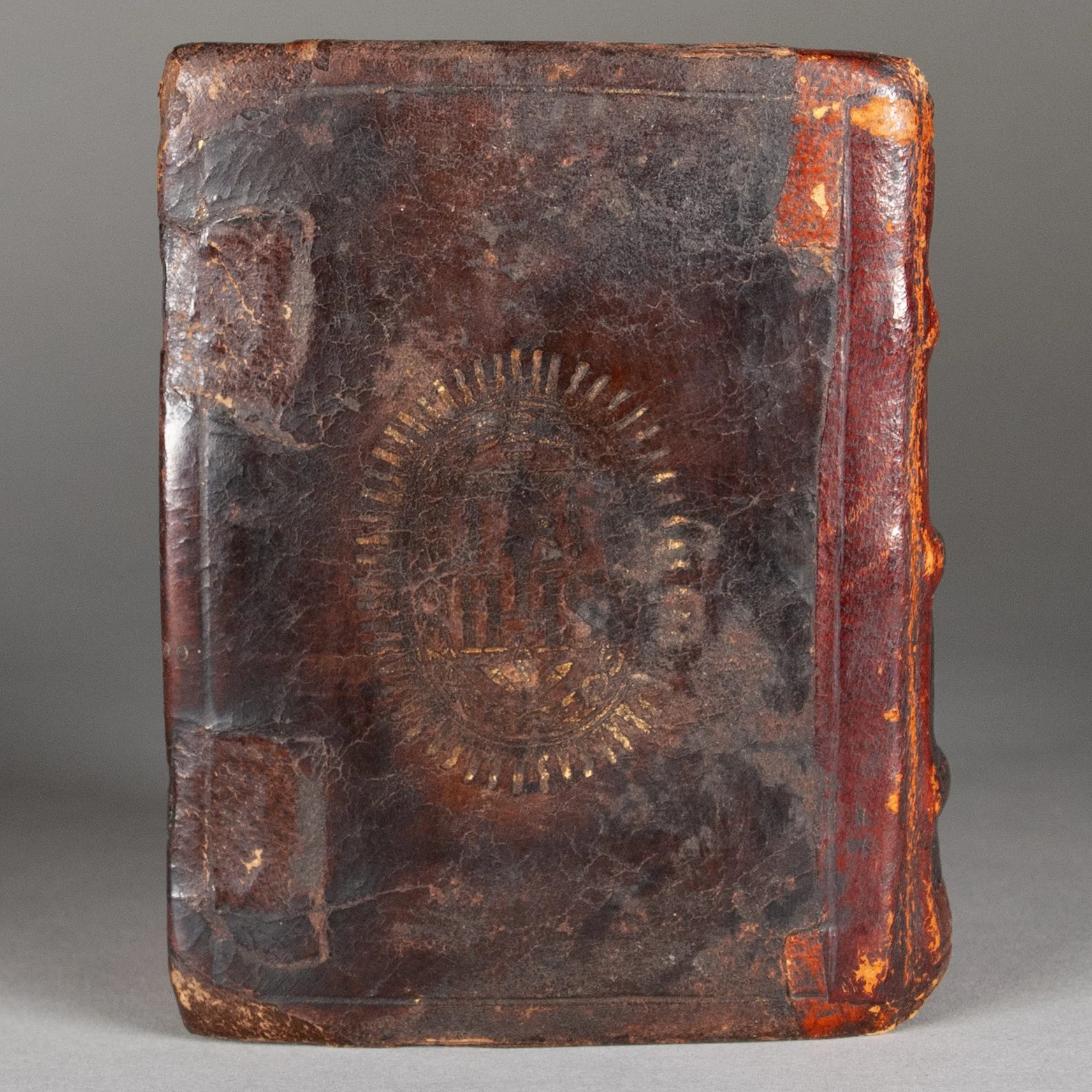
CONDITION: Contemporary brown leather, sewn on three double cords; each spine compartment with a single small gilt tool, and the covers with a faint Christogram device in gold. Mostly written in a legible (if not terribly formal) cursive, with a dozen older leaves in a bâtarde or cursiva formata. Folios 1 and 5 (second sequence) are blank. ¶ First few leaves wormed, affecting content, including the St. Christopher engraving; lower corner torn from the leaf bearing the St. Hubert engraving, with an added closed marginal tear, only affecting the frame of the image; fol. 11 in the printed psalter with a square inch of loss, affecting text; scattered mild soiling, the first and last few leaves the worst. Rebacked, with loss restored at the spine ends and board edges, the endpapers presumably renewed at the same time (but with old paper); fore-edge clasps lost, the scars since filled with leather; leather generally scuffed and worn, the gilt now quite dull, and a spot of white paint in the lower corner of the front board; leather cracked along the center of the spine, strictly cosmetic, the whole book being quite solid.
REFERENCES: William Sherman, Used Books (2008), p. 89 (for the Huntington book), 103-104 (cited above), 109 (on radically altered texts: “Even when we cannot know how representative a single object or practice is, it can shed light on larger topics (structural, social, and symbolic) that only can be glimpsed in their particular manifestations.”); Curt Bühler, The Fifteenth-Century Book (1960), p. 45 (cited above); Whitney Trettien, Cut/Copy/Paste (2021), p. 6 (cited above); Mary C. Erler, "Pasted-In Embellishments in English Manuscripts and Printed Books c. 1480-1533," The Library 6th Ser. 14.3 (Sept 1992), p. 185 (speaking of supplied printed illustrations, "this period sees a constant redefinition of the appearance of the book, and it produces a variety of visual experiments whose synthesis of old and new is often intriguing. Nowhere is this hybrid character more striking than in the surviving instances of books with pasted-in embellishments."), 186 ("investigation by art historians has identified a substantial tradition of printed elements added to printed books and manuscripts, often devotional in character, and particularly strong in Germany and the Low Countries"); Kathryn M. Rudy, Image, Knife, and Gluepot: Early Assemblage in Manuscript and Print (2019), p. 285-286 (“Someone who adds one kind of thing to a book (for example, more prayers) is also likely to add other kinds of things (curtains, more images, objects such as badges, or souvenirs from having taken the Eucharist"); David Pearson, Speaking Volumes (2022), p. 94 (“there are numerous surviving examples of religious texts printed around the turn of the sixteenth century which have been embellished by pasting in cut-out woodcuts. These kinds of homespun enhancements are less commonly encountered there after, as print culture matured, but there are exceptions," Little Gidding production notable among them); Whitney Trettien, "What is a Fragment?" Papers of the Bibliographical Society of America 117.4 (Dec 2023), p. 512 (cited above), 523 ("Recognizing that readers used books to generate fragmentary stuff for pasting, publishers at all periods from the fifteenth through the nineteenth century and beyond produced printed materials design to be repurposed. Adam Smyth describes how some early modern almanac publishers 'explicitly encouraged readers to remove and transfer their pages into other texts,' including 'by physically cutting up the printed page' and pasting it into another notebook. Extant manuscripts suggest that at least some readers followed these instructions."), 524 ("Because images prove more difficult to reproduce than text for most readers, perhaps the most frequent way that printed fragments are used as a technology of reproduction throughout the hand-press period is to illustrate a text"); Yann Sordet, Histoire du livre et de l'édition (2021), p. 285 (on the new standardized service books from the Council of Trent), 445 ("manuscript distribution remained an important method of textual distribution until the end of the 18th century. Various reasons explain this choice for certain work or for certain corpora: economic constraints, a wish to control circulation of the text, imperatives of prudence and discretion."); Laura Light, Primer 8: Breviaries ¶ For the paper: Briquet, Les filigranes, v. 3, p. 468-469 (overview of the gothic P watermark, ours from the printed portion perhaps best resembling #8809 and #8810, though certainly not the same); Edward Heawood, Watermarks Mainly of the 17th and 18th Centuries (1950), #3045-#3054) ¶ For the binding: Bibliotheca Brookeriana (Sotheby's, 18 Oct 2024), #737 (contemporary binding on 1547 Paris imprint, each spine compartment with a single small gold tool); Breslauer, Fine Books and Manuscripts in Fine Bindings...Catalogue 110, #28 (contemporary binding on 1538 Paris imprint, each spine compartment with a single small gold tool); Quatre siecles de reliure en Belgique 1500-1900, v. 2 #14 (contemporary binding on 1616 Douai imprint, each spine compartment with a single small gold tool, and the cover with a central gilt device), v. 3 #18 (contemporary binding on 1605 Antwerp imprint, each spine compartment with a single gold tool), v. 3 #22 (contemporary binding on 1613 Antwerp imprint, each spine compartment with a single small gold tool, and the cover also with a central Jesuit device in gold)
Item #926