
Eclectic manuscript compilation in longstitch binding
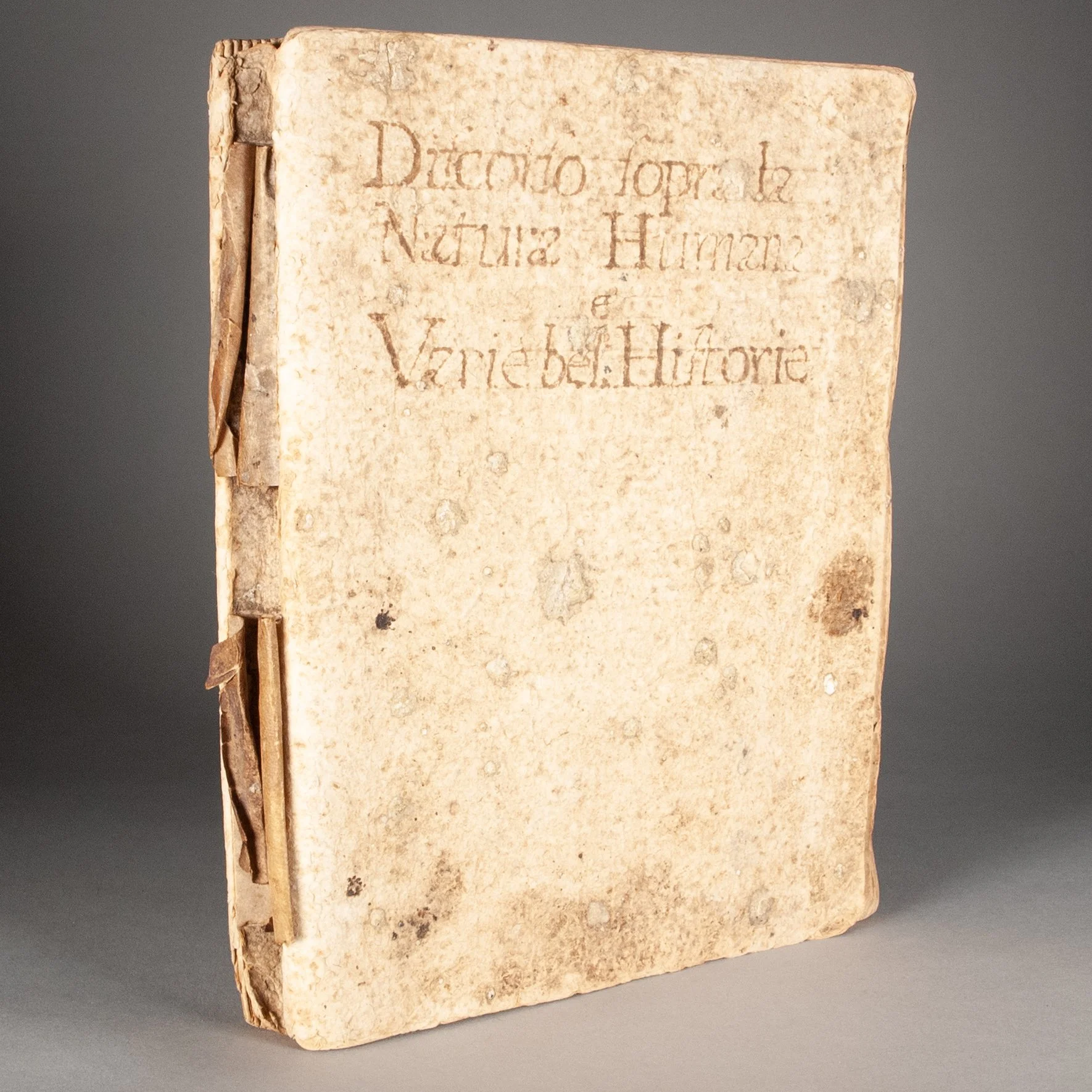
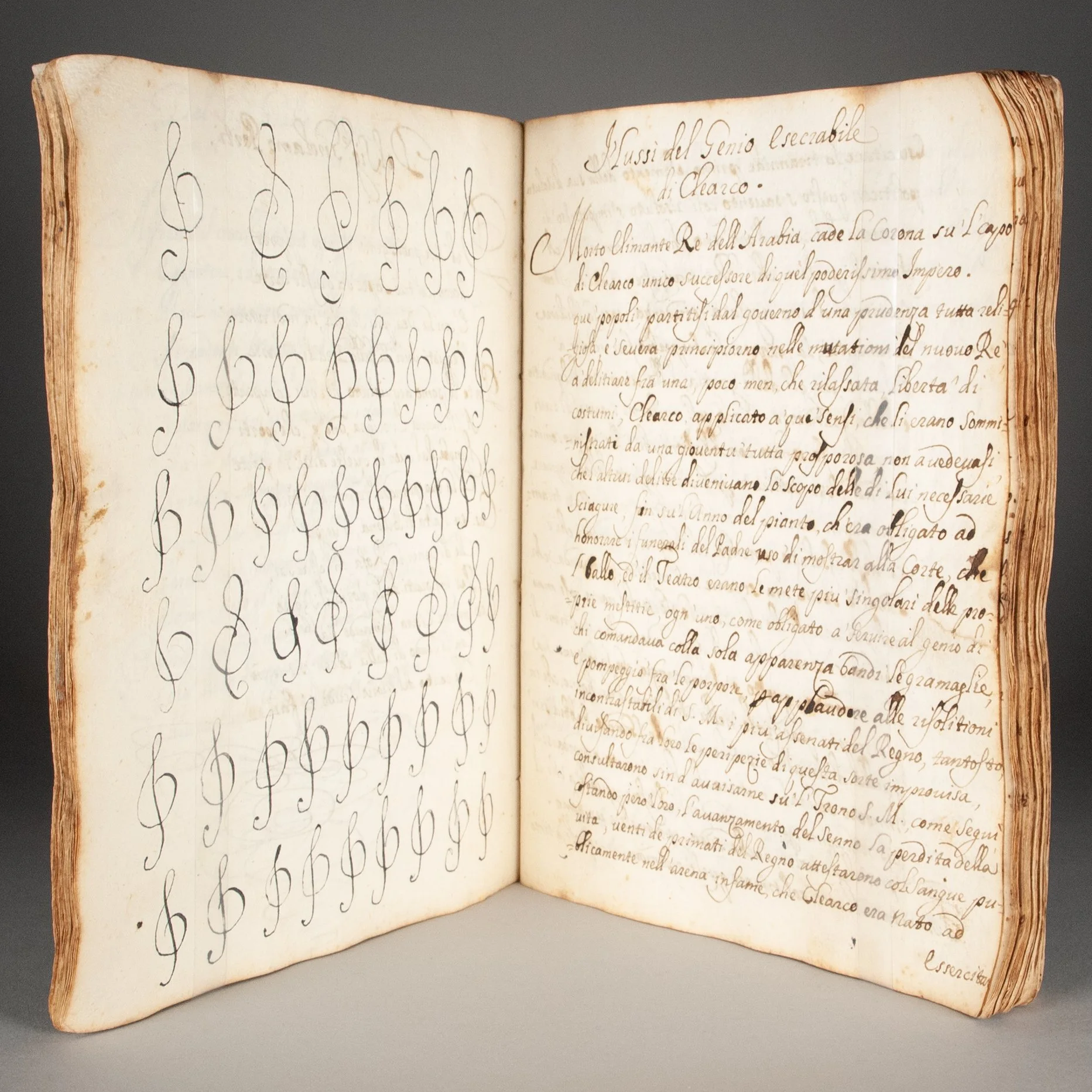
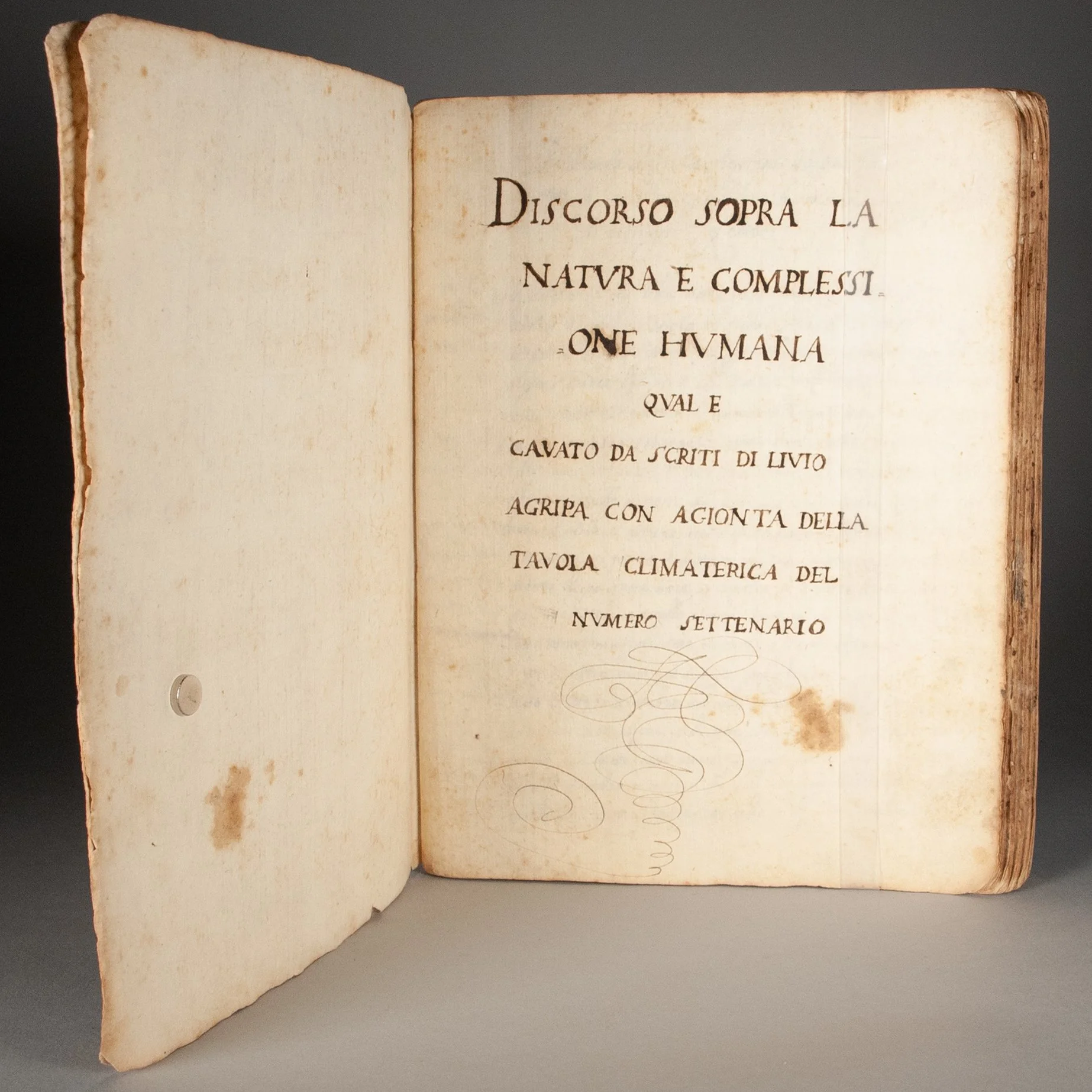
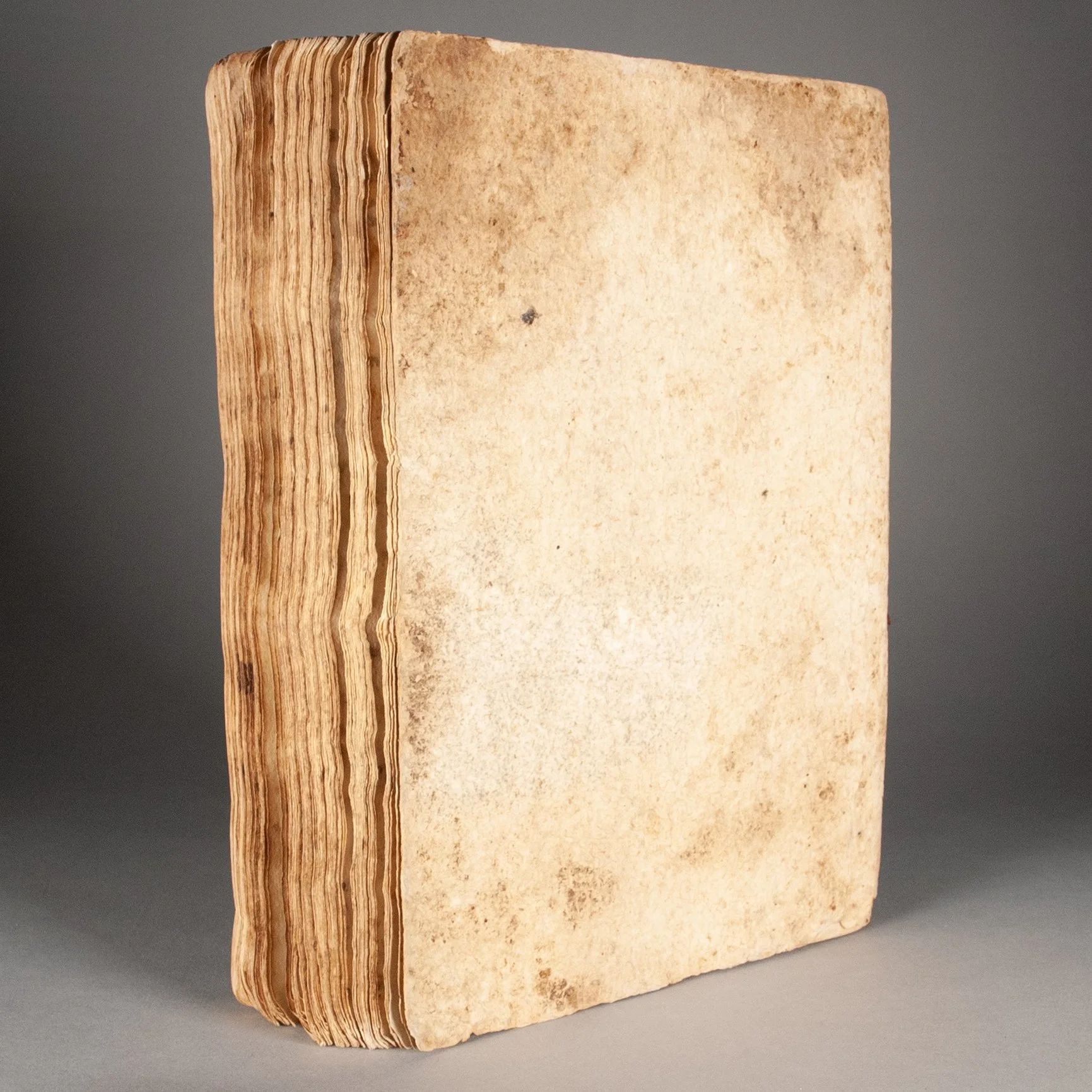
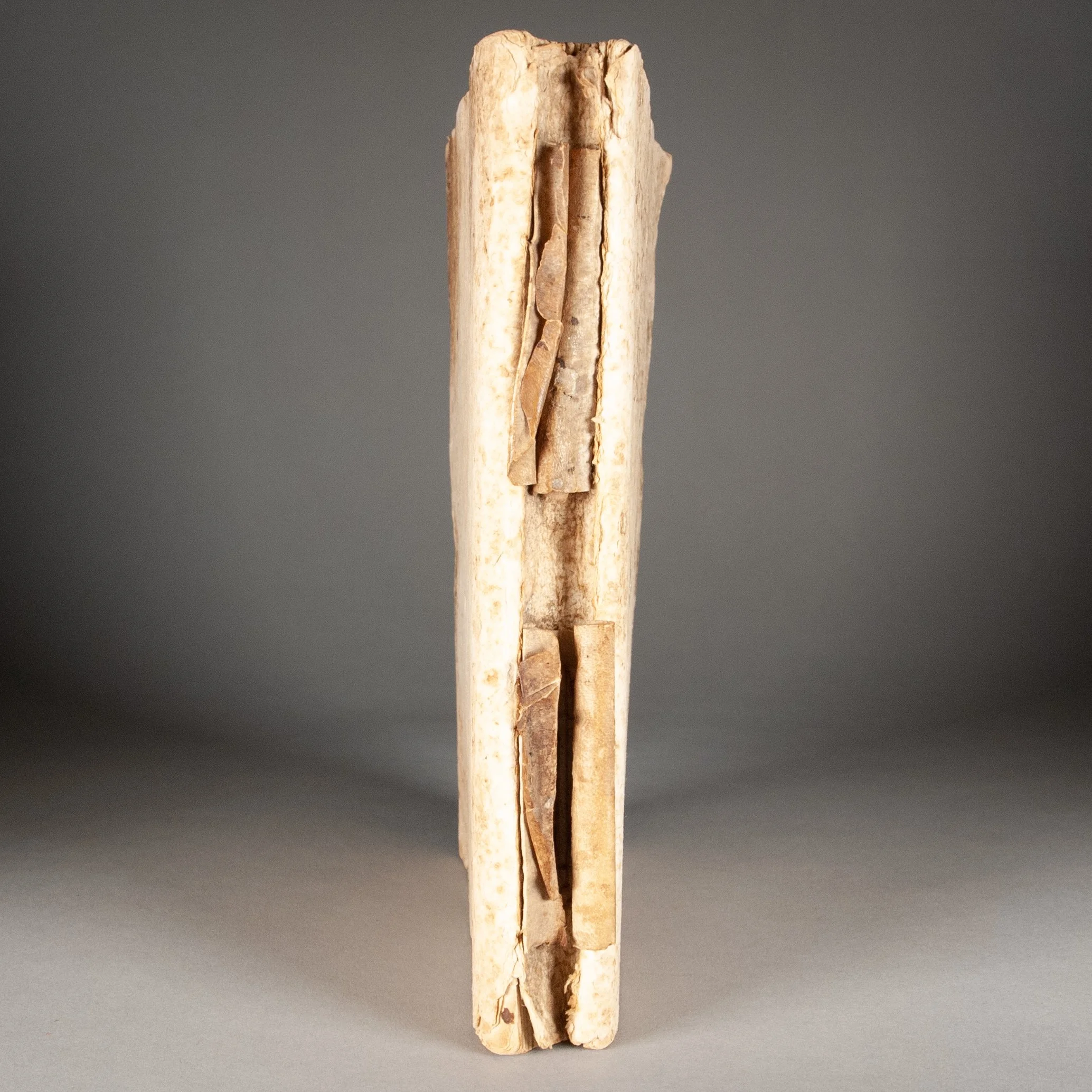
Eclectic manuscript compilation in longstitch binding
Discorso sopra la natura e complessione humana, qual e cavato da scriti di Livio Agripa con agionta della tavola climaterica del numero settenario [and five additional texts]
by Livio Agrippa, Sinibal de Spadacine, Giovannia Battista Moroni, and Giovanni Battista Magnavini
[Italy, not before 1683]
An eclectic manuscript compilation, ranging from astrology and physiognomy to ancient history and current events, containing Livio Agrippa's Discorso sopra la natura & complessione humana (its two tables included), first published in 1585 and reissued regularly over the next century (fol. 3r-9r); Agrippa's Dichiaratione della finosomia [sic] humana, which typically followed the Discorso in published editions (fol. 10r-14v); Sinibal de Spadacine's Fioretti d'astrologia, here under the name Antonio Francesco Cona, which presents horoscopes according to both months and zodiac signs, and which we find only appended to a 1620 edition of Agrippa's Discorso (fol. 15r-22v); a collection of brief writings we've been unable to trace, containing thoughts on the sword, gold, the fisherman, the phoenix, and more, one of these addressed to an Emanuelle Pisani (fol. 23r-31r); Giovannia Battista Moroni's I lussi del genio esecrabile di Clearco, a meditation on the excesses of Clearchus (but of Sparta or of Heraclea we're not sure, as both were considered tyrants), which only appears to survive in an edition of 1640 (fol.31v-103v); and Giovanni Battista Magnavini's Ragguaglio istorico della guerra tra l'armi Cesaree e Ottomane, an account of the Ottoman Empire's 1683 rebellion against the Habsburg-controlled Holy Roman Empire, first (and frequently) printed in 1683 (fol. 104r-183r). ¶ We're rather fond of these bespoke handwritten compendia of published material, at times seemingly random but always reflecting a particular reader's interests, and at times telling witnesses to one reader's desire for a book the publishing industry simply couldn't provide. "Miscellaneous manuscripts were seldom 'miscellaneous' for the audiences or individuals that produced, read, and used them," Barbara Shailor writes of medieval miscellanies, though we expect the fundamental reasons behind their idiosyncratic compilation endures still. "To label them as such today (without a more specific nomenclature or taxonomy) hinders our efforts to understand the manuscripts and their cultural context." And rather ironically, compilations like this are sometimes textual witnesses for works that have become scarce even in print. For example, three of these texts make no appearances in our auction records (the 1620 Discorso containing Spadacine's Fioretti, Magnavini's Ragguaglio, and Moroni's Clearco). The Ragguaglio is completely absent from WorldCat, which reports only a single copy of the 1620 Discorso (Mazarin Library, Paris) and just three copies of the Clearco (all in Europe). ¶ All preserved here in the original longstitch binding, a fine example of a classic medieval stationery structure. "The longstitch structure was used in Middle Ages for blank-book or stationery bindings, and the structure was transferred to printed books in Italy as early as the 1480s, as it provided an inexpensive and convenient way to protect and hold together books as they moved through the booktrade to their first owners" (Pickwoad). Rather than sewing the gatherings around traditional sewing supports, which are then secured to the covers, the gatherings are sewn directly through the covering material—in our case, plain limp board, with parchment strips added for strength. On account of the structure's simplicity and affordability, it endured well into the age of print, when "it became increasingly associated with inexpensive books such as guide books, popular devotional literature, romances, play-texts and opera libretti."
PROVENANCE: The manuscript appeared at Reiss & Sohn in 2019 (auction 195, lot 11), Finarte in 2021, Bertolami in 2024, then offered twice by Kiefer in 2024, from whom we acquired it (with an export license).
CONDITION: In a contemporary longstitch binding, as described above, a title inked on the front cover. Written in brown ink on laid paper; the watermark is partially obscured in the gutter, but incorporates the name Rocha(?). First leaf and last leaf are blank. ¶ Scattered light foxing, and a bit of dustiness and staining at the fore-edge. The cover heavily soiled (perhaps with some wax drippings), and moderately worn at the extremities; the spine has taken on a concave shape, its parchment reinforcements very curled at the edges. Altogether a well preserved example of a fundamental workaday binding style.
REFERENCES: Yann Sordet, Histoire du livre et de l'édition (2021), p. 445 ("Manuscript diffusion remained an important method of book diffusion until the end of the 18th century. Various reasons explain this choice for certain works or for certain genres: economic constraints, desire to control the circulation of texts, imperatives of prudence and discretion"); Barbara M. Shailor, "A Cataloger's View," The Whole Book: Cultural Perspecctives on the Medieval Miscellany (1996), p. 167 (cited above) ¶ On the binding: Language of Bindings (ligatus.org.uk), http://w3id.org/lob/concept/1425 (cited above; "Although very common in Italy, they are also found in the Low Countries and in Germany, in which latter country they seem to have been popular as bindings for student texts. In the Low Countries the structure survived into the twentieth century on almanacs, a testament to the practical virtues of the structure."); Nicholas Pickwoad, “The Interpretation of Bookbinding Structure,” Eloquent Witnesses: Bookbindings and Their History (Bibliographical Society, 2004), p. 163n3 (the longstitch binding “was a rapid and economical way to hold books together, and was often used for temporary, retail bindings and cheaper blank books from the late fifteenth-century onwards”)
Item #852