
Cornerstone of European iconography
Cornerstone of European iconography
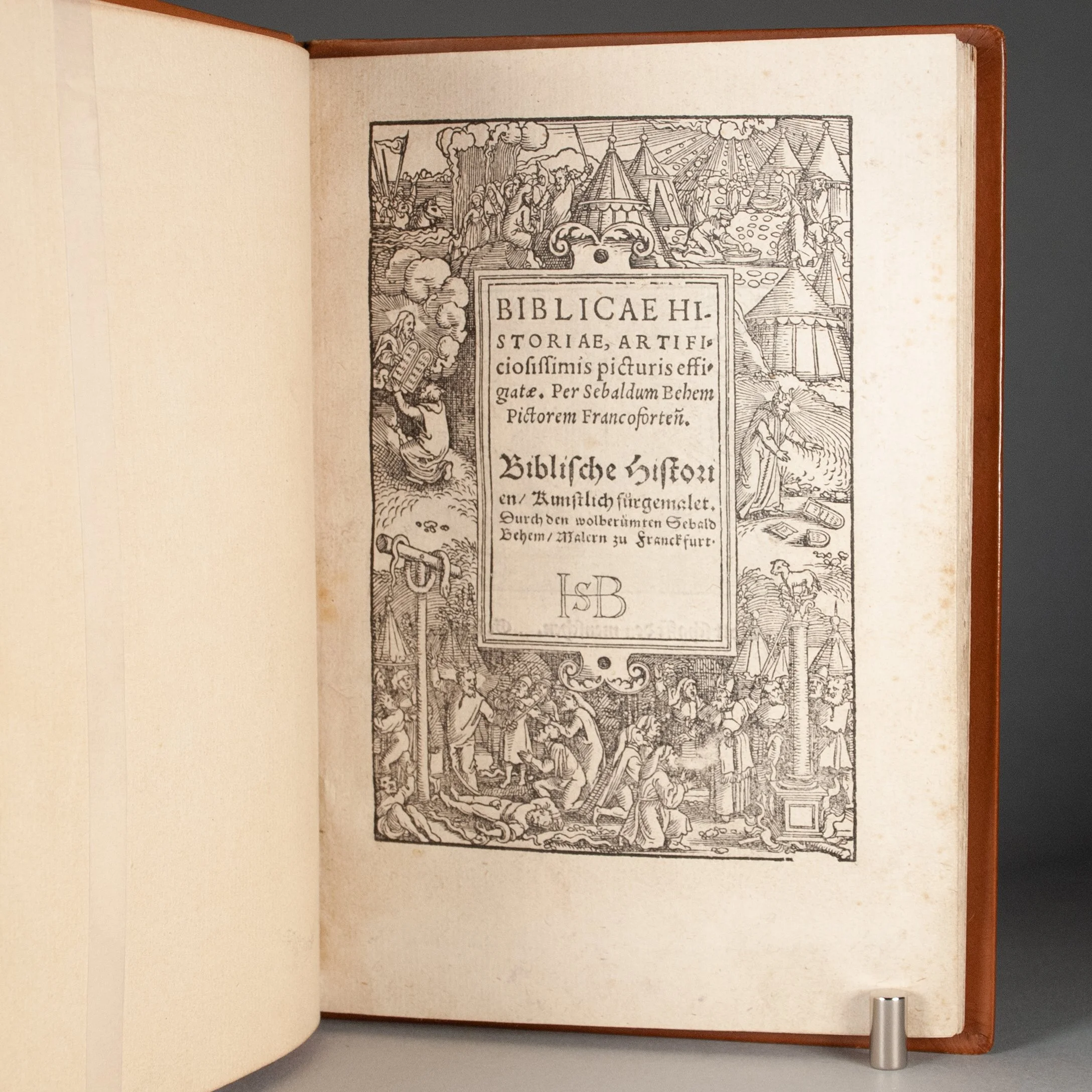
Biblicae historiae, artificiosissimis picturis effigiatae...Biblische Historien, kunstlich fürgemalet
by Hans Sebald Beham
[Frankfurt: Christian Egenolff, ca. 1537-1540]
[80] p. | 4to | A-K^4 | 170 x 119 mm
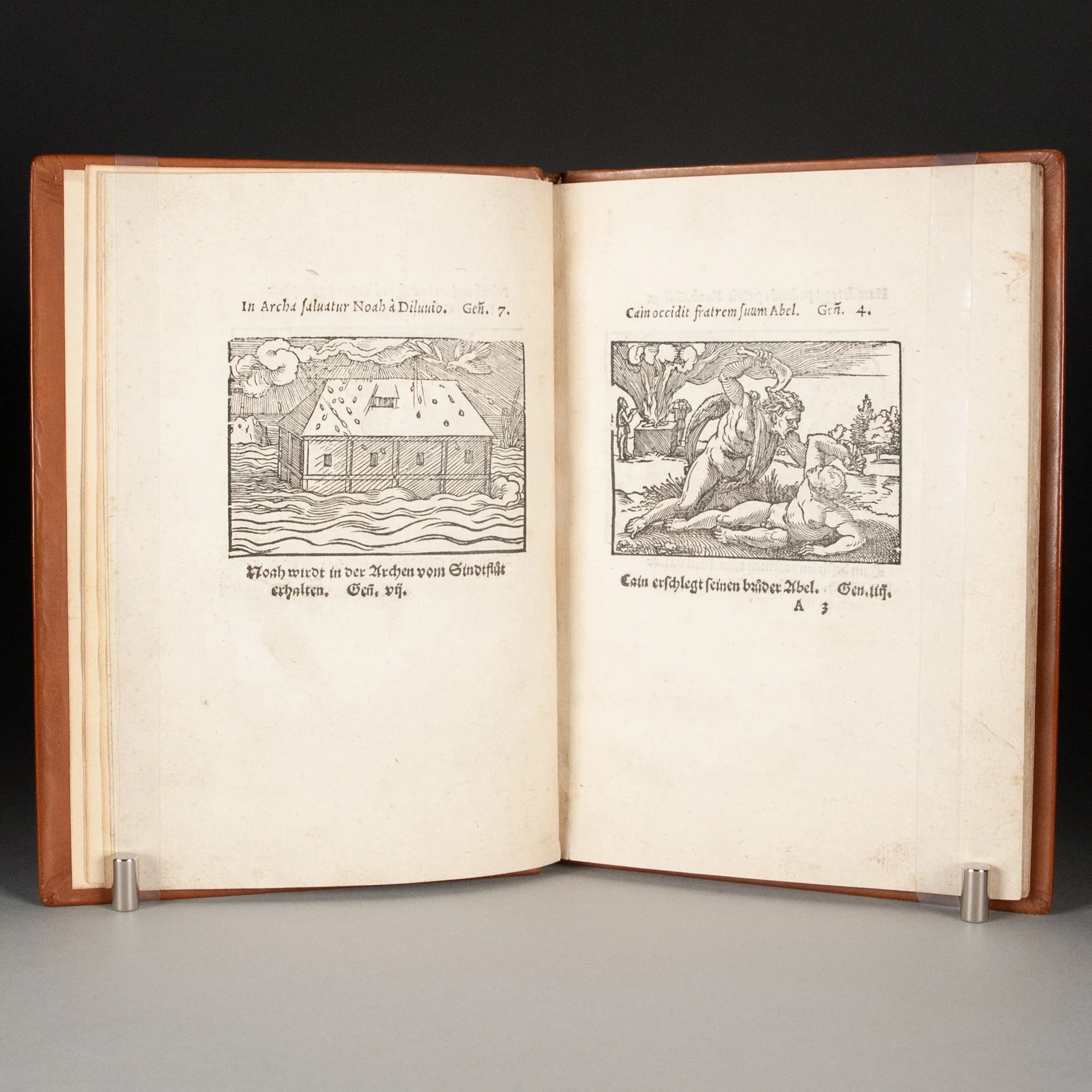
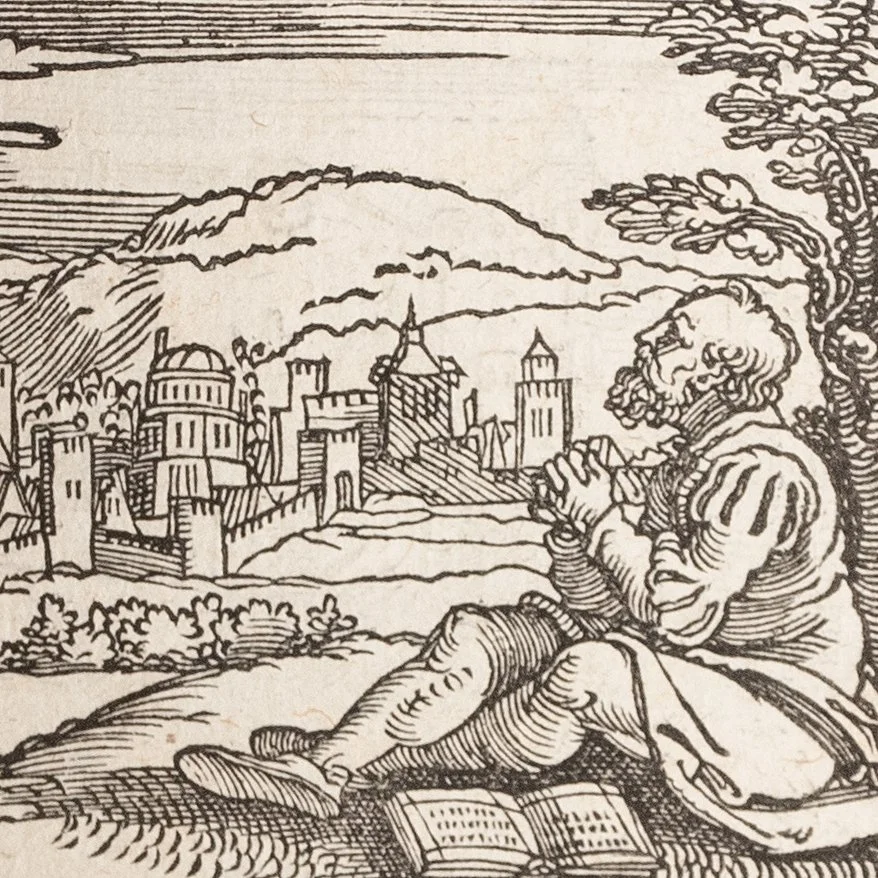
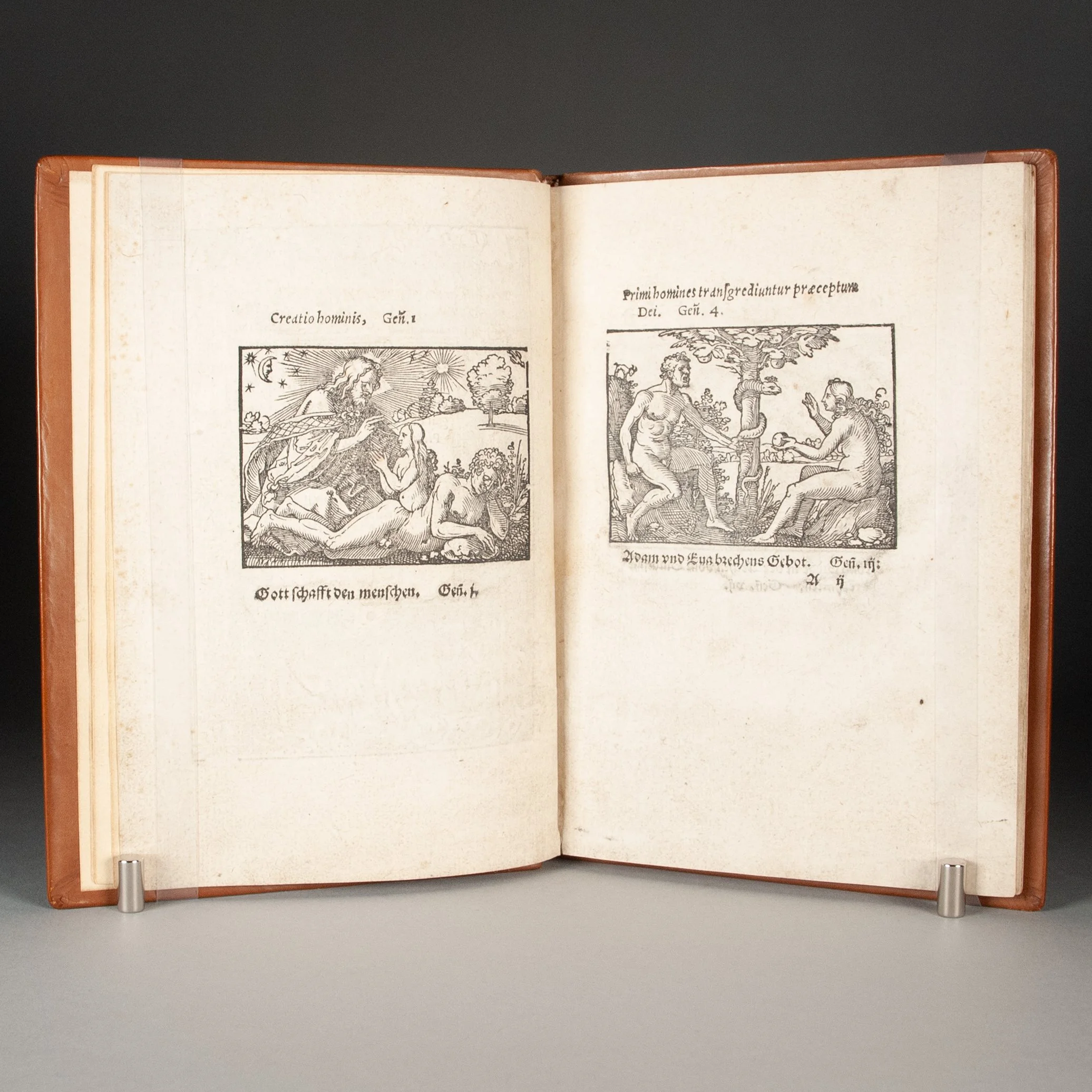
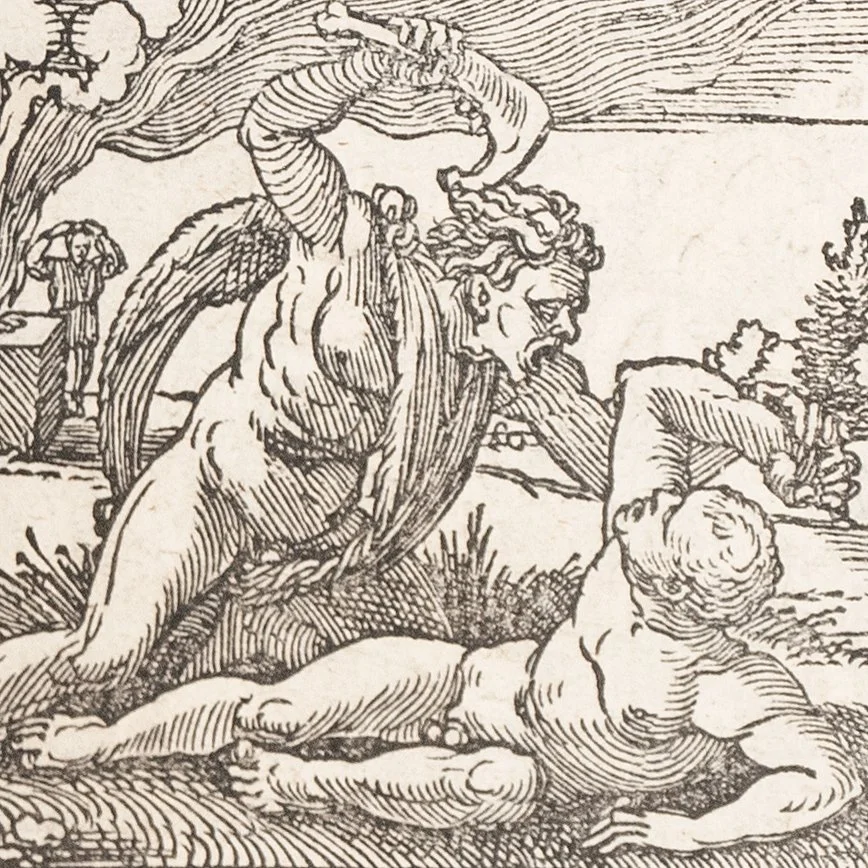
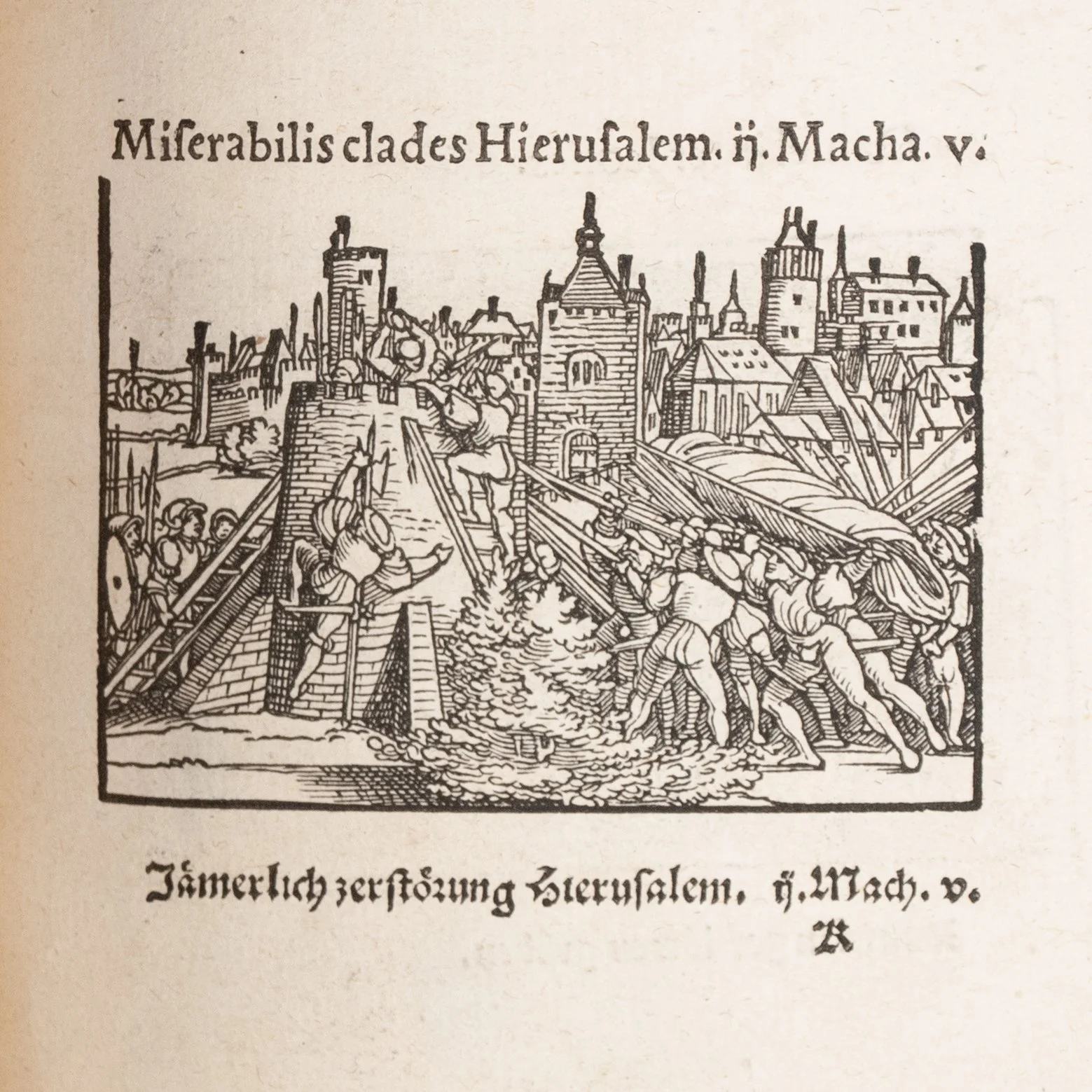
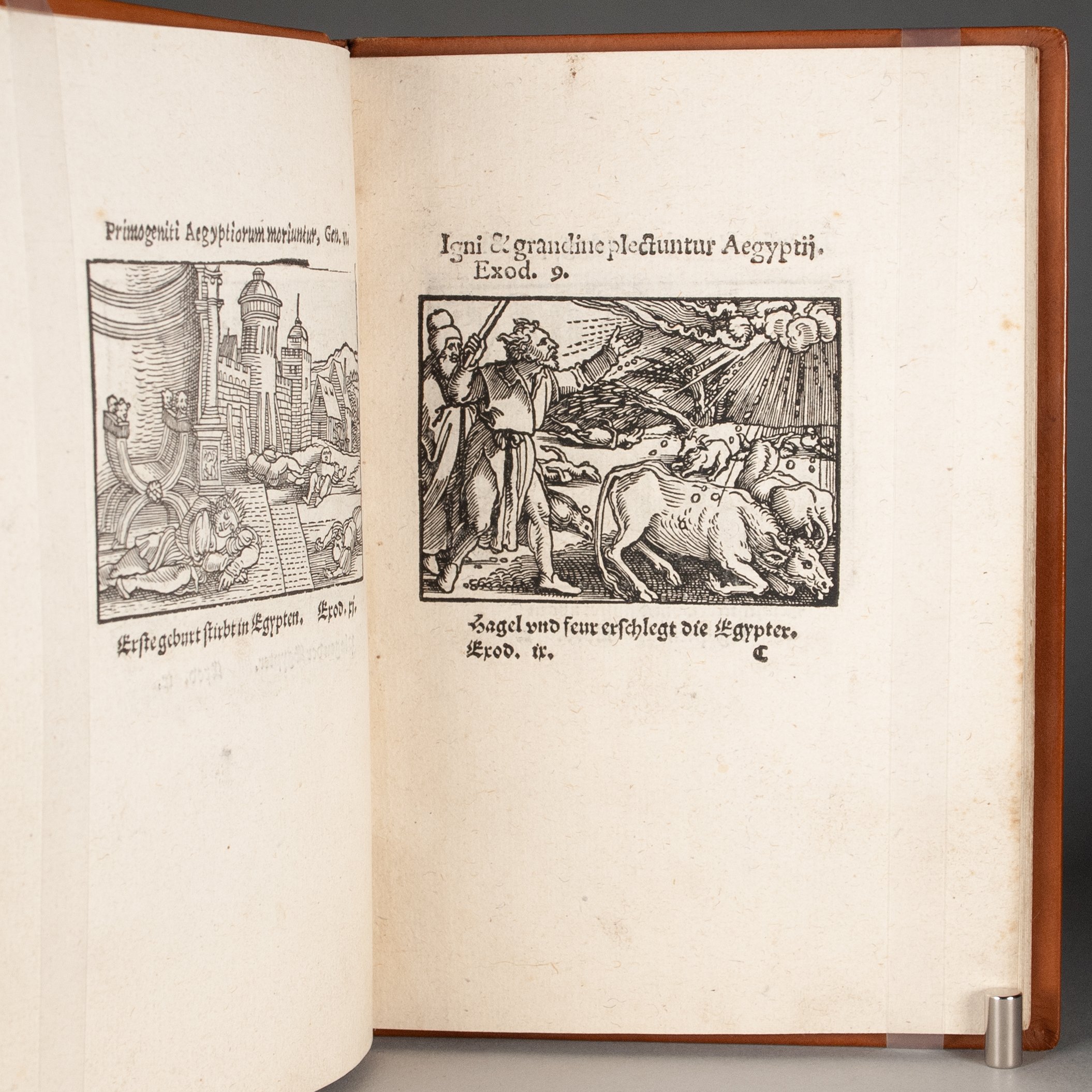
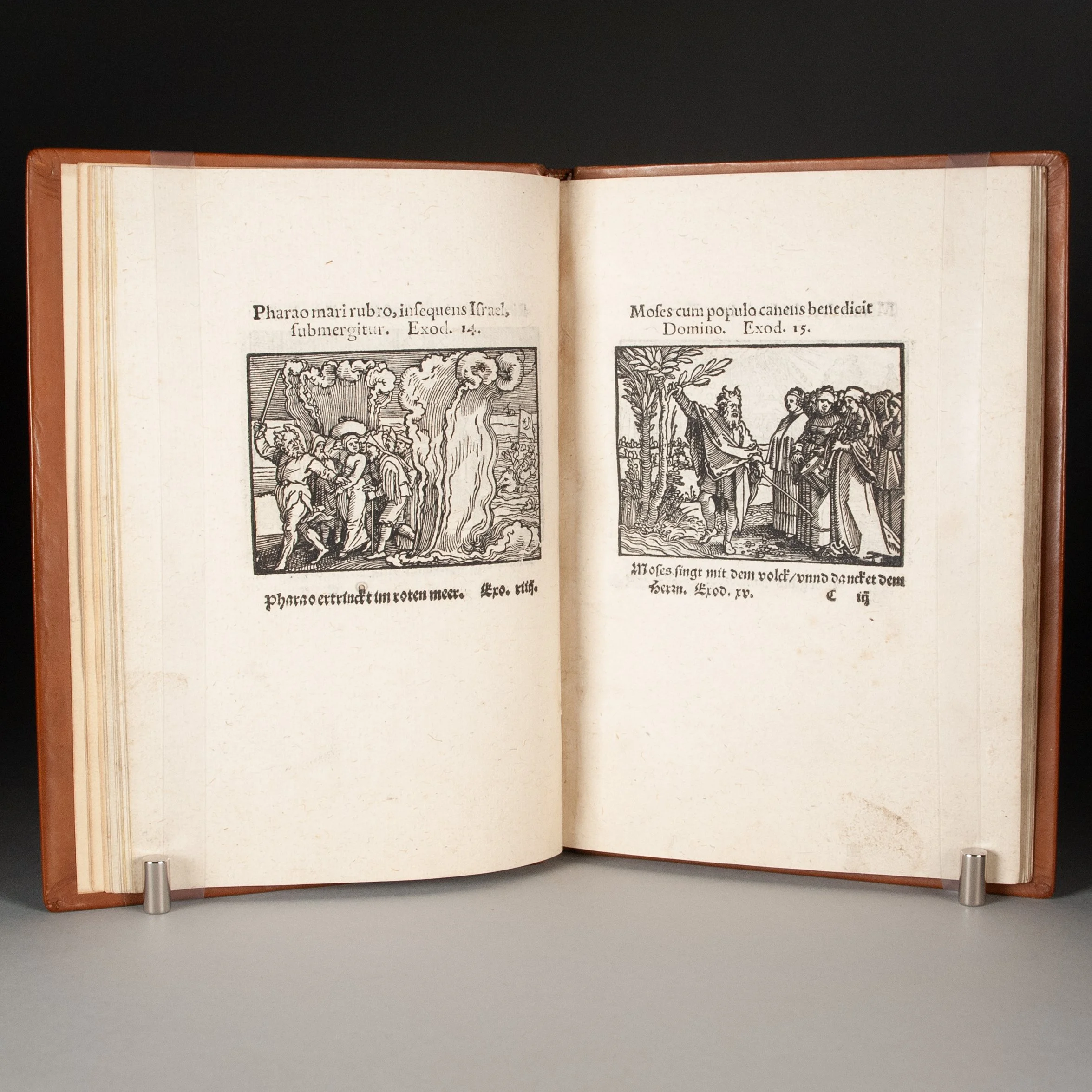
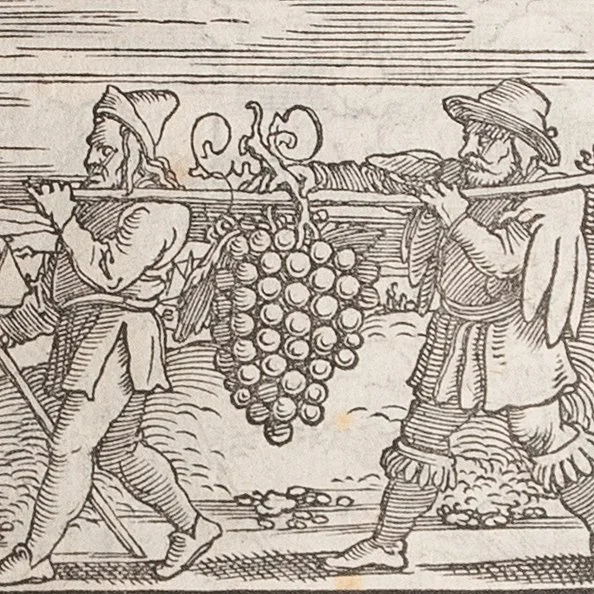
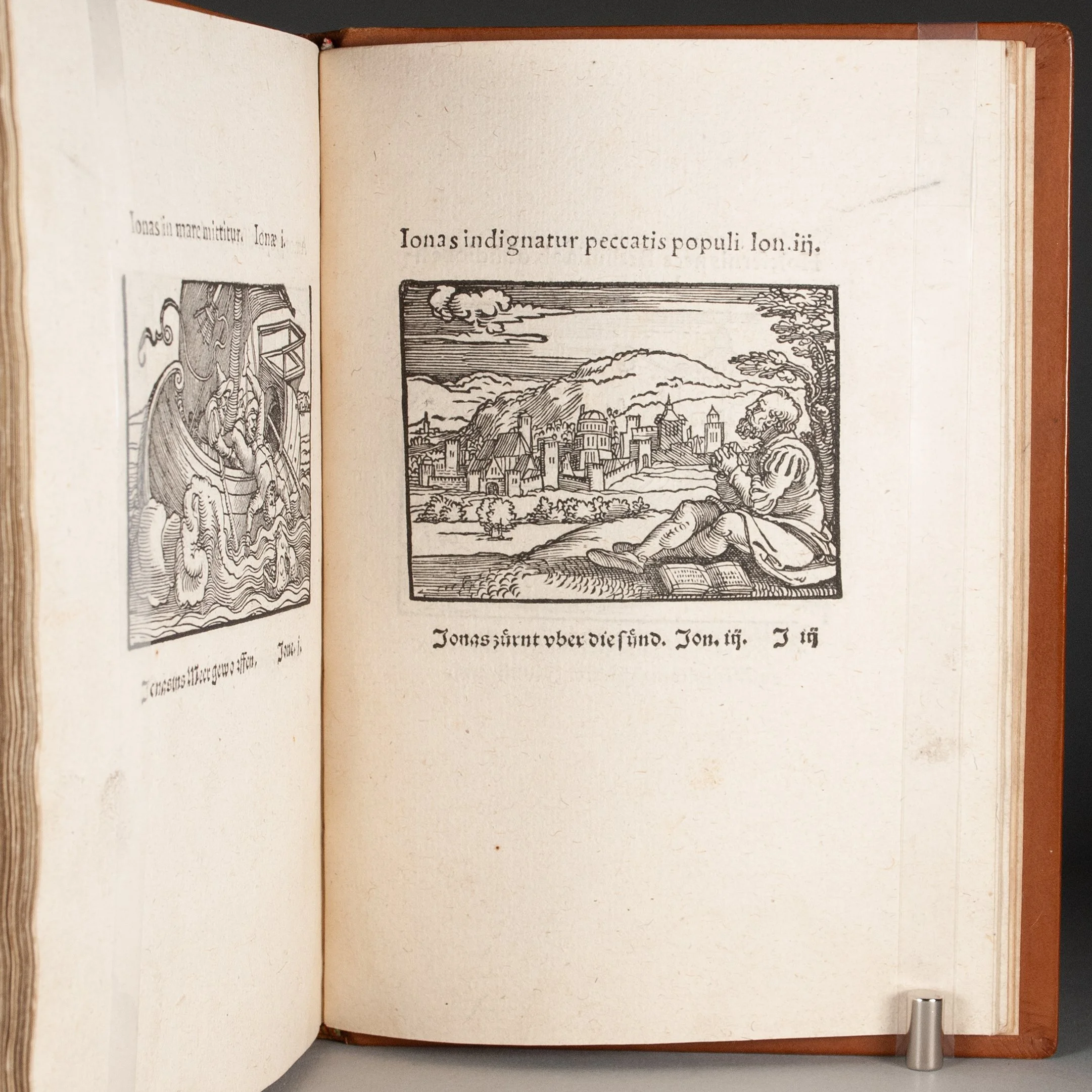
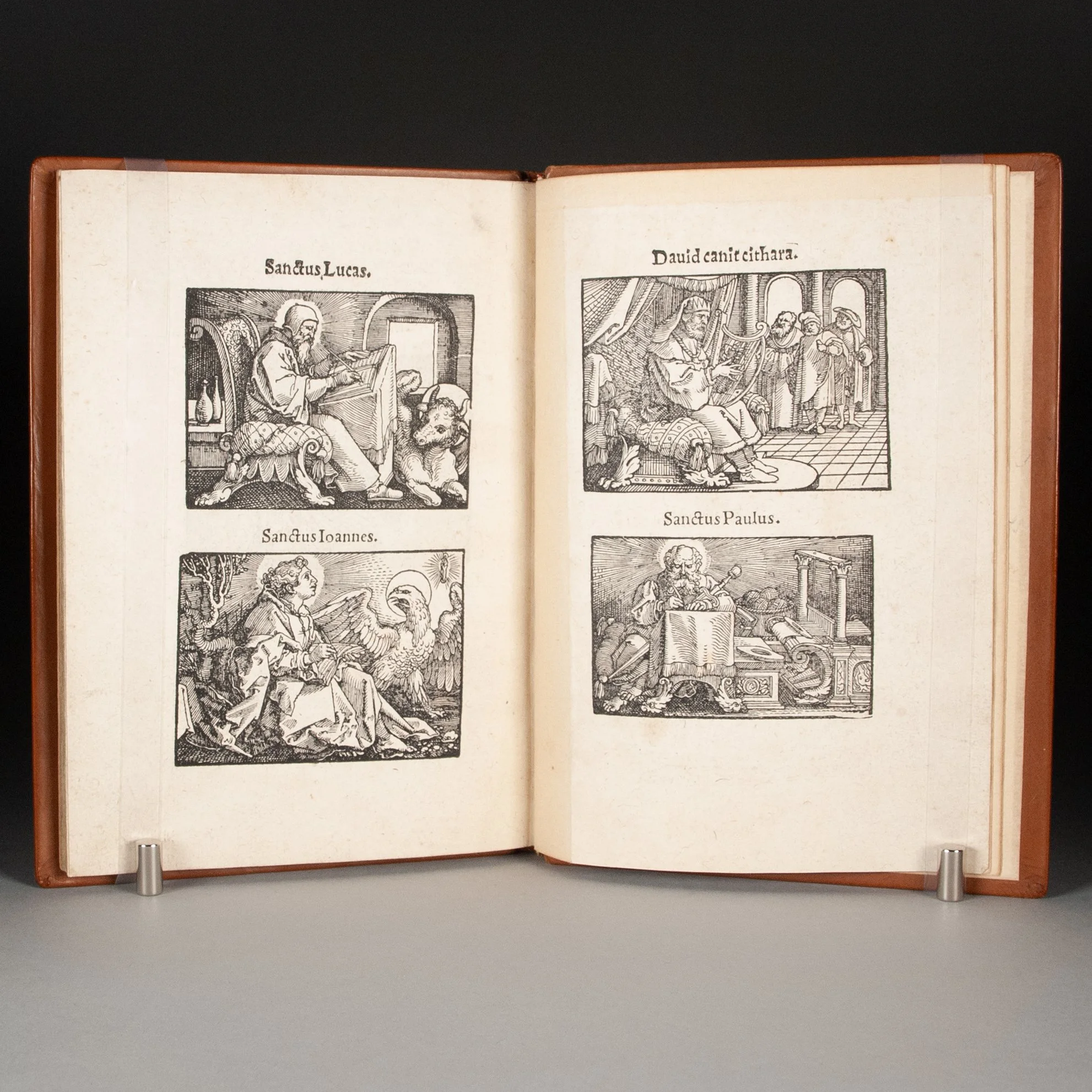
An early edition of Beham's massively influential picture Bible, containing 80 woodcuts here in strong impressions, each image with a brief biblical caption in Latin above and in German below. These small, nearly text-less pictorial Bibles are direct descendants of the late medieval Biblia Pauperum blockbook tradition, and Beham's images specifically had a tremendous impact on European visual culture. Certainly on subsequent Bible illustration—for example, they were copied for Coverdale's first complete English translation of the Bible, and so indirectly influenced a full century of English Bible illustration—but also on European craft more broadly, where Beham's designs were adapted to other media. ¶ There was a tremendous fashion for these little picture Bibles in the 16th and 17th centuries, "possibly a refashioning of the medieval biblia pauperum tradition...intended for a wealthy, adult audience who could understand the illustrations). Beginning with Hans Sebald Beham's Biblicae historiae (Frankfurt, 1533) and Hans Holbein's Icones (Lyons, 1538), the picture Bibles provided readers a panoramic sequence of images covering large swathes of the biblical narrative with realistic, rather than sacramental or devotional, representations. The book markets enjoyed a steady stream of these Bibles...Not only were these images taken seriously, but also they presented a different way of interacting with the Word of God. Where illustrations were normally subordinate to the biblical text, these picture Bibles elevated the image to be an equal, or even superior, medium of the biblical account" (Davis). Beham likely started work on these illustrations in 1529, placing him securely on the vanguard—even if Holbein's Old Testament images, copies of which appeared in Froschauer's 1531 Bible, may have influenced him (along with other woodcuts from that Zurich edition). But of course Beham could hold his own as an artist. Others, Virgil Solis among them, modeled their own designs on his, to say nothing of their role in setting the iconographic standard in England. Further testament to their broad influence, Beham's designs found their way into the work of many other crafts, tapestries and silverwork among them. His depiction of the Tower of Babel's construction was even copied to tin-glazed earthenware in Italy. ¶ A young Beham seems to have set his sights on a career as a painter—there's evidence he had his own workshop in 1525—but he's invariably remembered today as a woodcutter, his prodigious output amounting to some 1500 woodcuts. Sheer quantity aside, he was an accomplished artist, even "'more Renaissance' than Dürer, who never achieved a pure Renaissance outlook" (Leuthold). Dürer, that patriarch of the German woodcut, is commonly cited as Beham's teacher, and certainly exerted an influence on the young Beham. So did Albrecht Altdorfer, like Beham a leading member of the Little Masters group of German printmakers. For all his talent, Beham was beset with trouble in his native Nuremberg. His was a "dissolute life," to quote Alison Stewart, and he was forced to leave Nuremberg—twice—before settling in Frankfurt, where he found a strong supporter in Egenolff. ¶ Our edition is generally accepted as the penultimate of some eight recorded editions, and the only without a printer or date. Egenolff published the first edition in 1533 (Biblisch Historien) and the work reappeared regularly through 1539. The woodcuts themselves have a far more extensive publication history, used elsewhere in the 1530s, then even into the 17th century. While VD16 and USTC call our edition ca. 1533, it is more conventionally dated ca. 1537-1538 (see Pauli). Some of our woodcut borders admittedly appear more damaged than some in the 1539 edition, perhaps suggesting slightly later issue. At the same time, we occasionally find fuller borders in earlier editions that look less like integral parts of blocks and more like separately added rules. Consider, for example, the storming of Jerusalem from 2 Maccabees (our K1r) in the 1537 version, and note how the upper border sits just above the top of the lefthand border, and how it extends just beyond the woodcut's righthand border. ¶ A landmark of Bible iconography, and one with influence felt far beyond the book.
PROVENANCE: Bookplate of Arthur & Charlotte Vershbow on the front fly-leaf. Description of this copy clipped from a 1924 Gilhofer & Ranschburg catalog and tipped to the front paste-down.
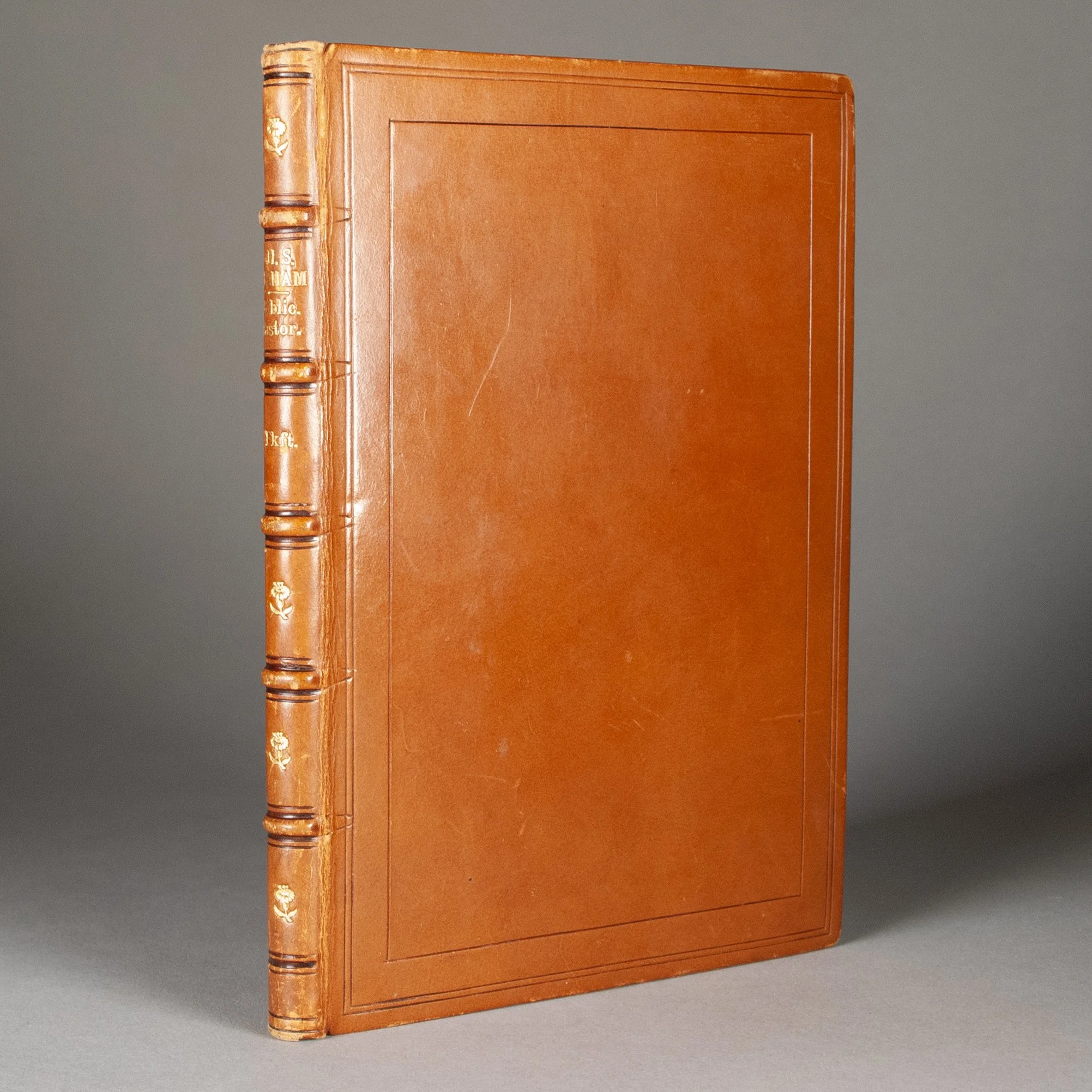
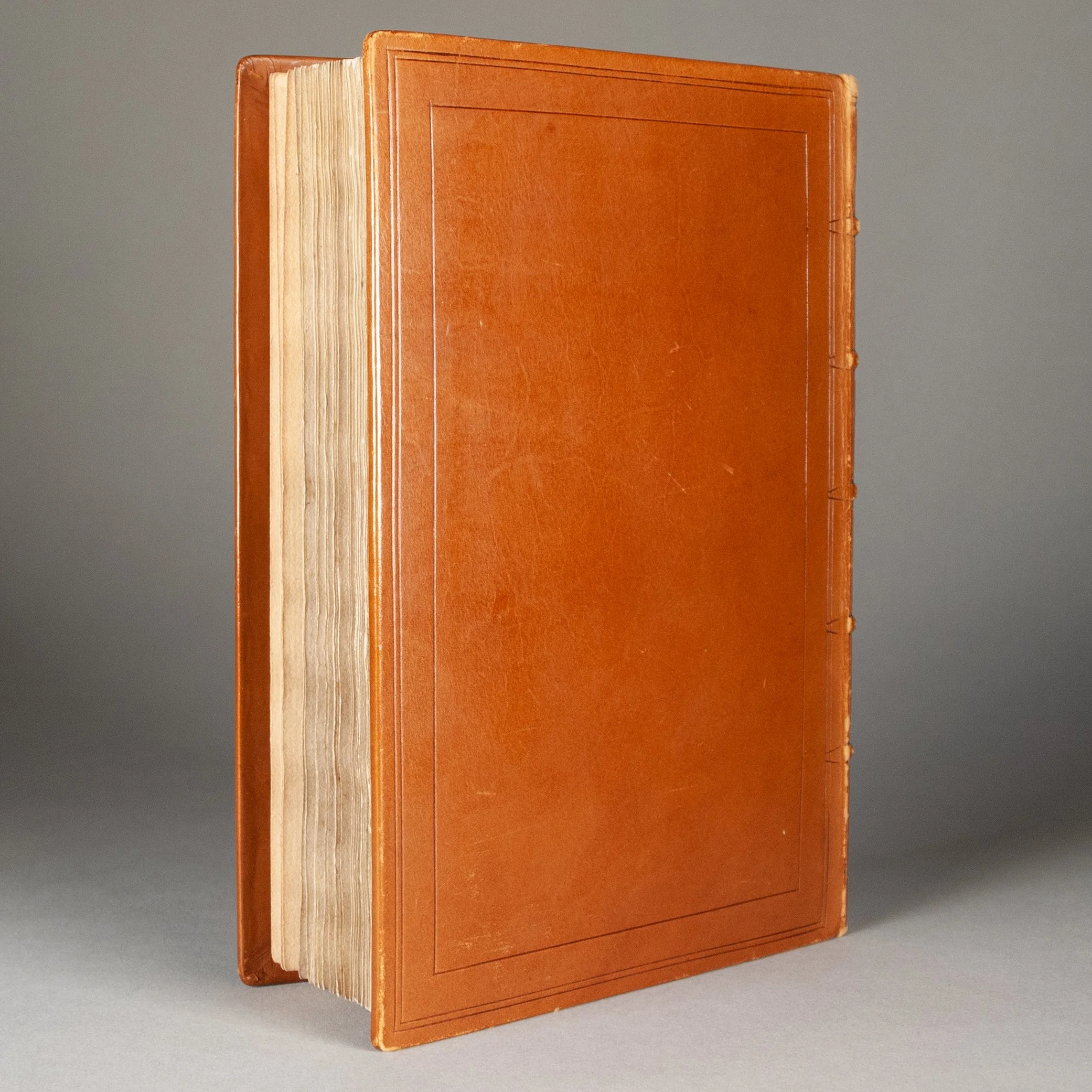
CONDITION: Polished brown calf, probably early 20th century, the spine simply tooled in gold and the covers with blind frames. Gathering H misbound, but all accounted for. ¶ Final leaf remargined at the top and inner margins; scattered light soiling, and the title a bit dusty and foxed. Binding extremities just very gently worn. Really a nice copy.
REFERENCES: VD16 B 1470; USTC 616718; Gustav Pauli, Hans Sebald Beham: Ein kritisches verzeichniss (1901), p. 510 ("This variant of the 1537 edition appears to have originated in the same year or 1538"); Ludwig Rosenthal, "Hans Sebald Beham's alttestamentarische Holzschnitte und deren Verwendung zur Bücher-Illustration," Repertorium für Kunstwissenschaft 5 (1882), p. 389, #27 ("probably Frankfurt, by Christian Egenolff, 1538"); Catalogue of a Collection of Early German Books in the Library of C. Fairfax Murray, #65 ("c. 1540") ¶ Pauli, p. 271 (overview of the woodcuts' publication history); Erika Michael, "The Iconographic History of Hans Holbein the Younger's Icones and Their Reception in the Later Sixteenth Century," Harvard Library Bulletin 3.3 (Fall 1992), p. 38 (on Holbein's influence; "Despite their more uninspired quality, the Froschauer copies had a significant impact on later Bible illustrations, particularly on a series of Old Testament woodcuts by Hans Sebald Beham, published in Frankfurt in 1533. A number of these illustrations are directly dependent on the Zürich woodcuts; they are not line-for-line copies but somewhat transformed renditions. Their relationship to the Icones is thus indirect. In fact, many of them follow other illustrations in the Zürich Bible which are not copied from or related to the Icones at all. These Beham illustrations were used as models by later woodcut designers, including Virgil Solis."); Rosenthal, p. 380 (claiming 1529 the year Beham started work on these); Alison Stewart, "Beham, Sebald," Grover Art Online (2003), accessed online; David J. Davis, "The Visual Culture of Reformation Bibles," The Oxford Handbook of the Bible & the Reformation (2024), p. 159 (cited above; "The popularity of the picture Bible is evidenced by the tapestries, silver engravings, embroidery, and interior home designs that copied them"); Timothy Wilson, Maiolica: Italian Renaissance Ceramics in the Metropolitan Museum of Art (2016), p. 210-211 (Beham's Babel in Italian maiolica); Ruth Bottigheimer, The Bible for Children (1996), p. 39 ("Picture Bibles like those by Sebald Beham, Tobias Stimmer, Hans Holbein the Younger, Vergil Solis, and Matthäus Merian carried late medieval blockbook iconography into the early modern period"); Steven Leuthold, "The Book and the Peasant: Visual Representation and Social Change in German Woodcuts, 1521-1525," Printing History 34/17.2 (1995), p. 12 (cited above, and citing Erwin Panofsky); G.E. Bentley, Jr., "Images of the Word: Separately Published English Bible Illustrations 1539-1830," Studies in Bibliography 47 (1994), p. 106 (on the Coverdale Bible illustrations, copied from Beham's: "there were very few additions to the iconographical canon in England until over a century later")
Item #954