Il Gordiano; drama per musica; da rappresentarsi nel nuovo Teatro di S. Cecilia della Felice, e fidelissima città di Palermo
by Adriano Morselli
Palermo: Domenico Cortese, 1700
4, [4], 64 p. | 12mo | A^4 A-B^12 C^8 | 139 x 76 mm
The fourth and final edition of this opera libretto, published twice in 1688, then again in 1689, all in Venice by Francesco Nicolini. Domenico Gabrielli composed the music, and it was first performed in Venice at San Salvatore on 21 January 1688. This work should not by confused with Il Gordiano pio, another libretto that also appeared in 1700. ¶ Our title indicates the opera is to be performed—da rappresentarsi, in the future—at Palermo's Teatro Santa Cecilia. "A libretto printed before a performance served a very different purpose from one printed afterwards. The latter could only have a commemorative value; it could recall the aura and even some of the details of a past success, reminding those who had seen the work what it was like and suggesting for those who had not just what they had missed. On the other hand, a libretto printed ahead of time could function as advertising for a forthcoming performance, to attract an audience; in addition, of course, it could serve the audience in the theater, as an aid to following the action on stage" (Rosand). ¶ The opera dramatizes the life of Gordian III, who became Roman emperor at the tender age of 13. We're rather captivated by the list of players—one of the most historically valuable elements of these libretti—documenting the cosmopolitan roster of men and women who played in Palermo: Oliviero Matraja, a Palermo local, played Gordiano; Giacomo Ratto, of Genoa, played Misiteo; Elena Garofalina, of Mantua, played Cirene; Angelica Bracci, a Florentine, played Valeria; Cristina Morelli, also of Mantua, played Lepido, which would appear to indicate a woman playing a male role; Torquato Ricci played Filippo; Cherubina Bracci, of Florence, played Lesbina; and Sebastiano Coppini, a Roman, played Adolfo. ¶ In a dashing contemporary red velvet binding, the covers trimmed with a wide ribbon of gold thread. As a luxury covering material for books, the use of velvet dates to the Middle Ages, though its fragility has done its survival rate few favors. The fabric was difficult to work with, laborious to make, and typically more expensive than leather. Even in the late 18th century, it was usually reserved for public-facing service books (missals, for example) and the more prized volumes from one's personal library. It was especially popular as a base for embroidery, and so we're rather charmed by the austerity of this particular binding. Rather than obscuring the velvet with embroidery, the owner chose to let the ruby color stand on its own (and the color remains quite vivid). This aesthetic choice tapped a rich history. "Plain velvet, sometimes attached to protective chemises and set off by gilt edges, was popular for books of prayers, as numerous Flemish paintings of the Annunciation attest, and although leather superseded fabric in most collections in the 16th century, velvet was still favored as late as James I's reign for some devotional works and by some owners" (Hobson). To be sure, in many parts of Europe, sumptuous textiles had long been a favored material for luxury bindings, even without embellishment. The Grolier Club, for example, has a wonderfully illuminated book of hours in an early—perhaps 16th- or 17th-century—completely unadorned red velvet binding. The Folger has one of ca. 1619 with only the owner's initials on the front cover. ¶ An old bookseller's description describes this as a "dress binding," gussied up for a night out just like its owner, ostentatiously bound expressly for that purpose. It's certainly a fashionable binding, and eminently suitable for an evening at the opera. We've been unable to locate any scholarship attesting such a genre, but it does satisfy a certain intuitive assumption. The libretto would have been available prior to the performance, intended, at least in part, to be brought along to the theater. And so the binding could well have served the same function as the finely bound personal service books one brought to church, another piece of finery carried on one's person to signal luxury. It would certainly make the book a more compelling artifact of early modern performance culture. ¶ WorldCat reports no copies in North America—just two copies, both in Italy—and we find no auction records for any edition.
PROVENANCE: Engraved armorial bookplate on front paste-down of Jacques Vieillard, likely the Bordeaux book collector whose library was sold in 1929.
CONDITION: Contemporary red velvet, described above; gilt edges and marbled endpapers. ¶ Trimmed close, occasionally affecting text at top or bottom; scattered worming, affecting some text; a handful of scattered small stains. Only stubs of old ties remain; velvet's pile worn away at the extremities, but the underlying cloth still impressively intact; gold thread now quite dulled; rear paste-down wormed.
REFERENCES: Claudio Sartori, I libretti italiani a stampa dalle origini al 1800, v. 3, p. 365-366, #12439 ¶ On the content: Eleanor Selfridge-Field, A New Chronology of Venetian Opera and Related Genres, 1660-1760, p. 183 (contains vital details for the opera, but identifies the subject as Gordian I; the cast of characters should suggest Gordian III); Ellen Rosand, Opera in Seventeenth-Century Venice: The Creation of a Genre, p. 67 (cited above; "The increasing incidence of publication beforehand confirms opera's changing status: its growing stability during the 1640s, both as a regular part of the carnival season and as a genre"); Laurine Quetin, "Il tiranno eroe de Tommaso Albinoni," Revue belge de musicologie 54 (2000), p. 305 (notes a male role played by a female singer around the same time, Maria Angelica Bracci, no doubt the same as our Angelica Bracci) ¶ On the binding: Maria Hayward, Rich Apparel, p. 125 (on the relative value of velvet); Anthony Hobson, "Introduction," Fine and Historic Bookbindings from the Folger Shakespeare Library, p. 11 (cited above); Folger, p. 139 (the ca. 1619 red velvet binding); H. George Fletcher, Judging a Book by Its Cover: Bookbindings from the Collections of the Grolier Club 1470s-2020, p. 76, #2.19 (mentioned above, and also citing Hobson); William Mitchell, A History of Scottish Bookbinding 1432 to 1650, p. 18 (at least in 16c Scotland: "Velvet—purple, green or red—satin, damask and silk, these were the favourite materials for covering books for the King or Queen"); Anthony Hobson, Humanists and Bookbinders, p. 18 (in late 15c Italy: “Aristocratic taste preferred silk, velvet, brocade or needlework to mundane blind-tooled leather"); Richard Wolfe, Marbled Paper, plate XXIII, #9 (a strong match for our mabled paper, "French patterns, late 17th and first half of the 18th centuries")
Item 1004
Il Gordiano; drama per musica; da rappresentarsi nel nuovo Teatro di S. Cecilia della Felice, e fidelissima città di Palermo
by Adriano Morselli
Palermo: Domenico Cortese, 1700
4, [4], 64 p. | 12mo | A^4 A-B^12 C^8 | 139 x 76 mm
The fourth and final edition of this opera libretto, published twice in 1688, then again in 1689, all in Venice by Francesco Nicolini. Domenico Gabrielli composed the music, and it was first performed in Venice at San Salvatore on 21 January 1688. This work should not by confused with Il Gordiano pio, another libretto that also appeared in 1700. ¶ Our title indicates the opera is to be performed—da rappresentarsi, in the future—at Palermo's Teatro Santa Cecilia. "A libretto printed before a performance served a very different purpose from one printed afterwards. The latter could only have a commemorative value; it could recall the aura and even some of the details of a past success, reminding those who had seen the work what it was like and suggesting for those who had not just what they had missed. On the other hand, a libretto printed ahead of time could function as advertising for a forthcoming performance, to attract an audience; in addition, of course, it could serve the audience in the theater, as an aid to following the action on stage" (Rosand). ¶ The opera dramatizes the life of Gordian III, who became Roman emperor at the tender age of 13. We're rather captivated by the list of players—one of the most historically valuable elements of these libretti—documenting the cosmopolitan roster of men and women who played in Palermo: Oliviero Matraja, a Palermo local, played Gordiano; Giacomo Ratto, of Genoa, played Misiteo; Elena Garofalina, of Mantua, played Cirene; Angelica Bracci, a Florentine, played Valeria; Cristina Morelli, also of Mantua, played Lepido, which would appear to indicate a woman playing a male role; Torquato Ricci played Filippo; Cherubina Bracci, of Florence, played Lesbina; and Sebastiano Coppini, a Roman, played Adolfo. ¶ In a dashing contemporary red velvet binding, the covers trimmed with a wide ribbon of gold thread. As a luxury covering material for books, the use of velvet dates to the Middle Ages, though its fragility has done its survival rate few favors. The fabric was difficult to work with, laborious to make, and typically more expensive than leather. Even in the late 18th century, it was usually reserved for public-facing service books (missals, for example) and the more prized volumes from one's personal library. It was especially popular as a base for embroidery, and so we're rather charmed by the austerity of this particular binding. Rather than obscuring the velvet with embroidery, the owner chose to let the ruby color stand on its own (and the color remains quite vivid). This aesthetic choice tapped a rich history. "Plain velvet, sometimes attached to protective chemises and set off by gilt edges, was popular for books of prayers, as numerous Flemish paintings of the Annunciation attest, and although leather superseded fabric in most collections in the 16th century, velvet was still favored as late as James I's reign for some devotional works and by some owners" (Hobson). To be sure, in many parts of Europe, sumptuous textiles had long been a favored material for luxury bindings, even without embellishment. The Grolier Club, for example, has a wonderfully illuminated book of hours in an early—perhaps 16th- or 17th-century—completely unadorned red velvet binding. The Folger has one of ca. 1619 with only the owner's initials on the front cover. ¶ An old bookseller's description describes this as a "dress binding," gussied up for a night out just like its owner, ostentatiously bound expressly for that purpose. It's certainly a fashionable binding, and eminently suitable for an evening at the opera. We've been unable to locate any scholarship attesting such a genre, but it does satisfy a certain intuitive assumption. The libretto would have been available prior to the performance, intended, at least in part, to be brought along to the theater. And so the binding could well have served the same function as the finely bound personal service books one brought to church, another piece of finery carried on one's person to signal luxury. It would certainly make the book a more compelling artifact of early modern performance culture. ¶ WorldCat reports no copies in North America—just two copies, both in Italy—and we find no auction records for any edition.
PROVENANCE: Engraved armorial bookplate on front paste-down of Jacques Vieillard, likely the Bordeaux book collector whose library was sold in 1929.
CONDITION: Contemporary red velvet, described above; gilt edges and marbled endpapers. ¶ Trimmed close, occasionally affecting text at top or bottom; scattered worming, affecting some text; a handful of scattered small stains. Only stubs of old ties remain; velvet's pile worn away at the extremities, but the underlying cloth still impressively intact; gold thread now quite dulled; rear paste-down wormed.
REFERENCES: Claudio Sartori, I libretti italiani a stampa dalle origini al 1800, v. 3, p. 365-366, #12439 ¶ On the content: Eleanor Selfridge-Field, A New Chronology of Venetian Opera and Related Genres, 1660-1760, p. 183 (contains vital details for the opera, but identifies the subject as Gordian I; the cast of characters should suggest Gordian III); Ellen Rosand, Opera in Seventeenth-Century Venice: The Creation of a Genre, p. 67 (cited above; "The increasing incidence of publication beforehand confirms opera's changing status: its growing stability during the 1640s, both as a regular part of the carnival season and as a genre"); Laurine Quetin, "Il tiranno eroe de Tommaso Albinoni," Revue belge de musicologie 54 (2000), p. 305 (notes a male role played by a female singer around the same time, Maria Angelica Bracci, no doubt the same as our Angelica Bracci) ¶ On the binding: Maria Hayward, Rich Apparel, p. 125 (on the relative value of velvet); Anthony Hobson, "Introduction," Fine and Historic Bookbindings from the Folger Shakespeare Library, p. 11 (cited above); Folger, p. 139 (the ca. 1619 red velvet binding); H. George Fletcher, Judging a Book by Its Cover: Bookbindings from the Collections of the Grolier Club 1470s-2020, p. 76, #2.19 (mentioned above, and also citing Hobson); William Mitchell, A History of Scottish Bookbinding 1432 to 1650, p. 18 (at least in 16c Scotland: "Velvet—purple, green or red—satin, damask and silk, these were the favourite materials for covering books for the King or Queen"); Anthony Hobson, Humanists and Bookbinders, p. 18 (in late 15c Italy: “Aristocratic taste preferred silk, velvet, brocade or needlework to mundane blind-tooled leather"); Richard Wolfe, Marbled Paper, plate XXIII, #9 (a strong match for our mabled paper, "French patterns, late 17th and first half of the 18th centuries")
Item 1004

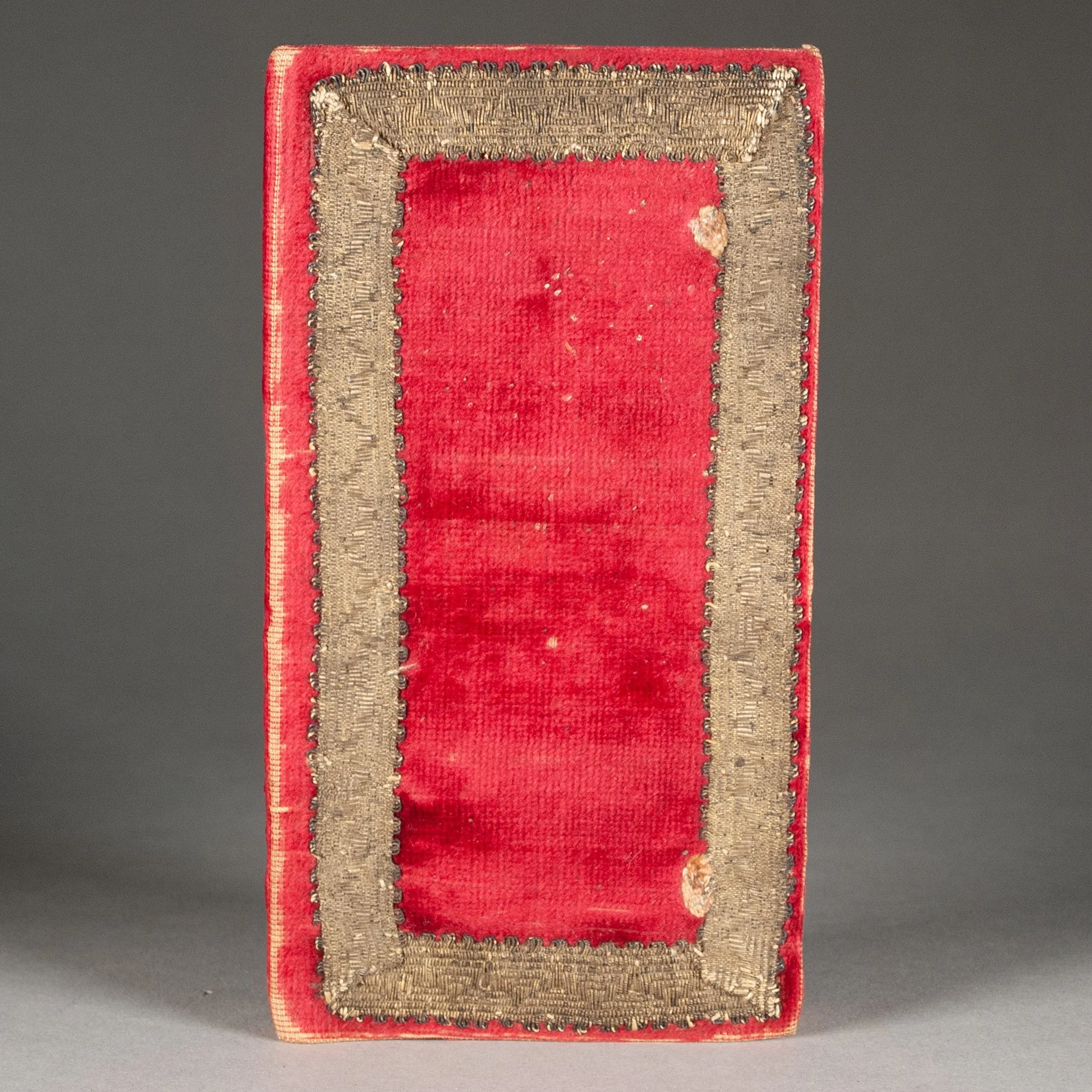 Image 1 of 7
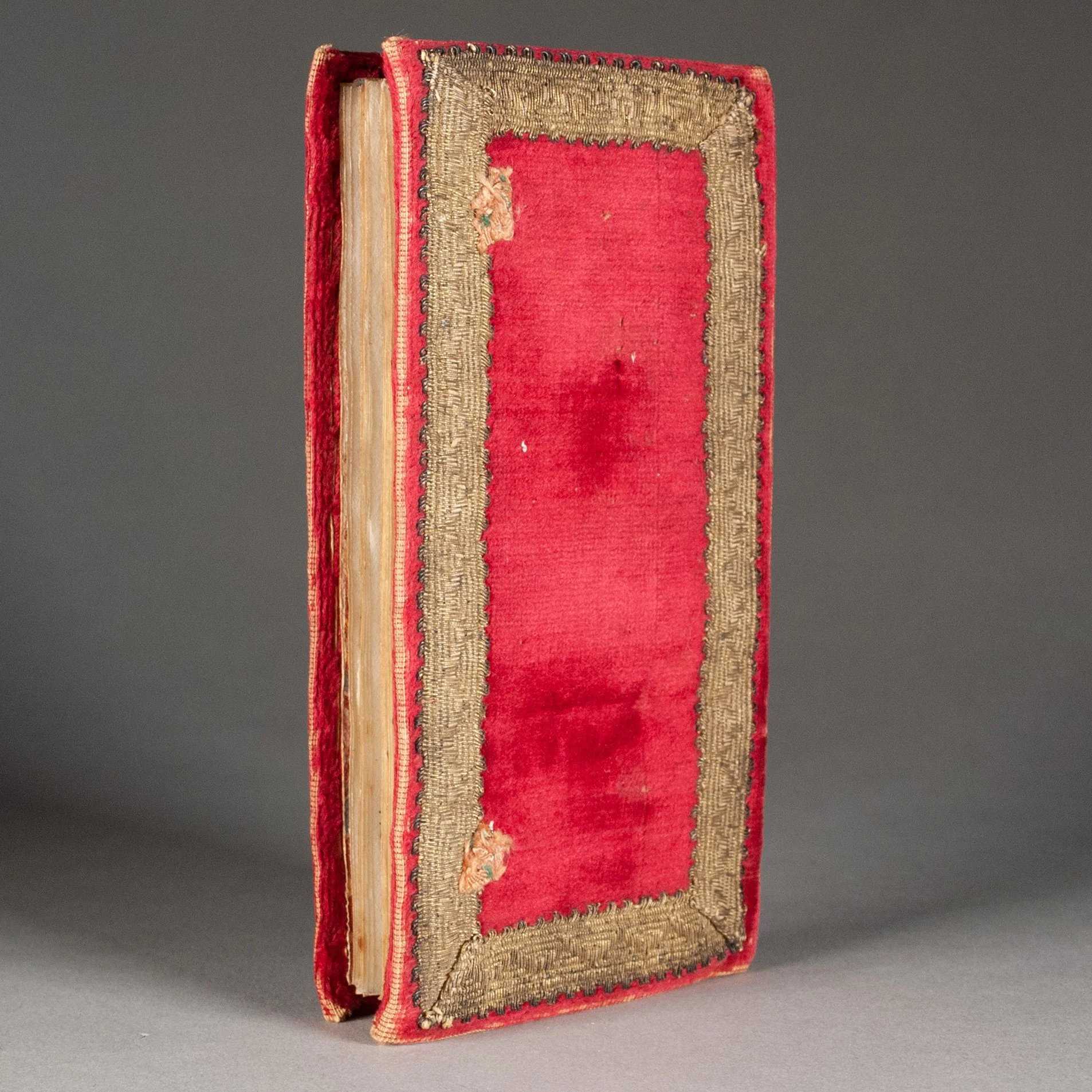 Image 2 of 7
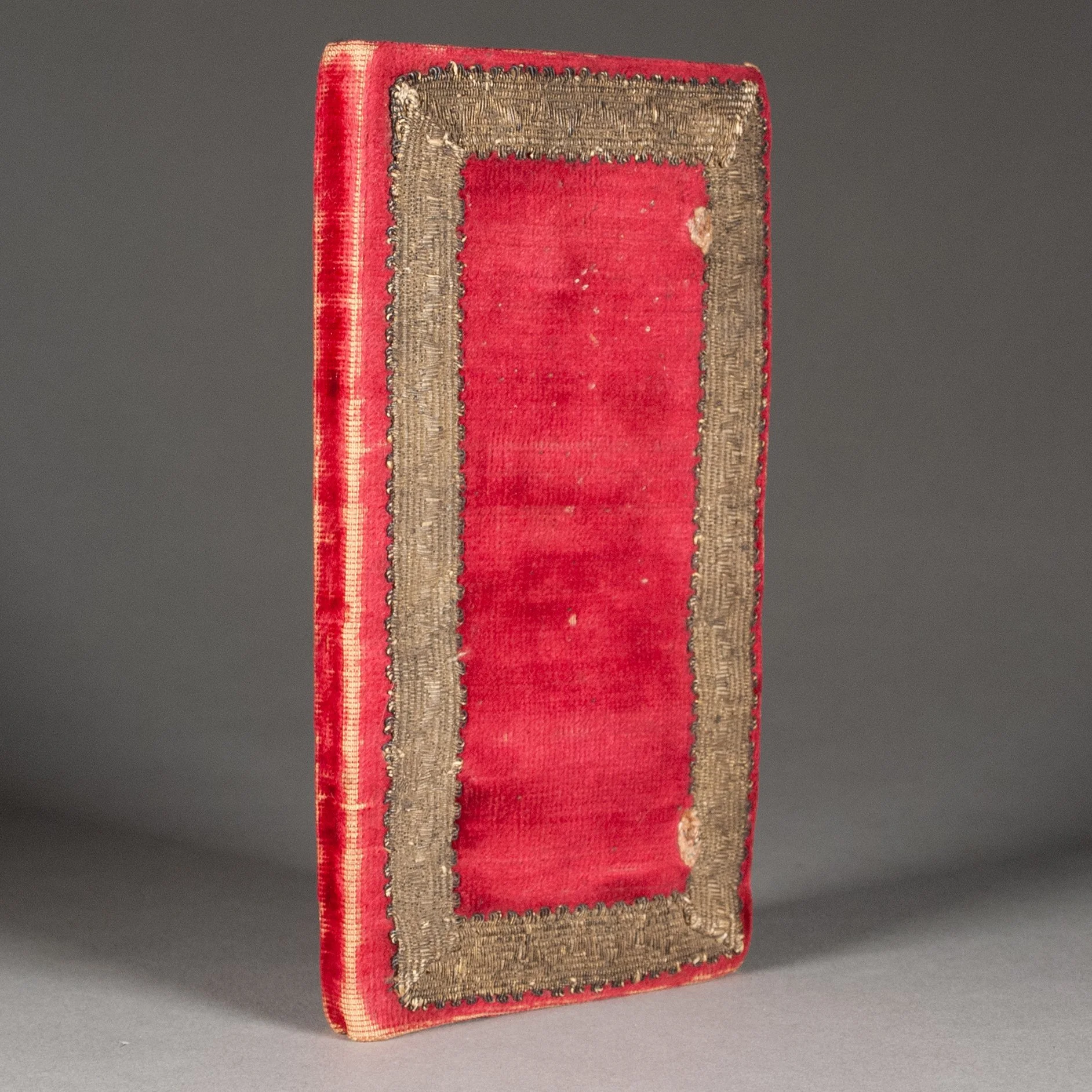 Image 3 of 7
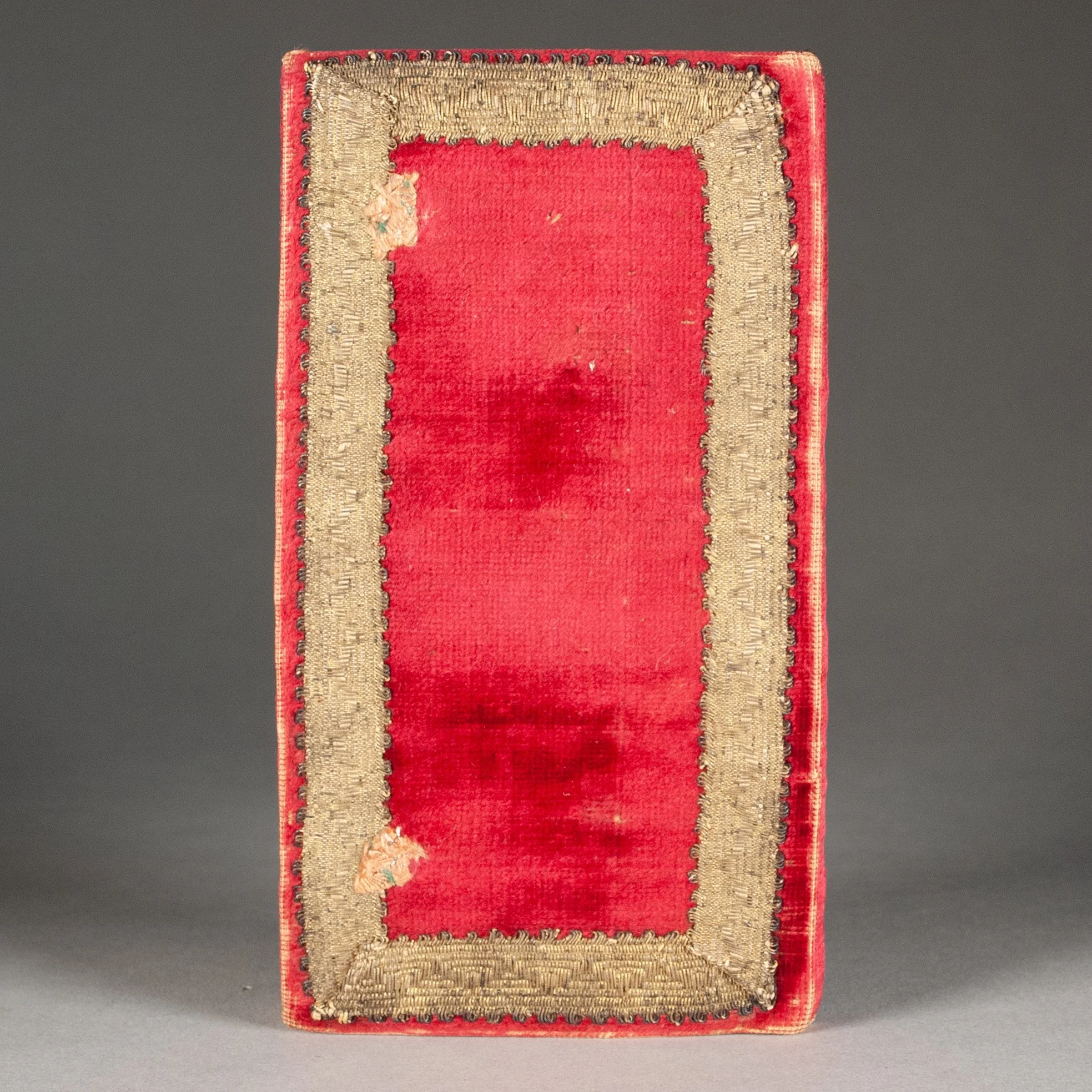 Image 4 of 7
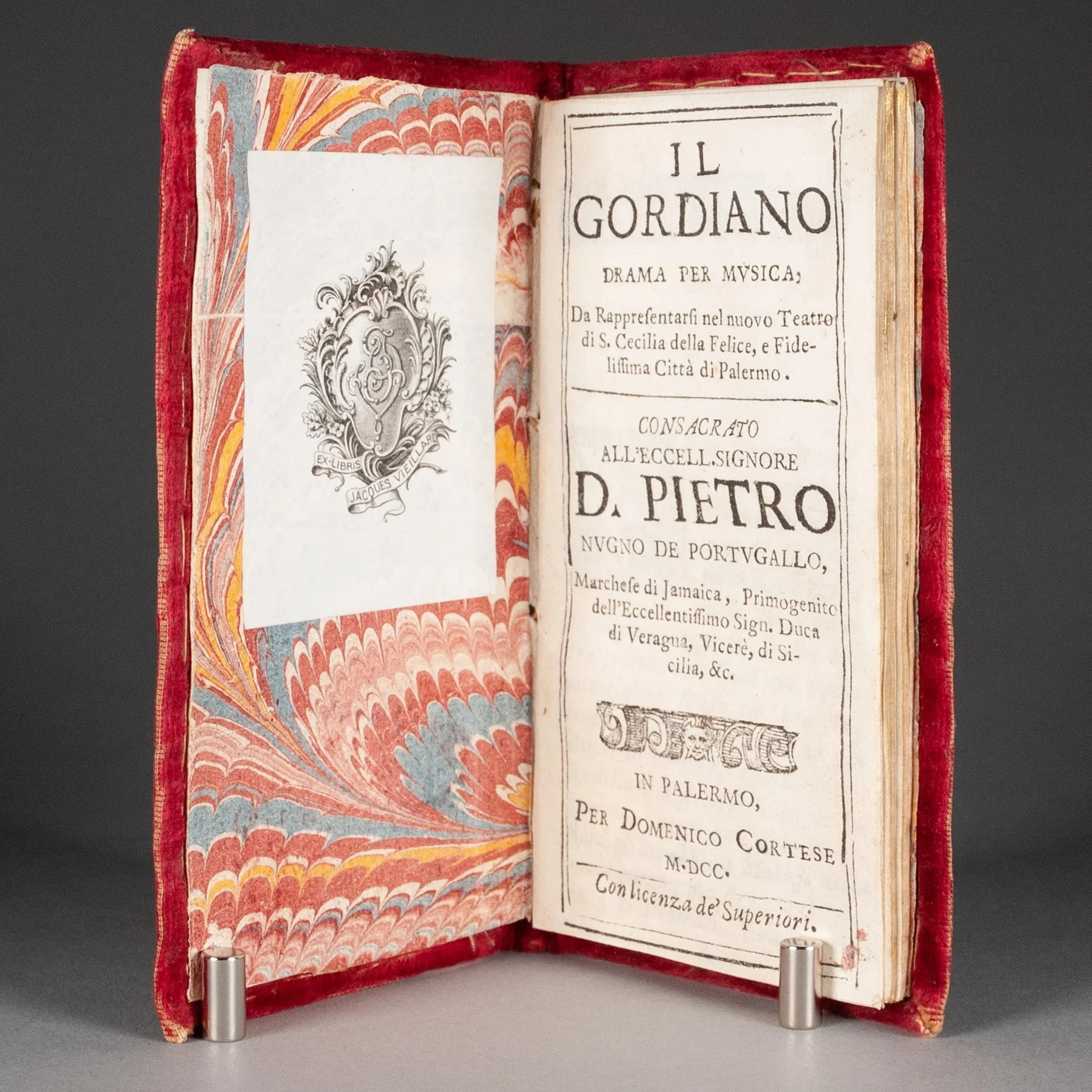 Image 5 of 7
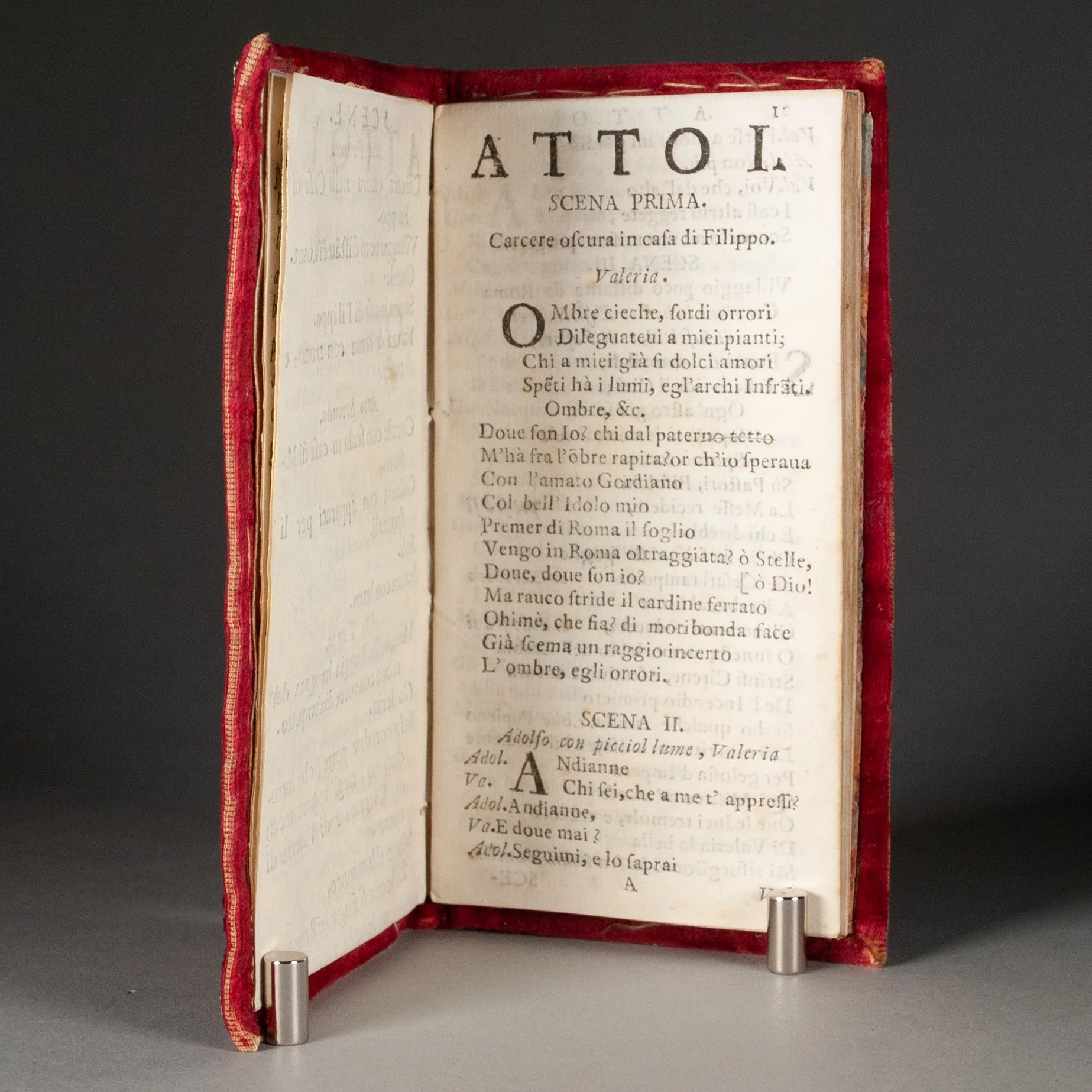 Image 6 of 7
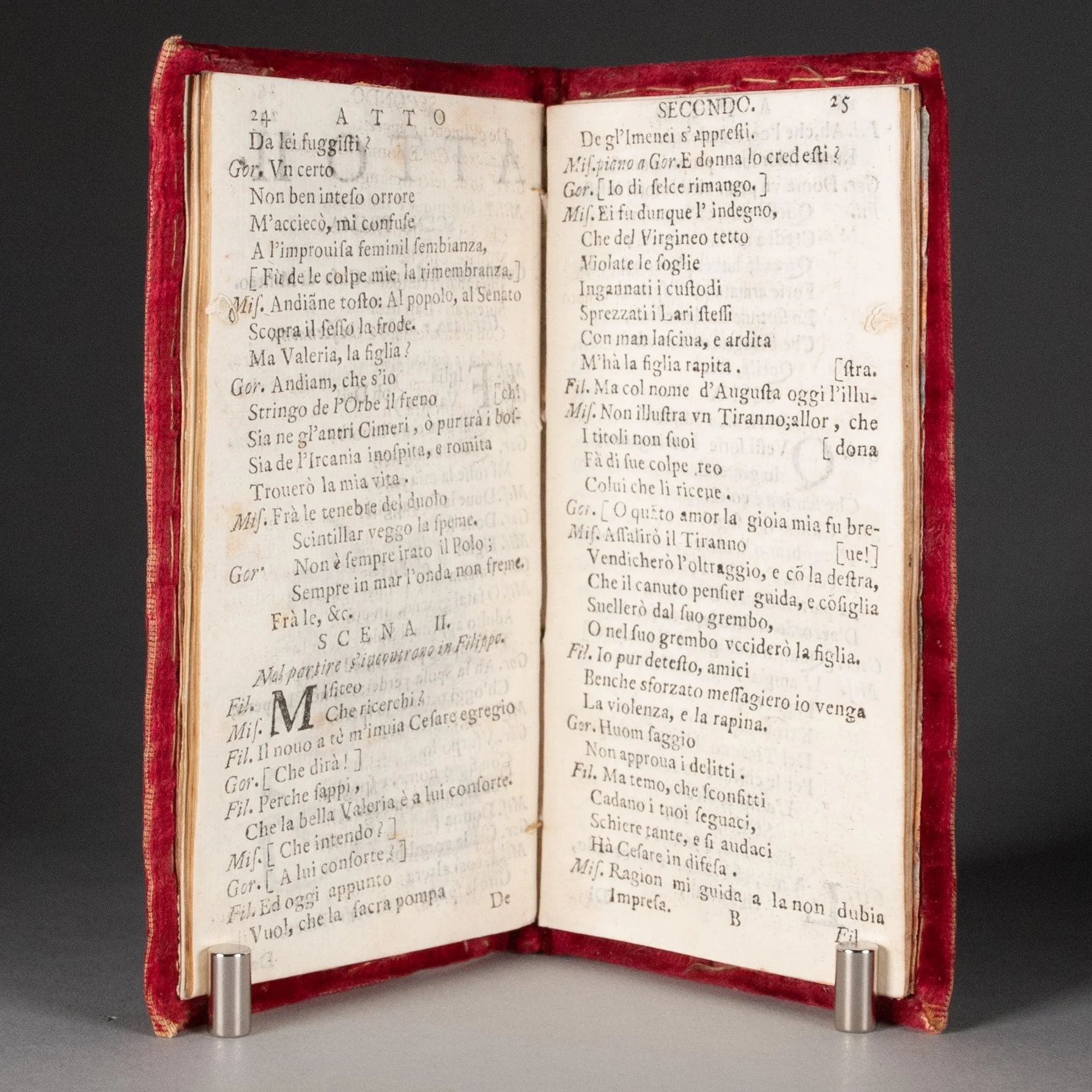 Image 7 of 7