
 Image 1 of 6
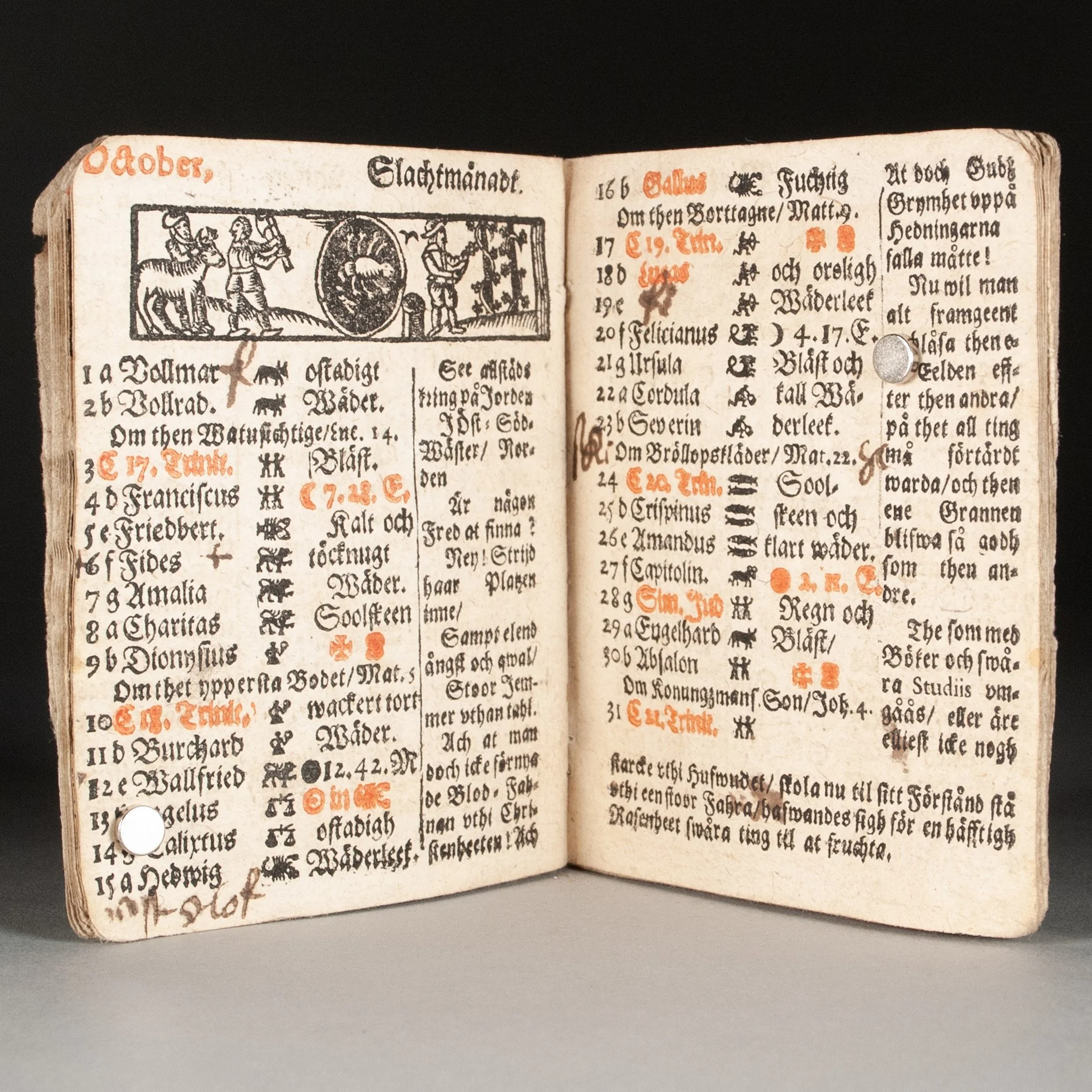 Image 2 of 6
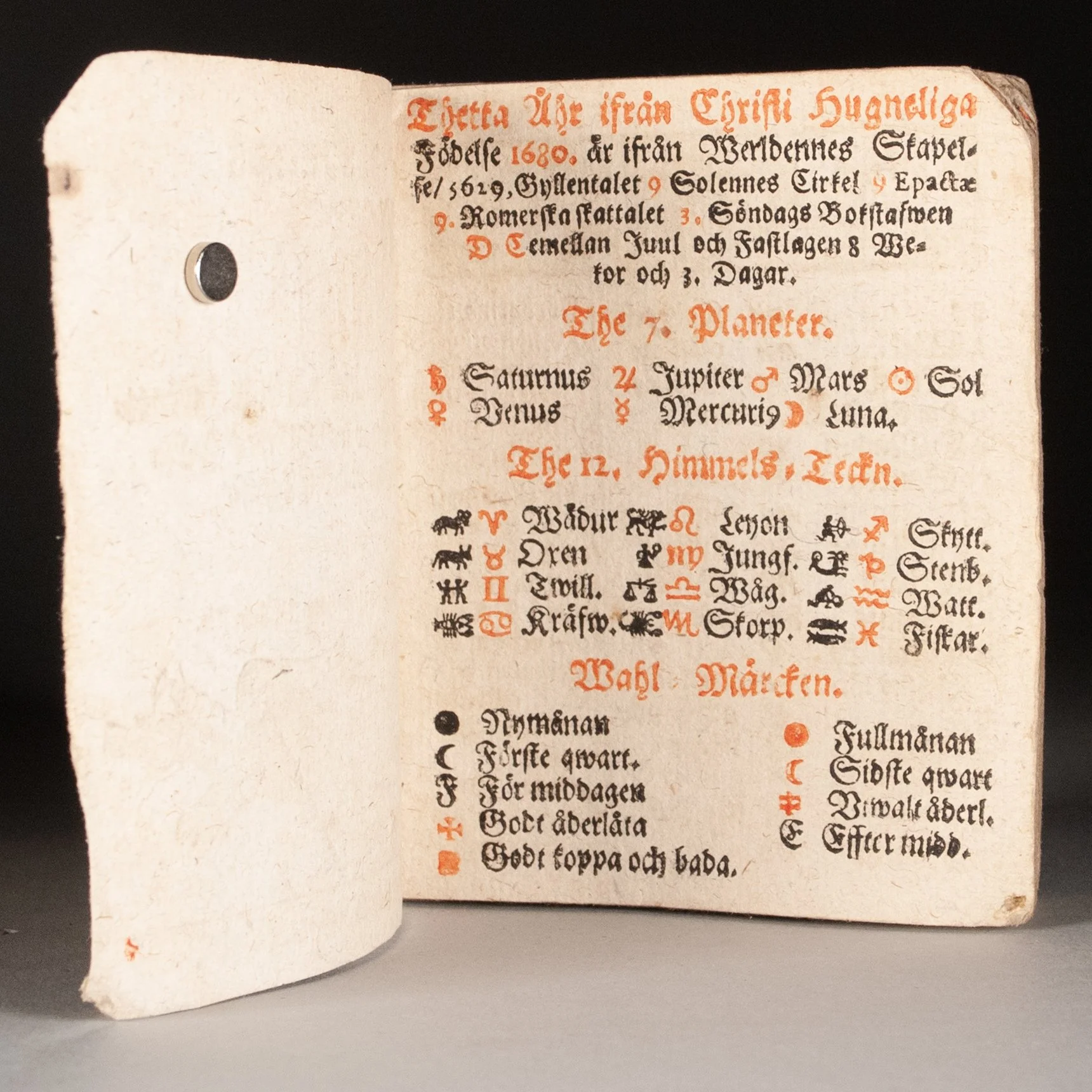 Image 3 of 6
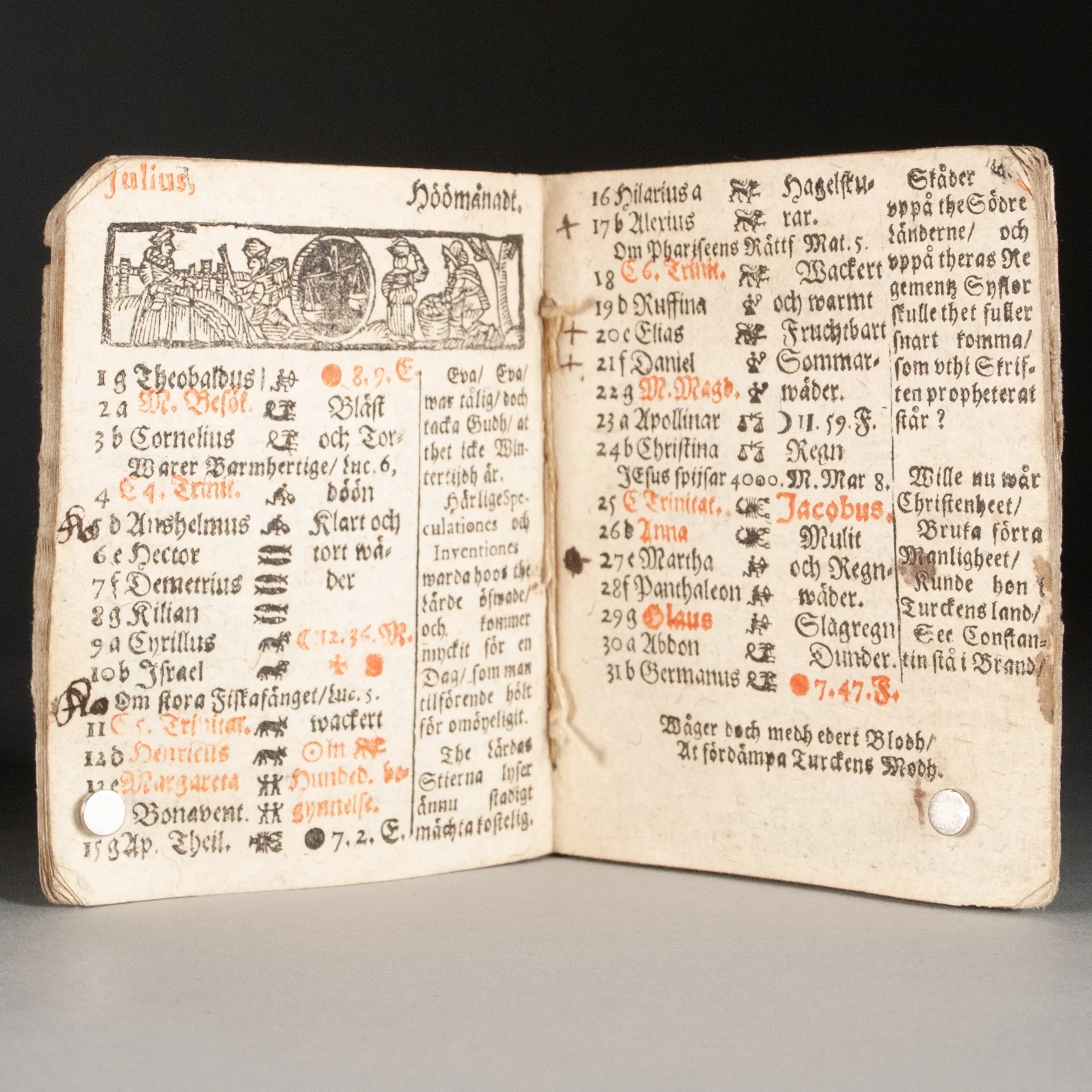 Image 4 of 6
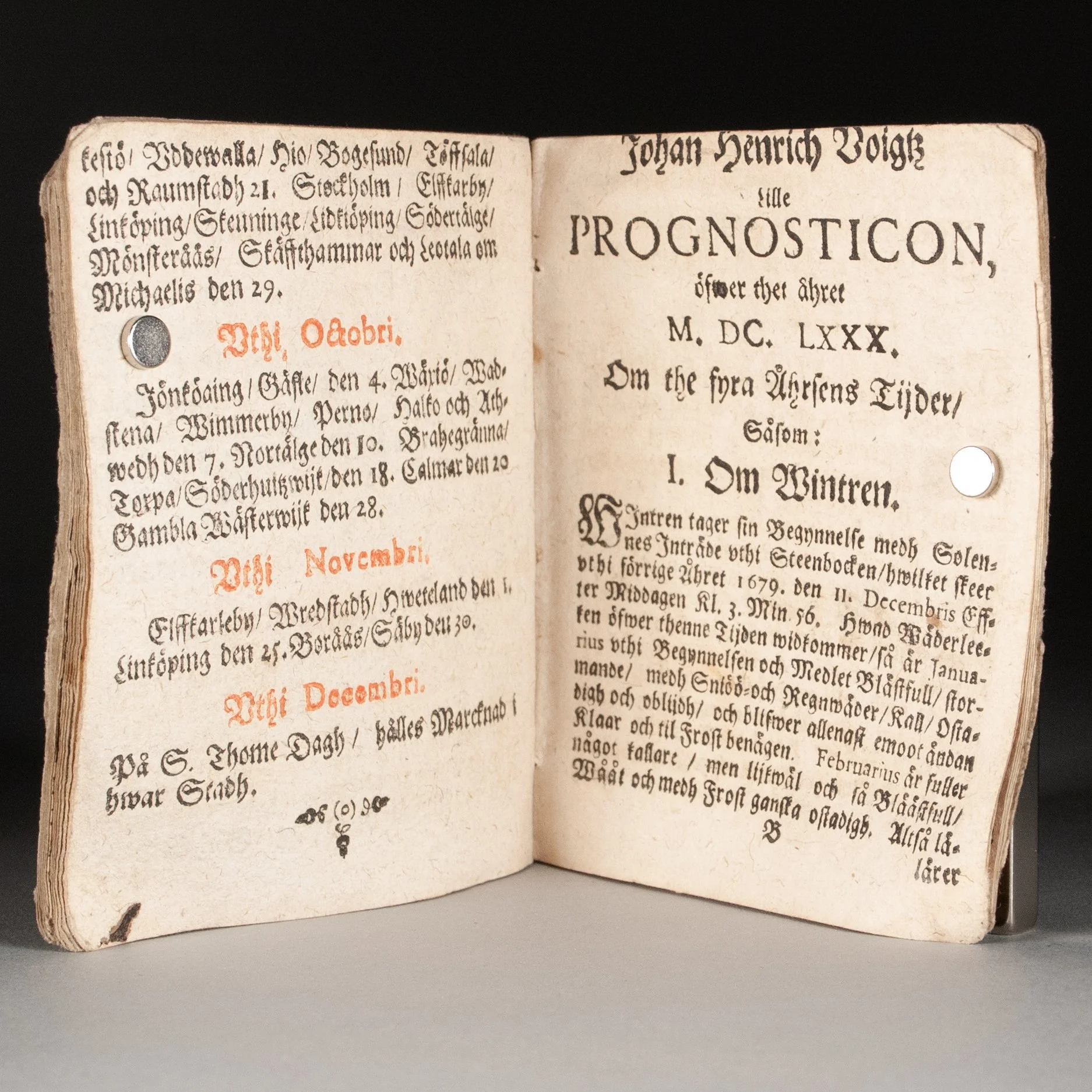 Image 5 of 6
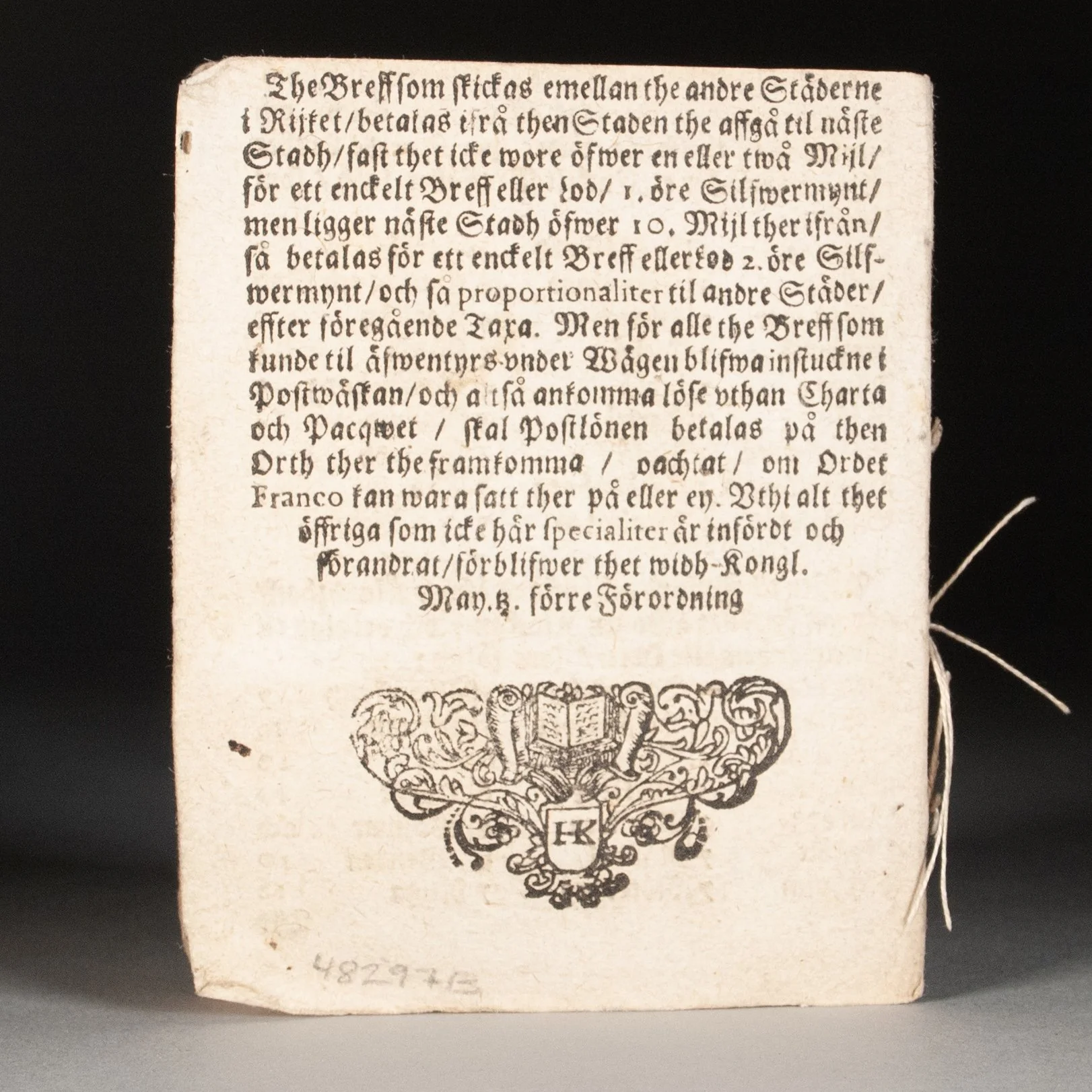 Image 6 of 6
Early Swedish pocket almanac with bloodletting guidance
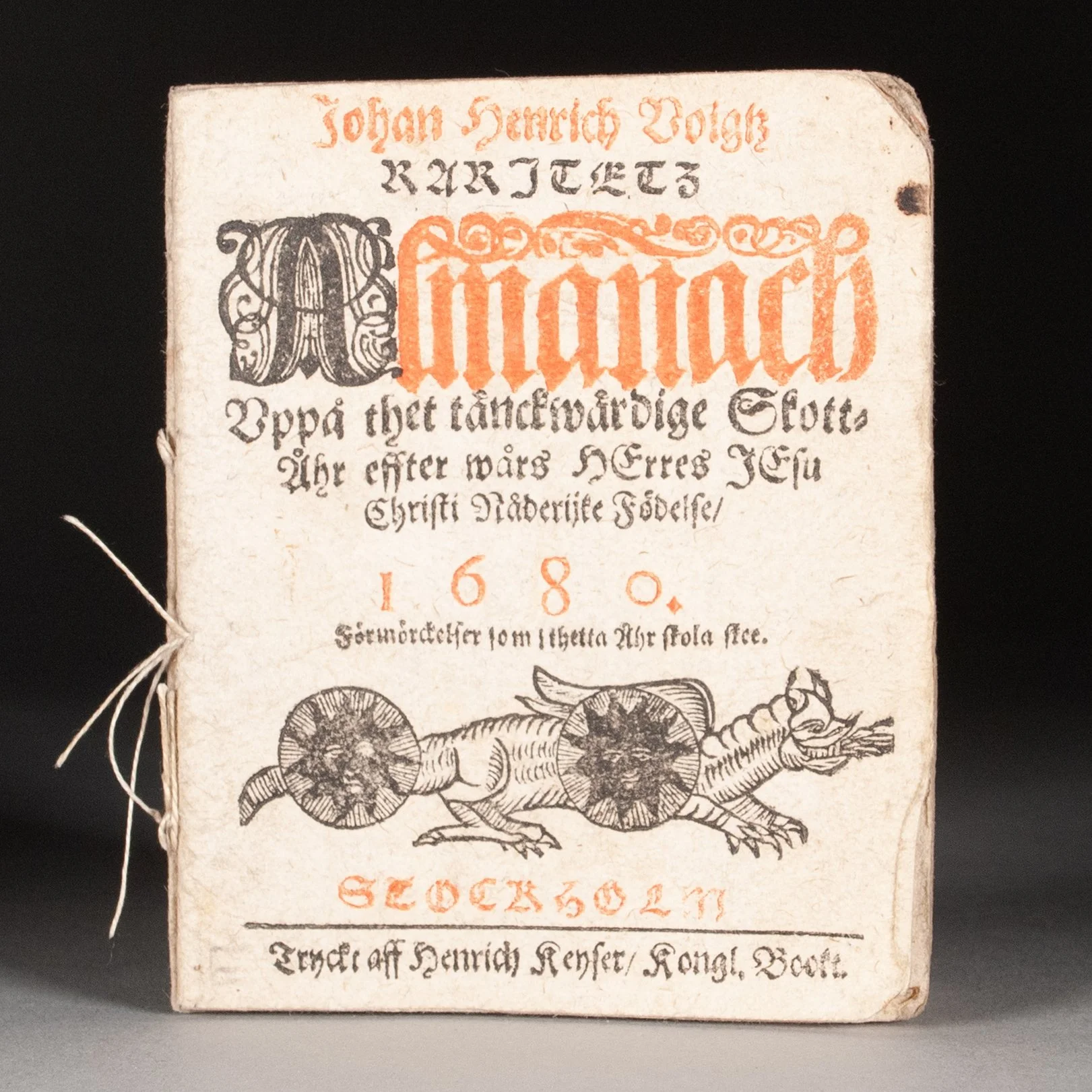
Raritetz almanach uppå thet tänckwärdige skott-ähr effter wärs herres Jesu Christi nåderijke födelse 1680; förmörckelser som i thetta ähr skola skee
by Johann Heinrich Voigt
Stockholm: Henrich Keyser, [1679]
[32]; [16] p. | 32mo | [A]^16 B^8 | 93 x 74 mm
A rare Swedish pocket almanac by Sweden's royal mathematician, who began authoring these as early as 1668. At a time when it was rare for any Swedish almanac to be published outside Stockholm, Voigt's proved popular enough that his—at least in this 1680 edition— were also issued in Malmö and Linköping. ¶ The format and content are both typical of the pocket almanac, opening with the annual chronological markers frequently found therein: the year since the creation of the world (5629); the year's golden number (9), marking its place in the 19-year Metonic lunar cycle; its place in the 28-year solar cycle (9); its epact (9); its dominical letters (D and C), which links dates to their days of the week; and its place in the indiction period (3), a 15-year tax assessment cycle that dates from antiquity. These figures are followed by legends that decode the special astrological types commonly used in almanacs (though regular almanac users would hardly need an introduction). Next follows the fundamental almanac content, with the daily calendar for each month occupying a two-page spread, each month opening with a small thematically appropriate woodcut. These monthly charts provide each day's date; its dominical letter, indicating the day of the week; saints celebrated, with notable feast days in red; and a zodiac symbol representing the current moon sign (the moon shifts 12-13 degrees each day). Additional details include the moon phase, represented by tiny moon types (black dot is a new moon, red dot is a full moon); a handful of small symbols to guide certain activities (red double cross for the best days to let blood, single red cross for middling days, something like a red mushroom for days to bathe); and occasional predictions for the day's weather (Blåst = windy, Regnskurar = rain showers, Snöglopp = sleet, etc.). Something like a running horoscope occupies the far right column of the calendar. A five-page guide to markets in Sweden, Finland, and present-day Denmark (Skåne) follows the almanac proper. Then comes the Prognosticon for the same year, a smaller work analogous to the Practica often appended to German almanacs of similar vintage. It provides a more macro-level guide to the year, with further commentary on weather predictions, for example, including the anticipated effects of eclipses. ¶ Produced in vast numbers but quick to disappear, almanacs were indispensable to early modern Europe, and were unsurprisingly among the first products issued from Europe's presses. A 1458 bloodletting calendar in the type of the 36-line Bible survives, for example, and these ephemeral pieces remained a staple of print culture throughout the hand-press period. “Published in considerable numbers according to an annual cycle, these singular amalgams of the quotidian and the celestial seldom survive in more than one copy," and "most have disappeared altogether. But they were a hugely profitable part of the book market” (Pettegree). We find the early almanac's unique blend of symbol and short text hopelessly enthralling, rendering at least some of its content accessible to even the most illiterate. “By its very nature the almanac was open to a plural readership, for it provided a written text for those who knew how to read and signs or images to be deciphered for those who did not. It gave information to some about the schedules of the courts and the markets; it told others about the weather to be expected, offering predictions and horoscopes and precepts and advice in its dual language of illustration and writing. A book to be used and to be used in multiple ways, the almanac intertwined signs and written text like no other book. It seems the quintessential book for a society still unequally used to the written word and in which many different relationships with print undoubtedly existed, ranging all the way from fluent reading to halting decipherment” (Chartier). ¶ WorldCat reports just one copy of this edition, and one each of the Malmö and Linköping editions, all at the Swedish Royal Library. Searching a dozen likely title keywords mined from Klemming and Enestrom, we find no earlier Stockholm almanacs in auction records.
PROVENANCE: The almanac proper with some old marks in ink, including a couple of single-word annotations. Is the handwritten comment on November 25 snöning, to note it snowed that day?
CONDITION: Sewn with a simple pamphlet stitch, without covers. Printed in black and red throughout the almanac proper, with the aforementioned monthly woodcuts, plus a dragon woodcut on the title. ¶ Trimmed close, occasionally grazing some text; corners worn and rounded, and generally a bit dusty. A rather miraculous survival, all things considered.
REFERENCES: Isak Collijn, Sveriges bibliografi 1600-talet, col. 982; Gustaf Klemming and Gustaf Eneström, Sveriges Kalendariska Literatur, p. 17 (and p. XVIII for Voigt's royal title) ¶ Andrew Pettegree, “Broadsheets: Single-Sheet Publishing in the First Age of Print: Typology and Typography,” Broadsheets (2017), p. 28 (cited above); Falk Eisermann, “Fifty Thousand Veronicas: Print Runs of Broadsheets in the Fifteenth and Early Sixteenth Centuries,” Broadsheets, p. 111 (on the 22,000-copy print run of a 1558 broadsheet almanac); Roger Chartier (Lydia G. Cochrane, tr.), The Cultural Uses of Print in Early Modern France (1987), p. 179 (cited above); Geneviève Bollème, Les almanachs populaires aux XVIIe et XVIIIe siècles (1969), p. 7 (second only to religious literature), 11 ("the almanac is first a book that one can consult without knowing how to read, it is composed of typographic signs, but also astrological symbols, numbers, images"), 13 (almanacs like these offered "a double possibility of decoding: of course that of the typographical signs, but also that of the astrological symbols alone that at least give them access to a basic but necessary reading to properly govern their lives according to the rhythm of seasonal variations to which they are essentially subjected"), 29 (medical and agricultural topics were most common in early almanacs); Yann Sordet, Histoire du livre et de l'édition (2021), p. 414 ("In pre-industrial European societies, where books remained relatively rare, and in the poorly literate social strata for which they were intended, the almanac nevertheless constituted a sort of 'encyclopedia for all', where one could learn both when to plant trees and celebrate saints, how to care for men and animals, but at the same time open oneself to entertaining literature and a certain knowledge of current events"); Catarina Zimmermann-Homeyer, "Illustrated Almanacs: Imaging Strategies on Bloodletting Calendars of the Incunabula Period," Gutenberg-Jahrbuch (2022), p. 119 (“The authors of the almanacs were therefore physicians, astronomers and mathematicians," given the centrality of astrological calculations to rendering medical advice); James Raven and Goran Proot, "Renaissance and Reformation," The Oxford Illustrated History of the Book (2020), p. 162 (“The small books that most people encountered were probably almanacs and prayer books"); Matthew J. Shaw, "Keeping Time in the Age of Franklin: Almanacs and the Atlantic World," Printing History New Series 2 (July 2007), p. 24 (“Almanacs typically mixed the complex with the commonplace, creating a dense cultural resource,” speaking of colonial American almanacs, but no less true for many others)
Item #1021
Raritetz almanach uppå thet tänckwärdige skott-ähr effter wärs herres Jesu Christi nåderijke födelse 1680; förmörckelser som i thetta ähr skola skee
by Johann Heinrich Voigt
Stockholm: Henrich Keyser, [1679]
[32]; [16] p. | 32mo | [A]^16 B^8 | 93 x 74 mm
A rare Swedish pocket almanac by Sweden's royal mathematician, who began authoring these as early as 1668. At a time when it was rare for any Swedish almanac to be published outside Stockholm, Voigt's proved popular enough that his—at least in this 1680 edition— were also issued in Malmö and Linköping. ¶ The format and content are both typical of the pocket almanac, opening with the annual chronological markers frequently found therein: the year since the creation of the world (5629); the year's golden number (9), marking its place in the 19-year Metonic lunar cycle; its place in the 28-year solar cycle (9); its epact (9); its dominical letters (D and C), which links dates to their days of the week; and its place in the indiction period (3), a 15-year tax assessment cycle that dates from antiquity. These figures are followed by legends that decode the special astrological types commonly used in almanacs (though regular almanac users would hardly need an introduction). Next follows the fundamental almanac content, with the daily calendar for each month occupying a two-page spread, each month opening with a small thematically appropriate woodcut. These monthly charts provide each day's date; its dominical letter, indicating the day of the week; saints celebrated, with notable feast days in red; and a zodiac symbol representing the current moon sign (the moon shifts 12-13 degrees each day). Additional details include the moon phase, represented by tiny moon types (black dot is a new moon, red dot is a full moon); a handful of small symbols to guide certain activities (red double cross for the best days to let blood, single red cross for middling days, something like a red mushroom for days to bathe); and occasional predictions for the day's weather (Blåst = windy, Regnskurar = rain showers, Snöglopp = sleet, etc.). Something like a running horoscope occupies the far right column of the calendar. A five-page guide to markets in Sweden, Finland, and present-day Denmark (Skåne) follows the almanac proper. Then comes the Prognosticon for the same year, a smaller work analogous to the Practica often appended to German almanacs of similar vintage. It provides a more macro-level guide to the year, with further commentary on weather predictions, for example, including the anticipated effects of eclipses. ¶ Produced in vast numbers but quick to disappear, almanacs were indispensable to early modern Europe, and were unsurprisingly among the first products issued from Europe's presses. A 1458 bloodletting calendar in the type of the 36-line Bible survives, for example, and these ephemeral pieces remained a staple of print culture throughout the hand-press period. “Published in considerable numbers according to an annual cycle, these singular amalgams of the quotidian and the celestial seldom survive in more than one copy," and "most have disappeared altogether. But they were a hugely profitable part of the book market” (Pettegree). We find the early almanac's unique blend of symbol and short text hopelessly enthralling, rendering at least some of its content accessible to even the most illiterate. “By its very nature the almanac was open to a plural readership, for it provided a written text for those who knew how to read and signs or images to be deciphered for those who did not. It gave information to some about the schedules of the courts and the markets; it told others about the weather to be expected, offering predictions and horoscopes and precepts and advice in its dual language of illustration and writing. A book to be used and to be used in multiple ways, the almanac intertwined signs and written text like no other book. It seems the quintessential book for a society still unequally used to the written word and in which many different relationships with print undoubtedly existed, ranging all the way from fluent reading to halting decipherment” (Chartier). ¶ WorldCat reports just one copy of this edition, and one each of the Malmö and Linköping editions, all at the Swedish Royal Library. Searching a dozen likely title keywords mined from Klemming and Enestrom, we find no earlier Stockholm almanacs in auction records.
PROVENANCE: The almanac proper with some old marks in ink, including a couple of single-word annotations. Is the handwritten comment on November 25 snöning, to note it snowed that day?
CONDITION: Sewn with a simple pamphlet stitch, without covers. Printed in black and red throughout the almanac proper, with the aforementioned monthly woodcuts, plus a dragon woodcut on the title. ¶ Trimmed close, occasionally grazing some text; corners worn and rounded, and generally a bit dusty. A rather miraculous survival, all things considered.
REFERENCES: Isak Collijn, Sveriges bibliografi 1600-talet, col. 982; Gustaf Klemming and Gustaf Eneström, Sveriges Kalendariska Literatur, p. 17 (and p. XVIII for Voigt's royal title) ¶ Andrew Pettegree, “Broadsheets: Single-Sheet Publishing in the First Age of Print: Typology and Typography,” Broadsheets (2017), p. 28 (cited above); Falk Eisermann, “Fifty Thousand Veronicas: Print Runs of Broadsheets in the Fifteenth and Early Sixteenth Centuries,” Broadsheets, p. 111 (on the 22,000-copy print run of a 1558 broadsheet almanac); Roger Chartier (Lydia G. Cochrane, tr.), The Cultural Uses of Print in Early Modern France (1987), p. 179 (cited above); Geneviève Bollème, Les almanachs populaires aux XVIIe et XVIIIe siècles (1969), p. 7 (second only to religious literature), 11 ("the almanac is first a book that one can consult without knowing how to read, it is composed of typographic signs, but also astrological symbols, numbers, images"), 13 (almanacs like these offered "a double possibility of decoding: of course that of the typographical signs, but also that of the astrological symbols alone that at least give them access to a basic but necessary reading to properly govern their lives according to the rhythm of seasonal variations to which they are essentially subjected"), 29 (medical and agricultural topics were most common in early almanacs); Yann Sordet, Histoire du livre et de l'édition (2021), p. 414 ("In pre-industrial European societies, where books remained relatively rare, and in the poorly literate social strata for which they were intended, the almanac nevertheless constituted a sort of 'encyclopedia for all', where one could learn both when to plant trees and celebrate saints, how to care for men and animals, but at the same time open oneself to entertaining literature and a certain knowledge of current events"); Catarina Zimmermann-Homeyer, "Illustrated Almanacs: Imaging Strategies on Bloodletting Calendars of the Incunabula Period," Gutenberg-Jahrbuch (2022), p. 119 (“The authors of the almanacs were therefore physicians, astronomers and mathematicians," given the centrality of astrological calculations to rendering medical advice); James Raven and Goran Proot, "Renaissance and Reformation," The Oxford Illustrated History of the Book (2020), p. 162 (“The small books that most people encountered were probably almanacs and prayer books"); Matthew J. Shaw, "Keeping Time in the Age of Franklin: Almanacs and the Atlantic World," Printing History New Series 2 (July 2007), p. 24 (“Almanacs typically mixed the complex with the commonplace, creating a dense cultural resource,” speaking of colonial American almanacs, but no less true for many others)
Item #1021