 Image 1 of 5
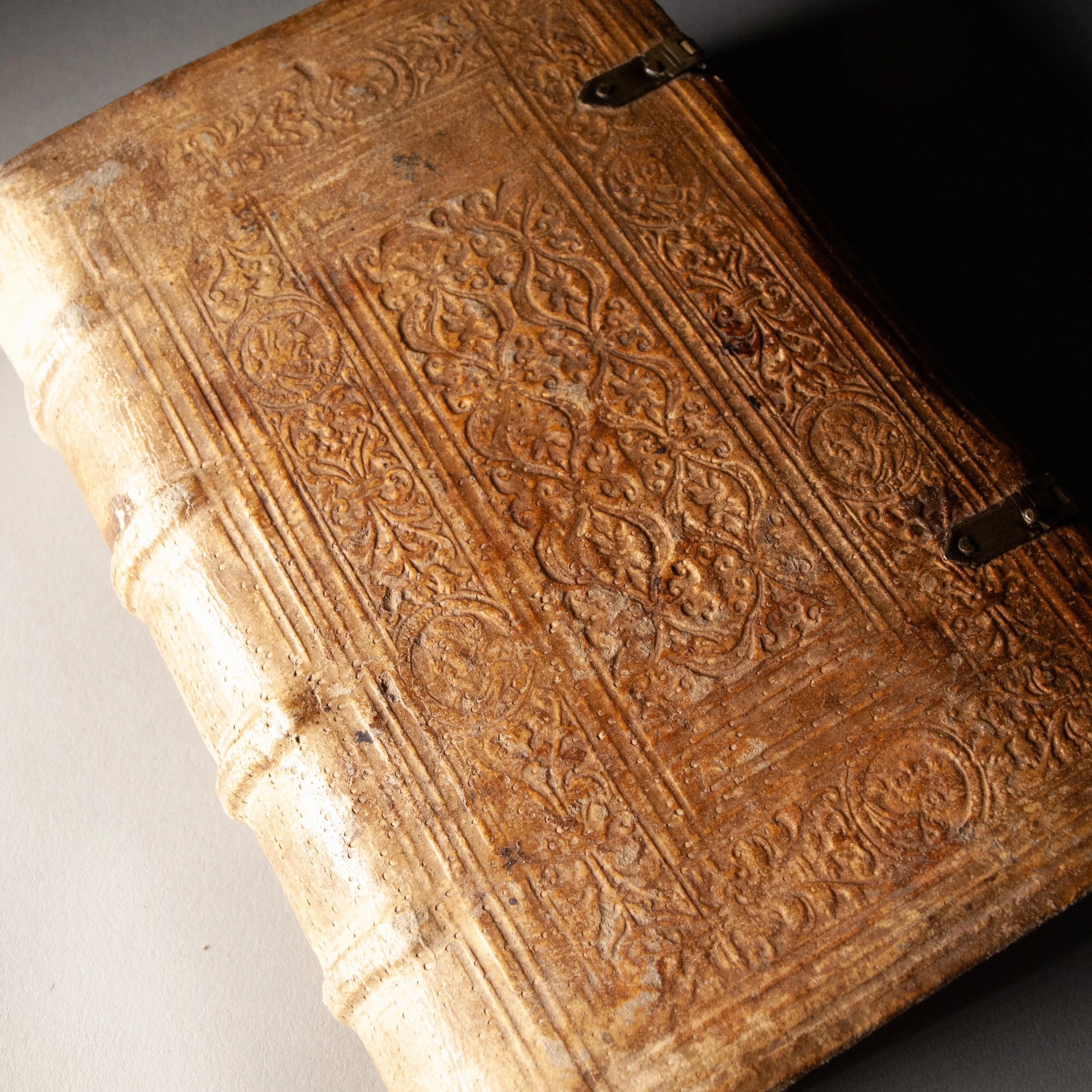 Image 2 of 5
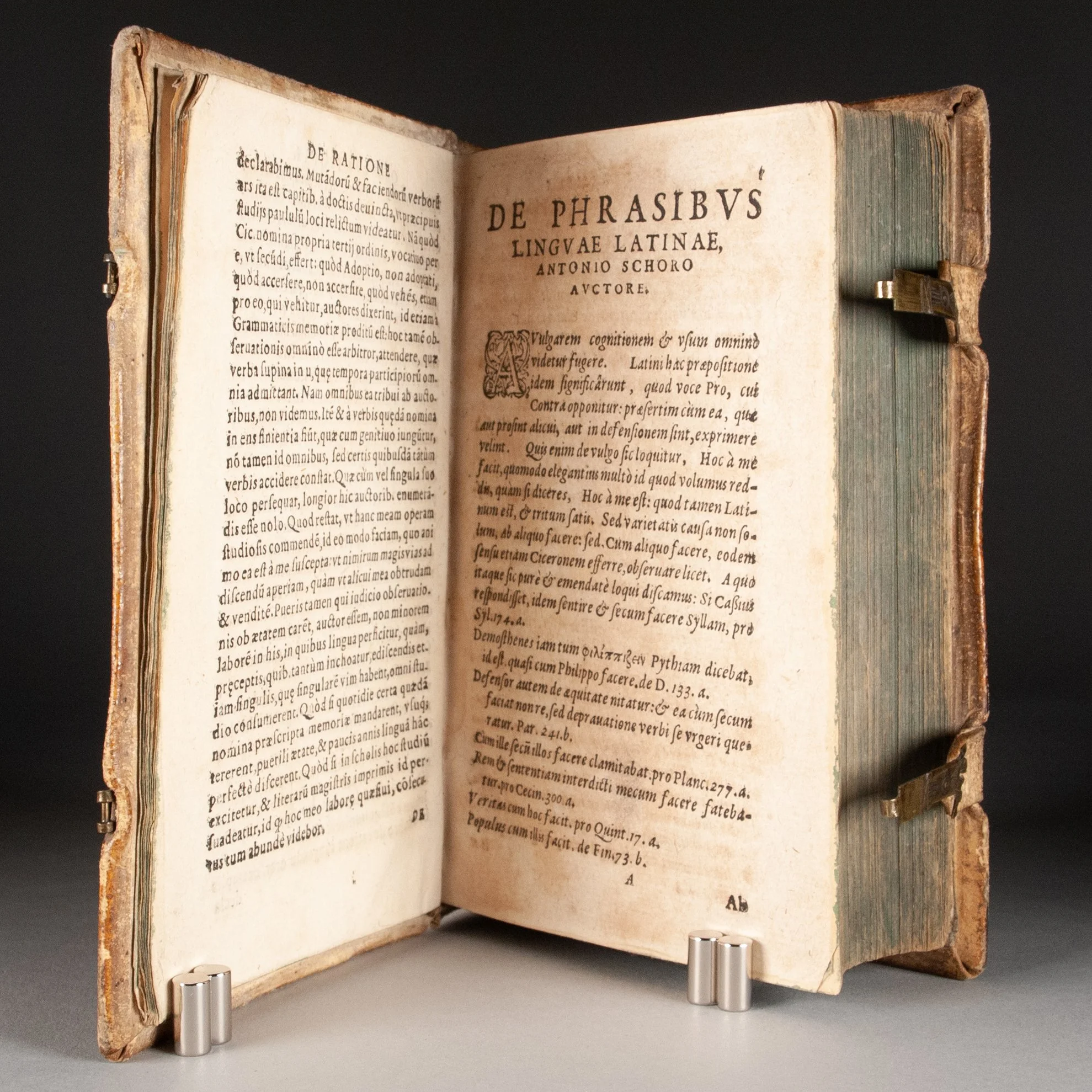 Image 3 of 5
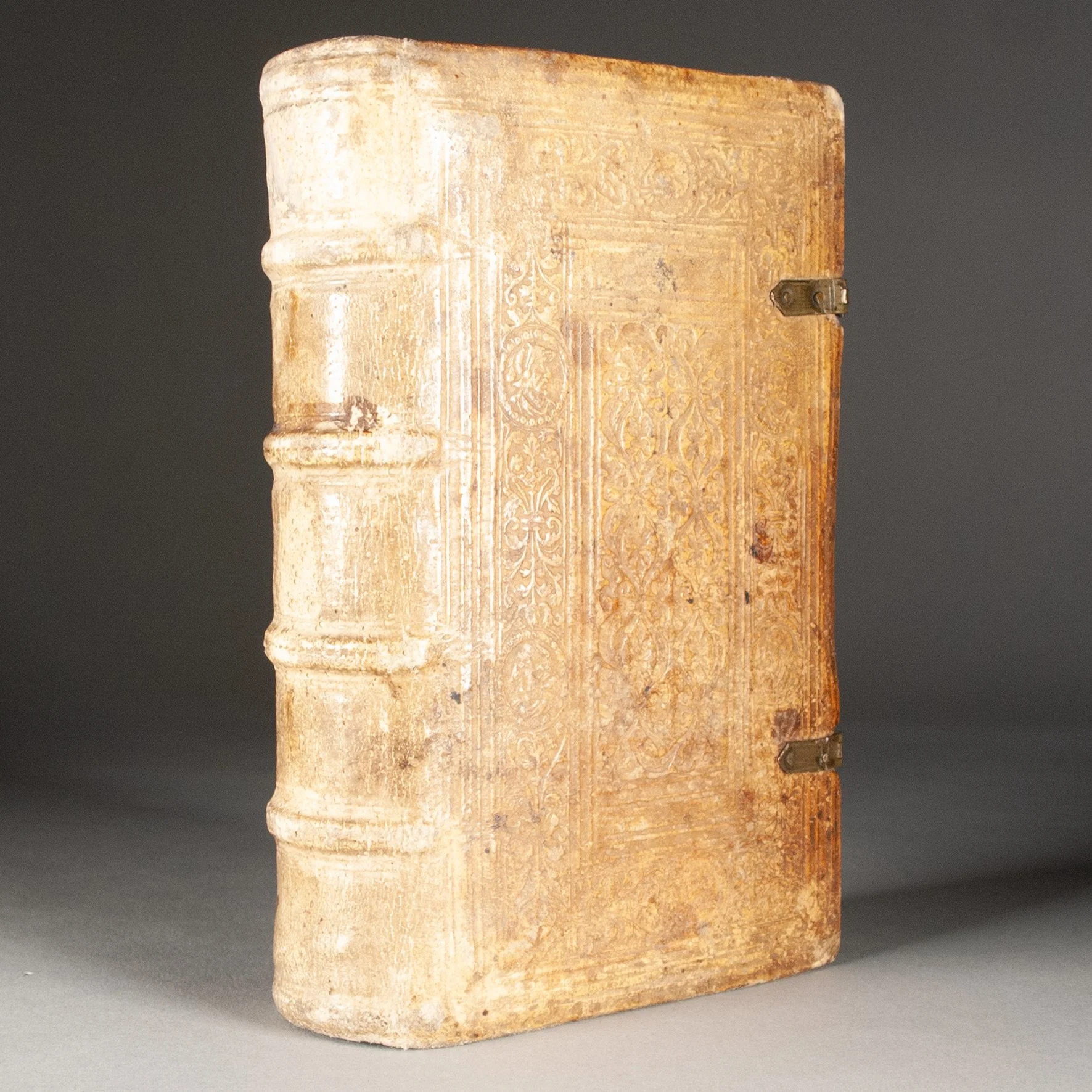 Image 4 of 5
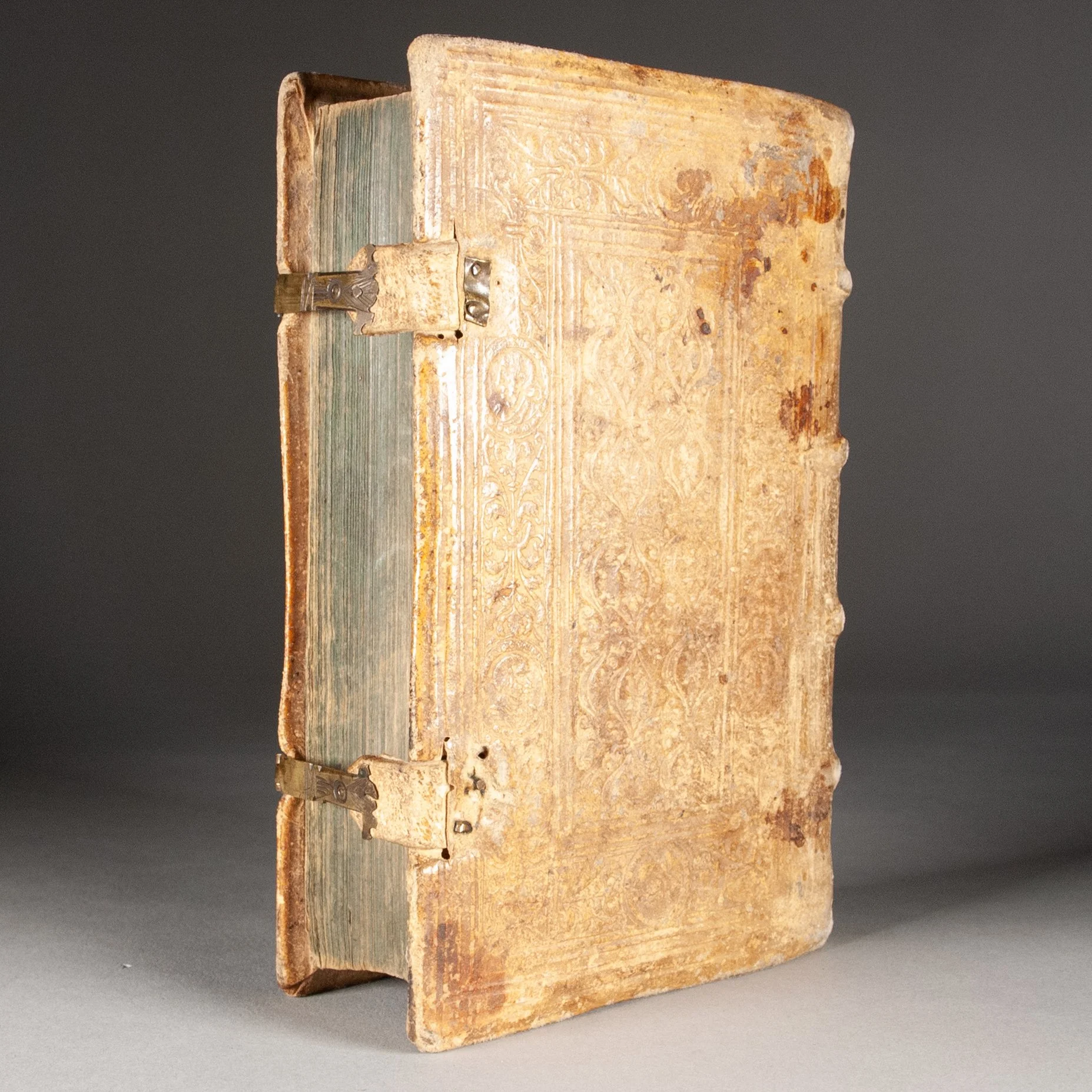 Image 5 of 5
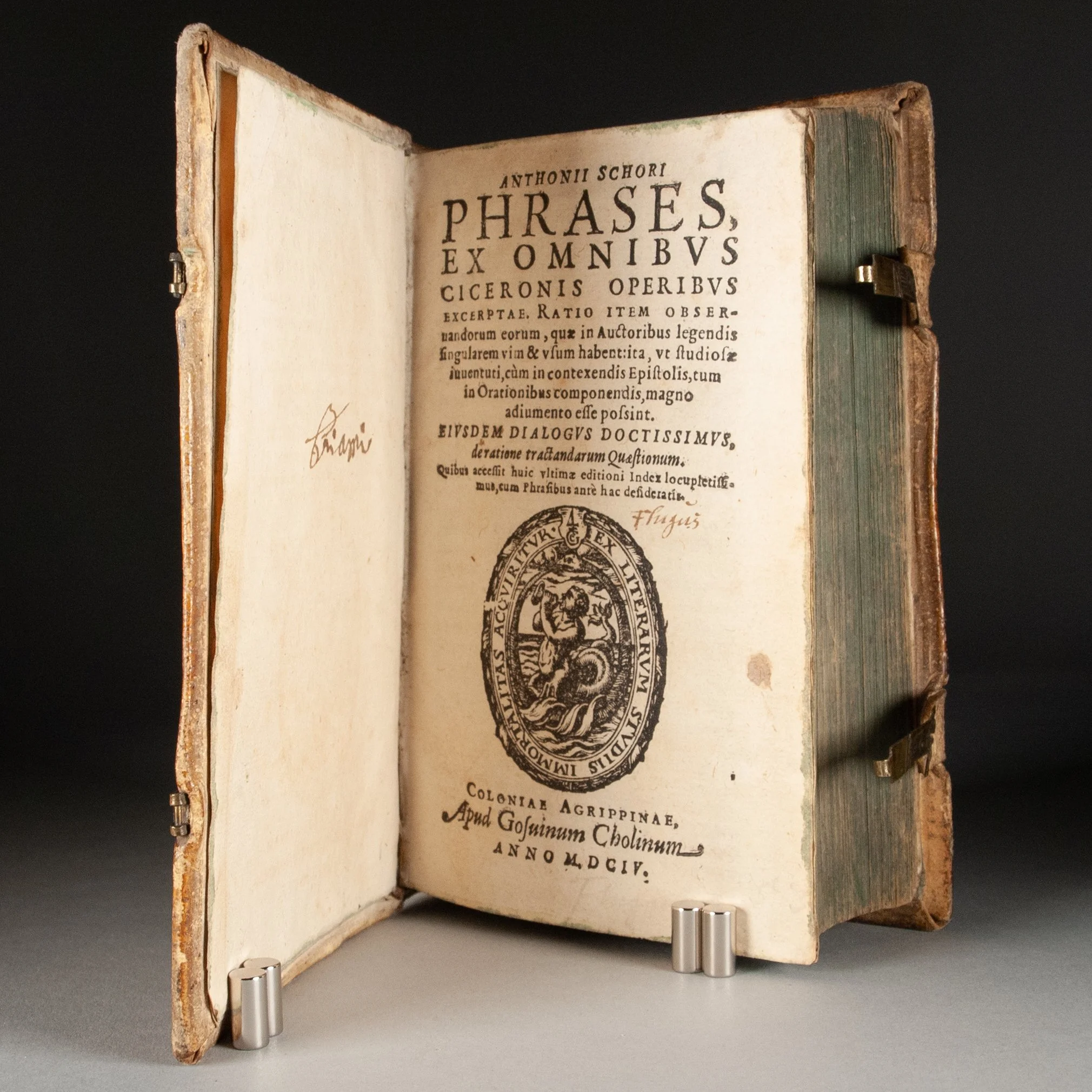
Phrases ex omnibus Ciceronis operibus excerptae; ratio item observandorum eorum, quae in auctoribus legendis singularem vim & usum habent; ita, ut studiosae inventuti, cum in contexendis epistolis, tum in orationibus componendis, magno adiumento esse possint; eiusdem dialogus doctissimus, de ratione tractandarum quaestionum; quibus accessit huic ultimae editioni index locupletissimus, cum phrasibus ante hac desideratis
by Cicero | edited and arranged by Antonius van Schore
Cologne: Goswin Cholinus, 1604
[16], 623, [17] p. | 8vo | )(^8 A-2R^8 | 163 x 95 mm
A later edition of the short-lived Dutch philologist's Phrases linguae Latinae (1550)—not to be conflated with his Thesaurus verborum linguae Latinae Ciceronianus (1557)—here with special emphasis on the book's express purpose: to allow students to better pepper their own letters and speeches with Ciceronian phrases. "The primacy of Cicero as a letter-writer was at no time in doubt, and the ability to compose an epistle as close to the Ciceronian model as possible was an accomplishment indispensable to every humanist, whose daily bread might depend upon his command of the commendatory, laudatory, gratulatory, petitory, regratiatory, or, in the last resort, vituperative letter, as the case might be" (Scholderer). These excerpts indeed appear to have been drawn primarily from Cicero, though we suspect (given the title of the first edition) that you'll occasionally encounter other classical authors. The book is arranged alphabetically by a rough combination of concept and keyword, and includes at back the author's De ratione tractandarum quaestionum populariter dialogus. ¶ Much like the published books of loci communes, such a work essentially outsourced the protracted labor of compiling one's own commonplace book, of mining original texts and documenting those phrases and passages worthy of deployment in one's own work. This had long been one of the reasons for studying Cicero—not just to emulate the paragon of good Latin style, but to incorporate his words into one's own. Such repackaging was hardly radical at the time. “As engines of copia, compilations of quotations and exempla were of use to all who composed in Latin and sought to impress by their mastery of textual culture, both ancient and biblical” (Blair). Van Schore's clear expression of purpose in the title, cum in contexendis epistolis, tum in orationibus componendis, rings of maximum candor, betraying a superficiality in the spirit of Bartlett's Familiar Quotations. ¶ This kind of shortcut has long inspired both proponents and opponents. The narrator in Borges's "Library of Babel" speaks of a sect that venerated the mythical librarian who had read the perfect compilation. “On some shelf in some hexagon, it was argued, there must exist a book that is the cipher and perfect compendium of all other books, and some librarian must have examined that book; this librarian is analogous to a god.” Montaigne held rather a different opinion: "These concoctions of commonplaces, by means of which so many men husband their study, are hardly useful except for commonplace subjects, and they serve to show us off, not to guide us." Even as he confesses to using such concoctions himself. ¶ Proof that shortcuts to seeming learned have been popular for centuries. WorldCat reports no copies of this edition in North America, and this the only appearance we find at auction.
PROVENANCE: A few old ownership inscriptions across the front endpapers and title. Small pressed plant between p. 152 and 153.
CONDITION: Contemporary blind-tooled pigskin. ¶ Quire 2C misbound; moderately foxed throughout. Binding soiled and lightly worn at the extremities, but really a satisfying copy.
REFERENCES: USTC 2013843; Lawrence D. Green and James J. Murphy, Renaissance Rhetoric Short-Title Catalogue 1460-1700 (2006; revised and expanded), p. 395 ¶ Victor Scholderer, "Printers and Readers in Italy in the Fifteenth Century," Fifty Essays in Fifteenth- and Sixteenth-Century Bibliography, p. 211; Ann M. Blair, Too Much to Know, p. 236 (cited above); Jorge Luis Borges, "The Library of Babel," Collected Fictions (1998), p. 116 (cited above); Michel de Montaigne (Donald Frame, ed.), "Of Physiognomy," Complete Essays (1965), p. 808 (cited above), see also "Of Books," 301 ("his way of writing, and every other similar way, seems to me boring...what life and marrow there is, is smothered by his long-winded preparations"), 302 ("As for his eloquence, it is entirely beyond comparison; I believe that no man will ever equal him")
Item #853
Phrases ex omnibus Ciceronis operibus excerptae; ratio item observandorum eorum, quae in auctoribus legendis singularem vim & usum habent; ita, ut studiosae inventuti, cum in contexendis epistolis, tum in orationibus componendis, magno adiumento esse possint; eiusdem dialogus doctissimus, de ratione tractandarum quaestionum; quibus accessit huic ultimae editioni index locupletissimus, cum phrasibus ante hac desideratis
by Cicero | edited and arranged by Antonius van Schore
Cologne: Goswin Cholinus, 1604
[16], 623, [17] p. | 8vo | )(^8 A-2R^8 | 163 x 95 mm
A later edition of the short-lived Dutch philologist's Phrases linguae Latinae (1550)—not to be conflated with his Thesaurus verborum linguae Latinae Ciceronianus (1557)—here with special emphasis on the book's express purpose: to allow students to better pepper their own letters and speeches with Ciceronian phrases. "The primacy of Cicero as a letter-writer was at no time in doubt, and the ability to compose an epistle as close to the Ciceronian model as possible was an accomplishment indispensable to every humanist, whose daily bread might depend upon his command of the commendatory, laudatory, gratulatory, petitory, regratiatory, or, in the last resort, vituperative letter, as the case might be" (Scholderer). These excerpts indeed appear to have been drawn primarily from Cicero, though we suspect (given the title of the first edition) that you'll occasionally encounter other classical authors. The book is arranged alphabetically by a rough combination of concept and keyword, and includes at back the author's De ratione tractandarum quaestionum populariter dialogus. ¶ Much like the published books of loci communes, such a work essentially outsourced the protracted labor of compiling one's own commonplace book, of mining original texts and documenting those phrases and passages worthy of deployment in one's own work. This had long been one of the reasons for studying Cicero—not just to emulate the paragon of good Latin style, but to incorporate his words into one's own. Such repackaging was hardly radical at the time. “As engines of copia, compilations of quotations and exempla were of use to all who composed in Latin and sought to impress by their mastery of textual culture, both ancient and biblical” (Blair). Van Schore's clear expression of purpose in the title, cum in contexendis epistolis, tum in orationibus componendis, rings of maximum candor, betraying a superficiality in the spirit of Bartlett's Familiar Quotations. ¶ This kind of shortcut has long inspired both proponents and opponents. The narrator in Borges's "Library of Babel" speaks of a sect that venerated the mythical librarian who had read the perfect compilation. “On some shelf in some hexagon, it was argued, there must exist a book that is the cipher and perfect compendium of all other books, and some librarian must have examined that book; this librarian is analogous to a god.” Montaigne held rather a different opinion: "These concoctions of commonplaces, by means of which so many men husband their study, are hardly useful except for commonplace subjects, and they serve to show us off, not to guide us." Even as he confesses to using such concoctions himself. ¶ Proof that shortcuts to seeming learned have been popular for centuries. WorldCat reports no copies of this edition in North America, and this the only appearance we find at auction.
PROVENANCE: A few old ownership inscriptions across the front endpapers and title. Small pressed plant between p. 152 and 153.
CONDITION: Contemporary blind-tooled pigskin. ¶ Quire 2C misbound; moderately foxed throughout. Binding soiled and lightly worn at the extremities, but really a satisfying copy.
REFERENCES: USTC 2013843; Lawrence D. Green and James J. Murphy, Renaissance Rhetoric Short-Title Catalogue 1460-1700 (2006; revised and expanded), p. 395 ¶ Victor Scholderer, "Printers and Readers in Italy in the Fifteenth Century," Fifty Essays in Fifteenth- and Sixteenth-Century Bibliography, p. 211; Ann M. Blair, Too Much to Know, p. 236 (cited above); Jorge Luis Borges, "The Library of Babel," Collected Fictions (1998), p. 116 (cited above); Michel de Montaigne (Donald Frame, ed.), "Of Physiognomy," Complete Essays (1965), p. 808 (cited above), see also "Of Books," 301 ("his way of writing, and every other similar way, seems to me boring...what life and marrow there is, is smothered by his long-winded preparations"), 302 ("As for his eloquence, it is entirely beyond comparison; I believe that no man will ever equal him")
Item #853