Comoediae omnes; cum absolutis commentariis Aelii Donati, Guidonis Juvenalis Cenomani, Petri Marsi in omnes fabulas, Ioannis Calphurnii Brixiensis in Heautontimorumenon; accedunt Antonii Goveani epistola ad Guillelmum Bellaium Langeum, Taurini proregem, de castigatione harum comoediarum; eiusdem de versibus Terentianis, necnon de ludis megalensibus, ac quaedam perpulchrae annotationes; Bartolomaei Latomi in singulas scenas argumenta, ordo & distinctio partium fabulae, vocum quarundam & locorum difficilium explicatio, loci argumentationum & amplificationum principales, schemata passim & ornamenta orationis; Henrici Loriti in carmina Terentii per omnes eius comoedias judicium; his item addidimus cuiusq[ue] scenae terna argumenta variis verbis eadem tamen sententia descripta; metris in suum ordinem rectè restitutis, ac variis lectionibus in margine appositis
by Terence | with commentary by Aelius Donatus (4th century), Guy Jouenneaux (d. 1507), Giovanni Calfurnio (d. 1503), and Pietro Marso (1441/1442-ca. 1511) | additional contributions from António de Gouveia (1505-1566?), Bartholomaeus Latomus (1485?-1570?), and Henricus Glareanus (1488-1563)
Venice: Girolamo Scotto, 1569
[20], 380 p. | Folio | *^10 A-Z^8 2A^6 | 316 x 210 mm
An exemplary illustrated scholarly edition of Terence, among the favorite playwrights of the early humanists, if less warmly embraced by others. Many held him to have a corrupting influence on the youth. Ignatius Loyola himself banned Terence from his Jesuit classrooms. "After Loyola's death in 1556, Terence made a limited return to Jesuit schools, either in expurgated form or in toto but restricted to 'mature' students. Further moral concerns drove him from the classroom for good in the 1570s" (Grendler). Nonetheless, Terence was by far the preferred playwright of 15th-century printers, outnumbering editions of Plautus by ten to one. ¶ With its decorative initials, small woodcuts, and voluminous commentary, this edition belongs to a classical fashion that became popular in the late 15th century. While the earliest editions of ancient texts stuck to an unaccompanied presentation of the original, commentaries began appearing in the 1480s. You've seen the mise-en-page, a few lines of original text drowning in a sea of commentary. The vogue declined in the 16th century, perhaps in part due to the influence of Aldus's commentary-free pocket editions of the classics. But obviously the scholarly folios endured, with decades, even centuries, of accumulated apparatus. Here we have the classic fourth-century commentary by Aelius Donatus; late medieval work, like that of Guy Jouenneaux and Giovanni Calfurnio; and more contemporary contributions, like António de Gouveia's Epistola and Bartholomaeus Latomus's Argumenta. Scattered throughout are additional shorter argumenta by others uncredited on the title page, most frequently Paul Haemmerlin (1488-1502) and Adriaan van Baarland (1486-1538). More is more. ¶ Illustrated throughout with twelve small woodcuts, one of those repeated half a dozen times: a man on stage in a toga before a packed audience (p. 1, 69, 144, 198, 270, and 323). The remaining woodcuts are clearly from a different series, slightly larger but less detailed, with holes cut in the blocks to label characters with movable type (p. 3, 71, 146, 200, 274, and 326). Otherwise quite generic in composition—figures on a stage before plain backdrops—this factotum-like alteration should have allowed the blocks to be used in any dramatic text while retaining the ability to identify individual characters. These appear to be from the same set of blocks used in Jean de Roigny's 1551/1552 Paris edition of Terence, slightly touched up and with aforementioned holes added for type. Compare our woodcut on p. 146 to Roigny's on his p. 82, for example.
PROVENANCE: Just a couple of early marginalia, and what looks like Del Giunta inked on the front cover.
CONDITION: Early parchment over boards, the title in gold on the spine; edges sprinkled red and light blue. Decorative initials throughout, from a variety of different series (foliate, historiated, criblé). ¶ Title a trifle soiled; minimal marginal dampstaining to the first few gatherings at front, and some faint marginal dampstaining near the back, affecting the text area; scattered foxing and ink stains; the occasional leaf quite darkened with age; small paper repair in the lower margin of the last few leaves, not affecting any text; discreet 8 mm closed tear in upper margin of I6, not touching text. Parchment moderately soiled and a couple of tiny wormholes in the spines; half of rear fly-leaf torn away.
REFERENCES: USTC 858775; EDIT16 CNCE 32383; Giovanni Cupaiuolo, Bibliografia Terenziana (1470-1983), p. 89, #531 (suggesting Jouenneaux as editor and adding the commentary of Étienne Dolet, French scholar and printer who was burned along with his books by the authorities in Paris) ¶ Paul F. Grendler, Schooling in Renaissance Italy (1989), p. 252 ("Perhaps Terence's portrayals of young aristocrats who consorted with prostitutes and impregnated virgins alarmed some people"); Dennis E. Rhodes, "La publication des comédies de Térence au XVe siècle," Le livre dans l'Europe de la Renaissance (1988), p. 285 (for 15c Terence stats); "La publication des Satires de Juvénal en Europe avant 1601," Le livre dans l'Europe de la Renaissance, p. 302 (citing the first Aldine pocket classics as the starting point for a preference for small-format, commentary-free editions); Severin Corsten, "Universities and early printing," Bibliography and the Study of 15th-Century Civilisation (1987), p. 95 (“In the mid-1480s, the printing of editions with commentary began, and these soon clearly exceeded in number the editions which provided the text on its own. The commentaries of professors, printed at the places where they taught, were intended not only for use at the professors’ own universities, but were disseminated far and wide.”)
Item #1020
Comoediae omnes; cum absolutis commentariis Aelii Donati, Guidonis Juvenalis Cenomani, Petri Marsi in omnes fabulas, Ioannis Calphurnii Brixiensis in Heautontimorumenon; accedunt Antonii Goveani epistola ad Guillelmum Bellaium Langeum, Taurini proregem, de castigatione harum comoediarum; eiusdem de versibus Terentianis, necnon de ludis megalensibus, ac quaedam perpulchrae annotationes; Bartolomaei Latomi in singulas scenas argumenta, ordo & distinctio partium fabulae, vocum quarundam & locorum difficilium explicatio, loci argumentationum & amplificationum principales, schemata passim & ornamenta orationis; Henrici Loriti in carmina Terentii per omnes eius comoedias judicium; his item addidimus cuiusq[ue] scenae terna argumenta variis verbis eadem tamen sententia descripta; metris in suum ordinem rectè restitutis, ac variis lectionibus in margine appositis
by Terence | with commentary by Aelius Donatus (4th century), Guy Jouenneaux (d. 1507), Giovanni Calfurnio (d. 1503), and Pietro Marso (1441/1442-ca. 1511) | additional contributions from António de Gouveia (1505-1566?), Bartholomaeus Latomus (1485?-1570?), and Henricus Glareanus (1488-1563)
Venice: Girolamo Scotto, 1569
[20], 380 p. | Folio | *^10 A-Z^8 2A^6 | 316 x 210 mm
An exemplary illustrated scholarly edition of Terence, among the favorite playwrights of the early humanists, if less warmly embraced by others. Many held him to have a corrupting influence on the youth. Ignatius Loyola himself banned Terence from his Jesuit classrooms. "After Loyola's death in 1556, Terence made a limited return to Jesuit schools, either in expurgated form or in toto but restricted to 'mature' students. Further moral concerns drove him from the classroom for good in the 1570s" (Grendler). Nonetheless, Terence was by far the preferred playwright of 15th-century printers, outnumbering editions of Plautus by ten to one. ¶ With its decorative initials, small woodcuts, and voluminous commentary, this edition belongs to a classical fashion that became popular in the late 15th century. While the earliest editions of ancient texts stuck to an unaccompanied presentation of the original, commentaries began appearing in the 1480s. You've seen the mise-en-page, a few lines of original text drowning in a sea of commentary. The vogue declined in the 16th century, perhaps in part due to the influence of Aldus's commentary-free pocket editions of the classics. But obviously the scholarly folios endured, with decades, even centuries, of accumulated apparatus. Here we have the classic fourth-century commentary by Aelius Donatus; late medieval work, like that of Guy Jouenneaux and Giovanni Calfurnio; and more contemporary contributions, like António de Gouveia's Epistola and Bartholomaeus Latomus's Argumenta. Scattered throughout are additional shorter argumenta by others uncredited on the title page, most frequently Paul Haemmerlin (1488-1502) and Adriaan van Baarland (1486-1538). More is more. ¶ Illustrated throughout with twelve small woodcuts, one of those repeated half a dozen times: a man on stage in a toga before a packed audience (p. 1, 69, 144, 198, 270, and 323). The remaining woodcuts are clearly from a different series, slightly larger but less detailed, with holes cut in the blocks to label characters with movable type (p. 3, 71, 146, 200, 274, and 326). Otherwise quite generic in composition—figures on a stage before plain backdrops—this factotum-like alteration should have allowed the blocks to be used in any dramatic text while retaining the ability to identify individual characters. These appear to be from the same set of blocks used in Jean de Roigny's 1551/1552 Paris edition of Terence, slightly touched up and with aforementioned holes added for type. Compare our woodcut on p. 146 to Roigny's on his p. 82, for example.
PROVENANCE: Just a couple of early marginalia, and what looks like Del Giunta inked on the front cover.
CONDITION: Early parchment over boards, the title in gold on the spine; edges sprinkled red and light blue. Decorative initials throughout, from a variety of different series (foliate, historiated, criblé). ¶ Title a trifle soiled; minimal marginal dampstaining to the first few gatherings at front, and some faint marginal dampstaining near the back, affecting the text area; scattered foxing and ink stains; the occasional leaf quite darkened with age; small paper repair in the lower margin of the last few leaves, not affecting any text; discreet 8 mm closed tear in upper margin of I6, not touching text. Parchment moderately soiled and a couple of tiny wormholes in the spines; half of rear fly-leaf torn away.
REFERENCES: USTC 858775; EDIT16 CNCE 32383; Giovanni Cupaiuolo, Bibliografia Terenziana (1470-1983), p. 89, #531 (suggesting Jouenneaux as editor and adding the commentary of Étienne Dolet, French scholar and printer who was burned along with his books by the authorities in Paris) ¶ Paul F. Grendler, Schooling in Renaissance Italy (1989), p. 252 ("Perhaps Terence's portrayals of young aristocrats who consorted with prostitutes and impregnated virgins alarmed some people"); Dennis E. Rhodes, "La publication des comédies de Térence au XVe siècle," Le livre dans l'Europe de la Renaissance (1988), p. 285 (for 15c Terence stats); "La publication des Satires de Juvénal en Europe avant 1601," Le livre dans l'Europe de la Renaissance, p. 302 (citing the first Aldine pocket classics as the starting point for a preference for small-format, commentary-free editions); Severin Corsten, "Universities and early printing," Bibliography and the Study of 15th-Century Civilisation (1987), p. 95 (“In the mid-1480s, the printing of editions with commentary began, and these soon clearly exceeded in number the editions which provided the text on its own. The commentaries of professors, printed at the places where they taught, were intended not only for use at the professors’ own universities, but were disseminated far and wide.”)
Item #1020

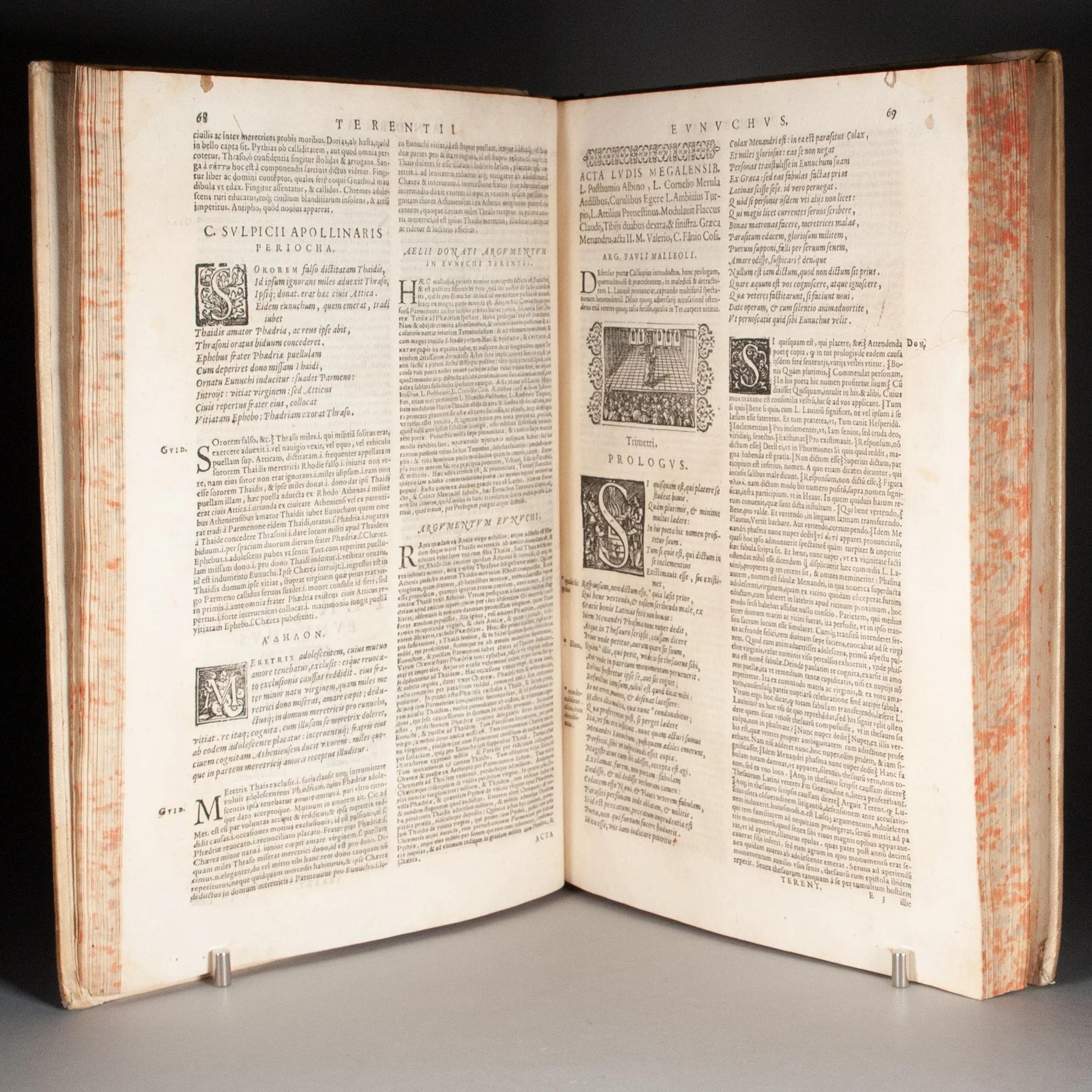 Image 1 of 7
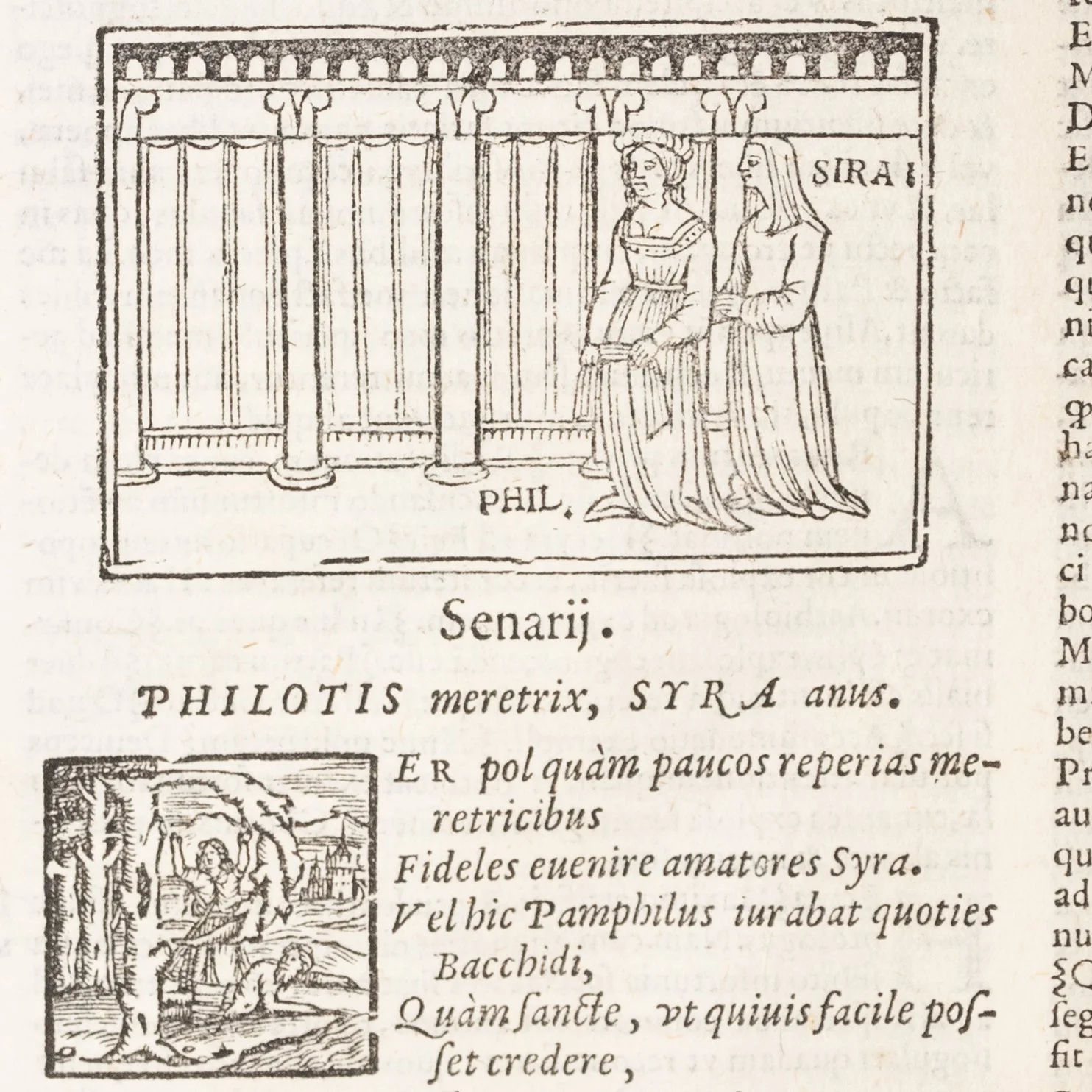 Image 2 of 7
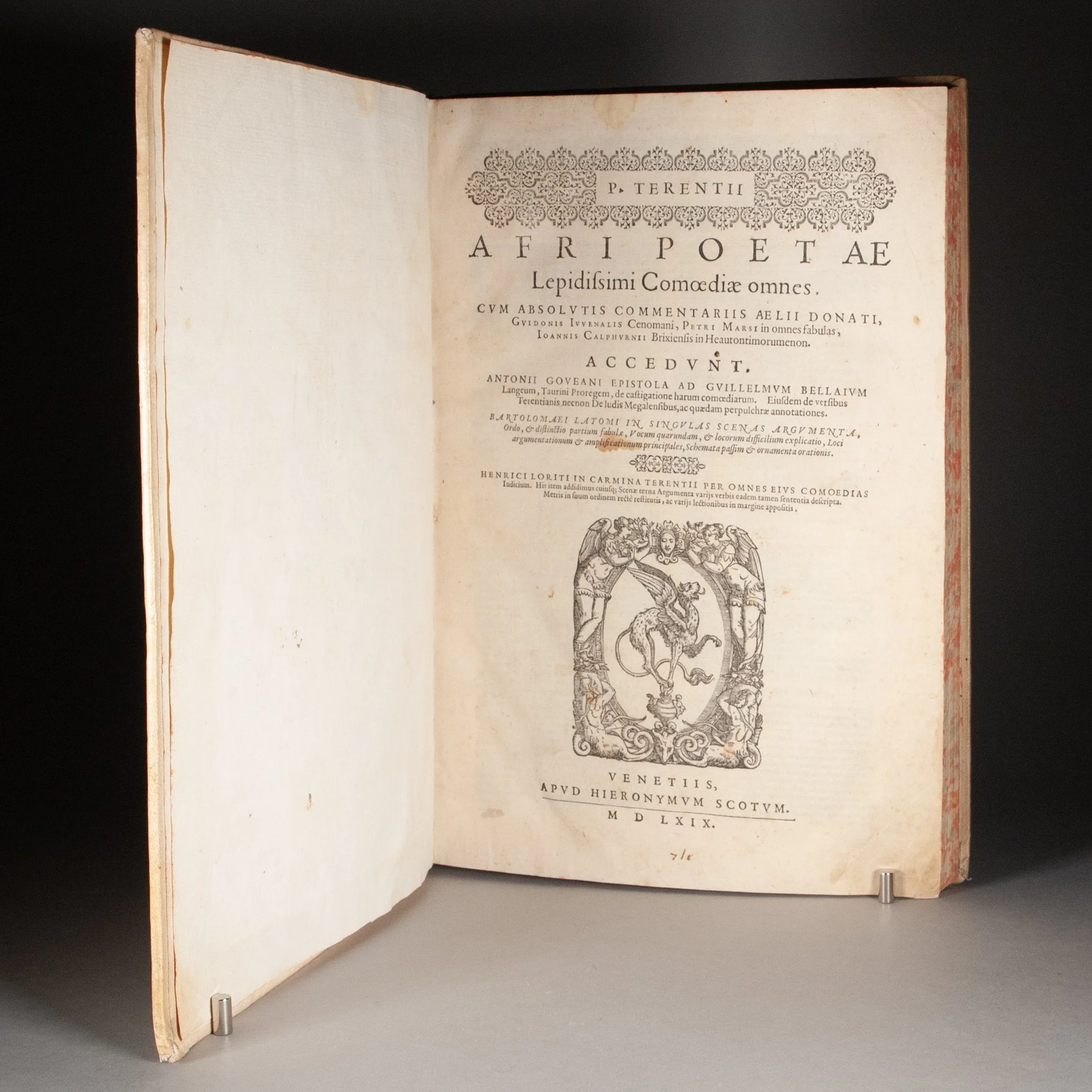 Image 3 of 7
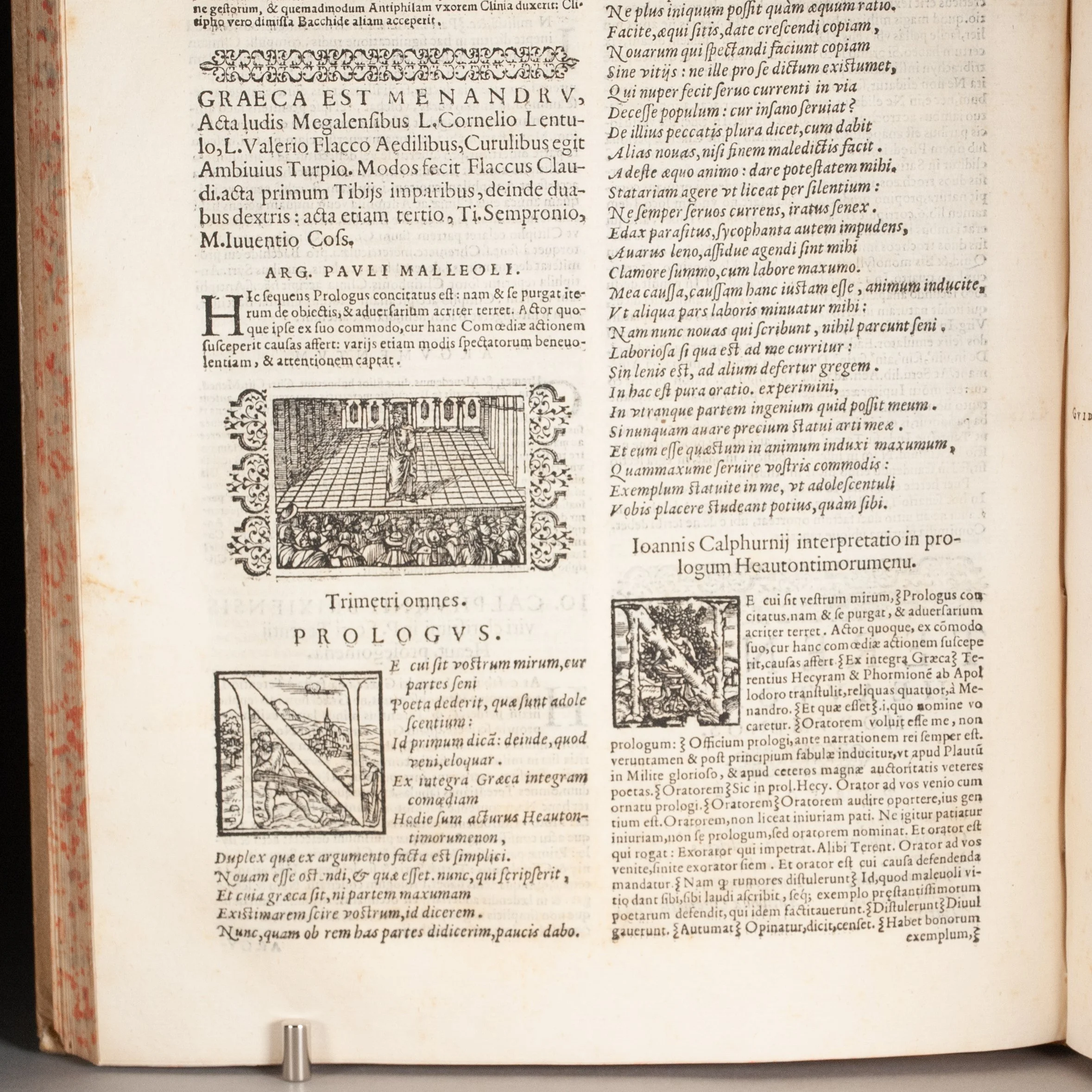 Image 4 of 7
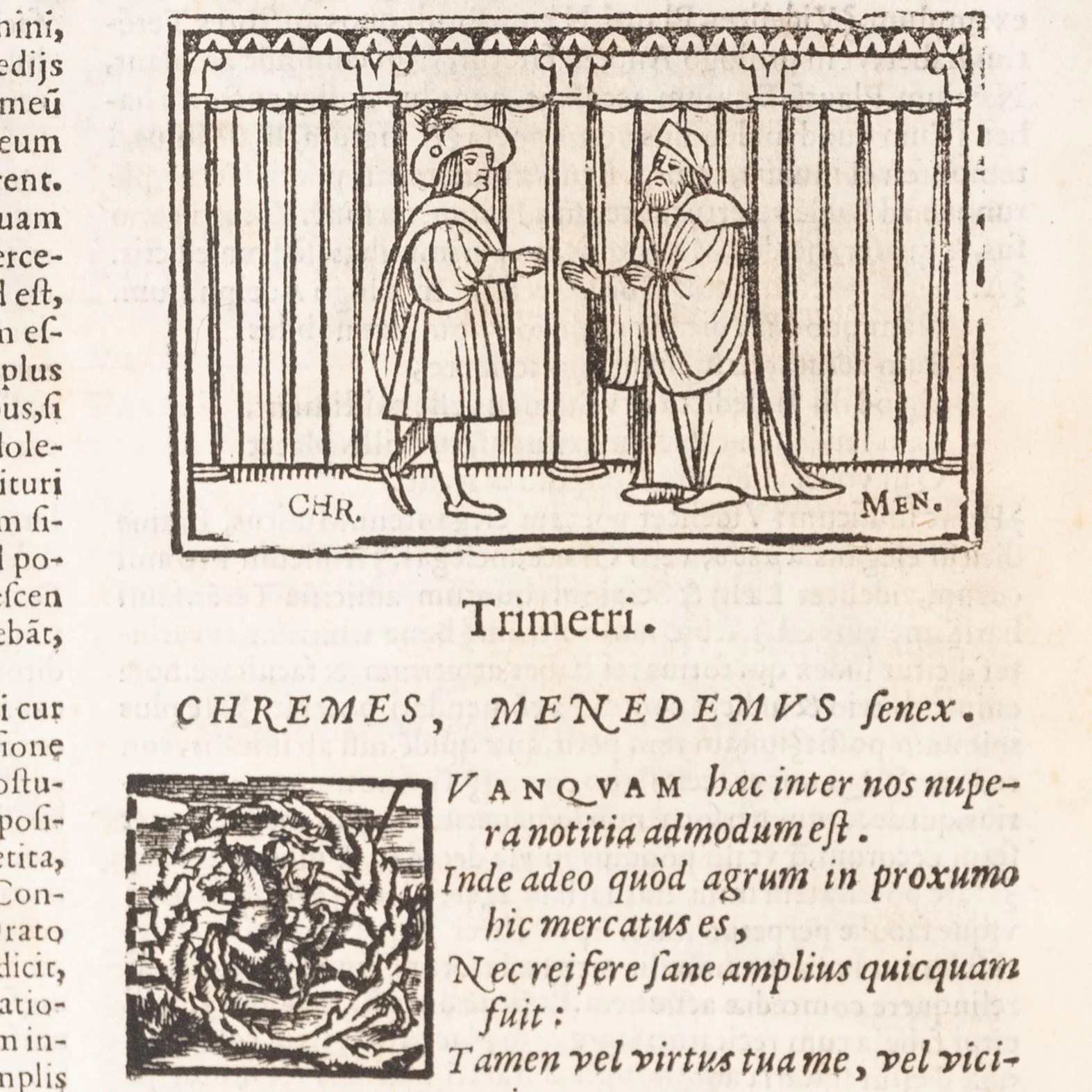 Image 5 of 7
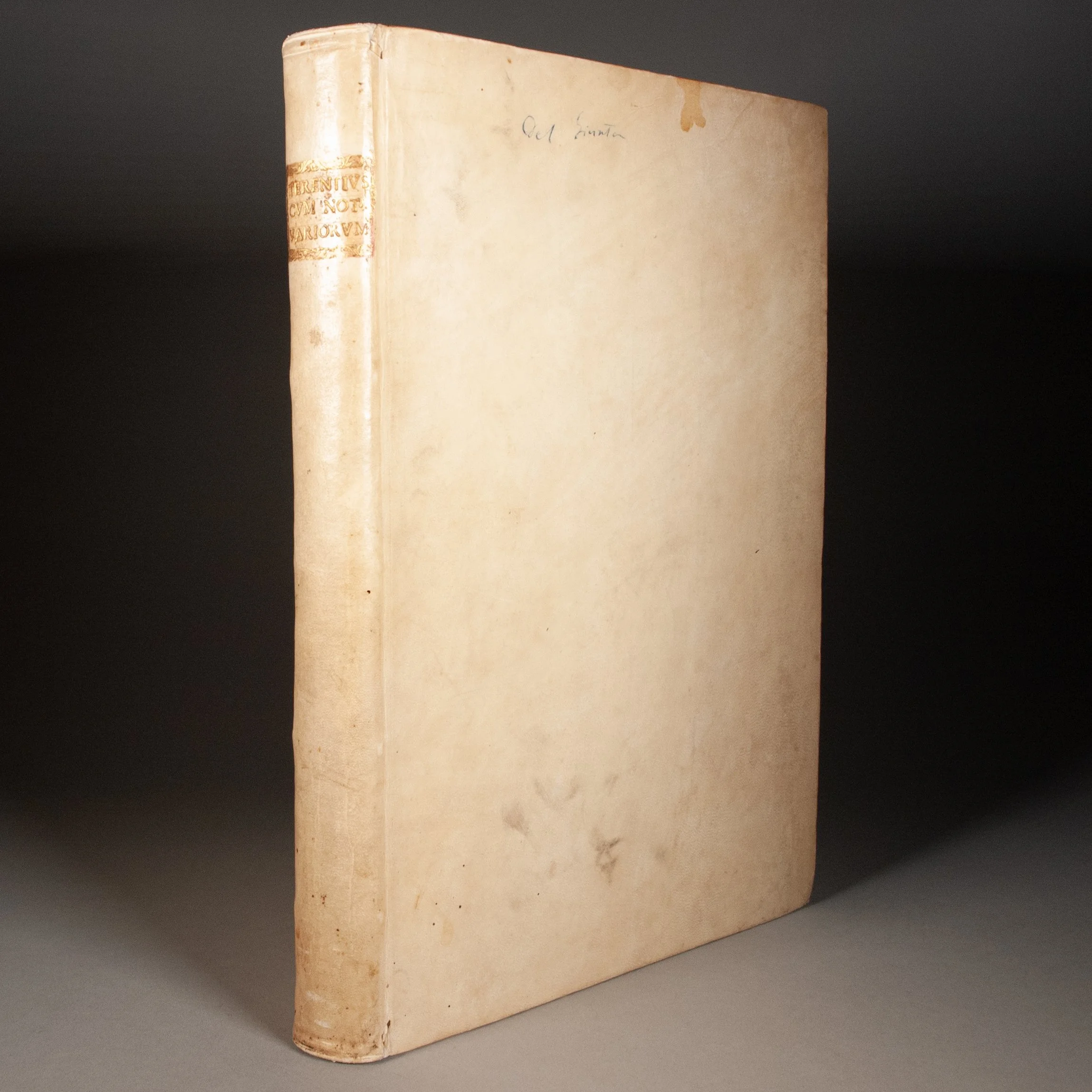 Image 6 of 7
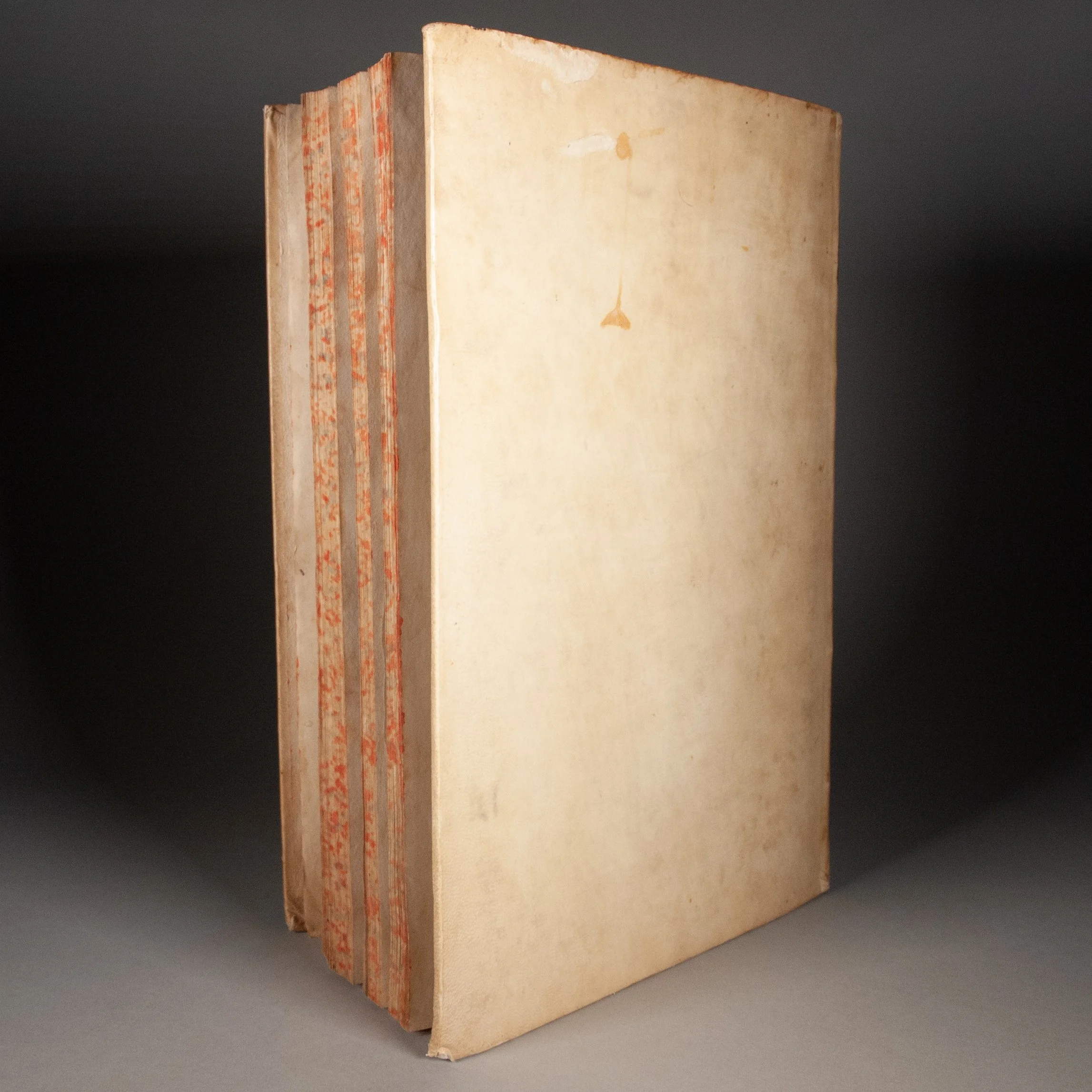 Image 7 of 7