
 Image 1 of 4
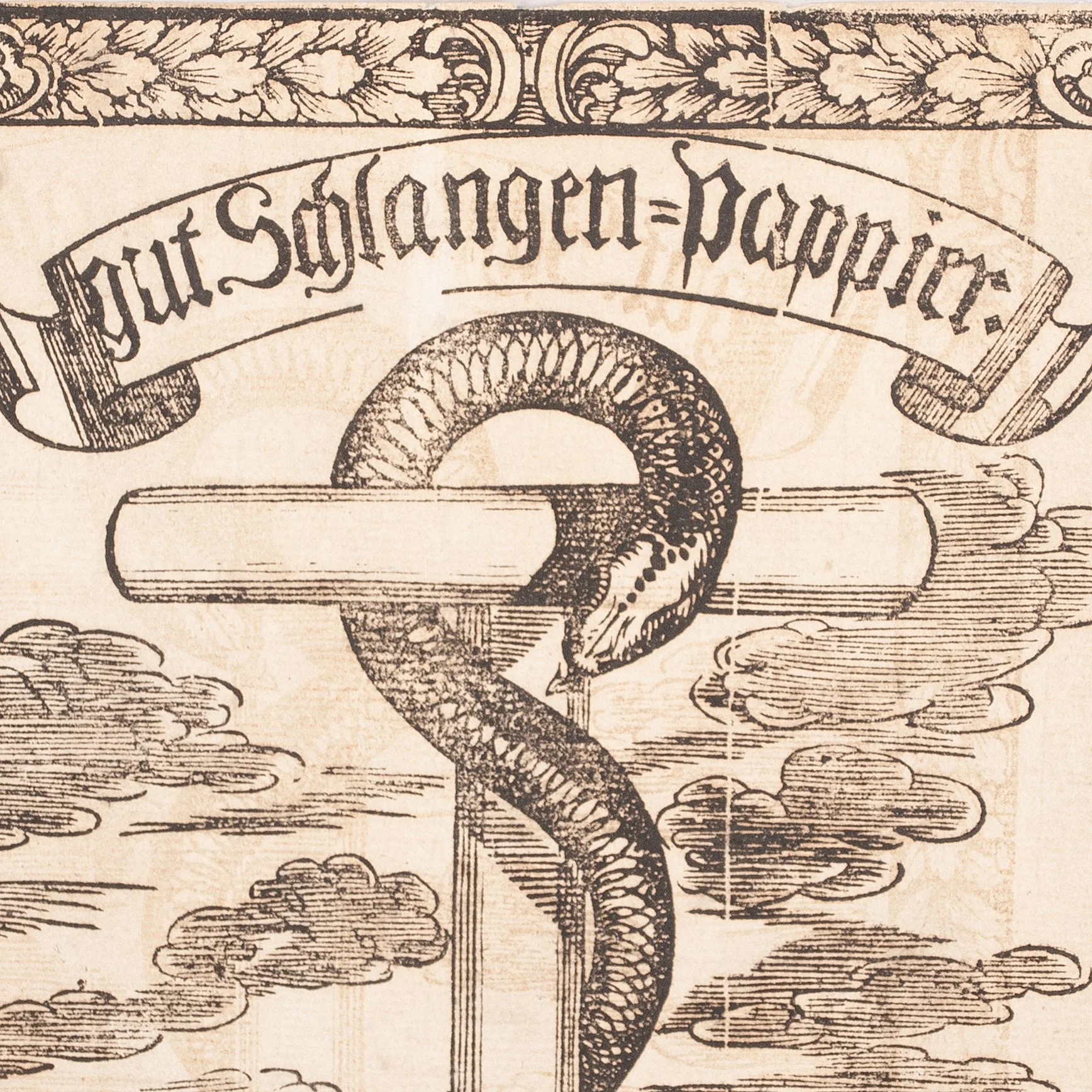 Image 2 of 4
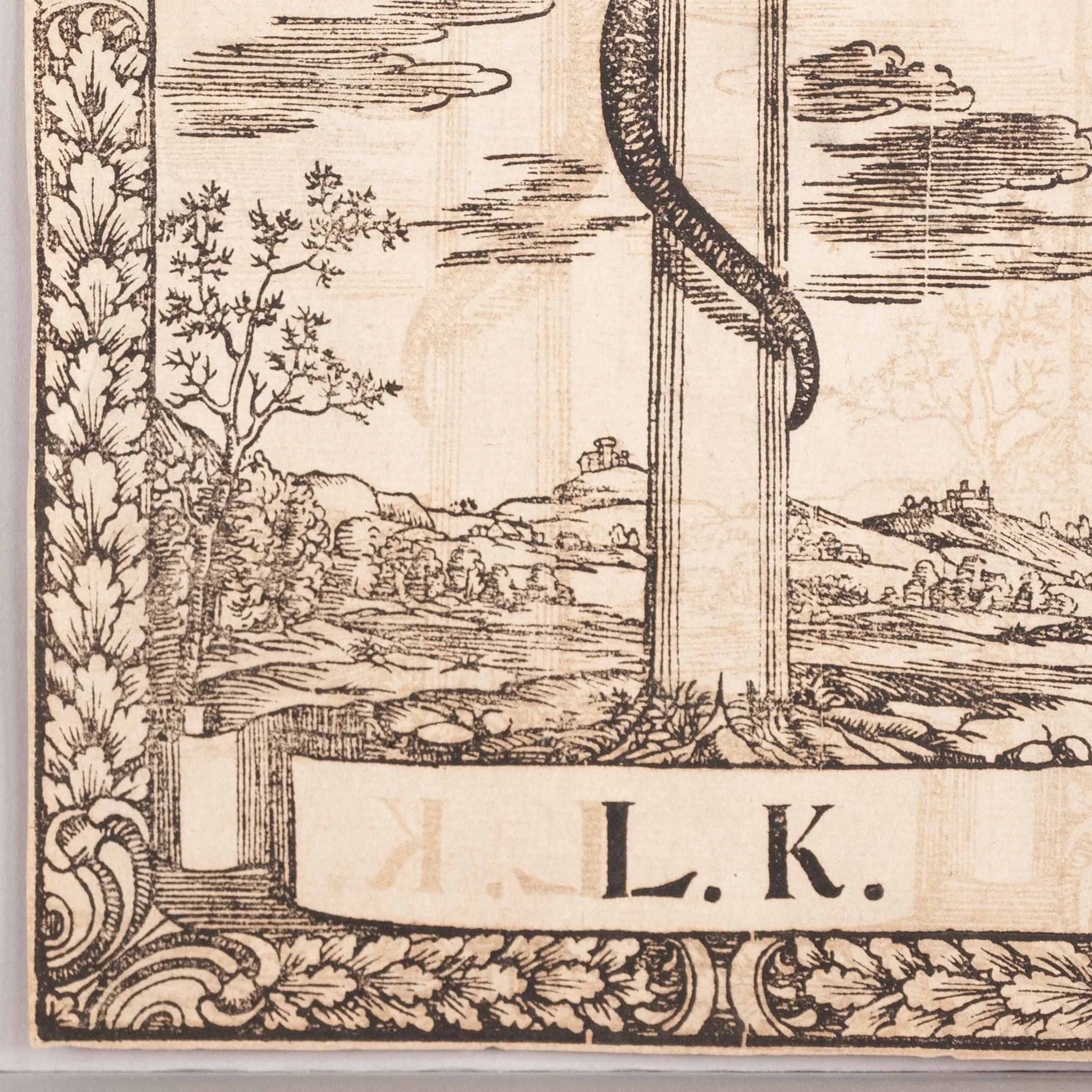 Image 3 of 4
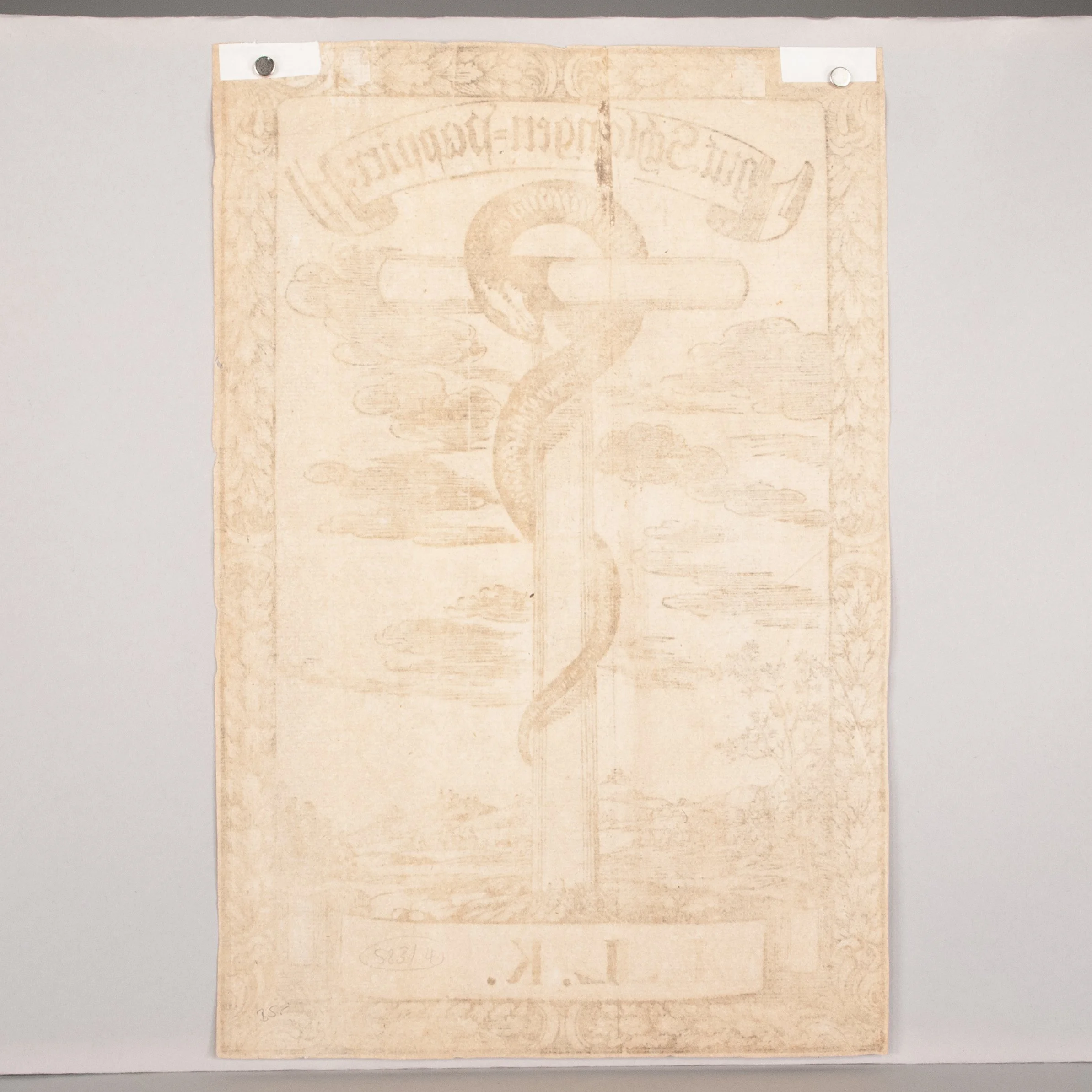 Image 4 of 4
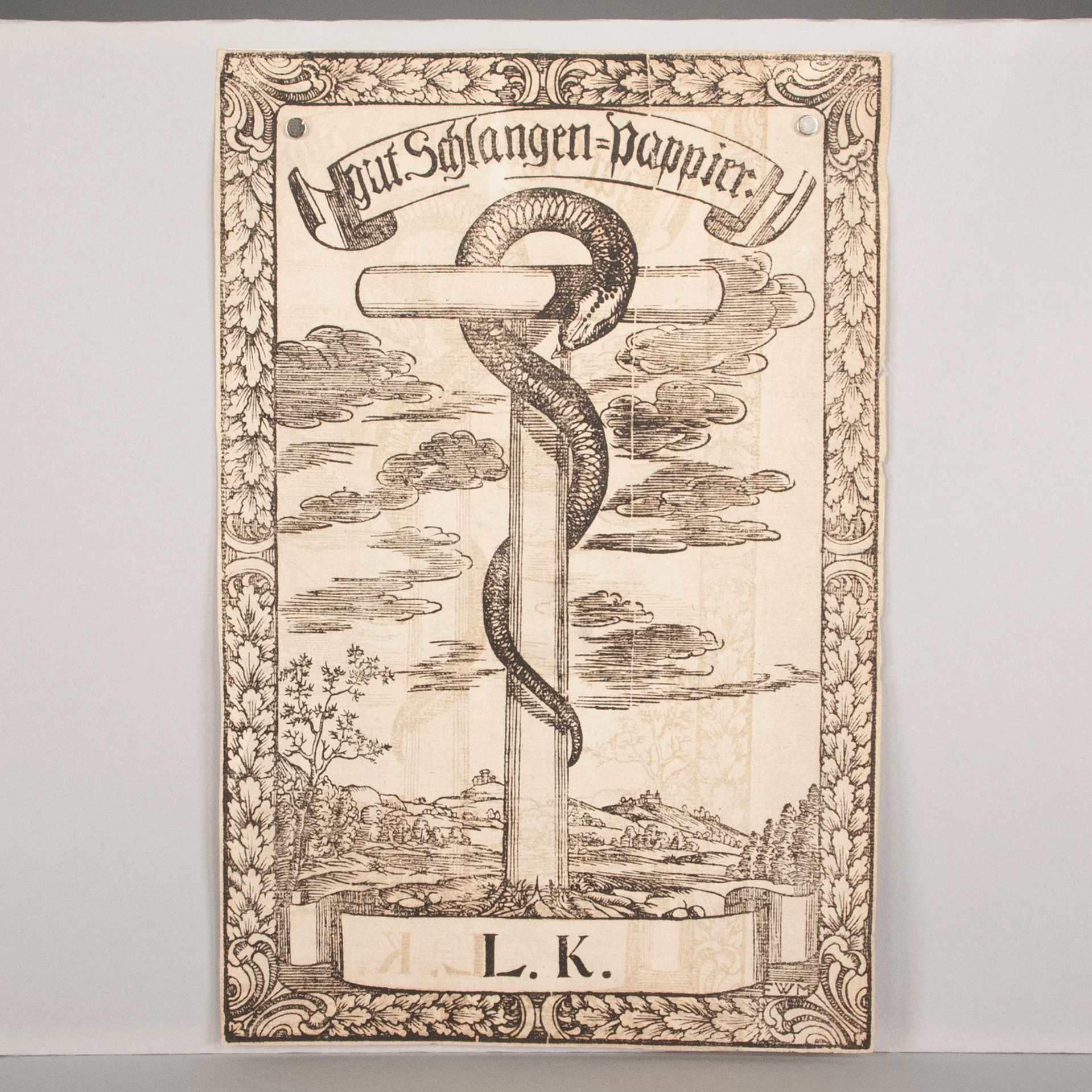
Gut Schlangen-Pappier [Ream wrapper label]
[Southern Germany? 18th century?]
1 woodcut | Half-sheet | 291 x 192 mm
A large woodcut from a ream wrapper—or perhaps, strictly speaking, the label affixed to the primary wrapper. Among our favorite genres of ephemera, a ream wrapper is exactly what it sounds like: a protective sheet used to wrap a ream of new paper for storage, transit, and sale. “Found chiefly with writing paper, ream-wrappers offered more than mere protection during transport; they also served to distinguish a paper’s quality and sort. Ream-wrappers were thus highly-visible commercial advertisements and branding for a widely-distributed, transregional commodity" (Williams). These have unsurprisingly become rather scarce, and we feel duty-bound to quote Voorn’s most persuasive statement from the bookseller’s perspective: “it is not easy to build a private collection since they are seldom offered for sale.” ¶ A ream wrapper's illustration typically matched the watermark of the paper it enclosed (with obvious differences in degree of detail afforded). The motif here, a snake wrapped around a staff or cross, had long been popular and likely came to Southern Germany from Italy. We've been unable to trace any papermakers with initials L.K. known to have used the snake and staff motif. Potential candidates include one Leonhard Karg (1677-1708), who appears to have owned a papermill at Haunritz, east of Nuremberg. A rather exhaustive German website on the history of paper, lacking precise citations but referencing some published scholarship, reports another Leonhard Karg (active 1559-1586) in Rottenburg; Lucas Kesel, a mill owner in Hainbach; Leonhard Knab (1650-1654) in Schafwiesen, Austria; Leopold Knap (1629-1640), also in Schafwiesen; and Ludolf Köhler (1666-1684) in Aumühle, perhaps too far north if the motif was indeed limited to the south of Germany. Given the elaborate nature of the woodcut, we tend to think it later rather than earlier, and prefer the 18th to 17th century. ¶ Nor have we been able to identify the artist who signed this woodcut FWM. He seems unlikely to be Dutch engraver F.W. Musculus, who principally produced engravings and etchings, and the only individual with those initials in G.K. Nagler's Monogrammisten. ¶ We find no other copies.
CONDITION: Printed on the recto only of a half-sheet of laid paper. ¶ Old creases across both dimensions, and a few wrinkles; trimmed very close to the border; two recent paper tabs affixed to top edge of verso, presumably once hinged to a mat, and remnants of an even old pair of paper tabs.
REFERENCES: Henk Voorn, Old Ream Wrappers (Bird & Bull, 1969), p. 23 ("more intricate woodcuts were used as early as the beginning of the seventeenth century"), 25 (cited above), 26 (“Many ream-covers are badly cracked or broken, and in general, perfect copies are rare. Good quality prints can hardly be expected"), 33 (“The illustrations on the ream-wrappers were nearly always the same design as the watermark"); Megan K. Williams, “’Unter dem Zeichen des Adlers’: Frankfurt as Hub of the Central European Paper Trade in the 16th Century,” The Paper Trade in Early Modern Europe (Brill, 2021), p. 77 (cited above); Maurice Rickards, The Encyclopedia of Ephemera (Routledge, 2000), p. 266 (“Many specimens have come down to us with a crease across the image, which results from the use of waste wrappers as improvised files by early office clerks”; of course there could be any number of reasons for a crease, but this does intrigue us); VIAF 306271062 (for Leonhard Karg); Friedrich von Hössle, "Die ältesten Papiermühlen im Kirchenstaat und in den angrenzenden Provinzen," Der Papier-Fabrikant 18.5 (Jan 1920), p. 78 ("Snake paper in general had been made in Italy since 1368," and commenting on a snake and staff watermark from Milan, "was imitated in almost all paper mills in southern Germany"); Karl Springer, "Ettlinger Wasserzeichen," Badische Heimat 15 (1928), p. 238 ("Another watermark, frequently used not only by the Ettlingen paper mill but by all paper mills, and adopted from Italy by the old masters, depicts a snake coiled around a staff, whether to represent the Rod of Asclepius or the temptress climbing the apple tree in Paradise")
Item #914
Gut Schlangen-Pappier [Ream wrapper label]
[Southern Germany? 18th century?]
1 woodcut | Half-sheet | 291 x 192 mm
A large woodcut from a ream wrapper—or perhaps, strictly speaking, the label affixed to the primary wrapper. Among our favorite genres of ephemera, a ream wrapper is exactly what it sounds like: a protective sheet used to wrap a ream of new paper for storage, transit, and sale. “Found chiefly with writing paper, ream-wrappers offered more than mere protection during transport; they also served to distinguish a paper’s quality and sort. Ream-wrappers were thus highly-visible commercial advertisements and branding for a widely-distributed, transregional commodity" (Williams). These have unsurprisingly become rather scarce, and we feel duty-bound to quote Voorn’s most persuasive statement from the bookseller’s perspective: “it is not easy to build a private collection since they are seldom offered for sale.” ¶ A ream wrapper's illustration typically matched the watermark of the paper it enclosed (with obvious differences in degree of detail afforded). The motif here, a snake wrapped around a staff or cross, had long been popular and likely came to Southern Germany from Italy. We've been unable to trace any papermakers with initials L.K. known to have used the snake and staff motif. Potential candidates include one Leonhard Karg (1677-1708), who appears to have owned a papermill at Haunritz, east of Nuremberg. A rather exhaustive German website on the history of paper, lacking precise citations but referencing some published scholarship, reports another Leonhard Karg (active 1559-1586) in Rottenburg; Lucas Kesel, a mill owner in Hainbach; Leonhard Knab (1650-1654) in Schafwiesen, Austria; Leopold Knap (1629-1640), also in Schafwiesen; and Ludolf Köhler (1666-1684) in Aumühle, perhaps too far north if the motif was indeed limited to the south of Germany. Given the elaborate nature of the woodcut, we tend to think it later rather than earlier, and prefer the 18th to 17th century. ¶ Nor have we been able to identify the artist who signed this woodcut FWM. He seems unlikely to be Dutch engraver F.W. Musculus, who principally produced engravings and etchings, and the only individual with those initials in G.K. Nagler's Monogrammisten. ¶ We find no other copies.
CONDITION: Printed on the recto only of a half-sheet of laid paper. ¶ Old creases across both dimensions, and a few wrinkles; trimmed very close to the border; two recent paper tabs affixed to top edge of verso, presumably once hinged to a mat, and remnants of an even old pair of paper tabs.
REFERENCES: Henk Voorn, Old Ream Wrappers (Bird & Bull, 1969), p. 23 ("more intricate woodcuts were used as early as the beginning of the seventeenth century"), 25 (cited above), 26 (“Many ream-covers are badly cracked or broken, and in general, perfect copies are rare. Good quality prints can hardly be expected"), 33 (“The illustrations on the ream-wrappers were nearly always the same design as the watermark"); Megan K. Williams, “’Unter dem Zeichen des Adlers’: Frankfurt as Hub of the Central European Paper Trade in the 16th Century,” The Paper Trade in Early Modern Europe (Brill, 2021), p. 77 (cited above); Maurice Rickards, The Encyclopedia of Ephemera (Routledge, 2000), p. 266 (“Many specimens have come down to us with a crease across the image, which results from the use of waste wrappers as improvised files by early office clerks”; of course there could be any number of reasons for a crease, but this does intrigue us); VIAF 306271062 (for Leonhard Karg); Friedrich von Hössle, "Die ältesten Papiermühlen im Kirchenstaat und in den angrenzenden Provinzen," Der Papier-Fabrikant 18.5 (Jan 1920), p. 78 ("Snake paper in general had been made in Italy since 1368," and commenting on a snake and staff watermark from Milan, "was imitated in almost all paper mills in southern Germany"); Karl Springer, "Ettlinger Wasserzeichen," Badische Heimat 15 (1928), p. 238 ("Another watermark, frequently used not only by the Ettlingen paper mill but by all paper mills, and adopted from Italy by the old masters, depicts a snake coiled around a staff, whether to represent the Rod of Asclepius or the temptress climbing the apple tree in Paradise")
Item #914