Étrennes mignones, curieuses et utiles, augmentées pour l'année bissextile; 1748
Paris: Durand, 1748 [1747?]
[80] p. + [2] folding plates | [A]^8 B-E^8 | 94 x 57 mm
The 1748 edition of a prominent Parisian almanac, in a handsome little painted binding, full of the practical content typical of the genre: annual chronological markers, including the year's predicted eclipses; a monthly calendar for the year, with days of the week, dates, feast days, moon phases, and times of the rising and setting of the sun and moon; a bit of (biblical) chronology and astronomical facts; details for Europe's national courts; tables of French monarchs, church dioceses, and administrative regions, including its overseas colonies; a list of high-ranking French officeholders; sundry facts and news, including a table of Parisian libraries and their operating days; exchange rates; and a comprehensive French chronology. Also includes a folding map of France at front, and one at back showing the Italian theatre of war (for the War of the Austrian Succession?). ¶ While our painted binding is admittedly off the beaten path, it fits right into the rich variety of bindings found on 18th-century French almanacs. To be sure, this quintessentially quotidian genre provided a platform for a wild variety of elaborate, and frequently groundbreaking, binding styles. Our covers here depict angels holding sacred hearts, set in romantic landscapes that gesture at a fashion for ancient ruins (our angels even wear knee-high strapped sandals). Inscribed beneath the painting on the front cover: Vous avés le secret de mon coeur ("You have the secret of my heart"), and beneath the rear, Je vous en offre les prémices ("I offer you the first fruits of it"). Little étrennes like this, all but synonymous with almanac, were frequently given as New Year's gifts, to which the latter inscription may refer. And men commonly gifted sumptuously bound almanacs to their ladies, which we suspect was the case here, hence the loving inscription on the front cover. ¶ Painted bindings certainly represent a small fraction of total output, but examples of such miniatures do occasionally turn up in our reference sources. We find in an Eric Speeckaert catalog, for example, two Liège Etrennes mignonnes in embroidered bindings with painted scenes on their covers, and the almanac collection of Henri Lavedan (1859-1940) contained a few such charmingly painted pocket calendars. Painted bindings have a long history, too, perhaps best represented by the famous wooden tavolette bindings on late medieval Siena account books (and frequently forged by a much later Siennese craftsman). ¶ Subject to the vagaries of serials cataloging, but we find no copies of this 1748 edition in North America.
CONDITION: Contemporary boards, the front and back covered with miniatures painted on paper (varnished), the spine and board edges covered with embossed green paper. The endpapers are fashioned from a handsome red and gold brocade paper laminated with silk, forming an expandable pocket at rear. ¶ The maps a bit crinkled, and the Paris map stained at its fore-edge. Much of the green paper has flaked away from the spine and front joint; something possibly lost from the inside front cover (a mirror?).
REFERENCES: Henri Lavedan, Almanachs chantants et galants du XVIIIe siècle (1928), #1 and #10 (mosaic bindings with paintings in a similar spirit), #32 (very much like ours, and which we sold in 2024); Louis W. Bondy, Miniature Books (1981), p. 48 (“France is perhaps the country where the art of the almanac reached its highest peak"); Geneviève Bollème, Les almanachs populaires aux XVIIe et XVIIIe siècles (1969), p. 38 ("the 18th century is indeed the great age of the almanac"); Claude Sorgeloos (for Eric Speeckaert), Quatre siecles de reliure en Belgique 1500-1900 (1999), v. 3, p. 202-205 (the Liège embroidered bindings)
Item #769
Étrennes mignones, curieuses et utiles, augmentées pour l'année bissextile; 1748
Paris: Durand, 1748 [1747?]
[80] p. + [2] folding plates | [A]^8 B-E^8 | 94 x 57 mm
The 1748 edition of a prominent Parisian almanac, in a handsome little painted binding, full of the practical content typical of the genre: annual chronological markers, including the year's predicted eclipses; a monthly calendar for the year, with days of the week, dates, feast days, moon phases, and times of the rising and setting of the sun and moon; a bit of (biblical) chronology and astronomical facts; details for Europe's national courts; tables of French monarchs, church dioceses, and administrative regions, including its overseas colonies; a list of high-ranking French officeholders; sundry facts and news, including a table of Parisian libraries and their operating days; exchange rates; and a comprehensive French chronology. Also includes a folding map of France at front, and one at back showing the Italian theatre of war (for the War of the Austrian Succession?). ¶ While our painted binding is admittedly off the beaten path, it fits right into the rich variety of bindings found on 18th-century French almanacs. To be sure, this quintessentially quotidian genre provided a platform for a wild variety of elaborate, and frequently groundbreaking, binding styles. Our covers here depict angels holding sacred hearts, set in romantic landscapes that gesture at a fashion for ancient ruins (our angels even wear knee-high strapped sandals). Inscribed beneath the painting on the front cover: Vous avés le secret de mon coeur ("You have the secret of my heart"), and beneath the rear, Je vous en offre les prémices ("I offer you the first fruits of it"). Little étrennes like this, all but synonymous with almanac, were frequently given as New Year's gifts, to which the latter inscription may refer. And men commonly gifted sumptuously bound almanacs to their ladies, which we suspect was the case here, hence the loving inscription on the front cover. ¶ Painted bindings certainly represent a small fraction of total output, but examples of such miniatures do occasionally turn up in our reference sources. We find in an Eric Speeckaert catalog, for example, two Liège Etrennes mignonnes in embroidered bindings with painted scenes on their covers, and the almanac collection of Henri Lavedan (1859-1940) contained a few such charmingly painted pocket calendars. Painted bindings have a long history, too, perhaps best represented by the famous wooden tavolette bindings on late medieval Siena account books (and frequently forged by a much later Siennese craftsman). ¶ Subject to the vagaries of serials cataloging, but we find no copies of this 1748 edition in North America.
CONDITION: Contemporary boards, the front and back covered with miniatures painted on paper (varnished), the spine and board edges covered with embossed green paper. The endpapers are fashioned from a handsome red and gold brocade paper laminated with silk, forming an expandable pocket at rear. ¶ The maps a bit crinkled, and the Paris map stained at its fore-edge. Much of the green paper has flaked away from the spine and front joint; something possibly lost from the inside front cover (a mirror?).
REFERENCES: Henri Lavedan, Almanachs chantants et galants du XVIIIe siècle (1928), #1 and #10 (mosaic bindings with paintings in a similar spirit), #32 (very much like ours, and which we sold in 2024); Louis W. Bondy, Miniature Books (1981), p. 48 (“France is perhaps the country where the art of the almanac reached its highest peak"); Geneviève Bollème, Les almanachs populaires aux XVIIe et XVIIIe siècles (1969), p. 38 ("the 18th century is indeed the great age of the almanac"); Claude Sorgeloos (for Eric Speeckaert), Quatre siecles de reliure en Belgique 1500-1900 (1999), v. 3, p. 202-205 (the Liège embroidered bindings)
Item #769

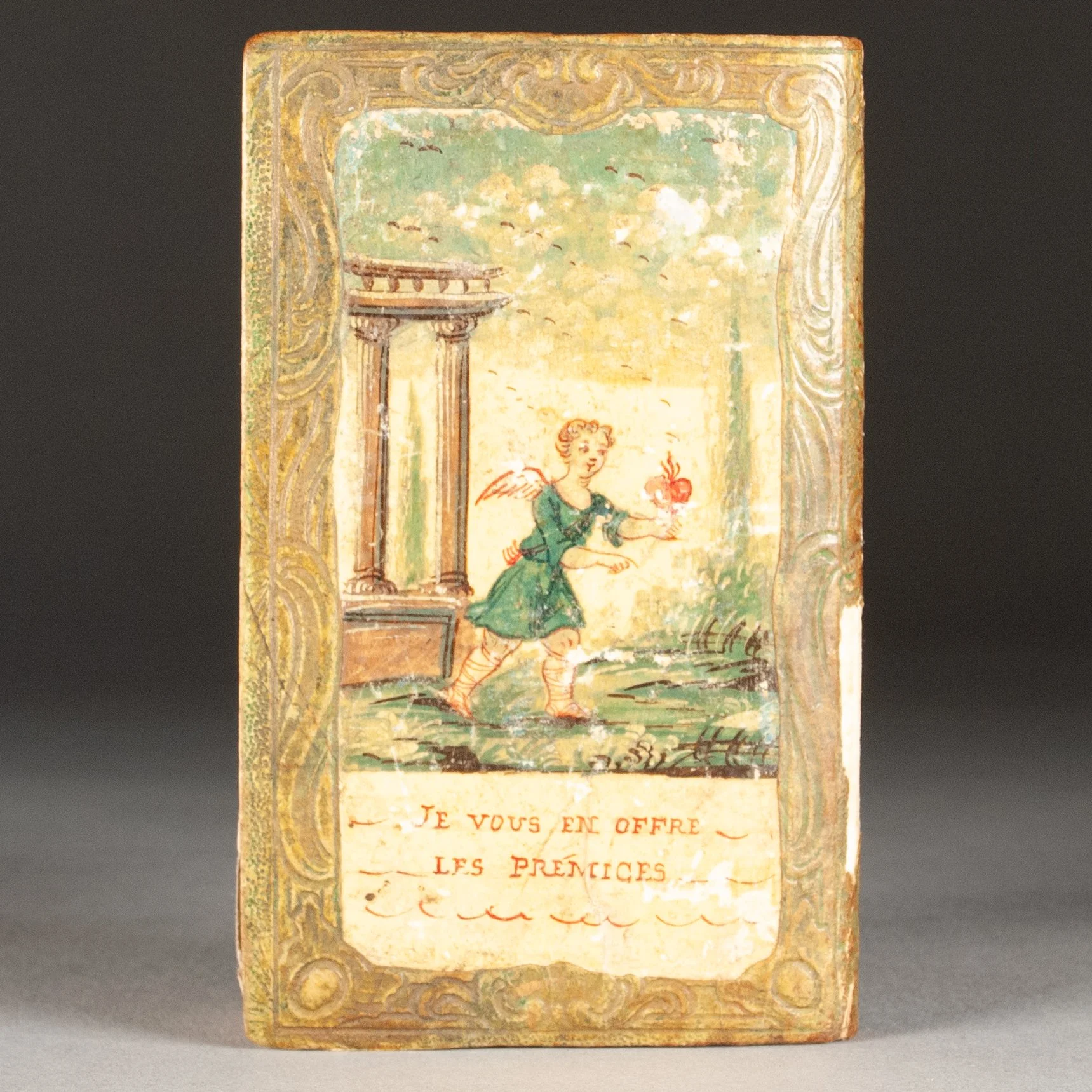 Image 1 of 8
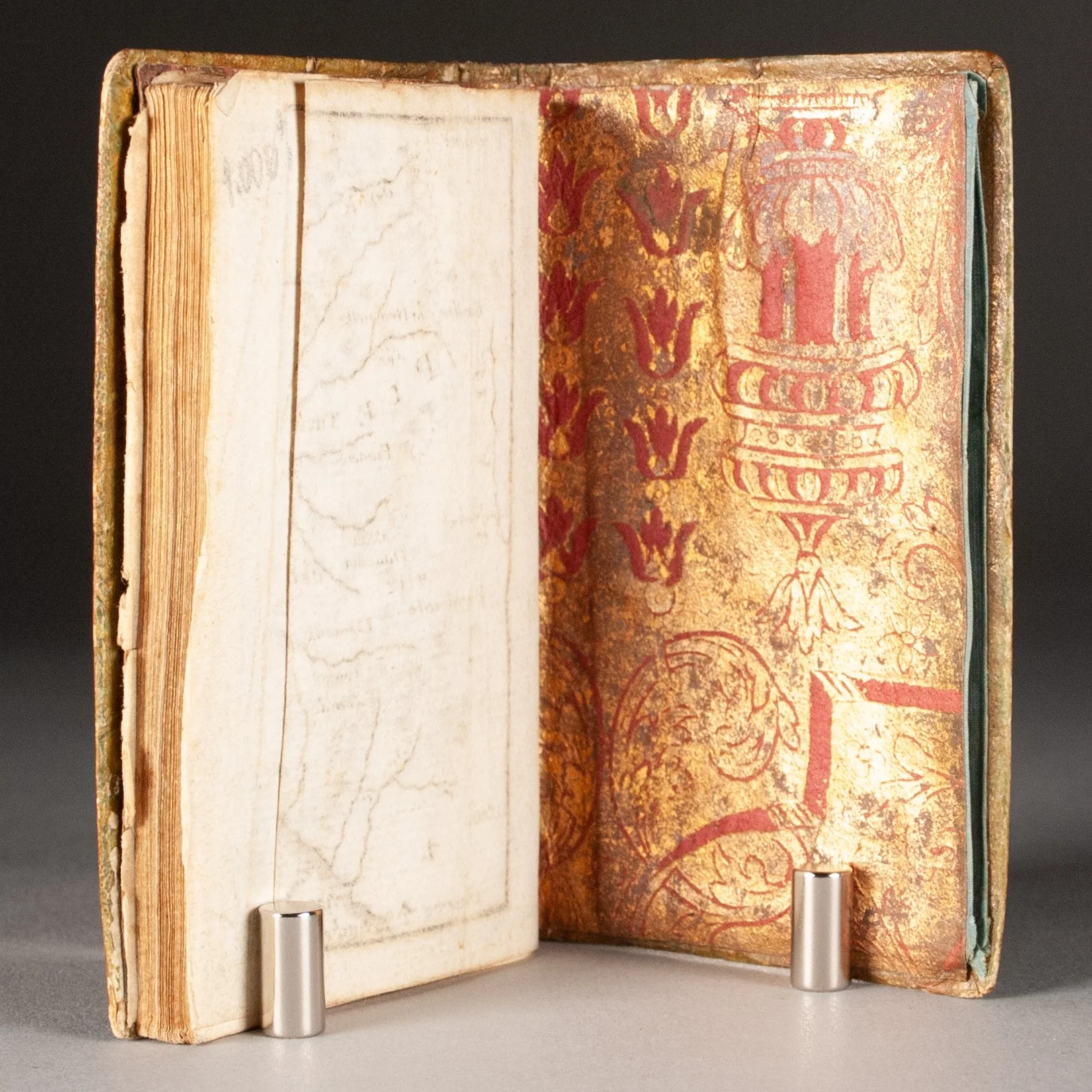 Image 2 of 8
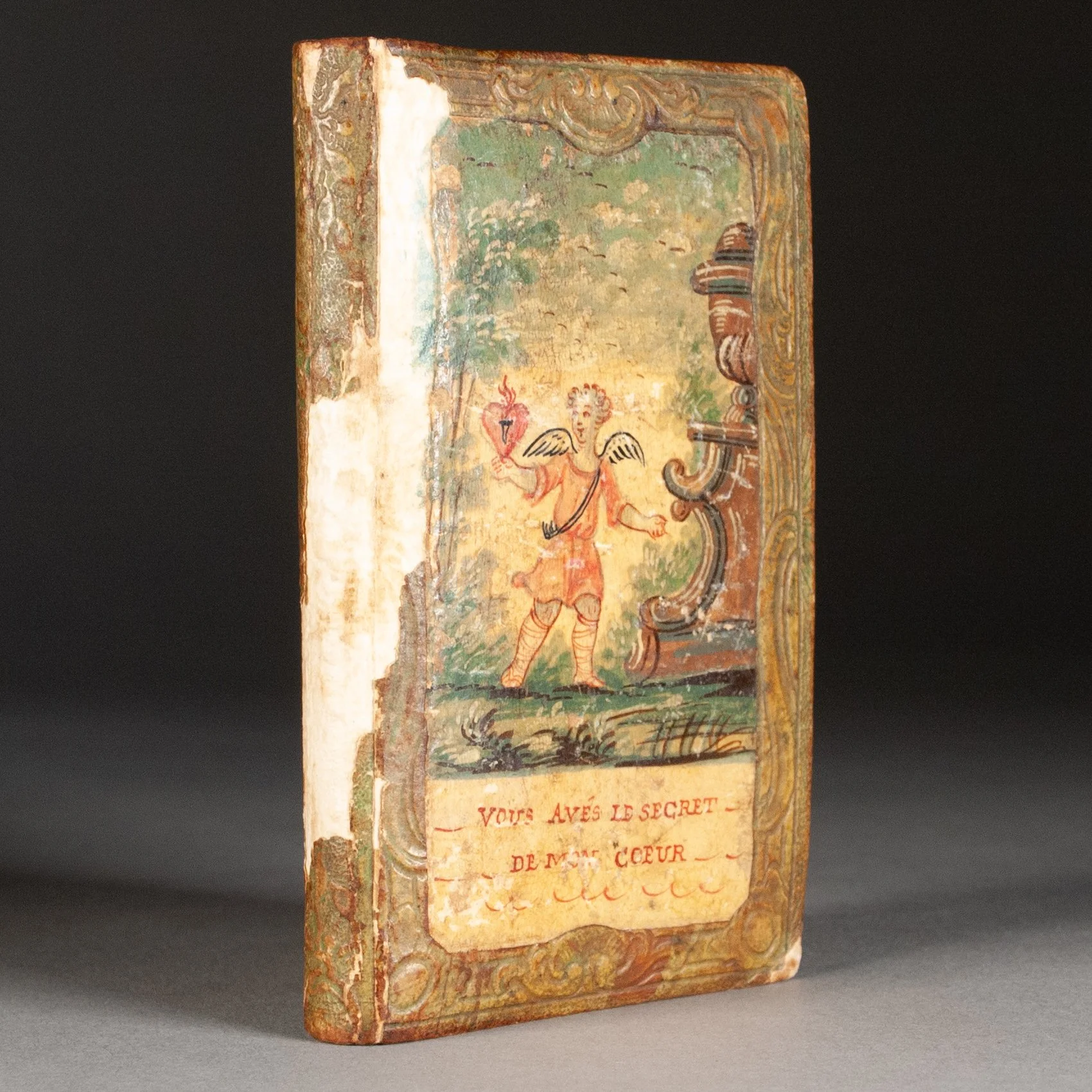 Image 3 of 8
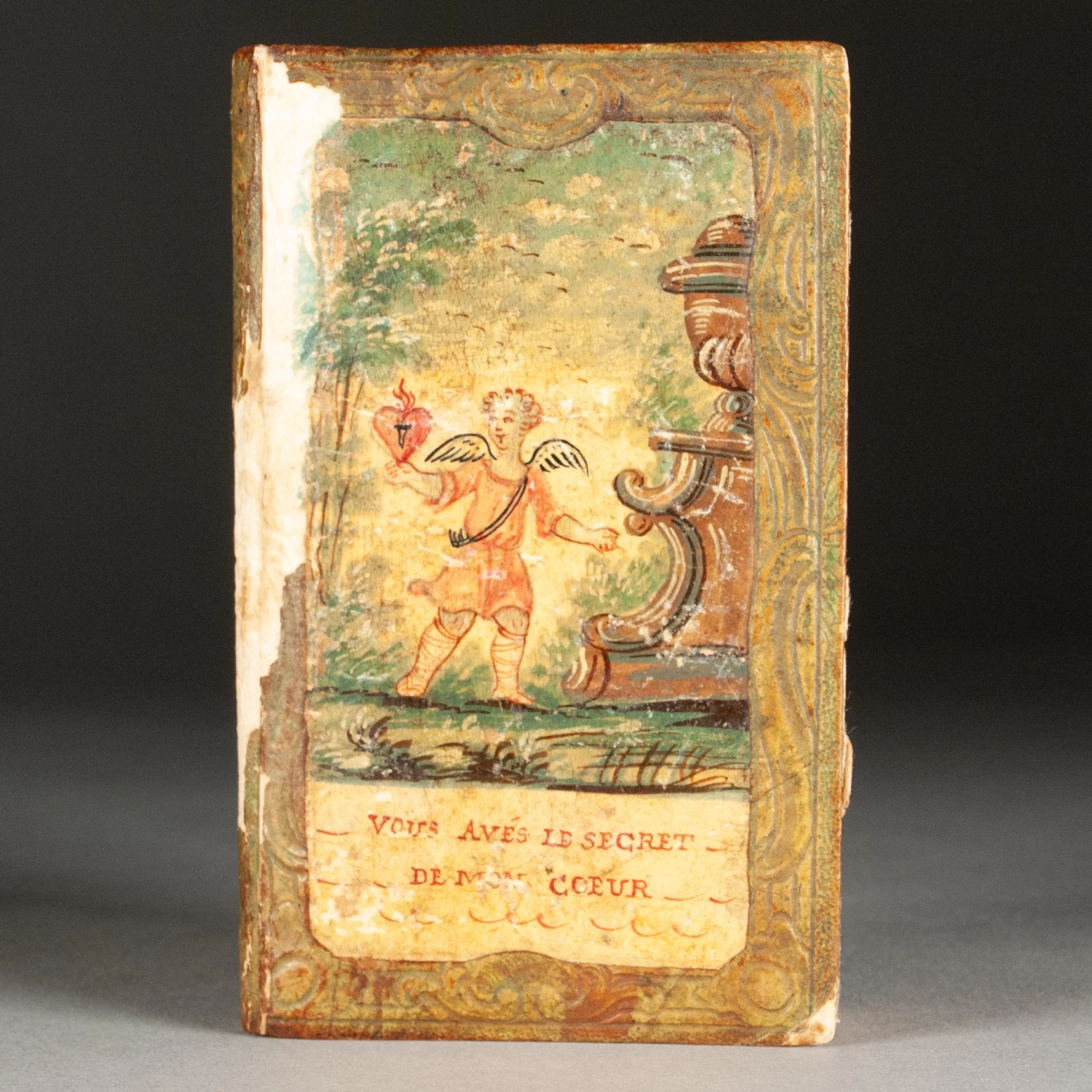 Image 4 of 8
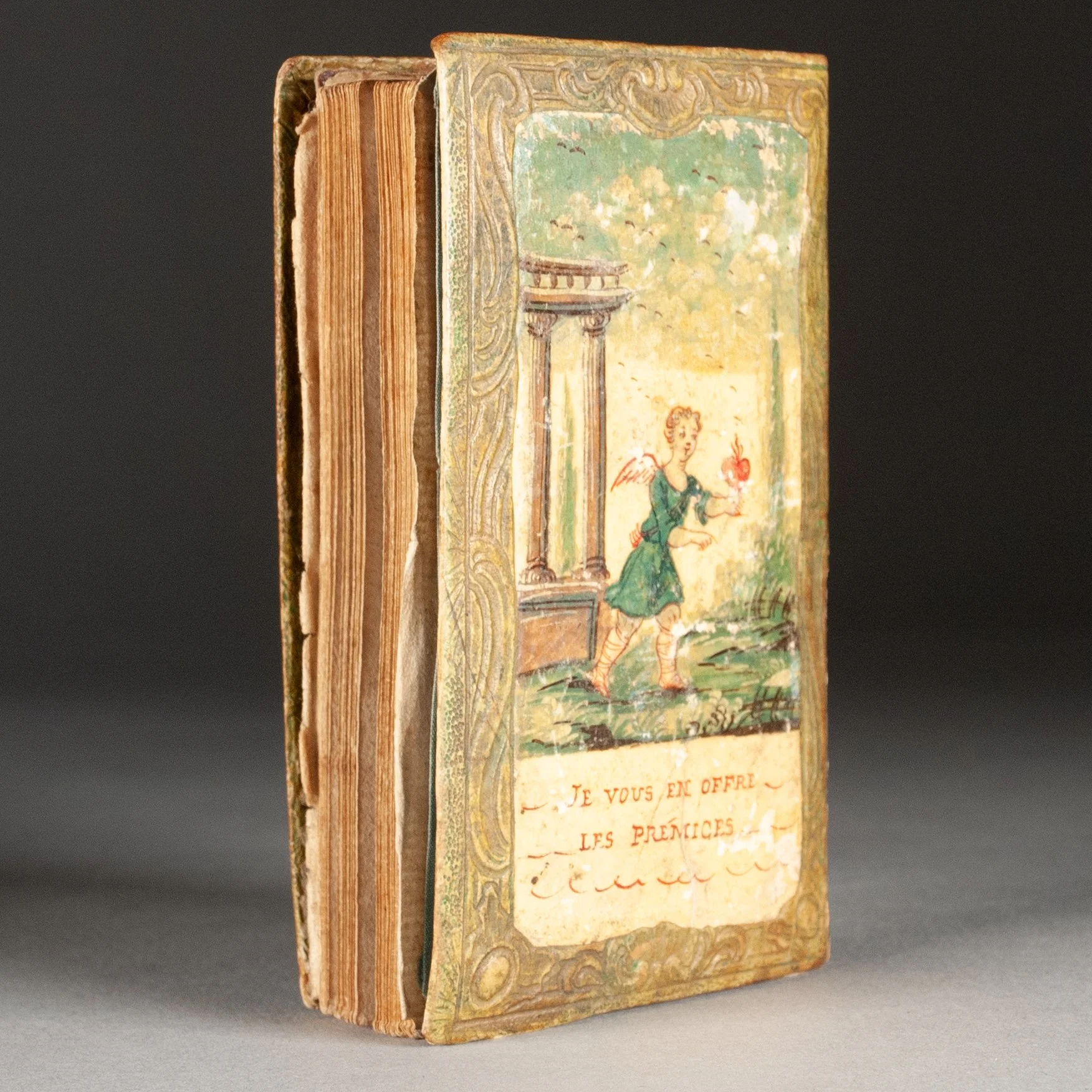 Image 5 of 8
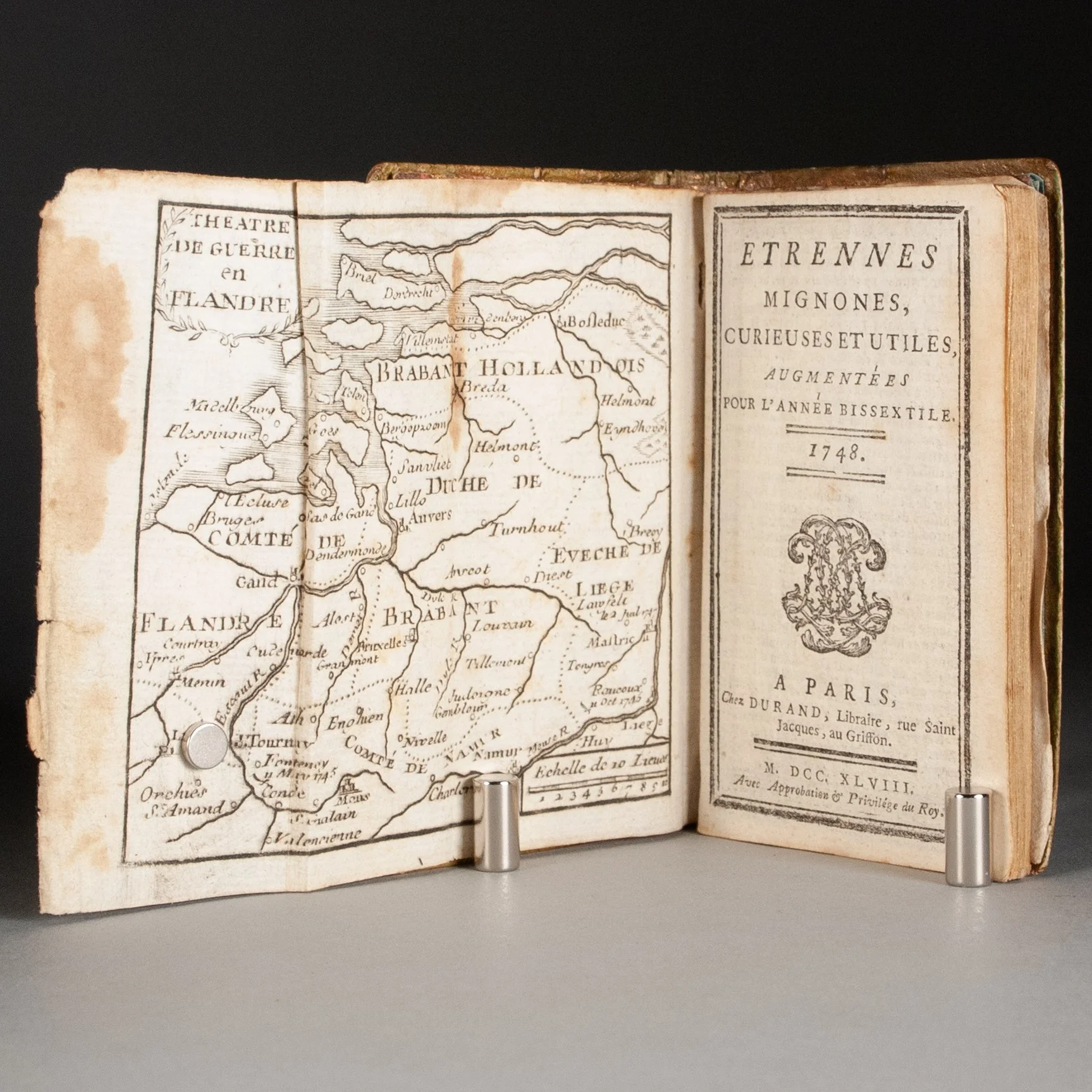 Image 6 of 8
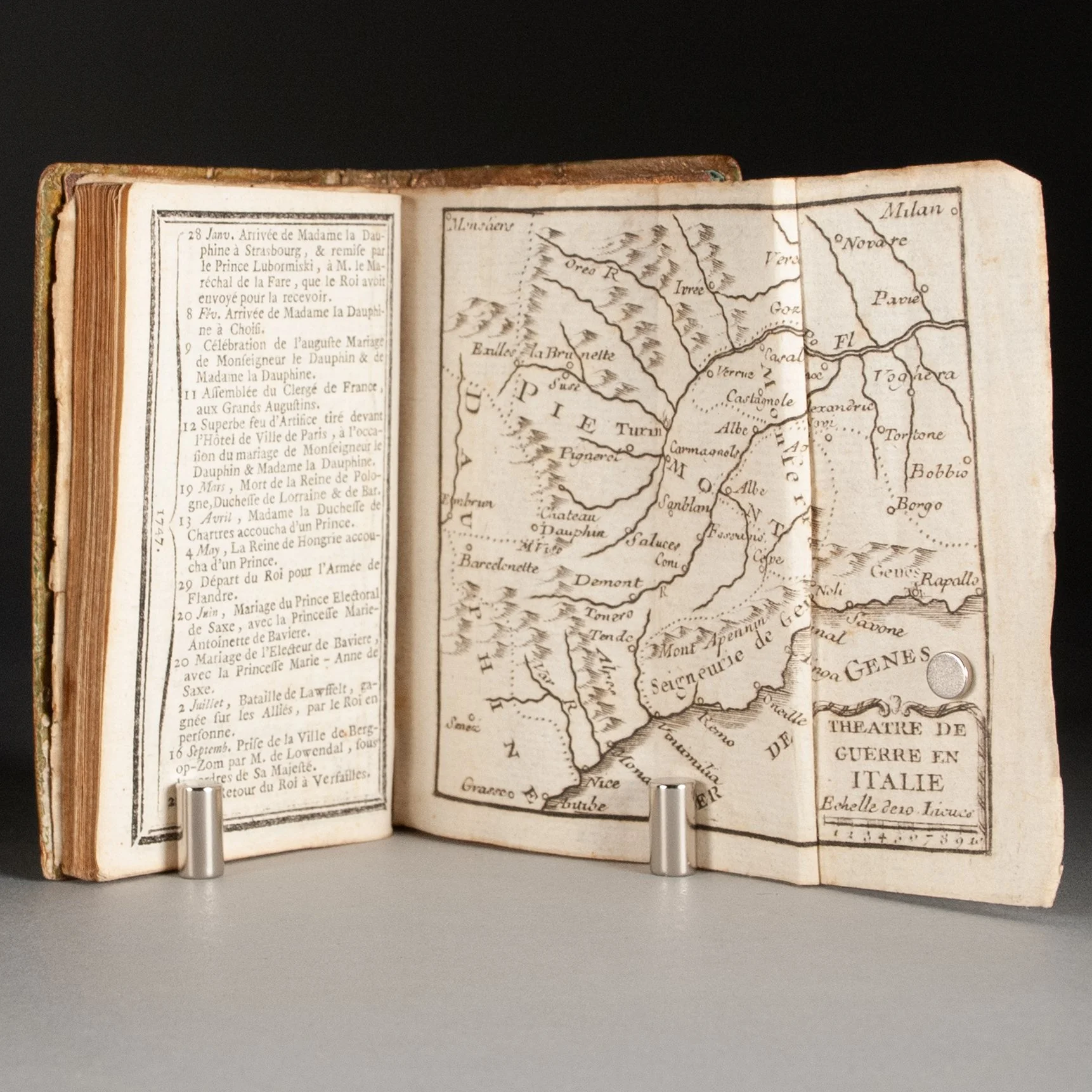 Image 7 of 8
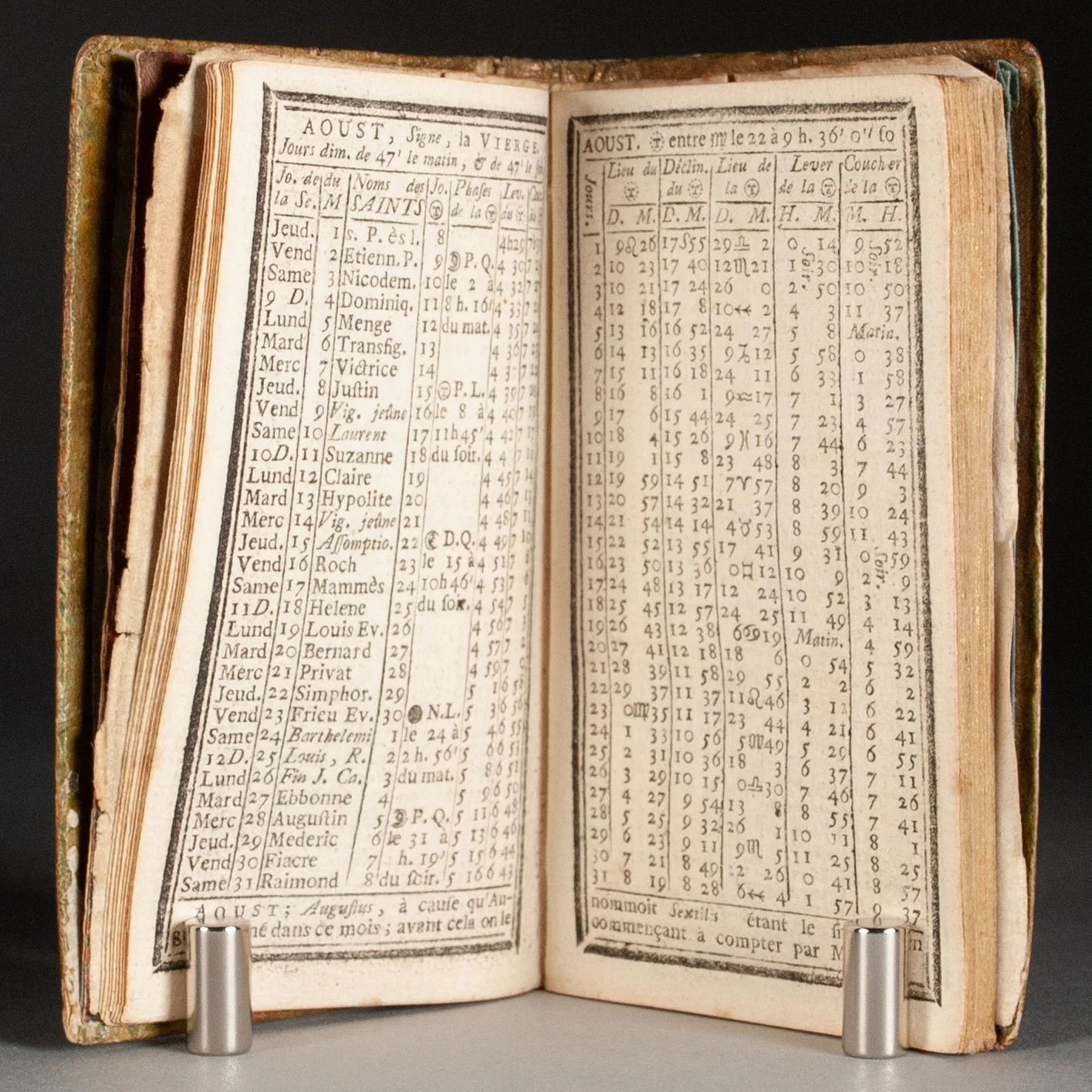 Image 8 of 8