
 Image 1 of 5
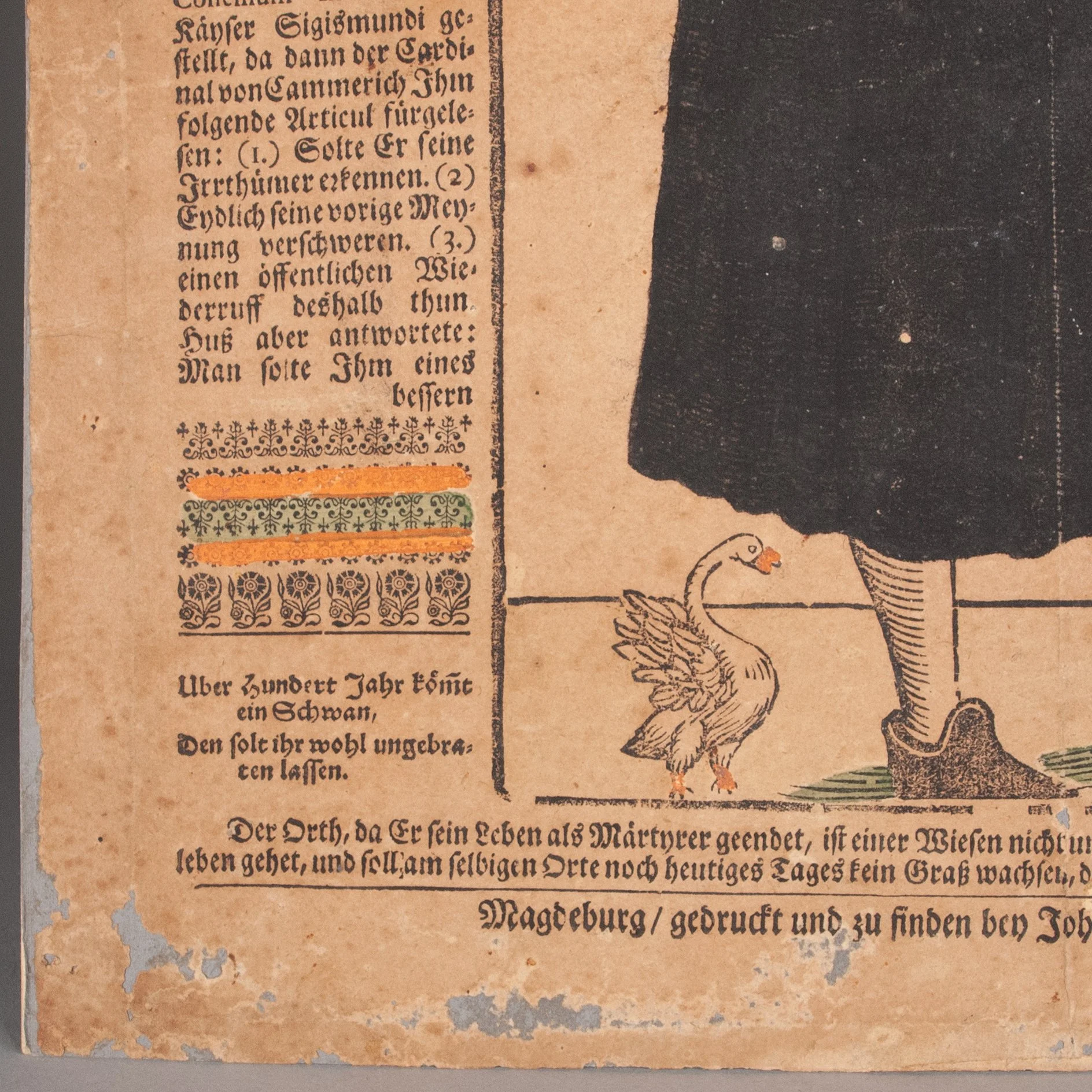 Image 2 of 5
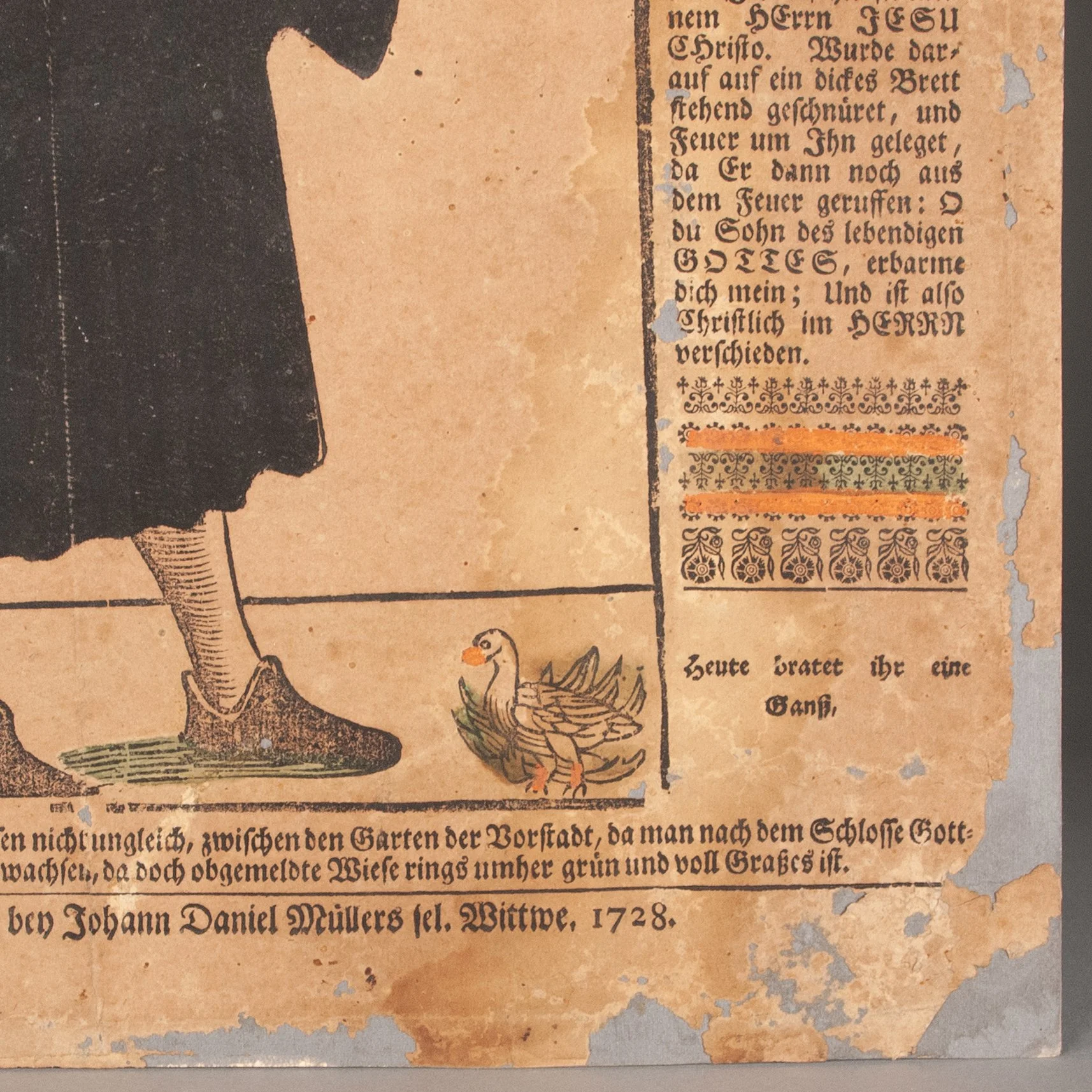 Image 3 of 5
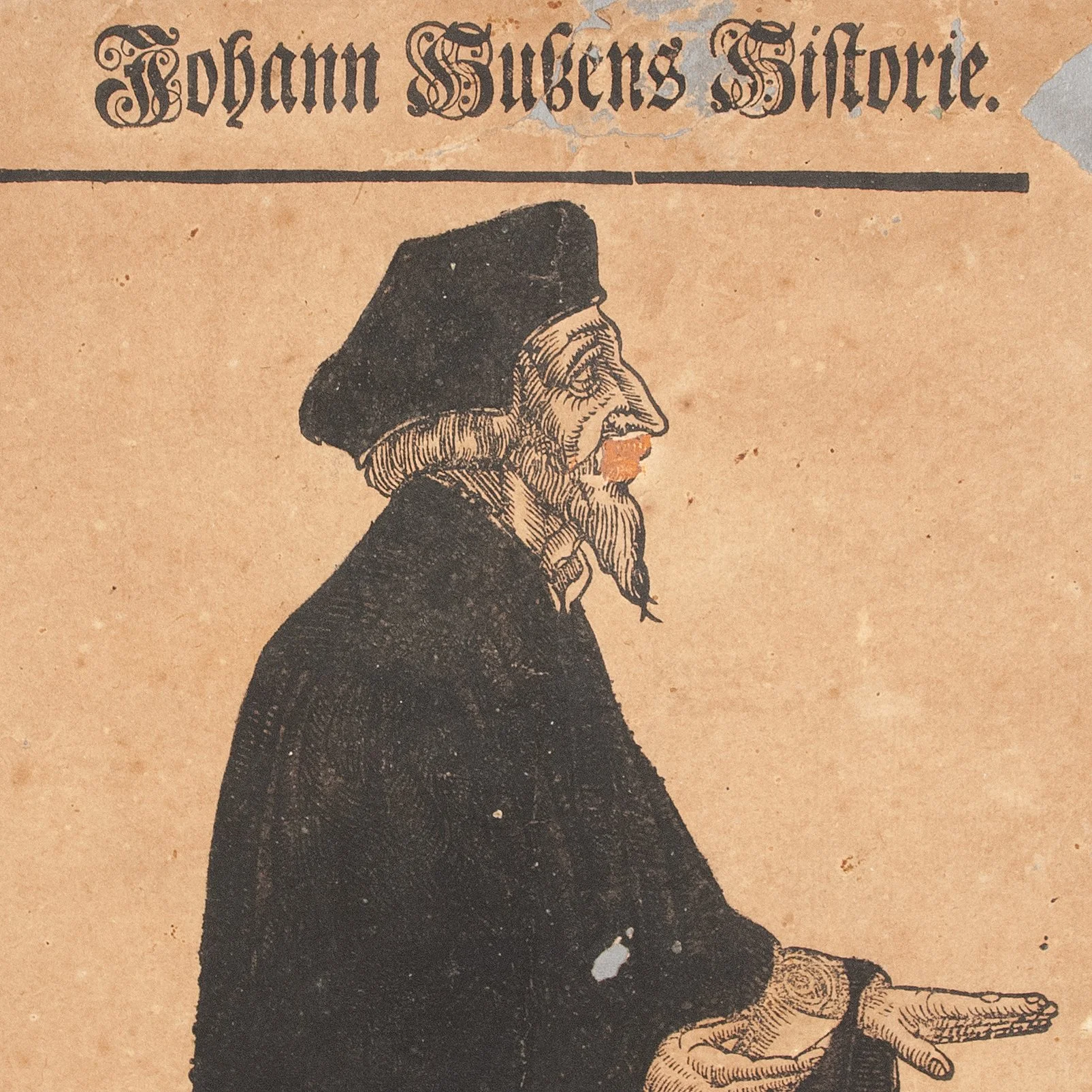 Image 4 of 5
 Image 5 of 5
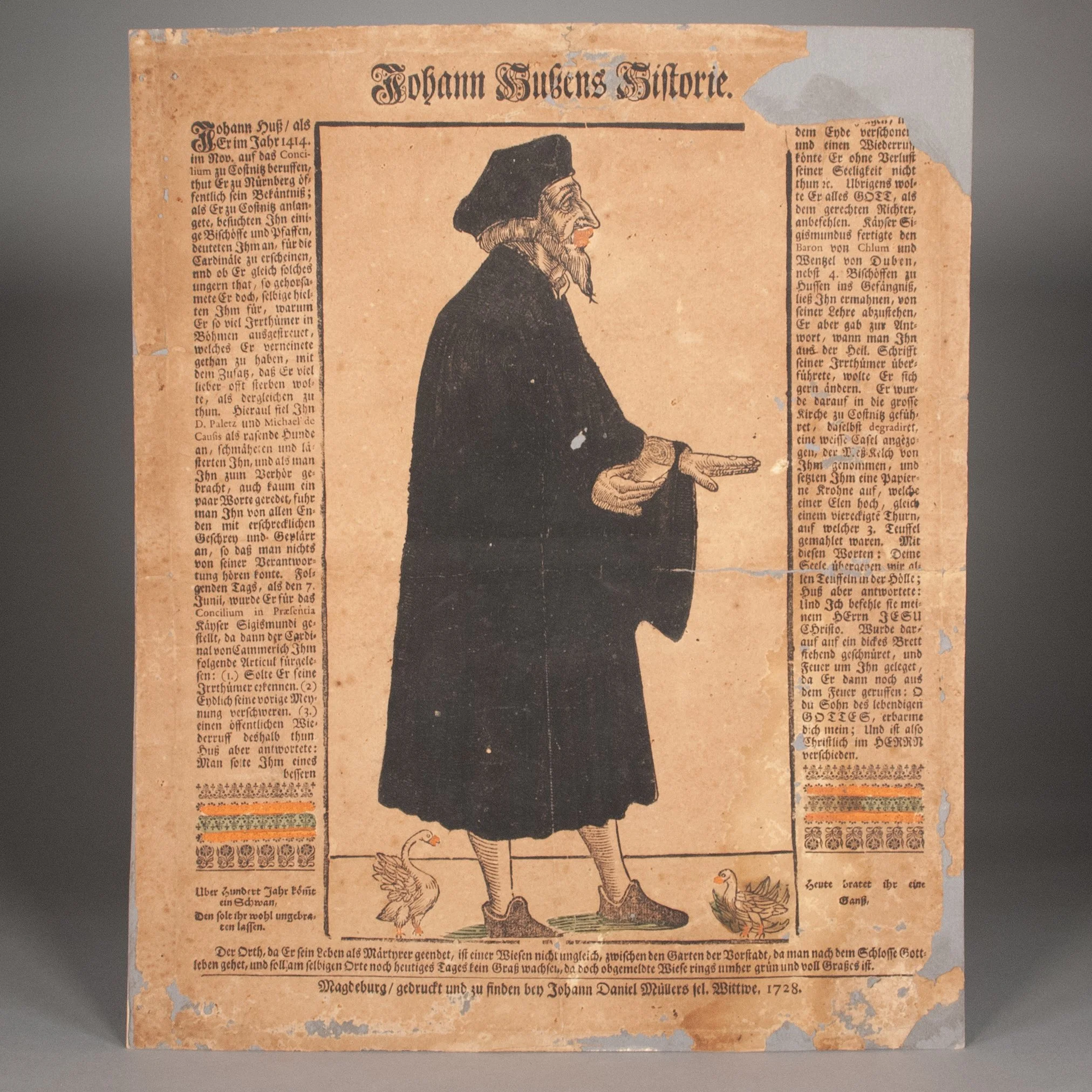
Johann Hussens Historie
Magdeburg: Widow of Johann Daniel Müller, 1728
1 broadside | Full-sheet | 397 x 326 mm
A rare German broadside recounting the story of Jan Hus, the Czech priest frequently cited as the first church reformer, a kind of proto-Protestant. He took issue with the sale of indulgences, for example, among other issues. Where he falls on the spectrum of reformation is surely more nuanced, since he retained some vital tenets of the faith, though it's perhaps likewise unfair to call him simply a rote follower of John Wycliffe. Historians will surely continue to debate his role, but there's no denying Hus was "a luminary of late medieval dissent" (Fudge). The Catholic Church excommunicated him, though it did nothing to suppress his controversial preaching. Lured to the Council of Constance by promises of a good-faith theological discussion, he was instead promptly imprisoned. Refusing to recant, he was declared a heretic and burned at the stake on 6 July 1415. Our broadside, clearly sympathetic to Hus, focuses on his innocent attendance at Konstanz and betrayal by a malicious church. ¶ The woodcut occupying most of the sheet—fully a foot tall—appears to be a very close copy of one used some two centuries earlier by Nuremberg printer Hans Guldenmund (1490-1560). In truth, we're not certain ours wasn't printed from the very same block. Ours is so thoroughly covered in dark paint, and the only Guldenmund reproduction we've found so low-res, that we've been unable to make a satisfactory comparison. Guldenmund's woodcut may well have been original, though its likeness of Hus in profile is strongly reminiscent of a slightly earlier woodcut by Erhard Schön. The verses flanking the bottom recall Hus's alleged declaration before his death: "Today you roast a goose, but in a hundred years a swann will rise from the ashes." The quote actually starts on the right side of the image, which we suspect was a compositor's mistake. The swan left of Hus's feet alludes to this quote, while the goose to his right puns on the reformer's name, which means goose in Czech. The text beneath his feet promulgates the legend that grass still refuses to grow from the soil where Hus was burned. ¶ The broadside also represents a scarce production from this woman-owned press, the business of Johann Daniel Müller having been split between his widow and his son following his death in 1726. VD18 reports just a dozen imprints from Müller's widow. ¶ We locate no other copies.
CONDITION: Fully mounted to a sheet of blue-gray board from perhaps the early 20th century. The broadside hand-colored, Hus's attire with a black or very dark brown, and elsewhere with bright orange-red highlights. ¶ Tears and loss in the margins, with several square inches of loss in the upper right affecting some text, and the title a bit mangled; some hard creases (now quite flattened), one of them resulting in a closed tear across nearly half the width; moderately soiled and dampstained. The board to which it's mounted previously hosted something else, with adhesive residue and a hand-drawn frame on the verso. Certainly worn, but stable in this mounted condition.
REFERENCES: Thomas A. Fudge, "Hus, Jan," The Oxford Encyclopedia of the Reformation (2005), accessed online (cited above; "His importance for the sixteenth-century Reformations lies more in his attack on abuses and immorality (moral reform) than in his theology (intellectual reform)"); VIAF 305118767 (for details on the printer)
Item #833
Johann Hussens Historie
Magdeburg: Widow of Johann Daniel Müller, 1728
1 broadside | Full-sheet | 397 x 326 mm
A rare German broadside recounting the story of Jan Hus, the Czech priest frequently cited as the first church reformer, a kind of proto-Protestant. He took issue with the sale of indulgences, for example, among other issues. Where he falls on the spectrum of reformation is surely more nuanced, since he retained some vital tenets of the faith, though it's perhaps likewise unfair to call him simply a rote follower of John Wycliffe. Historians will surely continue to debate his role, but there's no denying Hus was "a luminary of late medieval dissent" (Fudge). The Catholic Church excommunicated him, though it did nothing to suppress his controversial preaching. Lured to the Council of Constance by promises of a good-faith theological discussion, he was instead promptly imprisoned. Refusing to recant, he was declared a heretic and burned at the stake on 6 July 1415. Our broadside, clearly sympathetic to Hus, focuses on his innocent attendance at Konstanz and betrayal by a malicious church. ¶ The woodcut occupying most of the sheet—fully a foot tall—appears to be a very close copy of one used some two centuries earlier by Nuremberg printer Hans Guldenmund (1490-1560). In truth, we're not certain ours wasn't printed from the very same block. Ours is so thoroughly covered in dark paint, and the only Guldenmund reproduction we've found so low-res, that we've been unable to make a satisfactory comparison. Guldenmund's woodcut may well have been original, though its likeness of Hus in profile is strongly reminiscent of a slightly earlier woodcut by Erhard Schön. The verses flanking the bottom recall Hus's alleged declaration before his death: "Today you roast a goose, but in a hundred years a swann will rise from the ashes." The quote actually starts on the right side of the image, which we suspect was a compositor's mistake. The swan left of Hus's feet alludes to this quote, while the goose to his right puns on the reformer's name, which means goose in Czech. The text beneath his feet promulgates the legend that grass still refuses to grow from the soil where Hus was burned. ¶ The broadside also represents a scarce production from this woman-owned press, the business of Johann Daniel Müller having been split between his widow and his son following his death in 1726. VD18 reports just a dozen imprints from Müller's widow. ¶ We locate no other copies.
CONDITION: Fully mounted to a sheet of blue-gray board from perhaps the early 20th century. The broadside hand-colored, Hus's attire with a black or very dark brown, and elsewhere with bright orange-red highlights. ¶ Tears and loss in the margins, with several square inches of loss in the upper right affecting some text, and the title a bit mangled; some hard creases (now quite flattened), one of them resulting in a closed tear across nearly half the width; moderately soiled and dampstained. The board to which it's mounted previously hosted something else, with adhesive residue and a hand-drawn frame on the verso. Certainly worn, but stable in this mounted condition.
REFERENCES: Thomas A. Fudge, "Hus, Jan," The Oxford Encyclopedia of the Reformation (2005), accessed online (cited above; "His importance for the sixteenth-century Reformations lies more in his attack on abuses and immorality (moral reform) than in his theology (intellectual reform)"); VIAF 305118767 (for details on the printer)
Item #833