
 Image 1 of 8
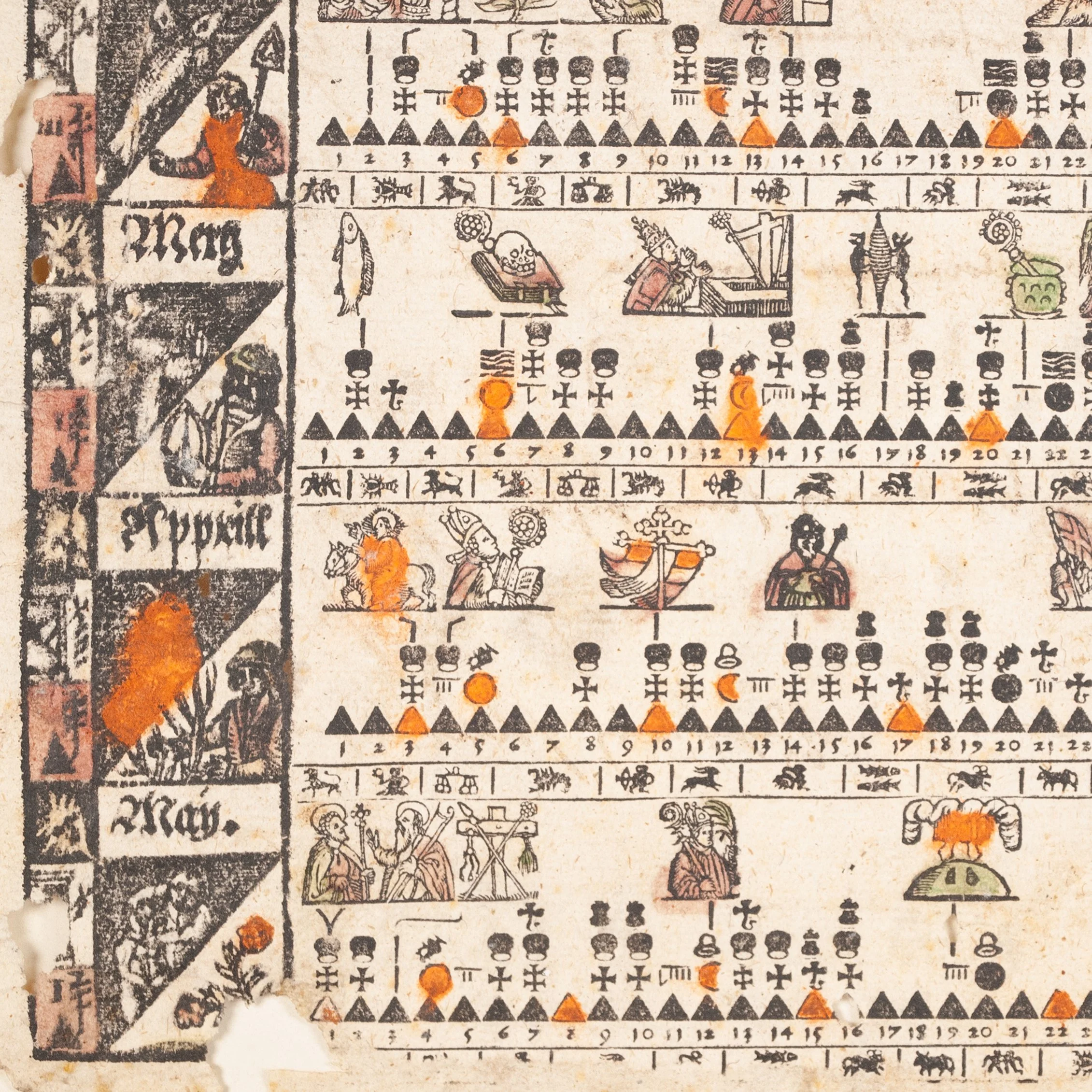 Image 2 of 8
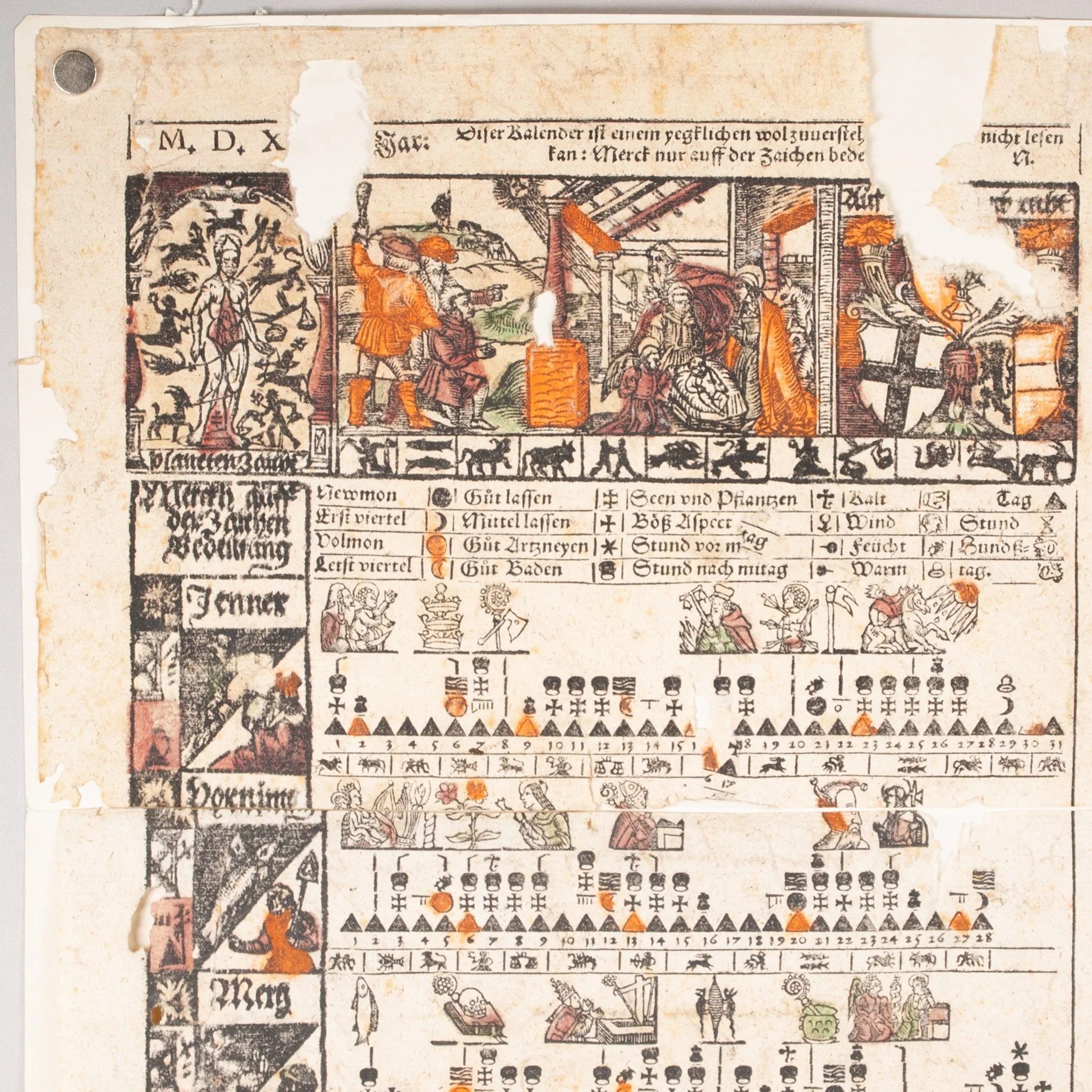 Image 3 of 8
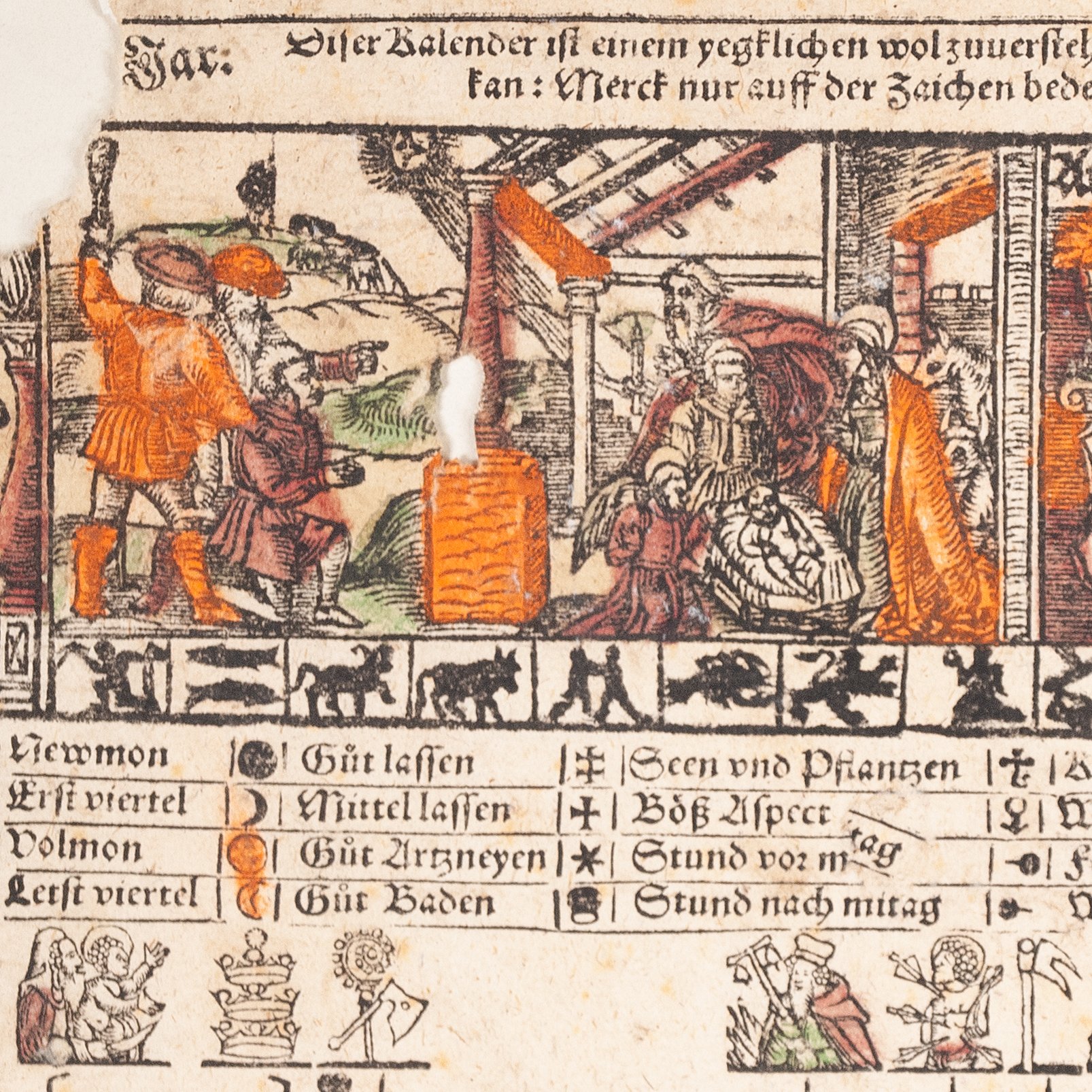 Image 4 of 8
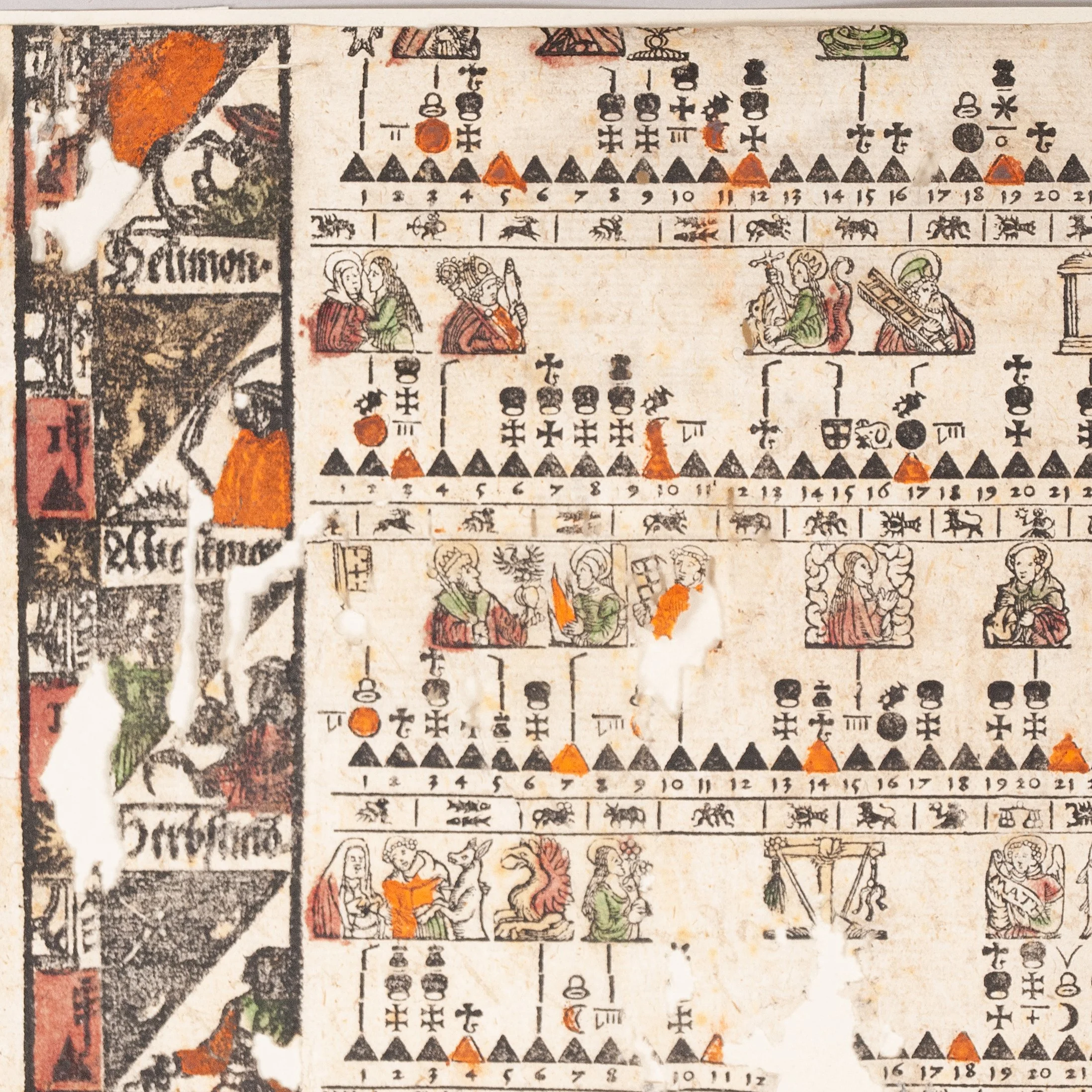 Image 5 of 8
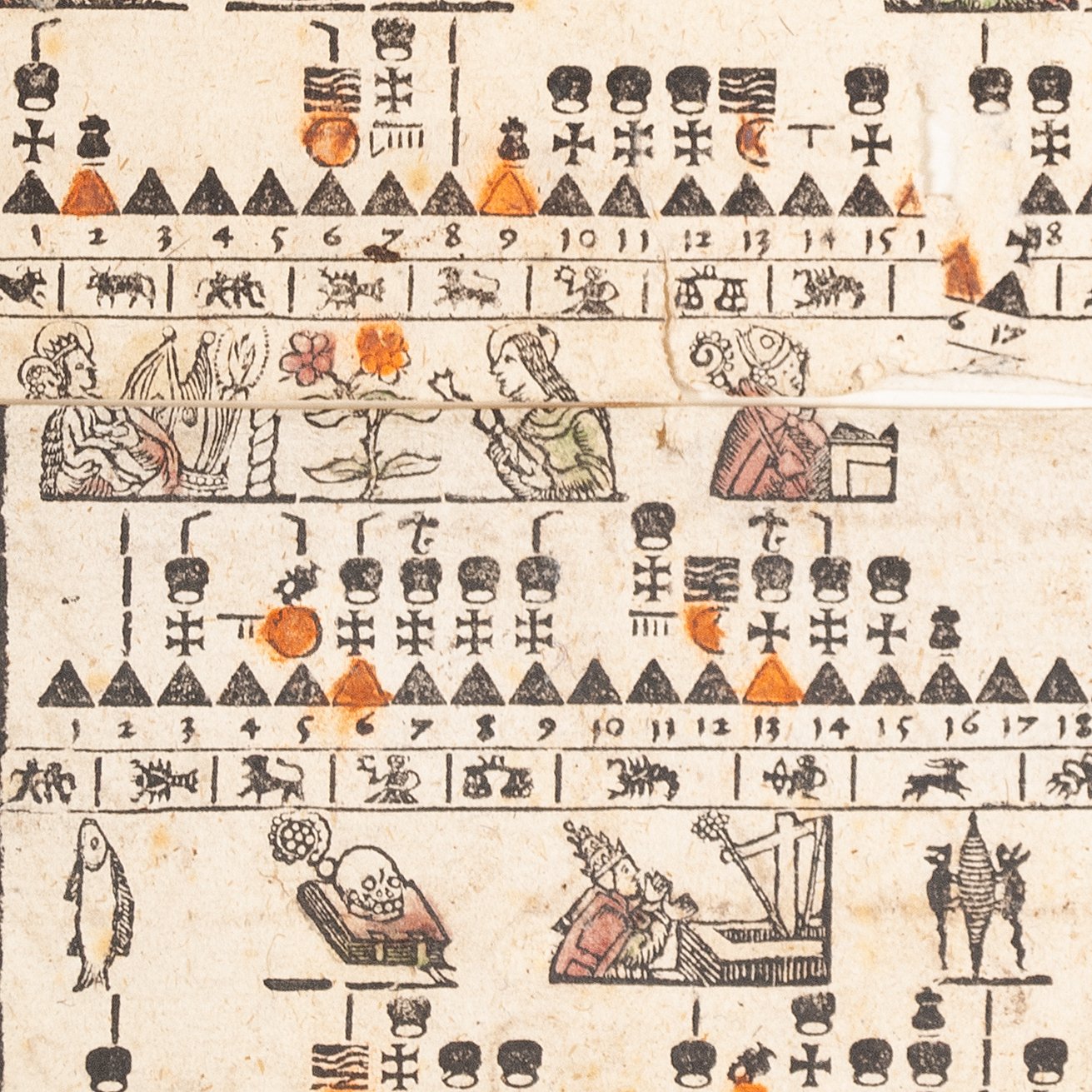 Image 6 of 8
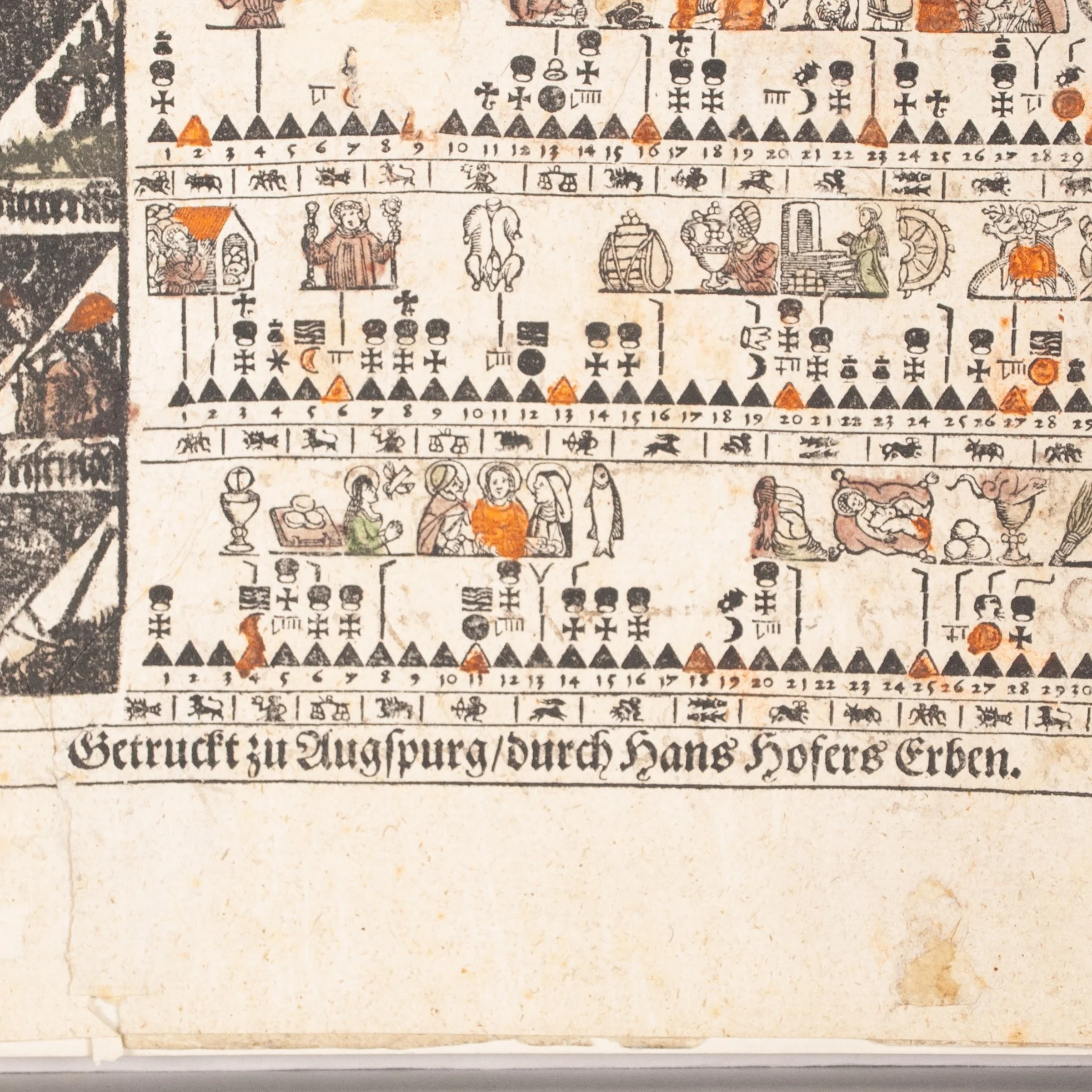 Image 7 of 8
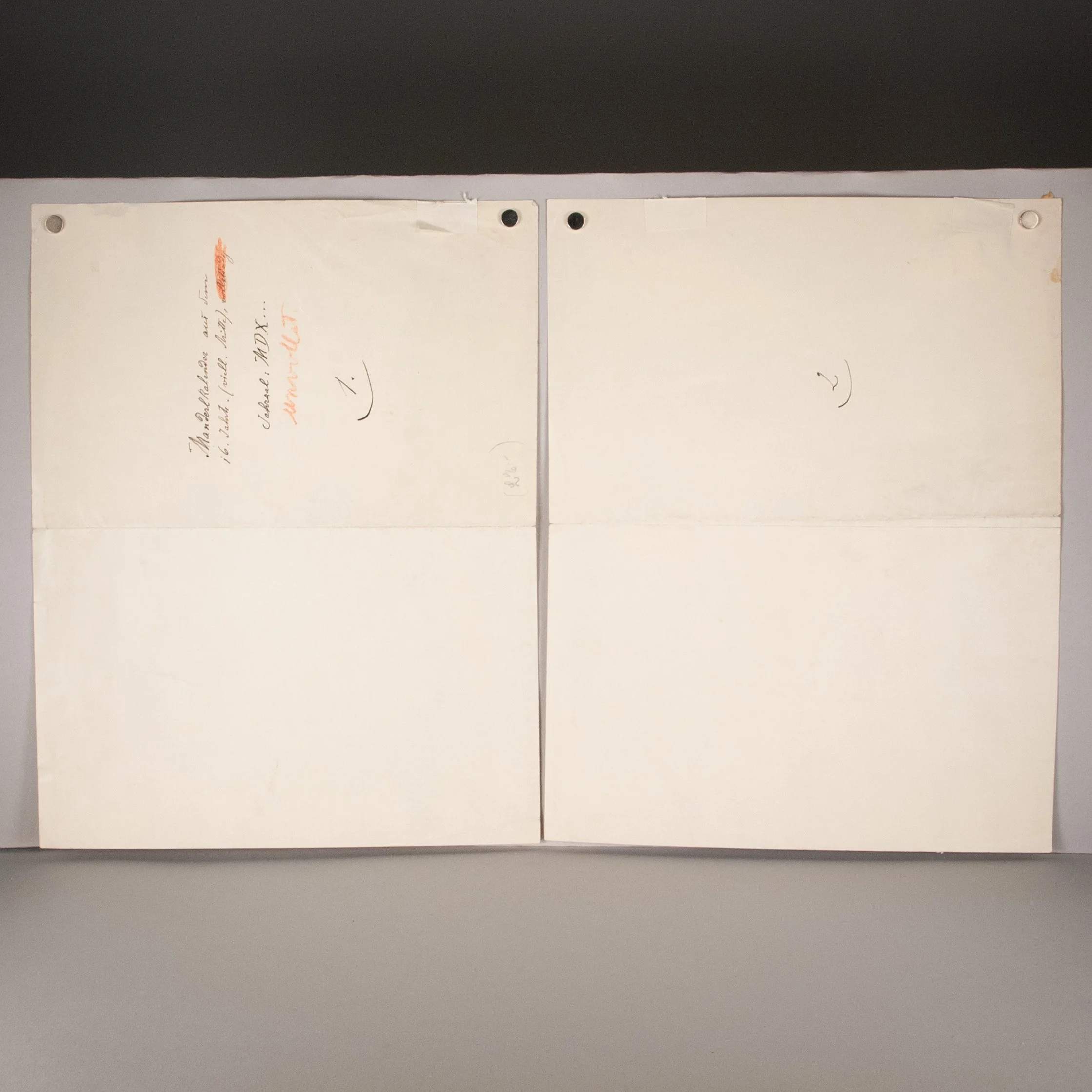 Image 8 of 8
Double broadside peasant calendar with bloodletting guidance
MDX[CIIII] Jar; diser Kalender ist einem yegklichen wol zuversteh[n, ober schon] nicht lesen kan; merck nur auff der Zaichen bede[utung] [Almanac for 1594]
Augsburg: Heirs of Hans Hofer, [1593]
2 broadsides | Half-sheets | 283 x 212 mm
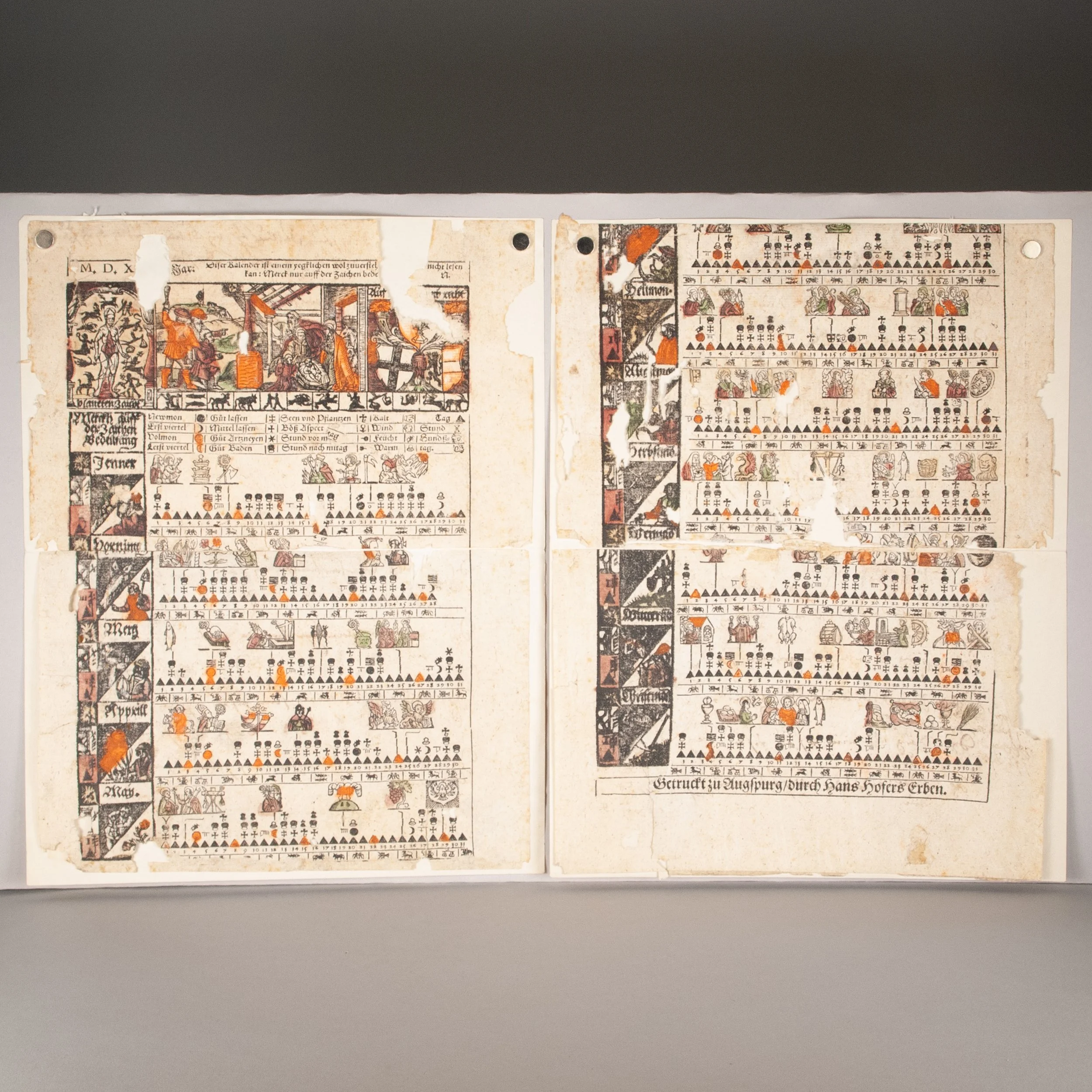
A German Bauernkalender, or peasant’s calendar, for 1594—truly an almanac for society's least literate, its visual information vastly exceeding the textual. We're hopelessly captivated by the particular blend of symbol and text that characterized early almanacs, and the Bauernkalender pushed this iconography to the extreme. This edition calls specific attention to that very feature: "easy for everyone to understand," the title reads, "even those who cannot read; just pay attention to the meaning of the symbols." The acutely visual nature of these Bauernkalender underscore Geneviève Bollème's argument, that "the almanac is first a book that one can consult without knowing how to read," one offering "a double possibility of decoding: of course that of the typographical signs, but also that of the astrological symbols alone that at least give them access to a basic but necessary reading to properly govern their lives according to the rhythm of seasonal variations to which they are essentially subjected." ¶ A letterpress legend—the only letterpress text beyond the title and dates—explains the symbols, though any regular almanac user would have readily understood them: black circle for a new moon, red circle for a full moon; a double cross for the most auspicious bloodletting times (Güt lassen), and a single cross for the mediocre times (Mittel lassen); symbols suggesting when to bathe (Güt Baden), take medicine (Güt Artzneyen), and sow crops (Seen und Pflantzen); when it will be cold, windy, or warm, and still more. Each day boasts up to three lines of such information, plus a triangle to represent each day (red for Sundays), a letterpress number for the date, a tiny astrological ornament for the day's lunar sign (which changes every two and a half days or so), and a small woodcut to represent occasional feast days. At left, every month is accompanied by a woodcut that blends its astrological sign, standard chronological markers, and a seasonal activity: for April, a man tending a shrub; May, blooming flowers; and grapes for October, whose old name translates as “wine month.” Beneath the title are woodcuts of the traditional zodiac man, a wider illustration combining the Nativity and Adoration of the Magi, and a third with three coats of arms, including those for the city of Augsburg (a pinecone, here with some loss). ¶ Produced in vast numbers but quick to disappear, almanacs were indispensable to early modern Europe, second in volume only to the mass of religious literature that poured from European presses, and were unsurprisingly among the first products issued from Europe's presses. A 1458 bloodletting calendar in the type of the 36-line Bible survives, for example, and these ephemeral pieces remained a staple of print culture throughout the hand-press period. “Published in considerable numbers according to an annual cycle, these singular amalgams of the quotidian and the celestial seldom survive in more than one copy," like the present, and "most have disappeared altogether. But they were a hugely profitable part of the book market” (Pettegree). If we take the 22,000-copy press run of Valentin Geissler’s 1558 Nuremberg broadsheet almanac as anything near typical, then these ephemeral publications should rank among the most fleeting artifacts of early print culture, understandably discarded after year’s end. But until disposal, they could be found just about anywhere. Certainly in private homes, but barber surgeons and bathhouses were likely sites, too, given the bloodletting content, and broadly speaking they "decorated the wall of many of Europe's commercial classes” (Pettegree). Beyond medical practitioners, these broadsides might have appealed just as well to those who sought medicine, too. Monasteries were regular sites of bloodletting, for example, and we can imagine the layperson wanting to know when best to send for the bloodletter. ¶ We find no almanacs issued by Hans Hofer himself, and only four from the press of his heirs: 1567, 1575, 1585, and 1590. USTC reports just fifteen imprints between Hofer and his heirs, and VD16 only one, wherein Hofer identified himself as a Briefmaler. The Briefmaler was the typically unnamed contributor who applied color by hand to early print. If those responsible for the work remain anonymous, it’s not for lack of numbers. In 1615, Augsburg recorded a whopping thirty Briefmaler operating within city walls, dwarfing the dozen printers, four illuminators, six engravers, and fifteen woodblock cutters. By 1594, broadsheet almanacs were quite commonly printed in red and black, but Hofer's legacy as a Briefmaler may explain why our copy was hand-colored—and not just a saturated orange-red, but also green and a pale reddish pink. ¶ An arresting example of an ubiquitous genre, uncommonly rich in visual information. We locate no other copies of this edition.
CONDITION: The two halves printed side by side on a single sheet of laid paper, colored by hand, and the broadsides since mounted ca. 1900 to sheets of glossy paper. There's partial loss to the year in our title, but what remains, and given Easter here falls on April 10 (note the Resurrection Banner), suggests the only candidates could be 1583 and 1594. Of these, our moon phases match the lunar calendar for the latter. ¶ Likely removed from an old binding, with many tears, some of them substantial; notable loss includes some portions of the title area, perhaps the upper half centimeter of June, and some spots in the July and August calendars; each broadside sliced in half across the short dimension; remnants of both older and more recent paper on the blank versos. In rough shape, but still substantially complete.
REFERENCES: Andrew Pettegree "Broadsheets: Single-Sheet Publishing in the First Age of Print: Typology and Typography," Broadsheets: Single-Sheet Publishing in the First Age of Print (2017), p. 27-28 (cited above), 32 (“the trade in broadsheets, bought, sold, handed out for free or publicly exhibited, was a vital tool in shaping society, wherever Europe’s citizens lived, traded and laughed together”); Falk Eisermann, “Fifty Thousand Veronicas,” Broadsheets: Single-Sheet Publishing in the First Age of Print (2017), 111 (on the Geissler print run, and nothing that, "first and foremost, they were intended for people in specialized medical and hygienic professions"); Suzanne Karr Schmidt, Altered and Adorned: Using Renaissance Prints in Daily Life (2011), p. 73 (“At the heart of the need to locate oneself in time and space was the calendar, one of the many ways man organized time, and one of the first to be printed in the form of books or sheets to be hung on the wall. At its simplest, the so-called Bauernkalendar, or peasant calendar, functioned as a type of broadsheet wall almanac with medical-astrological underpinnings, suggesting the most propitious times to plant fields, marry, or conceive and bear children.”), 254 (“This [broadside] format would become extremely popular in the second half of the sixteenth century, with numerous versions designed by Jost Amman, among other artists…The down-to-earth occupations mentioned correspond with the status of their owners.”); Francesco Maiello, Storia del calendario: la misurazione del tempo, 1450-1800 (Einaudi, 1996), p. 117-118 (“The calendar, although used in daily life to date written documents or identify a day of the year, had not yet become a conventional tool for orienting oneself in time, but remained bound to the contents thought to be necessarily associated with it: religion, astrology, meteorology and more generally the representation of the world.”); Roger Chartier (Lydia G. Cochrane, tr.), The Cultural Uses of Print in Early Modern France (1987), p. 179 (“By its very nature the almanac was open to a plural readership, for it provided a written text for those who knew how to read and signs or images to be deciphered for those who did not....A book [or broadside] to be used and to be used in multiple ways, the almanac intertwined signs and written text like no other book. It seems the quintessential book for a society still unequally used to the written word and in which many different relationships with print undoubtedly existed, ranging all the way from fluent reading to halting decipherment”); Geneviève Bollème, Les almanachs populaires aux XVIIe et XVIIIe siècles (1969), p. 7 (second only to religious literature), 11 ("the almanac is first a book that one can consult without knowing how to read, it is composed of typographic signs, but also astrological symbols, numbers, images"), 13 (cited above); Yann Sordet, Histoire du livre et de l'édition (2021), p. 414 ("In pre-industrial European societies, where books remained relatively rare, and in the poorly literate social strata for which they were intended, the almanac nevertheless constituted a sort of 'encyclopedia for all', where one could learn both when to plant trees and celebrate saints, how to care for men and animals, but at the same time open oneself to entertaining literature and a certain knowledge of current events"); James Raven and Goran Proot, "Renaissance and Reformation," Oxford Illustrated History of the Book (2020), p. 152 (“Almanacs were among the most popular productions of the early printing press, produced annually in hundreds of thousands of copies across Europe. Many were multi-functional with sophisticated and compressed layouts, and included rod and shipping distances, tide times, prognostications and horoscopes, calculating tables, or official and civic information.”); Catarina Zimmermann-Homeyer, "Illustrated Almanacs: Imaging Strategies on Bloodletting Calendars of the Incunabula Period," Gutenberg-Jahrbuch 2022, p. 118 ("In most cases, the almanacs were commissioned by the city council itself. Since the bloodletting was done by barbers and probably also in bathhouses, the calendars were likely to be displayed there. There is also evidence that the bloodletting calendars were hung on the walls of private homes."); Matthew J. Shaw, "Keeping Time in the Age of Franklin: Almanacs and the Atlantic World," Printing History New Series 2 (July 2007), p. 18 ("Almanacs played an intimate part in the shift from a predominantly oral culture, to one in which the authority of print was paramount"), 24 (“almanacs might also be reprinted in January or February with corrections or in response to demand"); Miriam Usher Chrisman, Lay Culture, Learned Culture: Books and Social Change in Strasbourg, 1480-1599 (1982), p. 70 (reporting wall almanacs in mid-16c Strasbourg belonging to a mine foreman's widow and the administrator of an orphanage); Kathryn M. Rudy, Image, Knife, and Gluepot: Early Assemblage in Manuscript and Print (OpenBook, 2019), p. 113 (cites a 1500 Book of Hours to suggest the Beghards, a cloistered male religious community, "were engaging in phlebotomy"); John Roger Paas, “Georg Kress, a Briefmaler in Augsburg in the late sixteenth and early seventeenth centuries,” Gutenberg-Jahrbuch (1990), p. 177-179
Item #911
MDX[CIIII] Jar; diser Kalender ist einem yegklichen wol zuversteh[n, ober schon] nicht lesen kan; merck nur auff der Zaichen bede[utung] [Almanac for 1594]
Augsburg: Heirs of Hans Hofer, [1593]
2 broadsides | Half-sheets | 283 x 212 mm
A German Bauernkalender, or peasant’s calendar, for 1594—truly an almanac for society's least literate, its visual information vastly exceeding the textual. We're hopelessly captivated by the particular blend of symbol and text that characterized early almanacs, and the Bauernkalender pushed this iconography to the extreme. This edition calls specific attention to that very feature: "easy for everyone to understand," the title reads, "even those who cannot read; just pay attention to the meaning of the symbols." The acutely visual nature of these Bauernkalender underscore Geneviève Bollème's argument, that "the almanac is first a book that one can consult without knowing how to read," one offering "a double possibility of decoding: of course that of the typographical signs, but also that of the astrological symbols alone that at least give them access to a basic but necessary reading to properly govern their lives according to the rhythm of seasonal variations to which they are essentially subjected." ¶ A letterpress legend—the only letterpress text beyond the title and dates—explains the symbols, though any regular almanac user would have readily understood them: black circle for a new moon, red circle for a full moon; a double cross for the most auspicious bloodletting times (Güt lassen), and a single cross for the mediocre times (Mittel lassen); symbols suggesting when to bathe (Güt Baden), take medicine (Güt Artzneyen), and sow crops (Seen und Pflantzen); when it will be cold, windy, or warm, and still more. Each day boasts up to three lines of such information, plus a triangle to represent each day (red for Sundays), a letterpress number for the date, a tiny astrological ornament for the day's lunar sign (which changes every two and a half days or so), and a small woodcut to represent occasional feast days. At left, every month is accompanied by a woodcut that blends its astrological sign, standard chronological markers, and a seasonal activity: for April, a man tending a shrub; May, blooming flowers; and grapes for October, whose old name translates as “wine month.” Beneath the title are woodcuts of the traditional zodiac man, a wider illustration combining the Nativity and Adoration of the Magi, and a third with three coats of arms, including those for the city of Augsburg (a pinecone, here with some loss). ¶ Produced in vast numbers but quick to disappear, almanacs were indispensable to early modern Europe, second in volume only to the mass of religious literature that poured from European presses, and were unsurprisingly among the first products issued from Europe's presses. A 1458 bloodletting calendar in the type of the 36-line Bible survives, for example, and these ephemeral pieces remained a staple of print culture throughout the hand-press period. “Published in considerable numbers according to an annual cycle, these singular amalgams of the quotidian and the celestial seldom survive in more than one copy," like the present, and "most have disappeared altogether. But they were a hugely profitable part of the book market” (Pettegree). If we take the 22,000-copy press run of Valentin Geissler’s 1558 Nuremberg broadsheet almanac as anything near typical, then these ephemeral publications should rank among the most fleeting artifacts of early print culture, understandably discarded after year’s end. But until disposal, they could be found just about anywhere. Certainly in private homes, but barber surgeons and bathhouses were likely sites, too, given the bloodletting content, and broadly speaking they "decorated the wall of many of Europe's commercial classes” (Pettegree). Beyond medical practitioners, these broadsides might have appealed just as well to those who sought medicine, too. Monasteries were regular sites of bloodletting, for example, and we can imagine the layperson wanting to know when best to send for the bloodletter. ¶ We find no almanacs issued by Hans Hofer himself, and only four from the press of his heirs: 1567, 1575, 1585, and 1590. USTC reports just fifteen imprints between Hofer and his heirs, and VD16 only one, wherein Hofer identified himself as a Briefmaler. The Briefmaler was the typically unnamed contributor who applied color by hand to early print. If those responsible for the work remain anonymous, it’s not for lack of numbers. In 1615, Augsburg recorded a whopping thirty Briefmaler operating within city walls, dwarfing the dozen printers, four illuminators, six engravers, and fifteen woodblock cutters. By 1594, broadsheet almanacs were quite commonly printed in red and black, but Hofer's legacy as a Briefmaler may explain why our copy was hand-colored—and not just a saturated orange-red, but also green and a pale reddish pink. ¶ An arresting example of an ubiquitous genre, uncommonly rich in visual information. We locate no other copies of this edition.
CONDITION: The two halves printed side by side on a single sheet of laid paper, colored by hand, and the broadsides since mounted ca. 1900 to sheets of glossy paper. There's partial loss to the year in our title, but what remains, and given Easter here falls on April 10 (note the Resurrection Banner), suggests the only candidates could be 1583 and 1594. Of these, our moon phases match the lunar calendar for the latter. ¶ Likely removed from an old binding, with many tears, some of them substantial; notable loss includes some portions of the title area, perhaps the upper half centimeter of June, and some spots in the July and August calendars; each broadside sliced in half across the short dimension; remnants of both older and more recent paper on the blank versos. In rough shape, but still substantially complete.
REFERENCES: Andrew Pettegree "Broadsheets: Single-Sheet Publishing in the First Age of Print: Typology and Typography," Broadsheets: Single-Sheet Publishing in the First Age of Print (2017), p. 27-28 (cited above), 32 (“the trade in broadsheets, bought, sold, handed out for free or publicly exhibited, was a vital tool in shaping society, wherever Europe’s citizens lived, traded and laughed together”); Falk Eisermann, “Fifty Thousand Veronicas,” Broadsheets: Single-Sheet Publishing in the First Age of Print (2017), 111 (on the Geissler print run, and nothing that, "first and foremost, they were intended for people in specialized medical and hygienic professions"); Suzanne Karr Schmidt, Altered and Adorned: Using Renaissance Prints in Daily Life (2011), p. 73 (“At the heart of the need to locate oneself in time and space was the calendar, one of the many ways man organized time, and one of the first to be printed in the form of books or sheets to be hung on the wall. At its simplest, the so-called Bauernkalendar, or peasant calendar, functioned as a type of broadsheet wall almanac with medical-astrological underpinnings, suggesting the most propitious times to plant fields, marry, or conceive and bear children.”), 254 (“This [broadside] format would become extremely popular in the second half of the sixteenth century, with numerous versions designed by Jost Amman, among other artists…The down-to-earth occupations mentioned correspond with the status of their owners.”); Francesco Maiello, Storia del calendario: la misurazione del tempo, 1450-1800 (Einaudi, 1996), p. 117-118 (“The calendar, although used in daily life to date written documents or identify a day of the year, had not yet become a conventional tool for orienting oneself in time, but remained bound to the contents thought to be necessarily associated with it: religion, astrology, meteorology and more generally the representation of the world.”); Roger Chartier (Lydia G. Cochrane, tr.), The Cultural Uses of Print in Early Modern France (1987), p. 179 (“By its very nature the almanac was open to a plural readership, for it provided a written text for those who knew how to read and signs or images to be deciphered for those who did not....A book [or broadside] to be used and to be used in multiple ways, the almanac intertwined signs and written text like no other book. It seems the quintessential book for a society still unequally used to the written word and in which many different relationships with print undoubtedly existed, ranging all the way from fluent reading to halting decipherment”); Geneviève Bollème, Les almanachs populaires aux XVIIe et XVIIIe siècles (1969), p. 7 (second only to religious literature), 11 ("the almanac is first a book that one can consult without knowing how to read, it is composed of typographic signs, but also astrological symbols, numbers, images"), 13 (cited above); Yann Sordet, Histoire du livre et de l'édition (2021), p. 414 ("In pre-industrial European societies, where books remained relatively rare, and in the poorly literate social strata for which they were intended, the almanac nevertheless constituted a sort of 'encyclopedia for all', where one could learn both when to plant trees and celebrate saints, how to care for men and animals, but at the same time open oneself to entertaining literature and a certain knowledge of current events"); James Raven and Goran Proot, "Renaissance and Reformation," Oxford Illustrated History of the Book (2020), p. 152 (“Almanacs were among the most popular productions of the early printing press, produced annually in hundreds of thousands of copies across Europe. Many were multi-functional with sophisticated and compressed layouts, and included rod and shipping distances, tide times, prognostications and horoscopes, calculating tables, or official and civic information.”); Catarina Zimmermann-Homeyer, "Illustrated Almanacs: Imaging Strategies on Bloodletting Calendars of the Incunabula Period," Gutenberg-Jahrbuch 2022, p. 118 ("In most cases, the almanacs were commissioned by the city council itself. Since the bloodletting was done by barbers and probably also in bathhouses, the calendars were likely to be displayed there. There is also evidence that the bloodletting calendars were hung on the walls of private homes."); Matthew J. Shaw, "Keeping Time in the Age of Franklin: Almanacs and the Atlantic World," Printing History New Series 2 (July 2007), p. 18 ("Almanacs played an intimate part in the shift from a predominantly oral culture, to one in which the authority of print was paramount"), 24 (“almanacs might also be reprinted in January or February with corrections or in response to demand"); Miriam Usher Chrisman, Lay Culture, Learned Culture: Books and Social Change in Strasbourg, 1480-1599 (1982), p. 70 (reporting wall almanacs in mid-16c Strasbourg belonging to a mine foreman's widow and the administrator of an orphanage); Kathryn M. Rudy, Image, Knife, and Gluepot: Early Assemblage in Manuscript and Print (OpenBook, 2019), p. 113 (cites a 1500 Book of Hours to suggest the Beghards, a cloistered male religious community, "were engaging in phlebotomy"); John Roger Paas, “Georg Kress, a Briefmaler in Augsburg in the late sixteenth and early seventeenth centuries,” Gutenberg-Jahrbuch (1990), p. 177-179
Item #911