[Canon table | Tabella secretarum | Canons d'autel | Carteglorie | Canontafel | Altar card]
[France? later 17th century]
1 vellum document | 374 x 489 mm
A wonderfully opulent canon table, a fleeting liturgical apparatus meant to assist the priest in reciting the major texts during Mass, this a richly illuminated example in baroque manuscript on vellum. The name comes from the Canon of the Mass, whose most important elements this tool contains, especially those required for the Eucharist. Underscoring its practical role, the most vital words are centrally positioned, larger than surrounding text, and written fully in gold: “This is my body,” for example, and “This is the cup of my blood.” Instructions for the priest are scattered in red ink, much as you might find in a missal. At the top of the center panel, for example, as the priest prepares the Eucharist: "Taking the Host in hands, he should say" (Accipiendo in manibus hostia[m] dicat). ¶ Like the ornately bound missal, but far more ephemeral, altar cards offered a chance to add decorative form to function. As a genre, they date to the 13th century, though such early examples are vanishingly rare. They could serve as a kind of portable altarpiece, deployed in private chapels and public churches alike, suggesting they may sometimes have served a private devotional function. Like so much of medieval manuscript culture, print eventually came to dominate the production method. Even some 15th-century printed examples survive. But manuscript long held its own where true luxury was demanded, no doubt the case here. Ours has been lavishly hand-painted and liberally heightened with gold. The scenes across the top suit the Eucharistic theme: at center, the Supper at Emmaus, with Cleopas likely seated to viewer's right, and his traveling companion across the table with a pilgrim's staff; at left, an angel bringing food to sleeping Elijah; and at right, Moses distributing manna. The figure left of the text, depicted with a pair of keys, should be St. Peter; right of the text, with a sword and book, St. Paul. Flowing among these scenes are borders of acanthus leaves, grapes, and winged putti heads, all heavily accented with gold. The text, in an accomplished roman hand, is peppered with thirteen two- to four-line initials in gold on blue and red grounds. All capital letters are gold. ¶ The canon table was long the only requisite altar card, even upon revision of the Roman Missal in 1570. But the suite expanded with time. "During the seventeenth century another card with the Gospel of St. John which is recited at the end of Mass...was introduced, and then, probably for the sake of symmetry, a third card, containing the prayers said by the celebrant when blessing the water at the Offertory and when washing his hands" (Anson). Given its age, our manuscript might well have been without such side cards at time of production. It is probably 17th-century, the second half perhaps more likely than the first. The saturated colors are far richer than the pastels that came to dominate rococo design in the 18th century, and the heavy, symmetrical mise-en-page belongs more to the baroque than the light, playful asymmetry of rococo. ¶ A variety of guides described how altar cards should be positioned: “Atop the altar, the crucifix is placed in the middle,” and “at the foot of the crucifix is placed the Canon Table [Tabella Secretarum]” (Ritus). A 15th-century painting by Juan de Nalda, Misa de San Gregorio, depicts one in action, leaning against the back of the altar beneath the crucifix. Although postdating our example by nearly two centuries, Carl Geiger’s Notizen über Stoff, Gestalt und Grösse der heiligen Geräthe und Gewande sheds a great deal of light on their construction: canon tables should not be made of walnut or oak, or any other dark wood, lest it show through the sheet glued to it; it should be wider than it is tall; the frame should be ornamental; and for the holiest days, it should be beautiful (prachtwoller) and gold-plated. ¶ An extraordinary relic of early modern liturgical culture. We trace a handful of 17th-century printed editions, but hardly any peers in manuscript. We find at Johns Hopkins a ca. 1700 French example, a fine 1604 manuscript at the Bridwell Library, and a ca. 1520 French manuscript split between the Morgan and the Free Library of Philadelphia. We find a single manuscript altar card in auction records, an illuminated canon table of the late 1590s that fetched £43,000 at Sotheby's in 1999.
PROVENANCE: To us from a fellow ILAB dealer. As always, we welcome inquiries about export documentation, which we diligently maintain.
CONDITION: Ink and paint on one side only of a vellum sheet. Matted and hinged within a conservation-grade portfolio; a loose sheet of mylar provides protection, but can be removed for close examination. The object is ready to safely lie flat on your shelf, or can easily and safely be removed if you prefer to frame it. ¶ A little rubbing here and there, the bottom border having lost some of its luster; some soiling and nicks at the edges, and a couple worm holes in the upper margin, but nothing affecting content; on the blank verso, traces of burning around the small nicks in the edges.
REFERENCES: Peter F. Anson, Churches: Their Plan and Furnishing (2012), "IV. Other Altar Furniture" (unpaginated ebook; "During the seventeenth and eighteenth centuries it became the fashion to insert altar cards in very ornate frames—some of which in the Baroque style are magnificent pieces of craftsmanship"); Ritus Celebrandi Missam secundum rubricas Missalis Romani et Decreta Sacrae Rituum Congregationis (Munich, 1825), p. 1; Carl Geiger, Notizen über Stoff, Gestalt und Grösse der heiligen Geräthe und Gewande (Munich, 1863), p. 18-19; Peter Schmidt, Origins of European Printmaking: Fifteenth-Century Woodcuts and Their Public (National Gallery of Art, 2005), p. 164 (“Only in the late sixteenth century did it become general practice for a priest celebrating the Mass to place such an object in full view on the altar...Printed versions were preceded by painted canon tables with manuscript texts, but almost none of these still exists"), 169-170 (at least in the 15th century, “the original liturgical function does not necessarily exclude a secondary, private use”); Suzanne Karr Schmidt, Interactive and Sculptural Printmaking in the Renaissance (Brill, 2018), p. 68-78 (on a canon table in a truly sumptuous silver frame at Andechs Abbey, still in use)
Item #997
[Canon table | Tabella secretarum | Canons d'autel | Carteglorie | Canontafel | Altar card]
[France? later 17th century]
1 vellum document | 374 x 489 mm
A wonderfully opulent canon table, a fleeting liturgical apparatus meant to assist the priest in reciting the major texts during Mass, this a richly illuminated example in baroque manuscript on vellum. The name comes from the Canon of the Mass, whose most important elements this tool contains, especially those required for the Eucharist. Underscoring its practical role, the most vital words are centrally positioned, larger than surrounding text, and written fully in gold: “This is my body,” for example, and “This is the cup of my blood.” Instructions for the priest are scattered in red ink, much as you might find in a missal. At the top of the center panel, for example, as the priest prepares the Eucharist: "Taking the Host in hands, he should say" (Accipiendo in manibus hostia[m] dicat). ¶ Like the ornately bound missal, but far more ephemeral, altar cards offered a chance to add decorative form to function. As a genre, they date to the 13th century, though such early examples are vanishingly rare. They could serve as a kind of portable altarpiece, deployed in private chapels and public churches alike, suggesting they may sometimes have served a private devotional function. Like so much of medieval manuscript culture, print eventually came to dominate the production method. Even some 15th-century printed examples survive. But manuscript long held its own where true luxury was demanded, no doubt the case here. Ours has been lavishly hand-painted and liberally heightened with gold. The scenes across the top suit the Eucharistic theme: at center, the Supper at Emmaus, with Cleopas likely seated to viewer's right, and his traveling companion across the table with a pilgrim's staff; at left, an angel bringing food to sleeping Elijah; and at right, Moses distributing manna. The figure left of the text, depicted with a pair of keys, should be St. Peter; right of the text, with a sword and book, St. Paul. Flowing among these scenes are borders of acanthus leaves, grapes, and winged putti heads, all heavily accented with gold. The text, in an accomplished roman hand, is peppered with thirteen two- to four-line initials in gold on blue and red grounds. All capital letters are gold. ¶ The canon table was long the only requisite altar card, even upon revision of the Roman Missal in 1570. But the suite expanded with time. "During the seventeenth century another card with the Gospel of St. John which is recited at the end of Mass...was introduced, and then, probably for the sake of symmetry, a third card, containing the prayers said by the celebrant when blessing the water at the Offertory and when washing his hands" (Anson). Given its age, our manuscript might well have been without such side cards at time of production. It is probably 17th-century, the second half perhaps more likely than the first. The saturated colors are far richer than the pastels that came to dominate rococo design in the 18th century, and the heavy, symmetrical mise-en-page belongs more to the baroque than the light, playful asymmetry of rococo. ¶ A variety of guides described how altar cards should be positioned: “Atop the altar, the crucifix is placed in the middle,” and “at the foot of the crucifix is placed the Canon Table [Tabella Secretarum]” (Ritus). A 15th-century painting by Juan de Nalda, Misa de San Gregorio, depicts one in action, leaning against the back of the altar beneath the crucifix. Although postdating our example by nearly two centuries, Carl Geiger’s Notizen über Stoff, Gestalt und Grösse der heiligen Geräthe und Gewande sheds a great deal of light on their construction: canon tables should not be made of walnut or oak, or any other dark wood, lest it show through the sheet glued to it; it should be wider than it is tall; the frame should be ornamental; and for the holiest days, it should be beautiful (prachtwoller) and gold-plated. ¶ An extraordinary relic of early modern liturgical culture. We trace a handful of 17th-century printed editions, but hardly any peers in manuscript. We find at Johns Hopkins a ca. 1700 French example, a fine 1604 manuscript at the Bridwell Library, and a ca. 1520 French manuscript split between the Morgan and the Free Library of Philadelphia. We find a single manuscript altar card in auction records, an illuminated canon table of the late 1590s that fetched £43,000 at Sotheby's in 1999.
PROVENANCE: To us from a fellow ILAB dealer. As always, we welcome inquiries about export documentation, which we diligently maintain.
CONDITION: Ink and paint on one side only of a vellum sheet. Matted and hinged within a conservation-grade portfolio; a loose sheet of mylar provides protection, but can be removed for close examination. The object is ready to safely lie flat on your shelf, or can easily and safely be removed if you prefer to frame it. ¶ A little rubbing here and there, the bottom border having lost some of its luster; some soiling and nicks at the edges, and a couple worm holes in the upper margin, but nothing affecting content; on the blank verso, traces of burning around the small nicks in the edges.
REFERENCES: Peter F. Anson, Churches: Their Plan and Furnishing (2012), "IV. Other Altar Furniture" (unpaginated ebook; "During the seventeenth and eighteenth centuries it became the fashion to insert altar cards in very ornate frames—some of which in the Baroque style are magnificent pieces of craftsmanship"); Ritus Celebrandi Missam secundum rubricas Missalis Romani et Decreta Sacrae Rituum Congregationis (Munich, 1825), p. 1; Carl Geiger, Notizen über Stoff, Gestalt und Grösse der heiligen Geräthe und Gewande (Munich, 1863), p. 18-19; Peter Schmidt, Origins of European Printmaking: Fifteenth-Century Woodcuts and Their Public (National Gallery of Art, 2005), p. 164 (“Only in the late sixteenth century did it become general practice for a priest celebrating the Mass to place such an object in full view on the altar...Printed versions were preceded by painted canon tables with manuscript texts, but almost none of these still exists"), 169-170 (at least in the 15th century, “the original liturgical function does not necessarily exclude a secondary, private use”); Suzanne Karr Schmidt, Interactive and Sculptural Printmaking in the Renaissance (Brill, 2018), p. 68-78 (on a canon table in a truly sumptuous silver frame at Andechs Abbey, still in use)
Item #997

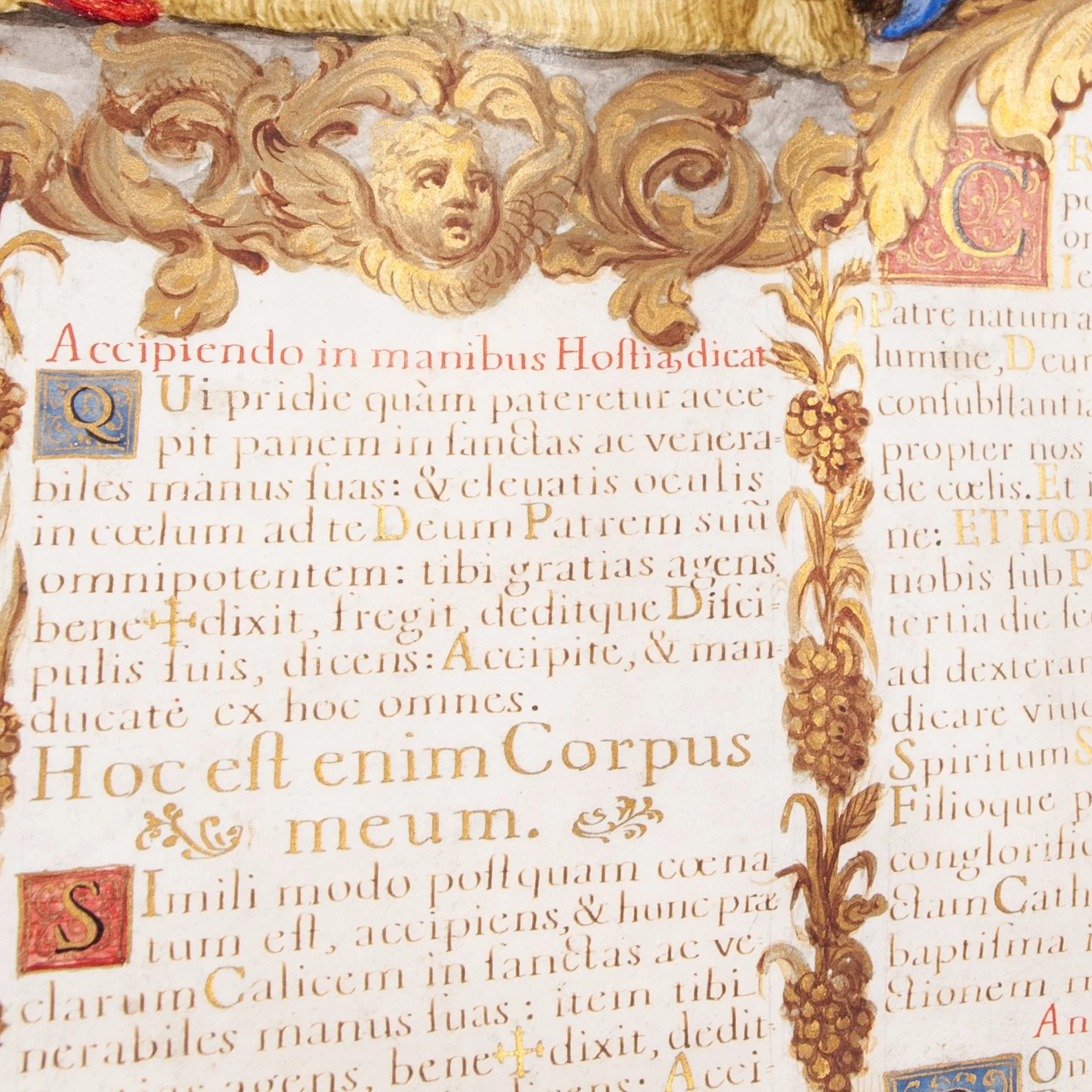 Image 1 of 9
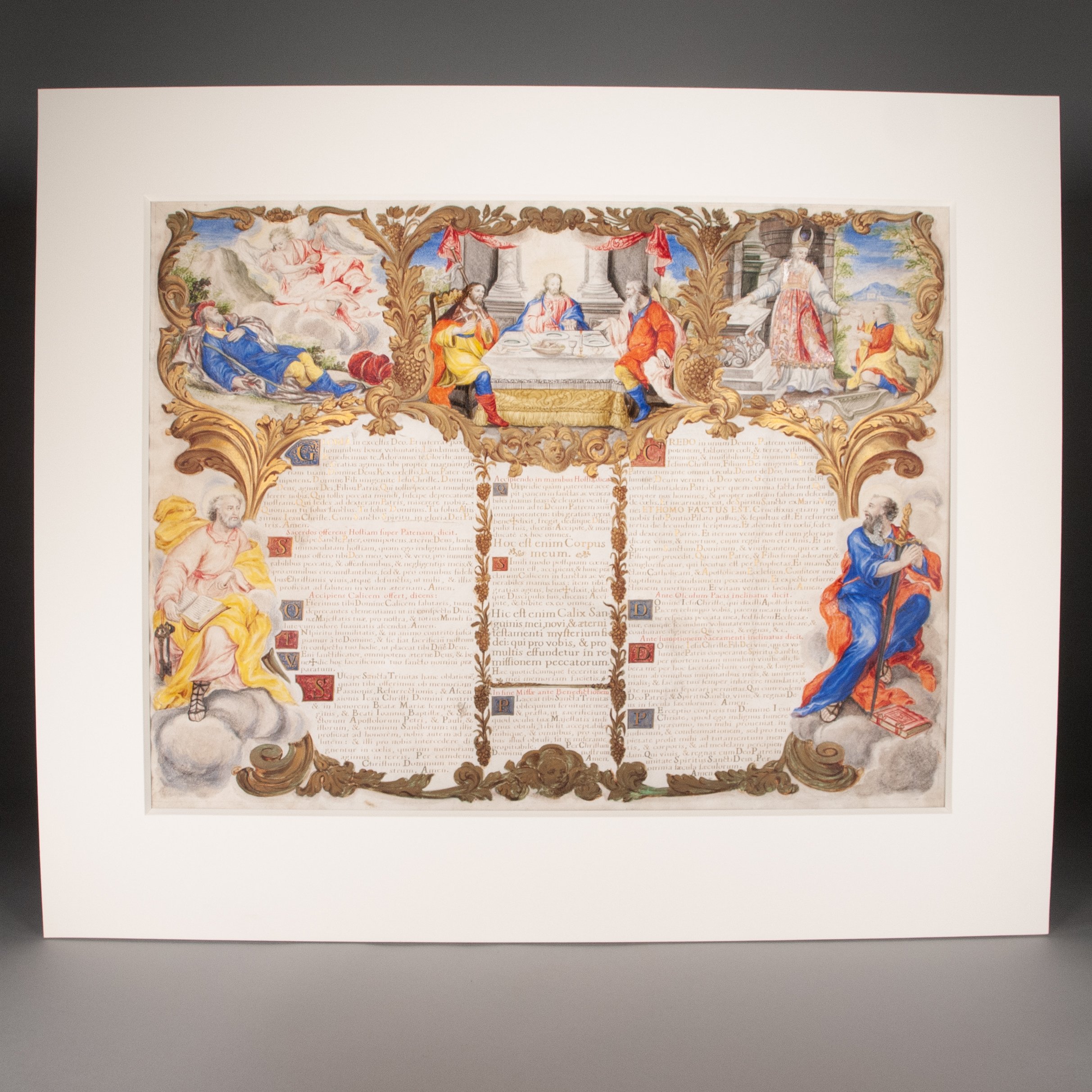 Image 2 of 9
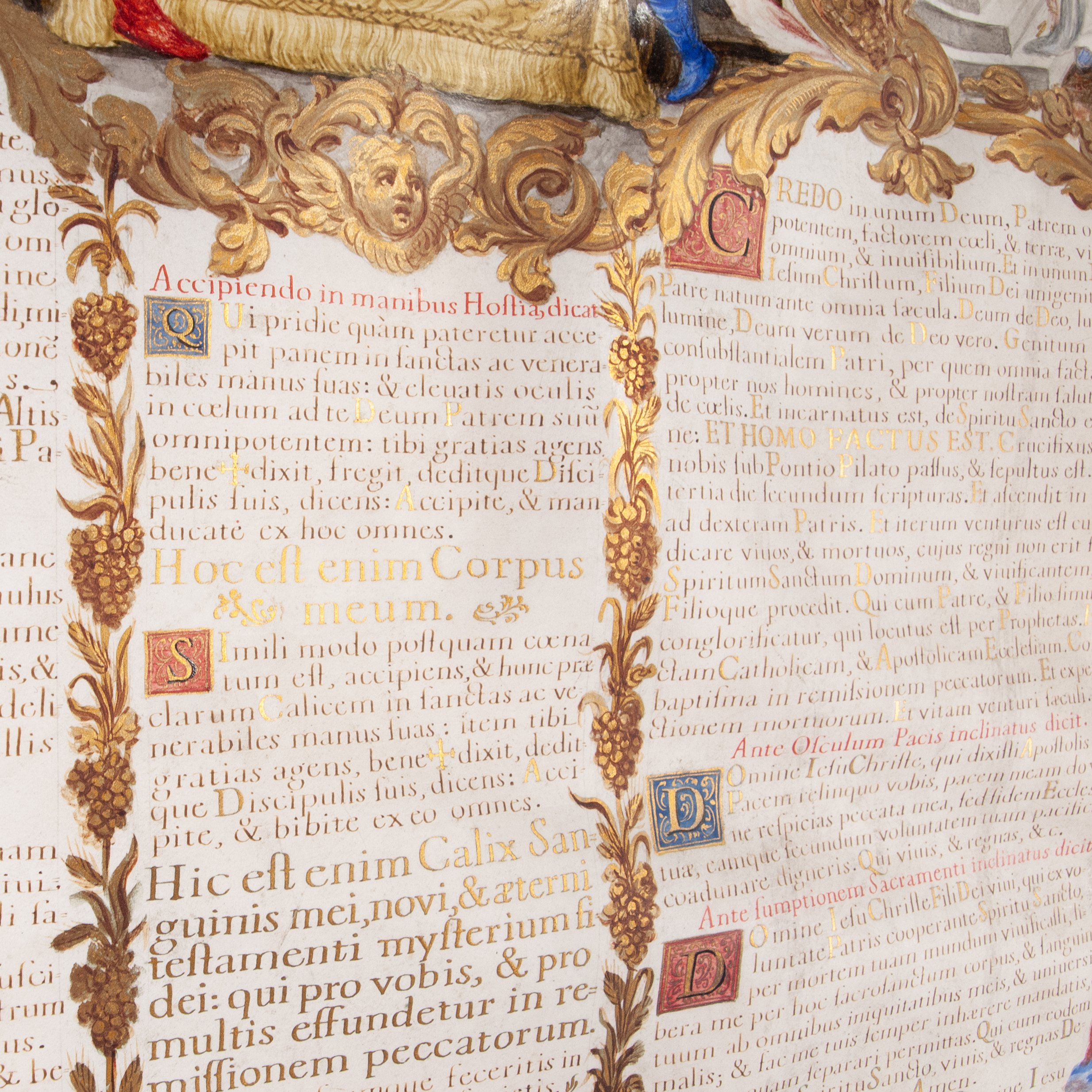 Image 3 of 9
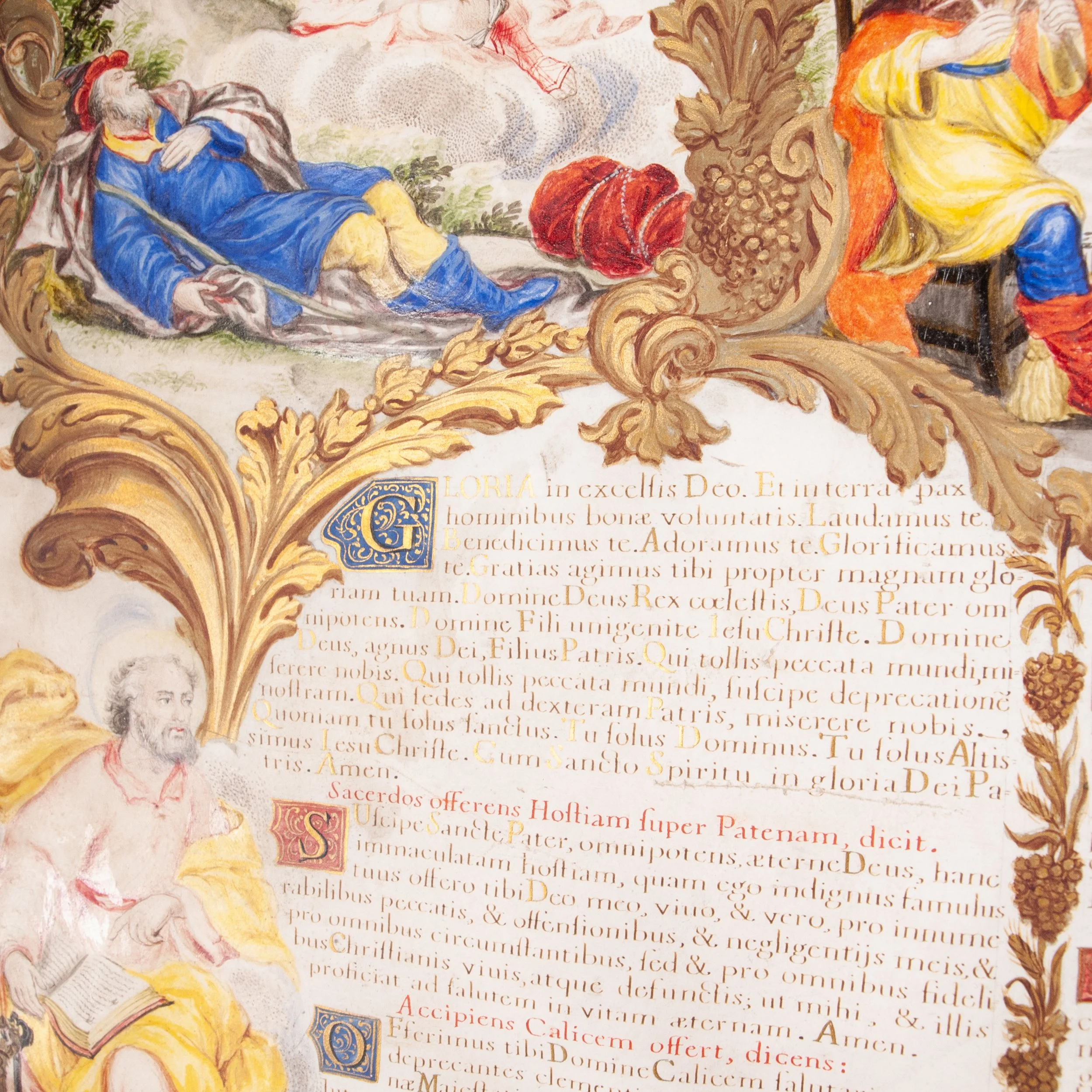 Image 4 of 9
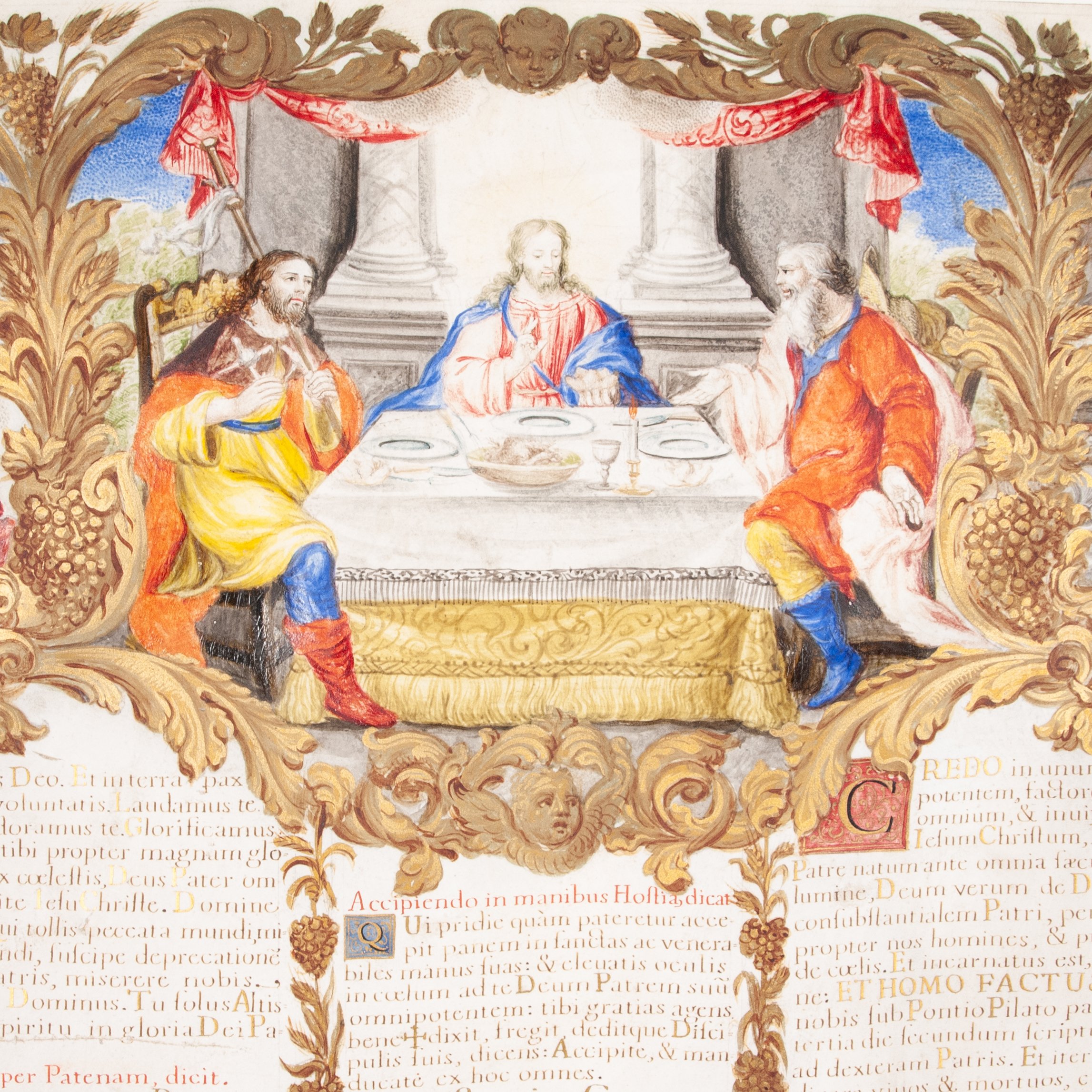 Image 5 of 9
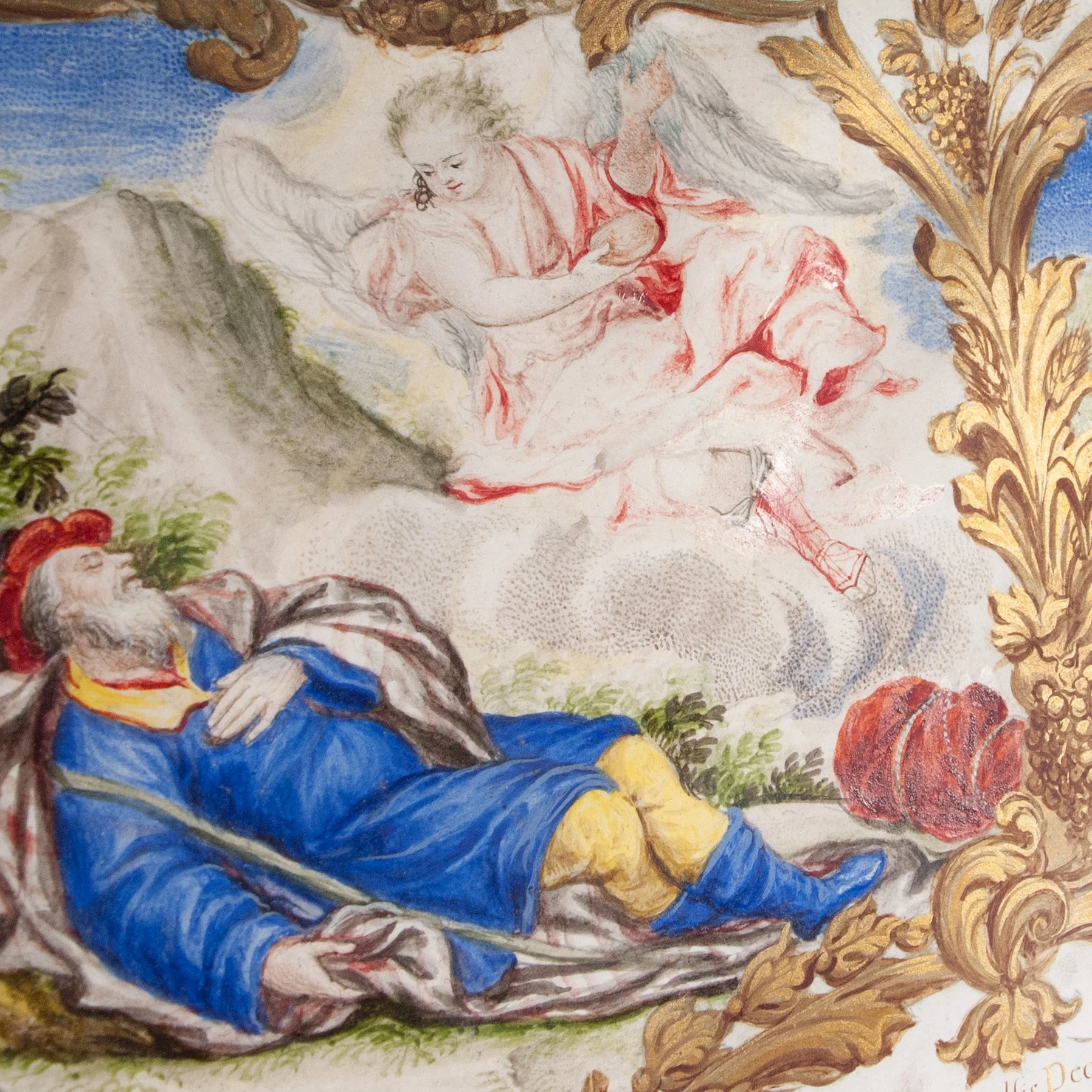 Image 6 of 9
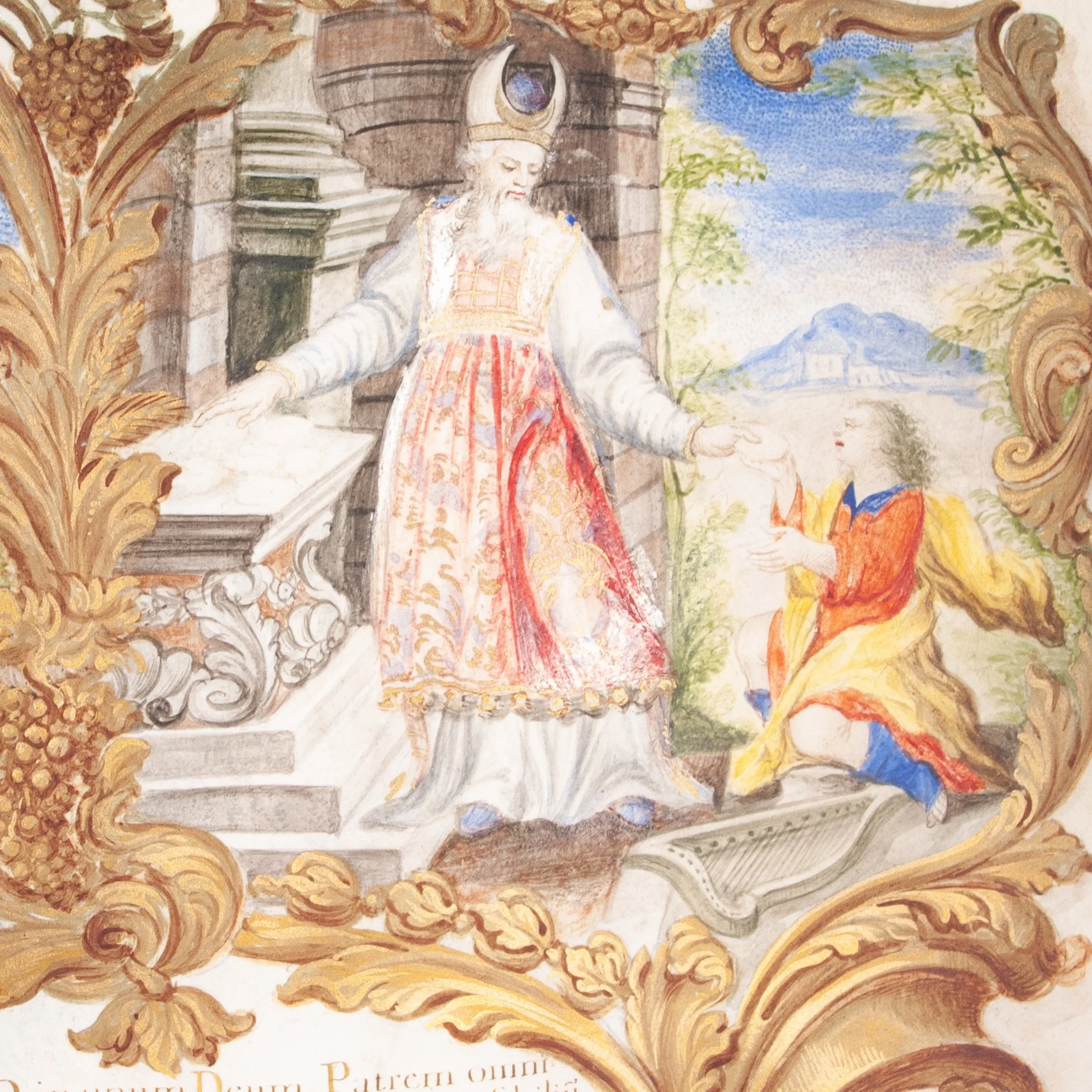 Image 7 of 9
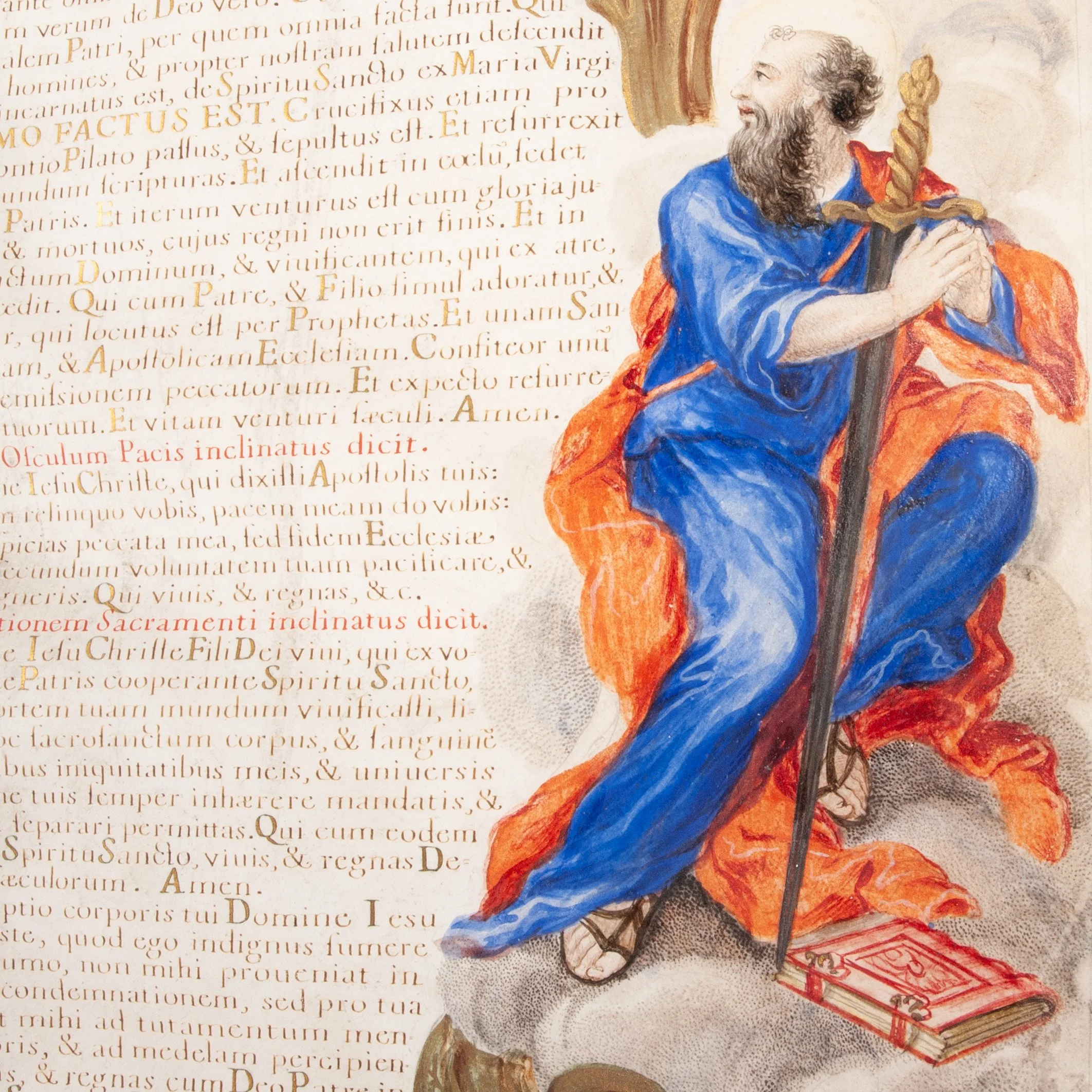 Image 8 of 9
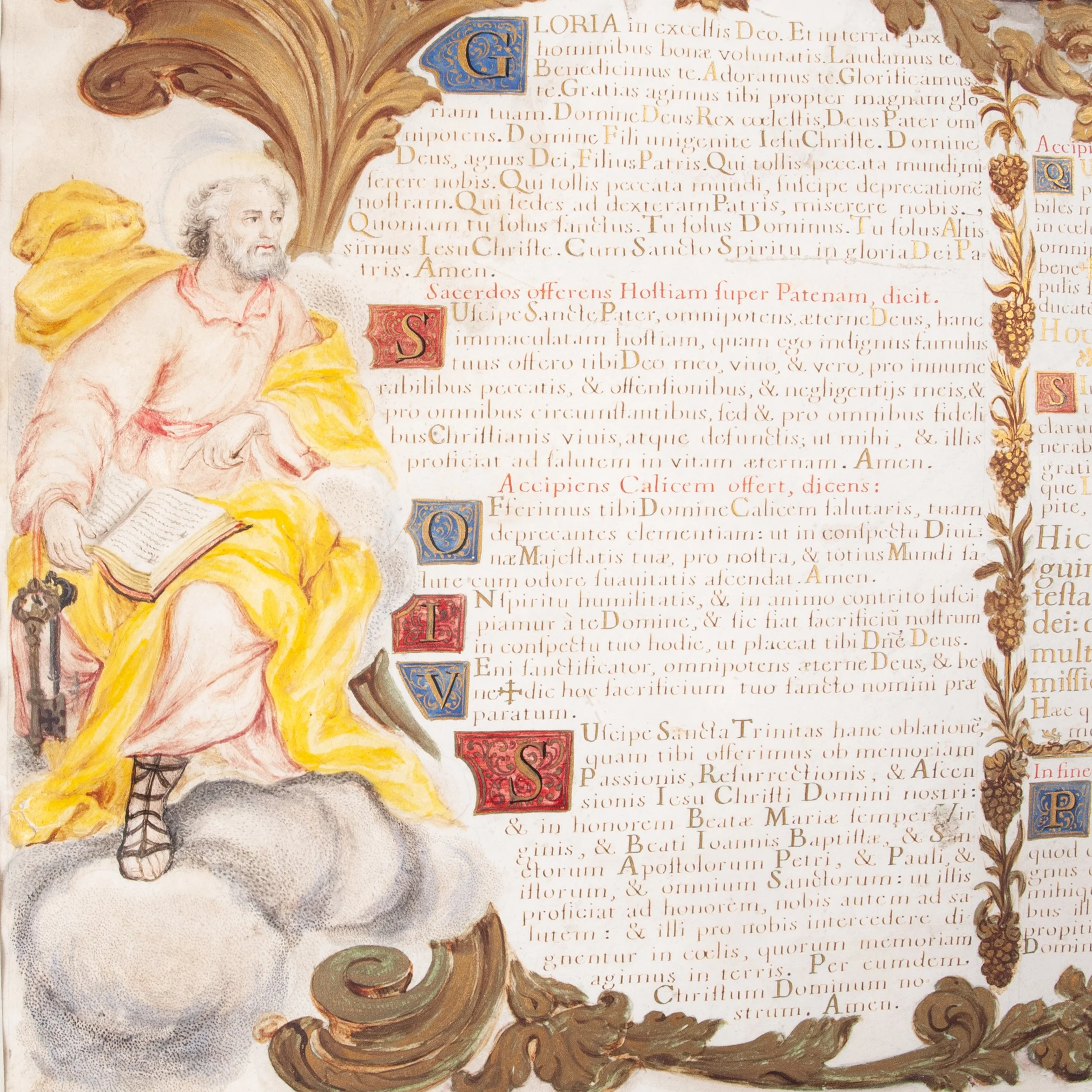 Image 9 of 9