
 Image 1 of 12
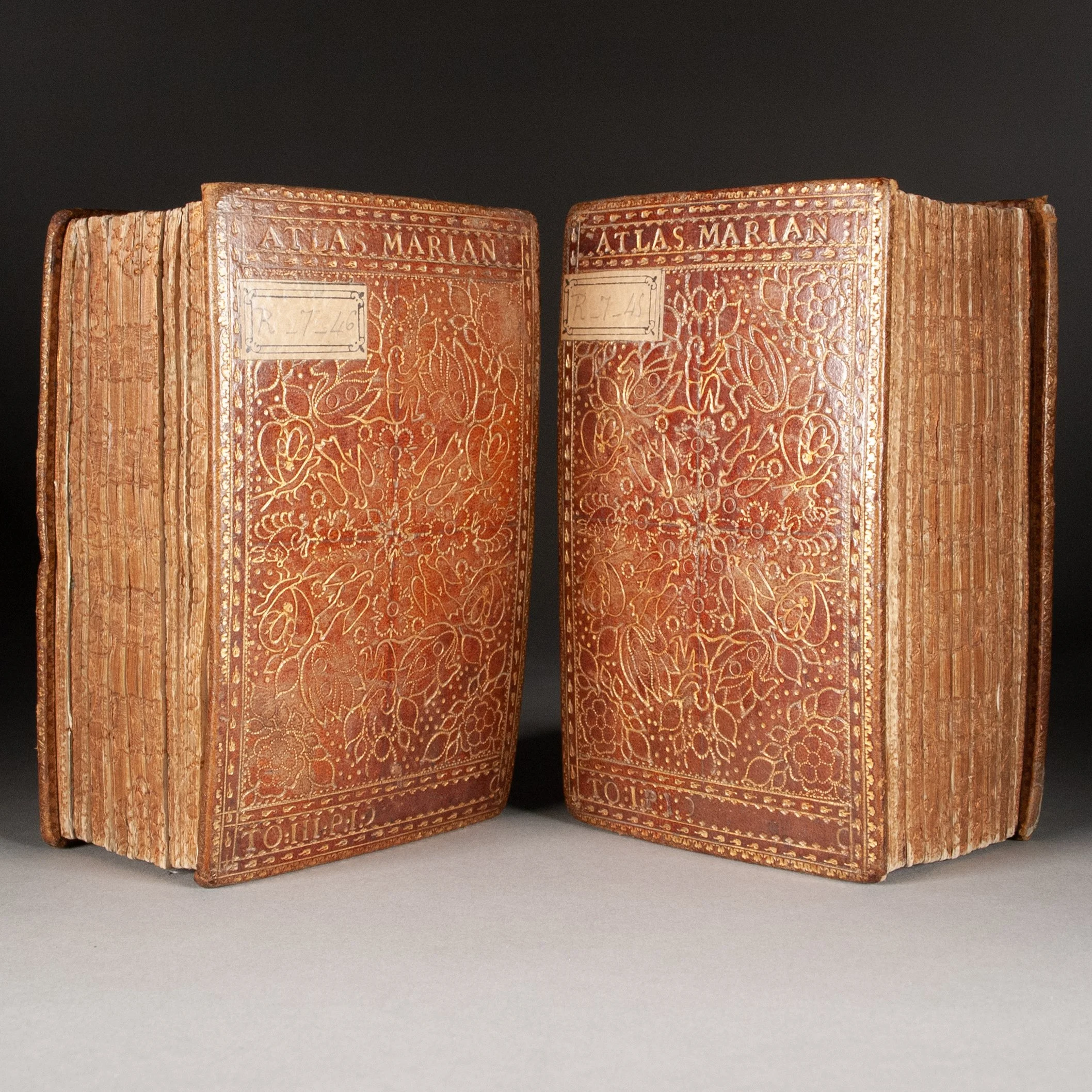 Image 2 of 12
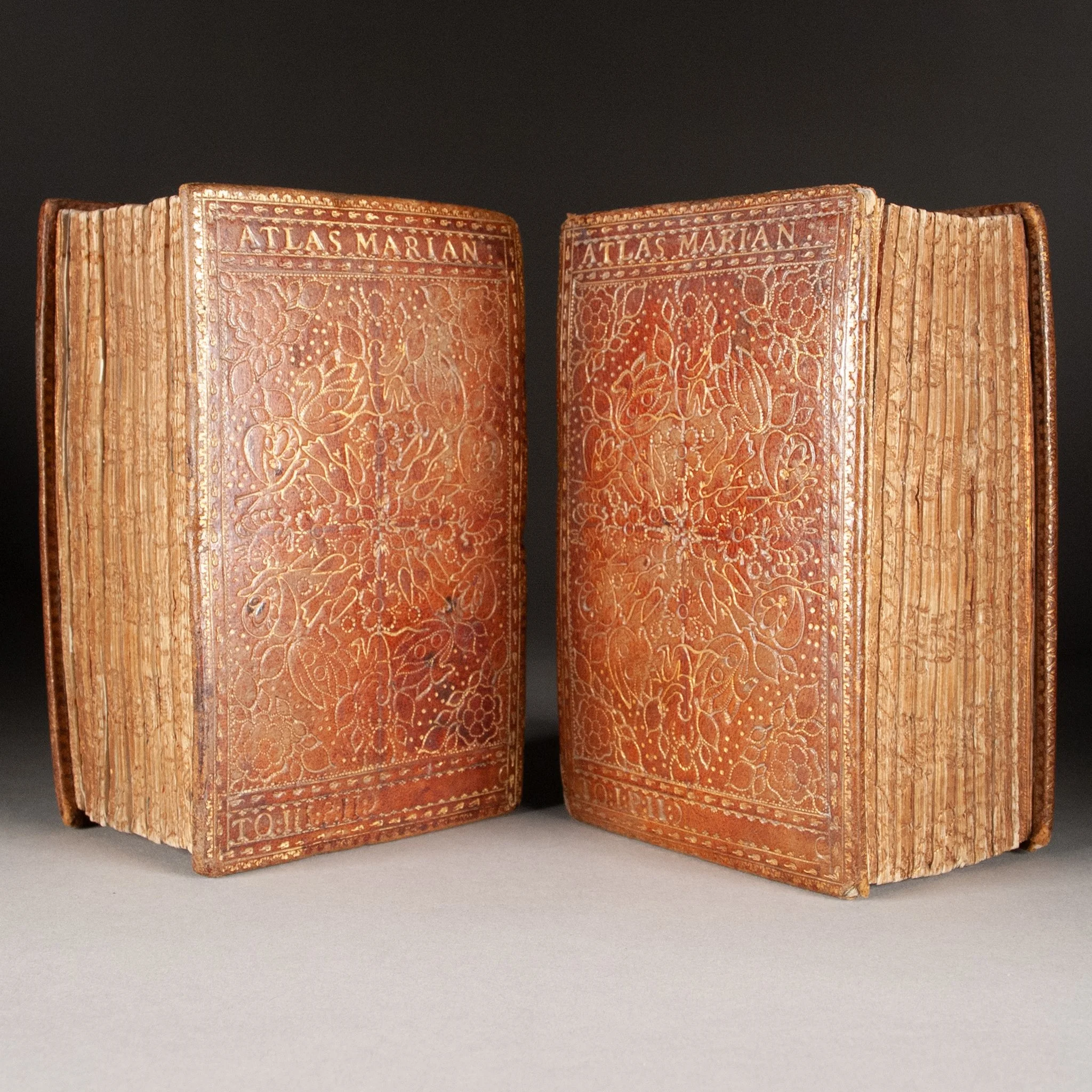 Image 3 of 12
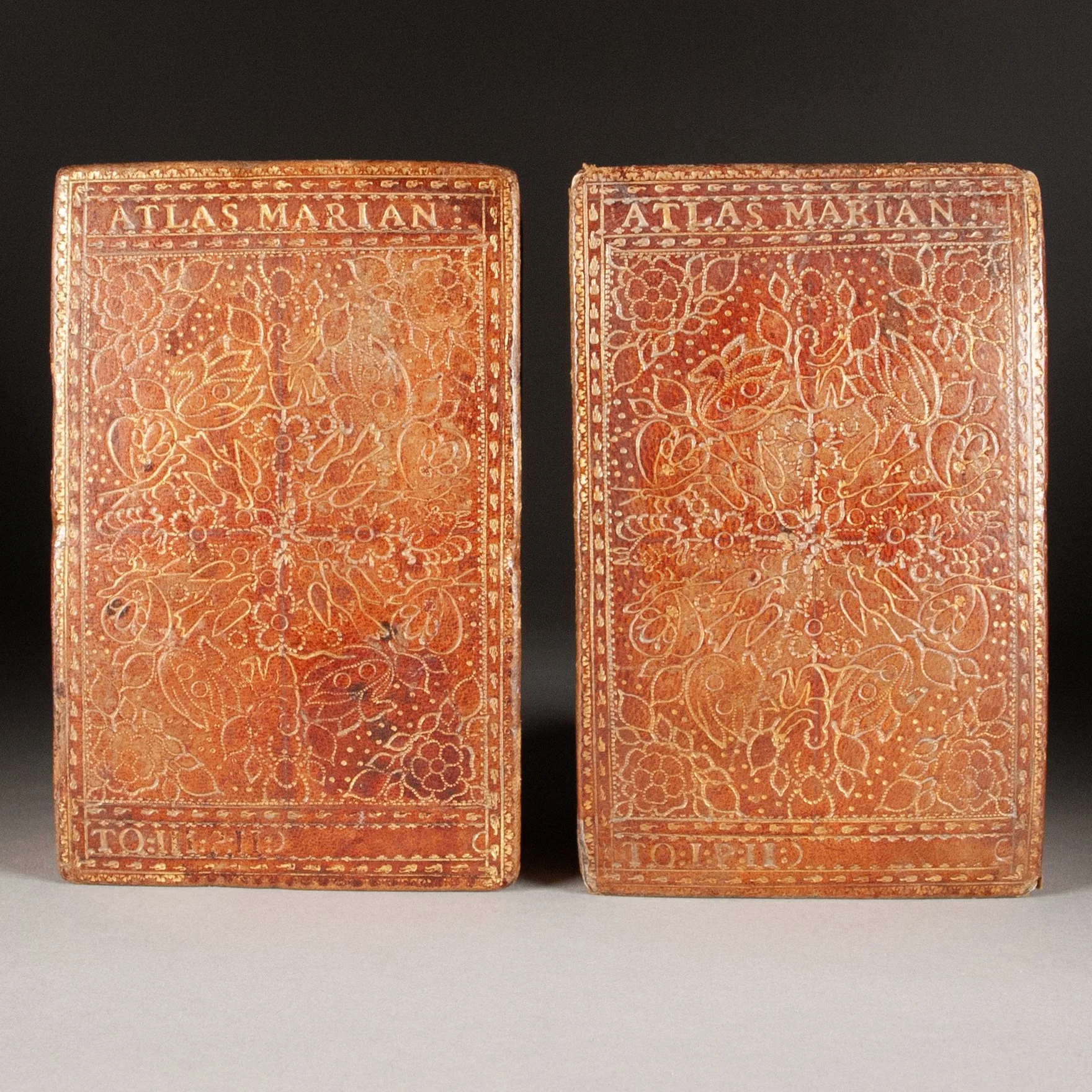 Image 4 of 12
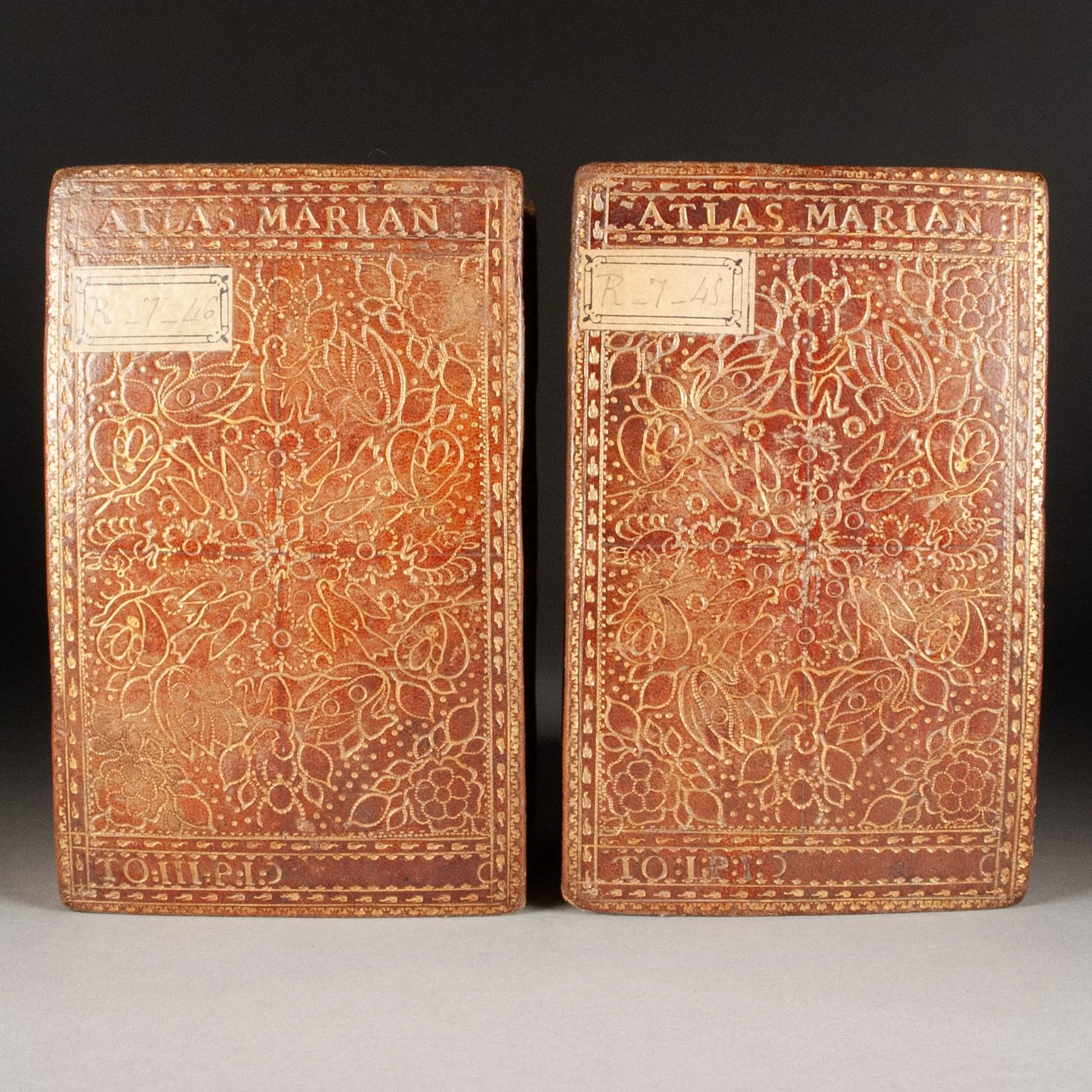 Image 5 of 12
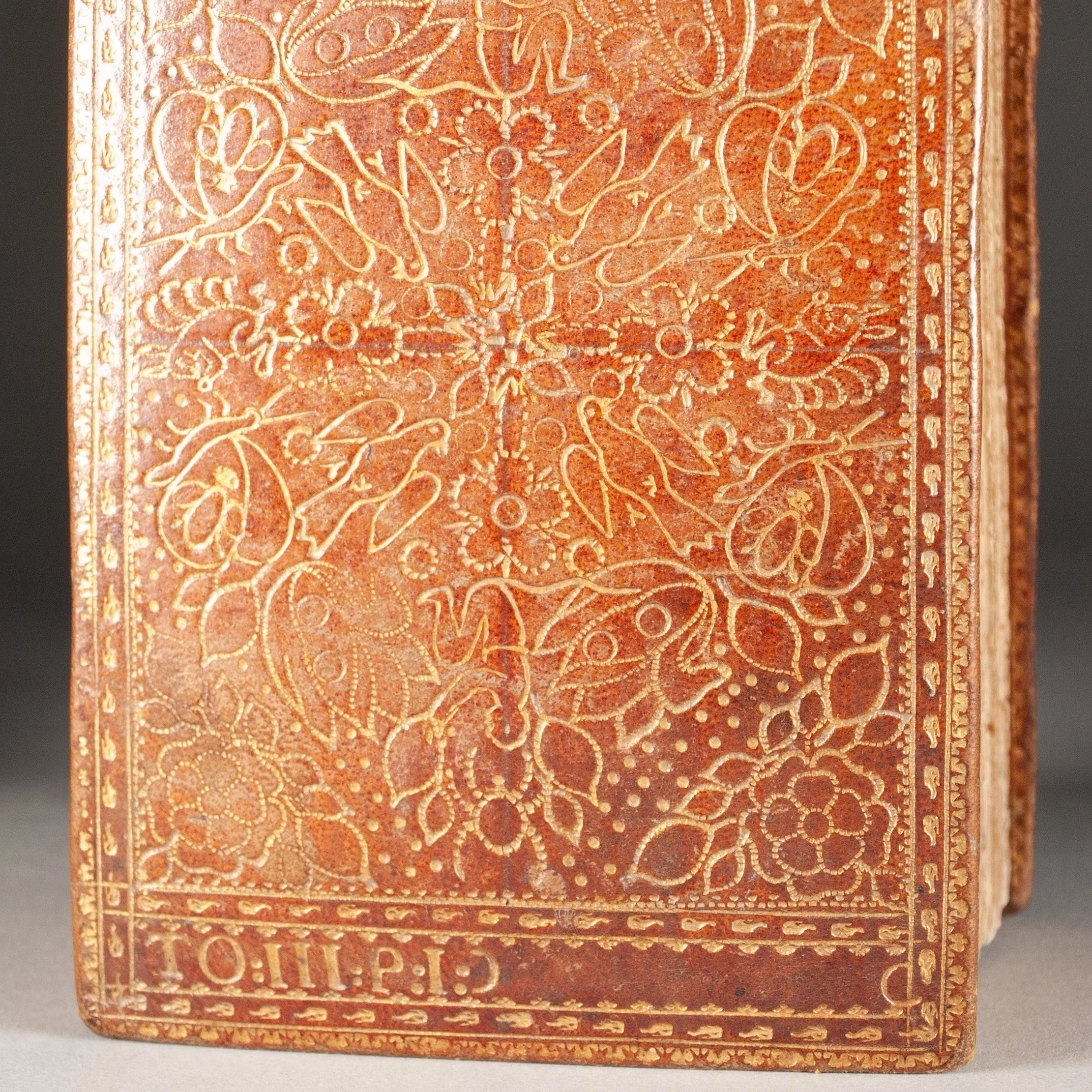 Image 6 of 12
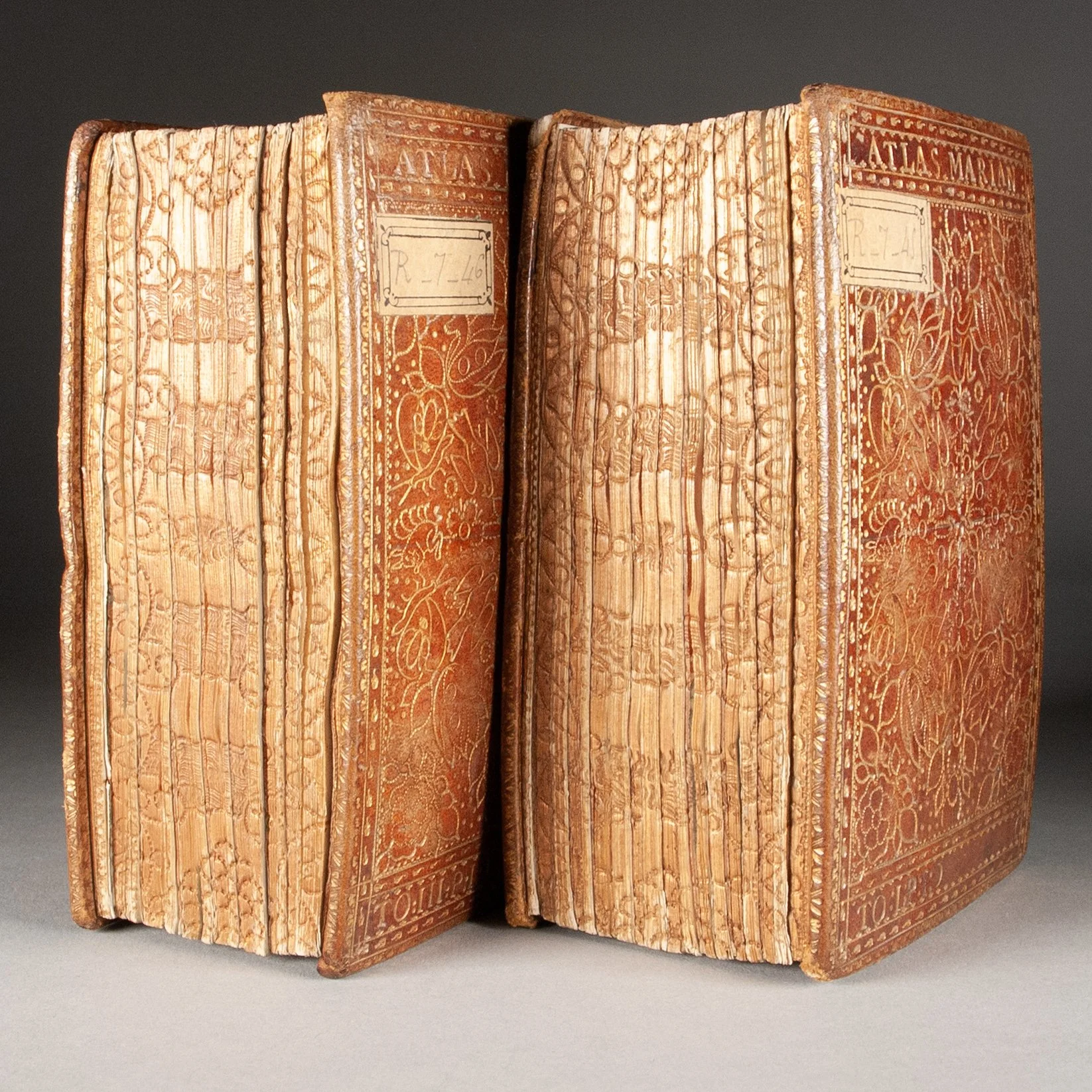 Image 7 of 12
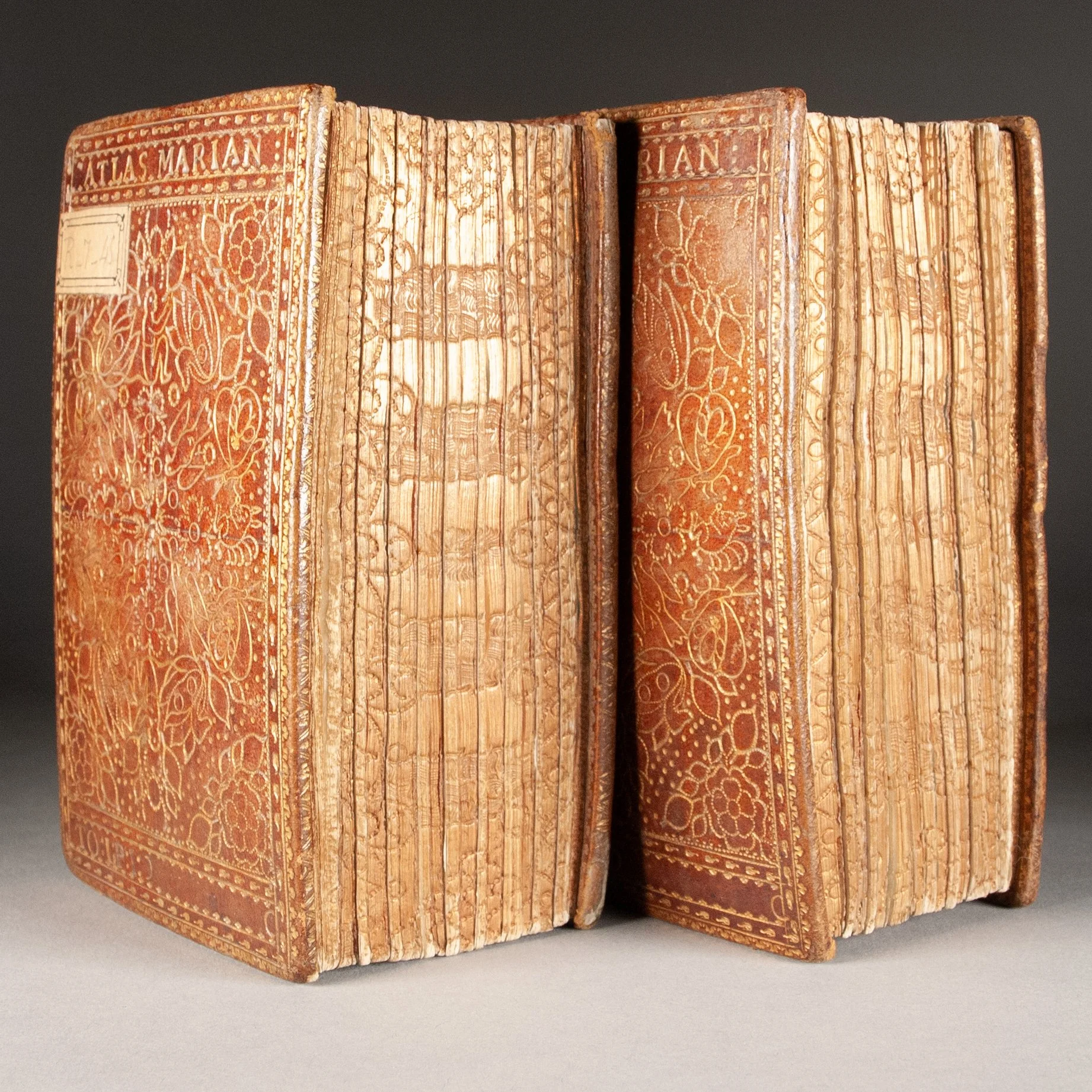 Image 8 of 12
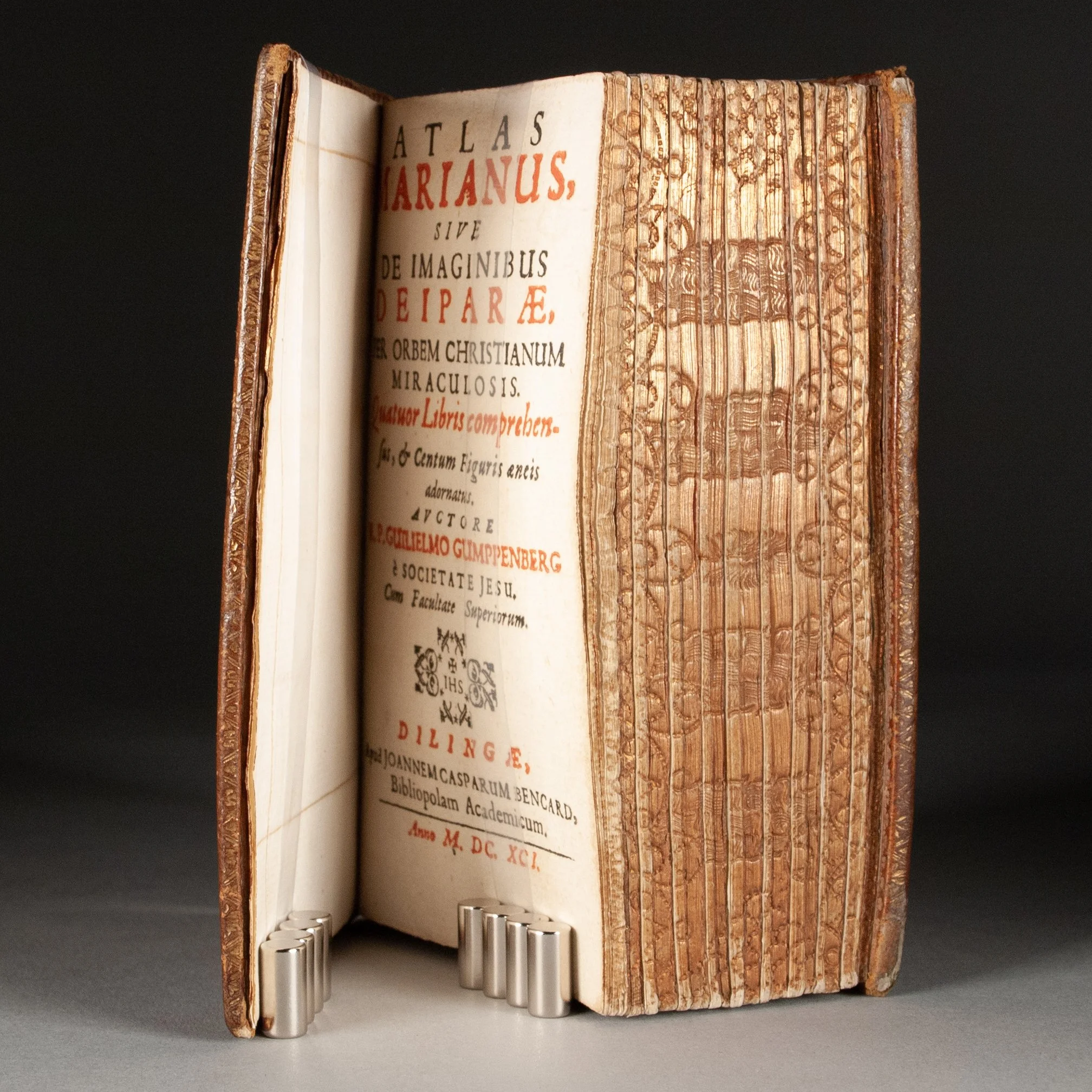 Image 9 of 12
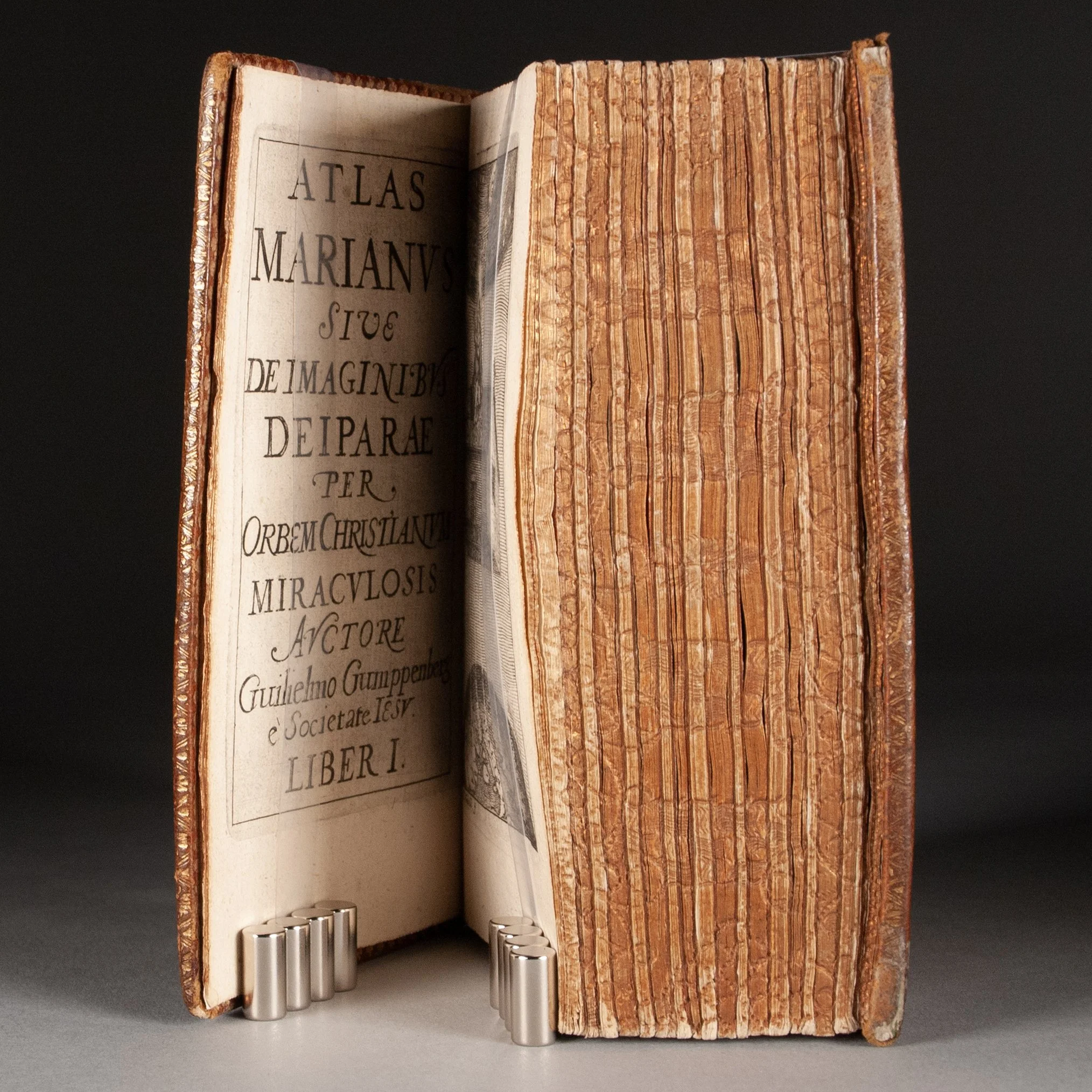 Image 10 of 12
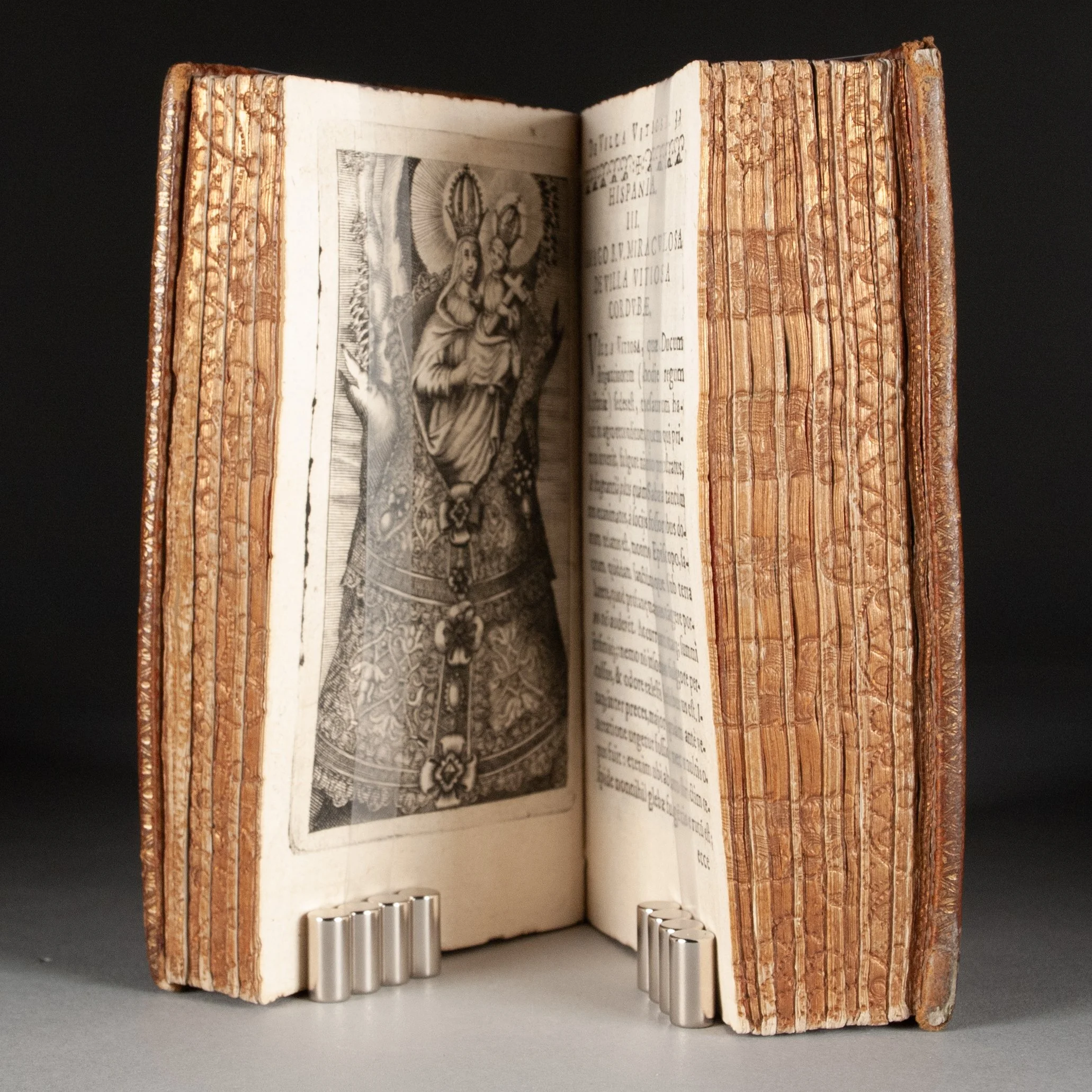 Image 11 of 12
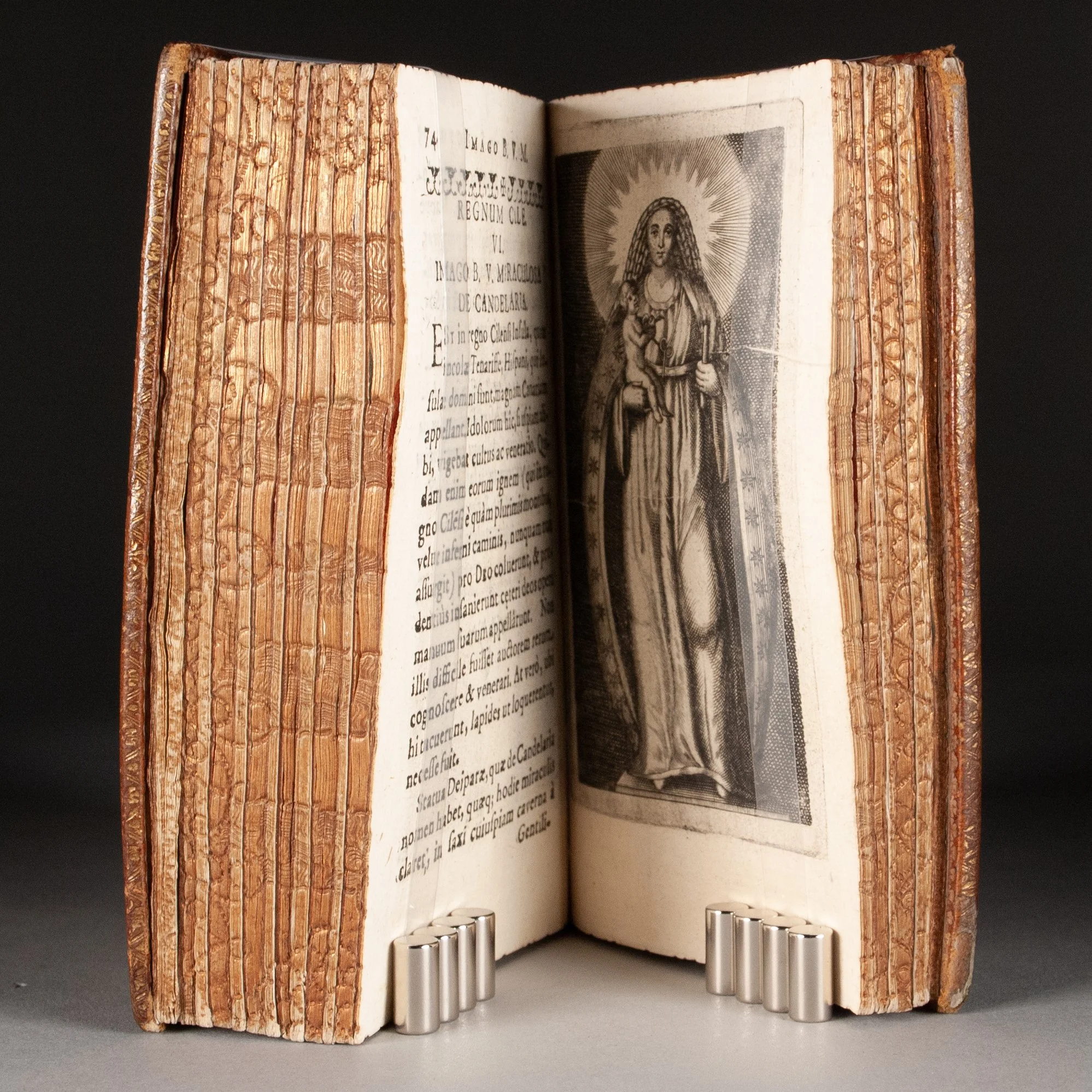 Image 12 of 12
Backless bindings
Atlas Marianus, sive, De imaginibus Deiparae, per orbem Christianum miraculosis; quatuor libris comprehensus & centum figuris aeneis adornatus
by Wilhelm Gumppenberg
Munich: Johann Jäcklin, 1657; Ingolstadt: Johann Ostermayr, 1659
v. 1: [30], 217, [9] p. + [27] plates; v. 3: 172 p. + [2], 25 plates | 12mo | A-K^12 L^8; A-G^12 H^2 | 133 x 83 mm
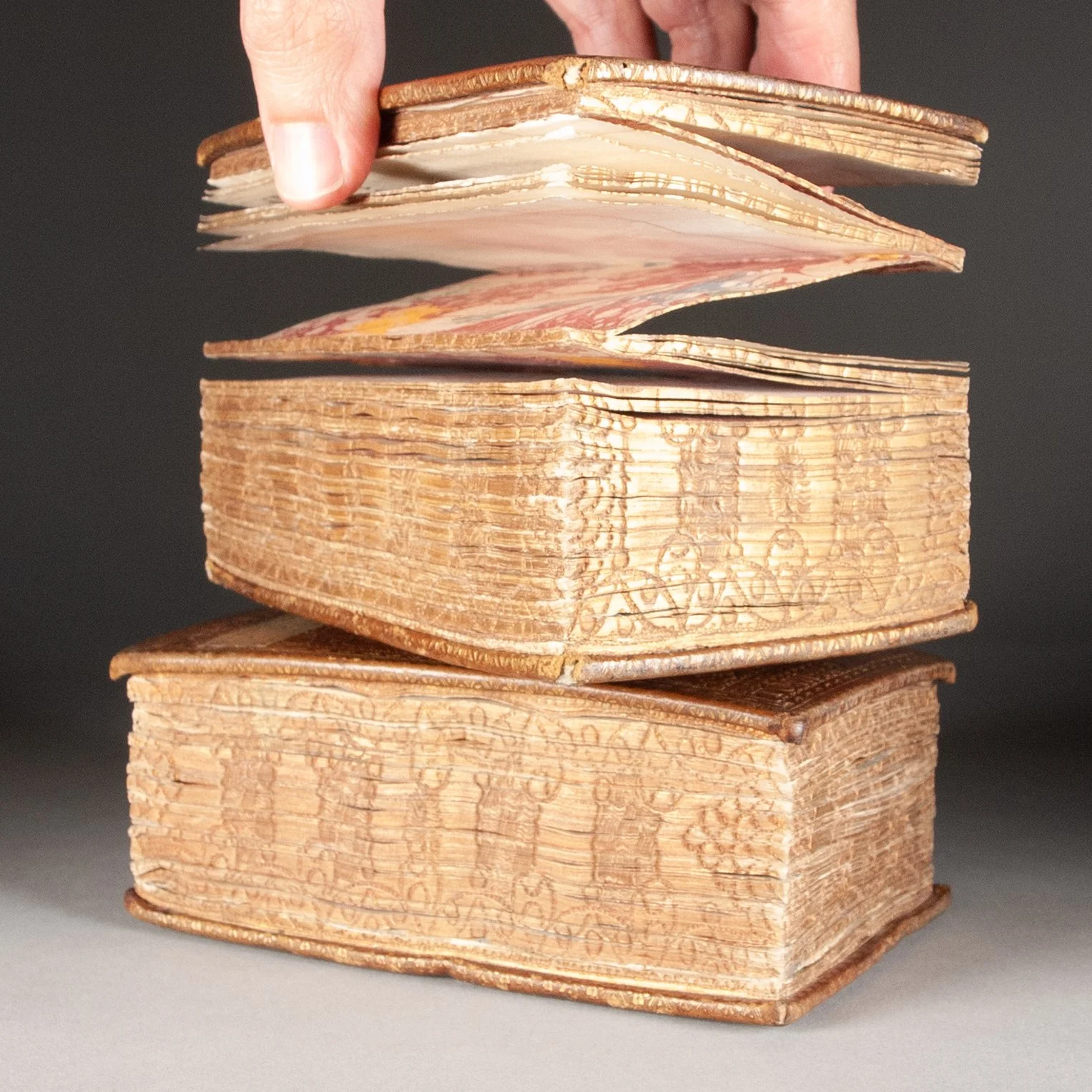
A partial set of the Bavarian Jesuit's guide to miracle-working likenesses of the Virgin Mary, here blended from three different editions, and in astonishing contemporary backless bindings. This is among the rarest of early modern novelty structures, a whimsical umbrella perhaps most commonly represented by the dos-à-dos binding. Here, small groups of leaves have been glued together at the inner margin, each small group with its own set of marbled endpapers. Each volume has functionally been divided in half—let's call them Part 1 and Part 2, as the binder has labeled the covers. The small groups of leaves from Part 1 face one way, and those from Part 2 face the other. But they alternate throughout the volume, with the marbled endpapers of a group from Part 1 glued to the endpapers from a group from Part 2. So as you page through Part 1, you encounter both the loose fore-edges of what you're reading, as you'd expect from any book, but also the glued inside edges of Part 2. When you get to the end of Part 1, you simply flip the volume horizontally and continue reading back to where you physically began. In truth, it's awkward to navigate. And relying entirely on glue, it doesn't open nearly as wide as a properly sewn text block. But it dazzlesas a showpiece of ingenuity and technical skill. The effect is completely unexpected, mesmerizing, even disorienting—turning over a volume in your hand with no spine, and with not three, but four gauffered edges. The proliferation of marbled endpapers inevitably meant some text had to be covered, so some two dozen leaves appear in duplicate to provide access to that text. Which is to say, the production of these backless bindings required two copies of each volume. ¶ The backless binding first appeared in France and Germany in the sixteenth century, spread to England in the next, and are found almost exclusively on devotional texts. "The purpose of this strange type of cover seems to have been, first of all, to amaze anyone who attempted to open the book; secondly, to demonstrate the skill of the bookbinder, who, by eliminating the spine, had made the sides of the book indistinguishable" (Macchi). They were never terribly common, and they're certainly thin on the ground today. Howard Nixon remarked upon a pair of 16th-century French examples. Isabelle de Conihout more fully treated one of the same in 2012, noting that the two Nixon identified remained the only known French examples from that century. Nixon and Mirjam Foot commented on a 16th-century English example, and Richard Balley, an English binder more contemporary with our own example, is said to have produced five backless bindings. In 1974, Kurt Köster surveyed 21 known Vexierbücher or "puzzle bindings," an extraordinary subset of the backless binding in which multiple texts and covers open in different directions. We find only some half a dozen examples of backless bindings in auction records, roughly the same number in our binding literature to hand, and a similar number again reported in online binding databases. ¶ But we've found no backless bindings quite like ours. In the typical construction, a textblock would be stab sewn, the folds at the spine then trimmed off. So while it would lack a spine, it would still function like a traditionally bound book, operable from a single side only. Ours occupies a middle ground between structurally simpler versions and more complex puzzle bindings. While our binding does not combine multiple volumes in different formats like the latter, our covers can be opened in two different directions, offering access to different parts of the text. We get the disorienting playfulness of a puzzle binding without its inherent fragility. ¶ The identity of our binder remains elusive, but the work is undeniably exceptional. The covers have been wondrously tooled in gold with a combination of flora and fauna, much of it in pointillé style, including doves, swans (made to resemble tulips), butterflies, flies (set within the butterfly wings), squirrels, and spiders. One tool, which looks at first like a seated figure, is likely meant to represent a monkey holding a mirror—a tool in use since at least the 15th century. The anonymity of such masterful work is apparently par for the course. "The creators of the finest pointillé bindings," John Harthan tells us, "have not been identified." ¶ The wildly ambitious Atlas Marianus sought to document all known miraculous images of the Virgin. The first edition described one hundred sites, many of them in Italy, with the House of Loreto assuming first position. Functioning at once as devotional text and pilgrimage guide, the work provides engraved reproductions of these Marian likenesses, plus brief accounts of their histories and miracles worked. "The compendium's aim was, firstly, the restoration of Christian unity; secondly, it was intended to serve as a reference for the development of Marian devotion; and thirdly, to contribute to the dissemination of numerous devotional practices described in the entries. Above all, however, the atlas was conceived through its enormous index and classification apparatus as an efficient response to the numerous attacks of the Protestants: by transforming sacred topography into a topic, the Jesuit Gumppenberg wanted to prove the omnipotence of the Blessed Virgin Mary" (Ghermani). The work took on a more global scope in later editions, quickly ballooning to some 1,200 sites. Such compass transcended Gumpperberg alone, and credit for the collection should be shared with his vast network of 266 Jesuit colleagues throughout Europe who provided him with the requisite documentation. He dutifully cites these sources by name and date. ¶ Our v. 3 is certainly the first edition, though our v. 1 is ambiguous. Georg Hänlin also issued editions of v. 1 and v. 2 at Ingolstadt in 1657, but apparently using the same plates, so we presume both the Ingolstadt and Munich editions were authorized and published more or less simultaneously. In 1657, Jäcklin also issued an editio tertia, with a dedicated leaf carrying that edition statement, but otherwise identical in setting to his first 1657 issue. Since our copy has been so severely modified, we can't be certain it wasn't a stated third edition, with the edition statement removed at time of binding. And mounted to the blank side of the original 1657 engraved title in v. 1 is a letterpress title from a 1691 Dillingen edition by Johann Caspar Bencard. ¶ A terrifically rare style of binding, and a paragon of playfulness.
PROVENANCE: Bookplate of the Marquis of Pidal on each endpaper, probably Pedro José Pidal y Carniado (1799-1865), Spanish writer and politician. Shelf label affixed to each front cover, and an old shelfmark inked on a fly-leaf in each volume. To us from a private collector, previously offered at Sotheby's Paris in 2019 and 2020.
CONDITION: Bound ca. 1700 in backless bindings of tan calf, lavishly tooled in gold, including title and volume numbers on every cover; all four edges gilt and elaborately gauffered, and with marbled endpapers throughout. Protected by custom corrugated boxes, ready for your shelf. ¶ Volumes 1 and 3 (of 4) only. VD17 suggests our v. 3 may be missing two unnumbered leaves at front, though it's unclear what those might be. Available scans suggest these never had letterpress titles; we have both the engraved title and the Loreto frontispiece, plus a complete numbered sequence of 25 plates. Perhaps VD17 accidentally counted the two plates at front twice, as both integral prelims and plates. Leaves trimmed close; v. 1 with 1" tear in fore-edge of A9, affecting some text; in v. 3, C3 stuck to the blank verso of the preceding plate, obscuring p. 53. Only gentle wear to the corners; Pidal bookplates in v. 1 effaced or mostly obliterated. Really in remarkable condition, inside and out.
REFERENCES: VD17 12:118401B (v. 1), 12:118379C (v. 3/4); Brunet, Manuel du libraire, v. 2, col. 1829 (citing our 1657 Munich edition, but not the 1657 Ingolstadt edition) ¶ On the binding: Federico Macchi, "Legature di forma bizzarra," Misinta 30 (Dec 2007), p. 68 (on their origins), 69-70 (cited above, and reproducing a Richard Balley backless binding); Kurt Köster, "Mehrfachbände und Vexierbücher: Materialen zu Einbandkuriosa des sechzehnten und siebzehnten Jahrhunderts," Archiv für Geschichte des Buchwesens 14 (1973–1974), col. 1879 ("In all areas of applied arts, forms occasionally appear that seem to have arisen less from reasons of beauty or utility than from the impulse to create something new, bizarre, and quite surprising," citing Schmidt, and adding: "This also applies to bookbinding"); Howard M. Nixon, Sixteenth-Century Gold-Tooled Bookbindings in the Pierpont Morgan Library, p. 132 (the 16c French examples); Isabeille de Conihout, #11, Un succès de librairie européen: l'Imitatio Christi 1470-1850, p. 79; Howard Nixon and Mirjam Foot, The History of Decorated Bookbinding in England, p. 30 (16c English example); Mirjam Foot, The History of Bookbinding as a Mirror of Society, p. 97 (on the same 16c English example); Eiluned Rees, "Art and craft: bookbindings in the National Library of Wales," The Book Trade & Its Customers 1450-1900, p. 285 (on Richard Balley); E. Ph. Goldschmidt, Gothic & Renaissance Bookbindings, v. 1, p. 25 (on the monkey tool); John Harthan, Bookbindings, p. 14 (cited above) ¶ On the content: Ralph Dekoninck, "Propagatio Imaginum: The Translated Images of Our Lady of Foy," The Nomadic Object, p. 241 (cited above; "one of its essential principles consists in giving an account of the vast web woven by Marian devotion throughout the entire Christian world...As Gumppenberg writes, the 'idea is to show how much the world owes to Mary and how much it may expect from her'. And he makes clear, in the address to the reader, that 'by means of miraculous images, this Marian atlas will teach with what power the Mother of God preserves the World'"); Ines G. Županov, "Eagle-Eyed Encounter: Miraculous or Global in Portuguese Asia (1720)," Palimpsests of Religious Encounter in Asia, 1500-1800, p. 46 (on the limited non-European coverage); Naïma Ghermani, "Zwischen Wunder und Vernunft: Der 'Atlas Marianus' des Jesuiten Wilhelm Gumppenberg," Zeitschrift für Historische Forschung 40.2 (2013), p. 227 ("represented a novelty in terms of both the form and the ambition of the work"), 230-231 (on the scope of this edition and the network the author relied on), 232 ("What distinguished the atlas from existing pilgrim guides was its ambition not only to catalog but also to substantiate the credibility of the miracle stories with evidence"), 233 ("The copper engravings, produced in various styles by Augsburg craftsmen, were considered reproductions of the originals"); Suzanna Ivanič, Catholica: The Visual Culture of Catholicism, p. 159 ("Interest in pilgrimage was renewed in the 16th and 17th centuries. Spurred on by the rejection of pilgrimage by Protestants, Catholics were keen to show their devotion and patronize sacred sites," citing the Atlas Marianus as an exemplary manifestation of this devotion)
Item #994
Atlas Marianus, sive, De imaginibus Deiparae, per orbem Christianum miraculosis; quatuor libris comprehensus & centum figuris aeneis adornatus
by Wilhelm Gumppenberg
Munich: Johann Jäcklin, 1657; Ingolstadt: Johann Ostermayr, 1659
v. 1: [30], 217, [9] p. + [27] plates; v. 3: 172 p. + [2], 25 plates | 12mo | A-K^12 L^8; A-G^12 H^2 | 133 x 83 mm
A partial set of the Bavarian Jesuit's guide to miracle-working likenesses of the Virgin Mary, here blended from three different editions, and in astonishing contemporary backless bindings. This is among the rarest of early modern novelty structures, a whimsical umbrella perhaps most commonly represented by the dos-à-dos binding. Here, small groups of leaves have been glued together at the inner margin, each small group with its own set of marbled endpapers. Each volume has functionally been divided in half—let's call them Part 1 and Part 2, as the binder has labeled the covers. The small groups of leaves from Part 1 face one way, and those from Part 2 face the other. But they alternate throughout the volume, with the marbled endpapers of a group from Part 1 glued to the endpapers from a group from Part 2. So as you page through Part 1, you encounter both the loose fore-edges of what you're reading, as you'd expect from any book, but also the glued inside edges of Part 2. When you get to the end of Part 1, you simply flip the volume horizontally and continue reading back to where you physically began. In truth, it's awkward to navigate. And relying entirely on glue, it doesn't open nearly as wide as a properly sewn text block. But it dazzlesas a showpiece of ingenuity and technical skill. The effect is completely unexpected, mesmerizing, even disorienting—turning over a volume in your hand with no spine, and with not three, but four gauffered edges. The proliferation of marbled endpapers inevitably meant some text had to be covered, so some two dozen leaves appear in duplicate to provide access to that text. Which is to say, the production of these backless bindings required two copies of each volume. ¶ The backless binding first appeared in France and Germany in the sixteenth century, spread to England in the next, and are found almost exclusively on devotional texts. "The purpose of this strange type of cover seems to have been, first of all, to amaze anyone who attempted to open the book; secondly, to demonstrate the skill of the bookbinder, who, by eliminating the spine, had made the sides of the book indistinguishable" (Macchi). They were never terribly common, and they're certainly thin on the ground today. Howard Nixon remarked upon a pair of 16th-century French examples. Isabelle de Conihout more fully treated one of the same in 2012, noting that the two Nixon identified remained the only known French examples from that century. Nixon and Mirjam Foot commented on a 16th-century English example, and Richard Balley, an English binder more contemporary with our own example, is said to have produced five backless bindings. In 1974, Kurt Köster surveyed 21 known Vexierbücher or "puzzle bindings," an extraordinary subset of the backless binding in which multiple texts and covers open in different directions. We find only some half a dozen examples of backless bindings in auction records, roughly the same number in our binding literature to hand, and a similar number again reported in online binding databases. ¶ But we've found no backless bindings quite like ours. In the typical construction, a textblock would be stab sewn, the folds at the spine then trimmed off. So while it would lack a spine, it would still function like a traditionally bound book, operable from a single side only. Ours occupies a middle ground between structurally simpler versions and more complex puzzle bindings. While our binding does not combine multiple volumes in different formats like the latter, our covers can be opened in two different directions, offering access to different parts of the text. We get the disorienting playfulness of a puzzle binding without its inherent fragility. ¶ The identity of our binder remains elusive, but the work is undeniably exceptional. The covers have been wondrously tooled in gold with a combination of flora and fauna, much of it in pointillé style, including doves, swans (made to resemble tulips), butterflies, flies (set within the butterfly wings), squirrels, and spiders. One tool, which looks at first like a seated figure, is likely meant to represent a monkey holding a mirror—a tool in use since at least the 15th century. The anonymity of such masterful work is apparently par for the course. "The creators of the finest pointillé bindings," John Harthan tells us, "have not been identified." ¶ The wildly ambitious Atlas Marianus sought to document all known miraculous images of the Virgin. The first edition described one hundred sites, many of them in Italy, with the House of Loreto assuming first position. Functioning at once as devotional text and pilgrimage guide, the work provides engraved reproductions of these Marian likenesses, plus brief accounts of their histories and miracles worked. "The compendium's aim was, firstly, the restoration of Christian unity; secondly, it was intended to serve as a reference for the development of Marian devotion; and thirdly, to contribute to the dissemination of numerous devotional practices described in the entries. Above all, however, the atlas was conceived through its enormous index and classification apparatus as an efficient response to the numerous attacks of the Protestants: by transforming sacred topography into a topic, the Jesuit Gumppenberg wanted to prove the omnipotence of the Blessed Virgin Mary" (Ghermani). The work took on a more global scope in later editions, quickly ballooning to some 1,200 sites. Such compass transcended Gumpperberg alone, and credit for the collection should be shared with his vast network of 266 Jesuit colleagues throughout Europe who provided him with the requisite documentation. He dutifully cites these sources by name and date. ¶ Our v. 3 is certainly the first edition, though our v. 1 is ambiguous. Georg Hänlin also issued editions of v. 1 and v. 2 at Ingolstadt in 1657, but apparently using the same plates, so we presume both the Ingolstadt and Munich editions were authorized and published more or less simultaneously. In 1657, Jäcklin also issued an editio tertia, with a dedicated leaf carrying that edition statement, but otherwise identical in setting to his first 1657 issue. Since our copy has been so severely modified, we can't be certain it wasn't a stated third edition, with the edition statement removed at time of binding. And mounted to the blank side of the original 1657 engraved title in v. 1 is a letterpress title from a 1691 Dillingen edition by Johann Caspar Bencard. ¶ A terrifically rare style of binding, and a paragon of playfulness.
PROVENANCE: Bookplate of the Marquis of Pidal on each endpaper, probably Pedro José Pidal y Carniado (1799-1865), Spanish writer and politician. Shelf label affixed to each front cover, and an old shelfmark inked on a fly-leaf in each volume. To us from a private collector, previously offered at Sotheby's Paris in 2019 and 2020.
CONDITION: Bound ca. 1700 in backless bindings of tan calf, lavishly tooled in gold, including title and volume numbers on every cover; all four edges gilt and elaborately gauffered, and with marbled endpapers throughout. Protected by custom corrugated boxes, ready for your shelf. ¶ Volumes 1 and 3 (of 4) only. VD17 suggests our v. 3 may be missing two unnumbered leaves at front, though it's unclear what those might be. Available scans suggest these never had letterpress titles; we have both the engraved title and the Loreto frontispiece, plus a complete numbered sequence of 25 plates. Perhaps VD17 accidentally counted the two plates at front twice, as both integral prelims and plates. Leaves trimmed close; v. 1 with 1" tear in fore-edge of A9, affecting some text; in v. 3, C3 stuck to the blank verso of the preceding plate, obscuring p. 53. Only gentle wear to the corners; Pidal bookplates in v. 1 effaced or mostly obliterated. Really in remarkable condition, inside and out.
REFERENCES: VD17 12:118401B (v. 1), 12:118379C (v. 3/4); Brunet, Manuel du libraire, v. 2, col. 1829 (citing our 1657 Munich edition, but not the 1657 Ingolstadt edition) ¶ On the binding: Federico Macchi, "Legature di forma bizzarra," Misinta 30 (Dec 2007), p. 68 (on their origins), 69-70 (cited above, and reproducing a Richard Balley backless binding); Kurt Köster, "Mehrfachbände und Vexierbücher: Materialen zu Einbandkuriosa des sechzehnten und siebzehnten Jahrhunderts," Archiv für Geschichte des Buchwesens 14 (1973–1974), col. 1879 ("In all areas of applied arts, forms occasionally appear that seem to have arisen less from reasons of beauty or utility than from the impulse to create something new, bizarre, and quite surprising," citing Schmidt, and adding: "This also applies to bookbinding"); Howard M. Nixon, Sixteenth-Century Gold-Tooled Bookbindings in the Pierpont Morgan Library, p. 132 (the 16c French examples); Isabeille de Conihout, #11, Un succès de librairie européen: l'Imitatio Christi 1470-1850, p. 79; Howard Nixon and Mirjam Foot, The History of Decorated Bookbinding in England, p. 30 (16c English example); Mirjam Foot, The History of Bookbinding as a Mirror of Society, p. 97 (on the same 16c English example); Eiluned Rees, "Art and craft: bookbindings in the National Library of Wales," The Book Trade & Its Customers 1450-1900, p. 285 (on Richard Balley); E. Ph. Goldschmidt, Gothic & Renaissance Bookbindings, v. 1, p. 25 (on the monkey tool); John Harthan, Bookbindings, p. 14 (cited above) ¶ On the content: Ralph Dekoninck, "Propagatio Imaginum: The Translated Images of Our Lady of Foy," The Nomadic Object, p. 241 (cited above; "one of its essential principles consists in giving an account of the vast web woven by Marian devotion throughout the entire Christian world...As Gumppenberg writes, the 'idea is to show how much the world owes to Mary and how much it may expect from her'. And he makes clear, in the address to the reader, that 'by means of miraculous images, this Marian atlas will teach with what power the Mother of God preserves the World'"); Ines G. Županov, "Eagle-Eyed Encounter: Miraculous or Global in Portuguese Asia (1720)," Palimpsests of Religious Encounter in Asia, 1500-1800, p. 46 (on the limited non-European coverage); Naïma Ghermani, "Zwischen Wunder und Vernunft: Der 'Atlas Marianus' des Jesuiten Wilhelm Gumppenberg," Zeitschrift für Historische Forschung 40.2 (2013), p. 227 ("represented a novelty in terms of both the form and the ambition of the work"), 230-231 (on the scope of this edition and the network the author relied on), 232 ("What distinguished the atlas from existing pilgrim guides was its ambition not only to catalog but also to substantiate the credibility of the miracle stories with evidence"), 233 ("The copper engravings, produced in various styles by Augsburg craftsmen, were considered reproductions of the originals"); Suzanna Ivanič, Catholica: The Visual Culture of Catholicism, p. 159 ("Interest in pilgrimage was renewed in the 16th and 17th centuries. Spurred on by the rejection of pilgrimage by Protestants, Catholics were keen to show their devotion and patronize sacred sites," citing the Atlas Marianus as an exemplary manifestation of this devotion)
Item #994